This of course forms the context for the creation of the All-Volunteer Force (AVF), the effective conversion of the United States military into a professional, fully standing military, which I’d argue is the single most dramatic shift in the civil-military relationship in American history, the full impact of which is not yet clear. For almost 200 years, the United States military had been an essentially civilian force which relied on conscription. For the decades prior to the creation of the AVF in 1973, conscription had been a fact of life. While the United States had demobilized substantially after WWII, there had been at least some conscription in every year from 1940 to 1972 except for 1947. In every year between 1950 and 1972, conscription had never been lower than at least 80,000 new conscriptions a year.
This was a huge change. For such a major change, I find that it draws surprisingly little attention. The 50th anniversary of the AVF passed with relatively little fanfare in 2023. I’ve mentioned For the Common Defense (1984, 1994, 2012) as the dominant textbook for introductory American military history: the shift to the All-Volunteer Force is dealt with in a single page (page 568, for the curious). The textbook I’ve seen most recently used for US Naval history (and which I used), J.C. Bradford and J. F. Bradford, America, Sea Power and the World (2016, 2023), doesn’t even give it that much: the shift is discussed in a single paragraph on page 351 (308 in the 2016 edition).1
The likely impacts of the shift to an AVF were studied prior to implementation in the Gates Commission, a report that had a preordained conclusion – it was convened to provide Nixon the cover to do the thing (end the draft) he had promised to do already in his campaign – and which honestly I find disappointing in its approach, which is mostly “happy talk” designed to justify what Nixon had already decided to do. It is striking to me, for instance, that the Gates Commission did not include a single historian to perhaps discuss how the shift towards fully professional militaries had gone for republics in the past. Instead, the focus is on the economics of the shift, with fairly blithe assertions that the civil-military relationship would remain unchanged despite the fairly obvious implausibility of that given the shift from “everyone serves” to “only a small portion of society serves”.2
As I’ve noted elsewhere, the Romans also seem to have thought that they could professionalize their army without reducing its ability to scale up in an emergency or altering the civil-military relationship and for quite a few decades that more or less worked, while the old norms held. But as those old norms decayed, the institution increasingly became what you’d expect from its institutional structure: a permanent political faction, advocating for its own interests, often with violence, to the point that the emperor Septimius Severus’ advice to his sons as he lay dying in 211 was, “Be harmonious, enrich the soldiers, and scorn all other men”,3 a fairly open admission that the soldiery was not just a political constituency, but the most important one. It took time for those norms to shift, but when one is building or rebuilding institutions, the long-term is the term that matters.
I do not think necessarily that this is the direction the All-Volunteer Force must go. It has two and a half centuries of strong norms pushing it away from this direction. But careful maintenance of the civ-mil bargain is made all the more necessary when the military is effectively fully professional. For my own part, all cards on the table, while I greatly value the service of the United States’ military personnel (there’s that third part of the bargain!) and think they serve honorably, I am quite skeptical of the long-term implications of the All-Volunteer Force. Its creators assumed that fully professionalizing the military would not impact the civil-military relationship and that it would always be possible to shift back to a mass-conscript army in the event of a major war, but historical examples suggest it is not so easy.
But the All-Volunteer Force is not the direction from which I see now the principal threat to the civ-mil bargain.
Bret Devereaux, “Collections: The American Civil-Military Relationship”, A Collection of Unmitigated Pedantry, 2025-07-04.
- In that book’s defense, the Navy has a really big set of reforms associated broadly with CNO Elmo Zumwalt that happen at basically the same time and are connected and it opts to focus on those. I will note that the position of the paragraph has changed because the updated 2023 version of the book has opted to grapple more extensively and more successfully with this period as one of increasing diversity in the navy, with a chapter by Kristy N. Kamarck on that specific topic. It is a marked improvement over the first edition, though I think both FtCD and the Bradford and Bradford remain too hagiographic, too willing to sweep the military’s problems under the rug and only comment on military diversity when they can tell the story as a happy tale of progress.
- Especially as that small portion tends to be concentrated, a thing the Commission essentially refuses to consider as a first principle of their analysis; they assume cheerfully that the AVF will naturally continue to reflect a cross-section of the United States. In some ways that is true, but in other ways it is very much not – there certainly are “military families”, where service tends to “run in the family” in the United States now – and the emergence of those patterns would have been a pretty obvious thing to expect, given that the same trend is extremely visible in the Roman army of the early empire.
- Dio 77.16
June 22, 2026
QotD: When the US switched to the All-Volunteer Force in 1973
June 16, 2026
The ever-declining (yet still effective) British military
Britain’s military needs have shifted a great deal since the United States took over the unofficial role of “world policeman” after the Second World War. As Imperial commitments overseas were reduced by former colonies achieving independence, the British armed forces have also diminished. In UnHerd, Edward Luttwak considers the current state of the British army, the Royal Air Force, and the Royal Navy in the wake of the sudden resignation of Defence Minister John Healey from Sir Keir Starmer’s cabinet:
Britain’s armed forces have undergone a very long recessional. In 1945, the Army alone had some three million men under arms, with millions more in the navy, air force and various colonial forces. At the start of this year, by contrast, the “trained strength” total of the Royal Navy, RAF, Marines, and Army came to just 126,440, a figure that has actually fallen since Putin’s invasion of Ukraine. But it was not just that very low figure that explains John Healey’s dramatic resignation last week.
Until relatively recently, British defence secretaries were much envied by their European counterparts — because they were allowed to conserve as much real combat strength as possible by cutting everything else to conserve money for training and realistic exercises, as well as the continuous maintenance it requires. Typical in that regard was Healey’s namesake Denis, a fiery socialist and decorated beachmaster at Anzio, who served as Labour’s defence secretary from 1964-70. No relation to his 21st-century successor, this elder Healey worked closely with his cabinet colleagues to cut costs on buying warships, aircraft, bases and the like, to focus instead on what really matters: training, munitions and maintenance.
That may seem like mere common sense. But since the post-Cold War drawdown that was underway by 1991, almost every European defence ministry has wasted increasing proportions of their diminishing defence spending to keep increasingly empty bases open — often just to preserve civilian janitors and ground-keepers in a job, and retired NCOs in their attached housing. Also bloated are the officer corps of most European forces, increasingly disproportionate to their shrinking personnel totals. The Spanish army is perhaps the leading champion here. Despite shrinking from 280,000 men in 1990 to just 75,000 today, it has preserved every formation command, and every regional headquarters and geographic command, including one for the Canary Islands, headed by a three-star army general and flanked by navy and air force counterparts.
Altogether, these commands absorb a remarkable percentage of the total armed force personnel: all just to keep up appearances, and jobs for generals and admirals. Nor is the Spanish army unique in this self-sabotage; Madrid’s wasted defence spending, which may even reflect the policy preferences of its pacifist government, is merely an exaggerated version of knowingly wasteful policies across Europe. By a remarkable coincidence, for instance, every branch of the Italian armed forces — as well as the civilian police, the customs police, and the carabinieri military police present in every town — buy almost all of their pistols, rifles and machine guns from privately owned Beretta. The French are arguably even worse offenders: all their combat aircraft are slated to come from the privately-owned Dassault Aviation, and for all the lobbying of British firms they are not allowed to become monopolies.
The root cause of John Healey’s complaint is that to preserve those envied British defence practices, to retain a disciplined focus in using taxpayers’ money to buy actually usable combat capabilities, there are minimum funding levels which must be respected. All concerned know perfectly well that spending on “combat readiness” is like buying cut flowers: which must be bought anew each day, at the expense of furniture that can last for decades or even centuries. In other words, doing defence for real is, much more than anything else a government does, like running a restaurant open 24 hours a day, 365 days a year. This is true even when compared with health care, in which the vast majority of patients do not require round-the-clock intensive care.
Luttwak pointedly differentiates the way the British armed services operate to most of the other NATO allies: “In sober strategic terms, there is nothing especially important about these examples. But think of the alternative: 3.5 million active NATO personnel, from Canada to Turkey, who eat breakfast, lunch and dinner in uniform every day — almost none of whom is ready to fight in earnest for any reason whatsoever.” The emphasis on the “soft” investment of skills and training has to be contrasted with the kinds of military organizations who boast vast numbers of tanks, artillery pieces, helicopters, fighter jets and bombers, but who lack the crews, maintenance technicians, and parts supply to keep them operational.
Update, 17 June: Welcome, Instapundit readers! Have a look around at some of my other posts you may find of interest. I send out a daily summary of posts here through my Substack – https://substack.com/@nicholasrusson that you can subscribe to if you’d like to be informed of new posts in the future.
May 31, 2026
The Battle Of Jutland: How Britain Should Have “ANNIHILATED” Germany’s Fleet & Won EASILY
History Undone with James Hanson
Published 13 Dec 2024James Hanson is joined by Rear Admiral Dr Chris Parry and the YouTuber and naval historian @Drachinifel to discuss the Battle of Jutland. It was the largest naval battle of the First World War and the only time the British and German fleets went head to head.
So just how significant was it and should it have ended differently? This is History Undone.
May 28, 2026
“Seamen tend to be wary of authority, unless it is wisely exercised”
In UnHerd, Peter Hitchens considers the plight of the Royal Navy, much diminished from its years (centuries, actually) of greatness:

Our own Royal Navy is famous for its mutinies, in HMS Bounty in 1789, at Spithead and the Nore in 1797, and most recently at Invergordon in 1931. It is a curious organisation, its hammocks once filled by the cruel Press Gangs kidnapping innocent men and forcing them to sea and possible death, its discipline for many years enforced by the cruel cat o’ nine tails and the occasional shooting of an admiral to encourage the others. But it stood between us and the world, without trying to take over the state, and it was very beautiful, and many of us loved it. In London and the big seaport cities, bluejackets in their Edwardian uniforms were still a common sight in my childhood. They were reassuring, not overbearing. Since 1901, when horses failed at the task, Navy men have pulled the gun carriage on which Royal coffins (and Churchill’s) have rested at state funerals, an extraordinarily moving sight. These were our defenders, upon whom, as Charles II’s Articles of War first proclaimed, “under the Good Providence of God, the safety, honour and welfare of this realm do chiefly depend”.
In an era when soldiers were often despised, or even feared, sailors were not. Think of Kipling’s 1890 poem “Tommy”, intended to change the drunken delinquent reputation of Queen Victoria’s redcoats:
For it’s “Tommy this, an’ Tommy that, an’ Chuck him out, the brute!”
But it’s “Saviour of ‘is country” when the guns begin to shoot.In George Orwell’s perfect novel Coming Up for Air, Edwardian civilians are appalled when a young man signs up for the Army: “‘Well now! Listed for a soldier! Just think of it! A fine young fellow like that!’ It just shocked them. Listing for a soldier, in their eyes, was the exact equivalent of a girl’s going on the streets.”
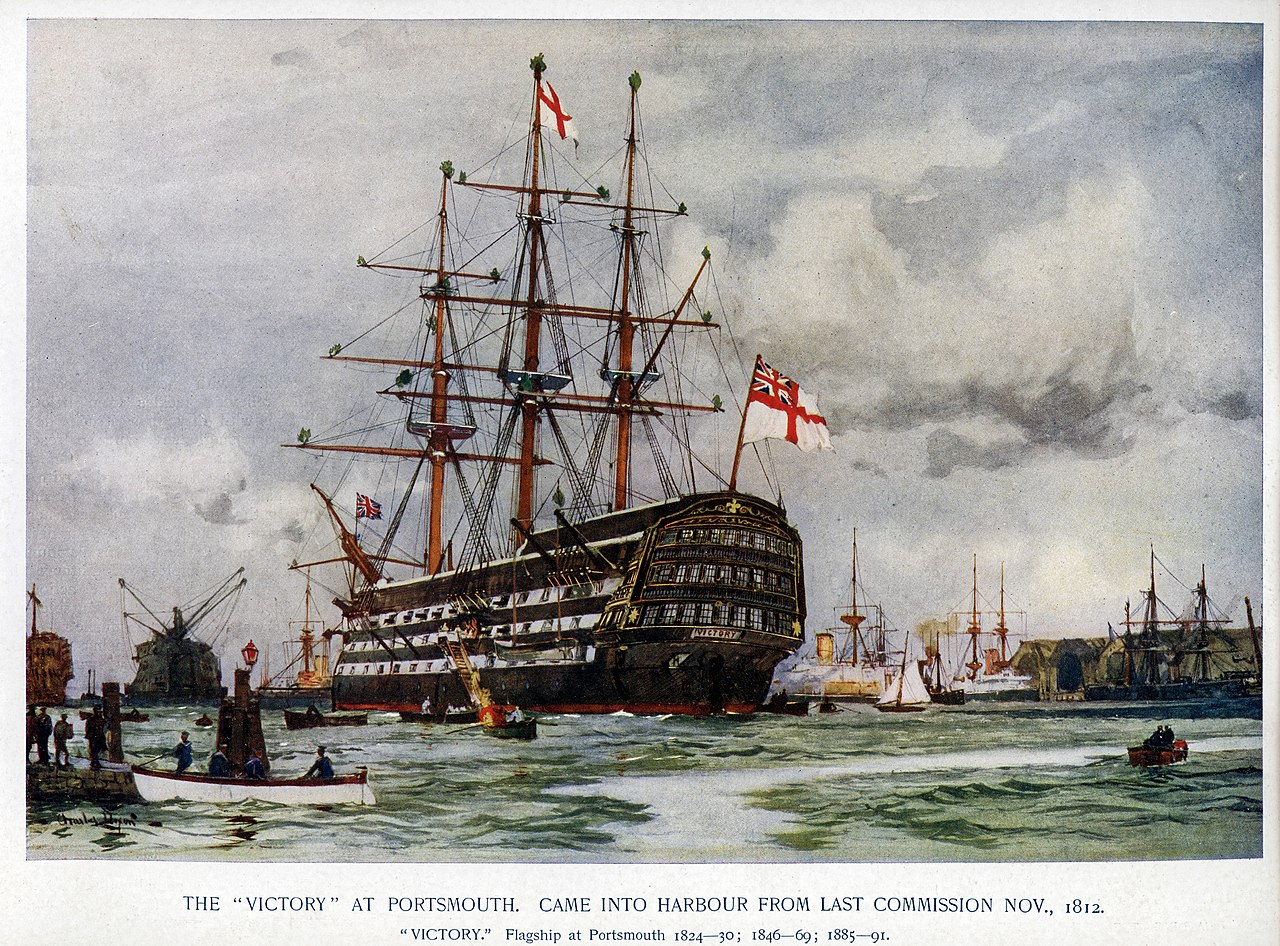
“HMS Victory in Portsmouth Harbour”
Painting by Charles Edward Dixon (1872-1934) via Wikimedia Commons.But sailors, possibly because they were at sea so much, were idealised as “hearts of oak” manning the wooden walls (and later the steel walls) of England. And the same was true for officers, credited above all with the great victory at Trafalgar in 1805, which secured national safety and prosperity for the rest of that century. They had a reputation for taciturnity and bluffness, which never does anyone any harm, and they often lived up to it. The fictional Jack Aubrey, in Patrick O’Brian’s witty and clever books about the Napoleonic wars, is a perfect rendering of this type. They tell terrible jokes. They don’t say much, just “Kiss me, Hardy” (Nelson as he died); “There seems to be something wrong with our bloody ships today, Chatfield” (Beatty at Jutland, as British warships repeatedly blew up under German fire); and “Continue to engage the enemy” (Warburton-Lee at Narvik, dying on his bridge after smashing up Hitler’s destroyer fleet and so making a cross-Channel invasion impossible).
And so the word “Navy” had, for many years, a useful commercial magic if you were selling something a bit manly and bluff, such as Navy Cut tobacco and Navy Rum, or even Senior Service cigarettes. But it did not have the yelling, martinet character of the Army. I have never yet seen a naval officer’s uniform that fits properly, and when sailors are marched aboard their ships (does this still happen?), the drill is far from pernickety. Close contact with the Navy — both my parents were in it, and so were most of their friends, some of my schoolteachers and many of the parents of my schoolfellows — revealed a dry, faintly sarcastic view of the outside world which had never been to sea. Even my mother, an ocean-going snob who would die of shame if she heard me use the word “toilet”, had mastered the sarcasm of the fleet. More than once I jumped with surprise when I heard her icily remarking about some inadequate if feeble attempt at recompense. “Well, that’s damned nice of him”, she’d say, which, for a Fifties married middle-class woman in a respectable suburb, was going it a bit.
May 25, 2026
Did The Taranto Raid Inspire Pearl Harbor?
TimeGhost Cartographic
Published 24 May 2026In November 1940, the British Royal Navy launched a daring carrier strike against the Italian fleet at Taranto. The attack shocked the world, crippled Italian naval power in the Mediterranean, and demonstrated just how devastating naval air power could be against battleships at anchor. But the consequences of Taranto didn’t end in Italy.
In this episode, we explore the aftermath of the raid, the race to understand how it had been achieved, and why military observers around the world paid such close attention to what happened there. From British convoy operations in the Mediterranean to Japanese investigations into shallow-water torpedo attacks, this episode examines how one raid would echo far beyond the harbor at Taranto.
How did the British make the attack possible? What lessons did foreign observers take away from it? And why did some nations react to the raid very differently than others?
May 24, 2026
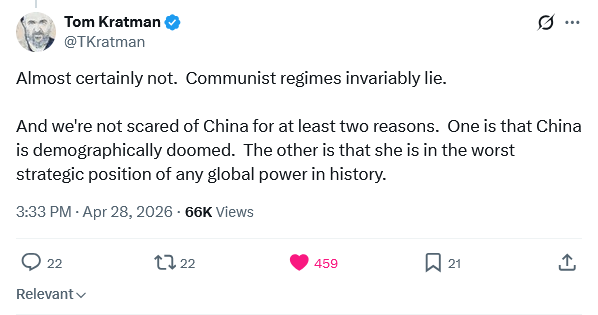
The PRC would need a literal “short, victorious war” to defeat the US
On Substack, Tom Kratman looks at the economic and strategic weakness of the Peoples Republic of China should it get into a serious shooting war with the United States:
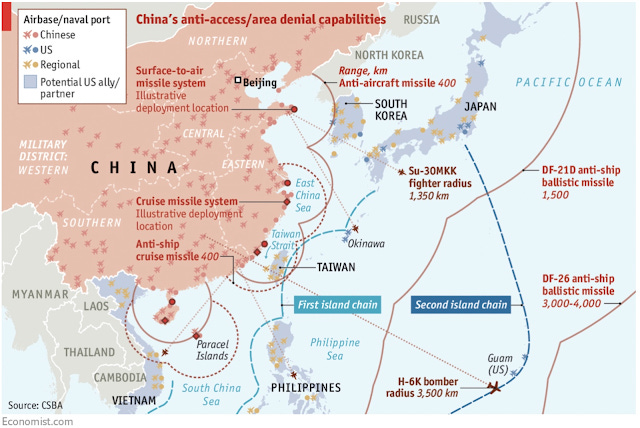
China’s strategic position is appalling, and at least the higher party cadres and senior military leadership have to know that it is. Why? China is utterly dependent on both imports and exports to keep their economy going and to feed themselves. By that latter, I don’t just mean they need to import food, though they do to the tune of one third. That’s bad enough, but they also need to import fertilizer to grow the inadequate amount of food they grow for themselves. No, nitrogen and phosphates aren’t a huge problem; they are net exporters. Potash is a problem. Loss of potash imports probably cut their grain production by about ten percent. This would be painful, but survivable with a touch of rationing and some weight loss.
Except for one thing, oil and natural gas. Cut those off and grain production drops by a third within two years and probably forty percent after that. On top of the loss of the third that they must import, that’s serious hunger.
And another thing, farm machinery and transportation. China only produces about a quarter of its oil needs domestically. Cut those off and mechanization of farming must be reduced.
Add in that this kind of food reduction also means they must stop feeding food animals.
Moreover, while a good deal of their transportation net runs off of electricity, which can be produced by the coal China does have, at what we might call the strategic level, getting the food from the farms to the railheads and from the railheads to markets to kitchens requires liquid fuel. China’s ability to produce liquid fuel from coal exists, but it is tiny.
Add in the increased need for liquid fuel for their military in this case.
A long series of interrogatories to Grok suggests that China’s total food production and importation collapses by seventy percent or more within two or three years if they go to war with us.
It won’t be sudden; they probably have about a year’s worth of food in storage against such a day. But within three years? We’re talking an entire civilization in kwashiorkor1 and marasmus2.
How do they keep that industrial civilization going in the absence of food and energy imports, or the exports that have kept their economy going? They likely don’t.
Although China’s population appears to be in accelerating collapse, they still have a lot more people than we do. Surely that represents … nothing. For a war fought largely at sea it represents nothing. Yes, they can, at least for the moment, build more ships faster than we can. However, we can build things to sink ships faster than they can build ships. Thus, we’ll keep our existing naval supremacy.
There’s a worse factor in there, though; in China sons are just a lot more important than daughters. No, I don’t care if this upsets western feminist sensibilities; we are not talking about the west but about China. Daughters, assuming they marry, go on to take care of their husband’s family. Sons take care of the parents. It is the rare Chinese family with an extra son to spare.
But can’t they build enough ships to overwhelm our blockade in the short term, at least? No, they can’t. China is surrounded by enemies on land, Vietnam, India, and Russia predominant among them, though none of the neighbors – barring, maybe, North Korea – really likes China or doesn’t fear it. No, however much public kissy face they may engage in for foreign consumption, China and Russia have long-standing, intractable issues between them. China is a threat to Russia and vice versa in ways we are not.
So all the manpower and money spent on a navy is largely wasted. They’re not going to get a navy large, powerful, and competent enough to take us on and, if they really try to, we will manufacture a war – the United States is good at this – to trim them down to size before they can. Worse, every increment of money and manpower they spend on the navy is money and manpower not spent on the much more important army and air force.3
- Caused by protein deficiency.
- Caused by deficiency in all macronutrients.
- The Navy is much more important to us because we have no serious land enemies in this hemisphere.
Update, 25 May: Welcome, Instapundit readers! Have a look around at some of my other posts you may find of interest. I send out a daily summary of posts here through my Substack – https://substack.com/@nicholasrusson that you can subscribe to if you’d like to be informed of new posts in the future.
May 22, 2026
The Real-Life British Top Gun
Imperial War Museums
Published 7 Jan 2026This video take an in depth look at the Sea Harrier. We cover its development, the air battle for the Falklands in 1982 and renowned Sea Harrier pilot Nigel “Sharkey” Ward.
0:00 Introducing Sea Harrier ZA175
0:57 Why the Sea Harrier?
2:00 Harrier Development
2:40 GR.3 vs Sea Harrier
3:30 Nigel “Sharkey” Ward
4:35 The Falklands Conflict
5:39 Preparing for Battle
7:12 The Air War
9:11 The AIM-9L Sindewinder
9:54 Sharkey’s Kill
11:41 The Sea Harrier’s Record
12:17 What happened to Sharkey and ZA 175?
(more…)
May 18, 2026
Isoroku Yamamoto – the admiral and the postwar legend
Big Serge examines the popular memory of Japanese admiral Isoroku Yamamoto, the architect of Japan’s early naval war successes against the United States from 1941 onwards, contrasting the postwar image with the man himself:
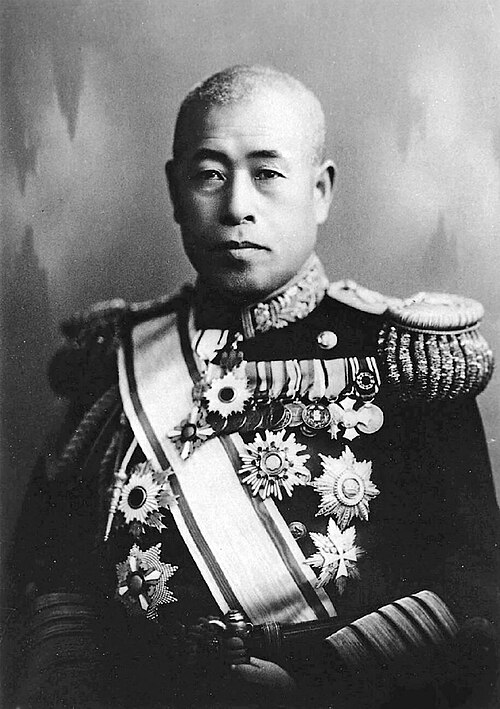
Admiral Isoroku Yamamoto, Commander-in-Chief of the Imperial Japanese Navy’s Combined Fleet.
Photo from the National Diet Library via Wikimedia Commons.
Japanese leadership in the Second World War enjoys noticeably lower name recognition than their German counterparts. Most people with a cursory knowledge of the war know the core German leadership group around Hitler — Himmler, Goering, Goebbels, Speer, and perhaps Heydrich and Bormann — and the all-star lineup of German generals like Rommel, Manstein, and Guderian. In contrast, the only particularly notorious member of Japan’s nebulous leadership group is General Hideki Tojo, who served as Prime Minister for most of the war and became the centerpiece defendant in the postwar trial. As far as Japanese commanders go, the list of name-brand personnel has but a single entry: Isoroku Yamamoto.
Yamamoto’s life and career present a fascinating trajectory that shapes a particular, sympathetic view of the man. A veteran of the Russo-Japanese War, he spent much of his 30’s in the United States, studying at Harvard and serving as naval attache in Japan’s Washington embassy. He therefore had a first hand understanding of America’s industrial depth, and was famously pessimistic about Japan’s prospects in a a war against the United States. “Anyone who has seen the auto factories in Detroit and the oil fields in Texas”, he argued, “knows that Japan lacks the power for a naval race with America”. In one of his more famous and widely recited (though often badly translated) remarks about a war with the United States, he told Prime Minister Fumimaro Konoe in September 1940:
If I was told that I had to do it, then you will certainly observe the Navy going all out for half a year to a year. However, I do not hold conviction about the outcome after 2-3 years.
This quote certainly seems remarkably prescient, in light of Japan’s initial wave of operational successes, which slowly faded away as American combat power ramped up. Far more famous still is his remark, after the attack on Pearl Harbor, that Japan had “awakened a sleeping giant, and filled him with terrible resolve”.
All of this shapes the perception of Yamamoto as a quasi-tragic figure who understood that Japan was unlikely to defeat the United States in the Pacific War, counseled against the conflict, and then dutifully tried to play a losing hand as well as he could once war had been thrust upon him against his own advice. Yamamoto was furthermore a critic of the Japanese Army’s war in China and a particularly vocal opponent of the Tripartite Pact with Germany and Japan, lending credence to the idea that he was war-averse.
This is the Yamamoto of American popular memory, and indeed of a great deal of Japanese postwar writing: a sort of samurai Cassandra, too perceptive and cosmopolitan for the militarist regime he served, a man who fired the opening shot of the Pacific War with a heavy heart and no illusions.
It is certainly true that Yamamoto had an appropriately pessimistic assessment of Japan’s prospects in an extended conflict with the United States. What is less often appreciated is that Yamamoto did not, on the basis of this assessment, conclude that Japan ought not to fight. He concluded instead that, if Japan was going to fight, it had to fight differently — with greater boldness, more risk, and an aggressive search for a decisive stroke. He did not spend the eighteen months before Pearl Harbor advocating for peace. He spent them designing what was, on balance, the single most aggressive operational scheme that was possible — and then only barely — within Japan’s kinetic parameters.
This is the critical distinction between Yamamoto-the-man and the Yamamoto of postwar hagiography. He was not a pacifist, reluctant or otherwise. He was a Japanese naval officer of strong patriotic conviction, deeply committed to his service and his nation, who happened to understand the arithmetic of industrial war better than most of his colleagues. Notwithstanding his appreciation for America’s vast industrial base, he shared a broader Japanese disdain for American martial proclivities, dismissing American naval officers as a club of “golfers and bridge players”. His understanding of the United States did not produce pacifism. It produced, rather, a particular kind of operational philosophy — one which held that Japan’s best hope in a war with the United States was to front-load its risk-taking, to achieve a string of dramatic early victories that would either compel American negotiation or, failing that, push the eventual American counter-offensive as far into the future as possible. In either case, the operational prescription was the same: bold, high-risk operations aimed at decisive results.
May 15, 2026
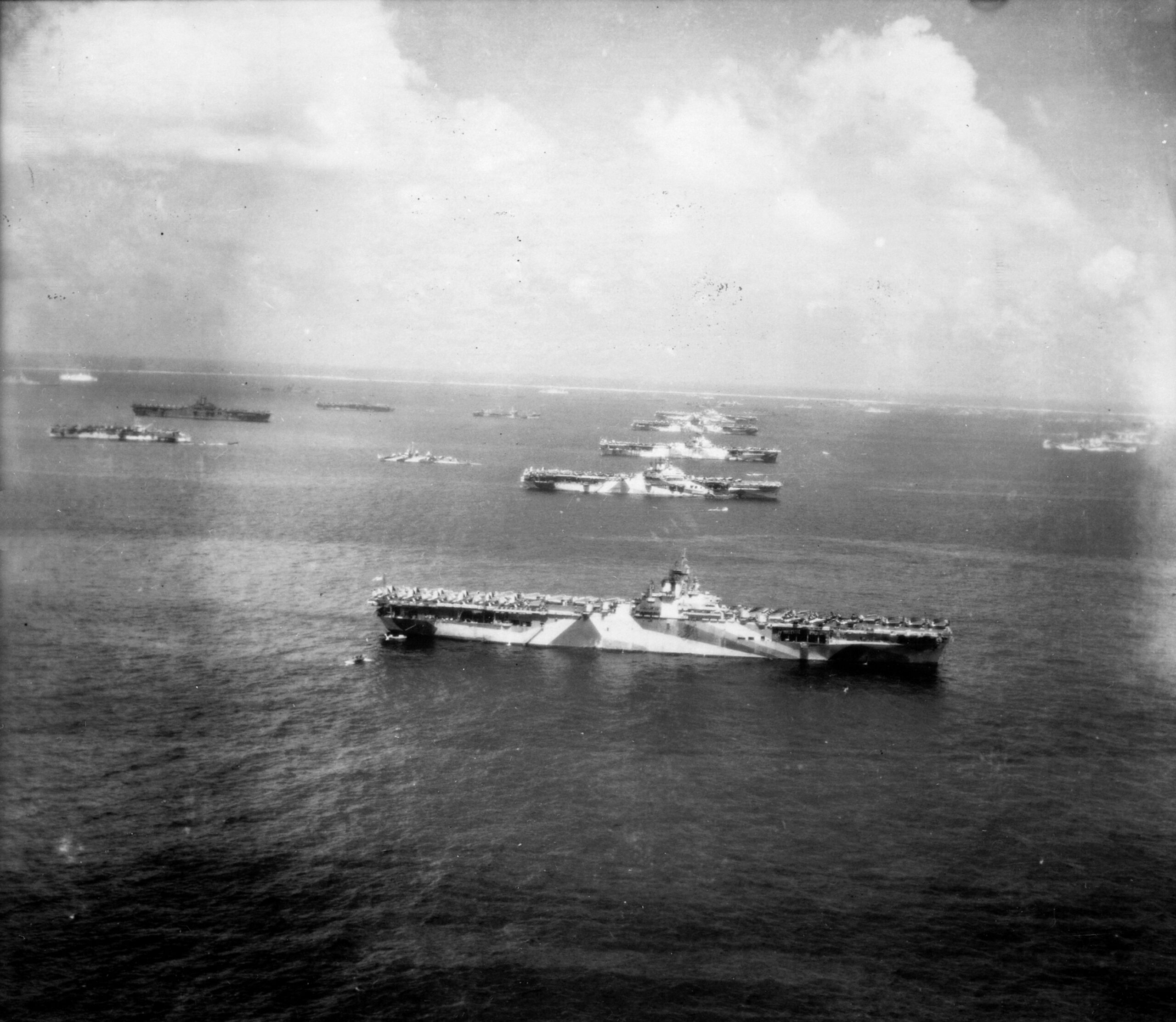
“One of the most iconic pictures of WWII” – the seen and the unseen, USN edition
CDR Salamander posts an iconic US Navy photo from late 1944, showing the unparalleled naval might of the American efforts against Japan. But, as with Bastiat’s famous economic essay, there are the obvious things we see and the important but unseen things that matter just as much:
Murderers’ Row. Ulithi anchorage, December 8th, 1944. Just three years after the attack on Pearl Harbor.
One of the most iconic pictures of WWII.
The carriers are (from front to back): USS Wasp (CV-18), USS Yorktown (CV-10), USS Hornet (CV-12), USS Hancock (CV-19) and USS Ticonderoga (CV-14).
The oldest of those ships, Yorktown, was only 19 months old. The youngest, Hancock, was commissioned only a little under eight months earlier. All were laid down and took from a bit under three to a bit under four years to build.
Just a year prior, the US Navy was so short of aircraft carriers, it had to borrow a carrier from the Royal Navy.
At first glance, it appears to be a flex of American naval power at flood tide — the aircraft carrier’s unassailable invincibility manifest — and it is. However, when you dig deeper, it has a more important story. It gives a warning. It informs us today, if we are willing to listen.
It isn’t about the power of being the world’s greatest shipbuider, that we were. It isn’t about an unequalled ability to project national will across the Pacific like no nation ever has in human history, which it is.
No. That isn’t what it tells us that is most important.
As we have done more than once over the last two decades, we’re taking a holder of a front row seat on the Front Porch and CDR Salamander Plank Owner Sid’s comments, in this case from yesterday, and bringing it to a standalone post.
Most of this post is his. The insight certainly is.
The actual story this picture tells is much more sobering, right there in plain sight, but you can’t see it.
The reality is that on the day this picture was taken, the Fast Carrier Task Force (TF 38/58) was down an entire Task Group from where it started two months earlier.
USS Franklin (CV-13) was severely damaged on 27 OCT by kamikaze and had to return [to] CONUS for repairs.
USS Belleau Wood (CVL-24) was severely damaged in the same attack.
USS Princeton (CVL-23) was sunk on 24 OCT by a Judy dive bomber.
USS Essex (CV-9) had a devastating hit by a kamikaze on 24 NOV followed by a disabling machinery casualty requiring a trip back to CONUS for repairs.
USS Enterprise (CV-6) departed a few days earlier for repairs in Pearl Harbor.
All the carriers in this picture had been damaged to varying degrees. Damage that today would require a trip to the yard to fix, like the absent Enterprise and Essex.
For example Ticonderoga (fourth Essex in the line from the bottom) would take damage to her radar waveguides in January. That could not be repaired forward and she would have to return to Bremerton as well.
April 30, 2026
China’s weaker-than-it-seems strategic position
On the social media site formerly known as Twitter, ESR expands on a post by Tom Kratman about the strategic weakness of the current Chinese government:
Tom didn’t explain his second assertion, but it’s important so I’m going to do it.
China is in the worst strategic position of any great power in history because it is critically dependent on resources it has to import, and it doesn’t have control of the sea lanes over which it imports them.
China is neither food nor energy self-sufficient. It needs to import pork from the United States, grain from Africa, coal from Australia, and oil from the Middle East to keep its population fed and its factories running.
Naval blockades at about three critical chokepoints (Hormuz, Malacca, Sunda) would cripple the Chinese economy within months, possibly within weeks. China does not have the blue-water navy required to contrast control of those chokepoints. The moment any first-rate naval power or even a second-rate like India decides China needs to be stopped, it’s pretty much game over.
As a completely separate issue thanks to the one-child policy, Chinese population probably peaked in 2006 and has been declining ever since. Every year in the foreseeable future they will have fewer military-age males than they do now. Most of those males are only sons; their deaths would wipe out entire family lines, giving the Chinese people an extremely low tolerance for war casualties.
Then there’s the glass jaw. The Three Gorges Dam. Which is already in some peril even without a war — you can compare photographs over time and see that it’s sagging. If anyone gets annoyed enough to pop that dam thing with a bunker-buster or a pony nuke, the resulting floods will kill millions and wipe out the strip of central China that is by far the country’s most industrially and agriculturally productive region.
The Chinese haven’t fought a war since 1971. They lost. Against Vietnam. The institutional knowledge that could potentially fit their army for doing anything more ambitious than suppressing regional warlordism does not exist.
I could go on. But I think I’ve made Tom’s statements sufficiently understandable already.
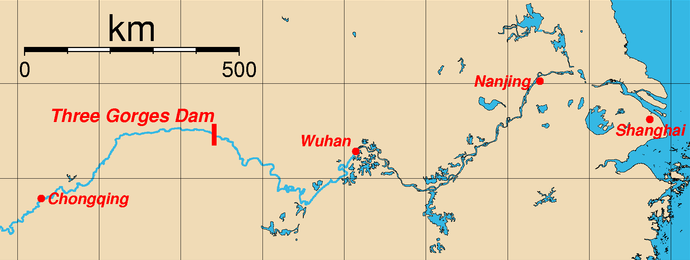
The position of the Three Gorges Dam on the Yangtze River in Hubei Province, showing the major cities downstream of the dam.
Image by Rolfmueller via Wikimedia Commons.
And Tom Kratman responds:
Almost perfect; you missed four tricks.
1. People, when we talk about blockading China, imagine that we’re talking about a civilized stop and search. Uh, uh; we will designate a no go zone and sink without further warning anything that enters it.
2. Our blockade will be distant, well out of range of those Oh-they’re-just-too-terrible-for-words (but never tested) DF-21s. [Wiki] (You did sort of address this, but not in so many words.)
3. We can blow the levees on the Yellow River, too, to kill many millions more and destroy still more industry (it flows above ground).
4. China not only doesn’t have the navy to contest with us, it can never have that navy. Why not? Because there’s only so much wealth to go around; China is surrounded on all sides by enemies with anywhere from decent to quite good armies, any or all of which might take a stab (pun intended) at carving China up like a turkey. They must put a lot more money and effort and manpower into stymying those than they can ever put into meeting us and Japan.
April 21, 2026
The Royal Canadian Navy’s proposed Arctic Mobile Base
At True North Strategic Review, Noah tries to answer the obvious question “what the hell is an Arctic Mobile Base?”
RCN Arctic Mobile Base concept image
RCN via True North Strategic ReviewFor those that don’t know, the Arctic Mobile Base, as it is currently called, is officially on the books. Despite a few years of conceptualization, the project is still in its early stages.
I always feel the need to reiterate that to folks; it is very much still a concept. It is not funded, not approved, but despite that, we already have a fairly decent vision of what the RCN is sorta looking for as a platform.
[…]
When you hear a name like Arctic Mobile Base, I’m sure a lot of ideas go through your head. Indeed. What exactly is a base in this context? Who or what is it meant to support? What sort of gaps is it designed to fulfill?
To understand the AMB (as I will call it from here on out), you need to understand exactly what the Navy is facing up in the Arctic; more specifically, the difficulty in building and maintaining infrastructure. With the failure of Nanisivik, the RCN is faced with a difficult position.
The first thing you need to know here is fundamental limitations. Canada, unlike our other allies, lacks an available ice-free port to utilize in the Arctic year-round. The closest available major ports that Canada has access to with year-round access are Saint John on the East Coast and Prince Rupert on the West Coast.
Iqaluit, Tuktoyaktuk, and Churchill, the major ports available in the Canadian Arctic, all freeze in the winter. Even Nome in Alaska freezes. The only port facility available year-round would be in Nuuk, where, while work is underway on the Danish side to expand current facilities, it is still not enough to provide ample support for Canadian vessels operating in the Archipelago.
[…]
That brings us to the vessels themselves, or at least the concept as I have been told. I guess one could say they are the true successors to the original Joint Support Ship concept; maybe even ALSC if you want to get deep into the philosophical.
They are an everything vessel. They will be Command and Control centres. They will have large, extensive medical facilities. They will be Replenishment Vessels, able to support the rest of the fleet at sea. They might have some submarine tender capabilities and forward repair capabilities built in. Those two are me speculating, though I’m sure someone is asking those questions.
They will be HADR platforms, able to operate independently of any existing infrastructure like ports. They will have an amphibious capability to support that, and if needed, support the Army in any endeavour they find themselves in. They will be able to reach any other vessel in the fleet, even the Polars if required.
That means that as of now, the Navy is looking at PC 2 for its potential rating, a monumental ask. It is likely to have similar range and endurance requirements to the existing Polar Icebreakers, so perhaps around a 25,000-30,000 Nautical Mile Range (as a general rough figure) and upwards of 270 days endurance.
That will allow for the AMB to maintain a persistent, on-station capability in the Archipelago for an extended period of time, similar to the future Arpatuuq and Imnaryuaq. Again, the AMBs are meant to be a semi-permanent capability in the Arctic, with the desire to have one up there or available to get up there at any given time and stay up there supporting both the fleet and local communities for an extended period of time.
As for what I know? Two are planned. Both will be based on the East Coast, where it is easiest to access the Arctic compared to going from Esquimalt, past the Bering Strait, and over Alaska. It is also the area of most activity for the Navy. So it makes sense, along with the typical desire to consolidate maintenance, crews, training, and additional infrastructure.
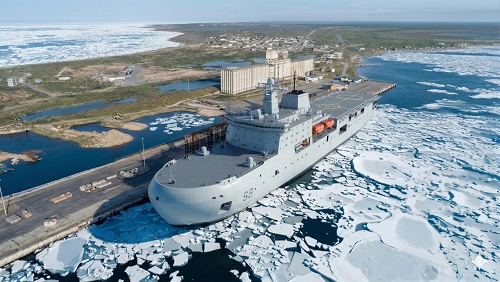
While I’m pleased to discover that the RCN seems to be taking the Arctic seriously and doing planning to that end, we should also keep in mind that the federal government is a big believer in the “ice free Arctic by 2050” predictions, they may not be willing to fund hulls built to PC 2 levels of ice-breaking capability. Which would be fine if the predictions come true, but very limiting to the planned ships if the Arctic fails to warm up as the climate models claim it will.
April 19, 2026
HMCS Magnificent – Canada’s Forgotten Carrier
Skynea History
Published 13 Nov 2025The Royal Canadian Navy is probably not the first one you think about for naval aviation. You’re more likely to think of lighter ships, like Haida.
However, the Canadians would operate three aircraft carriers during the Cold War. The short-lived (well, short-lived in Canadian service) Warrior. The more famous Bonaventure, that I’ve covered before. And, the topic of this video, HMCS Magnificent.
The middle child and probably the least famous of the three. But the one that is, largely, responsible for building Canadian carrier doctrine. It was Magnificent that built up the Canadian naval air arm. Magnificent trained the pilots that would go on to serve with Bonaventure.
And Magnificent is often overlooked for being the middle child. Hence why I chose to cover her today.
Further Reading:
https://forposterityssake.ca/Navy/HMC…
https://naval-museum.mb.ca/rcnships/c…
April 13, 2026
20 Biplanes vs Six Battleships – The Battle of Taranto
TimeGhost Cartographic
Published 12 Apr 2026Follow up this episode with our North Africa Miniseries on our WW2 channel: • North Africa
November 1940. In the Mediterranean, the British Royal Navy launches a daring carrier strike against the Italian fleet at Taranto. In Operation Judgement, Fairey Swordfish torpedo bombers from HMS Illustrious attack the main base of the Regia Marina, crippling multiple battleships in a single night.
This is the story of the attack on Taranto: a bold naval air raid that changed the balance of power in World War 2 and showed what carrier-based air power could do. With Admiral Andrew Cunningham orchestrating a complex deception operation, the strike caught Italy off guard and reshaped naval warfare in the Mediterranean.
Watch this episode of TimeGhost Cartographic for a detailed breakdown of the Taranto raid, Operation MB8, and the battle for control of the Mediterranean Sea.
(more…)
April 5, 2026
How To Let the People Pay For War – Death of Democracy 10 – Q2 1935
World War Two and Spartacus Olsson
Published 4 Apr 2026June 1935: Adolf Hitler reassures the world with promises of peace — while secretly accelerating Germany’s path to war. In this episode of Death of Democracy, we examine how Hitler manipulated international diplomacy and domestic opinion in the second quarter of 1935. From the collapse of the Stresa Front to the signing of the Anglo-German Naval Agreement, foreign leaders were drawn into a dangerous illusion. Meanwhile, inside Germany, antisemitic violence escalated, press censorship intensified under Joseph Goebbels, and economic realities worsened under Hjalmar Schacht’s policies.
Drawing on firsthand accounts from William L. Shirer and Victor Klemperer, this episode reveals a society caught between fear, propaganda, and growing dictatorship.
How did Hitler convince both his people and world leaders that he wanted peace – while preparing for war?
Watch to understand how democracies can be misled – and what happens when we fail to act.
(more…)
March 31, 2026
Japan’s navy … uh, I mean the “Japan Maritime Self-Defense Force”
On Substack, Francis Turner discusses what serious countries do (so you know the topic isn’t anything to do with Canada), and part of the post is about the Japanese Navy Japan Maritime Self-Defense Force and its latest ship building program:

Last month Japan started work on its second ASEV (Aegis System Equipped Vessel), which should probably classed a Guided Missile Cruiser, though it is unclear if the C designation will be used (let’s face it Japan still calls its two “not really aircraft carriers, honest guv” aircraft carrying warships “Helicopter Destroyers”. Though apparently it plans to change that soon).
At 190m long and 25m broad, the ASEVs will be some of the largest non-aircraft carrier ships being built by anyone this century1 until the Trump battleships start construction. The Trump battleships are projected to be about 50% larger but they haven’t yet been funded let alone contracted. The USN’s Zumwalts are roughly the same size.
It isn’t just the size that is impressive, it is also the speed of construction. The ASEV as a concept showed up in ~2020 when Japan decided the land based Aegis Ashore program was a failure and cancelled it. In October 2024, after about four years, plans had been made, budget allocated and contracts awarded for the two ships. Construction of the first started last July (2025) and the second last month (February 2026). Construction time is estimated to be around three years, with the first delivered/commissioned in March 2028 and the second one year later. Why one year later and not six months earlier? My guess is that the reason is to incorporate lessons learned from sea trials and operating the first in the final construction stages of the second. This seems similar to the Izumo/Kaga construction a decade ago.
Put together and you have ships that will have gone from concept to contract award in 4 years and contract award to fully-functioning delivery in under 5 years — assuming there are no delays. That seems plausible, the Izumo and Kaga were built in about the same time frame, and stands in stark contrast to the procurement speed of the US Navy and any European navy. The first Zumwalt, for example took over 5 years to go from concept to start of construction and another 5+ from there to commissioning and then another 4 to full acceptance. The ASEVs are also expected to be a lot cheaper, costing around JPY400B or about US$2.5 billion for the initial version. There will undoubtedly be upgrades — e.g. drone defenses, laser or rail guns — and there are some new features compared to previous ships — the SPY7 radar from Lockheed Martin for example — but this is an evolution of existing Japanese and US Aegis destroyers rather than a brand new concept which helps explain why I am confident about the timeline and budget.
Although the ASEV’s primary role is missile defense, there is no reason why one might not, in the fullness of time, be loaded with offensive missiles such as the TLAM or antiship missiles. Indeed the Naval News article lists both as options:
Each vessel will feature a 128-cell Vertical Launch System (VLS) — significantly more than the 96 cells installed on Japan’s latest Aegis destroyers.
The VLS will be capable of launching:
– SM-3 Block IIA interceptors, jointly developed by Japan and the United States for ballistic missile defense
– SM-6 missiles, capable of engaging advanced aerial threats, including hypersonic glide vehicles
The ships will also support Japan’s emerging counterstrike capability.
Planned armament includes:
– the extended-range Type 12 anti-ship missile (ship-launched improved variant)
– the U.S.-made Tomahawk cruise missile
Is that TLAM in your launcher or are you pleased to see me?
Notably the Tomahawk capability has already been fitted to one of the Aegis destroyers this class is supposed to replace. A 128 cell ASEV firing TLAMs could be very unpleasant for Little Rocket Man; if it fired antiship missiles that could make a Chicom invasion of Taiwan pretty miserable just on its own. It would also make a phenomenal commerce raider / blockade enforcer if such roles were needed.
[Aside: Unlike some country’s missiles I’d be pretty confident that the Type 12 anti-ship missile will work well]
As CDR Salamander observed on X, the real question is why Japan doesn’t make a few more and sell them to countries/navies that struggle with procurement. And for that matter why it doesn’t make a couple more for itself. Perhaps it will. I figure there’s a couple of years before there will be yard space to build them so there’s no hurry to make that decision.
Russia’s Kirov class battlecruisers are larger but a) they were built in the 1970s/80s and b) only one is currently active (for some definition of active).
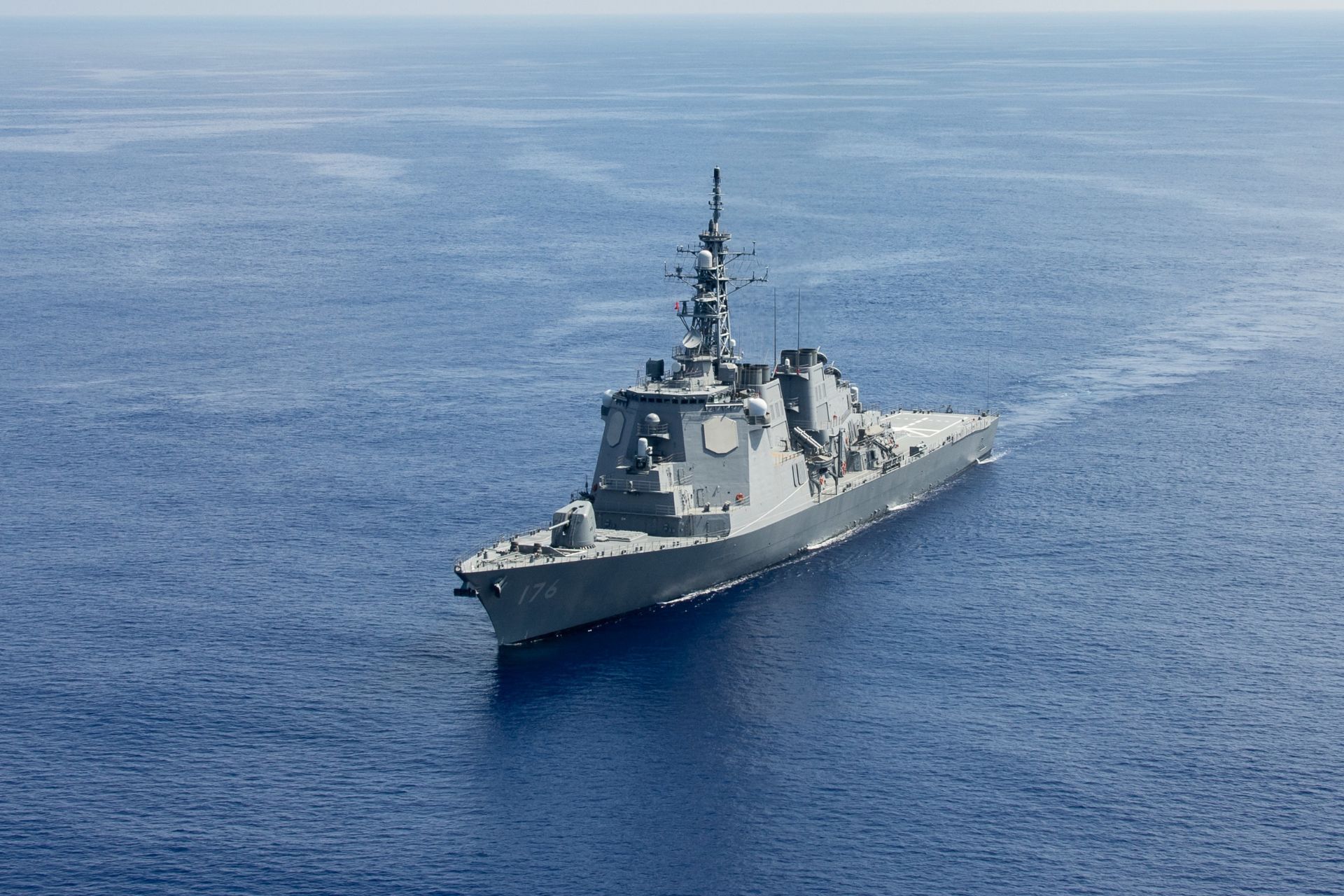
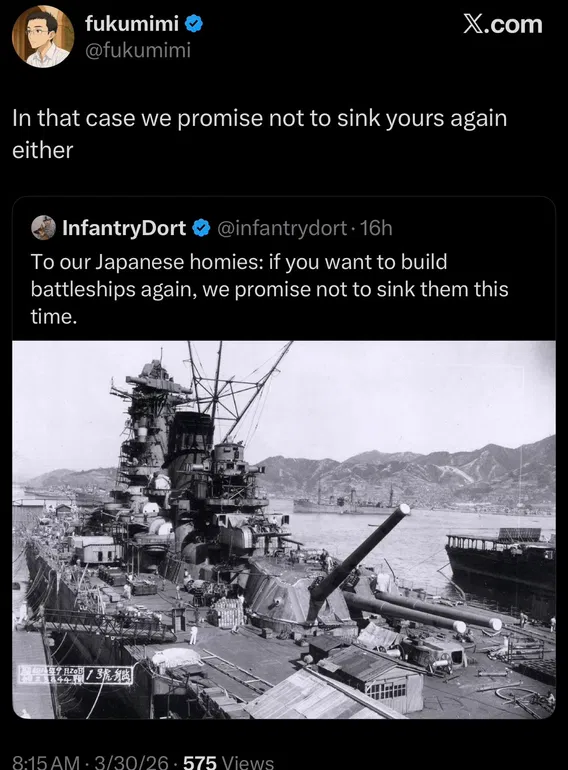
Japan’s decision to rebuild naval strength has been noted by others, too: