
So what is the truth about the Crusades? Scholars are still working some of that out. But much can already be said with certainty. For starters, the Crusades to the East were in every way defensive wars. They were a direct response to Muslim aggression — an attempt to turn back or defend against Muslim conquests of Christian lands.
Christians in the eleventh century were not paranoid fanatics. Muslims really were gunning for them. While Muslims can be peaceful, Islam was born in war and grew the same way. From the time of Mohammed, the means of Muslim expansion was always the sword. Muslim thought divides the world into two spheres, the Abode of Islam and the Abode of War. Christianity — and for that matter any other non-Muslim religion — has no abode. Christians and Jews can be tolerated within a Muslim state under Muslim rule. But, in traditional Islam, Christian and Jewish states must be destroyed and their lands conquered. When Mohammed was waging war against Mecca in the seventh century, Christianity was the dominant religion of power and wealth. As the faith of the Roman Empire, it spanned the entire Mediterranean, including the Middle East, where it was born. The Christian world, therefore, was a prime target for the earliest caliphs, and it would remain so for Muslim leaders for the next thousand years.
With enormous energy, the warriors of Islam struck out against the Christians shortly after Mohammed’s death. They were extremely successful. Palestine, Syria, and Egypt — once the most heavily Christian areas in the world — quickly succumbed. By the eighth century, Muslim armies had conquered all of Christian North Africa and Spain. In the eleventh century, the Seljuk Turks conquered Asia Minor (modern Turkey), which had been Christian since the time of St. Paul. The old Roman Empire, known to modern historians as the Byzantine Empire, was reduced to little more than Greece. In desperation, the emperor in Constantinople sent word to the Christians of western Europe asking them to aid their brothers and sisters in the East.
That is what gave birth to the Crusades. They were not the brainchild of an ambitious pope or rapacious knights but a response to more than four centuries of conquests in which Muslims had already captured two-thirds of the old Christian world. At some point, Christianity as a faith and a culture had to defend itself or be subsumed by Islam. The Crusades were that defense.
Thomas F. Madden, “The Real History of the Crusades”, Crisis Magazine, 2002-04-01.
September 7, 2015
QotD: The Crusades
August 27, 2015
QotD: The real purpose of the Inquisition
In order to understand the Spanish Inquisition, which began in the late 15th century, we must look briefly at its predecessor, the medieval Inquisition. Before we do, though, it’s worth pointing out that the medieval world was not the modern world. For medieval people, religion was not something one just did at church. It was their science, their philosophy, their politics, their identity, and their hope for salvation. It was not a personal preference but an abiding and universal truth. Heresy, then, struck at the heart of that truth. It doomed the heretic, endangered those near him, and tore apart the fabric of community. Medieval Europeans were not alone in this view. It was shared by numerous cultures around the world. The modern practice of universal religious toleration is itself quite new and uniquely Western.
Secular and ecclesiastical leaders in medieval Europe approached heresy in different ways. Roman law equated heresy with treason. Why? Because kingship was God-given, thus making heresy an inherent challenge to royal authority. Heretics divided people, causing unrest and rebellion. No Christian doubted that God would punish a community that allowed heresy to take root and spread. Kings and commoners, therefore, had good reason to find and destroy heretics wherever they found them—and they did so with gusto.
One of the most enduring myths of the Inquisition is that it was a tool of oppression imposed on unwilling Europeans by a power-hungry Church. Nothing could be more wrong. In truth, the Inquisition brought order, justice, and compassion to combat rampant secular and popular persecutions of heretics. When the people of a village rounded up a suspected heretic and brought him before the local lord, how was he to be judged? How could an illiterate layman determine if the accused’s beliefs were heretical or not? And how were witnesses to be heard and examined?
The medieval Inquisition began in 1184 when Pope Lucius III sent a list of heresies to Europe’s bishops and commanded them to take an active role in determining whether those accused of heresy were, in fact, guilty. Rather than relying on secular courts, local lords, or just mobs, bishops were to see to it that accused heretics in their dioceses were examined by knowledgeable churchmen using Roman laws of evidence. In other words, they were to “inquire”—thus, the term “inquisition.”
From the perspective of secular authorities, heretics were traitors to God and king and therefore deserved death. From the perspective of the Church, however, heretics were lost sheep that had strayed from the flock. As shepherds, the pope and bishops had a duty to bring those sheep back into the fold, just as the Good Shepherd had commanded them. So, while medieval secular leaders were trying to safeguard their kingdoms, the Church was trying to save souls. The Inquisition provided a means for heretics to escape death and return to the community.
Most people accused of heresy by the medieval Inquisition were either acquitted or their sentence suspended. Those found guilty of grave error were allowed to confess their sin, do penance, and be restored to the Body of Christ. The underlying assumption of the Inquisition was that, like lost sheep, heretics had simply strayed. If, however, an inquisitor determined that a particular sheep had purposely departed out of hostility to the flock, there was nothing more that could be done. Unrepentant or obstinate heretics were excommunicated and given over to the secular authorities. Despite popular myth, the Church did not burn heretics. It was the secular authorities that held heresy to be a capital offense. The simple fact is that the medieval Inquisition saved uncounted thousands of innocent (and even not-so-innocent) people who would otherwise have been roasted by secular lords or mob rule.
As the power of medieval popes grew, so too did the extent and sophistication of the Inquisition. The introduction of the Franciscans and Dominicans in the early 13th century provided the papacy with a corps of dedicated religious willing to devote their lives to the salvation of the world. Because their order had been created to debate with heretics and preach the Catholic faith, the Dominicans became especially active in the Inquisition. Following the most progressive law codes of the day, the Church in the 13th century formed inquisitorial tribunals answerable to Rome rather than local bishops. To ensure fairness and uniformity, manuals were written for inquisitorial officials. Bernard Gui, best known today as the fanatical and evil inquisitor in The Name of the Rose, wrote a particularly influential manual. There is no reason to believe that Gui was anything like his fictional portrayal.
By the 14th century, the Inquisition represented the best legal practices available. Inquisition officials were university-trained specialists in law and theology. The procedures were similar to those used in secular inquisitions (we call them “inquests” today, but it’s the same word).
Thomas F. Madden, “The Truth About the Spanish Inquisition”, Crisis Magazine, 2003-10-01.
July 30, 2015
Stary Olsa covers the Red Hot Chili Peppers on medieval instruments
Published on 29 Apr 2015
Stary Olsa performing “Californication” by Red Hot Chili Peppers for Belarusian TV-show “Legends. Live” on ONT channel.
Produced by Mediacube Production. (Minsk, Belarus)
H/T to Open Culture.
July 23, 2015
Stary Olsa cover Deep Purple on medieval instruments
Published on 14 Dec 2014
Stary Olsa performing Deep Purple – Child In Time!
Produced by Mediacube Production. (Minsk, Belarus)
H/T to Open Culture.
July 22, 2015
The pleasures of a weak government
At Samizdata, Brian Micklethwait sings the praises of “an infirm hand on the tiller” during the War of the Roses:
For my point is that this royal “hand on the tiller” that Wilson says the country so much needed can sometimes be rather too firm.
Wilson is right that medieval civil war, or medieval war of any kind, could be a disaster to the wider society in which it happened. A routine military method in those days was for a retreating army to wreck the countryside, burning crops and killing livestock, in order to deny these resources to an advancing enemy. That this was a death sentence to whoever lived in this devastated area may have troubled the people who inflicted such horrors, but not enough to stop them doing it whenever they were told to. Elsewhere in the book, Wilson mentions an episode of just this sort, in which the King of Scotland inflicted just this horrible fate upon great swathes of Scotland, when he was faced with an invading English army. Those medieval wars between England and Scotland were not quite the nationalist confrontations that Anglo-Scottish wars later became. They were battles between aristocratic dynasties, between “families”, in the Godfather movies sense. Civilian populations were more prizes to be contested, to be owned or failing that denied to an enemy, than the ideologically enthused participants in the contest, as they became later, for instance in the seventeenth century.
But, on the whole, England’s Wars of the Rose, as they later came to be called, were not like this. These “wars” tended to consist of relatively small armies having sometimes very bloody battles with one another, but not, on the whole, creating all that much havoc for nearby civilians, apart from the unlucky civilians whose crops or animals had been on the actual battlefield.
So, what of that mercantile class which, in Wilson’s word, “emerged” at the same time as all of this rather low level fighting? He makes it sound like an unrelated coincidence. But might there not be an element of cause and effect in operation here? Was not the very fact that all this commerce, all this development of the wool trade, was “beyond politics” perhaps one of the key things that enabled it to “emerge”?
For many people, the mere possibility that the dynastic fights of the fifteenth century might degenerate, even if only in their immediate vicinity, into something more like the English — or worse, the German — civil wars of later times, was probably enough to make them believe, as Wilson believes, that a firm hand on the tiller would be preferable to rival hands flailing at each other. But in the meantime, it surely must have helped farmers — often farmers way off the beaten tracks of the contending English armies in places like East Anglia, and merchants, and speculators, and seafarers, that the aristocrats who might have taken command of their “emerging” arrangements, who, had they been all on the same side, might have brought them into politics, and if not ruined them then at least slowed them down quite severely, instead had other things on their minds. Basically, each other. What I am suggesting is that, from the commercial point of view, the Wars of the Roses might have been quite good wars, complicated enough to divert the attentions of aristocrats away from their usual anti-commercial meddlings, yet not too widespread in their destructive effect. That the Wars of the Rose were, for some, very bad wars, I do not contest.
June 1, 2015
May 29, 2015
QotD: Buying modern indulgences for Silicon Valley billionaires
Silicon Valley is an American success story. At a time of supposed American decline, a gifted group of young entrepreneurs invented, merchandized, and institutionalized everything from smartphones and eBay to Google and Facebook. The collective genius within a small corridor from San Francisco to Stanford University somehow put hand-held electronics into over a billion households worldwide — and hundreds of billions of dollars in profits rolled into Northern California, and America at large.
Stranger yet, Silicon Valley excelled at 1950s-style profit-driven capitalism while projecting the image of hip and cool. The result is a bizarre 21st-century 1-percenter culture of $1,000-a-square-foot homes, $100,000 BMWs, and $500 loafers coexisting with left-wing politics and trendy pop culture. Silicon Valley valiantly tries to square the circle of driving a Mercedes or flying in a Gulfstream while lambasting those who produce its fuel.
But the paradox finally has reached its logically absurd end. In medieval times, rich sinners sought to save their souls by buying indulgences to wash away their sins. In the updated version, Silicon Valley crony capitalists and wheeler-dealers buy exemption for their conspicuous consumption with loud manifestations of cool left-wing politics.
Victor Davis Hanson, “The Valley of the Shadow: How mansion-dwelling, carbon-spewing cutthroat capitalists can still be politically correct”, National Review, 2014-07-22.
February 23, 2015
Do these count as “known unknowns”? Searching for copies of the Magna Carta
At the Magna Carta Project, Professor Nicholas Vincent recounts how he tracked down a previously unknown copy in Sandwich:
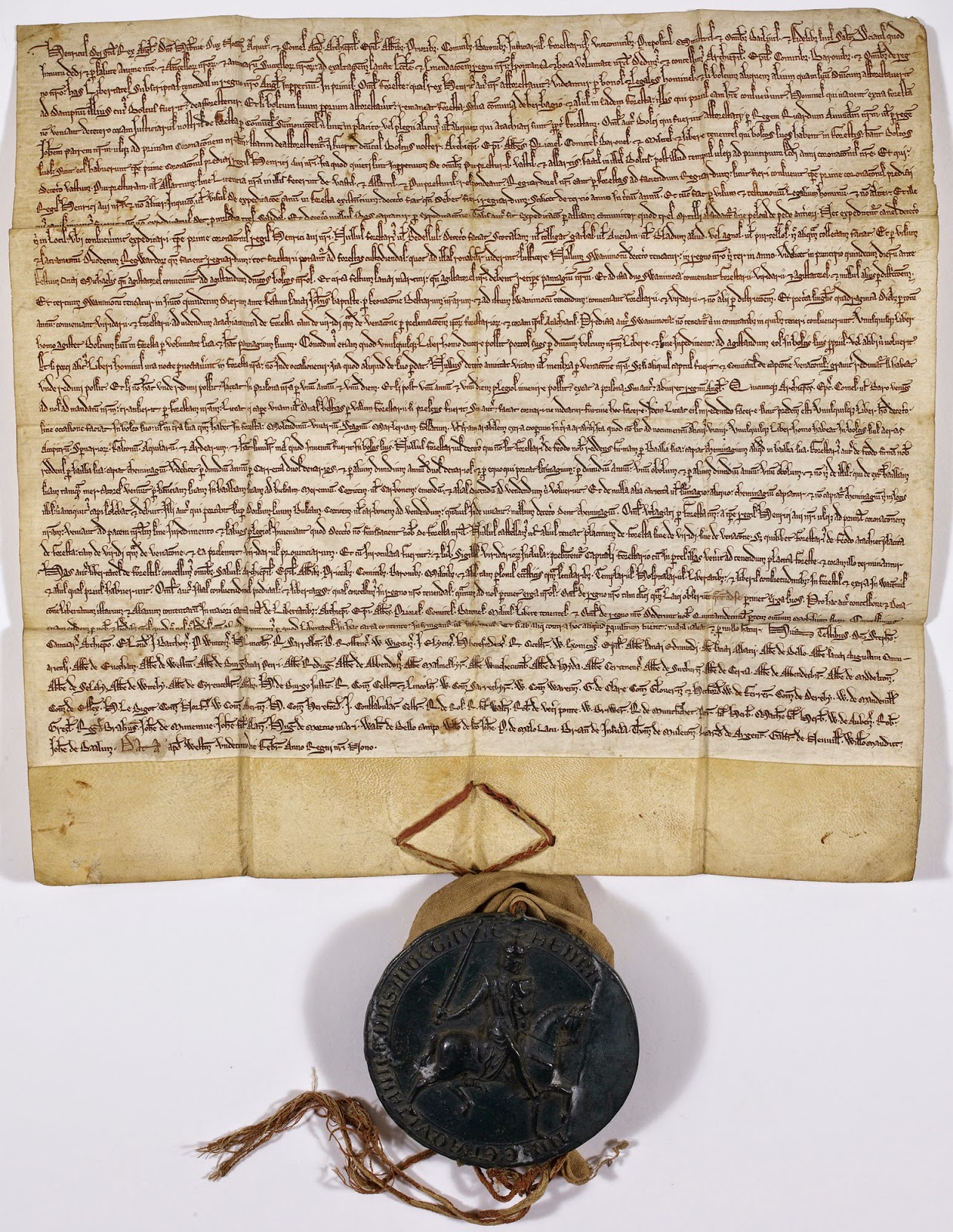
Now, I have often found that the most interesting original records of Magna Carta, as of much else, have gone unnoticed precisely because they are assumed either to be copies rather than originals or because they travel with other less famous documents. Cataloguers, assuming that Magna Carta is much too important to have been overlooked, have very frequently assumed that originals are copies, not from any physical evidence of the fact, but simply because the idea of possessing an unknown Magna Carta has appeared to the cataloguer to be as absurd as suddenly stumbling upon an unknown play by Shakespeare or a unknown canvas by Vermeer. The most famous documents are often the documents that, in their natural habitat, have been least studied. Edgar Allan Poe sums up this situation perfectly in his story “The Purloined Letter”. Poe’s plot here turns on the fact that, if you wish to hide something that everybody else assumes hidden, the best place to hide it is in plain view.
I can claim, long before last December, to have found at least three Magna Cartas. All were in plain view. None of them was ‘unknown’, in the sense that they had all previously been listed, albeit in obscure places, either as Magna Cartas or as ‘copies’ of Magna Carta. They were nonetheless ‘unknown’ in the sense that they were either assumed to be ‘copies’ or ‘duplicates’ rather than originals (one of the three 1217 Magna Cartas, and the 1225 Magna Carta in the Bodleian Library in Oxford), or were known locally but without any appreciation that local knowledge had not come to national or international attention (the 1300 Magna Carta preserved in the archives of the borough of Faversham). In one instance (the 1217 Magna Carta now in Hereford Cathedral), it had been catalogued as a royal charter of liberties, but without realizing that these liberties were those otherwise known as ‘Magna Carta’. I vividly remember phoning Hereford Cathedral, in 1989, and asking if I could go down there the following day to see their Magna Carta (for there could be little doubt from the catalogue entry that Hereford’s ‘Charter of liberties 1217’ was a 1217 Magna Carta). I received a very dusty answer. ‘We have no Magna Carta’, I was told, ‘You must be thinking of Mappa Mundi!’. Ignoring this, and ordering up the document by call number, I found myself, the following morning, greeted on Hereford railway station by the canon librarian and the delightful cathedral archivist, Meryl Jancey. Archivists and canon librarians do not generally go to the railway to greet visiting postgraduate students. Short of playing me up Hereford High Street with a brass band, they could not have expressed more joy. And inevitably, their first question was ‘How much is it worth?’.The Hereford Magna Carta of 1217
[…]
One other detail before we pass on. Magna Carta as issued in 1215 promised reform not only of the realm as a whole but of the King’s administration of those parts of England placed under ‘forest law’ (i.e. set aside for the King’s hunting, with severe consequences for land use and the preservation of game). In 1217, to answer this demand for reform, King Henry III not only issued a new version of Magna Carta but, as a companion piece, an entirely distinct and smaller charter known as the ‘Forest Charter’. From 1217 onwards, the Forest Charter travelled in the company of Magna Carta, rather as a pilot fish accompanies a shark. It was in order to distinguish between these two documents, bigger and smaller, that as early as 1217 Magna Carta was first named ‘Magna’ (‘the great’). Thereafter, on each successive reissue of Magna Carta, the Forest Charter was also reissued, in 1225, 1265, 1297 and 1300. The Record Commissioners, in their search for original documents, were much less thorough in their treatment of the Forest Charter than they were in their search for its more famous sibling. Blackstone had found only two original Forest Charters, both of them very late. The Record Commissioners knew of only three. By contrast, we now know that at least twelve survive. Some of these turned up fortuitously at the time of my own search for new manuscripts in 2007. Others had resurfaced even more recently.The Forest Charter of 1225, British Library
Add. Ch. 24712So it was, that around 4.30am in the morning of 9 December 2014, I decided that a catalogue entry describing a Forest Charter of 1300, might well merit further investigation. Even in the seven years between 2007 (when I compiled my lists for Sotheby’s) and 2014, when I stumbled on the reference to the borough of Sandwich’s Forest Charter, I had found at least three further original Forest Charters previously misidentified or ignored. The earliest of these, of 1225, came to light amongst the muniments of Ely Cathedral, the most recent, of 1300, in the British Library. An original of 1300 at Oriel College seen by Blackstone, reported missing in 2007, had re-emerged safe and sound.
Thanks to modern technology, from Belfast to Maidstone is a mere click of the mouse. At 4.39 Greenwich meantime on the morning of 9 December last year, I sent an email (I have it in front of me) to Dr Mark Bateson. I have known Mark for nearly twenty years, first as an archivist at Canterbury Cathedral (where he was one of those who devised the magnificent catalogue of Canterbury’s medieval charters), and more recently following his transfer to Maidstone. I told him that I had found the reference to a Forest Charter , and as I noted in my email: ‘If this really is the 1300 Sandwich copy of the forest charter, issued under the seal of Edward I, then it is a major find. There are only a handful of such exemplifications still surviving as originals. It would also fundamentally alter our understanding of the way in which the charters of liberties were distributed for the later reissues of Magna Carta. Is there any chance of your taking a sneak preview?’
November 9, 2014
A medieval cover of Metallica’s “One”
I’m not familiar with the original, but I love the cover by Belarus group Stary Olsa:
H/T to Metal Injection:
Metallica is just rip for covering on unique instruments. Today, we hear what it would be like if it was covered in Medieval Times. Here is a band from Belarus doing just that.
October 31, 2014
QotD: Nobody expects the Inquisition … to be a force for good
To understand the Inquisition we have to remember that the Middle Ages were, well, medieval. We should not expect people in the past to view the world and their place in it the way we do today. (You try living through the Black Death and see how it changes your attitude.) For people who lived during those times, religion was not something one did just at church. It was science, philosophy, politics, identity, and hope for salvation. It was not a personal preference but an abiding and universal truth. Heresy, then, struck at the heart of that truth. It doomed the heretic, endangered those near him, and tore apart the fabric of community.
The Inquisition was not born out of desire to crush diversity or oppress people; it was rather an attempt to stop unjust executions. Yes, you read that correctly. Heresy was a crime against the state. Roman law in the Code of Justinian made it a capital offense. Rulers, whose authority was believed to come from God, had no patience for heretics. Neither did common people, who saw them as dangerous outsiders who would bring down divine wrath. When someone was accused of heresy in the early Middle Ages, they were brought to the local lord for judgment, just as if they had stolen a pig or damaged shrubbery (really, it was a serious crime in England). Yet in contrast to those crimes, it was not so easy to discern whether the accused was really a heretic. For starters, one needed some basic theological training — something most medieval lords sorely lacked. The result is that uncounted thousands across Europe were executed by secular authorities without fair trials or a competent assessment of the validity of the charge.
The Catholic Church’s response to this problem was the Inquisition, first instituted by Pope Lucius III in 1184. It was born out of a need to provide fair trials for accused heretics using laws of evidence and presided over by knowledgeable judges. From the perspective of secular authorities, heretics were traitors to God and the king and therefore deserved death. From the perspective of the Church, however, heretics were lost sheep who had strayed from the flock. As shepherds, the pope and bishops had a duty to bring them back into the fold, just as the Good Shepherd had commanded them. So, while medieval secular leaders were trying to safeguard their kingdoms, the Church was trying to save souls. The Inquisition provided a means for heretics to escape death and return to the community.
Thomas Madden, quoted by Jonah Goldberg, “Nobody Expects a Defense of the Inquisition”, National Review, 2014-01-04.
October 14, 2014
Hastings, 1066? Think of it as a real-world model of Game of Thrones
In the Telegraph, Dominic Selwood explains the Norman Invasion of 1066 and the many shades of grey (or red) that are missing from the traditional story of the rise of the Normans:
As we wait for the next series of Game of Thrones, I cannot help but think I have seen it all before — dynastic families so intermarried that the members’ only loyalty is to self; ambitions so uncompromising that war is the inevitable result; and carnage so total that the threat of defeat is existential. But whenever the story takes me to the throne room in the Red Keep at King’s Landing, all I see is Westminster Abbey — because this is an old, old story.
We like to think that Anglo-Saxon England was brutally cut down in 1066 — unexpectedly — in a battle lasting just one day. To reinforce our assumptions, we still revel in Victorian and Hollywood melodrama stereotypes of dastardly Normans persecuting flaxen Saxons in box-sets of Ivanhoe or Tolkein’s thinly disguised versions set in Middle Earth.
The reality, of course, is far more complex.
[…]
The road to Hastings began ordinarily enough. A man lay dying. As it happened, it was Edward the Confessor. But what marked the event out as singular was that he had failed in one of his key royal responsibilities — he was leaving the world childless. To no one’s surprise, as the end approached, he nominated as heir his brother-in-law, the 46-year-old Earl Harold Godwinson of Wessex.
Harold was the kingdom’s richest noble, and a great military commander who had subjugated Wales in 1063. The Witenagemot promptly proclaimed him king, and Archbishop Stigand of Canterbury crowned him at Edward’s gleaming new Westminster Abbey the following day, the 6th of January 1066, the same day Edward was buried there.
But the dead king’s ineffectual leadership had passed Harold a major headache, as one of Edward’s favourite political strategies had been to promise all sorts of people he would make them his heir. Given his strong attachment to Normandy, it is no surprise that he had, most likely in 1051, promised the throne to Duke William of Normandy, a distant cousin. In fact, Norman sources go further, saying that in 1064 Edward had even sent Harold to Normandy to confirm the arrangement. At the same time, in front of William and on a box of relics, Harold apparently swore a sacred oath to uphold William’s claim to the English throne.
The headache did not end with William. There were other claimants, too. King Harald III “Hardraada” (the ruthless) of Norway had a claim to the throne via an earlier agreement between Harthacnut (king of England and Denmark) and Magnus I (king of Norway and Denmark). Over in Hungary, Edgar the Ætheling had a claim as grandson of King Edmund II “Ironside”. And in exile in Flanders and Normandy, Tostig Godwinson, Harold’s rebellious brother, was nursing a venomous grievance against the Anglo-Saxon establishment.
July 6, 2014
Henry II – “from the Devil he came, and to the Devil he will surely go”
Nicholas Vincent looks at the reign of King Henry II, the founder of the Plantagenet dynasty who died on this day in 1189:
Although in December 1154, Henry was generally recognised as the legitimate claimant to the throne, most notably by the English Church, his accession was fraught with perils. Among the Anglo-Norman aristocracy there were many who saw Henry as an outsider: an Angevin princeling, descended via his father, Count Geoffrey Plantagenet of Anjou, from a dynasty that had long been regarded as the principal rival on Normandy’s southern frontier. King Stephen had left a legitimate son, William Earl Warenne, still living in 1154, and Henry himself had two younger brothers who might well have disputed his claims to succeed to all his family’s lands and titles. Asked some years before to judge Henry’s chances of success, St Bernard of Clairvaux is said to have predicted of Henry that ‘from the Devil he came, and to the Devil he will surely go’.
Yet, from what contemporaries termed ‘the shipwreck’, and modern historians have described as ‘the anarchy’ of Stephen’s reign, Henry II was to emerge as one of England’s, indeed as one of Europe’s, greatest kings. The Plantagenet dynasty that he founded was to occupy the throne of England through to 1399 and the eighth successive generation. Henry himself came to rule over the most extensive collection of lands that had ever been gathered together under an English king – an empire in all but name, that stretched from the Cheviots to the Pyrenees, and from Dublin in the west to the frontiers of Flanders and Burgundy in the east.
In part this empire was the product of dynastic accident. From his mother, Matilda, daughter and sole surviving legitimate child of the last Anglo-Norman King, Henry inherited his claim to rule as king in England and as duke in Normandy. From his father, Geoffrey, he succeeded to rule over Anjou, Maine and the Touraine: the counties of the Loire valley that had previously blocked Anglo-Norman ambitions in the South. Rather than share these inherited spoils with his brothers, Henry seized everything for himself. William, his younger brother, was granted a rich but by no means royal estate. Geoffrey, the third brother, threatened rebellion but was bought off with a shortlived grant of the county of Nantes.
Henry, however, was far more than just a fortunate or crafty elder son. Through his own exertions he greatly expanded his family’s territorial claims. In 1152, two years before obtaining the throne of England, he had married Eleanor, heiress to the duchy of Aquitaine and only a few weeks earlier divorced from her previous husband, the Capetian King Louis VII. As effective ruler of Eleanor’s lands, Henry found himself in possession of a vast estate in south-western France, stretching from the Loire southwards through Poitou and Gascony to the frontiers of Spain. Henry’s marriage to Eleanor was regarded as scandalous even by his own courtiers. She was eleven years older than him and was rumoured to have enjoyed extra-marital affairs not only with her own uncle but with Henry’s father, Geoffrey Plantagenet. By temperament she was as fiery as Henry, and as determined to stake her own claims to rule. As a result, Henry’s domestic life was far from tranquil. From 1173 onwards, Eleanor was to be held under house arrest in England, whilst Henry, to judge by the bastard children that he fathered, had long enjoyed the favours of a series of mistresses. Even so, by his marriage, Henry laid the basis of the later claims made by England’s kings to rule over southern France: claims that were to unite Gascony to the English crown as late as the fifteenth century and which were to play a vital role in the history of Anglo-French relations throughout the Middle Ages and beyond.
June 20, 2014
The Black Death, the peasants’ revolt, and … tax increases
Put yourself in the position of an advisor to the 10-year old King Richard II shortly after his coronation in 1377. You’ve just witnessed one of the greatest population disasters in European history — the Black Death — where one third of the people of all classes died. The crown is at war with France (the Hundred Years’ War), and there’s little or no money in the treasury. You could probably come up with better policy ideas in your sleep than what Richard’s advisors did:
Fixated with outright victory in the One Hundred Years War, started by his grandfather Edward III, Richard’s government introduced hugely unpopular poll taxes in 1377 and 1379. A further tax introduced in 1381 was to be the straw that broke the camel’s back. Irrespective of wealth, the tax was fixed at a rate of 12 pence per person, meaning that it was a huge burden on the poor, but a minor inconvenience to the wealthy. In addition, rumours spread of widespread corruption in the government. The peasants were ripe for revolt.
Following the expulsion of a tax collector from the town Brentwood, 30 kilometres north-east of London, a band of rebels swept through Kent and Essex, swelling their numbers with volunteers as they went. They advanced upon London in a pincer movement from the south and east. The two leaders of the rebellion emerged as Wat Tyler, of whom little was previously known, and John Ball, a radical priest who had been broken out of prison by Kentish rebels, where he had been held for his beliefs in social equality and a fair distribution of wealth within the church. Indeed, as he preached to the crowd of thousands of rebels at Blackheath, then just outside London, he cried: ‘When Adam delved and Eve span, Who was then the gentleman? From the beginning all men by nature were created alike, and our bondage or servitude came in by the unjust oppression of naughty men.’
Londoners willingly opened the gates of their city to the rebels who set about their task with fervour. They sacked Savoy Palace, the home of the key adviser to the now 14-year-old Richard. Guards in the Tower of London opened the gates to the rebels, who freed the inmates and executed Simon Sudbury, the Archbishop of Canterbury and Lord Treasurer of England, who had been hiding inside. There were also several incidents of misplaced rage among the rebels, like when the crowd set their sights upon Flemish immigrants, many of whom were wealthy wool merchants, and murdered them in the streets.
Faced with a grave situation, the young king rode out to meet the rebel leaders at Blackheath. Their demands were an end to poll taxes, an immediate end to serfdom, the introduction of a more democratic form of government with local representation based on the Provisions of Oxford in 1258, and a fair distribution of wealth and power from the nobility. Richard initially gave into their demands as well as issuing pardons for all involved.
It got worse (for the peasants) after that brief high point…
June 16, 2014
Magna Carta
Allan Massie says there was “nothing revolutionary” about the signing of the Magna Carta on June 15, 1215:
The document was presented to the king and his signature, by seal, extracted. He had violated so many customs of the realm and infringed long-established liberties, which we might rather call privileges, that his rule in its present form had become intolerable to the barons and landholders, to the Church, and to the merchants of boroughs protected by their own charters.
The Magna Carta rehearsed these customs and liberties. It was a reproof to the king, to compel him to mend his ways. Far from being an abstract statement of rights, it was a practical document: calling the king to order, reminding him of the limits on his power, and insisting that he was not above the law, but subject to it.
This was not unusual. Kings had been brought to a similar point before. Medieval monarchy was limited monarchy, in theory and of necessity. Kings had to govern in collaboration with “the Community of the Realm” (essentially the propertied classes) and with their consent. Ultimately, having neither a standing army nor a police force, they had little choice. Moreover, the society of the Middle Ages was intensely legalistic – and the purpose of Magna Carta was to remind the king of what the laws were and of his duty to observe them if he himself was to receive loyalty and obedience.
If Shakespeare makes no mention of the document it is because in the years of the Tudor despotism the balance between government and governed shifted in favour of the former. The Tudors made use of what were called the Prerogative Courts to bypass the common law of England. Torture, practised on “subversive” Roman Catholics by the Elizabethan government, was illegal under the common law (and indeed under Magna Carta), but inflicted by the judgment of the Prerogative Courts (the Star Chamber and High Commission).
It was the parliamentary and judicial opposition to the less effective (and less oppressive) despotism of the early Stuarts which revived interest in Magna Carta, now presented as the safeguard or guarantee of English liberty. Though it had been drawn up by Anglo-Norman bishops and presented to the king by Anglo-Norman barons, the theory was developed that it represented a statement of the rights and liberties enjoyed in Anglo-Saxon England by the “free-born” Englishmen before they were subjugated to the “Norman Yoke”.
This, doubtless, offered an unhistorical and rather-too-rosy view of Anglo-Saxon England before the Norman Conquest, but it had this to be said for it: that the Norman and Plantagenet kings had regularly promised to abide by the “laws of King Edward” – the saintly “Confessor” and second-last Saxon king.
March 21, 2014
Byzantium’s secret weapon
Military History Now had a guest post from Κonstantinos Karatolios talking about the Byzantine secret weapon known as “Greek Fire”:
The thousand-year Byzantine Empire could not have survived through the centuries without its powerful military. But Constantinople’s mighty army and navy didn’t just keep enemies at bay, they also helped it to expand into new territories and ultimately dominate the whole of the Mediterranean for hundreds of years. Of course, while the Byzantines’ stunning battlefield success was in part a by-product of military knowledge inherited from the old Roman Empire, it was also born out of new tactics and weaponry. One example of this is Greek fire. Also known as thalassion pyr, skeyaston pyr and medikon elaion, this incendiary liquid, which could be squirted or hurled into the ranks of an enemy, was perhaps the most fearsome of all of the empire’s armaments. Its use, whether on land or sea, verges on legend and yet almost all we know about Greek fire remains clouded in mystery. We are sure of one thing however — it was used with devastating effect throughout the whole course of the Byzantine Empire.
Here are nine little known facts about Greek fire.
I think there’s a typo in the list, as it mentions the first recorded use of the weapon by Anastasios I in 541, which was actually the middle of the reign of Justinian I. Anastasios I reigned from 491 to 518.


