Quotulatiousness

December 10, 2022

Ed West finds nice-ish things to say about the French

Filed under: Britain, France — Tags: , , , — Nicholas @ 03:00

It’s actually part two, which I’m sure would astonish many a Brit:
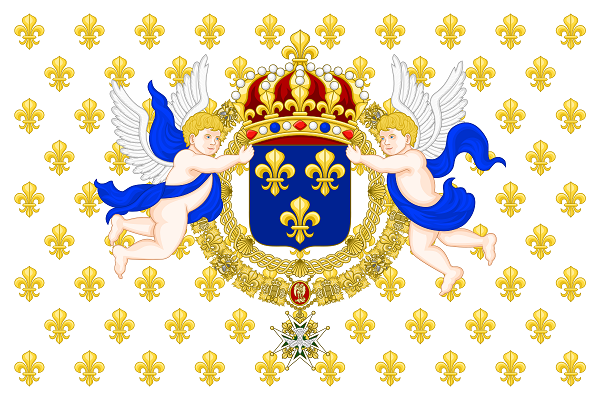
The Royal Standard of the King of France (and by default, the national flag), used between 1638 and 1790.
Wikimedia Commons.

“When, after their victory at Salamis, the generals of the various Greek states voted the prizes for distinguished individual merit, each assigned the first place of excellence to himself, but they all concurred in giving their second votes to Themistocles,” wrote the great 19th-century historian Edward Creasy. “This was looked on as a decisive proof that Themistocles ought to be ranked first of all. If we were to endeavour, by a similar test, to ascertain which European nation has contributed the most to the progress of European civilization, we should find Italy, Germany, England, and Spain, each claiming the first degree, but each also naming France as clearly next in merit. It is impossible to deny her paramount importance in history.”

France is central to the story of Europe, and indeed of Britain. It is almost impossible to understand England’s history without appreciating the relationship with its closest continental neighbour. It is a love-hate affair originating in a grand inferiority complex, a long rivalry that continues tomorrow [Saturday] when England meet France in the World Cup quarter-finals.

In a piece last year I cited some of the most endearing/maddening things about the French, all of which contributed to a sense of amused frustration on our part:

    Only in France would football fans protest that a local restaurant had lost a Michelin Star, as happened in Lyon two years ago. Only in France would an expedition to the Himalayas — of huge national importance — fail because it was weighed down by eight tonnes of supplies, including 36 bottles of champagne and “countless” tins of foie gras. And only in France would you get actual wine terrorists, the Comité Régional d’Action Viticole, who have bombed shops, wineries and other things responsible for importing foreign produce. This is a country which only reluctantly in the 1950s stopped giving school children a nutritious drink for their health, by which the French meant not milk but cider.

    This is a country where mistresses are so much part of life that they can legally inherit, and where murder doesn’t really count if it’s done for love. One of France’s most famous socialites, Henriette Caillaux, shot dead the editor of Le Figaro just before the First World War and received just four months in jail because it was a crime passionnel. So that’s all right then.

But there are so many other things to love about our strange neighbours …

The Anglo-French relationship is a difficult one, reflected in the troubled history of royal marriages. Charles I’s Catholic wife Henrietta Maria was a drag on his popularity among excitable Protestant radicals, and turned out to be the last French consort; in the 14th century Edward II’s wife Isabella overthrew him and, perhaps, conspired to have him killed, after a rocky marriage that began badly when he brought his lover to the coronation and acted inappropriately affectionate towards him. But then, as Edith Cresson pointed out, this is to be expected when you marry an Englishman.

In 1514 Louis XII married an English bride, Henry VIII’s sister Mary; she was 18, he was 53, and had syphilis, so she must have been delighted about the whole thing; however, within weeks she had “danced him to death”, the sex apparently proving too exciting for his nervous system. Francesco Vettori, Florence’s ambassador to Rome, wrote that King Louis had a lady “so young, so beautiful and so swift that she had ridden him right out of the world”. 

***

Perhaps not a terrible way for a Frenchman to go, and not the last French head of state to die in a similar manner. President Félix Faure expired in 1899 while with his mistress, after which his funeral featured this very understated carriage.

***

Numerous French presidents have had affairs, although Francois Mitterrand actually had a secret second family while in the Élysée Palace. Mitterrand’s last meal was also ultra-French: “He’d eaten oysters and foie gras and capon — all in copious quantities — the succulent, tender, sweet tastes flooding his parched mouth. And then there was the meal’s ultimate course: a small, yellow-throated songbird that was illegal to eat. Rare and seductive, the bird — ortolan — supposedly represented the French soul. And this old man, this ravenous president, had taken it whole — wings, feet, liver, heart. Swallowed it, bones and all. Consumed it beneath a white cloth so that God Himself couldn’t witness the barbaric act.”

***

The French are world outliers in their attitudes to adultery, the only country where a majority of people think it’s fine. Germany is number two in this index of permissiveness while the Americans, of course, are the most disapproving western nation. 

October 19, 2022

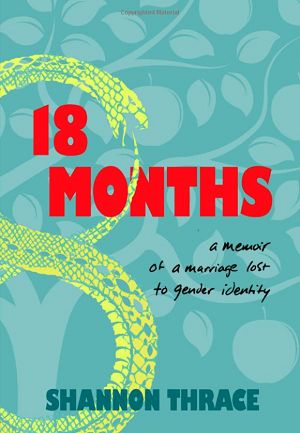
Jonathan Kay reviews 18 Months by Shannon Thrace

Filed under: Books, Health, Media, Politics, USA — Tags: , , , , , , , — Nicholas @ 05:00

At Quillette, a review of a new book on the breakdown of a once-happy marriage when one partner decides that mere transvestism isn’t enough any more and becomes transgendered:

The trans community is diverse, especially when it comes to attitudes toward sex. As writer Angus Fox noted in a seven-part Quillette series, When Sons Become Daughters, some biologically male trans-identified teenagers live a sexless existence; and are drawn to puberty blockers and androgynous aesthetics precisely because they seem to offer safe harbour from male sexual development. In the case of middle-aged men who abruptly adopt a trans identity later in life, on the other hand, it can be the opposite: the presentation is often hyper-sexualized.
(more…)

June 29, 2022

It’s not your imagination: young women are becoming more liberal

Filed under: Education, Politics, USA — Tags: , , , — Nicholas @ 03:00

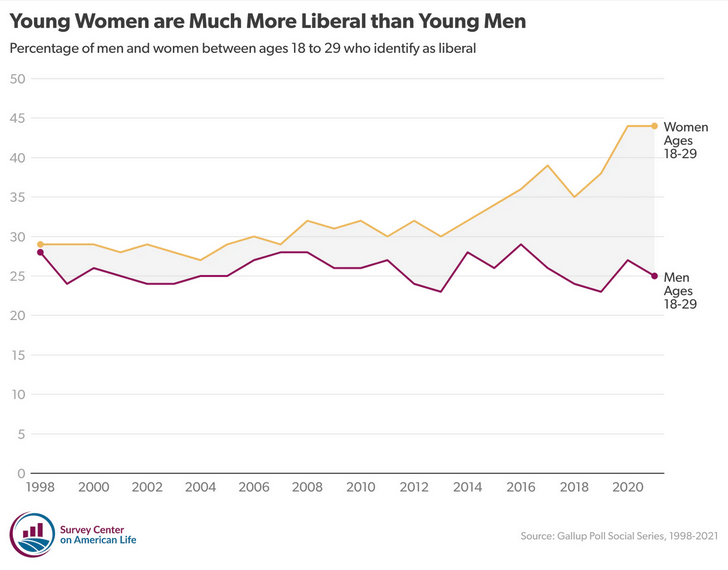
Daniel Cox looks at the noted shift in political opinions among young women (aged 18-29) compared to their male counterparts, and not just on the current hot-button topic of abortion rights:

… In fact, young women have become significantly more liberal over the past decade whereas the political identity of young men has remained largely unchanged over time.

Rise of Unmarried Women

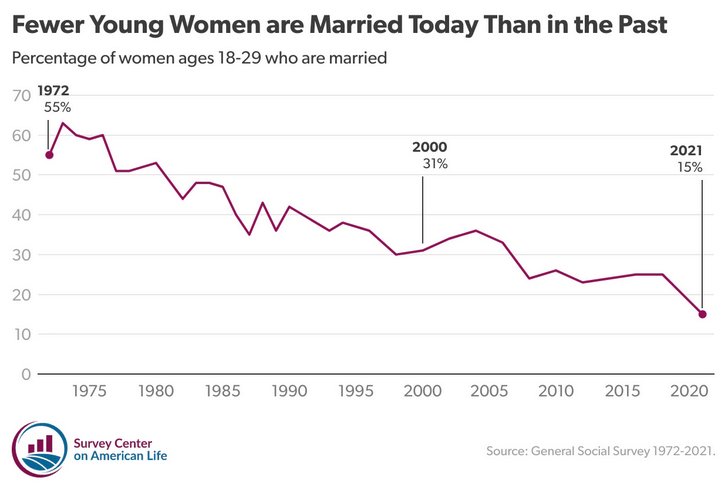
There are a few reasons for the increasingly liberal politics of young women. One explanation may lie in their marital status. Compared to previous generations of young women, far more women under the age of 30 today are unmarried. Only 15 percent of young women today are married compared to more than one-third of young women two decades ago.

Why does this matter? Research has shown that unmarried women feel more connected than their married counterparts to other women — a phenomenon known as “linked fate” — and it can lead them to support more liberal policies. In their fascinating 2017 study, Christopher T. Stout, Kelsy Kretschmer, and Leah Ruppanner argue that “women consistently earn less money and hold less power, which fosters women’s economic dependency on men. Thus, it is within married women’s interests to support policies and politicians who protect their husbands and improve their status.” This phenomenon of “linked fate” was not found to be evident among men, so even though young men are also less likely to be married compared to older generations, their marital status may have less of an impact on their politics than for women.

The Growing Education Divide

Over the past several decades, women’s educational attainment has far outpaced that of men’s; “Women in the United States have earned more bachelor’s degrees than men every year since the mid-1980s”, writes Derek Thompson in the Atlantic.

    American colleges and universities now enroll roughly six women for every four men. This is the largest female-male gender gap in the history of higher education, and it’s getting wider.

The education divide between men and women has become more politically relevant because of the stronger connection between educational attainment and political behavior. In recent elections, college graduates have become a much more loyal Democratic constituency. And on a range of issues, college-educated Americans are more liberal than those without a Bachelor’s degree.

February 18, 2022

QotD: Historical legal context of marriage

Filed under: History, Law, Liberty, Quotations — Tags: , , — Nicholas @ 01:00

The law of servitude in marriage is a monstrous contradiction to all the principles of the modern world, and to all the experience through which those principles have been slowly and painfully worked out. It is the sole case, now that negro slavery has been abolished, in which a human being in the plenitude of every faculty is delivered up to the tender mercies of another human being, in the hope forsooth that this other will use the power solely for the good of the person subjected to it. Marriage is the only actual bondage known to our law. There remain no legal slaves, except the mistress of every house.

John Stuart Mill, The Subjection of Women, 1869.

July 31, 2021

Rowan Atkinson Live – With friends like these AKA the wedding from hell

Filed under: Britain, Humour — Tags: , — Nicholas @ 04:00

Rowan Atkinson Live
Published 24 Sep 2010

Also know as the wedding from hell, Rowan plays 3 very different but horribly hilarious characters including a priest who talks about fellatio …

August 7, 2020

QotD: Celibacy and chastity

Filed under: History, Quotations, Religion — Tags: , , , , — Nicholas @ 01:00

Despite the common misunderstanding of the word, “celibate” does not refer to someone who abstains from sex. “Celibate” refers to someone who forgoes marriage — the part about not having sex is implied, at least in the Christian world, give or take an Alexander VI or two. “Chaste,” at the same time, doesn’t quite mean what people think it does: It refers principally to the abstention from extramarital sex, which in the case of the celibate means abstention from sex categorically. But chastity is part of marriage, too, describing a reverent attitude toward sex. In the Christian view (which is to say, in the view of Western civilization until ten minutes ago), the procreative act is the means by which men and women in union with one another participate in God’s creative work. “Chastity” means a lot more than mere abstinence. Chastity isn’t some kind of genital veganism.

There has been some pretty elevated stuff written on that subject, and if you want to take that particular high road, then Professor Robert George of Princeton is your guy. But consider the low road, too. There’s another conclusion, maybe a little bit cynical, that could be drawn from this: If you are a sexually frustrated young man, the smart play would be to join a church.

Kevin D. Williamson, “Advice for Incels”, National Review, 2018-05-10.

March 28, 2020

QotD: A man’s view of home decoration projects

Filed under: Football, Humour, Quotations — Tags: , , , — Nicholas @ 01:00

Potentially offensive language warning — hence the NSFW tag — so the QotD is below the fold:

(more…)

August 17, 2019

QotD: Bridal traditions

Filed under: Business, Europe, Humour, Italy — Tags: , , — Nicholas @ 01:00

The soap bottle had another claim. “Blue Lavender Essence Lore: Brides in Italy perfumed their wedding clothes with lavender in order to calm their prenuptial jitters”

Left unspoken: Didn’t do jack. You’d think the Brides in Italy would have figured this out in short order, eh? “Here, my child. Soak your dress in lavender. It will calm your nerves.” Did it work for you, mama? “No, I spent the morning sobbing and throwing up in rank terror, since I had only met your father the previous night, and he had the breath of cheese far gone with mold. But this is what we do, for we are superstitious peasants whose worldview is derived not from empirical observation of the world, but sage wisdom Grandmama got from her great-grandmama. Now put these grape stems up your nose so your first-born will be a boy.”

James Lileks, Star Tribune, 2004-05-24.

April 29, 2019

Father of The Bride Speech – Rowan Atkinson

Filed under: Britain, Humour — Tags: , , — Nicholas @ 02:00

Ralph Lindberg
Published on 16 Jan 2010

Looking for great father of the bride speech? How about this father of the bride speech from Rowan Atkinson aka Mr. Bean

April 1, 2019

How to hide shop expenses from your spouse

Filed under: Humour, Tools, Woodworking — Tags: , , , , , — Nicholas @ 02:00

Rex Krueger
Published on 14 Mar 2018

More videos and exclusive content: http://www.patreon.com/rexkrueger

In a spirit of fun and humor, I give you this guide to buying tools and materials and then hiding the expenses from your wife or husband. I’ll show you how to mix shop supplies in with groceries or auto parts and use the internet to keep some money on the side. You can also learn how to hide your paper-trail and smuggle packages into the house.

Also, this video is dedicated to all the husbands and wives who make shop life possible by working real jobs and helping us realize our dreams.

November 3, 2018

QotD: “Do you want to be married, or do you want to be right?”

Filed under: Humour, Quotations — Tags: — Nicholas @ 01:00

Shortly before I got married, I received a piece of sterling advice that I have been mulling a lot over the last year: “You have a big decision to make: Do you want to be married, or do you want to be right?”

Even a good marriage offers a lot of opportunities for grievance. Suddenly, you cannot make any major decision without consulting this other person — who will, inconveniently, often have very different ideas from yours about where to live, what to spend the money on, how to raise the children, and whether to turn the basement into a home theater space or a library. (The correct answer, for those who are wondering, is “library.”)

The more determined you are to win every battle, the more likely you are to lose what’s important: the person you love so much that you have chosen to spend the rest of your life with them. And so every time you have a real disagreement — the kind that cannot be finessed by agreeing that tonight you’ll order Indian, and next time you’ll get Chinese — you have to think carefully before you decide to have that fight. Is this really the hill that you’re willing to let your marriage die on? Because if not, now’s a good time to shrug your shoulders and let them paint the ceiling teal. How often do you really look up there, anyway?

You have to decide this even when the grievances are more important than paint colors: Your partner snaps at you when they’ve had a bad day, leaves their junk lying around for you to pick up, spends too much money on things you don’t need, or vanishes whenever your family comes over. Some hills are worth dying on. But a lot of them are of no strategic value in gaining your ultimate objective: a long and happy partnership.

If you spend your marriage trying to ensure that everything is always rigorously fair and just, and grabbing the flaming sword of righteousness every time some minor wrong is done to you, you may soon find that you spend more time fighting than you would have picking up their towels or going into the other room to watch a movie because your spouse is in a bad mood. Or you may find that you have a peaceful, clean house that’s exactly as you want it — because you’re living there alone.

Megan McArdle, “Can This Political Union Be Saved?”, Bloomberg View, 2016-12-30.

August 21, 2017

Joss Whedon’s ex-wife on Whedon’s affairs

Filed under: Media, USA — Tags: , , — Nicholas @ 04:00

Kai Cole at The Wrap:

I’ve been asked some questions by the press recently about my divorce from Joss Whedon, to whom I was married for 16 years. There is misinformation out there and I feel the best way to clear up the situation is to tell my truth. Let me begin by saying I am a very private person and the act of writing this is antithetical to who I am and everything I stand for. Yet, at the same time, I feel compelled to go on the record and clear up some misperceptions. I don’t think it is fair to me or other women to remain silent any longer.

I met Joss in 1991. I was driving across the country from Massachusetts on a whim, and met him when I was passing through Los Angeles. We fell in love and I moved to L.A. so we could be together.

I was with him when his Buffy the Vampire Slayer script was adapted, and the resulting movie released. It was painful to see how his vision was interpreted by the production team and on our honeymoon to England in 1995, I urged him to figure out how to turn it into a TV show. He didn’t want to work in television anymore, following in his father’s and grandfather’s footsteps, but I convinced him it was the fastest way to get the experience he needed, so he could direct his own films someday. I had no idea, in that lovely garden in Bath, that it would change everything.

There were times in our relationship that I was uncomfortable with the attention Joss paid other women. He always had a lot of female friends, but he told me it was because his mother raised him as a feminist, so he just liked women better. He said he admired and respected females, he didn’t lust after them. I believed him and trusted him. On the set of Buffy, Joss decided to have his first secret affair.

Fifteen years later, when he was done with our marriage and finally ready to tell the truth, he wrote me, “When I was running Buffy, I was surrounded by beautiful, needy, aggressive young women. It felt like I had a disease, like something from a Greek myth. Suddenly I am a powerful producer and the world is laid out at my feet and I can’t touch it.” But he did touch it. He said he understood, “I would have to lie — or conceal some part of the truth — for the rest of my life,” but he did it anyway, hoping that first affair, “would be ENOUGH, that THEN we could move on and outlast it.”

Joss admitted that for the next decade and a half, he hid multiple affairs and a number of inappropriate emotional ones that he had with his actresses, co-workers, fans and friends, while he stayed married to me. He wrote me a letter when our marriage was falling apart, but I still didn’t know the whole truth, and said, “I’ve never loved anyone or wanted to be with anyone in any real or long-term way except for you ever. And I love our life. I love how you are, how we are, who you are and what we’ve done both separately and together, how much fun we have…” He wanted it all; he didn’t want to choose, so he accepted the duality as a part of his life.

August 11, 2017

QotD: The plight of Hindu widows

Filed under: India, Quotations, Religion — Tags: , , — Nicholas @ 01:00

Some of the most conservative Hindus in India believe that a woman whose husband has died should no longer live because she failed to retain his soul. Rejected by their communities and abandoned by their loved ones, thousands of destitute women make their way to Vrindavan, a pilgrimage city about 100km south of Delhi that is home to more than 20,000 widows.

These women have no choice but to live in a vidhwa ashram (ashrams for widows) run by the government, private enterprises and NGOs. Clad in white, they know they will never return home and that this is where they’ll end their days.

Pascal Mannaerts, “Nowhere to go, nowhere to hide”, BBC Travel, 2016-09-13.

« Newer Posts

Powered by WordPress