Quotulatiousness

February 4, 2012

In praise of Her Majesty the Queen

Filed under: Britain, Cancon, History, Media — Tags: , , , — Nicholas @ 11:33

Conrad Black goes full monarch in his latest column:

The Queen has an outstanding record of absolutely unblemished service, through tumultuous changes and always having to endure suggestions of impending obsolescence — not just of the monarchy itself, but of its various separate functions, especially the ambiguous positions of head of the Commonwealth and supreme governor of the Church of England.

The 1950s were a constant round of independence ceremonies, mainly for countries that had a very rocky start and little aptitude for premature emancipation from unfashionable colonials status. This made for ever larger and more incongruous Commonwealth meetings, as the shared British traditions that supposedly united the “British Dominions, realms and territories beyond the seas” frayed and became always more threadbare except, perhaps, among the former so-called “white Dominions.”

In this present time of glaring, intrusive, nasty media, it is hard to imagine the proportions of the Queen’s achievement in serving 60 years, every one of them as one of the most prominent and publicized people in the world, without one gaffe, one embarrassing photograph, one injudicious utterance or slip on a banana peel, literal or metaphoric.

[. . .]

Queen Elizabeth II has personified the British middle-class virtues: moderation, unflamboyant consistency and unflappable reliability. It hasn’t always been exciting, and in satirical magazines such as Private Eye and on the BBC, she has paid a price for that and was lampooned for decades for stiff formality and stilted phrases — “My husband and I,” etc.

January 30, 2012

What’s happening at GuildMag?

Filed under: Gaming — Tags: , , — Nicholas @ 17:51

There’s a new post at GuildMag, where Dutch Sunshine offers some news about what will be happening with the website and the magazine:

The time has come to unveil our plans for the future. Whether you’ve been with us from the beginning or just discovered us yesterday, we’ll have something coming for you that you’ll surely enjoy. We at GuildMag want to keep you up to date on the latest news, share the lore behind the game, let you see how creative the community is and also give a range of opinions on the latest news and hottest topics. But we also want to involve you in this; we’re not here to tell you what’s great about Guild Wars (2) — chances are you’ve already got your own opinions on it and we want to hear them! We’re changing the way we operate as a fansite for good, and we want you there every step of the way. So no matter when you discovered us, let’s go forward together and build upon what we’ve already achieved. This is our story.

November 15, 2011

The Occupy movement: the height of 21st century civilization?

Filed under: Media, Politics, USA — Tags: , , , , , — Nicholas @ 09:21

Natalie Rothschild takes issue with a fellow journalist’s characterization of the Occupy movement:

A late October edition of the New Yorker carried a ‘postcard’ piece on Occupy Wall Street (OWS). On the third re-read it began to dawn on me that, perhaps, the writer was not being sarcastic, despite her grandiose opening line: ‘Visiting the site of Occupy Wall Street last week . . . was a bit like visiting civilisation at its peak: Paris in the Twenties, Rome in the second century, or, at the very least, Timbuktu in the fifteen hundreds.’

Really? I mean, really? I had recently visited the OWS Zuccotti Park encampment, too, and I’ve been there several more times. Over time, the camp has become better organised. There are now tents, clean-up teams, a set of portable toilets, a library and information points. But ‘the height of civilisation’? Come on.

[. . .]

None of this fawning has stopped occupiers and their supporters from decrying the mainstream media’s coverage — there’s not enough of it, apparently, and most of it is anyway shallow or negatively skewed. In truth, the OWS coverage has been dense and overwhelmingly positive.

The few critics of OWS have been slammed as contemptuous ignoramuses, as corrupt apologists for ‘the one per cent’. Or it is said that they simply ‘just don’t get it’ because they haven’t engaged with the new form of direct, participatory democracy practiced in Zuccotti Park. But, then, even those journalists who have reported directly from the Occupy headquarters and have taken note of the eccentricity and confusion that undoubtedly exist there have been said to be blinkered by prejudice or interested only in shallow, headline-grabbing snapshots. Any commentary that is less than praising is slammed as mocking or as right-wing mud-slinging.

October 28, 2011

Malthus provides “cover” for racism

Filed under: Books, History, Media — Tags: , , , , , — Nicholas @ 09:02

Tim Black explores why Thomas Malthus’ ideas have never been more popular than they are today:

Lisping, reclusive and reviled by the working class of his day, the Reverend Thomas Malthus (1766-1834) — the man behind the idea that the ‘lower orders of society’ breed too quickly — would probably be surprised by his current popularity. Because that’s what he is today: popular. Commentators, activists and academics positively fall over themselves in the rush to say, ‘you know what, that Malthus had a point. There are too many people and, what’s more, they are consuming far too much.’

Earlier this summer, a columnist for Time magazine was in no doubt as to the pastor’s relevance. The global population is ‘ever larger, ever hungrier’, he noted, ‘food prices are near historic highs’ and ‘every report of drought or flooding raises fears of global shortages’. ‘Taking a look around us today’, he continued, ‘it would be easy to conclude that Malthus was prescient’. Writing in the British weekly, the New Statesman, wildlife lover Sir David Attenborough was similarly convinced: ‘The fundamental truth that Malthus proclaimed remains the truth: there cannot be more people on this Earth than can be fed.’ Not to be outdone, the liberal-left’s favourite broadsheet, the Guardian, also suggested that Malthus may have been right after all: ‘[His] arguments were part of the inspiration for Charles Darwin’s theory of evolution, and they have validity in the natural world. On the savannah, in the rainforests, and across the tundra, animal populations explode when times are good, and crash when food reserves are exhausted. Is homo sapiens an exception?’ The melancholy tone whispered its answer in the negative. Writing in the New York Times, Paul Krugman was less coy: ‘Malthus was right!’ shouted the headline.

Given the encomia that are currently coming the way of Malthus you may well wonder what exactly it was that he was meant to be right about. To find the answer to this it is worth actually taking a look at the work, first published in 1798, on which his supposed prescience is based: An Essay on the Principle of Population. It makes for surprising reading.

October 26, 2011

When all the party leaders agree, it’s almost certainly a bad idea

Filed under: Britain, Government, Media, Politics — Tags: , , , — Nicholas @ 08:43

Mick Hume on the consistent refusal of British politicians to allow the electorate any choice on EU involvement:

When all of Britain’s elitist, unrepresentative and interchangeable political leaders unite behind an issue in the name of ‘the national interest’, it is a sure sign that something is amiss. Exhibit A: the united front presented by Tory prime minister David Cameron, his Lib Dem deputy Nick Clegg and opposition Labour leader Ed Miliband against the demand for a referendum on Britain’s relationship with the European Union. When this unappealing triumvirate is being cheered on by many in the high-minded media, alarm bells should really be ringing.

The official line from the Lib-Con government and the Labour opposition this week, as party leaders sought to marshal their MPs to vote against the parliamentary motion calling for an EU referendum, was that to have a national debate about the UK’s membership of the EU just now would not be in the national interest; it would be ‘a distraction’ from coping with Europe’s desperate economic and financial problems. As Cameron put in on the day of the vote, ‘it’s the wrong time to have this debate’ because ‘we’re in the middle of dealing with a crisis in the Eurozone’. A referendum now would be ‘rash’.

Turn that front-bench consensus on its head. It is precisely because of the parlous state of the Euro economy, and the paucity of solutions being offered by our rulers, that now is exactly the right time to have a major public debate on the future of the UK and Europe. The real ‘distraction’ that the Euro-elites fear today is democracy.

October 22, 2011

This probably explains why the “typical” comic book reader is no longer a young teen

Filed under: Economics, Media — Tags: , , — Nicholas @ 11:30

It’s all in the economics of the comic book world:

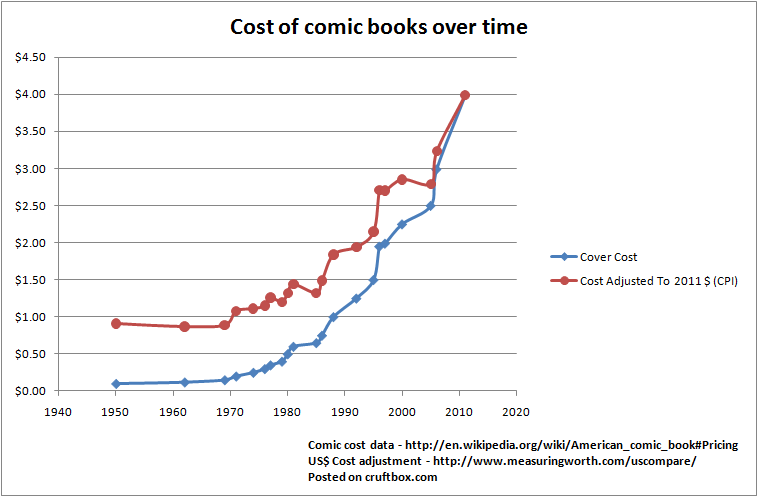
Looking at the graph we can see that the relative price of a comic book stayed around a buck until 1970 or so, slowly ramping up to a buck fifty over the next 15 years. That’s a 50% increase. From 1985 to 2000 the price almost doubles (100%) getting neat three dollars. From 2000 to 2011, it’s around a 33% increase.

It’s a fact that costs increase over time, so I’m not saying prices could remain at a buck forever. But it is hard to see how young kids and teenagers can get into comic books, it’s simply too expensive. For $20 you get 5-7 books. Serious comic readers will pick up 10-20 books a week. A few years ago, when I was a more regular reader, I would the totals of other people routinely $30-50 a week. That’s $120-200 per MONTH. There can’t be many parents helping pay that much for a kid’s comic habit.

When my family came to Canada in 1967, one of the things I missed the most were British comics. Canadian American comics were very different from what I was used to, so I never really became much of a comic collector. I’d pick up the odd few, but it never was a “have to buy” item for me. I remember having to decide whether I wanted the immediate satisfaction of a chocolate bar or a can of pop, or the slightly longer-term satisfaction of a comic book. Immediate satisfaction won more of the time, and with my princely 25 cents per week allowance, there wasn’t a lot of satisfaction whichever way I decided to go.

September 17, 2011

Rex Murphy: The failure of the media

Filed under: Media, Politics, USA — Tags: , , , — Nicholas @ 11:34

This is not the kind of column you expect from a long-time CBC employee. It points out the huge failing of the major media in their reporting about President Barack Obama:

As the bad economic news continues to emanate from the United States — with a double-dip recession now all but certain — a reckoning is overdue. American journalism will have to look back at the period starting with Barrack Obama’s rise, his assumption of the presidency and his conduct in it to the present, and ask itself how it came to cast aside so many of its vital functions. In the main, the establishment American media abandoned its critical faculties during the Obama campaign — and it hasn’t reclaimed them since.

Much of the Obama coverage was orchestrated sycophancy. They glided past his pretensions — when did a presidential candidate before “address the world” from the Brandenberg Gate in Berlin? They ignored his arrogance — “You’re likeable enough, Hillary.” And they averted their eyes from his every gaffe — such as the admission that he didn’t speak “Austrian.”

The media walked right past the decades-long association of Obama with the weird and racist pastor Jeremiah Wright. In the midst of the brief stormlet over the issue, one CNN host — inexplicably — decided that CNN was going to be a “Wright-free zone.” He could have hung out a sign: “No bad news about Obama here.”

On the plus side, however, he did let us know that there were 57 states in the union (although I’m still not sure of the names of the hidden 7).

September 12, 2011

The easy way to be come a celebrity scientist

Filed under: Media, Science — Tags: , , , , — Nicholas @ 09:28

Deevybee has the steps you need to take to become a TV science celebrity:

Maybe you’re tired of grotting away at the lab bench. Or finding it hard to get a tenured job. Perhaps your last paper was rejected and you haven’t the spirit to fight back. Do not despair. There is an alternative. The media are always on the look-out for a scientist who will fearlessly speak out and generate newsworthy stories. You can gain kudos as an expert, even if if you haven’t got much of a track record in the subject, by following a few simple rules.

Rule #1. Establish your credentials. You need to have lots of letters after your name. It doesn’t really matter what they mean, so long as they sound impressive. It’s also good to be a fellow of some kind of Royal Society. Some of these are rather snooty and appoint fellows by an exclusive election process, but it’s a little known fact that others require little more than a minimal indication of academic standing and will admit you to the fellowship provided you fill in a form and agree to pay an annual subscription.

September 7, 2011

If they take away your freedom of speech, you can’t defend any of your rights

Filed under: Bureaucracy, Cancon, Europe, Liberty, Media — Tags: , , , — Nicholas @ 09:19

Mark Steyn on the rapidly constricting “right” to free speech in most of the western world:

To be honest, I didn’t really think much about “freedom of speech” until I found myself the subject of three “hate speech” complaints in Canada in 2007. I mean I was philosophically in favor of it, and I’d been consistently opposed to the Dominion’s ghastly “human rights” commissions and their equivalents elsewhere my entire adult life, and from time to time when an especially choice example of politically correct enforcement came up I’d whack it around for a column or two.

But I don’t think I really understood how advanced the Left’s assault on this core Western liberty actually was. In 2008, shortly before my writing was put on trial for “flagrant Islamophobia” in British Columbia, several National Review readers e-mailed from the U.S. to query what the big deal was. C’mon, lighten up, what could some “human rights” pseudo-court do? And I replied that the statutory penalty under the British Columbia “Human Rights” Code was that Maclean’s, Canada’s biggest-selling news weekly, and by extension any other publication, would be forbidden henceforth to publish anything by me about Islam, Europe, terrorism, demography, welfare, multiculturalism, and various related subjects. And that this prohibition would last forever, and was deemed to have the force of a supreme-court decision. I would in effect be rendered unpublishable in the land of my birth. [. . .]

And what I found odd about this was that very few other people found it odd at all. Indeed, the Canadian establishment seems to think it entirely natural that the Canadian state should be in the business of lifetime publication bans, just as the Dutch establishment thinks it entirely natural that the Dutch state should put elected leaders of parliamentary opposition parties on trial for their political platforms, and the French establishment thinks it appropriate for the French state to put novelists on trial for sentiments expressed by fictional characters. Across almost all the Western world apart from America, the state grows ever more comfortable with micro-regulating public discourse—and, in fact, not-so-public discourse: Lars Hedegaard, head of the Danish Free Press Society, has been tried, been acquitted, had his acquittal overruled, and been convicted of “racism” for some remarks about Islam’s treatment of women made (so he thought) in private but taped and released to the world.

May 7, 2011

Lanny Friedlander, Patriarch of Reason

Filed under: Liberty, Media — Tags: , , — Nicholas @ 09:59

Lanny Friedlander, founder of the libertarian magazine Reason, died in March. The New York Times and Reason magazine both had obituaries for him:

As readers of this site and the print edition of our magazine know, Reason‘s founder, Lanny Friedlander (1947-2011), died in March at the age of 63 from a heart attack.

Today’s New York Times carries an obituary for Lanny. Here are excerpts:

Lanny Friedlander, who with little more than a typewriter and a stack of paper founded the libertarian magazine Reason in his college dorm room in 1968 and ran it briefly before dropping out of sight for the next 40 years, died on March 19 in Lowell, Mass. He was 63….

In its dorm room days, Reason never attained a circulation of more than a few hundred copies per issue. Today, the magazine is a glossy publication with a monthly circulation of about 50,000; its Web site receives four million visits a month. Reason.tv broadcasts original and archival video programming online.

May 3, 2011

The Royal Wedding as proof of monarchy’s descent to celebrity status

Filed under: Britain, Media — Tags: , , , — Nicholas @ 09:57

Brendan O’Neill won’t expect his name to show up on the royal honours list after this scathing piece:

Now that the I do’s have been done and the dress has been papped to death, it’s time to put the wedding of Prince William and Catherine Middleton into perspective. Friday’s knees-up in London and other parts of Britain was not, as both right-wing fantasists and bitter republicans would have us believe, evidence that everyday Brits remain in thrall to monarchy. Rather, the Big Day confirmed just how far the monarchy has been hollowed of meaning, and the extent to which it has rather desperately thrown its lot in with one of the few institutions that still has political purchase in Britain today: celebrity culture.

The observing classes were in equal measure overexcited and disgusted to see so many little people waving Union flags on Friday. For monarchists, this was evidence that Britons still have ‘great affection’ for their Queen and her brood and all that they represent — including hereditary privilege. For the more fashionable Windsor-weary set — republican commentators at publications such as the Guardian and the New Statesman — the sight of hordes of happy people cheering a prince and his gal was utterly alien. They are ‘brainwashed drones’, sniffed one columnist, partaking in a ‘monstrous [display] of imperial pride’, said another.

What both these cheerers and sneerers amongst the chattering classes fail to appreciate is the extent to which the royal wedding was a celebrity event rather than an imperial one. And people related to it accordingly, cheering and photographing Will’n’Kate not as their future natural rulers, but as individuals who have the aura, and authority, of celebrity. This was a celebrity happening not only in the much commented-upon fact that slebs such as David Beckham, Elton John and Tara-Wotsit-Wonkynose squeezed into the pews alongside the King of Tonga and the Queen of Denmark, but also in the fact that all those Union flags were handed out to the revellers by Hello! magazine. Responsibility for adding a nationalist gloss to Friday’s proceedings was effectively outsourced to the army of ‘Hello! helpers’ who ‘lined the royal wedding route’ armed with thousands of factory-made Union flags.

February 17, 2011

I believe this is my first-ever reference to “Justin Bieber”

Filed under: Cancon, Media, Quotations — Tags: , , , — Nicholas @ 08:57

And it’s prompted by Jimmie Bise, Jr, who also observes (most accurately) that “We bloggers are a mercenary lot who’ll find reason to write about almost anything if it’ll bring us that sweet, sweet blog traffic.”

The bad news is that Rolling Stone actually thinks anyone, anywhere, truly cares what Justin Bieber thinks about political parties, socialized medicine, or anything else beyond singing the word “baby” several times in a row.

Look, I get that we like to get inside the heads of entertainers we admire, but there really does have to be a limit. Rolling Stone, once upon a time, was a magazine that published real journalism from writers like Hunter S. Thompson, P.J. O’Rourke, and Lester Bangs. It was probably the go-to publication for details of the Patty Hearst abduction and its interview with Charles Manson in 1970 is one of the most chilling looks into a mind stuffed full of madness I’ve ever read. Now, thanks to the decline started by ardent progressive Jann Wenner, we just get a fluff interview with a 16 year-old kid on issues in which he has almost no knowledge or experience and wretched hacks like Matt Taibbi.

If nothing else, the Justin Bieber interview shows us what we lost. I’m actually sorry for it.

While a lot of what Hunter S. Thompson produced was vivid and entertaining, it probably skirted well clear of formal “journalism” even in the golden glow of nostalgia. But other than that little quibble, and that Jann Wenner was a co-founder of Rolling Stone . . . which means the decline he’s lamenting was actually baked in to the original recipie . . .

February 13, 2011

Jay Rosen analyses the “Twitter Can’t Topple Dictators” meme

Filed under: Media, Technology — Tags: , , , , , — Nicholas @ 10:42

Jay Rosen has been seeing too many facile dismissals of the actual impact of Twitter and other social media tools in recent uprisings:

In other words, tools are tools, Internet schminternet. Revolutions happen when they happen. Whatever means are lying around will get used. Next question!

So these are the six signs that identify the genre, Twitter Can’t Topple Dictators. 1.) Nameless fools are staking maximalist claims. 2.) No links we can use to check the context of those claims. 3.) The masses of deluded people make an appearance so they can be ridiculed. 4.) Bizarre ideas get refuted with a straight face. 5.) Spurious historicity. 6.) The really hard questions are skirted.

If that’s the genre, what’s the appeal? Beats me. I think this is a really dumb way of conducting a debate. But I cannot deny its popularity. So here’s a guess: almost everyone who cares about such a discussion is excited about the Internet. Almost everyone is a little wary of being fooled by The Amazing and getting carried away. When we nod along with Twitter Can’t Topple Dictators we’re assuring ourselves that our excitement is contained, that we’re being realistic, mature, grown-up about it.

This feeling is fake. A real grown-up understands that the question is hard, that we need facts on the ground before we can start to answer it. Twitter brings down governments is not a serious idea about the Internet and social change. Refuting it is not a serious activity. It just feels good… for a moment.

January 15, 2011

Indian model photoshopped against her will

Filed under: Health, India, Media, Technology — Tags: , , , , — Nicholas @ 09:43

It’s no secret that most of the images used for magazine covers have had a healthy dose of Photoshoppery, but this is a few filters too far:

Leave it to ELLE Magazine to photochop the world’s most beautiful woman. Aishwarya Rai, the reigning queen of Indian cinema, model and classically trained dancer is currently on the cover of ELLE India — several shades lighter. Rai’s skin has been lightened and her dark brown hair appears to have a red tint to it.

The Times of India reported the former Miss World is “furious with the bleaching botch-up” and is considering taking legal action against ELLE.

ELLE’s mission is to make women “chic and smart, guide their self-expression, and encourage their personal power,” but their recent covers could lead readers to believe that “chic, smart and personal empowerment” only comes to those with light skin.

H/T to Tim Harford for the link.

January 3, 2011

Healthy skepticism about study results

Filed under: Bureaucracy, Media, Science — Tags: , , , , — Nicholas @ 13:30

John Allen Paulos provides some useful mental tools to use when presented with unlikely published findings from various studies:

Ioannidis examined the evidence in 45 well-publicized health studies from major journals appearing between 1990 and 2003. His conclusion: the results of more than one third of these studies were flatly contradicted or significantly weakened by later work.

The same general idea is discussed in “The Truth Wears Off,” an article by Jonah Lehrer that appeared last month in the New Yorker magazine. Lehrer termed the phenomenon the “decline effect,” by which he meant the tendency for replication of scientific results to fail — that is, for the evidence supporting scientific results to seemingly weaken over time, disappear altogether, or even suggest opposite conclusions.

[. . .]

One reason for some of the instances of the decline effect is provided by regression to the mean, the tendency for an extreme value of a random quantity dependent on many variables to be followed by a value closer to the average or mean.

[. . .]

This phenomenon leads to nonsense when people attribute the regression to the mean as the result of something real, rather than to the natural behavior of any randomly varying quantity.

[. . .]

In some instances, another factor contributing to the decline effect is sample size. It’s become common knowledge that polls that survey large groups of people have a smaller margin of error than those that canvass a small number. Not just a poll, but any experiment or measurement that examines a large number of test subjects will have a smaller margin of error than one having fewer subjects.

Not surprisingly, results of experiments and studies with small samples often appear in the literature, and these results frequently suggest that the observed effects are quite large — at one end or the other of the large margin of error. When researchers attempt to demonstrate the effect on a larger sample of subjects, the margin of error is smaller and so the effect size seems to shrink or decline.

[. . .]

Publication bias is, no doubt, also part of the reason for the decline effect. That is to say that seemingly significant experimental results will be published much more readily than those that suggest no experimental effect or only a small one. People, including journal editors, naturally prefer papers announcing or at least suggesting a dramatic breakthrough to those saying, in effect, “Ehh, nothing much here.”

The availability error, the tendency to be unduly influenced by results that, for one reason or another, are more psychologically available to us, is another factor. Results that are especially striking or counterintuitive or consistent with experimenters’ pet theories also more likely will result in publication.

« Newer PostsOlder Posts »

Powered by WordPress