
Published on 20 Jun 2016
Special thanks to Karim Theilgaard for composing the the new theme for our brand new intro!
We are approaching the 100th regular episode and decided to surprise you with an extra special episode about the staggering numbers of World War 1.
June 21, 2016
World War 1 in Numbers I THE GREAT WAR Special
Comments Off on World War 1 in Numbers I THE GREAT WAR Special
June 8, 2016
WW2: The Resource War – IV: Strategic Bombing – Extra History
Published on 26 Apr 2016
*Sponsored* Hearts of Iron IV comes out on June 6!
A series of missed airstrikes resulting in the death of civilians sparked the no-holds-barred Battle of Britain. Germany launched a Blitz to bomb London into submission, but inadvertantly sparked more resistance and gave British industry a chance to bounce back.
On August 25, 1940, a group of German bomber planes got lost on a night-time mission over England. They wound up dropping bombs not on their industrial target, but on the city of London itself. Winston Churchill ordered a retaliatory strike against Germany, but this time it was the RAF who missed their target and hit civilians. Hitler was convinced this was intentional, so he rescinded his prohibition against targeting civilians. The Luftwaffe organized a massive attack against London, intending to break the British people’s will to fight. The Blitz backfired in several respects. First, it diverted Germany’s attention from strategic targets, which meant they were no longer putting real pressure on the British industrial war efforts. Second, they wound up bringing the British together and strengthening their will to fight on in the names of those who’d been lost to German bombs. Ultimately, the cost in men and material for Germany to wage the Battle of Britain exceeded the cost of damage they inflicted.
Comments Off on WW2: The Resource War – IV: Strategic Bombing – Extra History
May 30, 2016
WW2: The Resource War – III: The Engines of War – Extra History
Published on 19 Apr 2016
*Sponsored* Hearts of Iron IV comes out on June 6!
The armies and technology of World War II required a vast supply of resources. A close look at Germany and Japan shows how the need to secure those resources played a significent role in determining strategy throughout the war.
____________The armies of World War II needed a vast supply and variety of resources. The Allies had many of those resources on their side, but the Axis powers did not. Germany imported many of its resources from countries it would soon be fighting, and needed their war strategy to account for the acquisition of those resources. The Molotov-Ribbentrop Pact signed with the USSR set up a trade agreement to bring them oil from Russia for a while, in addition to establishing temporary non-aggression with the Soviets. When the war began in earnest, Germany targeted Norway with its supply of aluminum and iron as well as its access to the even more resource-rich Sweden. Conquering France also gave them access to rich farmland to feed the troops. But even though they had gained control of the oil fields in Romania, it wasn’t enough to power their war machine. Many Nazi generals wanted to target North Africa for this, but Hitler had his sights set on the Soviet Union and wound up squandering much of Germany’s reserves in a fruitless effort there. Meanwhile, Japan’s entrance into the war had cost them their primary trading partner: the United States. The Japanese army wanted to pursue the Northern Expansion Doctrine (Hokushin-Ron) and push through China into Siberia, wounding the USSR in the process. They attempted this strategy, but the Soviets met them in Mongolia and pushed them back in the Battle of Khalkhin Gol. So they turned to the Southern Expansion Doctrine (Nanshin-Ron) advocated by the navy, and began to sweep up islands in the Pacific. They planned to strip the European colonial powers of their holdings, and they succeeded in capturing 90% of the world’s rubber production. But the US responded by synthesizing rubber, and built an industry so large that even today, more rubber is synthesized than harvested. If World War I was the first industrial war, marked by mass production and industrial capacity, then World War II was the first scientific war, marked by advancements like synthesis, radar, and jet engines.
Comments Off on WW2: The Resource War – III: The Engines of War – Extra History
May 29, 2016
WW2: The Resource War – II: Lend-Lease – Extra History
Published on 12 Apr 2016
*Sponsored* Hearts of Iron IV comes out on June 6!
After Germany’s early push, the situation looked dire in Europe. The United States had resources to help out, but initially clung to an isolationist policy. Gradually, measures like Cash and Carry and the Lend-Lease Act expanded their involvement.
Germany’s blitzkrieg had been largely successful. France fell early, and Great Britain appeared on the verge of collapse. Europe needed more resources to sustain their resistance, but the United States was bound by the Neutrality Act which established a policy of isolationism and forbade the US from supporting foreign wars in any way. President Franklin Delano Roosevelt skirted those restrictions. He lobbied Congress to reinstate a provision in the law called Cash and Carry, which would allow other nations to buy US war materiel with cash and transport it themselves into the warzone. He also established an agreement which allowed him to place American military bases on British colonies in exchange for destroyer ships, thus safeguarding the far reaches of the United Kingdom from possible Axis invasions. When it turned out that the English won the Battle of Britain and successfully staved off the attempted Nazi conquest, America decided to support them in a more substantial, long term way. Thus the Lend-Lease Act was signed: the US would loan equipment to their strategic partners (who were not the Allies yet). Though supposedly the equipment had to be returned, it was pretty obvious that war materiel would not come back in the same shape if at all, so this was really the largest donation of war supplies ever. But it wound up benefiting the US in turn, since the increased production galvanized an economy that had been stagnant since the Great Depression. It also kickstarted the involvement of the US Merchant Marine, who were among the earliest US citizens to give their lives in World War II and suffered the highest casualty percentage of any branch of the service. These unarmed ships navigated U-boat infested waters to bring much needed supplies to Europe, North Africa, and Asia. Despite this, their service has gone largely unrecognized and unrewarded as they are still denied many veterans’ benefits and were not even formally thanked by Congress until 2012.
Comments Off on WW2: The Resource War – II: Lend-Lease – Extra History
May 25, 2016
WW2: The Resource War – I: Arsenal of Democracy – Extra History
Published on 5 Apr 2016
*Sponsored* Hearts of Iron IV comes out on June 6! Check out the game: http://pdxint.at/hoi4_coming_soon
To understand nations at war, you have to look at how their economies function. With World War II on the horizon, Europe and Asia dug themselves in for a fight – and a look at each other’s resources told them what to expect.
____________European economies were so closely connected that some people expected they have to avoid another world war or destroy their finances, but in fact World War I had taught them how to prepare for just such a scenario. Germany, France, and Great Britain all invested in their military before war broke out. When evaluating these economies to see how war would affect them, we look at four main factors: GDP, population, territorial extent, and per capita income. Broadly, this helps us determine how resilient, expansive, self-sufficient, and developed a nation is. All of those factors determine how a nation must conduct its war. For example, the vast territorial holdings of the British Empire meant that they had vast resources to draw upon but needed a long time to mobilize them, which helped Germany determine that they needed to strike fast and win big if they hoped to win the war before Britain’s full resources came into play. Japan also estimated that they could win a war in the Pacific if they managed to win before the US had been involved for more than 6 months. These calculations drove the early strategies of the Axis powers, but the participation of the US would later prove to be a crucial factor.
____________BONUS! Economies of Japan and China before WWII:
GDP (Bn USD-1990)
Japan – 169.4
Japanese Colonies – 62.9
China (exc. Manchuria): 320.5POPULATION (mil)
Japan – 71.9
Japanese Colonies: 59.8
China (exc. Manchuria): 411.7TERRITORY (thous sq.km)
Japan – 382
Japanese Colonies – 1602
China (exc. Manchuria): 9800AVG ANNUAL WAGE (USD-1990)
Japan – 2,356
Japanese Colonies – 1,052
China (exc. Manchuria) – 778From: The Economics of World War II: Six Great Powers in International Comparison by Mark Harrison
Comments Off on WW2: The Resource War – I: Arsenal of Democracy – Extra History
May 13, 2016
QotD: The boring efficiency of North American freight railways
The US rail system, unlike nearly every other system in the world, was built (mostly) by private individuals with private capital. It is operated privately, and runs without taxpayer subsidies. And, it is by far the greatest rail system in the world. It has by far the cheapest rates in the world (1/2 of China’s, 1/8 of Germany’s). But here is the real key: it is almost all freight.
As a percentage, far more freight moves in the US by rail (vs. truck) than almost any other country in the world. Europe and Japan are not even close. Specifically, about 40% of US freight moves by rail, vs. just 10% or so in Europe and less than 5% in Japan. As a result, far more of European and Japanese freight jams up the highways in trucks than in the United States. For example, the percentage of freight that hits the roads in Japan is nearly double that of the US.
You see, passenger rail is sexy and pretty and visible. You can build grand stations and entertain visiting dignitaries on your high-speed trains. This is why statist governments have invested so much in passenger rail — not to be more efficient, but to awe their citizens and foreign observers.
But there is little efficiency improvement in moving passengers by rail vs. other modes. Most of the energy consumed goes into hauling not the passengers themselves, but the weight of increasingly plush rail cars. Trains have to be really, really full all the time to make for a net energy savings for high-speed rail vs. cars or even planes, and they seldom are full. I had a lovely trip on the high speed rail last summer between London and Paris and back through the Chunnel — especially nice because my son and I had the rail car entirely to ourselves both ways.
The real rail efficiency comes from moving freight. As compared to passenger rail, more of the total energy budget is used moving the actual freight rather than the cars themselves. Freight is far more efficient to move by rail than by road, but only the US moves a substantial amount of its freight by rail. One reason for this is that freight and high-speed passenger traffic have a variety of problems sharing the same rails, so systems that are optimized for one tend to struggle serving the other.
Freight is boring and un-sexy. Its not a government function in the US. So intellectuals tend to ignore it, even though it is the far more important, from an energy and environmental standpoint, portion of transport to put on the rails.
Warren Meyer, “The US Has The Best Rail System in the World, and Matt Yglesias Actually Pointed Out the Reason”, Coyote Blog, 2016-05-02.
Comments Off on QotD: The boring efficiency of North American freight railways
December 30, 2014
The humble pallet … and a shipping revolution
It’s very easy to let your eye skip over the humble pallet, yet it represents a huge improvement in how products get from the factory to you:
The magic of these pallets is the magic of abstraction. Take any object you like, pile it onto a pallet, and it becomes, simply, a “unit load” — standardized, cubical, and ideally suited to being scooped up by the tines of a forklift. This allows your Cheerios and your oysters to be whisked through the supply chain with great efficiency; the gains are so impressive, in fact, that many experts consider the pallet to be the most important materials-handling innovation of the twentieth century. Studies have estimated that pallets consume 12 to 15 percent of all lumber produced in the US, more than any other industry except home construction.
Some pallets also carry an aesthetic charge. It’s mostly about geometry: parallel lines and negative space, slats and air. There is also the appeal of the raw, unpainted wood, the cheapest stuff you can buy from a lumber mill — “bark and better,” it’s called. These facts have not escaped the notice of artists, architects, designers, or DIY enthusiasts. In 2003, the conceptual artist Stuart Keeler presented stacks of pallets in a gallery show, calling them “the elegant serving-platters of industry”; more recently, Thomas Hirschhorn featured a giant pallet construction as part of his Gramsci Monument. Etsy currently features dozens of items made from pallets, from window planters and chaise lounges to more idiosyncratic artifacts, such as a decorative teal crucifix mounted on a pallet. If shipping containers had their cultural moment a decade ago, pallets are having theirs now.
Since World War II, most of America’s pallet needs have been met by several thousand small and mid-sized businesses. These form the nucleus of not just an industry, but a sprawling, anarchic ecosystem — a world, really, complete with its own customs, language, and legends, with a political class, with its own media. This world is known as “whitewood.” There are approximately forty thousand citizens of whitewood, ranging from pallet pickers (who salvage pallets from the trash) to pallet recyclers (who repair broken pallets and make them whole) to pallet manufacturers, pallet consultants, pallet academics, pallet thieves, and pallet association presidents. Whitewood includes people who crisscross the country selling pallet repair machinery, preaching the gospel of tools such as the Rogers Un-Nailer.
Not all pallets belong to the world of whitewood. The most important other category — and whitewood’s chief antagonist — is the blue pallet. These blues are not just a different color; they are also built differently, and play by different rules, and for the past twenty-five years, the conflict between blue and white has been the central theme in the political economy of American pallets. The person most identified with this conflict is a soft-spoken, middle-aged man from Kansas named Bob Moore. Currently embroiled in a legal battle over a pallet deal gone bad, Moore is a singular figure in the industry and a magnet for controversy. When not in federal court, he can sometimes be found piloting a Mooney Acclaim Type S airplane, which he prefers, when possible, to flying commercial. The Mooney is a good place to concentrate, one imagines. And it is important to concentrate when plotting the future of pallets.
Comments Off on The humble pallet … and a shipping revolution
December 4, 2014
Fully Fitted Freight (1957)
Published on 29 Nov 2013
How freight was moved around Britain by rail in the 1950s, although in reality a lot of it was unfitted.
Comments Off on Fully Fitted Freight (1957)
March 8, 2014
RCN’s Joint Support Ships behind schedule and over budget
Terry Milewski reports on the state of Canada’s shipbuilding program for the Royal Canadian Navy, and it’s not pretty:
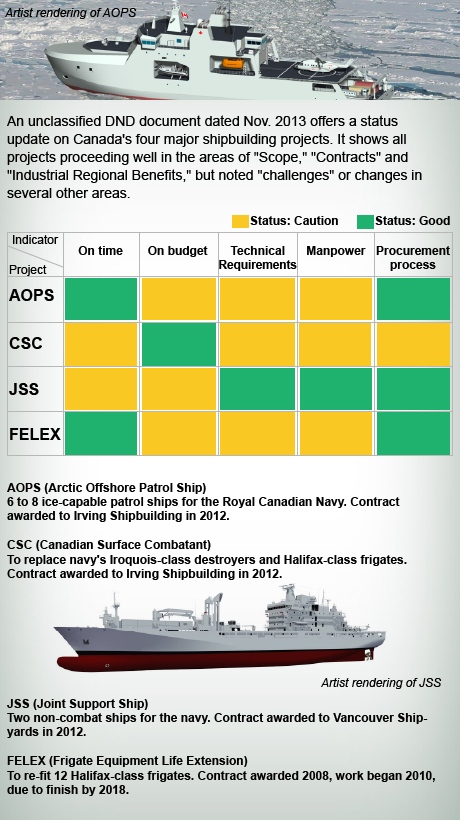
An internal government memo obtained by CBC News shows that all four parts of the government’s huge shipbuilding program are either over budget, behind schedule, or both.
Written Oct. 7 last year by the deputy minister of national defence, Richard Fadden, the memo shows that three of those four programs also face “major challenges” of a technical nature, as well as difficulties lining up skilled manpower to get the ships built at all.
The memo, released to the CBC following an Access to Information request, leaves little doubt that Canada’s crippled supply ship, HMCS Protecteur, won’t be replaced before the year 2020.
The spectacle of the 46-year-old Protecteur, Canada’s only supply ship in the Pacific, being towed into Honolulu after an engine-room fire has thrown the lack of a replacement into sharp focus. Although there’s a plan to build two new supply ships, there’s no sign the work will even begin until late 2016. That means a new one won’t enter service until the end of the decade.
A chart summarizing the state of the shipbuilding effort uses green and yellow squares to indicate where those problems are — the green meaning, on track, and yellow meaning, trouble — and there’s a lot of yellow.
For the Joint Support Ships — that’s the pair of supply ships — the chart shows trouble with both the schedule and the price. The memo explains that this means the program is up to 20 per cent behind schedule and up to 10 per cent over budget.
As I’ve said many times before, the Canadian government is managing to get the least possible bang for the buck on shipbuilding because they view the shipbuilding program as a regional economic development scheme (and a way of funneling money to marginal constituencies) rather than as an essential part of keeping the RCN properly equipped. It’s pretty obvious in this case:
Take the supply ships. “Yellow” suggests they’re over budget, but doesn’t indicate what the budget should be. But comparisons with Canada’s allies could raise eyebrows even further.
Britain, for example, opted to build its four new naval supply ships much more cheaply, at the Daewoo shipyard in South Korea. The contract is for roughly $1.1 billion Cdn. That’s for all four. By contrast, Canada plans to build just two ships, in Vancouver, for $1.3 billion each. So Canada’s ships will be roughly five times more costly than the British ones.
But there’s a twist. Canada’s supply ships will also carry less fuel and other supplies, because they’ll be smaller — about 20,000 tonnes. The U.K. ships are nearly twice as big — 37,000 tonnes. Canadians will lay out a lot more cash for a lot less ship.
Comments Off on RCN’s Joint Support Ships behind schedule and over budget
August 1, 2013
Efficiency in loading is key to container ship logistics
In Wired, Bryan Gardiner extracts some key knowledge from the folks who load those giant container ships:

Container ships are the pack mules of global trade, and journalist Rose George’s new book, Ninety Percent of Everything, is the latest look at how the steel boxes full of solids, liquids, and gases get to where they’re going. One huge challenge, George says, is simply loading and unloading these giant ships, a task that calls on physics, chemistry, and a knowledge of pirate tactics.
1 // Minimize the number of crane moves. Algorithms and computer systems help plan the most efficient and practical storage schemes so ships can get in and out of port fast.
2 // Cold boxes need juice. Refrigerated containers — or “reefers” — must be placed near a power source.
3 // Guard your vessel. Containers are sealed after inspection, but thieves can use simple tools to get around the seals and pop open the doors.
4 // Heaviest boxes go down low. This prevents the stack from collapsing. And they’re distributed as evenly as possible to keep the ship balanced.
Comments Off on Efficiency in loading is key to container ship logistics
July 18, 2013
The cost of withdrawal
A couple of days ago, I posted an item on the costs of removing military equipment from Afghanistan (that is, due to lack of direct port access, thousands of tons of gear have to be flown out at an eye-watering $14,000 per ton). The Washington Post had an article yesterday discussing the customs dispute between the US military and the Afghan government which is making the situation even more fraught:
An escalating dispute between the Afghan government and the United States over customs procedures has halted the flow of U.S. military equipment across Afghanistan’s borders, forcing commanders to rely more heavily on air transport, which has dramatically increased the cost of the drawdown, according to military officials.
The Afghan government is demanding that the U.S. military pay $1,000 for each shipping container leaving the country that does not have a corresponding, validated customs form. The country’s customs agency says the American military has racked up $70 million in fines.
If left unresolved, the disagreement could inflate the price tag of the U.S. military drawdown by hundreds of millions, if not billions, of dollars because of the higher cost of shipping by air — an unwelcome expenditure at a time when the Pentagon is scrambling to cope with steep congressionally mandated budget cuts and the White House is attempting to jump-start negotiations over a long-term security cooperation deal with Kabul.
The Afghan government’s demand for payment is part of a broader dispute over Kabul’s authority to tax entities from the United States, its chief benefactor. As the war economy that for years bankrolled Afghanistan’s political elite starts to deflate, the government is increasingly insisting that U.S. defense contractors pay business taxes and fines for a range of alleged violations.
H/T to Doug Mataconis who also wrote:
We invaded Afghanistan, arguably liberating them from the grip of the Taliban and their al Qaeda allies. We’ve spent ten years or so fighting to protect the government of Hamid Karzai from those same forces. And now they want to charge us to leave? Surely, this is a first, isn’t it? On the other hand, I can see a benefit here. If we knew going into a war that we’d have to pay money to get out at the end perhaps we’d be less willing to start it.
Comments Off on The cost of withdrawal
July 15, 2013
Expensive military gear to become piles of scrap
Strategy Page explains why billions of dollars in military equipment will be scrapped in Afghanistan:
It’s going to cost some $14 billion to deal with $26 billion worth of American equipment in Afghanistan. Half that cost will be for shipping gear out, but the other $7 billion will be the cost of equipment not worth shipping home and either destroyed or donated to the Afghans. About 78,000 tons of gear will be destroyed, including over 2,000 armored vehicles. Some has to be moved, given to the Afghan security forces, sold locally or destroyed. About 9,000 MRAPs will be sent back to the United States.
Unlike Iraq, where heavy stuff, like armored vehicles and trucks, could simply drive to a nearby port and put on a ship, Afghanistan has no ports. The nearest ones are in Pakistan and the road trip is expensive and dangerous because of the theft and the threat of attacks (by terrorists or gangsters seeking “protection” fees). So a lot more gear will be flown out of Afghanistan, which is quite expensive. The current plan calls for 28,000 vehicles and 20,000 shipping containers of gear are to be moved by the end of 2014.
The U.S. and NATO supplies coming in (or going out) via railroad from Western Europe, go through Ukraine, Belarus, Russia, Kazakhstan and Uzbekistan, to Afghanistan. This approach costs $400 a ton to move material to or from Afghanistan, versus three times that to truck it in from Pakistani ports, or $14,000 a ton to fly stuff in, or $10,000 a ton if you just fly material in from a friendly (Persian Gulf) port. For example, $600,000 MRAPs (Mine Resistant Ambush Protected) cost $140,000 to fly in from the Gulf. Some 2,000 of these MRAPs in Afghanistan are no longer needed by the United States or the Afghan forces so are being cut up for scrap in Afghanistan.
Comments Off on Expensive military gear to become piles of scrap
May 4, 2013
Why the terror-through-shipping-container threat has not materialized (yet)
Strategy Page explains why the much-discussed threat of terrorists smuggling in weapons of mass destruction using the ubiquitous shipping container has not actually happened:
A decade ago there was much talk about how vulnerable the United States was to a terror attack via shipping container. It never happened. It’s also unlikely because of the large number of variables the terrorists face. The problems associated with using cargo containers to move a nuclear or conventional bomb are manifold. The big problem is that these containers often don’t arrive right on schedule. Sometimes the ship breaks down or encounters bad weather. This last event leads to thousands of containers a year falling off cargo ships and going to the bottom with their cargo. Sometimes containers get lost “in the system.” More frequently containers get robbed or opened by mistake. Customs officials open a small percentage (this varies by port) for inspection. Another problem, whether the bomb goes off or not, is the fact that containers have to have documentation like bills of lading and such. These can be faked, but the problem is that a paper trail is being created and that can lead to terrorists getting arrested. All containers must officially belong to someone, they are tracked and any that aren’t being tracked tend to get noticed. Many countries do scrutinize containers coming from certain countries in an attempt to catch people smuggling drugs or arms. Large bombs, be they nuclear or conventional, are relatively fragile and may not survive (in working condition) the punishment received during a long sea voyage. If all that weren’t enough to make terrorists nervous, container ships can be delayed when trying to enter a port because of congestion. This can delay arrival by days, or even weeks.


