
The Korean War by Indy Neidell
Published 23 Jul 2024Taejon falls this week to the advancing North Korean steamroller, but the fight there is complete chaos that even sees the top American General fleeing into the local hills. However, two divisions of American reinforcements have arrived and perhaps they can turn the tide. The US also has decided to massively increase its defense spending and conscript tens of thousands of men, which may well help to do that.
(more…)
July 24, 2024
The Korean War – The Allied Cluster f**k at Taejon – Week 005 – July 23, 1950
Comments Off on The Korean War – The Allied Cluster f**k at Taejon – Week 005 – July 23, 1950
July 22, 2024
Chinese Type 50 PPSh: Founding “Gun City” in Manchuria
Forgotten Weapons
Published Apr 12, 2024One of the first new weapons adopted and used by the Chinese Peoples’ Liberation Army after the Communist victory in the Chinese civil war was the Type 50, a copy of the Soviet PPSh-41. The story of its manufacture begins at the Japanese-occupied Mukden Arsenal. It was briefly occupied by the Soviets in 1945 before coming under control of the CCP. It was a huge manufacturing complex at the time, making artillery, small arms, ammunition, and more. A Nationalist bombing raid in 1949 led to the production being distributed among three separate smaller facilities, and the small remote town of Bei’an was chosen to become the new small arms factory site.
The town became so heavily focused on weapons manufacture that it gained the nickname of “Gun City”. The factory was formally named #626, and given the cover name of Qinghua Tool Company. It initially began with production of the Type 38 Arisaka, Type 24 Mauser (the Chiang Kai Shek rifle), the M1 Carbine (a failed project), and the Type 50 copy of the PPSh. In the spring of 1951 in response to UN advances northward in Korea, production was ordered to scale up on the Type 50, to 7500-9000 per month. This took a couple of months to achieve, but in June 1951 the first large shipment of the guns left the factory, and by December 1953 a total of 358,000 had been made. At that point, production shifted to the Type 54, a copy of the PPS-43.
The Type 50 is a close copy of the Russian Shpagin, but differs in a couple of details. The Chinese used a rear aperture sight, and the sights were placed slightly farther forward than on Russian guns. They are also generally very well made — better than most Russia wartime examples.
For many more cool small arms stories, check out WWII After WWII:
https://wwiiafterwwii.wordpress.com
(more…)
Comments Off on Chinese Type 50 PPSh: Founding “Gun City” in Manchuria
July 17, 2024
Americans Repeatedly Routed – The Korean War – Week 004 – July 16, 1950
The Korean War by Indy Neidell
Published 16 Jul 2024Elements of the US 24th Division, the only American one that’s arrived in force in Korea so far, take on the North Korean forces aiming for Taejon, but they are badly — and easily — defeated each time. In the center and the east coast it’s the ROK- the forces of the South — that are reorganizing and getting into position to try to stop the enemy. And Douglas MacArthur is officially appointed commander of all UN forces in Korea.
(more…)
Comments Off on Americans Repeatedly Routed – The Korean War – Week 004 – July 16, 1950
July 10, 2024
The Korean War – Never Fear, MacArthur’s Here! – Week 003 – July 9, 1950
The Korean War by Indy Neidell
Published 9 Jul 2024American troops have arrived in Korea and engage the KPA — the forces of the North — in the field this week for the first time. It does not go well for them. In fact, it’s hard to imagine it going worse. The Americans are outnumbered and outgunned and are routed. In fact, the KPA are advancing all over the country, though they are taking heavy casualties themselves.
(more…)
Comments Off on The Korean War – Never Fear, MacArthur’s Here! – Week 003 – July 9, 1950
July 3, 2024
The Korean War Week 002 – The Fall of Seoul – July 2, 1950
The Korean War by Indy Neidell
Published 2 Jul 2024The North Korean forces are advancing all over, and this week they take Seoul, the South’s capital city, after just a few days of the war. There is another tragedy for the South when the Han River Bridge is blown while thousands of people are crossing it, resulting in hundreds of civilian deaths. The world responds to the invasion — condemning it everywhere, and the Americans decide to send in ground forces to help the South.
(more…)
Comments Off on The Korean War Week 002 – The Fall of Seoul – July 2, 1950
June 26, 2024
The Korean War Begins – Week 1 – June 25, 1950
The Korean War by Indy Neidell
Published 25 Jun 2024Despite the fact that there have been clear signs that they might soon invade South Korea, when the North actually does in force on June 25th, 1950, it comes as a complete shock to the world. But is this a full invasion, or just cross border raids such as there were in 1949? And is there something more behind this? Stalin’s Soviets? Mao’s Chinese? And how will the world react? Find out this week as our week by week coverage of the war begins!
(more…)
Comments Off on The Korean War Begins – Week 1 – June 25, 1950
March 31, 2024
HMS Unicorn (I72) – Guide 367
Drachinifel
Published Dec 23, 2023The Unicorn, a fleet maintenance carrier of the British Royal Navy, is today’s subject.
(more…)
Comments Off on HMS Unicorn (I72) – Guide 367
February 11, 2024
QotD: Learning and re-learning the bloody art of war
The values composing civilization and the values required to protect it are normally at war. Civilization values sophistication, but in an armed force sophistication is a millstone.
The Athenian commanders before Salamis, it is reported, talked of art and of the Acropolis, in sight of the Persian fleet. Beside their own campfires, the Greek hoplites chewed garlic and joked about girls.
Without its tough spearmen, Hellenic culture would have had nothing to give the world. It would not have lasted long enough. When Greek culture became so sophisticated that its common men would no longer fight to the death, as at Thermopylae, but became devious and clever, a horde of Roman farm boys overran them.
The time came when the descendants of Macedonians who had slaughtered Asians till they could no longer lift their arms went pale and sick at the sight of the havoc wrought by the Roman gladius Hispanicus as it carved its way toward Hellas.
The Eighth Army, put to the fire and blooded, rose from its own ashes in a killing mood. They went north, and as they went they destroyed Chinese and what was left of the towns and cities of Korea. They did not grow sick at the sight of blood.
By 7 March they stood on the Han. They went through Seoul, and reduced it block by block. When they were finished, the massive railway station had no roof, and thousands of buildings were pocked by tank fire. Of Seoul’s original more than a million souls, less than two hundred thousand still lived in the ruins. In many of the lesser cities of Korea, built of wood and wattle, only the foundation, and the vault, of the old Japanese bank remained.
The people of Chosun, not Americans or Chinese, continued to lose the war.
At the end of March the Eighth Army was across the parallel.
General Ridgway wrote, “The American flag never flew over a prouder, tougher, more spirited and more competent fighting force than was Eighth Army as it drove north …”
Ridgway had no great interest in real estate. He did not strike for cities and towns, but to kill Chinese. The Eighth Army killed them, by the thousands, as its infantry drove them from the hills and as its air caught them fleeing in the valleys.
By April 1951, the Eighth Army had again proved Erwin Rommel’s assertion that American troops knew less but learned faster than any fighting men he had opposed. The Chinese seemed not to learn at all, as they repeated Chipyong-ni again and again.
Americans had learned, and learned well. The tragedy of American arms, however, is that having an imperfect sense of history Americans sometimes forget as quickly as they learn.
T.R. Fehrenbach, This Kind of War: A Study in Unpreparedness, 1963.
Comments Off on QotD: Learning and re-learning the bloody art of war
January 23, 2024
The Korean War: The First Year
Army University Press
Published Jan 22, 2024Created for the Department of Command and Leadership and the Department of Military History at the US Army Command and General Staff College, The Korean War: The First Year is a short documentary focused on the major events of the Forgotten War. Designed to address the complex strategic and operational actions from June 1950 – June 1951, the film answers seven key questions that can be found in the timestamps below. Major events such as the initial North Korean invasion, the defense of the Pusan Perimeter, the Inchon landing, and the Chinese intervention are discussed.
Timestamps:
1. Why are there Two Koreas? – 00:25
2. Why did North Korea Attack South Korea? – 02:39
3. How did the UN stop the Communist invasion? – 06:30
4. Why did MacArthur attack at Inchon? – 10:24
5. Why did the UN attack into North Korea? – 14:27
6. Why did China enter the Korean War? – 18:51
7. How did the UN stop the Communist invasion … again? – 21:44
Comments Off on The Korean War: The First Year
January 7, 2024
QotD: The US Army between 1945 and 1950
The trouble is, different men live by different myths.
There are men who would have a society pointed wholly to fighting and resistance to Communism, and this would be a very different society from the one Americans now enjoy. It might succeed on the battlefield, but its other failures can be predicted.
But the infantry battlefield also cannot be remade to the order of the prevailing midcentury opinion of American sociologists.
The recommendations of the so-called Doolittle Board of 1945-1946, which destroyed so much of the will — if not the actual power — of the military traditionalists, and left them bitter, and confused as to how to act, was based on experience in World War II. In that war, as in all others, millions of civilians were fitted arbitrarily into a military pattern already centuries old. It had once fitted Western society; it now coincided with American customs and thinking no longer.
What the Doolittle Board tried to do, in small measure, was to bring the professional Army back into the new society. What it could not do, in 1946, was to gauge the future.
By 1947 the United States Army had returned, in large measure, to the pattern it had known prior to 1939. The new teen-agers who now joined it were much the same stripe of men who had joined in the old days. They were not intellectuals, they were not completely fired with patriotism, or motivated by the draft; nor was an aroused public, eager to win a war, breathing down their necks.
A great many of them signed up for three squares and a sack.
Over several thousand years of history, man has found a way to make soldiers out of this kind of man, as he comes, basically unformed, to the colors. It is a way with great stresses and great strains. It cannot be said it is wholly good. Regimentation is not good, completely, for any man.
But no successful army has been able to avoid it. It is an unpleasant necessity, seemingly likely to go on forever, as long as men fight in fields and mud.
One thing should be made clear.
The Army could have fought World War III, just as it could have fought World War II, under the new rules. During 1941-1945 the average age of the United States soldier was in the late twenties, and the ranks were seasoned with maturity from every rank of life, as well as intelligence.
In World War III, or any war with national emotional support, this would have again been true. Soldiers would have brought their motivation with them, firmed by understanding and maturity.
The Army could have fought World War III in 1950, but it could not fight Korea.
T.R. Fehrenbach, This Kind of War: A Study in Unpreparedness, 1963.
Comments Off on QotD: The US Army between 1945 and 1950
October 21, 2023
QotD: The US Army’s Korean War blooding
For his own sake and for that of those around him, a man must be prepared for the awful, shrieking moment of truth when he realizes he is all alone on a hill ten thousand miles from home, and that he may be killed in the next second.
The young men of America, from whatever strata, are raised in a permissive society. The increasing alienation of their education from the harsher realities of life makes their reorientation, once enlisted, doubly important.
Prior to 1950 they got no reorientation. They put on the uniform, but continued to get by, doing things rather more or less. They had no time for sergeants.
As discipline deteriorated, the generals themselves were hardly affected. They still had their position, their pomp and ceremonies. Surrounded by professionals of the old school, largely field rank, they still thought their rod was iron, for, seemingly, their own orders were obeyed.
But ground battle is a series of platoon actions. No longer can a field commander stand on a hill, like Lee or Grant, and oversee his formations. Orders in combat — the orders that kill men or get them killed, are not given by generals, or even by majors. They are given by lieutenants and sergeants, and sometimes by PFC’s.
When a sergeant gives a soldier an order in battle, it must have the same weight as that of a four-star general.
Such orders cannot be given by men who are some of the boys. Men willingly take orders to die only from those they are trained to regard as superior beings.
It was not until the summer of 1950, when the legions went forth, that the generals realized what they had agreed to, and what they had wrought.
The Old Army, outcast and alien and remote from the warm bosom of society, officer and man alike, ordered into Korea, would have gone without questioning. It would have died without counting. As on Bataan, it would not have listened for the angel’s trumpet or the clarion call. It would have heard the hard sound of its own bugles, and hard-bitten, cynical, wise in bitter ways, it would have kept its eyes on its sergeants.
It would have died. It would have retreated, or surrendered, only in the last extremity. In the enemy prison camps, exhausted, sick, it would have spat upon its captors, despising them to the last.
It would have died, but it might have held.
T.R. Fehrenbach, This Kind of War: A Study in Unpreparedness, 1963.
Comments Off on QotD: The US Army’s Korean War blooding
August 14, 2023
QotD: The US Army in the Korean War
The Army needed legions, but society didn’t want them. It wanted citizen-soldiers.
But the sociologists are right — absolutely right — in demanding that the centurion view of life not be imposed upon America. In a holy, patriotic war — like that fought by the French in 1793, or as a general war against Communism will be — America can get a lot more mileage out of citizen-soldiers than it can from legions.
No one has suggested that perhaps there should be two sets of rules, one for the professional Army, which may have to fight in far places, without the declaration of war, and without intrinsic belief in the value of its dying, for reasons of policy, chessmen on the checkerboard of diplomacy; and one for the high-minded, enthusiastic, and idealistic young men who come aboard only when the ship is sinking.
The other answer is to give up Korea-type wars, and to surrender great-power status, and a resultant hope of order — our own decent order — in the world. But America is rich and fat and very, very noticeable in this world.
It is a forlorn hope that we should be left alone.
In the first six months America suffered a near debacle because her Regular Army fighting men were the stuff of legions, but they had not been made into legionaries.
America was not more soft or more decadent than it had been twenty years earlier. It was confused, badly, on its attitudes toward war. It was still bringing up its youth to think there were no tigers, and it was still reluctant to forge them guns to shoot tigers.
Many of America’s youth, in the Army, faced horror badly because they had never been told they would have to face horror, or that horror is very normal in our unsane world. It had not been ground into them that they would have to obey their officers, even if the orders got them killed.
It has been a long, long time since American citizens have been able to take down the musket from the mantelpiece and go tiger hunting. But they still cling to the belief that they can do so, and do it well, without training.
This is the error that leads some men to cry out that Americans are decadent.
If Americans in 1950 were decadent, so were the rabble who streamed miserably into Valley Forge, where von Steuben made soldiers out of them. If American society had no will to defend itself, neither did it in 1861, at First Manassas, or later at Shiloh, when whole regiments of Americans turned tail and ran.
The men who lay warm and happy in their blankets at Kasserine, as the panzers rolled toward them in the dawn, were decadent, by this reasoning.
The problem is not that Americans are soft but that they simply will not face what war is all about until they have had their teeth kicked in. They will not face the fact that the military professionals, while some have ideas about society in general that are distorted and must be watched, still know better than anyone else how a war is won.
Free society cannot be oriented toward the battlefield — Sparta knew that trap — but some adjustments must be made, as the squabbling Athenians learned to their sorrow.
The sociologists and psychologists of Vienna had no answer to the Nazi bayonets, when they crashed against their doors. The soldiers of the democratic world did.
More than once, as at Valley Forge, after Bull Run, and Kasserine, the world has seen an American army rise from its own ashes, reorient itself, grow hard and bitter, knowledgeable and disciplined and tough.
In 1951, after six months of being battered, the Eighth Army in Korea rose from its own ashes of despair. No man who was there still believes Americans in the main are decadent, just as no man who saw Lieutenant General Matt Ridgway in operation doubts the sometime greatness of men.
T.R. Fehrenbach, This Kind of War: A Study in Unpreparedness, 1963.
Comments Off on QotD: The US Army in the Korean War
July 3, 2023
The Battle That Prevented A Nuclear World War Three | Kapyong: The Forgotten War | Timeline
Timeline – World History Documentaries
Published 2 Jul 2023On April 24, 1951, following a rout of the South Korean army, the Chinese People Volunteer Army pursued their enemy to the lines of Australian and Canadian troops still digging fall-back defences, 39 kilometres to the rear. Here, sometimes at the length of a bayonet, often in total darkness, individual was pitted against individual in a struggle between a superpower and a cluster of other nations from across the world. They fought for a valley, the ancient and traditional invasion route to Seoul. If it fell the southern capital and the war, was lost. The United Nations troops had the military advantage of the high ground and artillery support: the Chinese relied entirely on vastly superior numbers. As a result, young men from both sides found a battle which was very close and very personal.
The Battle of Kapyong became the turning point of China’s Fifth Offensive in that Korea spring. The aim of the offensive was to finally drive the foreign troops out of South Korea and into the sea. What happened instead, changed the history of the Korean War. The Chinese were denied victory and forced back into negotiations. Had they succeeded, another crushing defeat for the US could have triggered events that led to a nuclear holocaust in Asia — and World War Three.
(more…)
February 24, 2023
QotD: Relearning lessons as old as warfare
The people of Asia had changed, true. The day of the gunboat and a few Marines would never return. But that was not the whole story. The people of the West had changed, too. They forgot that the West had dominated not only by arms, but by superior force of will.
During the summer of 1950, and later, Asians would watch. Some, friends of the West, would even smile. And none of them would ever forget.
News reports in 1950 talked of vast numbers, overwhelming hordes of fanatic North Koreans, hundreds of monstrous tanks, against which the thin United States forces could not stand. In these reports there was truth, but not the whole truth.
The American units were outnumbered. They were outgunned. They were given an impossible task at the outset.
But they were also outfought.
In July, 1950, one news commentator rather plaintively remarked that warfare had not changed so much, after all. For some reason, ground troops still seemed to be necessary, in spite of the atom bomb. And oddly and unfortunately, to this gentleman, man still seemed to be an important ingredient in battle. Troops were getting killed, in pain and fury and dust and filth. What had happened to the widely heralded pushbutton warfare where skilled, immaculate technicians who had never suffered the misery and ignominy of basic training blew each other to kingdom come like gentlemen?
In this unconsciously plaintive cry lies buried a great deal of the truth why the United States was almost defeated.
Nothing had happened to pushbutton warfare; its emergence was at hand. Horrible weapons that could destroy every city on earth were at hand — at too many hands. But pushbutton warfare meant Armageddon, and Armageddon, hopefully, will never be an end of national policy.
Americans in 1950 rediscovered something that since Hiroshima they had forgotten: you may fly over a land forever; you may bomb it, atomize it, pulverize it and wipe it clean of life — but if you desire to defend it, protect it, and keep it for civilization, you must do this on the ground, the way the Roman legions did, by putting your young men into the mud.
T.R. Fehrenbach, This Kind of War: A Study in Unpreparedness, 1963
Comments Off on QotD: Relearning lessons as old as warfare
December 6, 2022
The coming of the Korean War
In Quillette, Niranjan Shankar outlines the world situation that led to the outbreak of the Korean War in 1950:
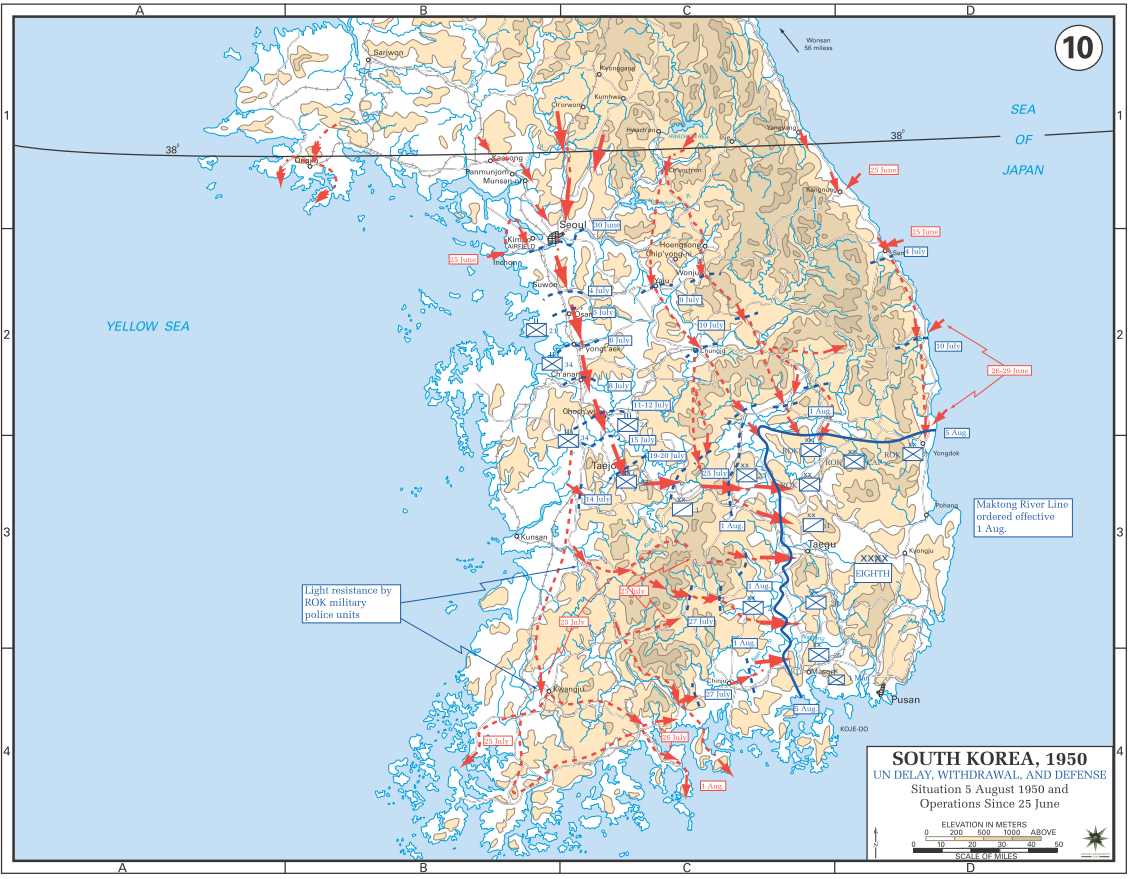
Initial phase of the Korean War, 25 June through 5 August, 1950.
Map from the West Point Military Atlas — https://www.westpoint.edu/academics/academic-departments/history/korean-war
The Korean War was among the deadliest of the Cold War’s battlegrounds. Yet despite yielding millions of civilian deaths, over 40,000 US casualties, and destruction that left scars which persist on the peninsula today, the conflict has never received the attention (aside from being featured in the sitcom M*A*S*H) devoted to World War II, Vietnam, and other 20th-century clashes.
But like other neglected Cold War front-lines, the “Forgotten War” has fallen victim to several politicized and one-sided “anti-imperialist” narratives that focus almost exclusively on the atrocities of the United States and its allies. The most recent example of this tendency was a Jacobin column by James Greig, who omits the brutal conduct of North Korean and Chinese forces, misrepresents the underlying cause of the war, justifies North Korea’s belligerence as an “anti-colonial” enterprise, and even praises the regime’s “revolutionary” initiatives. Greig’s article was preceded by several others, which also framed the war as an instance of US imperialism and North Korea’s anti-Americanism as a rational response to Washington’s prosecution of the war. Left-wing foreign-policy thinker Daniel Bessner also alluded to the Korean War as one of many “American-led fiascos” in his essay for Harper’s magazine earlier this summer. Even (somewhat) more balanced assessments of the war, such as those by Owen Miller, tend to overemphasize American and South Korean transgressions, and don’t do justice to the long-term consequences of Washington’s decision to send troops to the peninsula in the summer of 1950. By giving short shrift to — or simply failing to mention — the communist powers’ leading role in instigating the conflict, and the violence and suffering they unleashed throughout it, these depictions of the Korean tragedy distort its legacy and do a disservice to the millions who suffered, and continue to suffer, under the North Korean regime.
Determining “who started” a military confrontation, especially an “internal” conflict that became entangled in great-power politics, can be a herculean task. Nevertheless, post-revisionist scholarship (such as John Lewis Gaddis’s The Cold War: A New History) that draws upon Soviet archives declassified in 1991 has made it clear that the communist leaders, principally Joseph Stalin and North Korean leader Kim Il-Sung, were primarily to blame for the outbreak of the war.
After Korea, a Japanese imperial holding, was jointly occupied by the United States and the Soviet Union in 1945, Washington and Moscow agreed to divide the peninsula at the 38th parallel. In the North, the Soviets worked with the Korean communist and former Red Army officer Kim Il-Sung to form a provisional “People’s Committee”, while the Americans turned to the well-known Korean nationalist and independence activist Syngman Rhee to establish a military government in the South. Neither the US nor the USSR intended the division to be permanent, and until 1947, both experimented with proposals for a united Korean government under an international trusteeship. But Kim and Rhee’s mutual rejection of any plan that didn’t leave the entire peninsula under their control hindered these efforts. When Rhee declared the Republic of Korea (ROK) in 1948, and Kim declared the Democratic People’s Republic of Korea (DPRK) later that year, the division was cemented. Each nation threatened to invade the other and began preparing to do so.
What initially prevented a full-scale attack by either side was Washington’s and Moscow’s refusal to provide their respective partners with support for the military reunification of the peninsula. Both superpowers had withdrawn their troops by 1949 to avoid being dragged into an unnecessary war, and the Americans deliberately withheld weapons from the ROK that could be used to launch an invasion.
However, Stalin began to have other ideas. Emboldened by Mao Zedong’s victory in the Chinese Civil War and frustrated by strategic setbacks in Europe, the Soviet premier saw an opportunity to open a “second-front” for communist expansion in East Asia with Beijing’s help. Convinced that Washington was unlikely to respond, Stalin gave Kim Il-Sung his long-sought “green-light” to reunify the Korean peninsula under communist rule in April 1950, provided that Mao agreed to support the operation. After Mao convinced his advisers (despite some initial difficulty) of the need to back their Korean counterparts, Red Army military advisers began working extensively with the Korean People’s Army (KPA) to prepare for an attack on the South. When Kim’s forces invaded on June 25th, 1950, the US and the international community were caught completely off-guard.
Commentators like Greig, who contest the communists’ culpability in starting the war, often rely on the work of revisionist historian Bruce Cumings, who highlights the perpetual state of conflict between the two Korean states before 1950. It is certainly true that there were several border skirmishes over the 38th parallel after the Soviet and American occupation governments were established in 1945. But this in no way absolves Kim and his foreign patrons for their role in unleashing an all-out assault on the South. Firstly, despite Rhee’s threats and aggressive posturing, the North clearly had the upper hand militarily, and was much better positioned than the South to launch an invasion. Whereas Washington stripped Rhee’s forces of much of their offensive capabilities, Moscow was more than happy to arm its Korean partners with heavy tanks, artillery, and aircraft. Many KPA soldiers also had prior military experience from fighting alongside the Chinese communists during the Chinese Civil War.
Moreover, as scholar William Stueck eloquently maintains, the “civil” aspect of the Korean War fails to obviate the conflict’s underlying international dimensions. Of course, Rhee’s and Kim’s stubborn desire to see the country fully “liberated” thwarted numerous efforts to establish a unified Korean government, and played a role in prolonging the war after it started. It is unlikely that Stalin would have agreed to support Pyongyang’s campaign to reunify Korea had it not been for Kim’s persistent requests and repeated assurances that the war would be won quickly. Nevertheless, the extensive economic and military assistance provided to the North Koreans by the Soviets and Chinese (the latter of which later entered the war directly), the subsequent expansion of Sino-Soviet cooperation, the Stalinist nature of the regime in Pyongyang, Kim’s role in both the CCP and the Red Army, and the close relationship between the Chinese and Korean communists all strongly suggest that without the blessing of his ideological inspirators and military supporters, Kim could not have embarked on his crusade to “liberate” the South.
Likewise, Rhee’s education in the US and desire to emulate the American capitalist model in Korea were important international components of the conflict. More to the point, all the participants saw the war as a confrontation between communism and its opponents worldwide, which led to the intensification of the Cold War in other theaters as well. The broader, global context of the buildup to the war, along with the UN’s authorization for military action, legitimized America’s intervention as a struggle against international communist expansionism, rather than an unwelcome intrusion into a civil dispute among Koreans.
Comments Off on The coming of the Korean War


