Quotulatiousness

February 25, 2012

Burger King latest corporation to pull out of UK work experience program

Filed under: Britain, Bureaucracy, Economics, Government — Tags: , , , , , — Nicholas @ 10:14

The British government’s work experience program for unemployed would-be workers loses another employer:

The fast food giant said it had decided to cease its involvement in the Get Britain Working programme because of recent concerns expressed by the public.

The scheme has attracted growing criticism in recent weeks with opponents describing it as a form of slave labour because young people worked for nothing, while keeping their benefits.

Burger King said it had registered for the programme six weeks ago intending to take on young people for work experience at its Slough headquarters, but had not recruited anyone.

It sounds like the program was well intended — allowing people without work experience to at least have something to put down on a resumé — but fails the PR test because the corporation is seen as “getting work for nothing”. And, without a doubt, some corporations will use the program in exactly that way. Despite that, on balance it seems that the potential benefit to young entrants to the work force is greater than the actual benefit to the companies that get that “free labour”.

The value of that “free labour” may well be lower than the costs to the employer for training them: new employees with no marketable skills are not the bonanza of profit that some seem to think that they are. Some people I worked with early in my working life could be proven to be a net loss for months after hiring …

February 21, 2012

First it was the “he-cession”: now it’s the “she-cession” in Ontario

Filed under: Bureaucracy, Cancon, Economics, Government — Tags: , , , , — Nicholas @ 11:47

Frances Woolley in the Globe & Mail Economy Lab says that the next phase of Ontario’s recovery from the 2008 recession will disproportionally fall on women:

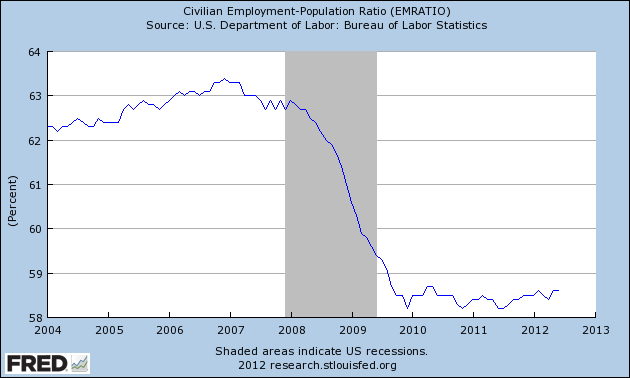
Men were hit hard by the 2008-9 economic downturn, with losses of construction jobs (98 per cent male), transport jobs (90 per cent male), and manufacturing jobs (70 per cent male). Male unemployment rose so quickly that people began to talk about a “he-cession.”

Three years on, a tenuous “he-covery” seems to be under way – male unemployment rates fell last year, and the percentage of men with jobs rose.

Now it’s the ladies’ turn. Ontario’s Drummond Report calls for deep cuts to financial, administrative and secretarial jobs throughout the public service. Strictly speaking, the report recommends cutting costs; automating, streamlining and consolidating the delivery of services. Yet administrative costs equal administrative jobs — jobs that are, 8 times out of 10, held by women.

The bulk of Ontario government spending goes to MUSH — Municipalities, Universities, Schools and Hospitals. Overall spending cannot be reduced substantially without making cuts in these areas. There are about 280,000 teachers and professors in Ontario, and 65 per cent of them are female. The Drummond report recommends larger class sizes for elementary and secondary school teachers, and “flexible” teaching loads for university professors. Yet more students per teacher mean fewer teaching jobs. Just as a downturn in the construction sector leads to male unemployment, a downturn in the teaching sector leads to female unemployment.

February 15, 2012

Italy faces the end of “a job for life”

Filed under: Economics, Europe, Italy, Law — Tags: , , — Nicholas @ 09:51

You could say that they’re not happy about the possibility:

It was just an off-the-cuff quip during a television interview this month. But when Prime Minister Mario Monti remarked that having a job for life in today’s economy was no longer feasible for young people — indeed, it was “monotonous” — he set off a barrage of protests, laying bare one of the sacrosanct tenets of Italian society that the euro zone crisis has placed at risk.

Reaction was fast, furious, bipartisan and intergenerational. “I think the prime minister has to be careful with the words he uses because people are a little angry,” Claudia Vori, a 31-year-old Rome native who has had 18 different jobs since graduating from high school in 1999, said of Mr. Monti’s “monotonous” moment.

[. . .]

In Italy in particular, every major political force after World War II subscribed to the idea of guaranteeing the work of the male breadwinner to preserve the traditional family structure, said Elisabetta Gualmini, a labor expert who teaches at the University of Bologna. This social doctrine was also blessed by the Roman Catholic Church, which still holds much sway in Italy.

“The problem is that this model is myopic” in a global marketplace, Professor Gualmini said. “But Italy has entrenched itself on this model, which became a strong ideology and so rooted in beliefs that it cannot be challenged.”

February 10, 2012

This is why the “patriarchy” is an unlikely culprit

Filed under: Britain, Economics, Liberty — Tags: , , , , , — Nicholas @ 11:27

Henry Hill explains the key market mechanism that would undermine “the patriarchy”:

Let’s imagine we have ten businesses competing for the same market. If we are spectacularly ungenerous to the male sex (as to get into Harriet Harman’s brain we must surely be) let’s assume that nine of those businesses are run by real, conviction sexists who consciously exclude capable women on the grounds that they’re women. This leaves a vast talent pool available to the tenth business, which presumably can lap up these highly capable workers. If sexism was depressing their wages as well, then this business would have a significant competitive advantage over the competition.

How long would rival businesses really keep deliberately hiring inferior labour at inflated prices out of allegiance to the principle of sexism? It would only take one company in a competitive market to break the ranks of chauvinist solidarity for such arbitrary and costly employment practises to be rendered totally unaffordable.

There are all kinds of reasons for differing employment patterns between men and women, including different priorities, working hours, child-rearing and so forth that have firm bases in business sense. To ascribe these differences to an omnipresent, more-important-that-profit sexist conspiracy, one must believe the entire spectrum of business subscribes to the exclusion of women at the expense of their own industrial and economic interests. That they literally looked at the ‘profits’ David Cameron is waving in front of them and decided that, if the cost was employing women, £40bn wasn’t for them.

Lorne Gunter: Toronto Star imagines oil just “bubbles up out of the ground and we Westerners just run out with buckets to collect it?”

Filed under: Cancon, Economics, Media — Tags: , , , , , — Nicholas @ 10:30

Lorne Gunter in the National Post:

As I read the Toronto Star’s editorial about Statistics Canada’s recently released 2011 census population data, it was hard for me not to imagine a plump, aging diva reclining on a brocade-covered chaise wailing, “I’m still beautiful! Really, I am.”

Entitled, “Census shows a fading Ontario? Don’t count on it,” the editorial makes the argument that it is “too simplistic” to claim “Ontario’s day is over.”

No one is making the case that Ontario can be dismissed as an afterthought. That is a concern without a cause.

[. . .]

But before anyone jumps to the conclusion that I, an Albertan, am pleased by Ontario’s decline, I’ll add that any trend that bodes ill for Ontario, eventually bodes ill for the country as a whole.

Canada needs a strong, prosperous, confident heartland. The West may be the new engine of the national economy, but that doesn’t mean the country can afford to have the old engine — Ontario — be idle.

The Star insults the West’s ingenuity and determination when it scoffs that “it’s relatively easy to grow based on resource extraction. Ontario does not have the luxury of sitting on gas and oil fields, so the task here is much harder.” Really? Have the paper’s editorial writers ever tried to find, extract, transport and refine oil and natural gas? Do they imagine the stuff bubbles up out of the ground and we Westerners just run out with buckets to collect it?

February 8, 2012

You can’t blame declining rates of marriage on poverty

Filed under: Economics, Media, USA — Tags: , , — Nicholas @ 11:33

Bryan Caplan explains:

I’m baffled by people who blame declining marriage rates on poverty. Why? Because being single is more expensive than being married. Picture two singles living separately. If they marry, they sharply cut their total housing costs. They cut the total cost of furniture, appliances, fuel, and health insurance. Even groceries get cheaper: think CostCo.

These savings are especially blatant when your income is low. Even the official poverty line acknowledges them. The Poverty Threshold for a household with one adult is $11,139; the Poverty Threshold for a household with two adults is $14,218. When two individuals at the poverty line maintain separate households, they’re effectively spending 2*$11,139-$14,218=$8,060 a year to stay single.

But wait, there’s more. Marriage doesn’t just cut expenses. It raises couples’ income. In the NLSY, married men earn about 40% more than comparable single men; married women earn about 10% less than comparable single women. From a couples’ point of view, that’s a big net bonus. And much of this bonus seems to be causal.

[. . .]

If being single is so expensive, why are the poor far less likely to get married and stay married? I’m sure you could come up with a stilted neoclassical explanation. But this is yet another case where behavioral economics and personality psychology have a better story. Namely: Some people are extremely impulsive and short-sighted. If you’re one of them, you tend to mess up your life in every way. You don’t invest in your career, and you don’t invest in your relationships. You take advantage of your boss and co-workers, and you take advantage of your romantic partners. You refuse to swallow your pride — to admit that the best job and the best spouse you can get, though far from ideal, are much better than nothing. Your behavior feels good at the time. But in the long-run people see you for what you are, and you end up poor and alone.

Tyler Cowen comments on the first part of Caplan’s post:

More plausibly it is the rise in female income (among other factors, including the rise of birth control, […]) which is behind the decline in marriage, but that doesn’t fit with traditional mood affiliation, which finds the rise in female income to be good (which it is), and the decline in marriage to be — neither good nor bad per se but not exactly worth celebrating. If you can blame capitalism and wage stagnation for the decline of the family among lower earners, so much the better for ideology but as a sociological proposition that is a very weak hypothesis (do you see convincing links to real sociological evidence, showing this to be the dominant factor? No) and as Caplan shows it doesn’t fit with the economics either.

February 6, 2012

America’s boom in “Moocher Culture”

Filed under: Books, Economics, Government, Politics, USA — Tags: , , , , — Nicholas @ 00:08

Glenn Harlan Reynolds in the Washington Examiner explains why the growth in something-for-nothing attitudes can and will come to grief:

“Fifty thousand for what you didn’t plant, for what didn’t grow. That’s modern farming — reap what you don’t sow.”

That’s a line from a song about farm subsidies, “Farming The Government,” by the Nebraska Guitar Militia.

But these days it applies to more and more of the U.S. economy, as Charles Sykes points out in his new book, A Nation Of Moochers: America’s Addiction To Getting Something For Nothing.

The problem, Sykes points out, is that you can’t run an economy like that. If you tried to hold a series of potluck dinners where a majority brought nothing to the table, but felt entitled to eat their fill, it would probably work out badly. Yet that’s essentially what we’re doing.

[. . .]

But the damage goes deeper. Sykes writes, “In contemporary America, we now have two parallel cultures: An anachronistic culture of independence and responsibility, and the emerging moocher culture.

“We continually draw on the reserves of that older culture, with the unspoken assumption that it will always be there to mooch from and that responsibility and hard work are simply givens. But to sustain deadbeats, others have to pay their bills on time.”

And, after a while, people who pay their bills on time start to feel like suckers. I think we’ve reached that point now:

  • People who pay their mortgages — often at considerable personal sacrifice — see others who didn’t bother get special assistance.
  • People who took jobs they didn’t particularly want just to pay the bills see others who didn’t getting extended unemployment benefits.
  • People who took risks to build their businesses and succeeded see others, who failed, getting bailouts. It rankles at all levels.

And an important point of Sykes’ book is that moocher-culture isn’t limited to farmers or welfare queens. The moocher-vs-sucker divide isn’t between the rich and poor, but between those who support themselves and those nursing at the government teat.

February 5, 2012

This is where all the manufacturing jobs have gone

Filed under: Britain, Economics, Education, History, Technology — Tags: , , — Nicholas @ 11:44

Jackart explains that they’ve not so much been “outsourced” as they’ve been compressed, optimized, economized, and made more efficient. Fewer workers are now required to produced more things, and this is unequivocally a good thing:

A small cadre of highly skilled professionals do the jobs with enormous machines once done by vast armies of peasant labourers; which is what’s happening to manufacturing. British industrial production is rising barring recessionary glitches, UK industrial production has kept rising for most of the last 100 years. We are still producing lots of things that can be dropped on a foot. It’s just it’s no longer done by the descendants of those peasants who left the land during the industrial revolution to seek work in factories. Those factories still exist, but they employ a small number of highly paid people to operate machines which do the riveting, welding, assembling and polishing. Each machine takes does the job of hundreds of people.

That’s what happened in Agriculture, and is happening in Manufacturing. And THIS IS A GOOD THING. Because all those people not employed in riveting in Tyneside shipyards or Scything Lincolnshire corn fields are employed doing something else for someone else. All that productive labour has been freed, but we’re still getting the food produced, in abundance the Lincolnshire harvestman would have thought impossible.

The majority of Western economies are now services. Even the Germans, who’ve a niche in Machine tools and Automobiles have only 21% of their economy in making things they can drop on their feet.

And this reflects another point. Manufactured products are getting cheaper, so to have material wealth unimaginable to our Lincolnshire harvestman requires far fewer hours of Labour to achieve. Thus cars, the most expensive manufactured products most of us buy, are getting cheaper relative to average earnings, decade by decade. A reliable runaround would have been beyond the means of a WW2 factory worker, but is available to a cleaning lady now. So the same car forms a smaller part of the economy. Having spent less on the car, we can spend more on clothes, shoes, music, computers, kitchen appliances etc, and in so doing provide jobs to people supplying those things. Above all we can pay for people do do things for us – cut our hair, serve us food in restaurants, mediate for us legally, invest our surplus production into other productive activities, heal our illnesses and so on.

[. . .]

The next challenge is to banish stress and misery from our lives. I suspect this will be harder. The only caveat is that I have a great deal more faith in Adam Smith’s “invisible hand” (a much maligned and misunderstood idea) than the idiotic ideas of politicians. Politicians still seem to think manufacturing jobs are special, which suggests they don’t understand why we’re rich. The only limitless resource is man’s ingenuity. Markets aren’t an ideology, they’re simply what works in the absence of one, by deploying that one limitless resource to everyone’s benefit.

February 3, 2012

The end of London’s diesel locomotive plant

Filed under: Cancon, Economics, Railways — Tags: , , , , — Nicholas @ 12:10

I’ve updated my earlier post on the labour dispute at London’s EMC plant now that the current owners have announced the closure of the facility.

Update, 5 February: Mike P. Moffatt at Worthwhile Canadian Initiative debunks some of the media coverage of the closure:

After the U.S.-Canada Free Trade Agreement, GM Diesel closed their La Grange, Illinois plant and consolidated their production to the London plant, though kept the head office, research, design, and manufacturing of some components in La Grange. EMD London was a direct beneficiary of the U.S.-Canada Free Trade agreement, something I have yet to hear in the media. The domestic locomotive market, by itself, would not have supported the level of production we have seen over the last two decades.

In 2005, GM Diesel sold the Electro-Motive Division (including the GM Diesel plant in London and the head office in La Grange) to a couple of U.S. private equity firms, who re-named it Electro-Motive Diesel. In 2010, those firms sold EMD to Caterpillar.

[. . .]

We need to keep in mind that:

  1. EMD has always been a U.S. corporation.
  2. The intellectual property from research and design, etc. was from the head office in La Grange, Illinois.

So that leaves “know-how” which Cohn mentions in a follow-up paragraph. On Twitter, Colby Cosh asked: “Cohn talks about “know-how” but (a) know-how isn’t IP and (b) Cat doesn’t seem to have much use for the workers who have it, do they?” Caterpillar, however, did send a number of employees from London to their new plant in Muncie, IN, to train newly hired workers. I am Facebook friends with an EMD worker and I remember him objecting loudly to this last fall. But did Caterpillar really buy EMD so that it could obtain the talents of a dozen guys to teach advanced welding techniques?

There are a lot of narratives to this story, many of them unpleasant. A narrative about a U.S. company buying Canadian IP at 15 cents on the dollar does not pass the sniff test, however.

Update the second, 7 February: Andrew Coyne gets his inconvenient, yucky facts in our lovely flag-waving, anti-capitalist nationalistic fantasy:

EMD never received any subsidies from the federal government; certainly not since Caterpillar bought it. Indeed, looking through the hundreds of pages of “grants and contribution” in the Public Accounts, it may be the only company in the country that didn’t. The Harper visit to which Olive refers was to promote a tax break for the purchasers of locomotives, not the manufacturers. The visit occurred in 2008, two years before the Caterpillar purchase.

It’s not clear how the foreign investment laws could have been invoked to cover a purchase of an American company by another American company, or if they could, why this should be the pretext for “demanding job guarantees.” Presumably if it is wrong for a firm to close a plant or lay off workers, it is just as wrong whether it has recently been the object of a foreign takeover bid or not. Perhaps you will say we should bar all companies from closing a plant. Okay: why would they ever open one? If workers, once hired, cannot ever be laid off, why would they ever be hired?

Of course, there’s always Olive’s suggestion of a punitive tariff, through which the cost of keeping jobs in London locomotive plants could be shared by consumers and businesses across the country. (You’re welcome.) This would recreate the system of foreign branch plants that existed in the days before free trade, small factories producing exclusively for the domestic market. Rather than lament at foreigners stealing our jobs and technology, the nationalists could once again lament at being tenants in our own land.

New economic ideas on employment and stimulus

Filed under: Economics, Government — Tags: , , , — Nicholas @ 10:03

Arnold Kling, writing in the Wall Street Journal, explains why (if his new theories are validated) governments have been doing exactly the wrong things to help the economy recover:

… I believe that the process of creating employment is explained not by the theories of Keynes, but rather by the theories of Adam Smith and David Ricardo. Smith famously described the advantages of specialization and division of labor. Ricardo pointed out the gains from trade that come from consuming goods that others produce more efficiently. From the perspective of Smith and Ricardo, real jobs emerge in the context of patterns of sustainable specialization and trade.

Unfortunately, the patterns of specialization and trade that had emerged five years ago were not sustainable. Many jobs in home construction, durable-goods manufacturing and distribution, and mortgage finance were dependent on housing markets with ever-rising prices. In the U.S. and the U.K. in particular, the finance industry expanded well beyond its true economic value. Once the property bubbles burst, these jobs were exposed as not viable. Meanwhile, ongoing creative destruction brought about by the Internet and globalization have continued to allow substitution of capital and emerging-market labor for industrialized countries’ labor in many sectors. Together, these phenomena have caused widespread dislocation.

More government spending will not bring back the days when supposedly triple-A-rated mortgage securities could be fashioned out of dodgy loans to unqualified borrowers. Doing so would not halt the ongoing improvements in productivity in manufacturing and retail trade. It would not facilitate the adjustments that are needed in the mix of skills in the labor force. The necessary adjustments can only be made by the decentralized efforts of entrepreneurs.

[. . .]

The word “sustainable” in “patterns of sustainable specialization and trade” refers to profitability. Patterns that are profitable can be sustained. Patterns that are not profitable must eventually be shut down. That is the problem with patterns of trade created by government borrowing and spending: They are not sustainable, as has been illustrated in the U.S. by the failure of many of the “green energy” companies supported by President Obama’s stimulus package. Moreover, as European policy makers have discovered, there are limits to how much governments can borrow to fund their experimentations in specialization and trade.

January 26, 2012

The fate of London’s diesel locomotive plant

Filed under: Cancon, Economics, Media, Politics, Railways — Tags: , , , , , — Nicholas @ 10:38

In the Toronto Star, Martin Regg Cohn (who claims he “is not an anti-globalization crusader”) does his level best to put forward a case for massive government intervention in a labour dispute between Caterpillar and the Canadian Auto Workers:

At the old locomotive plant now owned by U.S.-based multinational Caterpillar Inc., the Canadian Auto Workers union is not even on strike. The CAW has been locked out since New Year’s Day because it refused to sign its own death warrant by agreeing to slash wages in half for most workers from $34 an hour to $16.50.

When a powerful multinational negotiates in bad faith, it becomes a story that governments in Queen’s Park and Ottawa can no longer wash their hands of. To put it in language that resonates with Premier Dalton McGuinty: When a bully tries to humiliate people, you can’t just watch in silence.

When high-paying skilled local jobs can be shredded at the whim of a combative multinational giant, it dramatically undermines all the upbeat rhetoric we hear from McGuinty and Prime Minister Stephen Harper about Canada’s global appeal. It sends a signal that Ontario is not so much open for business as it is closed for unions.

We jump directly from Caterpillar’s demand for wage reductions to an assertion that the company is negotiating in bad faith (I guess, from the union’s point of view, anything other than a wage increase is proof). No indication whether the company’s demand is economically justifed — if sales of the plant’s railway locomotives are as bad as the wage offer implies, then the next step will be closing the plant — just straight over to bad-mouthing the company.

And, of course, it’s merely objective reporting to use pejorative descriptors when discussing the eeeeevil multinational firm. Not content merely to malign the company, he then calls on the Premier to support the union to the hilt:

So what can our anti-bullying premier do?

If I were McGuinty, I would ask myself a simple question: What would Bill Davis do?

The former Tory premier of Ontario wasn’t perfect, but he was always plugged in. He took labour seriously, listened closely to business and wooed foreign investors (remember Renault?). He knew how to leverage the power of the premier’s office to stand up for Ontario’s greater interests.

A phone call to Caterpillar’s corporate braintrust would show that Ontario’s premier is no pushover. If that didn’t work, a phone call to Harper — who is still trying to live down the tax breaks he gave the locomotive factory’s former owners a few years ago — might find a receptive ear.

And finally we get to a good point: the foolishness of governments in giving special tax breaks to certain industries or companies. If it’s in the company’s best interests to locate in your jurisdiction, they’ll probably do it. If you have to bribe them with tax breaks, low-interest or interest-free loans, or other special incentives, then once the incentive runs its course, the company has no further requirement to stay in your location.

Update: In the National Post, Kelly McParland has some suggestions for union leaders:

1. A lot of people (the membership figures suggest it’s the vast majority) think unions are concerned solely with their own members and couldn’t give a bird’s turd for anyone or anything else, including other working stiffs, members of other unions, the fortunes of the company they work for or the customers they deal with. When you display a total lack of interest in others, they generally adopt the same attitude towards you.

[. . .]

4. Union politics might consider moving out of the stone age. The world evolves over time, but unions persist in peddling the same trite bromides as if it’s still the dawn of the industrial revolution. The “us against them” mentality; the pretense that all employers exist to exploit workers and can never be trusted; the assumption that every contract must be succeeded by an even richer one no matter the health of the industry, the economy or the company; the fealty to leftwing political parties — all are symptoms of an exhausted, outdated perspective that has barely changed since “modern technology” meant the telephone.

If unions really want to save themselves, they might take a lesson from the market economy. If no one buys what you’re selling, it’s not because they buyers aren’t bright enough. It’s because people see no value in your product.

Update, 3 February: The plant is being closed. Here’s the official announcement:

Progress Rail Services has announced that it will close Electro-Motive Canada’s (EMC) locomotive production operations in London, Ontario.

Assembly of locomotives will be shifted from the London facility to the company’s other assembly plants in North and South America, which will ensure that delivery schedules are not impacted by the closing of the London facility.

All facilities within EMC, EMD and Progress Rail Services must achieve competitive costs, quality and operating flexibility to compete and win in the global marketplace, and expectations at the London plant were no different.

The collective agreement and cost structure of the London operation did not position EMC to be flexible and cost competitive in the global marketplace, placing the plant at a competitive disadvantage. While the company’s final offer addressed those competitive disadvantages, the gulf between the company and the union was too wide to resolve and as such, market conditions dictate that the company take this step.

January 14, 2012

How much is your time worth?

Filed under: Britain, Economics, Railways, Randomness — Tags: , , , , — Nicholas @ 12:00

In an article about the recently approved high speed train link between London and Birmingham, Tim Harford points out a few oddities in the calculations that supposedly show how beneficial the new railway connection will be:

But it’s not just about forecasts — it’s about the value of time saved because of a faster journey, right?

That’s true. The high-speed link would save about 40 minutes on a journey from London to Birmingham. How much that is worth is an interesting question.

If you have a morning meeting it might mean an extra 40 minutes in bed.

It might indeed, which is priceless. HS2 Ltd told me that they use numbers from the Department for Transport. The DfT apparently values leisure time at about £6 an hour — this, intriguingly, implies that the UK government’s official position is that anyone under the age of 21 is wasting their time earning the young person’s minimum wage and would be wise to chillax in front of the Nintendo.

What about business travel?

Well, business travel is valued at £50 an hour. Unless the business travel in question is commuting, in which case it’s £7 an hour.

What?

Doesn’t make a bit of sense to me, either. Perhaps the idea is that commuting is eating into your leisure time, which is almost valueless apparently, whereas business travel is eating into your employer’s time, which is precious indeed. Complain to the DfT if you don’t like it.

January 10, 2012

What a difference a decade makes

Filed under: Economics, History, USA — Tags: , , , — Nicholas @ 10:53

Megan McArdle reports from her business school’s ten-year reunion on the fates of her fellow MBA students:

It was my 10-year reunion at the University of Chicago Booth School of Business. Obviously I wanted to see if people had gotten fatter, balder, and wrinklier. (Surprisingly, not really.) But I also wanted to know what had become of us, and our careers.

Ten years ago, we graduated into a country where the Twin Towers were still standing, Webvan was a going concern, and the unemployment rate was 4.5 percent. Many of us headed to New York or other cities to become what Tom Wolfe, in The Bonfire of the Vanities, called “the Masters of the Universe” — the financiers who can earn lottery-size sums on a single deal. Others went to Silicon Valley start-ups, or became the consultants who worked with them. I couldn’t find anyone at the reunion who admitted to trading dodgy residential mortgage-backed securities, but we participated in all the other madness of two decades of financial froth—and got smashed in two crashes.

We weren’t the people who inflated the bubbles; we were the ones hired, and then fired, by those people. We were the ones who happened to be standing next to the guy who was pushing the buttons when everything went to hell.

[. . .]

I have a theory about what happened to us, and our nation: when too much money is piled together in one place, it starts to decay, and as it does, it emits some sort of unidentified chemical that short-circuits the parts of your brain controlling common sense. When my class matriculated in 1999, ads for a firm called Discover Brokerage featured a tow-truck driver whose passenger notices in the cab a picture of the home — an island — that the driver has purchased with his fabulous online-trading profits. The passenger looks taken aback while the driver muses, “Technically, it’s a country.”

What’s even more amazing than the fact that this ad was ever made is that this sort of triple-distilled balderdash could intoxicate a large group of very smart people at one of the nation’s top finance schools.

Oh, don’t get me wrong: none of us was simpleminded enough to take those ads literally. Oh, ho-ho, no, not us! No, we made only the most erudite and sophisticated sorts of mistakes, like gang-rushing banking internships, and telling ourselves we were “consumption smoothing” as we used student loans to finance vacations. Believe it or not, many of us talked frequently about the echoes of 1929 — but we still didn’t necessarily act on that insight, as the markets cratered in the early 2000s.

For my summer 2000 internship at Merrill Lynch, I chose the technology-banking group despite having watched the March 2000 NASDAQ crash from the lobby of Merrill’s auditorium, where we were supposed to be undergoing orientation. Ignoring the helpless, angry flapping of the HR staff, a bunch of us spent the afternoon telling nervous jokes and watching the eerie flicker that billions of dollars give off when they evaporate on live TV.

January 4, 2012

A call to reform the welfare state … from the pages of the Guardian

Filed under: Britain, Economics, Government — Tags: , , , , — Nicholas @ 09:27

Brendan O’Neill links to Liam Byrne’s column in the Guardian, suggesting not only is Byrne right, but that he doesn’t go far enough:

The Left won’t thank him for it, but in the Guardian Liam Byrne has tried to kickstart a potentially interesting debate about the welfare state. For many well-off Liberal commentators — who, notably, have no interaction with the welfare state, except in the sense that buddies of theirs probably manage huge chunks of it for a fat wage packet — the welfare state is a sacred thing and criticism of it is the equivalent of blasphemy. Yet Byrne surely has a point when he says the welfare state is in need of “radical reform” and we should seriously explore how to get “communities working again”. Indeed, I would go further and say that the expansion of the welfare state into more and more areas of less well-off people’s lives is one of the worst developments of recent years, seriously zapping resourcefulness and social solidarity from working-class communities.

Byrne’s mistake is that he seems motivated by a narrow desire to save the state money. The financial cost of social welfare is “simply too high”, he says, and we should “bring down [the] benefits bill to help pay down the national debt”. That is a Scrooge’s approach to the problem of the welfare state. The really terrible cost of ever-expanding welfarism is measured not in cash, but in the impact welfarism has on working communities, on those who have been made increasingly reliant upon the charity, largesse and therapeutic meddling of the massive and monolithic welfare machine. Relentless financial and therapeutic intervention by the state into poor people’s lives has, not surprisingly, had a pretty devastating impact both on social interaction and individual aspiration.

When people come to be more reliant on the state than they are on each other, community bonds fray and social solidarity falls into disrepair. When the struggling mum looks to the state for help, rather than turning to family, friends, neighbours, the end result is that she becomes more isolated from her community. When a 17-year-old school student short of cash turns to the state for a weekly handout, he never really develops skills of self-sufficiency or dependency on friends and neighbours.

December 27, 2011

Retirement age will have to rise: The Economist

Filed under: Economics, Government, Health — Tags: , , , — Nicholas @ 10:38

In a development that should surprise nobody at all, governments around the world are slowly, reluctantly, grudgingly starting to make changes to their state pension systems:

Put aside the cruise brochures and let the garden retain that natural look for a few more years. Demography and declining investment returns are conspiring to keep you at your desk far longer than you ever expected.

This painful truth is no longer news in the rich world, and many governments have started to deal with the ageing problem. They have announced increases in the official retirement age that attempt to hold down the costs of state pensions while encouraging workers to stay in their jobs or get on their bikes and look for new ones.

Unfortunately, the boldest plans look inadequate. Older people are going to have to stay economically active longer than governments currently envisage; and that is going to require not just governments, but also employers and workers, to behave differently.

« Newer PostsOlder Posts »

Powered by WordPress