
I used to publish in the National Post back in the day Conrad Black ran the show. It was a business run with integrity. The last time I had a call from their editorial board I had to explain the Post paid me 40 cents a word. The man was genuinely scandalized — I mean audibly taken aback and offended — when I told him I would not hand my work over to him for free (btw, Adam, how did selling your integrity work out for you? Looks like you got what it was worth).
These days they don’t bother to call. Last week, they took my Margaret Atwood story and ran with it uncredited. They lacked the decency to do something that would have cost them nothing.
[. . .]
I am a writer. I don’t expect to get paid much. But I do expect to get paid. If this country aspired to be something more than a grasping, pissant kleptocracy celebrating third-raters and UCC school ties my work — this blog and others like it — would be understood as part of the real Canadian cultural establishment.
Fortunately, I don’t require their acknowledgement.
Nicholas Packwood, “Neither honour nor courage: The National Post”, Ghost of a Flea, 2010-09-29
September 29, 2010
QotD: “Never attribute to malice that which can be explained by malice and incompetence”
Austin Bay summarizes the demographic problems China is facing
This is all old hat if you’ve been reading the blog for a while, but it’s always good to see a good summary of key points, like this list by Austin Bay:
Internal Disorder: China’s primary threat is not the United States, or any other foreign power, but internal disorder. There are more angry people in China every day, and the government knows that this could blossom into widespread uprisings. It has happened so many times before in Chinese history. Protesting factory workers are an indicator.
Corruption: Corruption is the biggest complaint among China’s discontented; government officials, who are more interested in enriching themselves than in taking care of “the people” are particular targets. Many of the demonstrations and labor disruptions are the result of corruption among local officials, including the police.
The Communications Dilemma: In 2007, Chinese Internet use grew to over 210 million users. Cell phones are also increasingly available. China is the world’s largest cell phone market. The Internet is an economic and educational tool. However, it also undermines an authoritarian government’s ability to control (deny and spin) information. China’s 2010 “war with Google.com” illustrated this dilemma.
Ethnic Minorities and Language: China has a population of 1.4 billion. Han Chinese (“ethnic Han”) constitute approximately 92 percent of China’s population. China also has 55 “minority nationalities,” however, amounting to 100 million people. The 2009 Uighur riots in Xinjiang province (western China) and resistance in Tibet are symptomatic of the problem. They are resisting “Hanicization.”
Pollution and Water: In early 2008, China began shutting down “high pollution” factories. The reason? To clear the air for the 2008 Beijing Olympics. The growing wealth of the Chinese people is causing enormous pollution problems and water shortages. Effective pollution controls mean more expensive production methods. That makes Chinese goods less competitive.
The Marriage Gap: China’s “one child” policy crimped population growth, all right. More boys were born than girls; Chinese culture “favors” sons. As a result, there is a serious imbalance between men and women. In some places, there are 120 men per 100 women. Marriageable daughters are, reportedly, going largely to the upper social groups within each village or district. The sons of the poorest families are, to an extent, not finding wives. This is an indicator of future social trouble.
As I’ve said several times before, I’m not anti-Chinese: China has accomplished economic marvels in amazingly short time spans . . . but not without serious costs. Urban and coastal dwellers have benefitted disproportionally from the growth: rural and inland Chinese have suffered to provide the means for that growth. China is still not a free economy, and still represses dissent, imprisons critics, and controls far too much of the country’s economy both directly and indirectly. Corruption is rife, despite the savage punishment meted out to (some of) the (accused) perpetrators.
China’s miracle can’t continue for much longer unless the government starts to address these problems with the same kind of single-mindedness that they’ve brought to other problems. Introducing the rule of law would be an excellent first step, but it would directly challenge too many powerful men, some of whom (literally) have armies.
September 23, 2010
Meh. Civ V isn’t that addictive . . . is it really 2am?
I received my copy of Civilization V from Amazon.ca yesterday, but I was in town all evening, so I didn’t sit down to start installing it until 10:30. I figured I could install it, twiddle about with the new UI, and still get to sleep by midnight. I probably could have, except you can’t play Civ V without registering an account with Steam. After creating the account, you apparently have to download the whole game (no idea why, as there’s a DVD-ROM in the package), and because I was online at peak hour for west coast gamers, the connection speed left more than a bit to be desired.
At around 11:30, the game finished downloading and I was able to actually start. “Oh,” I said to myself, “they’ve included tutorials. That’s nice of them. I guess that’ll cover the changed UI elements. I’ll try ’em.” I spent the next two hours just playing the tutorial scenarios.
It certainly does have the “gotta play just one more turn” thing down pat. It’ll do nicely to cover the gap until Guild Wars 2 is released.
September 22, 2010
September 13, 2010
QotD: An alternate history we might have suffered
Thought experiment: imagine an Internet in which email and web addresses were centrally issued by government agencies, with heavy procedural requirements and no mobility — even, at a plausible extreme, political patronage footballs. What kind of society do you suppose eventually issues from that?
I was there in 1983 when a tiny group called the IETF prevented this from happening. I had a personal hand in preventing it and yes, I knew what the stakes were. Even then. So did everyone else in the room.
Thought experiment: imagine a future in which everybody takes for granted that all software outside a few toy projects in academia will be closed source controlled by managerial elites, computers are unhackable sealed boxes, communications protocols are opaque and locked down, and any use of computer-assisted technology requires layers of permissions that (in effect) mean digital information flow is utterly controlled by those with political and legal master keys. What kind of society do you suppose eventually issues from that?
Remember Trusted Computing and Palladium and crypto-export restrictions? RMS and Linus Torvalds and John Gilmore and I and a few score other hackers aborted that future before it was born, by using our leverage as engineers and mentors of engineers to change the ground of debate.
[. . .]
Did we bend the trajectory of society? Yes. Yes, I think we did. It wasn’t a given that we’d get a future in which any random person could have a website and a blog, you know. It wasn’t even given that we’d have an Internet that anyone could hook up to without permission. And I’m pretty sure that if the political class had understood the implications of what we were actually doing, they’d have insisted on more centralized control. ~For the public good and the children, don’t you know.~
So, yes, sometimes very tiny groups can change society in visibly large ways on a short timescale. I’ve been there when it was done; once or twice I’ve been the instrument of change myself.
Eric S. Raymond, “Engineering history”, Armed and Dangerous, 2010-09-12
September 5, 2010
Craigslist surrenders, problem totally resolved
Dan Tynan recounts the glorious moral victory scored by unhappy state legislators against the final bastion of sin and decadence, Craigslist:
Bowing to pressure from 17 state attorneys general, Craigslist has begun censoring its Adult Services ads. Visitors coming to any of the 400+ Craigslist sites will encounter a big black CENSORED tab where Adult Services used to be.
As we all know, the scourge of prostitution had been entirely eradicated from modern society before Craigslist came along. And now that Adult Service ads are banned, you can expect all those hard-working gals to pack up their condoms and lubricants and enroll in secretarial school.
Alas, we fear that — despite the best intentions of 17 state attorneys general desperately trying to get re-elected — a ban on Adult Services won’t quite put an end to adult-oriented advertising on Craigslist.
August 23, 2010
QotD: Peak Culture
The height of their society peaked in 1969. They used militarism and socialism to put two guys on the Moon, they trotted out their public-private partnership (Concorde) to build exclusive supersonic transport for the rich. Max Faget and some other brilliant engineers designed a space shuttle fleet of ten vehicles capable of hundreds of flights a year to make access to low Earth orbit cheap and routine. And the Advanced Research Projects Agency had some geeks create an inter-networking protocol that could survive a nuclear war.
Obviously, they shot their wad, as it were, and no longer put guys on the Moon. They no longer fly supersonic transports. Their space shuttle is going to stop flying soon, if it hasn’t already. Those geeky guys went on to develop open source cryptography, open source software, and totally private economic transactions. The future we’re creating is going to be very, dramatically different. It is going to be decentralised to a fare thee well.
Right now, today, two people anywhere in the world *can* have a totally private economic exchange that cannot be detected by anyone else. And since it cannot be detected, it cannot be regulated, it cannot be prohibited, and it cannot be taxed. Even inflation cannot tax it, if the exchange is denominated in some money like silver or gold. Which means that those who dream of ruling the world sowed the seeds of their own damnation?
Jim Davidson, “Peak Culture”, Libertarian Enterprise, 2010-08-22
August 20, 2010
“C will not only let you shoot yourself in the foot, it will hand you a new magazine when you run out of bullets”
Charles Stross enumerates some of the ways “we went wrong” in the rush to today’s computing world:
According to one estimate pushed by the FBI in 2006, computer crime costs US businesses $67 billion a year. And identity fraud in the US allegedly hit $52.6Bn in 2004.
Even allowing for self-serving reporting (the FBI would obviously find it useful to inflate the threat of crime, if only to justify their budget requests), that’s a lot of money being pumped down a rat-hole. Extrapolate it worldwide and the figures are horrendous — probably nearer to $300Bn a year. To put it in perspective, it’s like the combined revenue (not profits; gross turnover) of Intel, Microsoft, Apple, and IBM — and probably a few left-overs like HP and Dell — being lost due to deliberate criminal activity.
Where does this parasitic drag come from? Where did we go wrong?
I’m compiling a little list, of architectural sins of the founders (between 1945 and 1990, more or less) that have bequeathed us the current mess. They’re fundamental design errors in our computing architectures; their emergent side-effects have permitted the current wave of computer crime to happen . . .
I make it a rule never to believe the order of magnitude claimed by a self-interested party about how much money is “lost” because of their current hobby-horse mopery and dopery. Even if the amount claimed by the FBI is off by an order of magnitude, that’s still serious money.
August 16, 2010
Practically speaking, the end is in sight for passwords
Advances in computing are not always uniformly beneficial: short passwords are increasingly vulnerable to brute-force cracking:
The availability of password-cracking tools based on increasingly powerful graphics processors means that even carefully chosen short passwords are liable to crack under a brute-force attack.
A password of less than seven characters will soon be “hopelessly inadequate” even if it contains symbols as well as alphanumerical characters, according to computer scientists at the Georgia Tech Research Institute. The security researchers recommend passwords at least 12 characters long.
The number crunching abilities of graphics processors were recently applied to commercial password auditing and recovery tools from Russian developer ElcomSoft. It’s a safe assumption that black hats are able to use the same type of technology for less laudable purposes. Richard Boyd, of the Georgia Tech Research Institute, told the BBC that the number-crunching capacity of graphics cards compares to those of supercomputers built only 10 years ago.
Passwords are going to go away, sooner rather than later. All of us have too many passwords to remember that it’s pretty much guaranteed that you’re using one of the following coping strategies:
- Using the same password on many different sites (or, shudder, all of them)
- Using a simple password (among the most commonly used are “password” and “letmein”)
- Leaving a sticky note on your monitor or your keyboard with your passwords listed
- Using the name of the site as your password for that site
There are tools available to generate passwords that avoid the most obvious pitfalls (too short, no numeric or non-alphanumeric characters, using full words), but very few people use them consistently. I don’t know what the replacement for passwords will be, but we clearly need to move to more secure ways of verifying identity as soon as we can.
August 11, 2010
Felicia Day talks about making The Guild
More at Fast Company.
August 9, 2010
IPv6 still not ready for primetime?
As you’ve probably heard, the current internet addressing system, IPv4, is running out of unallocated addresses. The replacement is called IPv6 and was supposed to be in use by now. Security concerns are holding it back:
The internet’s next-generation addressing scheme is so radically different from the current one that its adoption is likely to cause severe security headaches for those who adopt it, a researcher said last week.
With reserves of older addresses almost exhausted, the roll-out of the new scheme — known as IPv6 or Internet Protocol version 6 — is imminent. And yet, the radical overhaul still isn’t ready for prime time — in large part because IT professionals haven’t worked out a large number of security threats facing those who rely on it to route traffic over the net.
“It is extremely important for hackers to get in here fast because IPv6 is a security nightmare,” Sam Bowne, an instructor in the Computer Networking and Information Technology Department at the City College of San Francisco, said on day one of the Defcon hacker conference in Las Vegas. “We’re coming into a time of crisis and no one is ready.”
Chief among the threats is the issue of incompatible firewalls, intrusion-prevention devices, and other security appliances, Bowne said. That means many people who deploy IPv6 are forced to turn the security devices off, creating a dangerous environment that could make it easier for attackers to penetrate network fortresses.
July 30, 2010
July 20, 2010
Paywall experiment not going to plan
A drop in use was probably expected when the Times put up a paywall on their website, but I doubt they expected the drop to be on the order of 90%:
The Times has lost almost 90% of its online readership compared to February since making registration mandatory in June, calculations by the Guardian show.
Unregistered users of thetimes.co.uk are now “bounced” to a Times+ membership page where they have to register if they want to view Times content. Data from the web metrics company Experian Hitwise shows that only 25.6% of such users sign up and proceed to a Times web page; based on custom categories (created at the Guardian) that have been used to track the performance of major UK press titles online, visits to the Times site have fallen to 4.16% of UK quality press online traffic, compared with 15% before it made registration compulsory on 15 June.
These figures can then be used to model how this may impact on the number of users hitting the new Times site. Based on the last available ABCe data for Times Online readership (from February 2010), which showed that it had 1.2 million daily unique users, and Hitwise’s figures showing it had 15% of UK online newspaper traffic, that means a total of 332,800 daily users trying to visit the Times site.
If none of the people visiting the site have already registered, the one-on-four dropout rate means that traffic actually going from the registration site to the Times site is just 84,800, or 1.06% of total UK newspaper traffic – a 93% fall compared with May.
I have to admit that the paywall meant I just didn’t bother going to the Times at all, and no longer link to anything there (because most of my readers wouldn’t be able to open the link anyway). The Times might as well have gone out of business, from the online perspective.
July 15, 2010
Pleated-Jeans identifies the modern Maslow’s hierarchy
Pleated-Jeans has done the heavy lifting to pull the old, outdated Maslow diagram into the 21st century:
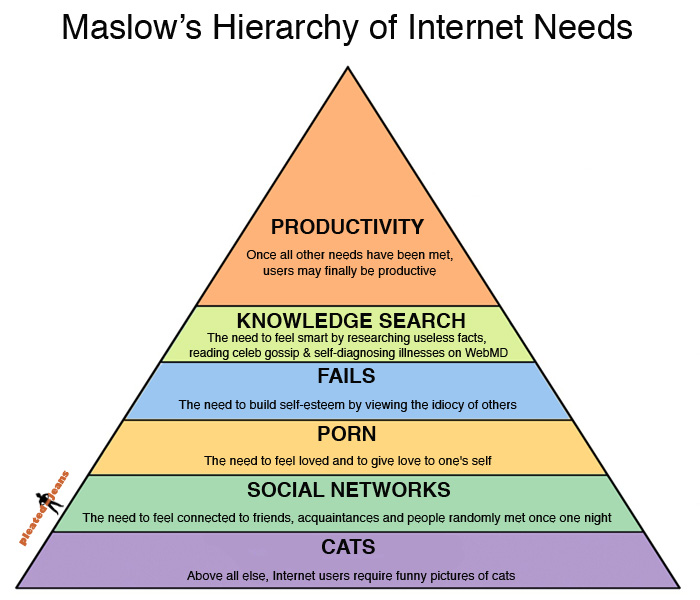
H/T to Michael O’Connor Clarke who advises “Caution: may cause psych majors to eject hot coffee through nasal passages.”


