
The words “hype”, “fad” and “trend” were bandied about. As was my absolute favourite, “hipster fuckery”. What’s hipster fuckery, you ask? According to its utterer, it is the completely unnecessary addition of whimsical ingredients and brewing techniques, especially piled on top of each other. You’re left with a beer that is fighting itself.
Hipster fuckery is a great way to alienate potential craft beer fans.
So how about we all just agree to be innovative as hell, but stop well short of hipster fuckery? Excellent! But, umm, where is that line exactly?
Rebecca Whyman, “Beer gimmicks, pretentious nonsense and other hipster fuckery”, The Growler: Ontario Craft Beer Guide, Volume 1, Issue 3, 2018.
July 31, 2021
QotD: The dangers of “hipster fuckery” in the craft beer business
Comments Off on QotD: The dangers of “hipster fuckery” in the craft beer business
July 28, 2021
Tank Chats #117 | Stridsvagn 103 | The Tank Museum
The Tank Museum
Published 5 Feb 2021Curator David Willey discusses the Cold War era Swedish Stridsvagn 103, also known as the ‘S-Tank’. Developed in the 1950s, the S-Tank was the first production tank to be powered by a turbine engine and it was also the only mass produced tank since the Second World War to not have a turret. A truly unconventional tank.
(more…)
Comments Off on Tank Chats #117 | Stridsvagn 103 | The Tank Museum
July 9, 2021
Evolution of the Sturmgewehr: MP43/1, MP43, MP44, and StG44
Forgotten Weapons
Published 18 Oct 2017Today we are going to look at the evolution of the Sturmgewehr — from the MP43/I and MP43 to the MP44 and StG44, what actually changed and why?
http://www.patreon.com/ForgottenWeapons
Cool Forgotten Weapons merch! http://shop.bbtv.com/collections/forg…
If you enjoy Forgotten Weapons, check out its sister channel, InRangeTV! http://www.youtube.com/InRangeTVShow

Comments Off on Evolution of the Sturmgewehr: MP43/1, MP43, MP44, and StG44
July 6, 2021
QotD: Generational dislocation
Grant McCracken, “Gender Watch”, This Blog Sits at the, 2005-03-24.
Update: Link had rotted since I first posted this on the old blog. The link has been updated to the current location. H/T to WarEagle82 for calling this to my attention.
Comments Off on QotD: Generational dislocation
July 2, 2021
Britain’s “agricultural revolution”
In the latest Age of Invention newsletter, Anton Howes wonders about the almost-forgotten revolution that pre-dated the much better known Industrial Revolution:
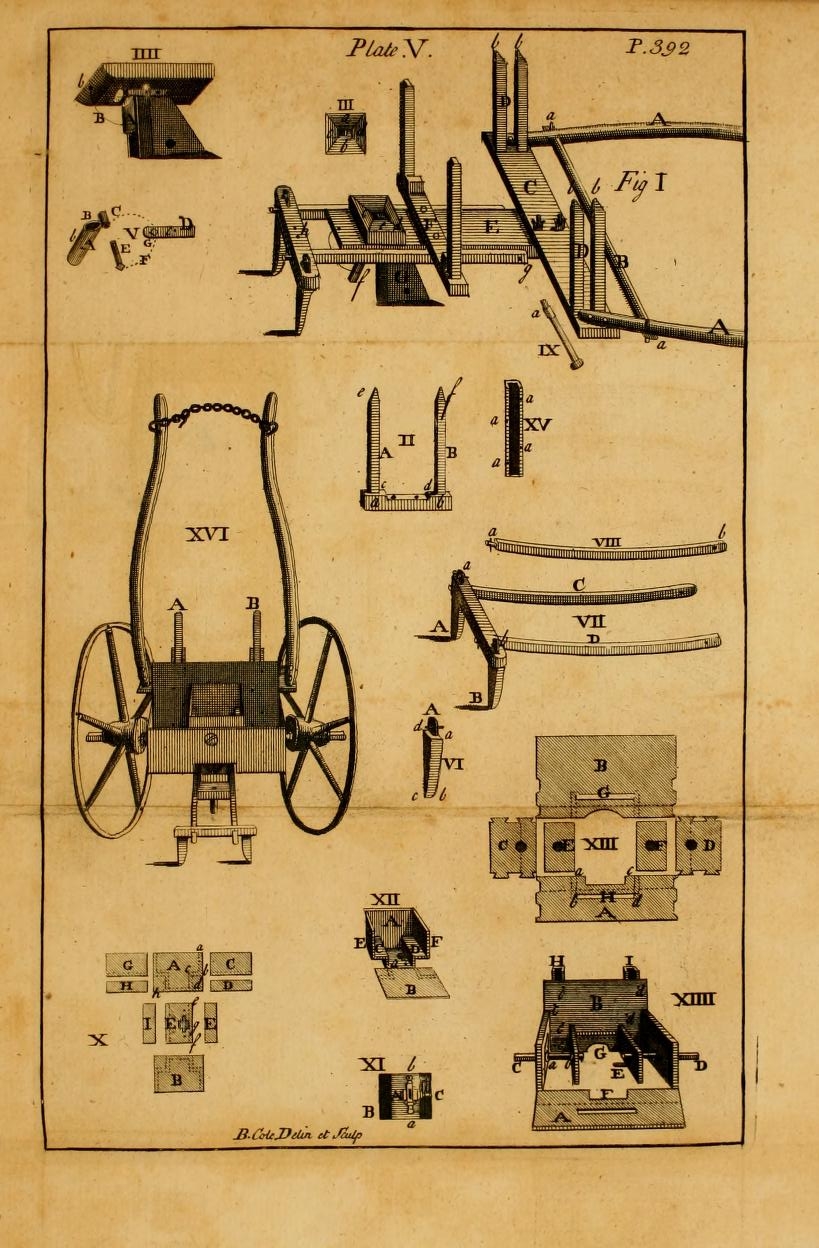
Illustration of a seed drill from Horse-hoeing husbandry, 4th edition by Jethro Tull, 1762 (original work 1731).
Wikimedia Commons.
Whatever happened to “the Agricultural Revolution” of seventeenth and eighteenth-century Britain? In recent years I’ve hardly seen the term used at all, and the last major book on the subject was seemingly published twenty-five years ago. It has become almost totally eclipsed by its more famous sibling “the Industrial Revolution”, with its vivid associations of cotton, coal, and exponential hockey-stick graphs.
Yet for all that popularity, nearly every book investigating the causes of modern economic growth complains about the use of The Industrial Revolution. Even one of the pioneers of economic history, T. S. Ashton, who actually wrote the book The Industrial Revolution, complained on the very second page about the term’s inaccuracy. Much like “Holy Roman Empire”, there’s an error in every word. It involved too many series of changes to really be a The, was about so much more than just industry, and was too gradual a process to properly call a revolution. Yet Ashton had to concede that the term had “become so firmly embedded in common speech that it would be pedantic to offer a substitute.” And this was in 1948. In the intervening three quarters of a century, the term has become all the more difficult to dislodge.
I am, like everyone else, guilty of perpetuating the term Industrial Revolution. It’s a useful shorthand for people to at least get a rough idea of what I’m talking about, for me to then refine. Best to start with what people know, or at least what they think they know, and go from there. You may think of the Industrial Revolution as being about cotton, coal, and steam, but the period also saw major developments in every other industry, from agriculture to watch-making, and everything in-between. And so on. My preferred terms, like “acceleration of innovation”, always require at least a paragraph or two of explanation first.
With the term Agricultural Revolution, however, there’s just no need to reference it. Nobody really talks about it, or has anything more than a very vague conception of what it may mean. At best, people recall a few things from decades-old textbooks: names like “Turnip” Townshend or Jethro Tull, and perhaps a smattering of jargon like selective breeding, crop rotation, or enclosures. Even these are widely misunderstood. See last week’s post, for patrons, on how we get almost everything about the enclosure movement wrong. As for the Agricultural Revolution’s timing, who knows? When, over the course of the sixteenth, seventeenth, eighteenth, and maybe even nineteenth centuries is it supposed to have occurred? With the Industrial Revolution, there’s at least a “classic” period of 1760-1830, with a few decades of leeway. That is of course up for debate, and I’m especially keen on pushing it back much earlier, but it’s at least a half-decent starting point. With the Agricultural Revolution, there’s just no baseline at all. The experts themselves can’t agree.
For all that the term Agricultural Revolution has lost its salience, however, early modern changes to the productivity of agriculture were perhaps the most important of all. The ability to support a much larger population is itself a major economic achievement. For all that we obsess over historical measures of GDP per person, we often forget the much earlier and extraordinary increase in just the sheer number of people. In the early seventeenth century England’s population not only recovered to its pre-Black Death peak of about 5 million, but then from 1700 onwards it began to exceed it. By 1800, after just another century, the population of Britain had doubled to 10 million. And this in a period throughout which the country was a net exporter of grain.
Comments Off on Britain’s “agricultural revolution”
June 22, 2021
QotD: The “Stringbag”, formally known as the Fairey Swordfish
There are three reasons for this feat. The first is that the British were early adaptors of night operations, and performed successful Swordfish strikes (such as the amazingly successful strike at the Port of Taranto which crippled or sank several major warships – becoming the Japanese model for Pearl Harbor), and successful night attacks at sea once the second innovation came in. This was the development of airborne radar, which was first operational on Swordfish operating on British carriers six months before Pearl Harbor. The British were to hold this unique ability to use radar for carrier aircraft operations for a couple of years before the Americans deployed similar concepts in 1943. They were to hold their unique advantage of night-time strikes also. (Both the Japanese and Americans lost many pilots over the next few years in strikes that failed to get home before dark!) So the Swordfish could soldier on under the cover of night, and continued to be useful as a strike aircraft long after its use in daytime had been demonstrated to be suicidal by the easy slaughter of those attempting to attack the Scharnhorst and Gneisenau during the Channel Dash in 1941.
The third, and unexpected reason, why the Swordfish was still in production at the end of the war, was that its unrivalled flying characteristics made it the only aircraft capable of surviving operations from small escort carriers operating in the Arctic Circle in bad weather. Whereas more modern, higher speed aircraft, like the Hurricane, Wildcat and Avenger could work from escort carriers in calmer seas, none of those would even consider operations under the sort of conditions that a Swordfish could easily manage. So the venerable old bus continued to serve successfully purely in an anti-submarine role until the final days of the war. This was not because there weren’t many better aircraft available, but simply because no other aircraft available could do the job as well. An example of a World War Two aircraft still having a (slightly reduced) role, long after being technically obsolete — see the many inadequate fighters that lived on as very successful night fighters. (Though the fact that “modern” B-52s are scheduled to still be operational 80 or 90 years after their initial deployment shows that new roles are always possible for reliable old aircraft, even when their technology is fifty years out of date.)
Nigel Davies, “Comparing naval aircraft of World War II”, rethinking history, 2010-12-20.
Comments Off on QotD: The “Stringbag”, formally known as the Fairey Swordfish
June 21, 2021
Turner Semiauto SMLE Conversion
Forgotten Weapons
Published 12 Nov 2016Cool Forgotten Weapons Merch! http://shop.bbtv.com/collections/forg…
Russell Turner was a Pennsylvania gunsmith and inventor who developed this semiautomatic conversion of an SMLE bolt action rifle circa 1940. It was intended for trial and potential sale to the Canadian military, as it would allow them to retrofit existing rifles into semiautomatic configuration and still use existing supplies of .303 British ammunition. Rather than try to devise a reliable system to rotate the original Enfield bolt, Turner replaced the bolt entirely, using instead a side-tilting design much like what he used in his M1 Carbine trials rifle for the US military. This was coupled with a long stroke gas piston and a hammer firing trigger mechanism.
Reportedly the rifle was tested by Canadian authorities, and performed quite well, with the adjustable gas system allowing it to function reliably even in temperatures of 25 below zero (where the Garand, tested alongside, experienced problems). However, Turner’s rifle was deemed too complex for military adoption.
That decision against the rifle was probably the right one for Canada, although Turner’s conversion is one of the better semi auto bolt acton conversions I have handled. It was remarkably non-awkward — that may not sound like much to crow about, but it sets a pretty high standard for this type of rifle.

Comments Off on Turner Semiauto SMLE Conversion
June 18, 2021
Innovation was minimal in the Roman Empire, because slave societies think they don’t need new inventions
Mark Koyama writes for the Foundation for Economic Education on the similarities and differences of the economy of the Roman Empire at its second-century peak and the booming European economies of the 17th and early 18th centuries:
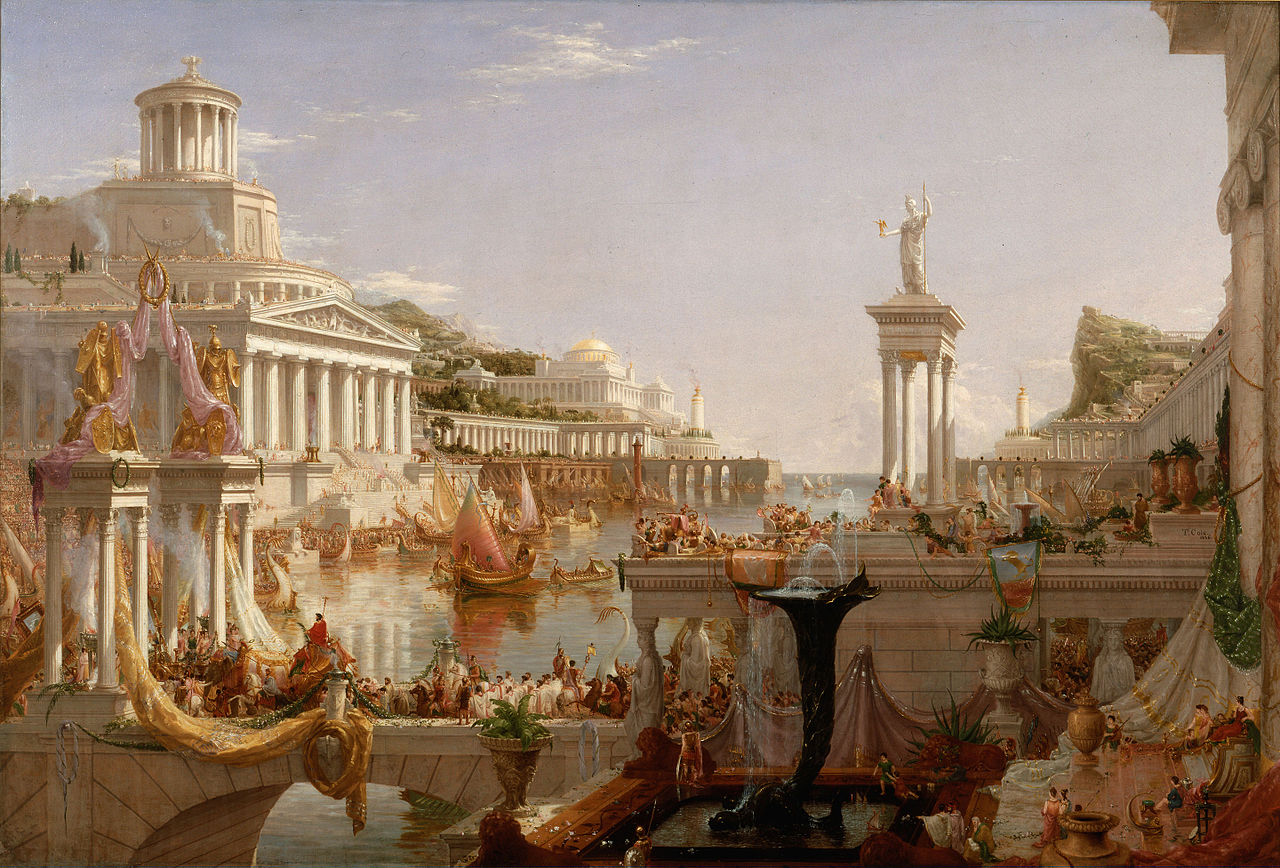
“The Consummation of Empire” from the painting series “The Course of the Empire” by Thomas Cole (1801-1848).
New York HIstorical Society collection via Wikimedia Commons.
The most obvious institutional difference between the ancient world and the modern was slavery. Recently historians have tried to elevate slavery and labor coercion as a crucial causal mechanism in explaining the industrial revolution. These attempts are unconvincing […] but slavery certainly did dominate the ancient economy.
In its attempt to draw together the various strands through which slavery permeated the ancient economy, [Aldo] Schiavone’s chapter “Slaves, Nature, Machines” [in The End of the Past] is a tour de force. At once he captures the ubiquity of slavery in the ancient economy, its unremitting brutality — for instance, private firms that specialized in branding, retrieving, and punishing runaway slaves — and, at the same time, touches the central economic questions raised by ancient slavery: to what extent was slavery crucial to the economic expansion of the period between 200 BCE and 150 AD? And did the prevalence of slavery impede innovation?
It is impossible to do justice to the argument in a single post. Suffice to say that after much discussion, and many fascinating interludes, Schiavone suggests that ultimately the economic stagnation of the ancient world was due to a peculiar equilibrium that centered around slavery.
One can think of this equilibrium as resting on two legs. The first is the observation that the apparent modernity of the ancient economy — its manufacturing, trade, and commerce rested largely on slave labor. The expansion of trade and commerce in the Mediterranean after 200 BC both rested on and drove the expansion of slavery. Here Schiavone notes that the ancient reliance on slaves as human automatons — machines with souls — removed or at least weakened, the incentive to develop machines for productive purposes.
The existence of slavery, however, was not the only reason for the neglect of productive innovation. There was also a specific cultural attitude that formed the second leg of the equilibrium:
None of the great engineers and architects, none of the incomparable builders of bridges, roads, and aqueducts, none of the experts in the employment of the apparatus of war, and none of their customers, either in the public administration or in the large landowning families, understood that the most advantageous arena for the use and improvement of machines — devices that were either already in use or easily created by association, or that could be designed to meet existing needs — would have been farms and workshops
The relevance of slavery colored ancient attitudes towards almost all forms of manual work or craftsmanship. The dominant cultural meme was as follows: since such work was usually done by the unfree, it must be lowly, dirty and demeaning:
technology, cooperative production, the various kinds of manual labor that were different from the solitary exertion of the peasants on his land — could not but end up socially and intellectually abandoned to the lowliest members of the community, in direct contact with the exploitation of the slaves, for whom the necessity and demand increased out of all proportion … the labor of slaves was in symmetry with and concealed behind (so to speak) the freedom of the aristocratic thought, while this in turn was in symmetry with the flight from a mechanical and quantitative vision of nature
Thus this attitude also manifests itself in the disdain the ancients had for practical mechanics:
Similar condescension was shown to small businessmen and to most trade (only truly large-scale trade was free from this taint). The ancient world does not seem to have produced self-reproducing mercantile elites. Plausible this was in part because of the cultural dominance of the landowning aristocracy.
The phenomenon coined by Fernand Braudel, the “Betrayal of the Bourgeois”, was particularly powerful in ancient Rome. Great merchants flourished, but “in order to be truly valued, they eventually had to become rentiers, as Cicero affirmed without hesitation: ‘Nay, it even seems to deserve the highest respect, if those who are engaged in it [trade], satiated, or rather, I should say, satisfied with the fortunes they have made, make their way from port to a country estate, as they have often made it from the sea into port. But of all the occupations by which gain is secured, none is better than agriculture, none more delightful, none more becoming to a freeman'” (Schiavone, 2000, 103).
Such a cultural argument fits perfectly with Deirdre McCloskey’s claim in her recent trilogy that it was the adoption of bourgeois cultural norms and specifically bourgeois rhetoric that distinguished and caused the rise of north-western Europe after 1650.
Comments Off on Innovation was minimal in the Roman Empire, because slave societies think they don’t need new inventions
June 17, 2021
Encouraging innovation by … rejigging the honours system
In the latest Age of Invention newsletter, Anton Howes considers how one man’s efforts to encourage and reward innovation in the United Kingdom eventually led to “mere inventors” receiving honours that once were dedicated to military paladins and political giants:
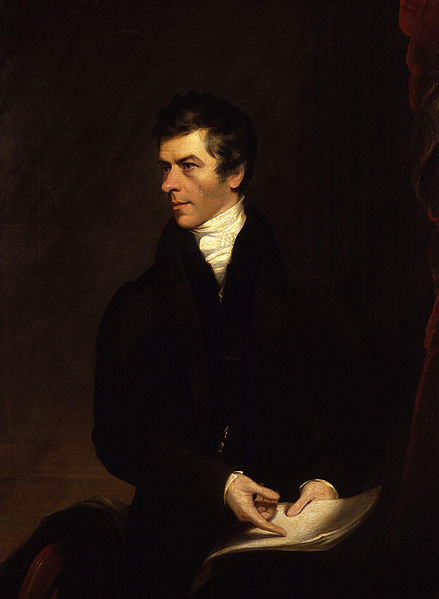
Henry Brougham, 1st Baron Brougham and Vaux, by James Lonsdale (died 1839), given to the National Portrait Gallery, London in 1873.
Image from the National Portrait Gallery via Wikimedia Commons.
One of my all-time favourite innovation evangelists is the nineteenth-century barrister, journalist, and politician Henry Brougham. He was an innovator himself, in the late 1830s designing a form of horse-drawn carriage, and as a teenager even managed to get his experiments on light published in the Royal Society’s prestigious Transactions. But his main achievements were as an organiser. Clever, dashing, and articulate, the son of minor gentry, he was an evangelist extraordinaire. In the 1820s he helped George Birkbeck to found the London Mechanics’ Institute (which survives today as Birkbeck, University of London), was instrumental in the creation of University College London (to provide a university in England where you didn’t have to swear an oath to the Church of England), and founded the Society for the Diffusion of Useful Knowledge (to print reference works and textbooks cheaply and in bulk). They were all organisations intended to widen access to education, spreading science to the masses.
He also presided at the opening of many more worker-run mechanics’ institutions, libraries, and scientific societies. As a Member of Parliament who went out of his way to support workers’ efforts at self-education, even though none of them could vote, Brougham thus became something of a celebrity to working-class inventors. John Condie, born in Gorbals, Glasgow, to poor parents, and apprenticed to a cabinet maker, would become a prolific and successful improver of iron-making, locomotive springs, and photography, as well as an inspiring lecturer on scientific subjects in his own right — his students at the Eaglesham Mechanics’ Institution were reportedly so engrossed that they would attend his evening classes until midnight. Having once exhibited a model steam engine at the opening of the Carlisle Mechanics’ Institution, however, Condie was reportedly “not a little proud” that Brougham — who had presided at the opening — recalled the model over thirty years later. The detail comes from Condie’s obituary notice in the local papers; I like to think that it was a story upon which he frequently dined out.
Brougham’s celebrity, I suspect, made him appreciate the usefulness of status and prestige, and his influence only grew when in 1830 he was made a lord and appointed Lord High Chancellor — a high-ranking ministerial position, which he held for four years. Brougham was soon behind many efforts to increase the visibility of inventive role-models. The nineteenth-century mania for putting up statues — to people like Johannes Gutenberg, Isaac Newton, and James Watt — often had Brougham or his political allies behind them. Brougham even hoped that while the “temples of the pagans had been adorned by statues of warriors, who had dealt desolation … ours shall be graced with the statues of those who have contributed to the triumph of humanity and science”.
His hero-making extended to print, too, when in the 1840s his Society for the Diffusion of Useful Knowledge embarked on publishing a comprehensive biographical dictionary — an early forerunner to the Oxford Dictionary of National Biography, but with the extraordinary aim of covering notable individuals from all over the world. It managed to print seven volumes covering the letter “A” before financial considerations forced the whole society to cease, but in 1845 Brougham published Lives of Men of Letters and Science who Flourished in the Time of George III, in which he showcased a handful of eighteenth-century literati and scientists from whom readers were to draw inspiration.
And Brougham tried to raise the status of inventors who were still living. This was done by co-opting a Hanoverian order of chivalry, the Royal Guelphic Order (by this stage the kings of the United Kingdom of Great Britain and Ireland were also simultaneously the kings of Hanover). The order was generally used to recognise soldiers, but an interesting precedent had been set when the astronomer Frederick William Herschel, the discoverer of Uranus, had been made a knight of the order in 1816. So when Brougham rose to power in the 1830s, he envisaged using it more widely, to recognise inventors, scientists, and medical pioneers, as well as literary scholars like museum curators, archivists, antiquarians, historians, heralds, and linguists. Thanks to Brougham’s machinations, the knighthood of the order was offered to the mathematician James Ivory, the scientist and inventor David Brewster, and the neurologist Charles Bell (after whom Bell’s Palsy is named). It was later also awarded to serial inventors like John Robison, who improved the accuracy of metal screws, experimented with cast iron canal locks and the water resistance of boats, and applied pneumatic presses to cheesemaking.
One problem, however, was that the Royal Guelphic Order was considered second-rate. It was technically a foreign order, and did not actually entitle one to be called “Sir” in the UK. The mathematician and computing pioneer Charles Babbage was apparently insulted to have been fobbed off with the offer of a Guelphic knighthood instead of a British one. Although William Herschel had accidentally been called “Sir” during his lifetime, this was soon realised to be a mistake in protocol. When his son John — a scientific pioneer in his own right — was also made a knight of the order, he was also quietly knighted normally a few days later so that the rest of the family would be none the wiser. And regardless, the whole scheme came to an end with the accession of Queen Victoria in 1837 — as a woman, she did not inherit the throne of Hanover, and so appointments to the Guelphic order simply passed out of British control.
Comments Off on Encouraging innovation by … rejigging the honours system
MG-34: The Universal Machine Gun Concept
Forgotten Weapons
Published 7 Oct 2017The MG34 was the first German implementation of the universal machine gun concept — and really the first such fielded by any army. The idea was to have a single weapon which could be used as a light machine gun, heavy machine gun, vehicle gun, fortification gun, and antiaircraft gun. The MG34 was designed to be light enough for use as an LMG, to have a high enough rate of fire to serve as an antiaircraft gun, to be compact and flexible enough for use in vehicles and fortifications, and to be mounted on a complex and advanced tripod for use as a heavy machine gun.
Mechanically, the MG34 is a recoil operated gun using a rotating bolt for locking. It is chambered for 8mm Mauser, and feeds from 50-round belt segments with a clever and unique quick-change barrel mechanism. The early versions were fitted with adjustable rate reducers in the grips allowing firing from 400 to 900 rounds per minute, and also had an option for a top cover which would fit a 75-round double drum magazine. Both of these features were rather quickly discarded, however, in the interest of more efficient production. However, the gun fulfilled its universal role remarkably well.
The MG34 was considered a state secret when first developed, and despite entering production in 1936 it would not be formally adopted until 1939 — by which time 50,000 or so had already been manufactured. It would comprise about 47% of the machine guns in German service when the Wehrmacht invaded Poland, but would be fully standardized by March of 1941. It was replaced by the MG42 later in the war, as that weapon was both faster and cheaper to produce and also required substantially less of the high-grade steel alloys that Germany had limited supplies of. However, it would continue to be produced through the war, particularly for vehicle mounts.
http://www.patreon.com/ForgottenWeapons
Cool Forgotten Weapons merch! http://shop.bbtv.com/collections/forg…
If you enjoy Forgotten Weapons, check out its sister channel, InRangeTV! http://www.youtube.com/InRangeTVShow

Comments Off on MG-34: The Universal Machine Gun Concept
June 12, 2021
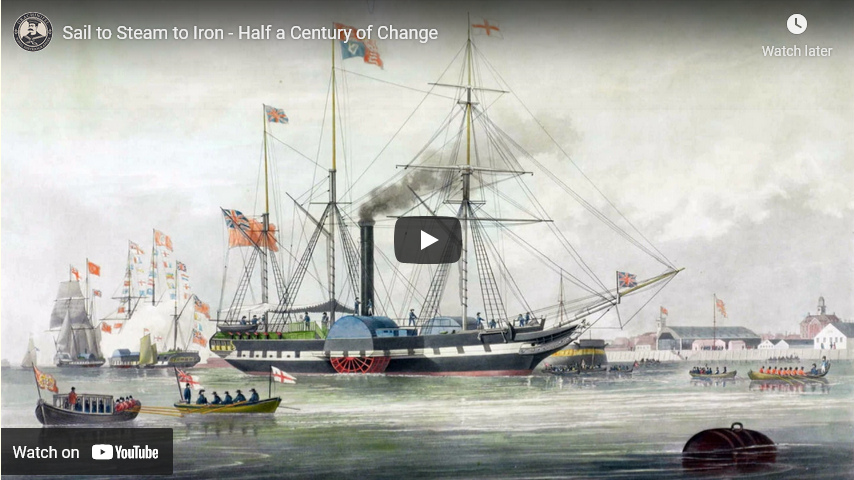
Sail to Steam to Iron – Half a Century of Change
Drachinifel
Published 19 Dec 2018Today we look at the development of warships from 1815 to 1860.
Want to support the channel? – https://www.patreon.com/Drachinifel
Want to talk about ships? https://discord.gg/TYu88mt
Comments Off on Sail to Steam to Iron – Half a Century of Change
June 11, 2021
Tanks Chats #110 | T-72 | The Tank Museum
The Tank Museum
Published 13 Nov 2020Join David Willey as he discusses the T-72, a Soviet era main battle tank which first entered production in 1971. The T-72’s service life has proven to be extremely successful. With about 20,000 produced, it has seen service with over 40 countries, and thanks to refurbishment, is still in service to this very day.
With thanks to RecoMonkey for additional images https://www.recomonkey.com/
(more…)
Comments Off on Tanks Chats #110 | T-72 | The Tank Museum
June 10, 2021
The odd history of Irish Cream as we make Irish Cream hard candy at Lofty Pursuits
Lofty Pursuits
Published 25 Feb 2021Jake makes Irish Cream green shamrock hard candy for St. Patrick’s day. We discuss the history of the weird flavor and how it has become a tradition even though it was invented in the 1970’s
A great article about the history of Irish Cream
https://www.irishtimes.com/culture/bo…Buy our candy: http://www.pd.net
Listen to our podcast: http://loftypursuits.libsyn.com/website
Join our Patreon at https://www.patreon.com/LoftyPursuits

Comments Off on The odd history of Irish Cream as we make Irish Cream hard candy at Lofty Pursuits
June 2, 2021
Prototype Ross “H5” from 1909
Forgotten Weapons
Published 22 Feb 2021http://www.patreon.com/ForgottenWeapons
https://www.floatplane.com/channel/Fo…
Cool Forgotten Weapons merch! http://shop.bbtv.com/collections/forg…
The Ross MkII (aka Ross 1905) was a reasonably successful rifle design, but it lacked a few elements that the Canadian military would have preferred. Most significantly, it was not compatible with the charger clip that was introduced for the Lee Enfield rifles in 1907. The rifle we have today is a toolroom prototype Ross from about 1909 that was an experiment in adding clip compatibility. The receiver is a 1905/MkII type, but with a combination stripper clip guide and rear sight screwed onto the rear of the action. It has a 5-round staggered Mauser-type magazine box, a Lee Enfield style buttstock, a 1903 Springfield type bolt stop, and a thinner profile barrel than either the MkII or eventual MkII Ross patterns. The only marking on the rifle is the designation “H5” on the receiver and bolt. Ultimately, virtually none of this rifle’s unique features were included in the finalized MkIII Ross.
Contact:
Forgotten Weapons
6281 N. Oracle #36270
Tucson, AZ 85740

Comments Off on Prototype Ross “H5” from 1909
May 8, 2021
Special Presentation: Semiauto Pistols of the 1800s
Forgotten Weapons
Published 19 Sep 2018http://www.patreon.com/ForgottenWeapons
Cool Forgotten Weapons merch! http://shop.bbtv.com/collections/forg…
Today’s Special Presentation is an overview of all the semiautomatic pistols that were actually put into serial production before the year 1900. We have looked at these individually before, but I think it is worthwhile to examine them together in context, to gain a better understanding of what the automatic pistol scene was really like in the last years of the 19th century.
If you enjoy Forgotten Weapons, check out its sister channel, InRangeTV! http://www.youtube.com/InRangeTVShow
Contact:
Forgotten Weapons
6281 N Oracle #36270
Tucson, AZ 85704
From the comments:
Joseph Heschmeyer
2 years ago (edited)
“Hi guys, thanks for tuning in for another video on ForgottenWeapons.com. Today we’ll be looking at the science fair project that got me kicked out of middle school.”

Comments Off on Special Presentation: Semiauto Pistols of the 1800s


