
In reality, economics is not the fiscal rocket-science you make it sound. Capitalism itself is based on good old-fashioned honesty. The money at the heart of it must be both an honest store-of-value and an efficient medium of exchange. It ceases to be so when the inherent deceits of fractional reserve banking allow trillions of false credit to be pumped into the system, thus forcing up prices (booms) which inevitably lead to over-valued commodities (busts).
What happens next is that the banks, having privatised their gains in the good times, simply socialise their losses onto the tax-payer. It’s a crime. Simple as that really.
Telegraph commentator “dionysusreturns“, responding to “Fed fiddles as America slides back into recession” by Ambrose Evans Pritchard, 2012-07-15
July 18, 2012
QotD: Quantitative Easing is institutionalized theft
April 17, 2012
Argentina’s latest economic lesson
Jan Boucek explains why Argentina is providing a helpful example to other countries on what not to do in economic policy:
This week, President Cristina Fernandez de Kirchner announced the seizure of Spanish oil company Repsol’s stake in Argentine oil company YPF to give the government 51% control. Spain is outraged and has recalled its ambassador. […]
Ms Fernandez justified her move on the grounds that YPF has failed to invest sufficiently to prevent Argentina from importing ever greater quantities of fuel. The fact that Argentine oil reserves have been dwindling means the sector needs greater and increasingly sophisticated investment to reach more complex structures, just like in the North Sea. Expropriation isn’t going to attract that kind of high-risk investment.
[. . .]
The YPF seizure continues Argentina’s cavalier attitude towards other people’s money shown back in 2008 when Ms Fernandez grabbed some $24 billion of private pension funds and used central bank reserves to meet debt payments. More recently, the country has been in a spat with the IMF over the quality of its statistics. Argentina claims inflation is running at somewhere between 5% and 11% but private independent estimates put the number at somewhere around 25%. The Economist is refusing to publish official Argentine inflation data.
Update: Well, regardless of the state of the economy, President Fernandez de Kirchner has a friend in the White House! President Obama has indicated his support for the Argentinian claim to … the ¿Maldives?
President Obama erred during a speech at the Summit of the Americas in Cartagena, Colombia, when attempting to call the disputed archipelago by its Spanish name.
Instead of saying Malvinas, however, Mr Obama referred to the islands as the Maldives, a group of 26 atolls off that lie off the South coast of India.
The Maldives were a British protectorate from 1887 to 1965 and the site of a UK airbase for nearly 20 years.
March 28, 2012
“[T]he Government of Canada is [like] a big national insurance company with a side business as a tax collector for the provinces”
Kevin Milligan in the Globe and Mail:
The first question to ask of any budget announcement is whether the dollars are recurring or one-time only. If we change a tax that brings in $1-billion a year, the budget changes not just this year but in future years as well. […] Politicians and commentators often choose the time frame that suits their current argument. Confusion results. A good economist keeps her eye open to these tricks and tries to ensure we compare numbers on similar time-frames.
Next up is properly adjusting future dollars to account for inflation and our ability to pay. Dollars spent in the future are different than dollars spent now. Imagine that inflation averages 2 per cent a year, and inflation-adjusted economic growth is 1.5 per cent a year on top of that. In just 20 years, prices will increase by 50 per cent and the size of our economy — and our ability to pay for programs priced in nominal dollars — will double.
[. . .]
As a final note, it is always useful when crunching the numbers to keep in mind what the Government of Canada actually does with our tax dollars. Transfers to individuals for insurance programs (such as Employment Insurance and Old Age Security) are 25 per cent of spending. Transfers to provinces and territories (health and other transfers) are another 20 per cent. Interest takes a further 11 per cent. The best way to think of the Government of Canada is a big national insurance company with a side business as a tax collector for the provinces. (This is only slightly different from the US Government, which has been called by Ezra Klein an insurance company with a standing army.) Everything else the Government of Canada does — from fisheries management to culture to the military — takes the remaining 44 per cent. Making any change to the trajectory of total spending when insurance and inter-government transfers are both projected to grow rapidly requires very large changes to that residual 44 per cent.
December 14, 2011
October 22, 2011
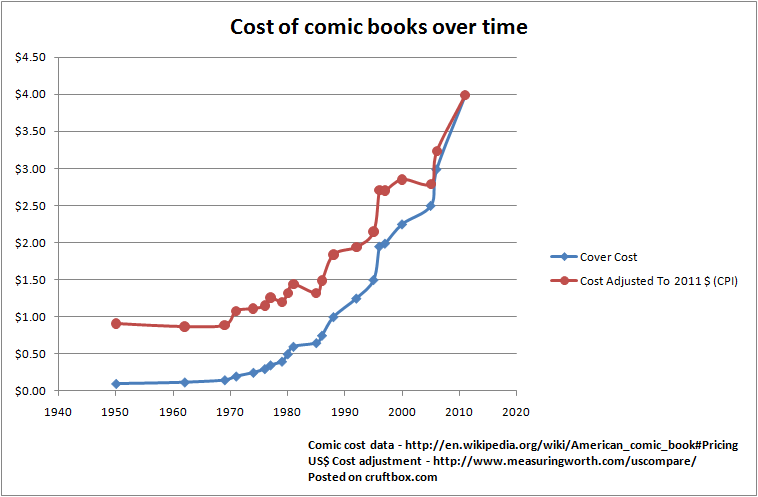
This probably explains why the “typical” comic book reader is no longer a young teen
It’s all in the economics of the comic book world:
Looking at the graph we can see that the relative price of a comic book stayed around a buck until 1970 or so, slowly ramping up to a buck fifty over the next 15 years. That’s a 50% increase. From 1985 to 2000 the price almost doubles (100%) getting neat three dollars. From 2000 to 2011, it’s around a 33% increase.
It’s a fact that costs increase over time, so I’m not saying prices could remain at a buck forever. But it is hard to see how young kids and teenagers can get into comic books, it’s simply too expensive. For $20 you get 5-7 books. Serious comic readers will pick up 10-20 books a week. A few years ago, when I was a more regular reader, I would the totals of other people routinely $30-50 a week. That’s $120-200 per MONTH. There can’t be many parents helping pay that much for a kid’s comic habit.
When my family came to Canada in 1967, one of the things I missed the most were British comics. Canadian American comics were very different from what I was used to, so I never really became much of a comic collector. I’d pick up the odd few, but it never was a “have to buy” item for me. I remember having to decide whether I wanted the immediate satisfaction of a chocolate bar or a can of pop, or the slightly longer-term satisfaction of a comic book. Immediate satisfaction won more of the time, and with my princely 25 cents per week allowance, there wasn’t a lot of satisfaction whichever way I decided to go.
October 21, 2011
July 21, 2011
This is why the Bank of Canada will raise rates soon
Stephen Gordon explains why the Bank of Canada will be raising interest rates in the near term:
The relatively hawkish language in the Bank of Canada’s interest rate decision — most notably the removal of the word ‘eventually’ from the sentence describing the conditions in which interest rates will increase — took financial markets by surprise.
Central banks try to avoid surprises when they can, but in this case the Bank has the best of excuses: the facts changed.
[. . .]
These new numbers may well be revised away in the coming months, but policy makers have to work with the data they have before them. If you take an output gap that is shrinking much faster than you thought and add it to a core inflation rate that is drifting towards and perhaps past the Bank’s 2 per cent target, you will find yourself in a position where you have to start preparing to increase interest rates earlier than you had planned.
May 18, 2011
China facing recession?
At risk of setting my hobby horse to full gallop, reports like this one are starting to sound a few mild alarms about the real state of China’s economy. But accepting official Chinese government statistics like this isn’t going to help:
The Chinese central bank has responded to overheating in its economy by raising interest rates four times since October 2010. Inflation has subsequently cooled, slowing to 5.3 percent in April, but the economy is still roaring with a 9.7 percent increase in gross domestic product for the first quarter.
The rate moves have raised questions about whether the government is going too far to slow things down, and whether the country can accomplish its desired transition from an export-driven economy to growth based more on internal consumption.
As I’ve said several times before, you can’t trust these kinds of numbers because they’re not independently generated from reliable data. They’re numbers that range from kinda-sorta in the same ballpark as reality all the way out to the lower stratosphere. The people providing the numbers are subject to rather more risk than just losing their jobs if they displease the government. Honesty is not a virtue when your life may depend on providing the “right” answer.
As Monty puts it:
I’ll keep hammering this point as long as I’m able: The Chinese “economic miracle” is mostly a sham. The Chinese are awash in cheap Western money, essentially, and when that money dries up (which it is doing right now), the Chinese don’t have much of a domestic market to fall back on. Plus, in case anyone forgot, they’re still run by Communists who don’t really believe in that whole “capitalism” thing.
I’ve ridden this hobby horse many times before. I don’t doubt that I’ll be riding it many times again in the future.
May 10, 2011
“The recent recession was probably the last nail in the coffin of the proposal for a common Canada-U.S. currency. “
Stephen Gordon explains how the Canadian economy has benefitted from the independent Canadian dollar:
Let’s think about what would have happened over the past few years if a monetary union had already been in place. Instead of generating an appreciation of the Canadian dollar, the commodity boom would have drawn in larger and destabilizing flows of investment. As it was, the appreciation of the Canadian dollar tempered the flow of capital, and kept inflation under control.
When the recession hit and commodity prices fell, our floating currency gave us a 20 per cent exchange rate depreciation in the space of five months. This sort of stimulus would have been unavailable under a monetary union — as Spain is now finding out, to its great cost.
For reasons that Paul Krugman explains here, Canada has always been an interesting case study in international monetary policy. Canada’s decision to adopt a floating exchange rate in 1950 — several decades before the post-war Bretton Woods system of fixed exchange rates collapsed — was an unorthodox reaction to a situation with which we’ve become familiar: sharply fluctuating commodity prices.
April 21, 2011
Why the headline inflation rate may not force the Bank of Canada to increase interest rates
Stephen Gordon explains why the spike of certain prices may not trigger interest rate hikes from the Bank of Canada:
The increase in the headline March CPI inflation rate is due to increases in a relatively small number of goods, and is best seen as a change in relative prices that will have only a transitory increase in the CPI. There are two ways that headline CPI can return to target. The first is that consumers adjust their spending patterns and substitute away from the goods whose prices have risen; the resulting fall in demand will bring prices back down. If this doesn’t happen, prices of other goods can fall — or at least rise more slowly — so that the rate of inflation of the broader index falls back to target.
The Bank of Canada is preoccupied with inflation, not fluctuations in relative prices, so the current increase in the CPI will only be a problem if firms and workers start using 3 per cent as a benchmark for increases in wages and the prices of other goods.
Even though the target is the headline CPI inflation rate, it is the Bank’s opinion that the core CPI inflation rate is a better predictor for future inflation. The components of core CPI are generally those whose prices are set infrequently and whose increases reflect expectations for future inflation as well as market conditions. If expected inflation starts to rise, it will be more visible in the core rate than in the headline number.
April 18, 2011
The real secret weapon of the “China economic miracle”
Chriss W. Street thinks the Chinese banks are about to suffer a crisis moment:
It is ironic that China is demanding greater control of the World Bank and International Monetary Fund, just as the nation’s banking system is about to be devastated by the white hot flames of inflation.
From a distance, China’s economy seems to be the poster child of sustainable growth. Recent government reports show the economy expanding by 9.7%, retail sales up a blistering 17.4%, foreign reserves at $3 trillion, and inflation only 5.4%. But these statistics mask a dark side; Chinese communist authorities have been artificially holding down fierce inflationary pressures by subsidizing consumer prices.[. . .]
The less known and far more important secret-weapon of the “China Economic Miracle” is the absolute control of the banking industry by China’s four largest state-owned banks (“SOB”); Industrial and Commercial Bank, Agricultural Bank, People’s Bank of China and Construction. Since the government does not provide adequate social welfare programs and restricts its citizen’s investment options to bank accounts, about 40% of Chinese household income is deposited in SOBs each month. The SOBs then leverage the deposits by ten times and loan 75% of this massive amount of cash at extremely low interest rates to state-owned-enterprises (“SOE”). The other 25% of lending is allocated to real estate development.
China is no stranger to bankers making risky loans to communist party officials and their crony real estate developers. During the Asian Financial Crisis of the mid-1990s, it is estimated that 40% of all SOB loans were non-performing and most were written off. The Chinese paid for the SOB losses with a 76% devaluation of their currency that crushed the people’s buying-power by 76%. From 1997 to 2004 Chinese frivolous lending was somewhat restrained, but since 2003 the bureaucrats have mandated a massive expansion of lending. In comparison to the U.S. and Europe where bank lending is flat, SOBs have been expanding loans by 25% annually.
H/T to Jon for the link.
October 13, 2010
QotD: Economic misconceptions
Students typically come to an economics class with many misconceptions, not just random errors but systematic biases.
Bill Goffe recently (2009) surveyed one of his macro principles classes and found, for example, that the median student believes that 35% of workers earn the minimum wage and a substantial fraction think that a majority of workers earn the minimum wage (Actual rate in 2007: 2.3% of hourly-paid workers and a smaller share of all workers earn the minimum wage, rates are probably somewhat higher today since the min. wage has risen and wages have not).
When asked about profits as a percentage of sales the median student guessed 30% (actual rate, closer to 4%).
When asked about the inflation rate over the last year (survey was in 2009) the median student guessed 11%. Actual rate: much closer to 0%. Note, how important such misconceptions could be to policy.
When asked by how much has income per person in the United States changed since 1950 (after adjusting for inflation) the median student said an increase of 25%. Actual rate an increase of about 248%, thus the median student was off by a factor of 10.
Alex Tabarrok, “Economic Misconceptions”, Marginal Revolution, 2010-10-11
August 23, 2010
QotD: Peak Culture
The height of their society peaked in 1969. They used militarism and socialism to put two guys on the Moon, they trotted out their public-private partnership (Concorde) to build exclusive supersonic transport for the rich. Max Faget and some other brilliant engineers designed a space shuttle fleet of ten vehicles capable of hundreds of flights a year to make access to low Earth orbit cheap and routine. And the Advanced Research Projects Agency had some geeks create an inter-networking protocol that could survive a nuclear war.
Obviously, they shot their wad, as it were, and no longer put guys on the Moon. They no longer fly supersonic transports. Their space shuttle is going to stop flying soon, if it hasn’t already. Those geeky guys went on to develop open source cryptography, open source software, and totally private economic transactions. The future we’re creating is going to be very, dramatically different. It is going to be decentralised to a fare thee well.
Right now, today, two people anywhere in the world *can* have a totally private economic exchange that cannot be detected by anyone else. And since it cannot be detected, it cannot be regulated, it cannot be prohibited, and it cannot be taxed. Even inflation cannot tax it, if the exchange is denominated in some money like silver or gold. Which means that those who dream of ruling the world sowed the seeds of their own damnation?
Jim Davidson, “Peak Culture”, Libertarian Enterprise, 2010-08-22
June 8, 2010
Are we ready for “a serious debate about returning to the gold standard”?
The more I read of Maxime Bernier’s thoughts, the more I wonder how long it’ll be before he’s drummed out of Stephen Harper’s party: he’s far too sensible. Here, for example, he outlines what it is that central banks do to your money, and why it’s a bad deal for ordinary Canadians:
All this guessing about setting rates has nothing to do with capitalism and free markets; it has more to do with central planning and government control of the money supply. In a monetary free market, the interest rate would be determined by the demand for credit and the supply of savings, just like any other price in the economy.
Government control over money has serious consequences that few people seem to be aware of.
One of them is that central banks are continually increasing the quantity of money that is circulating in the economy. In Canada for example, if we use the strictest definition of money supply, it has increased by 6 to 14% annually during the past dozen years. The situation is about the same everywhere.
The effects of constantly creating new money out of thin air have been a debasement of our money and a dramatic increase in prices. The reason why overall prices go up is not because businesses are greedy, or because wages go up, or because the price of oil goes up. Ultimately, only the central bank is responsible for creating the conditions for prices to rise by printing more and more money.
With all this, it’s surprising that he has (so far) managed to stay in the Conservative party, which doesn’t appear to actually believe in anything much anymore . . . other than the need to stay in power.
Update, 9 June: His speech (from which the article linked above was drawn) gets positive reviews.
August 13, 2009
QotD: Interpreting the Fed’s message
After two days of satanic worship, no-safeword BDSM and blackface minstrel performances, the Federal Open Market Committee (FOMC) announced today that it will stay the course on currency manipulation. According to the post-meeting press release, the Federal Reserve will maintain its effective negative target range for the federal funds rate. With economic activity “leveling out,” “signs of stabilizing” in household spending, “tight credit,” continued business cutbacks and a “gradual resumption of sustainable economic growth in a context of price stability,” the Fed expects inflation to “remain subdued for some time.” But the Fed is also standing by its plan to discontinue purchases of Treasury debt this fall [. . .]
The plan to phase out Treasury purchases is a bet that inflation will be kicking in by the fall, as Americans gear up for the harvest festival that marks their winter solstice. Will Santa be bringing you a wallet full of degenerated dollars? Some early signs: The greenback spiked right after the FOMC’s announcement, but has been falling against the currencies of countries with adult supervision. Demand for the the 10-year Treasury note followed the same pattern — with the FOMC’s statement triggering a brief flurry after a disappointing auction of $23 billion in new government debt earlier in the day. Maybe the market took the boilerplate about “subdued inflation” seriously. Or maybe it’s easier to believe the economy will heat up when the Fed doesn’t say so.
Tim Cavanaugh, “Fed Thinks It Has Conjured Inflation”, Hit and Run, 2009-08-12


