
Extra Credits
Published on 20 Apr 2019Leopold knew it was time to get the Holy Roman Empire involved if he wanted to keep Vienna, but it wouldn’t be as simple as asking for a favor. Charles of Lorraine and Sobieski of Poland would be the ones to lead the charge on the battlefield against the Janissaries.
Join us on Patreon! http://bit.ly/EHPatreon
April 22, 2019
Siege of Vienna – Charge of the Winged Hussars – Extra History – #3
Comments Off on Siege of Vienna – Charge of the Winged Hussars – Extra History – #3
April 14, 2019
British diplomatic blunders in history – German unification
An interesting article in Vox, suggesting that the gradual unification of all the German principalities, electorates, duchies, counties, bishoprics, free cities, and miscellaneous other semi-independent bits and bobs of the Holy Roman Empire was not inevitable and that — absent British blundering after the Napoleonic wars — it would have produced a very different 20th century:
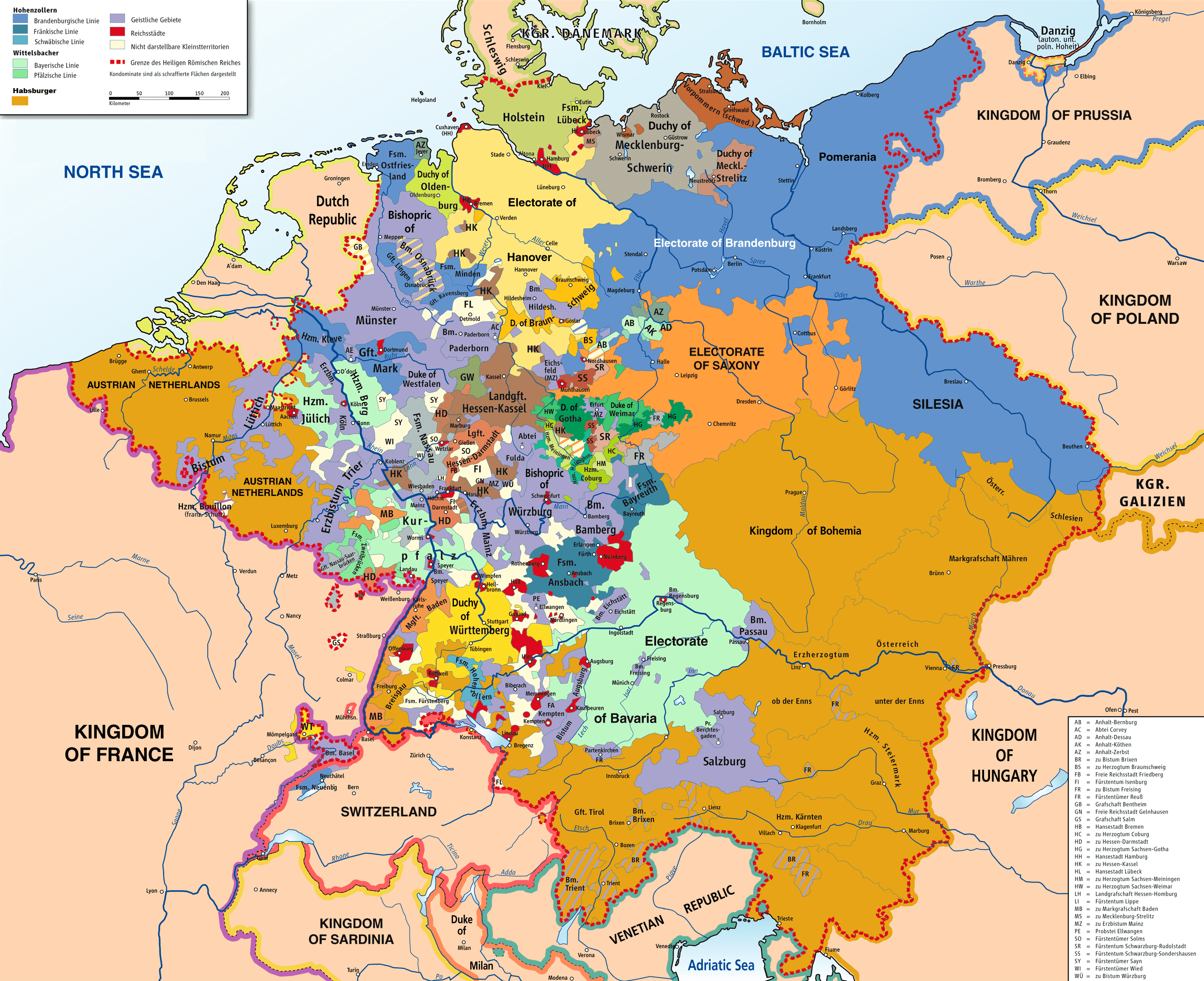
The Holy Roman Empire in 1789, before Napoleon “rationalized” hundreds of smaller entities into the Confederation of the Rhine.
Image from Wikimedia Commons.
The boundaries of states are the heart of many recent debates, be it the European refugee crisis, the Transatlantic Trade and Investment Partnership (TTIP), or Brexit (Snower and Langhammer 2019). After decades of stability, today we are again seeing heated discussions about the shape and extent of political borders. Clearly, borders are neither naturally given nor random. In Europe and elsewhere, the current state borders have been formed and changed over centuries, sometimes peacefully, often in bloody wars. In Huning and Wolf (2019), we look at the formation of the German nation state led by Prussia and trace it back to a change in borders decided at the Congress of Vienna in 1814/15.
In a nutshell, we have two findings:
- First, the geographic position of a state can be a crucial factor for institutional change and development.
- Second, the formation of the German Zollverein in 1834 under Prussian leadership was a truly European story, involving Britain, the Russian Empire, and the Belgian revolution of 1830/31. We show in particular that the Zollverein formed as an unintended consequence of Britain’s intervention in 1814/15 to push back Russian influence over Europe.
In theory, why would the geographic position of a state relative to that of other states matter? Intuitively, it should matter as long as the costs of trade and factor flows depend on their routes. If a large share of my trade has to pass the territory of one or several neighbours, my trade and trade policy will depend on the trade policy of my neighbours. Moreover, if tariffs are levied not only on imports but also on transit trade, as was general practice until the Barcelona Statute of 1921 (Uprety 2006), policymakers face the problem of multiple marginalisation, which is well known from the literature on supply chains. In our work, we provide a simple theoretical framework (in partial equilibrium) to show how the location of a revenue maximising state planner will affect its ability to set tariffs. Some states can increase their tariff revenue at the expense of their hinterland. Next, we show that a customs union can be beneficial for a group of states exactly because it solves the problem of multiple marginalisation.
A major challenge to testing our idea empirically is that a state’s political boundaries (and hence its location) do not change very often, and if they do, the change is unlikely to be unrelated to trade or factor flows. However, the formation of the German Zollverein in 1834 can be considered as a quasi-experiment. Let us briefly revisit this historical episode. At the end of the Napoleonic wars of 1792-1814/15, only Russia and the UK were left as major military powers. Habsburg, Prussia, and the defeated France attempted to consolidate their positions at the expense of the many smaller states that had just about survived the wars, notably the former allies of Napoleon such as Saxony and Poland. Overall, the negotiations at the Congress of Vienna in 1814 were dominated by military-strategic considerations between the two great powers. Russia wanted to expand westwards, Prussia was desperate to annex the populous Kingdom of Saxony, which bordered Prussia in the south and would create a large and coherent territory. To this end, Prussia was willing to give up not only her Polish territories to Russia, but also her positions and claims on the Rhineland (Müller 1986). This met stiff resistance from Britain, joined by Habsburg and France, which feared a new Russian hegemony on the continent – the ‘Polish Saxon question’. After weeks of diplomatic struggle, the outcome was a division of Saxony, another division of Poland and Prussia being established as the “warden of the German gate against France” (Clapham 1921: 98). Figure 1 shows the result of these negotiations.
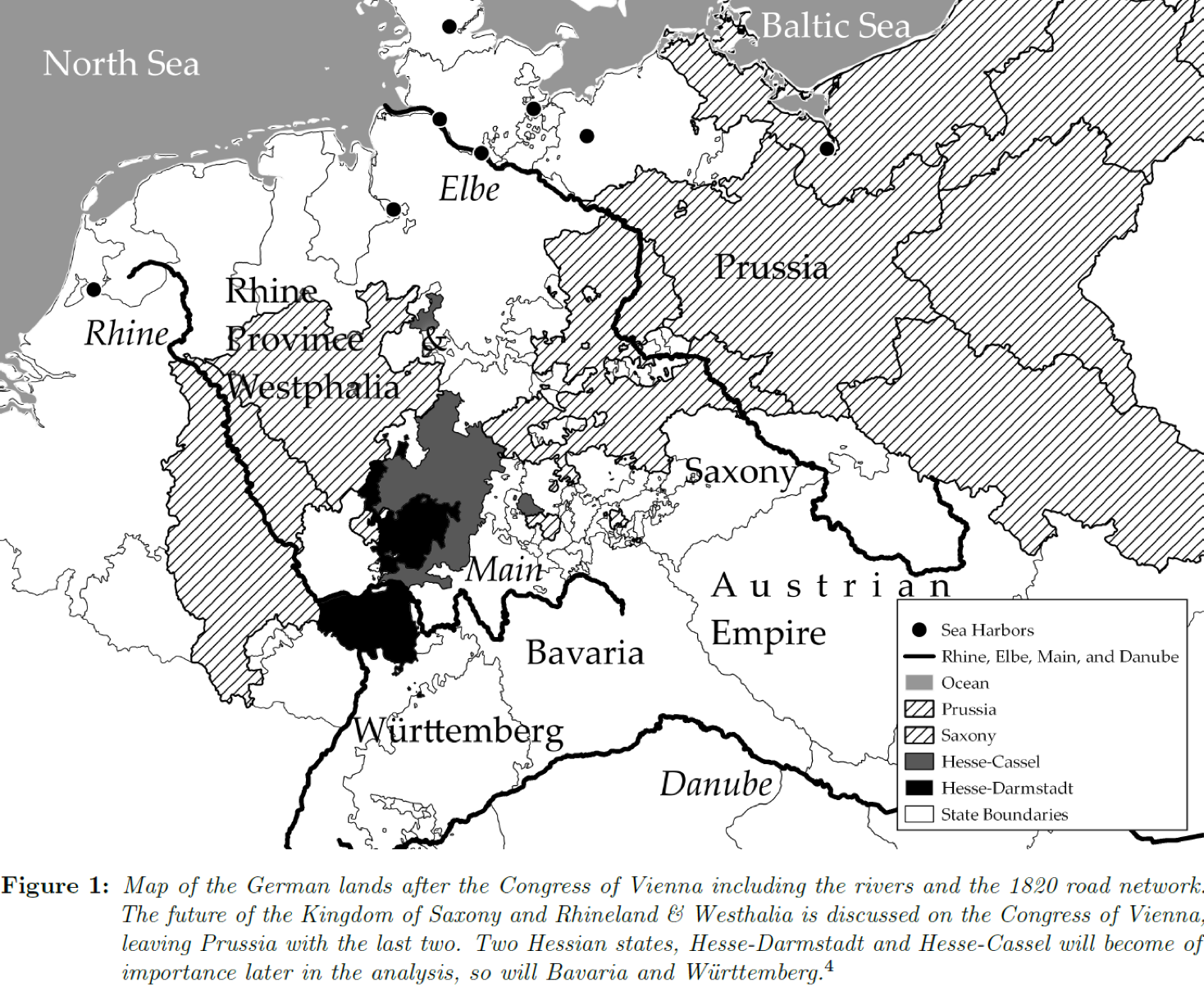
H/T to Continental Telegraph for the link.
Comments Off on British diplomatic blunders in history – German unification
September 23, 2018
30 Years War | 3 Minute History
Jabzy
Published on 28 Oct 2015Thanks to Xios, Alan Haskayne, Lachlan Lindenmayer, William Crabb, Derpvic, Seth Reeves and all my other Patrons. If you want to help out – https://www.patreon.com/Jabzy?ty=h
Comments Off on 30 Years War | 3 Minute History
September 9, 2018
Holy Roman Empire Explained
WonderWhy
Published on 9 Aug 2018Looking at the origins and history of the Holy Roman Empire, assessing the claim by Voltaire that it was not holy, nor Roman, nor an empire, and finally looking at the complex hierarchical political structure of the empire.
Have you ever wondered what the world would be like if the Holy Roman Empire existed today? This video is a collaboration was RealLifeLore, who looked at that very question. Link here: https://www.youtube.com/watch?v=SIwNR…
Comments Off on Holy Roman Empire Explained
June 11, 2018
Feature History – Thirty Years’ War
Feature History
Published on 12 Nov 2016Hello and welcome to Feature History, featuring religious conflict, tragic war, and a really nifty collaboration with Jabzy.
3 Minute History – German Peasant’s War
https://www.youtube.com/watch?v=zeQVAUmyLksInvolvement Chart
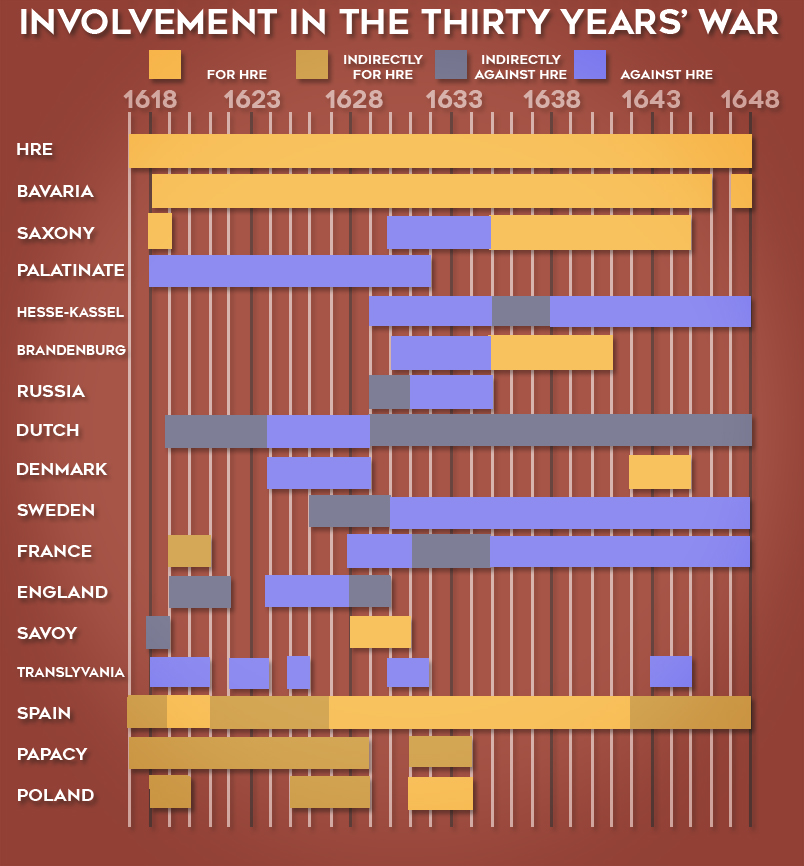
Comments Off on Feature History – Thirty Years’ War
September 13, 2017
The Thirty Years War
Published on 10 Nov 2014
The Thirty Years’ War was fought from 1618-1648 (Thirty Years!) in the Holy Roman Empire. It began as a conflict between Catholics and Protestants in Bohemia, but grew to involve Denmark, Sweden, and France. After the French began helping Gustavus Adolphus, the Protestant king of Sweden, the lines became blurry and the war became more about the balance of power in Europe than about religion. The Peace of Westphalia paved the way for France to become the dominant power in Western Europe and for the permanent decline of the Holy Roman Empire as a political institution.
If you like this lecture, check out my other lectures for AP European History and Western Civilization!
April 20, 2016
Suleiman the Magnificent – II: Master of the World – Extra History
Published on 19 Mar 2016
Knowing that most of Europe is preoccupied with internal struggles, Suleiman launches his wars against Hungary and Rhodes while they’re cut off from outside reinforcements.
Suleiman wanted to erase the failures of his predecessor, and extend the Ottoman Empire into Europe…
The boy king of Hungary had given Suleiman the perfect pretext for war by killing his envoy, and he’d done it at a time when Hungary was especially isolated from the rest of the continent. The Holy Roman Empire and Papal States were being torn apart by the declarations of Martin Luther. Spain and France were busy fighting each other. Suleiman even ensured that Venice would stay out of the dispute by offering them a lucrative trade treaty with his empire. Though he felt certain of victory, he still studied every route and painstakingly worked out the logistics of moving his army. He would not risk failure through carelessness. Yet the siege from his cannons could not bring down the walls of Belgrade, so he turned to treachery: eventually, the Orthodox Serbian contingent in the city gave him access in order to escape the oppression of the Catholic Hungarians. Suleiman massacred the Hungarians, but honored his agreement with the Serbs and let them leave. Then he turned to Rhodes. He offered them a chance to surrender in advance, but they refused. The Knights of Rhodes were after all a sacred order, equal in discipline to his janissary forces. They fought hard, repulsing several attempts by the Turks to invade through collapsed walls and repeatedly refusing Suleiman’s offers to let them surrender. But at last they wore down and agreed to terms of truce. Suleiman allowed them to leave along with any Christian subjects who wished to go with them. It had taken him two years to complete his wars, but he had succeeded.
Comments Off on Suleiman the Magnificent – II: Master of the World – Extra History


