
The Korean War by Indy Neidell
Published 27 Jan 2026Things heat up in the Panmunjom Peace Talks, which each side arguing that the other side’s proposals violate the Geneva Convention, but by the end of the week they talks are in recess. Naval aircraft pound the North Korean infrastructure all week long, though, and US President Harry Truman has a few things to say about the Soviet Union that the world may wish to hear.
00:00 Intro
00:51 Recap
01:29 Repatriation and Parole
05:29 Airfields
07:22 Naval Aircraft Get Busy
10:36 Truman’s Diary
11:42 Summary
(more…)
January 28, 2026
The Korean War Week 84: Inside Truman’s Diary – January 27, 1952
Comments Off on The Korean War Week 84: Inside Truman’s Diary – January 27, 1952
October 7, 2025
How a Myth Started the Nuclear Arms Race – W2W 47
TimeGhost History
Published 5 Oct 2025The Bomber Gap: a mid-1950s panic that convinced Washington the USSR was outproducing the U.S. in long-range strategic bombers — and triggered a massive nuclear buildup. This episode traces Eisenhower’s New Look, Curtis LeMay and SAC’s push for jets, the Dulles brothers’ influence, the M-4 “Bison” bluff, and the Symington hearings that turned bad intel into national policy. Learn how politics, optics, and deliberate Soviet deception combined to accelerate the arms race and reshape deterrence for decades.
[NR: At Dominion Review, Palmiro Campagna discusses the missile gap and how it impacted the decision to cancel the Avro Arrow.]
(more…)
Comments Off on How a Myth Started the Nuclear Arms Race – W2W 47
August 8, 2025
Debunking the idea that Japan was about to surrender anyway
Dr. Robert Lyman on the common misunderstanding of Japan’s situation in July and August of 1945 — no, they weren’t “on the brink of surrender so atomic bombing was unjustified” … instead, they were intending to make the assault on the Home Islands the biggest bloodbath ever:
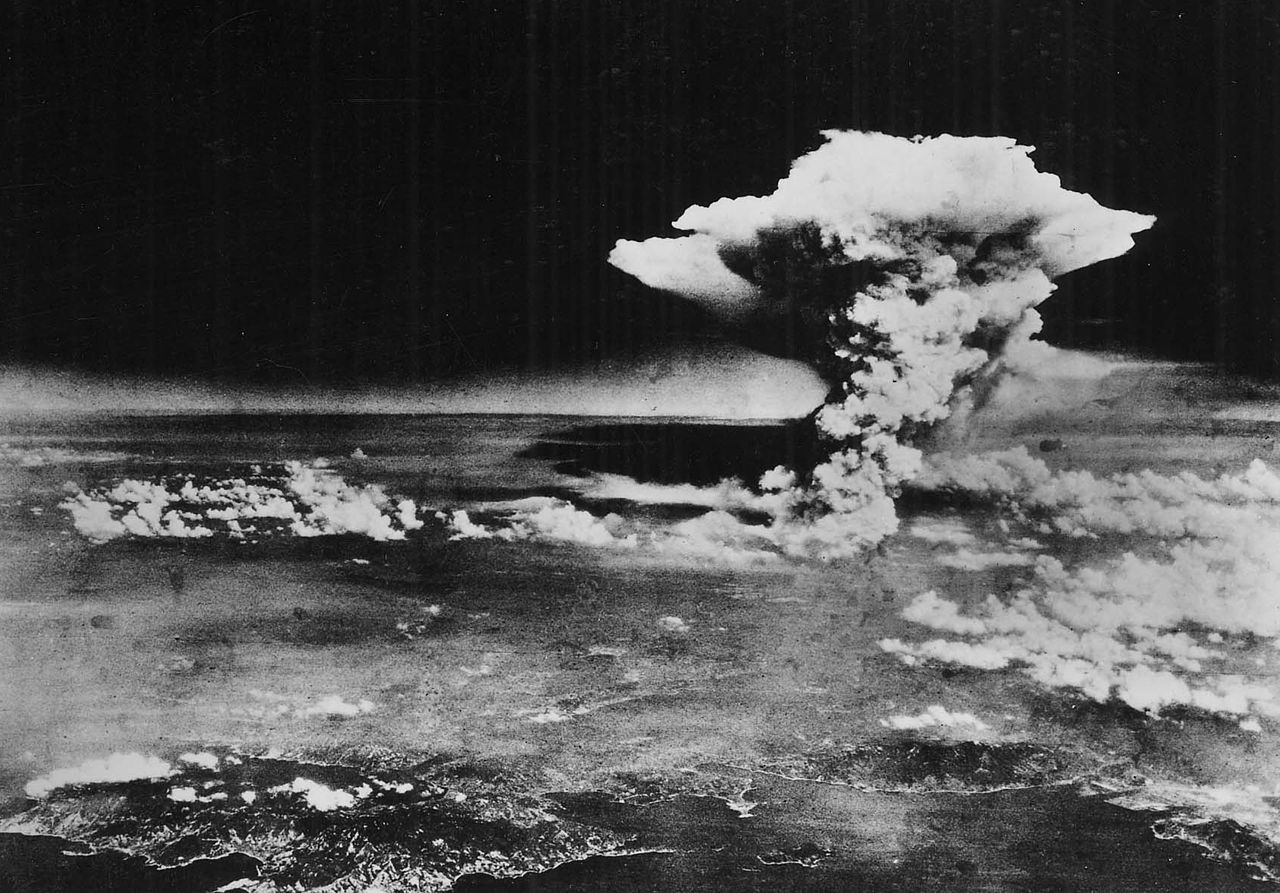
Atomic cloud over Hiroshima, taken from “Enola Gay” flying over Matsuyama, Shikoku, 6 August, 1945.
US Army Air Force photo via Wikimedia Commons.
It’s the anniversary of Hiroshima again today. I wasn’t going to write anything to mark the event (more coming next week on VJ Day), but I’ve been triggered already by nonsense on the radio which suggests that the atomic bombs on Hiroshima and Nagasaki were unnecessary, because Japan was about to surrender.
Nonsense. There is not a shred of real evidence to support this idea. In fact, the evidence that Japan wanted to keep on fighting is irrefutable. And yet this lie persists, despite the deluge of scholarly work demonstrating Japan’s commitment to the ritual suicide of its entire nation right until the end, when Hirohito pulled the plug. If you are in any doubt about the facts of the case, as opposed to the propaganda, read Toland’s Rising Sun (1970), Frank’s Downfall (2001), Spector’s In The Ruins of Empire (2007), Pike’s Hirohito’s War and, more recently, Stewart Binn’s Japan’s War (2025). All are excellent, clear, analytical and well researched. There are lots more, too.
Why does this canard keep on popping up? Is it because people don’t read? Or is it that they just don’t want to believe in the necessity of such a dramatic event to force Japan to surrender and thus bring about an end to the greatest man-made tragedy the world has ever suffered? The origins of this wishful myth in fact derives from hard right nationalist propaganda in post-war Japan (driven by Admiral Suzuki himself), quickly lapped up by the gullible and wishful thinkers in the West. Its one of the most enduring of the Hiroshima and Nagasaki myths, in part because it seems palatable to many, and because it is inherently anti-American.
What is the real story? In short, the Allies tried hard to persuade Japan to surrender. They demonstrated unequivocally to Japan that it was going to lose the war by defeating its armies and by beginning the long, slow and painful crawl towards the Japanese home islands. All the books I’ve mentioned note the extreme chaos of Japanese decision-making before and during the war. Who really was in charge? Who could one talk to, to secure a commitment to negotiate? In any case, the chaotic government under Koiso which replaced that of General Tojo following the fall to the Americans of Saipan in 1944, made not a single effort to engage with the Allies to seek terms. This government also collapsed on 5 April 1945. The replacement prime minister was Admiral Suzuki, and it was from this man that the myth seems to have arisen, after the war, that Japan was considering surrender and that the A-bombs were unnecessary. This is not true. During his entire time as Prime Minister he resolutely refused to do anything but continue to fight, unless the ending of the war could be secured on Japan’s terms. There were some initiatives to persuade the Suzuki government to surrender, but none of them amounted to much, because they didn’t engage directly with the government in Tokyo, and they didn’t derive from the Allied powers. The evidence that peace-feelers were being put out by various sources (such as the Vatican) in 1944 and 1945 is evidence only that the Japanese government ignored them. None were taken seriously in Tokyo.
Indeed, throughout the period of the Suzuki government, the war parties were dominant. In early June the military Supreme Command submitted a paper entitled The Fundamental Policy to be Followed Henceforth in the Conduct of the War, in which it demanded that the government confirmed that Japan would fight to the very last Japanese in an act of national suicide leading to the “honourable death of the hundred million”:
With a faith born of eternal loyalty as our inspiration, we shall – thanks to the advantages of our terrain and the unity of our nation, prosecute the war to the bitter end in order to uphold our national essence, protect the Imperial land and achieve our goals of conquest.
The proposition was passed, not unanimously, but overwhelmingly nonetheless.
There were some in the government – interestingly including Tojo himself – who saw that this was self-defeating, and that Japan must negotiate to secure acceptable peace terms. Naively, it was hoped that this would enable it to retain parts of its empire. Suzuki was part of this group who thought that Japan could negotiate favourable terms to end the war, in the form of a negotiated settlement such as that had brought about the end of the Russo-Japanese war in 1905, but when he suggested this in parliament on 13 June he was shouted down by the war mongers. Hirohito then endorsed an approach to the Soviets in late June. Bizarrely – though Moscow was neutral in the Far Eastern war at this point – Tokyo’s emissaries suggested that the USSR and Japan join forces to rule the world. It was yet more evidence of how Tokyo fundamentally misunderstood the world, and its enemies, and the way the war would have to end: complete and utter surrender by Japan.
Moscow, of course, scorned these “negotiations” as meaningless.
Comments Off on Debunking the idea that Japan was about to surrender anyway
June 10, 2025
How Moscow Got the Atomic Bomb – W2W 31
TimeGhost History
Published 8 Jun 2025In 1949, the Soviet Union detonates its first atomic bomb — years ahead of Western expectations. This episode dives into how the USSR mobilized former Nazi scientists, forced Soviet physicists into secret cities, and relied on intelligence from spies like Klaus Fuchs. While Stalin pushes for rapid progress, Beria enforces brutal discipline, and Soviet scientists race to meet an impossible deadline. The nuclear balance of power is about to shift — forever.
(more…)
Comments Off on How Moscow Got the Atomic Bomb – W2W 31
April 23, 2025
The Korean War Week 44 – Mac’s Lies Boil Truman’s Blood – April 22, 1951
The Korean War by Indy Neidell
Published 22 Apr 2025The stage is set for the Chinese Communist Forces’ next big offensive in Korea, but that is not where American eyes are fixed this week. Instead, focus swings to Washington D.C. where the recently-fired Douglas MacArthur arrives and proceeds to address crowds and Congress alike. It soon becomes clear that he will not go gentle into that good night.
Chapters
00:00 Intro
00:58 Recap
01:46 Soviet Intervention?
04:22 Operation Rugged
07:01 Task Force 77
09:36 South Korean Porters
11:02 MacArthur and McClellan
13:55 Summary
14:13 Conclusion
(more…)
Comments Off on The Korean War Week 44 – Mac’s Lies Boil Truman’s Blood – April 22, 1951
April 16, 2025
The Korean War Week 43 – Truman Dismisses MacArthur! – April 15, 1951
The Korean War by Indy Neidell
Published 15 Apr 2025It’s finally happened, President Harry Truman has relieved Douglas MacArthur of command. If you’ve followed us lately you’ll know the why, but today you’ll see then how, when, and where. But the fight in the field goes on- this week fighting for control of the Hwacheon Reservoir.
(more…)
Comments Off on The Korean War Week 43 – Truman Dismisses MacArthur! – April 15, 1951
April 9, 2025
The Korean War Week 42 – Seize Hwacheon Reservoir? A Dam Good idea – April 8, 1951
The Korean War by Indy Neidell
Published 4 Apr 2025Operation Rugged is in full swing, and it’s taking a decent amount of territory, but Matt Ridgway is worried about the possibility of the enemy blowing the dam at the Hwacheon Reservoir and flooding his army, so he gets set to try and soon take it. Meanwhile there’s an explosion in Congress in Washington DC, when the Minority Leader openly reads Douglas MacArthur’s letter of his plans for the war that are diametrically opposed to those of President Harry Truman. Truman realizes that he’s going to have to remove MacArthur from UN command.
Chapters
00:57 Recap
01:31 When to Fire MacArthur?
03:53 Joe Martin Speaks
07:11 Operation Rugged
09:23 The Hwacheon Reservoir Dam
13:35 Summary
13:51 Conclusion
(more…)
Comments Off on The Korean War Week 42 – Seize Hwacheon Reservoir? A Dam Good idea – April 8, 1951
April 2, 2025
The Korea War Week 41 – One Order Away from WWIII – April 1, 1951
The Korean War by Indy Neidell
Published 1 Apr 2025The UN forces have again crossed the 38th Parallel in many places, but High Command is worried about Soviet intervention, which could ultimately force them to withdraw from Korea entirely. However, plans are still set for Operation Rugged to soon go into action — aiming into the Iron Triangle.
Chapters
00:00 Intro
00:58 Recap
01:46 Soviet Intervention?
04:22 Operation Rugged
07:01 Task Force 77
09:36 South Korean Porters
11:02 MacArthur and McClellan
13:55 Summary
14:13 Conclusion
(more…)
Comments Off on The Korea War Week 41 – One Order Away from WWIII – April 1, 1951
March 26, 2025
The Korean War Week 040 – MacArthur Sandbags Truman – March 25, 1951
The Korean War by Indy Neidell
Published 25 Mar 2025Harry Truman is moving forward with his plans to somehow end the fight with the Chinese, but Douglas MacArthur takes a hatchet to those plans. Truman is furious, and the question remains, for how long will MacArthur’s defiance be tolerated? In the field, Operations Ripper, Courageous, and Tomahawk are in action, but are all disappointing for the UN forces, as they fail in their mission to destroy the enemy’s war making capacity. They don’t actually do much of that at all.
Chapters
00:00 Intro
00:51 Recap
01:08 Operation Ripper Ends
04:09 Operation Courageous
06:20 Operation Tomahawk
09:44 MacArthur’s Sabotage
13:27 Summary
13:36 Conclusion
(more…)
Comments Off on The Korean War Week 040 – MacArthur Sandbags Truman – March 25, 1951
March 23, 2025
Rigged Votes and Terror: Stalin’s Takeover Tactics! – W2W 014 – 1947 Q2
TimeGhost History
Published 21 Mar 2025By 1947, Stalin’s Soviet Union has begun to firmly grip Eastern Europe, reshaping nations through rigged elections, terror tactics, and propaganda. From Poland to Bulgaria, countries are forced into Moscow’s orbit, crushing opposition and extinguishing democratic freedoms. As Truman declares a doctrine to contain communism, the stage is set for decades of Cold War confrontation.
(more…)
Comments Off on Rigged Votes and Terror: Stalin’s Takeover Tactics! – W2W 014 – 1947 Q2
March 12, 2025
The Korean War 038 – The US President is Angry! – March 11, 1951
The Korean War by Indy Neidell
Published 11 Mar 2025Operation Ripper kicks off this week, and gains plenty of ground … but the enemy is almost nowhere to be found. Douglas MacArthur gives what becomes known as his “die for a tie” speech, which could have a serious negative effect on UN troop morale. But the Chinese are building up their forces for an eventual counterstrike, and the North Koreans even have a new Chief of Staff.
Chapters
00:00 Intro
00:50 Recap
01:15 Plans for Operation Ripper
04:45 Die for a Tie
06:34 MacArthur Won’t Toe the Line
08:17 The KPA Build-Up
10:38 Nam Il
12:31 The Chinese Build-Up
14:01 Ripper Begins
15:33 Summary
15:45 Conclusion
(more…)
Comments Off on The Korean War 038 – The US President is Angry! – March 11, 1951
March 5, 2025
The Korean War 037 – Matt the Ripper! – March 4, 1951
The Korean War by Indy Neidell
Published 4 Mar 2025This week is really a week of planning, as Matt Ridgway unveils the plans for Operation Ripper — to follow the somewhat disappointing Operation Killer, but there are South Korean spies involved, the blockade of Wonsan, and the continuing escalation of tensions between Douglas MacArthur and Harry Truman, with people in American High Command concerned that MacArthur is bent on starting World War 3.
Chapters
00:00 Intro
00:25 Recap
00:44 Killer and Ripper
04:14 Intel and Distractions
06:57 South Korean Spies
08:06 Truman and MacArthur (Again)
(more…)
Comments Off on The Korean War 037 – Matt the Ripper! – March 4, 1951
December 11, 2024
The Korean War 025 – UN Forces Abandon Pyongyang – December 10, 1950
The Korean War by Indy Neidell
Published 10 Dec 2024This week, UN forces in the west pull out of the North Korean capital Pyongyang. In the east, the marines continue to fight their way towards safety. Over in Washington, the aftershocks of the Chinese intervention have shaken high command as much as they have the troops on the ground, and America’s allies, especially Britain, grow alarmed over the US response.
Chapters
00:00 Intro
00:26 Recap
01:20 The Blame Game
03:58 Retreat in the West
07:43 The Chinese Situation
10:59 Escaping Chosin
13:57 Atoms and Attlees
18:07 Summary
18:20 Conclusion
(more…)
Comments Off on The Korean War 025 – UN Forces Abandon Pyongyang – December 10, 1950
November 13, 2024
The Korean War Week 21 – US Elections Threaten MacArthur! – November 12, 1950
The Korean War by Indy Neidell
Published 12 Nov 2024MacArthur’s forces struggle to make sense of the recent Communist Chinese intervention in Korea, especially when the Chinese vanish as quickly as they arrived. Back in the US, the war’s popularity has reached an all-time low on the eve of the crucial 1950 midterm elections. Is MacArthur about to pay the price for his failure to deliver results on the ground?
Chapters
00:00 Intro
01:01 Recap
01:24 The Chinese Vanish
02:37 The East
04:35 The US Situation
11:28 Bombing the Yalu
13:03 Summary
13:23 Conclusion
14:26 CTA
(more…)
Comments Off on The Korean War Week 21 – US Elections Threaten MacArthur! – November 12, 1950
October 23, 2024
The Korea War 018 – The Fall of Pyongyang – October 22, 1950
The Korean War by Indy Neidell
Published 22 Oct 2024The North Korean capital falls to the UN forces, which isn’t really surprising since the North Korean armies have been completely routed. However, the Chinese are entering the country in droves to back up the Northern forces, which UN Commander Douglas MacArthur is unaware of despite endless recon sorties every day. In other aerial news, an unlikely apology from MacArthur manages to soothe the Soviets after UN planes hit targets in the USSR, but what’s really the story there?
(more…)
Comments Off on The Korea War 018 – The Fall of Pyongyang – October 22, 1950


