
Forgotten Weapons
Published on 24 Aug 2015http://www.patreon.com/ForgottenWeapons
Hammer Price: $3,750
Pretty much every major military had an antitank rifle in service when WW2 kicked off, and the British example was the Boys rifle, named after the Captain Boys who designed it. It was a bolt action .55 caliber rifle with 5-round detachable magazines. If was obsolete by 1943 and replaced by the more effective but equally unpleasant PIAT.
October 4, 2017
British Boys Anti-Tank Rifle
Comments Off on British Boys Anti-Tank Rifle
September 24, 2017
Brilliant job on the Kalashnikov statue, Tovarisch, but what’s that weapon right there?
The Guardian reports on some emergency fix-ups required to a brand new statue honouring Mikhail Kalashnikov:
Workers have removed part of a new monument to Mikhail Kalashnikov, the inventor of the Soviet Union’s AK-47 assault rifle, after eagle-eyed Russians noticed that it mistakenly depicted a German second world war weapon.
The monument to the creator of one of Russia’s best known export brands was unveiled in central Moscow three days ago to much fanfare.
A metal bas-relief behind a statue of Kalashnikov depicts the AK-47 and other weapons all supposedly designed by the engineer, who died in 2013.
But embarrassed sculptor Salavat Shcherbakov had to admit that among them was the Sturmgewehr 44 (StG 44) assault rifle used by Nazi troops.
“We will rectify this,” Shcherbakov said in comments broadcast by state-run Rossiya 24 channel. “It looks like this [mistake] sneaked in from the internet.”
By Friday evening a square hole gaped where the German rifle had been depicted in the bas-relief.
Kalashnikov’s weapon, created in 1947, does have a striking resemblance to German arms designer Hugo Schmeisser’s StG 44 rifle, created in 1942, although they have major design differences.
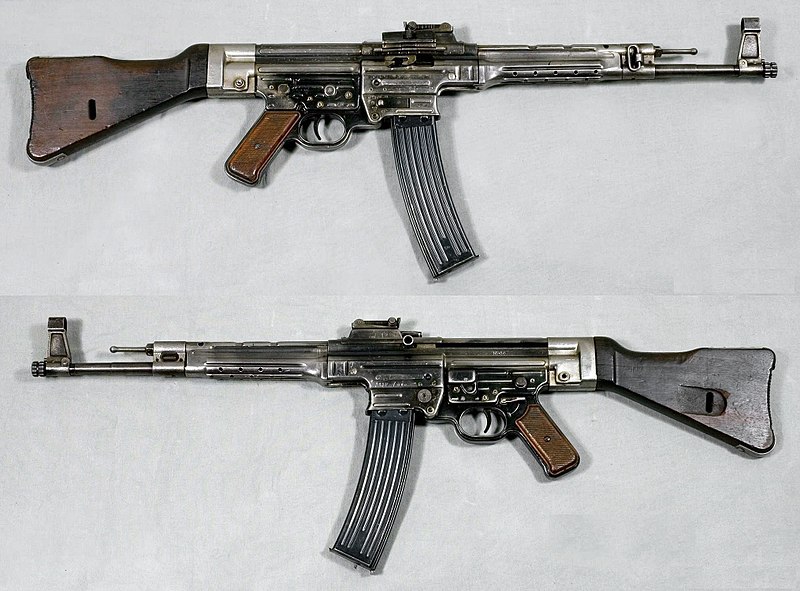
MP44 (Sturmgewehr 44), Germany. Caliber 8x33mm Kurz- From the collections of Armémuseum (Swedish Army Museum), Stockholm. (via Wikimedia)
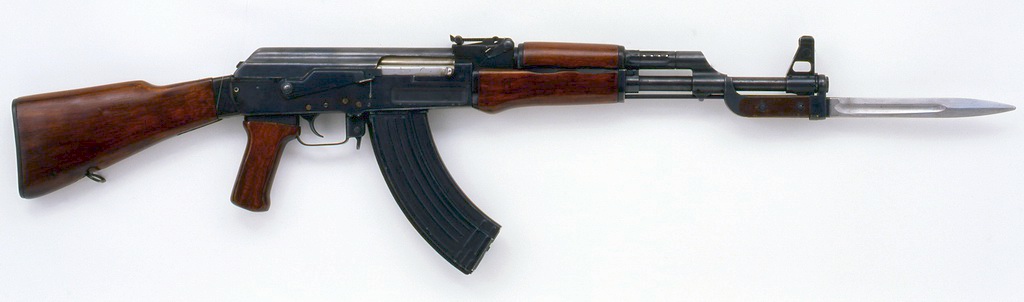
Kalashnikov АК-47 with bayonet attached (via Wikimedia)
Comments Off on Brilliant job on the Kalashnikov statue, Tovarisch, but what’s that weapon right there?
September 8, 2017
Book Review: The Schmeisser Myth by Martin Helebrant
Published on 17 Feb 2017
The Schmeisser Myth: German Submachine Guns Through Two World Wars is a newly published history of SMG development from the Villar Perosa and MP18 through the MP38 and MP40, written by Martin Helebrant. Given that it is published by Collector Grade, it should be no surprise that it is an excellent volume, which includes both historical and developmental context as well as detailed collectors’ information on markings, variations, and production numbers.
Comments Off on Book Review: The Schmeisser Myth by Martin Helebrant
August 28, 2017
Heavy Machine Guns of the Great War
Published on 14 Aug 2015
Check out The Great War’s complete playlist here for your easy binge-watching enjoyment:
https://www.youtube.com/playlist?list=PLB2vhKMBjSxMK8YelHj6VS6w3KxuKsMvT
I have been really enjoying The Great War series, so I figured I ought to take advantage of an opportunity to look at several WWI heavy machine guns side by side. This is a video to give some historical context to the guns, and not a technical breakdown of exactly how they work (that will come later). These really were the epitome of industrialized warfare, and they wrought horrendous destruction on armies of the Great War.
The guns covered here are the German MG08, British Vickers, and French Hotchkiss 1914.
Hammer Prices:
Vickers: $20,000
MG08: $11,000
Hotchkiss 1914: $7,000Other heavies used in the war include the Austrian Schwarzlose 1907/12, the Russian 1905 and 1910 Maxims, the Italian Fiat-Revelli, and the American Browning 1895. The book I was quoting from towards the end was Dolf Goldsmith’s unmatched work on the Maxim, The Devil’s Paintbrush.
Comments Off on Heavy Machine Guns of the Great War
August 16, 2017
Thompson SMG in 30 Carbine
Published on 17 Oct 2016
When the US military released a request for what would become the M1 Carbine in 1940, the Auto-Ordnance Corporation offered up a Thompson submachine gun simply rechambered for the new .30 Carbine cartridge. This entailed a new magazine, a receiver modified for the longer magazine, and a new barrel and bolt face – but the other Thompson parts could remain unchanged from the standard .45 ACP models. This made the submission a pretty cheap and easy effort for Auto-Ordnance … which is a good thing, considering that it was almost assured to be rejected.
The stipulations for the new carbine included a weigh requirement of 5 pounds, and the Thompson weighed more than double that (in both .45ACP and .30 Carbine forms). Only a few were made, and the one submitted for military testing was rejected outright on the basis of weight. This example is serial number 1, and resides at the Cody Firearms Museum.
Comments Off on Thompson SMG in 30 Carbine
August 15, 2017
Italian Pistols of World War 1 I THE GREAT WAR Special feat. C&Rsenal
Published on 14 Aug 2017
Italian Gisenti 1910 Pistol in detail: https://www.youtube.com/watch?v=M7eLhcNRwps
In this edition of our live stream episodes with C&Rsenal we take a look at the Italian pistols of World War 1.
Comments Off on Italian Pistols of World War 1 I THE GREAT WAR Special feat. C&Rsenal
August 14, 2017
The NRA as a “domestic security threat”
Kevin Williamson on the recent calls for the National Rifle Association to be viewed in the same way as the KKK, al Queda or ISIS:
Representative Kathleen Rice, a batty New York congressman — and, significantly, a former prosecutor — […] called upon the U.S. government to designate the National Rifle Association and its public faces, including Dana Loesch, “domestic security threats.” This demand comes in response to the NRA’s having shown a recruiting video in which Loesch criticizes sundry progressive bogeymen (the media, Hollywood, etc.) and calls upon like-minded allies to “fight this violence of lies with the clenched fist of truth.” It was immediately denounced by the usual opportunistic nincompoops as a call to violence and sedition, even a call to overthrow the government.
It is of course no such thing. It’s a dopey bit of cheap PR hackery from an increasingly partisan NRA that has made the lamentable decision to branch out from what it is good at — its enormously successful and historically bipartisan campaign of agitation for gun rights — and go all-in with Trump (a fickle friend of the Second Amendment) and the kulturkampf associated with his movement. None of that adds up to “domestic security threat” or anything like a domestic security threat. The only thing the NRA or Loesch have done violence to is a decent respect for the limitations of metaphor.
“Domestic security threat” is a term without legal meaning, being a conflation of two terms that Democrats like to employ against their critics: “national-security threat” and “domestic terrorists.” That should give us some idea of what Representative Rice would like to see done in response to the “domestic security threat” she imagines. Recent precedent here is not particularly inspiring: The Obama administration assassinated an American citizen, Anwar al-Awlaki, for the grave offense of being “the Osama bin Laden of Facebook,” a phrase that would be hard to say without laughing in a context other than the extrajudicial killing of an American citizen.
Gun owners and gun enthusiasts have been targeted for some time by Democrats, who have insisted, among other things, that the federal government ought to suspend the constitutional rights of people put on a secret blacklist by the federal government with no due process and no course of appeal. Democrats dream of registries, property seizure, and other invasive measures reminiscent of the totalitarian excesses of the 20th century — so long as those tools of tyranny are used on their political enemies.
What are the possible offenses of the NRA? It is an organization that does nothing more aggressive than political organization and political communication. Its efforts are labor-intensive: Contrary to the ignorant assumptions that inform our political discourse, the NRA is a relatively small spender when it comes to campaign donations and lobbying, being at the moment the 460th-largest campaign donor and the 156th-highest-spending lobbyist. The NRA has long excelled at its core mission because it excels at arguing its case in public and at delivering the votes, particularly in tight House races. And it is for this — for ordinary political activism of precisely the sort that the First Amendment exists to protect — that Representative Rice and others seek to have the NRA punished as a criminal organization, or as a terrorist organization. That these authoritarian measures are cheered by people who still call themselves “liberals” suggests a widespread moral and intellectual failure among a significant portion of the American public.
Comments Off on The NRA as a “domestic security threat”
August 11, 2017
Penn & Teller on Gun Control
Published on 11 Feb 2013
Penn and teller explain the 2nd amendment in very simple, easy to understand terms. Just the way it was written.
Comments Off on Penn & Teller on Gun Control
August 4, 2017
The recent machine gun purchase is a great example of how broken our defence procurement system
About a week ago, the Department of National Defence announced they were purchasing some new machine guns for the Canadian Army. The new weapon is an improved version of the C6 General Purpose Machine Gun (GPMG) currently in service. The Ottawa Citizen gave the basic information on the deal in this article:
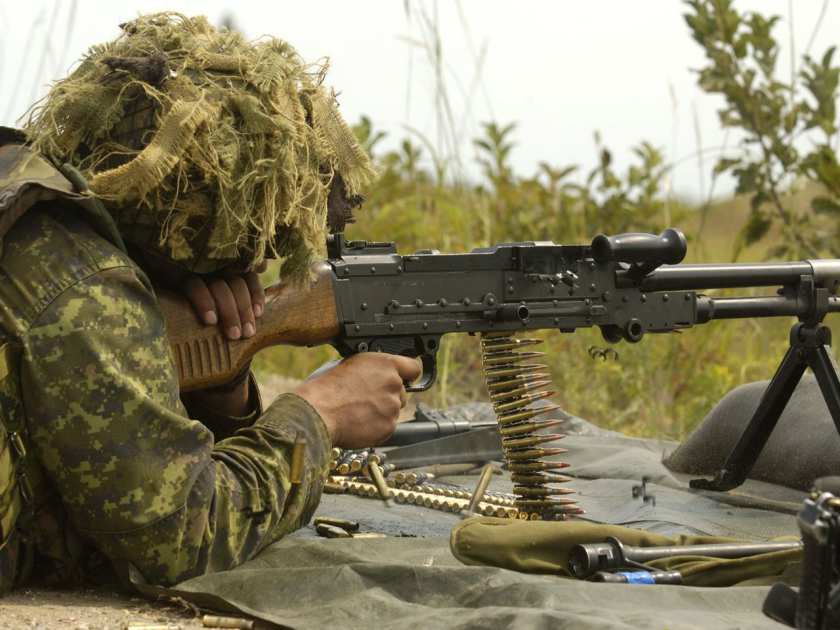
Canadian C6 GPMG. (DND photo)
The Canadian government will purchase 1148 new C6A1 FLEX General Purpose Machine Guns from Colt Canada, Defence Minister Harjit Sajjan announced Wednesday.
The current C6 machine guns were procured over 30 years ago. Some have been removed from service due to wear and tear and others are reaching the end of their service life, according to the Canadian military.
The new C6A1 FLEX (flexible) is designed to be carried by soldiers or attached to vehicles such as the new Tactical Armoured Patrol Vehicle. The new machine gun will feature a durable polymer butt stock instead of the current wooden style, according to the Canadian Forces. Additionally, soldiers will be able to attach pointing devices and optical sighting systems to the new weapon to help increase their operational effectiveness.
Sounds good, right? Not so fast:
On the face of it this is a good news story. The C6, a 7.62-mm is a fully-automatic, air-cooled, gas- and spring-operated medium machine gun that is well liked by the troops of the many western nations which use some version of this weapon. Based on the Fabrique Nationale (FN) MAG it has been used by more than 80 countries, and is made under licence in several countries, most notably the USA where it is known as the M240. It is many ways the standard machine gun, used by all our allies.
A closer look suggests that this announcement reveals everything that is wrong with Canadian defence procurement.
For our $32.1 million we get 1148 new C6A1 machine guns (with cleaning and repair kits, spare parts and carrying slings), 13 jobs which it seems reasonable to assume are for the length of the contract, i.e. two years, and a production line including engineering validation and certifications. Or perhaps more accurately, Colt Canada gets a production line at the Colt Canada plant.
Even if we accept that the implied a cost of nearly $28,000 per weapon should be informed by the fact that about one-quarter of the contract cost goes toward setting up a production line it still means that each weapon is costing almost $21,000 each.
The price of the equivalent US weapon, the M240, is somewhere between $6,600 US and $9,200 US depending on which model is being purchased. This means that, at current exchange rates, if we were to purchase the weapons from FN’s U.S.plant they would cost us about $10,000 each, in Canadian dollars. This in turn suggests that we would save at least $12,628,000. If you assume that in this case we don’t have to buy Colt Canada a new production line it works out to a savings of almost $20 million dollars.
This is the real cost of those 13 jobs for 2 years, over $750,000 for each job per year.
One would think that jobs that cost taxpayers $750,000 per year would raise questions.
Questions like; do we need to make our own machine guns, especially when we consider that they are almost universally available from a number of our allies and that we have the proven ability to maintain them ourselves?
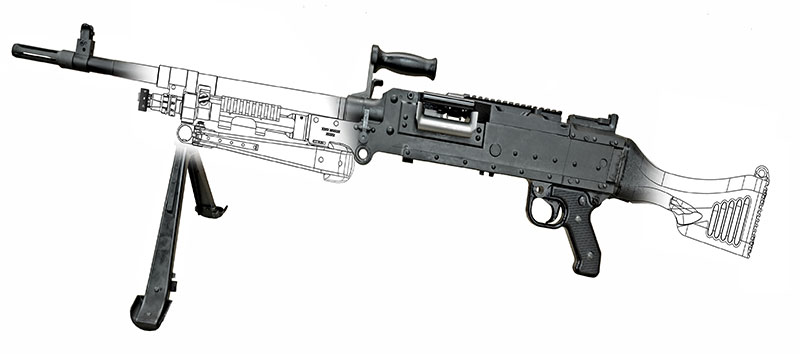
So, it’s not just that we can’t buy ships or fighter aircraft at a competitive price — because our politicians are addicted to using military spending for partisan purposes — we can’t even buy a slight variant on a bog-standard infantry support weapon without paying through the nose.
H/T to MILNEWS.ca for the link (perhaps we should consider changing that standard section heading from “What’s Canada Buying?” to “What’s Canada subsidizing in the form of procurement?” or “What’s Canada being robbed blind over now?”)
July 29, 2017
Matchlock Musket Demonstration with Armor (Live Rounds)
Published on 15 Apr 2014
Live rounds were fired from this matchlock with the musketeer first using no armor, then wearing standard armor, and finally equipped with a modified armor breastplate that had an attached piece for the musket butt to rest. Accuracy did not seem to be a factor, as all three tests yielded similar results. However, the modified breastplate was much more comfortable and easier to use than the standard breastplate. In 1611 at Jamestown, a law was enacted which stipulated that musketeers had to start wearing armor. In response they adapted by changing some of the existing armor to suit their needs, and this is evidenced with an adaptive breastplate found in a James Fort period well. A special thanks to Fred Scholpp from the Jamestown-Yorktown Foundation for coming out to the island to conduct experimental archaeology with the matchlock and armor breastplate reproductions.
If you are interested in donating to this non-profit research project, please click the following link. https://donatenow.networkforgood.org/jamestownrediscovery
Comments Off on Matchlock Musket Demonstration with Armor (Live Rounds)
July 25, 2017
British Rifles of WW1 I THE GREAT WAR Special feat. C&Rsenal
Published on 24 Jul 2017
Check out Othais’ episode about the Ross Rifle: https://www.youtube.com/watch?v=2uGYSQ_-FJU
Othais introduces us to the famous British standard rifles of WW1 including the Short Magazine Lee Enfield (SMLE), the Long Enfield and the controversial Ross Rifle.
Update: Patrick Crozier offers a bit of light entertainment in relation to the “Smellie”:
Lee Enfield, eh? Pile of rubbish https://t.co/ljExkgxcKY
— Patrick Crozier (@patrickcrozier) July 25, 2017
Comments Off on British Rifles of WW1 I THE GREAT WAR Special feat. C&Rsenal
July 17, 2017
How fast & how far do bullets go? – James May’s Q&A (Ep 13) – Head Squeeze
Published on 28 Mar 2013
James May imparts his wisdom on all things bullets.
History of Bullets and How they are Made: http://www.madehow.com/Volume-7/Bullet.html
Bullet Types and Abbreviations: http://www.scribd.com/doc/20889587/A-Guide-To-Bullet-Types-and-Abbreviations
Gun Timelines: http://inventors.about.com/od/militaryhistoryinventions/a/firearms_2.htm
10 Most Expensive Weapons in the World (Including R&D): http://www.therichest.org/technology/most-expensive-weapons/
5 Bullet Facts: http://www.howitworksdaily.com/technology/top-five-facts-bullets/
Comments Off on How fast & how far do bullets go? – James May’s Q&A (Ep 13) – Head Squeeze
July 14, 2017
Canadian Experimental Lightweight No4 Enfield
Published on 20 Mar 2017
Sold for $25,300 – http://jamesdjulia.com/item/1659-396/
In 1943 the need for a lighter and handier version of the Lee Enfield rifle became clear throughout the British Commonwealth, and experimentation began in Canada, Britain, and Australia. The work in Britain would culminate in the No5 Mk1 rifle, but the Canadian arsenal at Long Branch would try some different ideas first. Several different experimental prototypes were made with varying features, but they all shared the idea of substantially lightening the rifle without shortening it very much. This was done by removing metal anywhere possible, most obviously including the elimination of the stock socket and the use of a single piece stock in place of the traditional two piece Enfield stock.
These modifications, also including an aluminum alloy trigger guard, were able to cut 25% of the weight from the rifle, and do so without a significant loss in accuracy. However, I suspect the resulting rifle would have proven far too fragile for combat use had it been adopted. The stock is surprisingly light and thin at the wrist, and it feels like it would not take much force to crack it. In addition, lightening cuts down the length of the hand guard made it quite susceptible to warping with heat and humidity changes.
Ultimately the Long Branch Lee Enfield carbine experiments would be abandoned as the No5 “Jungle Carbine” was adopted instead.
Comments Off on Canadian Experimental Lightweight No4 Enfield
July 12, 2017
Someone at the NRA finally speaks out on the shooting death of Philando Castile
Radley Balko on the problems the NRA creates for itself by its reflexive support of the police, which weakens its efforts on upholding gun rights for ordinary Americans:
At long last, someone from the National Rifle Association has spoken up about Philando Castile. Sort of. During a CNN segment, NRA spokeswoman and pundit Dana Loesch said this:
I think it’s absolutely awful. It’s a terrible tragedy that could have been avoided. I don’t agree with every single decision that comes out from courtrooms of America. There are a lot of variables in this particular case, and there were a lot of things that I wish would have been done differently. Do I believe that Philando Castile deserved to lose his life over his [traffic] stop? I absolutely do not. I also think that this is why we have things like NRA Carry Guard, not only to reach out to the citizens to go over what to do during stops like this, but also to work with law enforcement so that they understand what citizens are experiencing when they go through stops like this.
As Jacob Sullum points out at Reason, this is pretty weak stuff. A law-abiding gun owner was shot and killed by a cop after doing everything he was supposed to do. It then took more than a year for anyone from the nation’s largest gun rights organization to comment, and when she did, she offered a vague, heavily qualified, quasi-criticism of the cop while implying not only that Castile contributed to his death but also that he might be alive if only he were carrying an NRA Carry Guard card.
This is about par for the course for the NRA. This is the group that claims to be the only thing preventing the government from obliterating the Second Amendment, yet they’re noticeably quiet about the people doing the most violence to the Second Amendment — the armed, badge-wearing government employees we call law enforcement officers. For all the NRA’s dire warnings about government gun confiscation, the real, tangible threat to gun-owning Americans today comes not from gun-grabbing bureaucrats but from door-bashing law enforcement officers who think they’re at war — who are too often trained to view the people they serve not as citizens with rights but as potential threats. Here, the NRA just doesn’t want to get involved.
[…]
In short, the NRA seems to think we’re at risk of creeping tyranny and abuse of power from all sectors of government except from the men and women armed, badged and entrusted with the power to kill. That’s a problem, because if armed agents who enforce the laws on the ground aren’t required to respect our rights, our rights don’t really exist.
The Supreme Court could rule the NRA’s way on the Castle Doctrine for the next 25 years, but if the police continue to kick down doors with impunity, law-abiding gun owners will be at risk, and the Second Amendment will be more of an empty gesture than a constitutional protection. The Supreme Court could rule the NRA’s way on conceal carry for the next 25 years, but if the organization keeps pushing the line that cops are at war, that the populace is dangerous, and that every citizen is a possible threat, the right to carry a gun in public will always be constrained by cops conditioned to see every weapon as a threat to their existence.
Finally, the Supreme Court could rule the NRA’s way and abolish all the state laws like those that ensnared Shaneen Allen, but as long as the NRA and its allies push rhetoric that makes white people (and white cops) see all crime with a black face, the right to bear arms for people who look like her — or who look like Philando Castile — exist only in theory.
Comments Off on Someone at the NRA finally speaks out on the shooting death of Philando Castile
July 8, 2017
Four Fun Facts about the Oerlikon 20mm Antiaircraft Cannon!
Published on 13 Apr 2017
The 20mm Oerlikon automatic cannon was a mainstay of United States naval air defense during World War 2, and today we will look at a few of the characteristics and questions that apply to this sort of automatic cannon but not to typical small arms. Like, for instance, how do you cock a gun that has a 400 pound recoil spring? Or, what happens if you fire a high explosive shell into your muzzle cover?
Comments Off on Four Fun Facts about the Oerlikon 20mm Antiaircraft Cannon!


