Quotulatiousness

November 24, 2022

Viewing the Public Order Emergency Commission spectacle from abroad

Filed under: Cancon, Government, Law, Liberty, Media, Politics — Tags: , , , , , — Nicholas @ 03:00

Chris Bray on how the Public Order Emergency Commission inquiry in Ottawa has utterly failed to show up on the radar of the US legacy media:

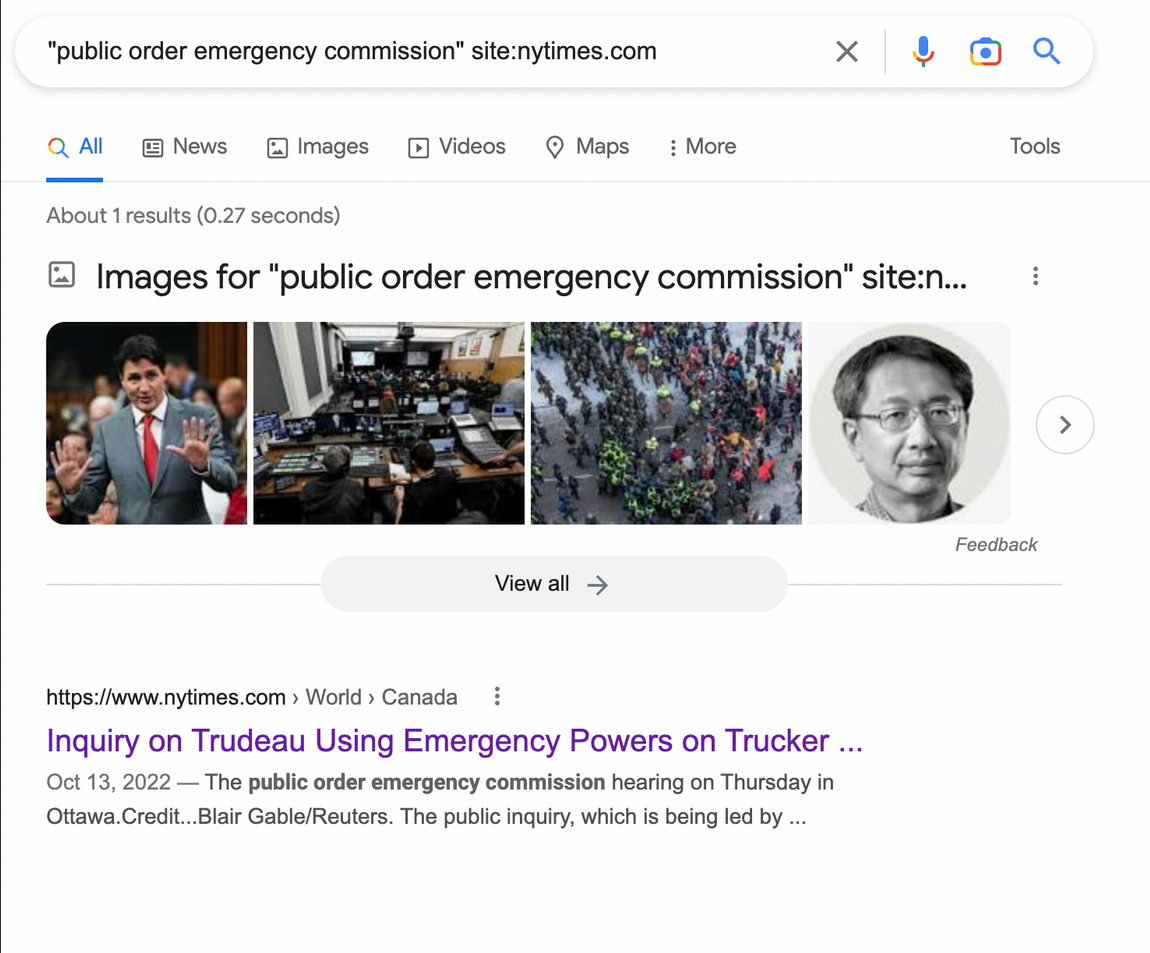
I conducted a dignified survey of a number of politically savvy people this evening, by which I mean I staggered around a bar and slurred questions at friends, and I was surprised to discover that no one has noticed the POEC. At all. Similarly, the US news media appears to have taken a nearly complete pass on covering the thing. The New York Times offered a single story, more than a month ago, describing the fact that it would be happening, and then lapsed into silence. I left some blank space at the bottom of this image so you can see all the nothing down there:

But the spectacle has been extraordinary, and it opens the curtains on the world of high-status malevolence, elite mediocrity, and news media cravenness. For background, remember that the Canadian government led by Prime Minister Derek Zoolander responded to the peaceful truckers’ “Freedom Convoy” in Ottawa and anti-Covid-measure blockades at several border crossing areas this February — the infamous bouncy castle protests — by invoking Canada’s Emergencies Act, for the first time since that law was created in 1988. That declaration of a national emergency allowed the government to exercise extraordinary power, most infamously in the form of an order to Canadian banks to completely freeze the bank accounts of protest participants. Zoolander lost his state of emergency as the Canadian Senate signaled its growing alarm at the decision, after a shameful vote in the House of Commons to affirm the declaration. The state of emergency was declared on February 14, and revoked on February 23.

Now comes the second act. The invocation of the Emergencies Act triggers a legal duty to review that decision after the fact. Here’s the directive calling the Public Order Emergency Commission into being.

So the commission is meeting, with testimony from government officials, and — this is the important part — with cross-examination from lawyers representing the targets of the declaration of emergency. In effect, the truckers are in the room; their representatives can ask questions of the government officials who did things like ordering banks to take their money because they disagreed with the government.

If you read the mainstream Canadian press, which pisses me off every time I try to do it, this means that the moronic lawyers for a bunch of idiotic terrorists are being pointlessly mean to senior government officials. Conspiracy theories! Debunked claims! I mean, truck drivers versus respectable figures, amirite? All the usual deployment of marking language is in effect, telling readers what to think about what’s happening while carefully limiting their description of what’s actually happening.

[…]

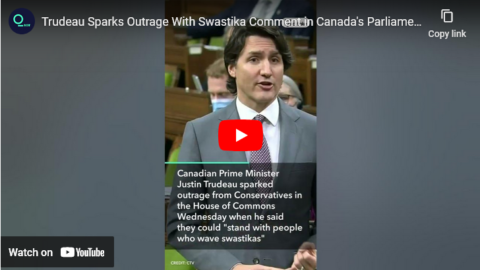
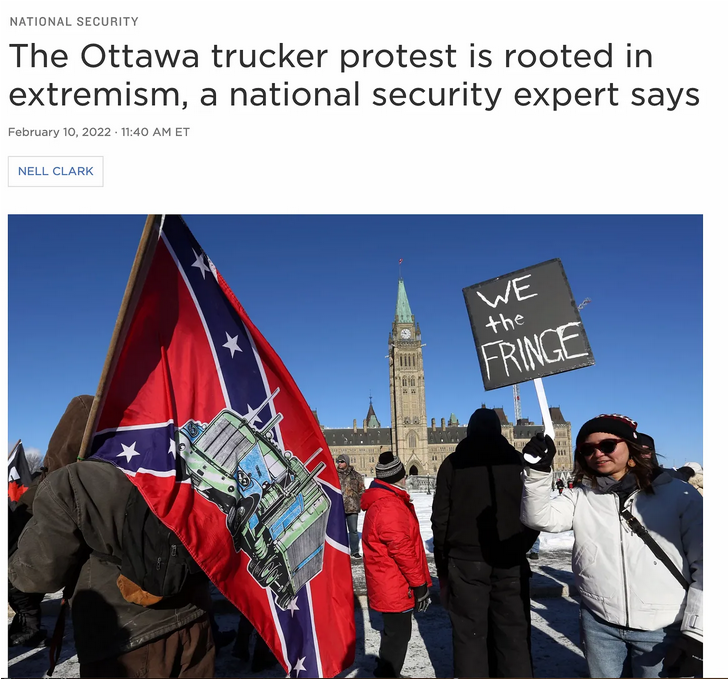
And finally, most remarkably, if you followed the Emergencies Act debate in the House of Commons back in February, you’ll recall that Prime Minister Zoolander and his ministers responded to every criticism and question regarding their handling of the convoy by saying that Canadians won’t stand with people who carry Confederate flags, and with “those who fly swastikas”.

That’s how they framed the entire event, full stop: the truckers, the swastika people. The anti-vaccine-mandate Nazis!

The news media picked up that framing and ran with it, non-stop, pounding the message that the truckers were flying Nazi symbols and Confederate flags:

Now: Miller said, before the commission, that he knows the identity of the people who carried those Nazi and Confederate flags in Ottawa — and that they’re employees of a public relations firm that was working on behalf of officials in the Canadian government.

October 23, 2022

“It’s starting to be noteworthy how often people in government record their important conversations”

Filed under: Cancon, Government, Liberty, Media, Politics — Tags: , , , , , — Nicholas @ 03:00

From the kindness of his heart, Paul Wells decided to make this column available to cheapskate non-paying subscribers like me because he feels it needs to be seen by a wider audience. The topic is the ongoing inquiry into the Trudeau government’s invocation of the Emergencies Act and it’s certainly promising to stay entertaining for a while (unlike the vast majority of such inquiries):

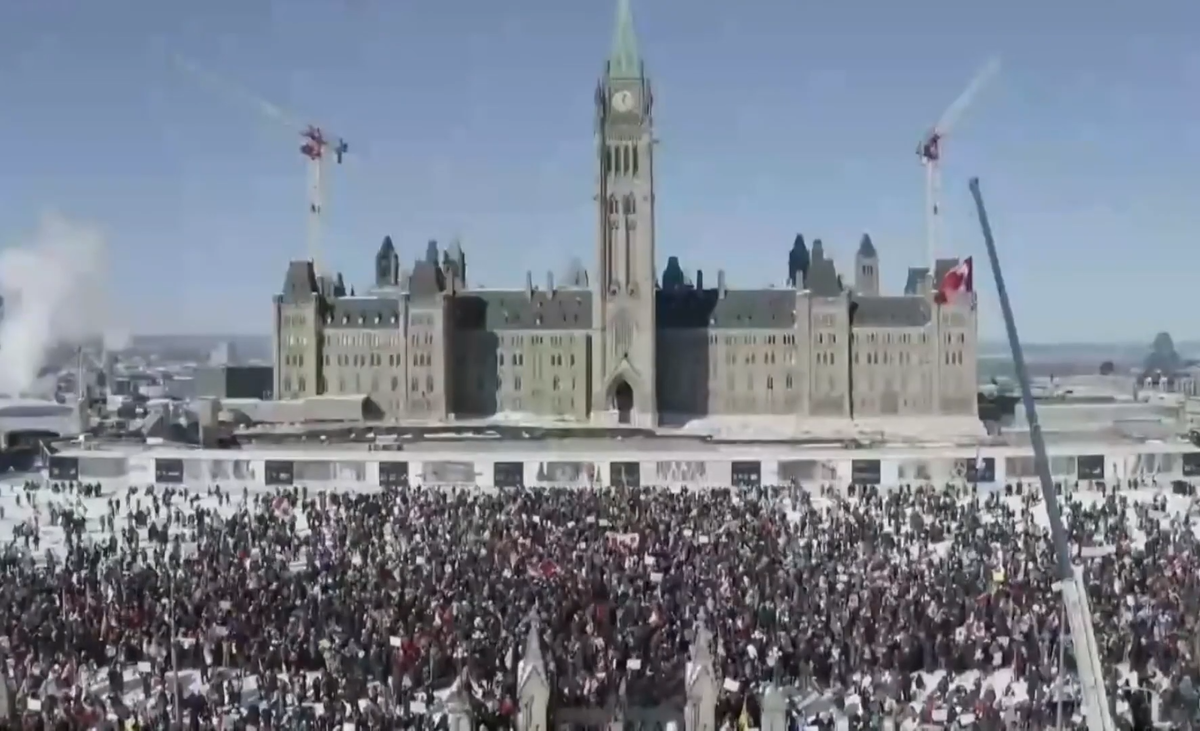
A screenshot from a YouTube video showing the protest in front of Parliament in Ottawa on 30 January, 2022.
Photo via Wikimedia Commons.

The goal of it all is to permit Rouleau to decide whether the Emergencies Act was used properly when it was invoked, for the first time in its 34-year existence, by the Trudeau government to end the mess in Ottawa’s Centretown. But it’s also a deep dive into conflicting ideas of police doctrine, the best look we’ve had at the stressed and dysfunctional city administration in Ottawa. And while we haven’t yet heard much about the Trudeau government’s processes, that’s coming. The prime minister and seven of his senior cabinet ministers, with their deputies, will testify soon.

Nobody can keep up with it. For Ottawa reporters it’s as though we’ve dragged ourselves for a decade through a desert of talking points and euphemisms into an oasis of unbelievable information bounty. The temptation is to gorge. I took Wednesday off, only to learn that Diane Deans, the city councillor who was heading the Ottawa Police Service Board when the mess began, secretly recorded the call in which she informed Mayor Jim Watson that she’d gone ahead and negotiated the hiring of an interim police chief Watson had never heard of. […]

Aaron Sorkin couldn’t have written it better. Deans tells Watson she’s found a new police chief for him in the middle of the worst public-security crises of their lives. He tells her it’s a terrible plan. She asks whether he’ll vote to remove her from her post and he won’t say, which of course is the same as saying. They talk about what to do next, in a way that leaves room for each to have an understanding of what they agreed that’s incompatible with the other’s. It’s gold. The consensus on Thursday among Parliament Hill people I talked to who’d heard the tape was that conversations like this happen all the time in workplaces across the capital, as of course they happen around the world. It’s just that usually in governments, as in most large organizations, any sign of their existence is buried under lakes of Novocaine.

It’s starting to be noteworthy how often people in government record their important conversations. Almost as though people were increasingly worried they might be lied about. When Jody Wilson-Raybould did such a thing three years ago, it was possible for her ex-colleagues to clutch their pearls and protest that such a thing just isn’t done. But after months of claims and assertions about what RCMP commissioner Brenda Lucki told the RCMP detachment in Nova Scotia, nine days after the worst mass murder in Canadian history, it’s handy to have a recording, isn’t it.

By this emerging standard, Patricia Ferguson is old-fashioned. As far as we know she didn’t record her meetings. But she did break open a notebook methodically, like clockwork, to write detailed longhand notes after her conversations. Those notes are hard to reconcile with the portrait Deans painted in her testimony a day earlier, of Peter Sloly as a lone good man, standing up for proper policing in the face of heckling and even racism from the city’s old guard.

In Ferguson’s version, it sounds like Ottawa’s cops were all reasonably good but they were cracking and colliding under immense pressure.

Ferguson described an Ottawa Police Service already worn down by the beginning of this year. There had been retirements, resignations, a high-level suspension and a suicide before and during the COVID lockdowns, followed by Black Lives Matter protests with the attendant internal soul-searching and external scrutiny every North American police corps faced.

And then the convoy hit. And then it stayed. This last was more of a surprise than it should have been.

The late stories out of Wednesday’s testimony were from Pat Morris, an Ontario Provincial Police superintendent in charge of intelligence-gathering. He dumped a bunch of old OPP “Project Hendon” reports, a term of art for the force’s intelligence-gathering operations, onto the commission server. Those reports were sent regularly to the Ottawa police as the various truck convoys approached the capital. Ferguson testified that she didn’t become aware of them until just before the trucks arrived. Which is too bad. What the OPP had found was a very large group of protesters from all over. They did not pose an organized threat of violence, though the Hendon reports acknowledged that confrontation can always escalate and that “lone wolf” extremists could well be tempted to join the crowd. But all the trucks represented a huge problem anyway, because they had rapidly growing funding — and no plans to go home at any point.

October 13, 2022

Are we to believe that Prime Minister Trudeau lied about the Freedom Convoy? To the fainting couches!

Filed under: Cancon, Government, Media, Politics — Tags: , , , — Nicholas @ 03:00

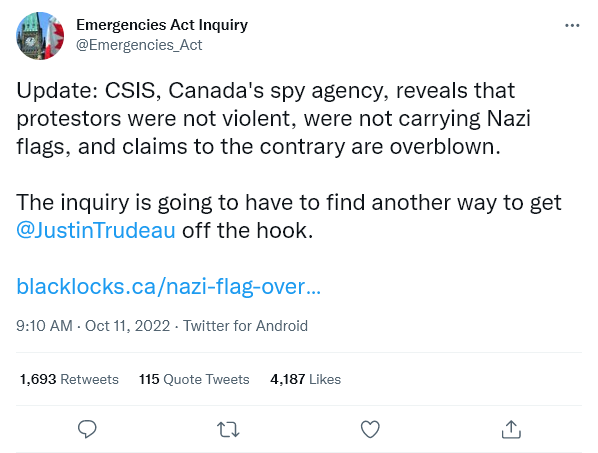
Some recent revelations show that Prime Minister Justin Trudeau was … less than perfectly honest … about the intelligence reports he was receiving about the Freedom Convoy:

It has now been revealed that statements by Prime Minister Justin Trudeau associating the “Freedom Convoy” with Nazism were unfounded, according to Canadian Security Intelligence Service (CSIS) documents published by Blacklock’s Reporter.

On January 31, 2022, Trudeau conflated support for the “Freedom Convoy” with “Nazi symbolism” in his first press conference addressing the massive anti-mandate demonstration that captured the world’s attention in the first two months of the year.

Trudeau also stated at the time that he would not meet with the truckers because of their supposed “hateful rhetoric” and “violence towards citizens”, behavior he consistently implied was a core aspect of the movement’s strategy to put an end to COVID jab mandates nationwide.

Contradicting Trudeau’s characterization, the now-revealed documentation from CSIS, dated February 2 – just two days after the prime minister’s initial comments – explain that the protest was predominantly comprised of “patriotic Canadians standing up for their democratic rights” and not of those holding extremists beliefs.

Detailing how the presence of bigoted imagery is “not unique” when it comes to large-scale protests, CSIS also noted that the presence of swastikas on some flags was “not necessarily to self-identify as Nazis but to imply the Prime Minister and federal government are acting like Nazis by imposing public health mandates”.

It was therefore the conclusion of CSIS that while some attendees had manually added swastikas to flags, it was to associate Trudeau with Nazism as a statement of their opposition to the ideology.

Two weeks after the CSIS report was produced, Trudeau doubled-down on his conflation of the Freedom Convoy with Nazism, accusing the Conservative Party of Canada, and in particular Jewish MP Melissa Lantsmann, of standing “with people who wave swastikas”.

July 3, 2022

David Warren waves the flag

As noted the other day, the official period of mourning sickness that enveloped Canada last year after the blockbuster revelations about residential schools has not been followed-up by any substantive proof of any of the sensational claims that Prime Minister Trudeau seized upon to lecture Canadians about our historical guilt (the “genocideal nation” that he claimed we were) and to haul the national flag down to half-staff for half a year. David Warren chooses to wave the flag instead:

Justin Trudeau has always had a strong affinity for the symbolic gesture, especially when the media are around to record it.

The latest trick in what we might call “eco-commie-perv agitprop”, emerged while shaming Canadian history and traditions. I’ll touch on it in a moment. It is a product chiefly of the Indian Wars of the last few years. The White Man, and more specifically when Catholic, has been accused of massacring the Native People in 20th-century residential schools, just as he did upon coming to the continent. He then ploughs the anonymous victims into mass graves, showing his affinity to, exempli gratia, the Nazis.

This propaganda campaign, which quickly reached the tedious stage, was founded on a series of oft-repeated unambiguous lies, driven into our susceptible children in our compulsory public schools, and throughout life by such agencies as the CBC. (All our significant media are now under government control, subsidy, and watch.) White men, especially the Catholics, contaminate Canadian history by their Satanic essence, according to this malicious fantasy. Goodness and innocence can be found only in their victims, the “visible minorities” (or majorities, as the case may be). Shame is inculcated among persons exhibiting the wrong race.

I write of Canada, but something similar is happening in the United States, and has been carried to Europe on the sails of Hollywood and popular “music”. Canada is, however, an extreme example — of brazen idiocy — and even to underprivileged (all-white) rural places the message is piped in. Disharmonious voices must expect state interference, and eventual arrest.

For Canada now has political prisoners, including many who participated in the Freedom Convoy of truck drivers. Tamara Lich, a prominent organizer of this demonstration, has been gratuitously jailed, though she didn’t even try to commit a plausible crime. This week she was gaoled again, apparently for receiving a freedom medal. (Persons it was in her bail conditions not to meet may have been in the audience.) She was put out of sight for “Canada Day” (the former Dominion celebration, yesterday). This manipulation of Canadian law is, sadly, no longer unprecedented. It seems to be ordered directly from the Prime Minister’s Office.

June 28, 2022

Pierre Poilievre … not the Canadian Trump?

Allan Stratton points out to sheltered central Canadian urban voters that populism has a long history in Canadian politics, and didn’t need to be imported from the US:

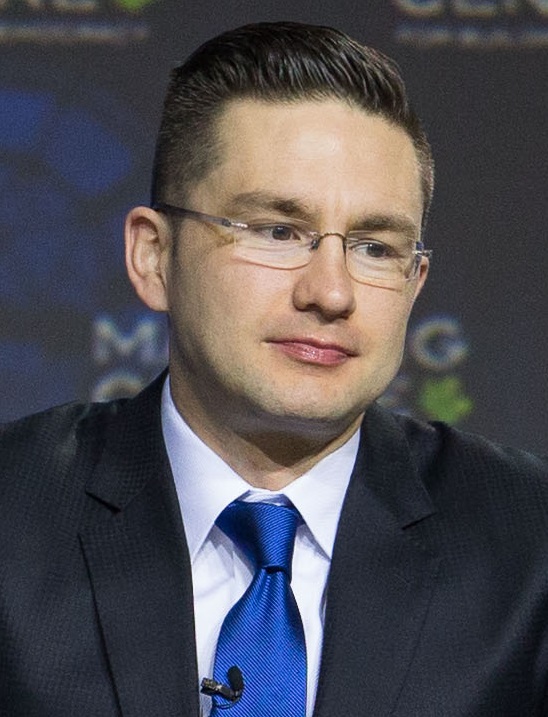
Conservative MP Pierre Poilievre at a Manning Centre event, 1 March 2014.
Manning Centre photo via Wikimedia Commons.

Conservative leadership candidate Pierre Poilievre is oft accused of importing divisive American right-wing populism to our politics. His endorsement of the trucker protest against vaccine mandates — though not the legal violations of its organizers — has been portrayed as a play for Christian nationalists, racists and fascists. Likewise, his attacks on Davos and the World Economic Forum are said to welcome Trumpian conspiracy theorists, anti-Semites and Great Replacement nativists.

Common wisdom suggests that this strategy may win Poilievre the Conservative party leadership, but will render his party toxic to respectable, mainstream Canadian voters.

There’s a lot of smoke and at least some fire to this critique: The People’s Party of Canada will find it hard to tag Poilievre as a centrist squish.

But thanks to our constitution, the Supreme Court and our general political culture, all more liberal than their American counterparts, social conservative attacks on abortion and LGBT rights seem off the table.

Further, far from a Trumpian nativist, Poilievre is in favour of immigration and wants to cut the red tape that blocks immigrants from employment in their fields, something the current federal government has failed to accomplish into its third mandate.

My fear, as someone who shares many concerns about the prospect of a Poilievre government, is that commentators are misreading the broad appeal of his populism, leading Liberals to unwarranted overconfidence.

Sure, Poilievre’s strategy shares some Trumpian elements, but it’s equally rooted in a progressive Canadian tradition that dates back to the early 19th century and was prominent in the last half of the 20th.

If the Liberals don’t course correct, they may discover that while they are attacking Poilievre as a far-right extremist, he is eating their traditional liberal, working-class lunch.

In broad strokes, I imagine Poilievre channelling Louis-Joseph Papineau and William Lyon Mackenzie during the Rebellions of 1837-38. Instead of the Château Clique and the Family Compact, I see him fighting the Laurentian Consensus, another powerful, unelected group, this time composed of academics, bureaucrats, media apparatchiks and Central Canada think-tankers who dominate our culture and financial establishment — and who arrogate to themselves the right to determine Canadian values and the ways in which we are allowed to describe and think about ourselves as a nation.

For those of us who grew up on the left under Mike Pearson, Tommy Douglas, Pierre Trudeau and David Lewis, it is hard to stomach the recent illiberal turn in elite liberal discourse. It once assumed the importance of free speech, understanding that censorship has always been used by the powerful to suppress the powerless. Yet today, in academia and the arts, free speech has been recast as “hate speech”, and our Liberal government is passing C-11, which seeks to regulate what we read and how we express ourselves online.

June 6, 2022

Very convenient – “Only the cabinet can invoke the Emergencies Act, and if only the cabinet can be privy to the information that informs that decision, only the cabinet can judge whether the cabinet got it right”

Filed under: Cancon, Government, Law, Liberty — Tags: , , , , , — Nicholas @ 03:00

In the free-to-cheapskates portion of The Line‘s weekly dispatch, the editors discuss the lack of evidence that the federal government was actually justified in its invokation of the Emergencies Act in February to break up the Freedom Convoy 2022 protests in Ottawa:

A screenshot from a YouTube video showing the protest in front of Parliament in Ottawa on 30 January, 2022.
Photo via Wikimedia Commons.

Your Line editors always understood that the situation in Ottawa (and at the borders) was indeed a crisis. We never doubted that. It was a very serious challenge that required a very serious response. But we have never seen the case for invoking the Emergencies Act. Under the law, which is very clear, a public-order emergency can only be invoked when the emergency cannot be met under existing laws. We really don’t know what, if anything, convinced Prime Minister Justin Trudeau and his cabinet that we had reached that point.

We have always been reasonable about this. The government may well be in possession of classified information that is not publicly known that convinced them, in good faith, that that condition had been met.

The problem is, they’re asking us to take it on their say-so. The position of the federal government thus far, as regards the inquiries and parliamentary reviews that are automatically triggered by invoking the act, is that they will not necessarily disclose all of the information that was known to the cabinet, and they may treat internal discussions as protected by cabinet confidentiality. This is setting up a perfect little loop of zero accountability. Only the cabinet can invoke the Emergencies Act, and if only the cabinet can be privy to the information that informs that decision, only the cabinet can judge whether the cabinet got it right.

You see the problem, right? As noted above, maybe they know something we don’t, and acted reasonably. Or maybe, under enormous political pressure, the PM whipped out the Emergencies Act to show us how big it is. That would be entirely within his character.

Do we think that’s what happened? We don’t know. Can we rule it out? No.

One of the only things the feds have yet said about their decision to invoke the Emergencies Act was that they did it because the police said it was necessary. But [former Ottawa Police Chief Peter] Sloly now says he never asked for it. The interim chief who succeeded him has said the same. The RCMP has said they did not ask for it. Who does that leave?

Maybe it was the OPP. Maybe it was one of the police agencies that patrols parliament itself. We don’t know. They just want us to take their word for it.

We’re sorry, but we don’t. The Emergencies Act is far too powerful to ever be invoked by a government on the basis of, “Trust us”. That’s not how things work in a democracy. And it should alarm all Canadians that the Liberals seem not to realize this, or are at least hoping that you don’t.

May 6, 2022

“Canadians might not know their constitutional history or even the text of the Charter, but they know in their bones that these orders were unconstitutional”

Long before the Freedom Convoy protests earlier this year, I’d been somewhat skeptical of the value of the Canadian Charter of Rights and Freedoms — not that I thought it was a bad thing to have a clear enumeration of Canadians’ rights, but in the degree to which those rights could be ignored or abrogated whenever the government found it convenient to do so. The invocation of the Emergencies Act proved that lacking strong and effective absolute rights, the Charter was merely a bit of tissue paper. In The Line, Josh Dehass shows he’s not as cynical as I am about the value of the Charter and provides some history predating the current document:

In a Boston courtroom in 1761, lawyer James Otis Jr. made one of the most consequential legal arguments of all time.

Otis was challenging the legality of “writs of assistance”, a form of general warrant giving unfettered discretion to customs agents to force their way into people’s homes to search for and seize smuggled goods, and to require the “assistance” of bystanders.

“It appears to me (may it please your honours) the worst instrument of arbitrary power, the most destructive of English liberty, and the fundamental principles of the constitution, that ever was found in an English law-book,” Otis inveighed.

John Adams later described that day in court as “the first scene of the first Act of opposition to the Arbitrary claims of Great Britain. Then and there the Child Independence was born. Every Man of an immense crowded Audience appeared to me to go away, as I did, ready to take Arms against Writs of Assistants.”

This hard-won right to be secure against unreasonable searches and seizures, affirmed by Section 8 of the Canadian Charter of Rights and Freedoms, is the reason so many of us felt queasy about the Emergency Economic Measures ordered by the Liberal cabinet under the Emergencies Act in February to quell the trucker protests. Canadians might not know their constitutional history or even the text of the Charter, but they know in their bones that these orders were unconstitutional.

The emergency measures required financial institutions to search their records for customers suspected of “directly or indirectly” engaging in a “public assembly that may reasonably be expected to lead to a breach of the peace”, or “directly or indirectly” using their money to facilitate such protests, and then seize their accounts.

That’s a classic general warrant, a writ of assistance in fact, enlisting banks to help King Trudeau and Queen Freeland hunt down their political enemies without going before a judge to prove reasonable grounds that a specific offence had been committed by a specific person. Section 8 is designed to keep us secure against unreasonable searches and seizures by the executive, and the only way for individuals to maintain this security is by requiring specific warrants from an independent judiciary, barring exigent circumstances.

This profound assault on our section 8 right will hopefully be raised during Justice Paul Rouleau’s inquiry into the use of the Emergencies Act, despite Trudeau’s attempt to focus the inquiry on the truckers themselves. Even if section 8 doesn’t get examined during the inquiry, the Canadian Civil Liberties Association expects to raise it in Federal Court if they’re successful in convincing a judge to review the decision to declare the protests a national emergency.

I don’t expect anything useful to come out of this inquiry process, otherwise Trudeau wouldn’t have let it get started in the first place.

March 21, 2022

For some reason, Canadians’ interest in alternative currencies has risen substantially since February

Filed under: Cancon, Economics, Government, Technology — Tags: , , , , — Nicholas @ 03:00

I’m far from alone in taking the Canadian government’s absurd over-reaction to the Freedom Convoy 2022 political protest in February as a reason to be concerned about the Canadian banking system. Until then I’d paid very little attention to alternative currency options like Bitcoin and the like, but I now understand that they may be a key element in future financial planning. At Quillette, Jonathan Kay explains that he realized at the same time he needed to know much more about crypto:

“Bitcoin – from WSJ” by MarkGregory007 is licensed under CC BY-NC-SA 2.0

On February 15th, following weeks of anti-vaccine-mandate protests in downtown Ottawa, Justin Trudeau lurched from complete inaction to absurd overreaction by declaring a national emergency. One effect of this was that banks were suddenly authorized to freeze the personal assets of citizens linked with the protests, civil liberties be damned. Around the same time, moreover, hackers acquired and published identifying information associated with thousands of people who’d donated money to the protest movement. Rather than denounce this apparent criminal data breach, many public figures — including Gerald Butts, who’d been Trudeau’s right-hand man before resigning amid scandal in 2019 — actually celebrated this doxxing. Some media outlets even tried to mine the dox information for clickbait before being stung by a public backlash. While I hadn’t donated to the Freedom Convoy movement, I was sufficiently appalled by these developments that I started educating myself about how one might donate to a similar cause without government officials and social-media hyenas exploiting these transactions as a pretext to attack my assets and reputation.

The easiest way to get into the crypto market, I learned, is simply to open an account at an exchange platform such as Coinbase or Wealthsimple. But while they’re easy to use, exchange platforms also generally require clients to supply government-issued ID when they secure their accounts, and transactions are traceable by authorities. To assure myself of real anonymity and theft-protection, my tutor instructed me, a better (if more complex) option is “cold storage”. This is a real physical device — in my case, something called a Ledger — that acts as a personal crypto wallet.

My Ledger (which looks like a large USB key drive) contains the data required to generate the “private keys” (which look like long passwords, though that isn’t quite what they are) that allow me to send my crypto to other people. And that spending can be done only in those moments when the device is connected to the Internet, after which it can be relegated to a drawer or safe (thus the metaphorical concept of “cold storage”). On the other hand, I can receive money even if the Ledger is offline, so long as the sender has my public key, which (unlike a private key) is generally safe to give to others (such as, say, a prospective donor to any charitable cause that I might establish).

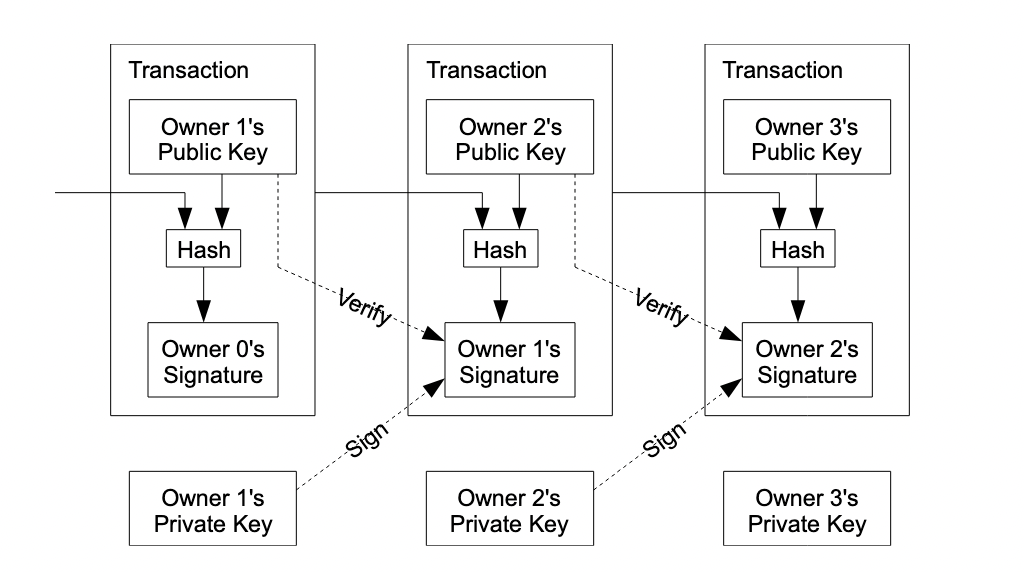
Bitcoin’s basic mechanics were set out in 2009 by the much-mythologized pseudonymous author (or collective) known as “Satoshi Nakamoto”. In a legendary white paper titled Bitcoin: A Peer-to-Peer Electronic Cash System, Satoshi describes the newly conceived electronic coin as consisting of a chain of digital signatures (a blockchain) that build one upon the next through a mathematical mechanism known as a cryptographic hash function — a one-way function whose output doesn’t expose the original private key to reverse-engineering. So once a bitcoin transaction is recorded and added in verified form to the blockchain by everyone — this being the “public distributed ledger” that bitcoin users are part of — the transaction can’t be erased or reversed (with one important theoretical exception, described later on).

Image contained in Bitcoin: A Peer-to-Peer Electronic Cash System, demonstrating the use of public and private keys to verify and sign bitcoin transactions.

Of course, you don’t need to understand how this cryptography works to use cryptocurrency. But it is worth getting your head around an important concept that fundamentally separates crypto from conventional assets such as, say, money that sits in a bank account. Your bank account number doesn’t have any value in and of itself: It’s just an institutional convenience that tells you and your bank where your actual money’s been filed (which is why that account number sits in plain sight on every physical check you sign, assuming you still use checks). But in the case of bitcoin, a private key basically is money — in the sense that anyone with access to such a key can spend the associated funds. And so if you lose your private-key information, or it gets stolen by a thief, there’s no 1-800 helpdesk number. It’s gone forever.

March 11, 2022

Donate money to a legal, peaceful protest and be deprived of your rights on a governmental whim. Welcome to Canada!

Filed under: Cancon, Government, Law, Liberty — Tags: , , , , , — Nicholas @ 05:00

In First Things, Craig A. Carter recaps the events of February here in Canada after the government suddenly decided to treat non-violent protests as existential threats to the regime:

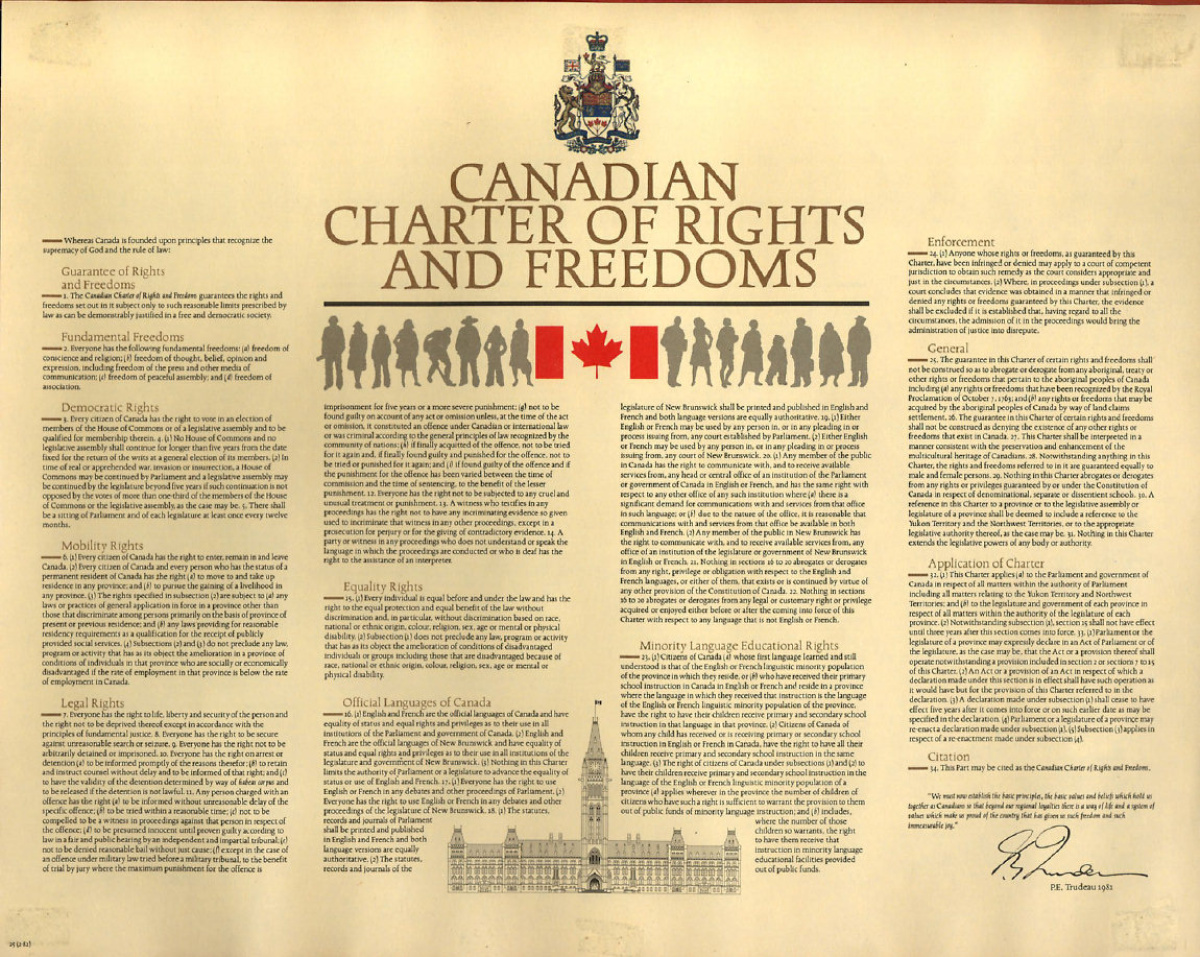
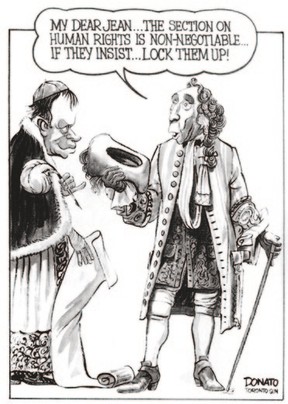
A Toronto Sun editorial cartoon by Andy Donato during Pierre Trudeau’s efforts to pass the Canadian Charter of Rights and Freedoms. You can certainly see where Justin Trudeau learned his approach to human rights.

Last month, Canadian Prime Minister Justin Trudeau’s cabinet used special powers under the Emergencies Act to freeze the bank accounts of Canadian citizens who supported Freedom Convoy protests against vaccine mandates. The government partnered with banks and other businesses to “de-bank” Canadians, circumventing due process and normalizing a dangerous, undemocratic policy. Canada has since revoked the Emergencies Act and instructed banks to unfreeze the targeted bank accounts, but this action set a dangerous precedent.

On February 22, the House of Commons Finance Committee questioned Department of Finance Assistant Deputy Minister Isabelle Jacques about the details of these financial measures. The government revealed that more than 206 accounts were frozen. Exactly how many “more” was not indicated. Trudeau revoked the Emergencies Act on February 23. But we still do not know how many accounts were frozen. No judicial review is permitted of the actions of banks under the Emergencies Act.

The government targeted not only protest participants, but also those who merely donated to the protesters. A reporter asked Jacques if a person who donated to a crowdfunding platform with no further involvement in protests could have their bank account frozen. The answer was “Yes.” Some people were punished without being formally charged with a crime at all.

In some cases, the right to a trial and the presumption of innocence were discarded. The Royal Canadian Mountain Police (RCMP) has stated that they provided the names of Freedom Convoy donors to financial institutions. The RCMP claimed that these individuals were major influencers in the protests or truck drivers who refused to leave the area. This might be the case, but we have no way of knowing for sure. Normally, when the RCMP conducts an investigation, they charge an individual with a specific crime and then give evidence to the Crown prosecutor, who decides if the person should be tried in court. If the person is found guilty after trial, then the judge sentences the person, and the sentence is carried out. However, in this situation, the whole process was reversed. The RCMP determined guilt and imposed a punishment before conducting a proper trial for explicit charges. And because this was done under the Emergencies Act, citizens do not have the ability to sue the bank or the RCMP for mistakes — cases of mistaken identity, for example. There was no incentive against carelessness.

There has also been controversy over whose accounts were frozen. The Globe and Mail reports that the RCMP told the House of Commons Finance Committee on March 7 that a “small number” of additional accounts were frozen under the Emergencies Act based on the banks’ own “risk-based” reviews and were not on a list of names provided by the RCMP.

March 1, 2022

One of the amazing features of Trudeau the lesser’s reign has been the Liberal Party’s abandonment of Canadian nationalism

Filed under: Cancon, History, Media, Politics — Tags: , , , — Nicholas @ 05:00

In The Line, Andrew Potter points out an interesting historical quirk where Canadian practice has long been at odds with most other western democracies:

On social media, it was common to see people lamenting this co-optation of the Canadian flag, with some wondering if it was even acceptable to fly the flag any more.

The reason this has been so disconcerting for so many is that a long-standing feature of the Canadian political landscape has been that the nationalists were predominantly on the left. As the author Stephen Henighan noted years ago in his essay “Free Trade Fiction”, this made Canada close to unique among industrialized, developed countries in the West, where the nationalists tend to be on the right. Left-wing nationalism is typically a feature of post-colonial states, where the fight for independence or liberation from colonial oppressors gets wrapped up into a nationalist narrative.

The reason left-wing nationalism has been so appealing to Canadians was precisely because of our weak identity and ongoing concerns over assimilation, first into the British empire, then later into the American continentalist project. If there’s a founding document of this tendency it is Margaret Atwood’s Survival, but it is prefigured by books like George Grant’s Lament for a Nation and finds its popular expression in everything from Heritage Minutes to the famous Joe Canada ad for Molson beer.

The left-wing focus of Canadian nationalism held sway from the end of the Second World War until about five years ago, and it was hugely consequential for Canadian politics. Most obviously, it helped establish the Liberals as the natural governing party. By making support for Liberal policies synonymous with defending Canadian independence, and by treating Liberal values as Canadian values, the Liberals were able to effectively frame their conservative opponents as un-Canadian.

On the continental policy front, it served to place a pretty clear barrier to deep political integration with the United States. In a 2005 essay that looked at the prospects for political co-operation between Paul Martin’s Liberals and George W. Bush’s Republicans, Joe Heath noted that the big obstacle to Canadian participation on things like Ballistic Missile Defence was the fact there was virtually no ideological overlap between nationalist groups in Canada and the U.S.

[…]

Today, things have completely reversed. A major catalyst for this shift was the decision by Justin Trudeau, when he came to power in 2015, to make denigrating Canada central to his Liberalism. It began when he started issuing formal apologies for past wrongs, at an unprecedented rate for Canadian federal governments. Then there was his acceptance of one of the findings of the National Inquiry into Missing and Murdered Indigenous Women and Girls, that Canada committed genocide against Indigenous peoples. Then there was his decision last spring to order all federal flags to fly at half-mast after the reports of the unmarked graves of hundreds of Indigenous children who died while in the supposed care of the residential school system. The flags remained lowered for months, until pressure from veterans groups and the approach of Remembrance Day forced his hand and he ordered the flags raised.

Whatever the merits of any of these initiatives taken on their own, taken as a whole they set a recurring tone from the government, that Canadians were a fallen people. There is no question that dumping on Canada is a deliberate strategy for the Trudeau Liberals. What is less clear is whether, in persuading Canadian leftists to dislike their country, the prime minister realizes the forces he has unleashed in the process.

February 23, 2022

If the protest is over, why does the government believe it still needs the Emergencies Act powers?

Depressingly, the House of Commons approved Justin Trudeau’s use of the Emergencies Act, and various officials at federal and municipal level have continued rhetorical scorched-earth statements to the media and directly on social media about the protest. If the stated need for those emergency powers has abated, why are the feds still pushing to hang on to them?

In the Toronto Sun, former Liberal Party president Stephen LeDrew is scathing in his criticisms of Trudeau:

Just walk or drive through cities and villages and the countryside, and see the Canadian flags — paired with signs expressing vehement disapproval of our federal government. Loyal Canadians are fed up with their federal government.

And one person is responsible for this — Prime Minister Justin Trudeau.

He has drastically altered Canadian institutions and norms so considerably that usually calm people are raising their voices in protest.

The core of the protestors in Ottawa and other Canadian centres were angry not only about government heavy-handedness in its pandemic policies, but also the changes being brought about by Trudeau.

He has cheapened public discourse and public life.

He talks so high-minded, yet has a lifelong history of deplorable acts.

He has arbitrarily ruined the lives of many other people who have been supposedly guilty of far less egregious acts than have been proven by photographs against him — perhaps to deflect his own guilt?

Does “do as I say, not as I do” strike home? How about “one standard for the masses, and another for the elites like me?”

His intolerance, and high-handed and ill-founded rectitude has led many to regard the government with disdain, and doubt its ability to get things right.

And now his decision to not only invoke the Emergencies Act (which most minds — those not cowardly beholden to Trudeau — agree was not necessary to get the job done in Ottawa), but to keep it in force for an undetermined period (to “hunt down” some Canadians to charge them with mischief?), has shown precisely how inappropriate Trudeau really is for this high office.

David Warren is, in his own words, modestly optimistic despite the current political situation here in the Trudeaupian Maple Dictatorship:

Our provincial and Dominion governments went formally off the rails of settled law in response to the Batflu epidemic, two years ago. They arrogated to themselves powers never previously claimed by our politicians, except in wartime — to regulate the smallest details of everyday life. It began with “two weeks to disable the Constitution and Human Rights”, both here, and under Trump across the border. The “vaccine passports” were merely the latest crass obscenity of this political and bureaucratic class.

I am modestly optimistic about the course of events, however. True, I must expect direct persecution by the Party of the Dictatorship, which is out to settle scores. But the Freedom Convoy sent to the national capital has shown, for the first time in many years, that a substantial number of Canadians will resist.

That a majority cannot cope with freedom, and are likely to squall when exposed to it, I take for granted. Humans have always been “conservative”, in this worst possible sense. But the splendid Canadian reaction to tyranny went beyond what I had hoped for. In particular, many articulate voices have been raised to speak truth — in the dark fever-swamp of lies in which our culture, and by extension our economy, is choking. This will make a huge difference. The sun is distantly shining; and the spring can once again be imagined. Sunlight is the best disinfectant, to filth accumulating in public life.

In 1993, the then-governing “Progressive Conservatives” were reduced from a majority, to two seats in Parliament, and then to extinction at the “federal” level. Men of good will shall be working towards a similar result, at the next general election, in which the Liberals and NDP should be annihilated.

While my dislike of Trudeau runs extremely high, I didn’t have much of an opinion about Chrystia Freeland, the deputy PM, until very recently. Apparently, I’m way behind the curve on disliking “the Nurse Ratched of the New World Order”:

Sorkin’s Visa piece is suddenly relevant again, after fellow former finance reporter Chrystia Freeland — someone I’ve known since we were both expat journalists in Russia in the nineties — announced last week that her native Canada would be making Sorkin’s vision a reality. Freeland arouses strong feelings among old Russia hands. Before the Yeltsin era collapsed, she had consistent, remarkable access to gangster-oligarchs like Boris Berezovsky, who appeared in her Financial Times articles described as aw-shucks humans just doing their best to make sure “big capital” maintained its “necessary role” in Russia’s political life. “Berezovsky was one of several financiers who came together in a last-ditch attempt to keep the Communists out of the Kremlin” was typical Freeland fare in, say, 1998.

Then the Yeltsin era collapsed in corrupt ignominy and Freeland immediately wrote a book called Sale of the Century that identified Yeltsin’s embrace of her former top sources as the “original sin” of Russian capitalism, a “Faustian bargain” that crippled Russia’s chance at true progress. […]

Years later, she is somehow Canada’s Finance Minister, and what another friend from our Russia days laughingly describes as “the Nurse Ratched of the New World Order”. At the end of last week, Minister Freeland explained that in expanding its Financial Transactions and Reports Analysis Centre of Canada (FINTRAC) program, her government was “directing Canadian financial institutions to review their relationships with anyone involved in the illegal blockades.”

The Emergencies Act contains language beyond the inventive powers of the best sci-fi writers. It defines a “designated person” — a person eligible for cutoff of financial services — as someone “directly or indirectly” participating in a “public assembly that may reasonably be expected to lead to a breach of the peace.” Directly or indirectly?

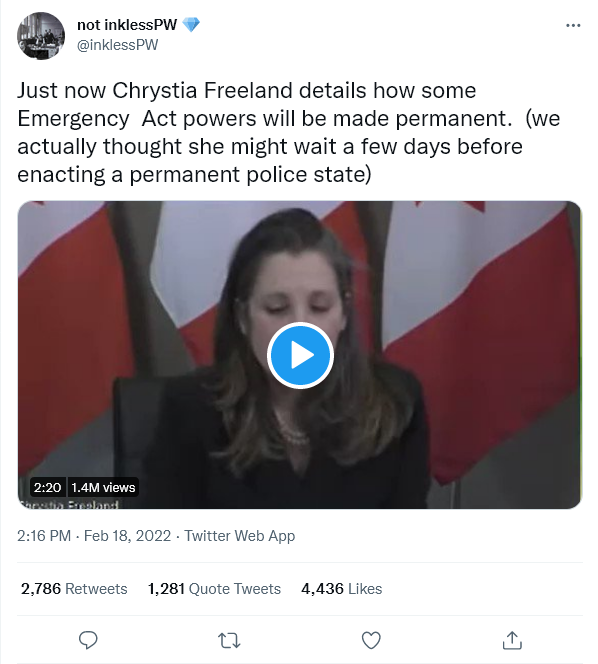
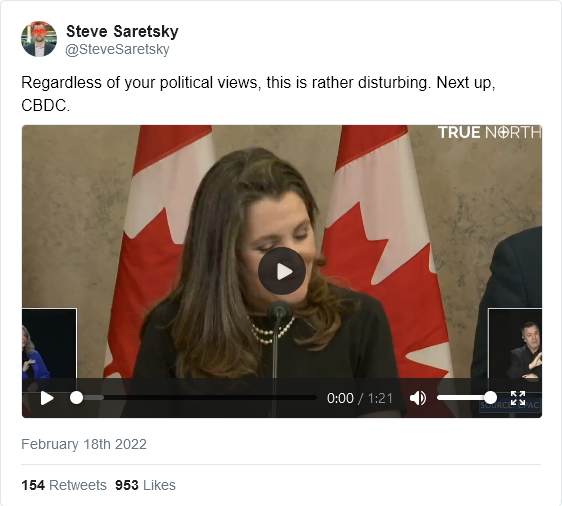
She went on to describe the invocation of Canada’s Emergencies Act in the dripping-fake tones of someone trying to put a smile on an insurance claim rejection, with even phrases packed with bad news steered upward in the form of cheery hypotheticals. As in, The names of both individuals and entities as well as crypto wallets? Have been shared? By the RCMP with financial institutions? And accounts have been frozen? As she confirmed this monstrous news about freezing bank accounts, Freeland burst into nervous laughter, looking like Tony Perkins sharing a cheery memory with “mother”:
One of the oddest moments during the weeks-long protest in Ottawa was when “counter-protesters” showed up, but as one observer noted, they seemed to be at the wrong protest:

At first glance, it looked like one of the strangest, most incongruous moments of the great trucker uprising of 2022. There were the truckers and their working-class allies, in Ottawa, loudly agitating against Justin Trudeau’s vaccine mandates, when a bunch of hyper-woke, definitely not working-class counter-protesters rocked up to rail against this horn-honking throng. And what did they chant, these painfully PC counter-protesters? “Trans rights are human rights”, that’s what. As clear as anything, these supposed leftists, seemingly horrified by the sight of working-class men and women fighting for their rights, engaged in arguably the most striking non-sequitur of the 2020s so far – they brought transgenderism into an issue that has nothing whatsoever to do with transgenderism.

The truckers have said nothing about trans people. We have no idea what these pissed-off working-class drivers think about genderfluidity and all the rest. My hunch is that they think it’s nonsense. But we don’t know. This vast gathering of truckers and their supporters, which has so rattled the Trudeau administration and inspired copycat revolts around the world, is completely unrelated to sex changes and pronouns and the right of born men to beat women in sports and all the other things that fall under the banner of “trans rights” these days. So, understandably, many people were perplexed by the counter-protesters’ chant. “I don’t think they are at the right protest”, said one observer. Memes emerged, saying: “Truckers: Freedom for all! Counter-protest: Trans rights are human rights. Truckers: What??” What indeed.

[…]

In other words, that strange “trans rights” counter-protest captured a larger truth about the truckers’ uprising. Which is that wokeness has enabled the Canadian state’s exceptionally intolerant and violent assault on this working-class uprising. Many of us have marvelled at the allegedly radical left’s studious ignoring of the Canadian working-class revolt against the bourgeois state. But as more and more time passes, it has become clear that the left has not in fact ignored this globally important protest – rather, it has played a key role in legitimising state tyranny against the protesters, in providing the political justification for the Ottawa police’s violent wielding of truncheons and their crushing of working people. The woke are not mere bystanders, not mere wide-eyed shoulder-shruggers to this working-class uprising. On the contrary, they have been the moral facilitators of the state’s classist violence against the truckers and their allies.

February 21, 2022

Trudeau government intends to keep (some of) the powers seized through illegitimate use of the Emergencies Act

The Canadian government under Justin Trudeau took advantage of a peaceful protest in the streets of Ottawa to invoke the Emergencies Act, the modern-day successor to the War Measures Act (which itself had only ever been used three times). Nothing the police have done in Ottawa since the emergency was declared required the powers enabled under the legislation, but apparently the protest was just a pretext to let the government do what it really wanted to do anyway:

The regular weekly round-up from The Line was delayed until Saturday as the events in Ottawa were far too fast-moving to summarize at that point. Here’s part of the later newsletter:

As the protest in Ottawa winds down, your Line editors are beginning to ask themselves, perhaps too optimistically: what happens after the emergency is over?

The Liberal government has arrogated to itself enormous powers through the Emergencies Act: the most notable among them, the ability to freeze assets of protest participants without any kind of prior judicial approval or warrant. It’s not entirely clear to us what would constitute an offence that the government would consider serious enough to justify using this power.

If someone gave $500 to the protest movement three weeks ago, would that merit freezing a bank account? Is the number $5,000? Or $50,000? Would this act apply to independent media livestreaming the protests?

Complicating matters, on Wednesday, Justice Minister David Lametti gave an interview with CTV’s host Evan Soloman. Solomon asked whether ordinary people who donated to the trucker convoy should be worried about the provisions in the Emergencies Act. Lametti responded:

“If you are a member of a pro-Trump movement who is donating hundreds of thousands of dollars, and millions of dollars to this kind of thing, then you ought to be worried,” said Lametti.

Excuse us, but … wtf?

Threatening people who are donating cash to anything that can be construed as a “pro-Trump” movement suggests that attempts to freeze assets aren’t directed toward criminal behaviour, but are rather politically motivated.

We asked Lametti’s office for response to his “pro-Trump” comments and this was his response:

    “We always ask our police forces as well as our prosecutors to act reasonably, where they’re going to work with the banks to ensure that they act reasonably. Obviously there are going to be judgment calls that will be made and serious contributors will be treated more seriously. But, as always, we’re going to leave it to law enforcement to work with the banks, as they already do in other areas that already exist. Such as in anti-terrorism financing and in other areas through FINTRAC.”

This is, frankly, not much of an answer. It amounts to “we will be reasonable. Trust us!”

Well, we don’t. We don’t trust NDP leader Jagmeet Singh to hold this government to account in Parliament. We don’t trust the left to clue into the fact that the tactics used against the convoy will be used against their causes in turn. We don’t trust conservatives to show more principle or restraint when in power.

David Sacks, posting at Bari Weiss’s Common Sense blog, says that the federal government’s moves to seize bank accounts is a clear sign that we’re having a Chinese-style “social credit” system imposed on us:

Last summer, I warned readers of Common Sense that financial deplatforming would be the next wave of online censorship. Big Tech companies like PayPal were already working with left-wing groups like the ADL and SPLC to define lists of individuals and groups who should be denied service. As more and more similarly minded tech companies followed suit (as happened with social media censorship), these deplorables would be deplatformed, debanked, and eventually denied access to the modern economy altogether, as punishment for their unacceptable views.

That prediction has become reality.

What I could not have anticipated is that it would occur first in our mild-mannered neighbor to the north, with the Canadian government itself directing the reprisals. It remains to be seen whether Canada will be a bellwether for the U.S. But anyone who cares about the future of America as a place where citizens are free to protest their government needs to understand what has just occurred and work to stop it from taking root here.

[…]

Trudeau escalated things further on Tuesday night, when he issued a new directive called the Emergency Economic Measures Order. Invoking a War on Terror law called the Proceeds of Crime and Terrorist Financing Act, the order requires financial institutions — including banks, credit unions, co-ops, loan companies, trusts, and even cryptocurrency wallets — to stop “providing any financial or related services” to anyone associated with the protests (a “designated person”). This has resulted, according to the CBC, in “frozen accounts, stranded money and canceled credit cards”.

Banks, according to this new order, have a “duty to determine” if one of their customers is a “designated person”. A “designated person” can refer to anyone who “directly or indirectly” participates in the protest, including donors who “provide property to facilitate” the protests through crowdfunding sites. In other words, a designated person can just as easily be a grandmother who donated $25 to support the truckers as one of the organizers of the convoy.

Because the donor data to the crowdfunding site GiveSendGo was hacked — and the leaked data shows that Canadians donated most of the $8 million raised — many thousands of law-abiding Canadians now face the prospect of financial retaliation and ruin merely for supporting an anti-government protest.

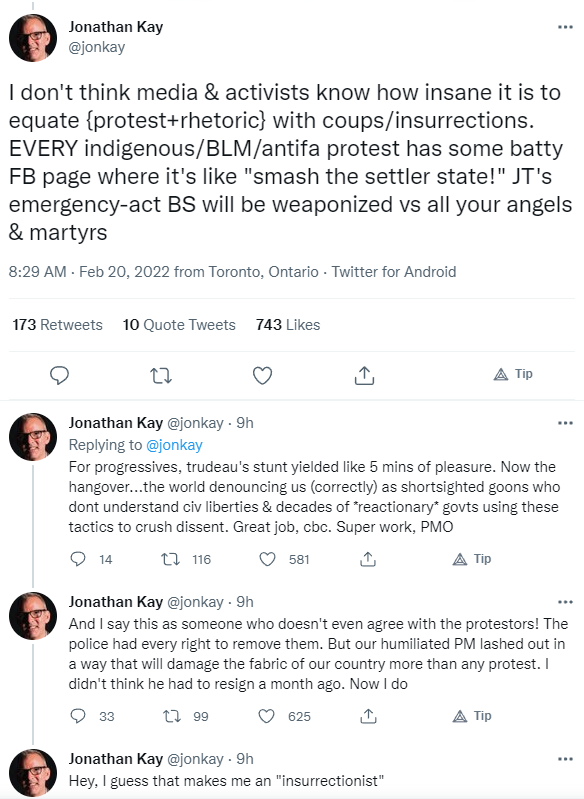
Hard to disagree with Jon Kay here:

Jordan Peterson discusses the catastrophe of Canada with Rex Murphy:

February 20, 2022

That “small fringe minority … holding unacceptable views” and their banner of racism and white supremacy (checks notes) — the Canadian flag

Filed under: Cancon, Government, Media, Politics — Tags: , , , , , — Nicholas @ 03:00

David Warren notes that if nothing else, the Freedom Convoy has managed to get some central Canadians to turn against the national flag:

There is one interesting, nearly universal feature of the demonstrations in Canada for political freedom. The members — called a “small fringe minority” by our prime minister — would seem to be almost entirely Christian. They are also patriotic, as is evident even to legacy media, who feel compelled to use photographs and footage, and thus to admit a fragment of the truth. Canadian flags are exhibited on the grilles of the honking trucks, and generally.

Indeed, a Globe reporter has tweeted that she is now traumatized by this experience, of being confronted by Canadian flags. She gags at what I used to call the “Pearson pennant”. (It is only in the last few weeks, that I have ceased to be “traumatized” by it, myself; though truth to tell, I’m not the “traumatized” type.)

But the Christian attachments, among the protestors, is not waved about as a flag. It is expressed mostly in prayers, and the articulation of blessings, and in subtle decorations worn close to head and heart, that may be illegal in Quebec.

Batya Ungar-Sargon reports on the situation in Ottawa for Spiked:

It’s been quite a few weeks for our neighbours to the north. Three weeks ago, a ragtag, grassroots campaign of disgruntled truckers made their way to the Canadian capital to protest a government vaccine mandate. As of last night, two of the organisers of what has been, by all accounts, a peaceful protest have been arrested, giving Canada – a country that bills itself a democracy – its first political prisoners in recent memory.

On Thursday, Chris Barber was arrested, while Tamara Lich had her personal bank account frozen and was detained on a charge of “aiding and abetting mischief” – a trumped-up charge resulting directly from a naked power grab by Canadian prime minister Justin Trudeau.

Instead of meeting with his citizens to hear their demands, Trudeau has spent the past three weeks smearing them as hateful and violent. On Monday he became the first Canadian leader to invoke the Emergencies Act – giving his government a series of draconian powers. Without one iota of evidence that the “violence” of the truckers’ protests has ever exceeded honking, Trudeau broadened the scope of Canada’s anti-money-laundering and terrorist-financing rules, putting the striking truckers on a par with terrorists, suspending their civil liberties and allowing banks to freeze the personal accounts of anyone linked to them. Now Trudeau is having them arrested. And on Friday morning, he cancelled a parliamentary session in which his edict was due to be voted on, and could have potentially been revoked, by the House of Commons or the Senate.

The truckers’ protest began with Trudeau smearing the truckers as Nazis and fascists – a line gladly repeated, day in day out, by reporters and pundits in the elite liberal media. It is now ending with those same elites cheering on Trudeau’s authoritarianism.

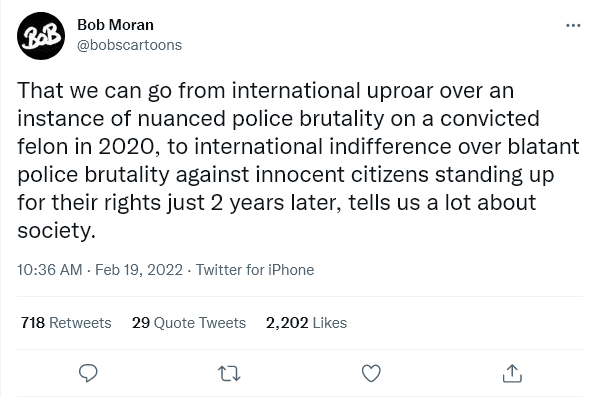
Although the media have promoted Trudeau’s falsehoods and cheered his overreach, many Canadians see the protests for what they are. The Canadian Civil Liberties Association is taking the federal government to court for invoking the Emergencies Act. “It’s possible for protests to be both disruptive and peaceful”, Noa Mendelsohn Aviv, its executive director, rightly argued. Others have pointed out Trudeau’s hypocrisy. In 2020 the Canadian PM threw his support behind both Black Lives Matter’s disruptive protests and protesting farmers in India who were blocking major highways. “Canada will always be there to defend the right of peaceful protest”, Trudeau said back then.

H/T to Samizdata for the link.

Of course, it’s totally reasonable (in the government’s view anyway) to set the mounted unit and riot-helmeted, baton-wielding police against the dangerous bouncy castle terrorists in Ottawa, but on the other side of the country actual terrorist actions are being downplayed:

There has been an outbreak of political violence in Canada. A member of the Royal Canadian Mounted Police was hurt and people going about their daily business were threatened by masked men with axes. Roads were blocked with barricades, Millions of dollars of damage was caused. At one point some of the workers were trapped in a building while the demonstrator tried to set light to it with them still inside.

This happened on Thursday night. It didn’t happen in Ottawa where hundreds of truck drivers maintained their protest despite emergency powers being granted to the authorities. Powers to steal their trucks, close their bank accounts – including those who have donated to their cause, and now they are talking about forcibly removing their children, and euthanising pet dogs, all because they have engaged in peaceful protest. People who have been vilified in the Canadian media as terrorists or as insurrectionists intent on overthrowing the democratically elected government of Canada as the January 6th protesters did at the White House, but this time in plaid shirts.

No this attack took place, not in Ottawa, but in British Columbia, at an industrial site. This is what the RCMP (Royal Canadian Mounted Police) had to say: “Shortly after midnight, Houston RCMP was called to the Marten Forest Service Road (FSR) after Coastal Gas Link (CGL) security reported acts of violence at their work site … approximately 20 people, some armed with axes, were attacking security guards and smashing their vehicle windows …

“Upon police attendance at the 41 km mark, the roadway had been blocked with downed trees, tar covered stumps, wire, boards with spikes in them, and fires had been lit throughout the debris. As police worked their way through the debris and traps, several people threw smoke bombs and fire lit sticks at the police, injuring one officer.

“At the 43 km mark, an old school bus blocked the road … When police arrived … they found significant damage had been done to heavy machinery, fencing, and portable buildings …

“This is a very troubling escalation in violent criminal activity that could have resulted in serious injury or death. This was a calculated and organized violent attack that left its victims shaken and a multimillion dollar path of destruction,” says Chief Superintendent Warren Brown, North District Commander, “While we respect everyone’s right to peacefully protest in Canada, we cannot tolerate this type of extreme violence and intimidation. Our investigators will work tirelessly to identify the culprits and hold them accountable for their actions.”

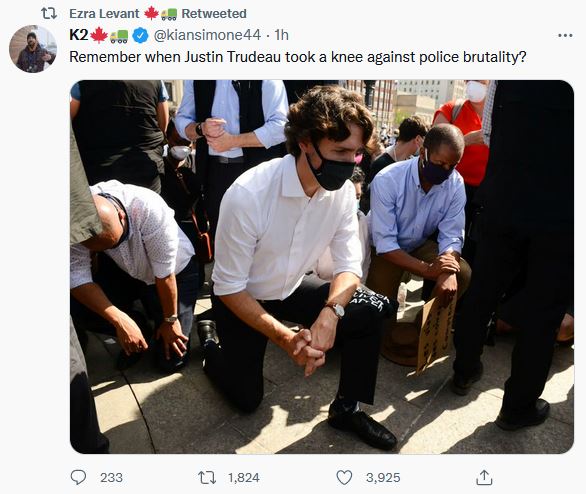
And from the “That was then, this is now” file, here’s Justin Trudeau taking a knee over police brutality in the far, distant days of the past:

H/T to JoNova for the screencap.

February 19, 2022

Freedom Convoy organizers arrested, Ottawa police “operations” pre-empt Parliamentary session to debate the invocation of the Emergencies Act. Just another day in Trudeaupia

Parliament was scheduled to debate the Prime Minstrel’s use of the Emergencies Act, but the session was cancelled because the Ottawa police were conducting an “operation” on Parliament Hill. The police also warned journalists to avoid the area for their own safety. Nothing disturbing or authoritarian about attempting to ensure that there won’t be any independent reports on the “operation”, right? This isn’t the kind of “free and democratic society” most of us imagined it was just a few days ago.

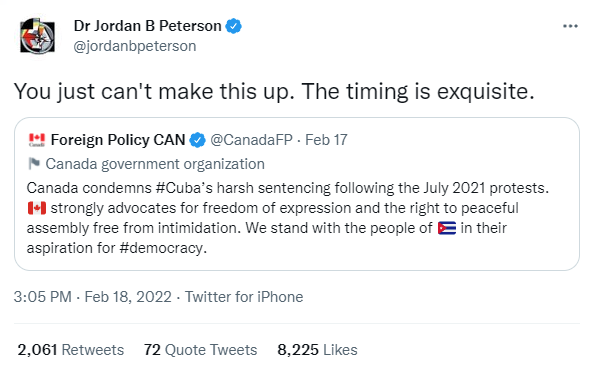
Jordan Peterson points out the amazing tone-deafness of the federal government on yet another topic:

ReasonTV looked at the “Revolt of the Canadian Truckers” and compared it to other populist protest movements of recent years:

PPC leader Maxime Bernier sent out this email to supporters:

There is violence in the streets of Ottawa.

The police, armed with riot gear, are brutalizing and arresting peaceful demonstrators from the truckers’ convoy.

Meanwhile, Parliament is not sitting today because of this police operation. All parties agreed to stay away while the regime cracks down on dissidents.

Just like in a banana republic.

They should have been debating Trudeau’s decision to invoke the Emergencies Act.

The Emergencies Act replaced the War Measures Act in 1988. The only other times in Canadian history that it was invoked were during the First and Second World Wars, and during the October Crisis in 1970.

There is no emergency in Canada. No war, no insurrection, no terrorist attack, no sanitary or environmental catastrophe that justifies invoking this law.

It’s outright illegal, undemocratic, and unconstitutional for this government to give itself exceptional powers to deal with peaceful demonstrators.

It’s a power grab on Trudeau’s part to crush dissidence, that’s all it is.

Trudeau and his Finance minister Chrystia Freeland have given themselves the power to freeze the bank accounts not only of the organizers of the Freedom Convoy, but of anyone who is suspected of helping and funding them.

And we’re supposed to believe that a government that has violated our Constitution and our rights and freedoms for two year will not abuse these new powers?

Nicholas, it’s a dark day for Canada.

But it’s not over. We will continue to fight this authoritarian government, and bring back freedom, respect and justice to this country.

Don’t despair. Stay strong and free.
-Max

The good folks at Spiked explain why the truckers must win:

GiveSendGo sent an email in response to queries about whether the truckers had received the money that had been donated:

Where’s the money?

The questions keep on coming, so we want to answer!

The number one question people are asking right now is, “Have the truckers received the funds?” Our answer is this: “Yes, the truckers have received some of the funds paid out to the ‘Adopt a Trucker’ campaign.”

As this plays out with the Canadian government, there have been steps taken to prevent the funds from being “frozen”. Currently, the bulk of the funds are in an undisclosed U.S. bank.

Right now, the teams involved are actively discussing the legal options for getting the funds where they need to go. (Thank you to those who’ve sent in suggestions, you’ve definitely had some creative ones!)

What we need from you:

We ask that you do not request a refund at this time as these funds will be needed for the truckers and their legal teams. Additionally, please be patient and pray for wisdom for all involved. We will keep you updated as we move forward.

Thank you for all your prayers and support over these past few weeks!

“But as for you, be strong and courageous, for your work will be rewarded.” ‭‭2 Chronicles‬ ‭15:7

‭‭Shine Brightly!

February 18, 2022

The “small fringe minority … holding unacceptable views” who can now have their bank accounts seized without recourse

Filed under: Cancon, Government, Politics — Tags: , , , , , , — Nicholas @ 03:00

Prime Minstrel Justin Trudeau invoked the Emergencies Act earlier this week, which gives the federal government the kind of powers previously reserved for wartime. Among other measures, it is claimed that the act gives the feds the power to have Canadian banks seize the accounts of Canadians holding unacceptable views. Even those of us who donated to the support of the trucker convoys in Ottawa and several border crossings are now “legally” able to be deprived of our property. This is far from the kind of free and democratic society most of us thought we inhabited before the public health crisis of the Wuhan Coronavirus somehow transmuted our country into a would-be dictatorship.

At Essays in Idleness, David Warren demands that we stop it now:

The idea that one has the right, under a “Charter”, to speak freely, demonstrate and protest, but not the right to occupy physical space and time, has long been apparent to persons of the cold-blooded, criminal disposition.

In this respect Justin Trudeau is hardly unique. Like, for instance, the New Zealish prime minister, Jacinda Ardern, he rose to his present eminence as the embodiment of an empathy, that was entirely fake. Indeed, he had no other skills or gifts, and like Miss Ardern, has only offered administrative incompetence. He is what we call “a nasty piece of work”.

He has now declared a national State of Emergency: because there are trucks parked illegally on Wellington Street in Ottawa. Had he been quicker with his proclamation, he could have mentioned a bridge in Windsor and border crossings in Manitoba and Alberta. But this would not have made his claim more plausible, as all the demonstrations were provocatively peaceful. The only chance of violence is to use force against them.

An economy is a controversial thing, for economic activity will often involve the use of space and time. For instance, truckers, and most others who are inclined to resist government “mandates”, are known to have bank accounts. They buy food to put in themselves, and fuel to put in their vehicles. By “freezing” these financial instruments, Trudeau vainly hopes to starve his opponents into panicked submission.

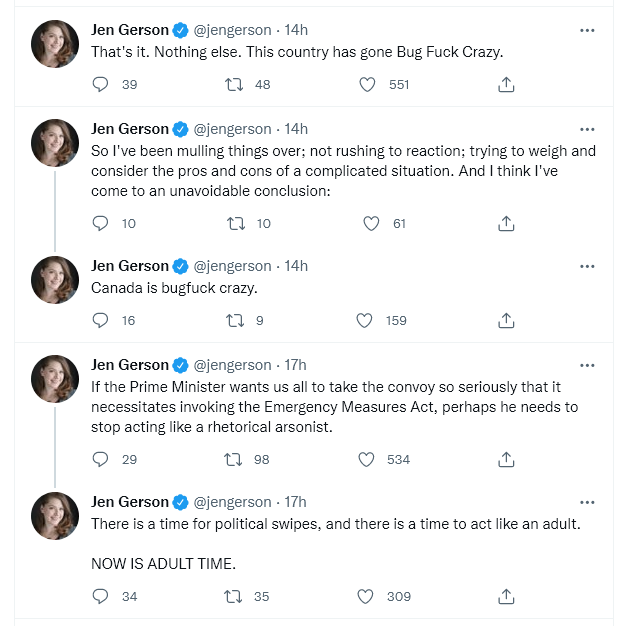
As Jen Gerson notes on Twitter, Canada is suffering a psychotic break. The technical term is “Bug Fuck Crazy”:

She continues:

I mean, perhaps this was inevitable. No country can be this uptight and stoic for so long without losing its collective bugfuck crazy mind eventually.

    @MacLeodKirk: Yeah, to be honest I’m rather tired of us measuring our level of excellence based on the batshit crazy happenings in the US.
    Perhaps we could aim just a tad bit higher?

The difference is that America can tolerate a certain baseline level of crazy. It’s like having an alcohol tolerance.

Canada, by comparison, is an 18-year-old Ontario girl crossing into Quebec and taking her first shot of Sourpuss right now. We can’t handle our shit.

“ALL OF YOU ARE ACTING LIKE CRAZY PEOPLE” she screamed into the Internet abyss before throwing her wine glass at the wall and disappearing for three days.

Earlier this week, the government’s spokesgoons in the media made not-so-veiled threats against the children of truckers and other supporters. On Thursday, Ottawa officially threatened to dognap any pets at the protest … for their own good, of course. Interestingly, Thursday was also the day that workers began to install a fence around the Parliament buildings, in imitation of the fortifications at the American Congress.

Malcom Kyeyune calls it “Justin Trudeau’s phoney dictatorship”:

When Justin Trudeau invoked emergency powers to quell protests against mandatory Covid-19 vaccinations this week, it was another sign that for Western liberal democracy, business as usual is over. This is the first time Canada’s Emergencies Act has ever been called upon by a Prime Minister. Its predecessor, the War Measures Act, was used three times: once for World War One, once for World War Two, and once to deal with a violent campaign of bombing, kidnapping, and murder by Quebecois separatists in 1970.

Yet Trudeau’s invocation of the Emergency Act is also a bizarre moment. Consider that the law stipulates that the government can fine people violating the act between 500 and 5,000 dollars. On the face of it, these are not numbers that seem commensurate to punish violators of the most powerful emergency law in the Canadian state’s armoury. But the reason these numbers seem so strange is simple: the law hasn’t been updated to keep up with the times, or inflation.

The oddness doesn’t end there. A law that in a real sense was forgotten — and designed to handle the most extreme situations a nation state can find itself in — is now dredged up to deal with a fairly routine political protest. Trudeau, and his finance minister Chrystia Freeland, have also called on financial institutions to freeze or suspend any bank accounts without a court order if they are being used to fund the protests. They believe, as David Frum writes in The Atlantic, that the truckers represent a “form of performative intimidation”.

Compared to the mass burning and vandalism of Catholic Churches in Canada last summer — which Trudeau both denounced and sympathised with, calling the arsons “understandable” at one point — the truckers hardly represent a nadir of public order. Across the border in the United States, the rioting that occurred there in the summer of 2020 involved loss of life, and massive damage to property. Back then Kamala Harris’s response was markedly similar to that of Trudeau — hand-wringing, sure, but also sympathy with the motivations of those who rioted.

Perhaps buildings being burned down, sometimes with their occupants still inside them, is just part and parcel of living in a vibrant democracy. Meanwhile, a protest that has led to zero loss of life and no torched buildings is cast as a grave threat to democracy. Put up bouncy castles for kids to play in and have public barbecues, as the truckers have done? Then, in the words of the New York Times‘ editorial board, you are “far-Right”, and represent a “test of democracy” itself.

Or you will be accused of “sedition” by the usually phlegmatic Mark Carney. The former Bank of England governor may support Trudeau’s use of emergency powers, but by all indications it is a spectacularly ill-conceived move. Many provincial leaders are already openly rejecting the necessity of such extreme measures.

Kim du Toit responds to a rant by one of Sarah Hoyt’s contributors:

As I see it, most ordinary Americans — if faced with the choice — would rather go to war against our own government than against Canada, present company included.

And as Mr. Free Market put it to me during a semi-drunken phone call last night: how bad does the Canadian government have to be, to have pissed off the nicest, politest people on the planet?

They’re so nice that SoyBoy Trudeau is highly unlikely to have a Ceaușescu Moment, even though it could be argued that he deserves one

As always, Canadians love it when foreigners (especially Brits and Americans) call us “nice” and “polite” … it shows they don’t follow hockey or know many actual Canadians. Canadians are polite, generally, but it’s a kind of passive-aggressive niceness that can snap unexpectedly under sufficient provocation, then the gloves come off and there’s blood on the ice. That last bit is only sometimes metaphoric.

« Newer PostsOlder Posts »

Powered by WordPress