Quotulatiousness

July 2, 2012

Meet the new boss … of Mexico

Filed under: Americas, Government, Politics — Tags: , — Nicholas @ 09:47

After more than a decade in opposition, Mexico’s equivalent of the Natural Governing Party* has returned to power:

Mexico’s old rulers claimed victory in a presidential election on Sunday, ending 12 years in opposition after a campaign dominated by a sputtering economy and rampant drug violence.

After pledging to restore order and ramp up economic growth, Enrique Pena Nieto of the Institutional Revolutionary Party (PRI) had a clear lead over his rivals in exit polls and a “quick count” conducted by electoral authorities.

Although his main rival said it was too early to concede defeat, the 45-year-old Pena Nieto delivered a late-night victory speech to cheering supporters, and a senior electoral official said the PRI candidate’s lead was “irreversible”.

“Mexicans have given our party another chance. We are going to honor it with results,” a visibly moved Pena Nieto told followers packed inside the PRI headquarters in Mexico City.

* For non-Canadians, the joke about the “Natural Governing Party” is that the Liberal Party of Canada had been effectively the permanent government in Canada for most of the 20th century, with only a few isolated interruptions by the Progressive Conservatives (aka the Forward-Backward party).

Update: The Economist has more:

The return of the PRI is not welcomed by everyone. The party ran Mexico for seven uninterrupted decades until it was ousted from the presidency in 2000. Back then few expected that the “perfect dictatorship”, as the PRI regime was dubbed by the Peruvian novelist Mario Vargas Llosa, would return to power just 12 years later. But the television-friendly Mr Peña ran a professional campaign and faced weak opposition from the fiery Mr López Obrador and from Ms Vázquez, whose poor result is in part a verdict on Mr Calderón’s disappointing six-year term in office.

Many have predicted that a close result would lead to a challenge by Mr López Obrador, who lost the 2006 election by less than 1% and mounted a months-long blockade of Mexico City’s main thoroughfare to protest that result, which he claimed (with thin evidence) was fraudulent. This year’s race looks to be nothing like as close as that of 2006. But if Monday’s final results show a narrower gap, Mr López Obrador’s committed followers could yet take to the streets again.

Election day provided some ammunition for a challenge, with evidence of cheating by some parties and cock-ups by the electoral authorities—though the scale of both was unclear. There were reports of voters in poor areas being offered upwards of 500 pesos ($38) to hand over their voting cards, which prevented them from casting their votes and perhaps enabled someone else to cast them instead. The PRI featured most often in such reports. A ban on political advertising after the end of the campaign on Wednesday was flouted by the Green Party, a formal ally of the PRI. The Greens illegally sent text-messages and recorded phone calls to many people (including your correspondent) on the day of the election, urging them to vote for their candidates.

June 18, 2012

Rerun of the Greek election

Filed under: Economics, Europe, Greece, Politics — Tags: , , , — Nicholas @ 09:16

The Economist summarizes the results of yesterday’s election in Greece:

WHEN deciding whether to grant citizenship to an outsider, the Ancient Greeks would put the matter to a vote, tossing coloured pebbles into a clay jar. On June 17th almost 29.7% of voting Greeks picked the colours of New Democracy, a centre-right party that broadly supports the country’s EU bail-out agreement. It was seen as a vote to remain citizens in good standing of the single currency. New Democracy narrowly beat Syriza, the “coalition of the radical left”, which was threatening to rip up the bail-out agreement. That would have resulted in ejection from the euro area or at least ostracism (another Ancient Greek practice) from its fellow members.

On the face of it, this do-over election has generated the kind of result euro-officials were hoping to see in the first election on May 6th. The leader of New Democracy, Antonis Samaras, will now seek to form a coalition with other parties that broadly support the bail-out. The Greek people can look forward to the sweat of fiscal austerity, not the tears of financial chaos. They can expect chronic misery rather than acute disaster.

[. . .]

What about the economy? As our piece last week reported, it has spent the last six weeks in suspended animation. Unfortunately, economies do not keep well in the freezer. The hesitation has wreaked great and irreparable harm. The banks have lost more deposits. The government’s arrears have grown. Erik Nielsen, chief economist of UniCredit, reports that pharmacists have suspended credit to the government, hampering the supply of medicines. The pebbles cast in May have spread damaging ripples through world markets, which have not reversed themselves. They “introduced yet another round of uncertainty” that the second bail-out programme “was not built to deal with.”

June 16, 2012

Obama’s really bad week

Filed under: Media, Politics, USA — Tags: , , , — Nicholas @ 10:56

Matthew Continetti on President Obama’s really awful week:

I can’t be the only person in America who, at about minute 35 in President Obama’s almost hour-long “framing” speech in Cleveland Thursday, wanted to tell the president, as the Dude famously screams at Walter Sobchak in The Big Lebowski, “You’re living in the past!”

Obama’s overly long, repetitive, and by turns self-pitying and self-congratulatory address was so soaked through with nostalgia that MSNBC should have broadcast it in sepia tones. The speech — which even the liberal Obama biographer Jonathan Alter called one of the president’s “least successful” political communications — revealed an incumbent desperately trying to replay the 2008 election. But no oratory will make up for a flawed record and a vague, fissiparous, and unappealing agenda.

The president himself forced this abrupt re-launch of his reelection campaign. After a bad week that began with terrible job numbers, proceeded to Scott Walker’s victory in the Wisconsin recall, and culminated in awful fundraising news, Obama tried to recover last Friday by addressing the press on the state of the economy. Except things went horribly wrong. The president uttered six words — “the private sector is doing fine” — that not only will plague him for the rest of the campaign, but also perfectly captured his complacent attitude toward all things outside the realm of government.

May 20, 2012

This is why I don’t expect the Bush tax cut to be allowed to expire

Filed under: Economics, Government, USA — Tags: , , , , — Nicholas @ 08:42

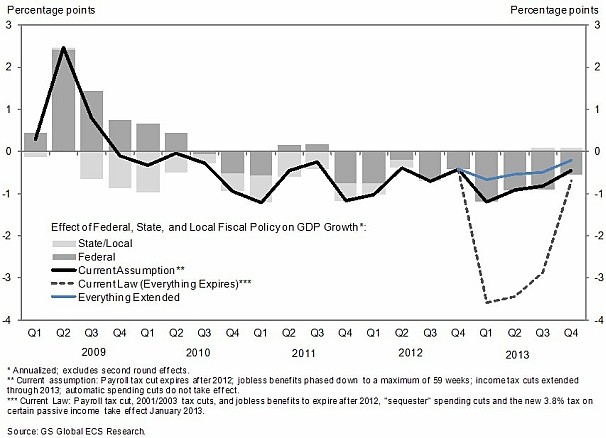
Here it is in one easy-to-understand graph:

Brad Plumer explains:

What will the economy look like in 2013? A great deal depends on what Congress decides to do at the end of this year. Remember, the Bush tax cuts are expiring, the payroll tax holiday will sunset, and a bunch of new spending cuts under the debt-deal “sequester” are scheduled to kick in. Coming all at once, that’s a potentially big drag on growth.

[. . .]

To put this in perspective, the Federal Reserve expects the economy to grow at a roughly 2.9 percent pace in 2013. If Congress does nothing at the end of this year, much of that growth could be wiped out, and there’s a strong possibility that the United States could lurch back into recession. (Granted, a lot could depend on how the Fed reacts in this situation.)

On the flip side, as Ezra discussed in Thursday’s Wonkbook, letting all of the tax cuts expire and spending cuts kick in would also cut the U.S. deficit considerably: “Public debt falls from 75.8 percent in 2013 to 61.3 percent in 2022.”

H/T to Doug Mataconis for the link.

May 16, 2012

The real reason for Ron Paul’s surprising announcement

Filed under: Liberty, Politics, USA — Tags: , , , , — Nicholas @ 09:52

Edward Morrissey thinks the reason Ron Paul won’t be contesting any more primaries is that he’s already achieved his real aim:

On Monday, the Republican nomination fight finally got reduced to a single candidate. This might surprise people who believed that the departure of Newt Gingrich and Rick Santorum had already made Mitt Romney the official nominee. But until Monday, Rep. Ron Paul (R-Texas) had continued to raise funds and campaign in upcoming primary states.

That changed with a statement from the candidate himself — or at least it changed somewhat. Unlike Santorum and Gingrich, who suspended their campaigns entirely, Paul has instead decided not to contest any more states. Paul explained that his efforts in the rest of the nomination process would focus on consolidating his delegate gains in states that had already held their contests. “Our campaign will continue to work in the state convention process,” Paul explained in his message. “We will continue to take leadership positions, win delegates, and carry a strong message to the Republican National Convention that Liberty is the way of the future.”

[. . .]

So what is the real endgame? Some wonder whether Paul wants to stage a demonstration at the Republican convention, which he adamantly denied last week. Rumors have also circulated that Paul would flex his muscle to get the rules changed and unbind all delegates at the convention, but he doesn’t have that kind of muscle, and it wouldn’t result in a Paul nomination even if he did. Paul’s delegates will have an impact on the party platform, which most believe is the object of Paul’s strategy, but party platforms don’t really have that much practical impact. Few people read them, and even fewer candidates feel bound to them.

Most people miss the fact that Paul has already achieved his end game, or is within a few weeks of its conclusion. The aim for Paul isn’t the convention, which is a mainly meaningless but entertaining exercise in American politics. The real goal was to seize control of party apparatuses in states that rely on caucuses. With that in hand, Paul’s organization can direct party funds and operations to recruit and support candidates that follow Paul’s platform, and in that way exert some influence on the national Republican Party as well, potentially for years to come. Paul hasn’t won every battle in that fight, but Minnesota will probably end up being more the rule than the exception.

May 10, 2012

Megan McArdle on “eyewitness” accuracy, bullying, and the failures of human memory

Filed under: Law, Liberty, Politics, Science — Tags: , , , , , — Nicholas @ 11:34

In a fascinating series of Twitter updates, Megan McArdle discusses the inherent problems we encounter when we depend on eyewitness testimony, especially long after the event. This is a long series of separate entries starting with this one:

It’s heartwarming to see all these journalists and twitterers who never did anything morally wrong in high school.

I mean, most of the high school students I knew were pretty much selfish and immoral herd beasts. But maybe things were different elsewhere.

[Responding to a comment from @jbouie] No, just saying that it’s not really backed up. You and I both know what the quality of eyewitness evidence is when given . . . immediately, and by the time it’s 50 years old and delivered in re a presidential election . . . the Swift Boaters had more . . . eyewitnesses who corroborated that Kerry was “lying”. Wouldn’t exactly be surprised to find that those who remember . . . Romney as ringleader were maybe not planning to vote for Mitt Romney.

I don’t think they’re lying as much as motivated cognition plus memory from 50 years ago is not reliable. Dito swiftboaters.

I don’t even think that’s only explanation; just think I can’t reliably distinguish from “they’re remembering accurately”

Note: I actually watched lots of formerly bullied girls become bullies themselves in girls’ camp when social dynamic of cabin . . . shifted for some reason. In most cases difference between bullied and bullies was group support/encouragement, not . . . some fundamental difference in their character. I never saw a bullied girl turn down the opportunity to bully someone else.

[. . .]

[in response to @pjdoland] I am sure that many of my bullies have forgotten it. I don’t think they’re sociopaths. I think they’re humans who grew up.

All the research on memory shows that it’s incredibly unreliable, and very easy to create factitious memories . . . that seem perfectly real. The odds that either Kerry or the Swift Boat vets accurately recalled what happened are zero.

And people who come out of the woodwork decades later with memories that impeach a presidential candidate are almost . . . certainly, either individually or as a group, altering those memories in ways that help the candidate they like.

. . . or they are embellishing memories. Seriously, this is a huge problem with eyewitness testimony, particularly in old trials.

If you tell people what happened, they will report it as if they recall it–they will in fact recall it.

A personal example: my mother was in hospital for an undiagnosed abdominal ailment that turned out to be appendicitis.

I spent the worst 13 hours of my life in the ER with her and would have sworn that it was seared—seared!–into my memory.

But as it happened, I kept a record of what was happening in RT, in case I wanted to write about it. (Fucking journalists, right?)

Three weeks later, I’d forgotten most of the stuff on the list. Some of it came back to me when I read it.

Some of it I still have absolutely no idea what I’m talking about. (I googled snoring? Why?) Memory is not what we think.

It’s a narrative that is constantly being recreated as we tell it, not a record.

The malleability of memory is something that none of us particularly want to face up to: we like to think of ourselves as reliable witnesses to our own lives, yet the evidence is that we are very much not. Some of us are a bit better at accurate recollection, while others consciously remember things as they should have happened instead of how they actually happened.

This, of course, should require us to move the entire “history” section over into the “fiction” part of the mental library…

Reason.tv: Ron Paul’s young voter fanbase

Filed under: Economics, Liberty, Media, Politics, USA — Tags: , , — Nicholas @ 07:36

May 9, 2012

Misreading the European electoral tea leaves

Filed under: Economics, Europe, France, Government, Greece, Italy, Media — Tags: , , — Nicholas @ 10:19

Brendan O’Neill points out that there’s something lacking in the analyses of all the recent electoral upheavals in Europe:

Great claims are being made in the wake of the local elections in Britain, the presidential elections in France, and the legislative elections in Greece. Britain’s Labour Party may have secured the votes of just 12.5 per cent of the eligible electorate, but it came top in the local elections, and so we’re told that ‘Labour is back’. The victories of Hollande in France (where he won 51.63 per cent of the vote to Nicolas Sarkozy’s 48.37 per cent), and of SYRIZA in Greece (the anti-austerity, radical left coalition which won 16.78 per cent of the vote), are being talked up as a ‘new dawn’ for European social democracy. According to a Guardian editorial, we have witnessed a ‘stunning victory… for the left in Europe’.

These observers urgently need to take a reality check. Because in truth, the most striking thing about the recent elections in Europe has been the utter absence of any matters of doctrine, of principle, of ideological outlook. In England, France, Greece, Italy, no doctrinal matters whatsoever have been raised, far less contested. These elections are best seen, not as a new dawn for social democracy, but as an unfocused emotional reaction against things — against Sarkozy, austerity, Brussels. Actually, it’s worse than that. Where once the left was concerned with creating a new reality, one based on systems and values quite distinct from those of traditionalists, today’s emerging left is obsessed with avoiding reality, with hiding away from the harshness of economic life in 2012 and simply saying: ‘Be gone!’ The problem with the newly successful left movements is not just that they’re attracting shallow protest votes, but that they’re extraordinarily infantile, blinkered outfits.

The only ‘doctrine’ uniting the various movements against austerity in modern Europe (both the left-wing and right-wing ones) is the doctrine of responsibility aversion, of shirking seriousness in favour of emotionalism. What the cheerleaders of these movements fail to realise is that being anti-austerity without positing an alternative route out of recession, without any serious proposals for stabilising economic life in Europe, is mere gesture politics. In fact it’s an act of irresponsibility, of wilfulness, where the key aim is to insulate oneself and one’s supporters from the harsh realities of our recessionary times rather than face up to those realities and potentially transform them. The new anti-austerity posturing, to quote an old communist, is an infantile disorder.

May 6, 2012

Gary Johnson wins the Libertarian nomination

Filed under: Economics, Liberty, Politics, USA — Tags: , , — Nicholas @ 09:19

Former New Mexico governor Gary Johnson won the Libertarian Party’s nomination for their presidential candidate. Yesterday, before the vote, Dave Weigel posted this profile of Johnson:

Gary Johnson is late. He’s pretty happy about the reason: too many interviews on the schedule today. That was never a problem when he was running for the Republican Party’s presidential nomination. Now that he’s the front-runner for the less-exclusive Libertarian Party nod, people want to talk to him.

“We started out at Grover Norquist’s meeting,” says Johnson, putting down his iPad to join me at a Dupont circle coffee shop. Norquist’s meeting of conservatives is off the record, but attendees can confirm that they crossed the threshold. “I thought it was a really good reception. Part of being out there, campaigning, talking to people, is being able to read body language. And it was all good. Nobody was dozing off. Nobody was shaking their heads. They were actually shaking their head this way.” He nods vigorously.

We’re talking on the day that Newt Gingrich announced the end of his profound presidential bid, when the Republican Party, supposedly, was learning to love Mitt Romney. It’s a few days before Johnson will claim the Libertarian Party’s nomination, potentially becoming a spoiler for Romney. The heads really nodded this way? No heads shaking that way?

“No, none, zero,” says Johnson. “I really believe I’m gonna take it from Obama rather than Romney. I joke, you know — maybe all those pot-smoking, marriage equality, get out of Afghanistan voters for Romney are going to switch to me. Then, boy, he’ll be in trouble!”

May 3, 2012

Reason.tv: Brian Doherty on Ron Paul’s Revolution

Filed under: Economics, Liberty, Media, USA — Tags: , , , , — Nicholas @ 10:39

“Ron Paul invented the notion of a populist, activist, modern movement thats transpartisan” says Reason’s Brian Doherty

Brian Doherty sat down with ReasonTV to talk about his new book and how Ron Paul has changed politics in America. Doherty wrote about the evolution of the libertarian movement in his 2007 book “Radicals for Capitalism: A Freewheeling History of the Modern American Libertarian Movement”. He has been following and writing about Ron Paul and his movement since then. Doherty examines Ron Paul’s influence in a new book out May 15, “Ron Paul’s rEVOLution: The Man and the Movement He Inspired”.

Sarkozy’s best chance to win? The DSK effect

Filed under: Europe, France, Government — Tags: , , , — Nicholas @ 10:26

John Gizzi on the slim hopes Nicolas Sarkozy has to catch up to front-runner Francois Hollande in the French presidential election:

Before arriving here today to find France braced for its presidential election run-off May 6, I stopped at London’s Ladbroke’s, the world’s most storied of oddsmakers. The odds against Nicolas Sarkozy winning, the bookmaker told me, were 4-to-1, while the odds favoring Socialist challenger Francois Hollande were 1-to-7.

[. . .]

With those chunks of LePen and Bayrou voters, Sarkozy would be in a near-tie with his Socialist nemesis and would need some dramatic event or stumble by Hollande to put him over. As to what this stumble might be, one possibility could have occurred at a birthday party for Socialist politician Julian Drey last Sunday. The big news was who showed up: Dominique Strauss-Kahn, whose own presidential hopes were dashed in a sensational string of scandals beginning with his arrest in New York last May for allegedly assaulting a hotel maid. The politician known as DSK dodged that bullet, but is now facing more serious charges of his alleged involvement in a prostitution ring in France.

Upon learning that DSK was at the birthday party, 2007 Socialist nominee Segolene Royal (who is the mother of Hollande’s four children) stormed out and Hollande himself canceled an appearance at the party. Incredibly, the party was held at the site of what was once a notorious house of prostitution.

Just the appearance of Strauss-Kahn sent the Hollande camp into fervent denials that DSK would ever be considered for a position in a Socialist government.

May 1, 2012

A second Obama term might be better for the Republicans

Shikha Dalmia explains why a Mitt Romney presidency is far from the best outcome for the Republican party:

One: Smart folks are betting that the Supreme Court will outlaw the individual mandate but leave the rest of ObamaCare to Congress. Hence, one conservative argument for a Romney victory is that, combined with a GOP-controlled Congress, it’ll offer the last hope for repealing the law. But repeal is not an end in itself. The question is, can the GOP replace ObamaCare with sensible market-based reforms?

[. . .]

Two: Commentators like Michael Gerson maintain that precisely because Romney has been a serial flipper previously, he’ll be less likely to flop now on conservative issues. But Romney’s desperation to establish his street cred with the base is not a blessing when it comes to government spending.

[. . .]

Three: Both the left and the right, according to the polls, are troubled by the fact that America is becoming a land of crony capitalism. No doubt that’s why Romney has been mouthing clumsy platitudes about how “you’ve got to stop the spread of crony capitalism” and striking a brave pose against the auto bailout.

But, tellingly, the financial bailout was just fine with him. That’s no coincidence. He is, after all, the ultimate Wall Street insider, receiving millions of dollars in subsidies and government handouts for companies he was trying to rescue as CEO of Bain Capital. He might not be running with the intention of helping his corporate pals, but it is inevitable that they’ll have his ear. Their interests and needs are far more comprehensible to him than, say, those of consumers

[. . .]

Four: If Romney wins this election, odds are he’ll automatically be the Republican nominee in 2016. Regardless of whether he wins then, this will effectively kill all prospects for putting a more serious Republican reformer (such as Wisconsin’s Rep. Paul Ryan) in the White House until 2020 or 2024. It might be far better to swallow hard and accept another Obama term to keep the path clear for a Republican more likely to deal with our fiscal and political dysfunction, rather than elect President Romney and block that possibility for another generation.

The Onion: Every Potential 2040 President Already Unelectable Due To Facebook

Filed under: Government, Humour, Media, Technology, USA — Tags: , , — Nicholas @ 08:47

April 27, 2012

Colby Cosh on the Alberta election results versus the pollsters

Filed under: Cancon, Media, Politics — Tags: , , , , — Nicholas @ 12:42

Most of the national press live and work in either Ottawa or Toronto. Neither location is a good vantage point for figuring out what is happening in the rest of the country:

One point three. Twelve. Fourteen. Seventeen. Eight, seven, seven, six, eight, seven, ten, nine, nine . . . two.

That’s a word picture of the polls taken in the run-up to April 23’s Alberta election, starting with a Leger survey for which interviews took place April 5-8. The numbers represent the Wildrose party’s estimated province-wide lead over the incumbent Progressive Conservatives. No public poll taken by a respectable firm during the campaign had the Wildrose behind the PCs. All pollsters agreed that at least a narrow Wildrose majority government was likely. Reporters in Eastern Canada dutifully filed “Wildrose wins” copy for the April 24 morning papers, believing that the outcome was certain.

And then came the shocking result of the election itself, arriving at the end of the mathematical sequence like some indecipherable symbol from a lost language:

Minus nine point six.

April 26, 2012

Romney’s biggest challenge in selecting a running mate

Filed under: Government, Humour, Media, USA — Tags: , , — Nicholas @ 08:52

Steve Chapman outlines the big issue that Mitt Romney needs to consider while ruminating over who’ll be his running mate this year:

As he begins his search for a running mate, Mitt Romney needs to keep one question foremost in his mind, because the decision could affect us all for years to come. He needs to ask: Will this person be good for American comedy?

The prospective Republican nominee will have a tough time living up to recent standards. It’s hard to imagine a Romney vice president who would inspire a story like the one in The Onion: “Shirtless Biden Washes Trans Am In White House Driveway.”

Nobody is ever going to have a run like Tina Fey had with Sarah Palin. The chances are slim that the next veep will accidentally shoot someone in the face.

[. . .]

Dan Quayle instantly became a national joke while riding to victory with George H.W. Bush in 1988. Geraldine Ferraro, the first woman on a major party ticket in 1984, couldn’t keep Ronald Reagan from capturing 55 percent of the female vote.

In 2000, when Al Gore picked Joe Lieberman to be the first Jewish running mate, the Democratic share of the Jewish vote soared to 79 percent — from 78 percent four years earlier. Dick Cheney brought the GOP the shimmering promise of Wyoming’s three electoral votes, which hadn’t gone to a Democrat since 1964.

It’s a rare vice presidential nominee who affects the outcome. Even if Palin hadn’t cost John McCain 2 percent of the overall vote, as one study calculated, Barack Obama would still be president.

« Newer PostsOlder Posts »

Powered by WordPress