Quotulatiousness

February 22, 2020

Andrew Sullivan on the “inconvenient pioneers”

Filed under: Government, Media, Politics, USA — Tags: , , , , — Nicholas @ 05:00

Along with a mandatory worry piece on Trump and some positive news on the British economy under Boris Johnson, Andrew Sullivan noted the dog that didn’t bark about either Republican or Democratic pioneers:

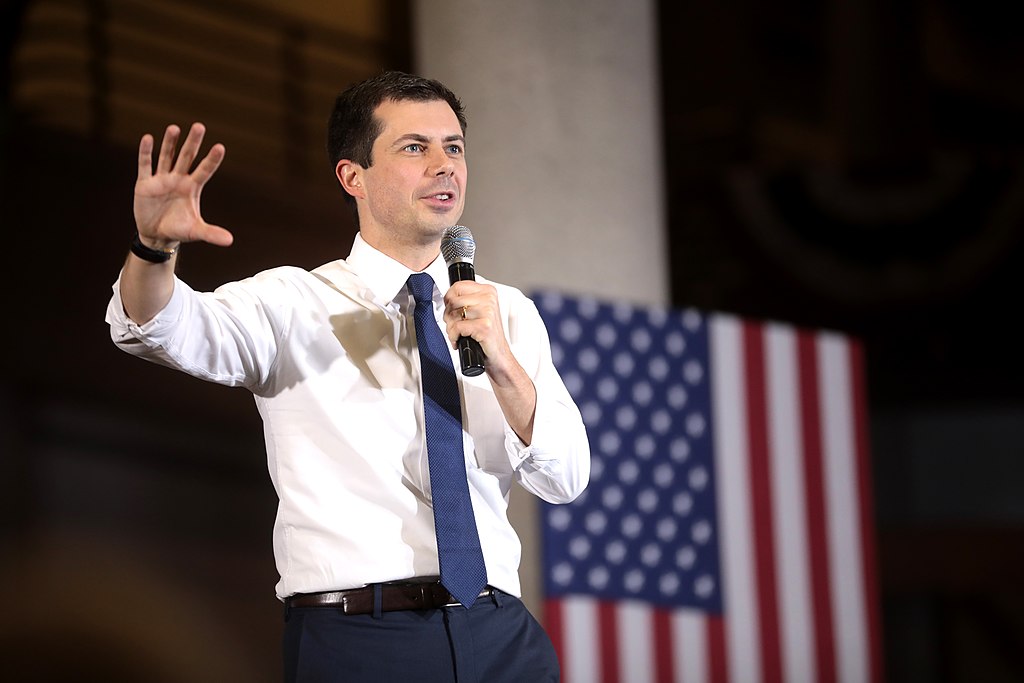
Mayor Pete Buttigieg speaking with supporters at a town hall at the State Historical Museum in Des Moines, Iowa, 12 January 2020.
Photo by Gage Skidmore via Wikimedia Commons.

Every now and again, I take a moment to take stock of how deep gay integration has gotten in my adult lifetime. This past week, our politics featured two relatively young men, on both sides of the political divide, whose sexual orientation is both clear and irrelevant. Pete Buttigieg has been at the top of the field in Iowa and New Hampshire, one of seven remaining candidates, and in the circular flamethrower squad of Wednesday’s debate, he once again held his own. More than that: He was relentless in his attacks on Amy Klobuchar and more than a little blunt about Bernie Sanders’s plans to take private health insurance away from everyone (something that doesn’t even happen in socialized health care in Britain). There was not the slightest whiff of defensiveness about him.

His moderate politics (on most subjects) is filtered through a seemingly brutal, calculating Rhodes Scholar–style ambition. And why can’t gays as well as straights harbor that? It’s fantastic also that he is a man of Christian faith — like countless other gays and lesbians in America. Who would have imagined that the pioneering gay figure of 2020 would be a married Christian who got a standing ovation in a Fox News town hall? But that’s old news now.

It’s also fantastic that, for the most part, his sexual orientation is ignored. Yes, the queer left hates him — but they hate a lot of gay success in public life if it doesn’t exactly fit their ideological niche. And Rush Limbaugh indeed took a slightly homophobic dig the other day. But I doubt Trump would openly use Pete’s orientation as a way to demean him. And that’s not just because Trump is not personally homophobic but because he knows it would look ugly, and be counterproductive. That’s how far we’ve come.

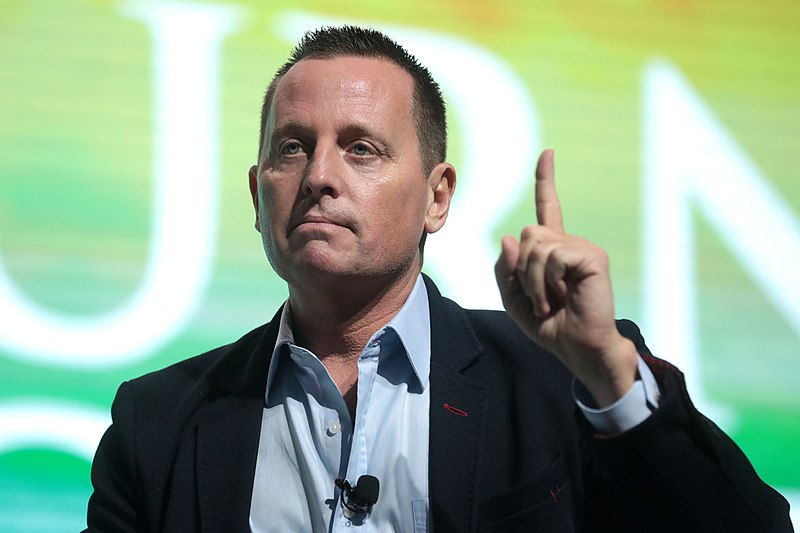
Richard Grenell has not subjected himself to getting elected anywhere, but, like Buttigieg, he’s a classic careerist D.C. meritocrat (and why the fuck not?). From the heartland, he got a degree from Harvard’s Kennedy School and then attached himself to Republican pols — notably George Pataki and George W. Bush, who made him communications director for the U.S. seat at the U.N., a post he held for seven years. Launching his own communications shop, Grenell subsequently worked Fox News gigs even as he was a signatory to an amicus brief in defense of the right of gay couples to marry. By all accounts he has been a disaster as ambassador to Germany, trolling the E.U. and German elites, although I doubt Trump sees his regular Twitter provocations as a liability.

But check out a simple video of Grenell being sworn in for the Germany job. Mike Pence, of all people, officiates as Grenell’s longtime partner, Matt Lashey, holds the family Bible. This week his appointment as acting director of National Intelligence was widely panned — and is not expected to last long. But he nonetheless became the first-ever openly gay member of the Cabinet in U.S. history. You missed that? All the better. But for some of us, it’s a quiet landmark tarred only by the fact that most gay groups won’t even acknowledge it. The Human Rights Campaign’s Twitter feed has made no mention at all — even as they are rightly touting the first lesbian mother in Congress. Why is the first openly gay Cabinet member a nonevent? Because he’s a conservative. And to the activist left and too many of the Establishment liberals in the gay movement, that means he’s not really gay.

My politics tilt more toward Buttigieg than Grenell — but a moment like this should not be filtered entirely through ideology. History matters too. When I was a very lonely openly gay figure in Washington in the 1980s and 1990s, the idea that I would live to see an openly gay and successful presidential candidate and an openly gay Cabinet member at the same time would have been preposterous. And now it’s virtually normal. I’ll take that.

U.S. Ambassador to Germany Richard Grenell speaking with attendees at the 2019 Student Action Summit hosted by Turning Point USA in West Palm Beach, Florida on 20 December 2019.
Photo by Gage Skidmore via Wikimedia Commons.

Update: Inconvenient typo in the headline fixed.

February 7, 2020

Modern day Kremlinology and show trials

Filed under: Government, History, Politics, Russia, USA — Tags: , , , , , — Nicholas @ 03:00

At Rotten Chestnuts, Severian explains why the Soviet Union’s Moscow Trials were so important well outside the borders of the USSR:

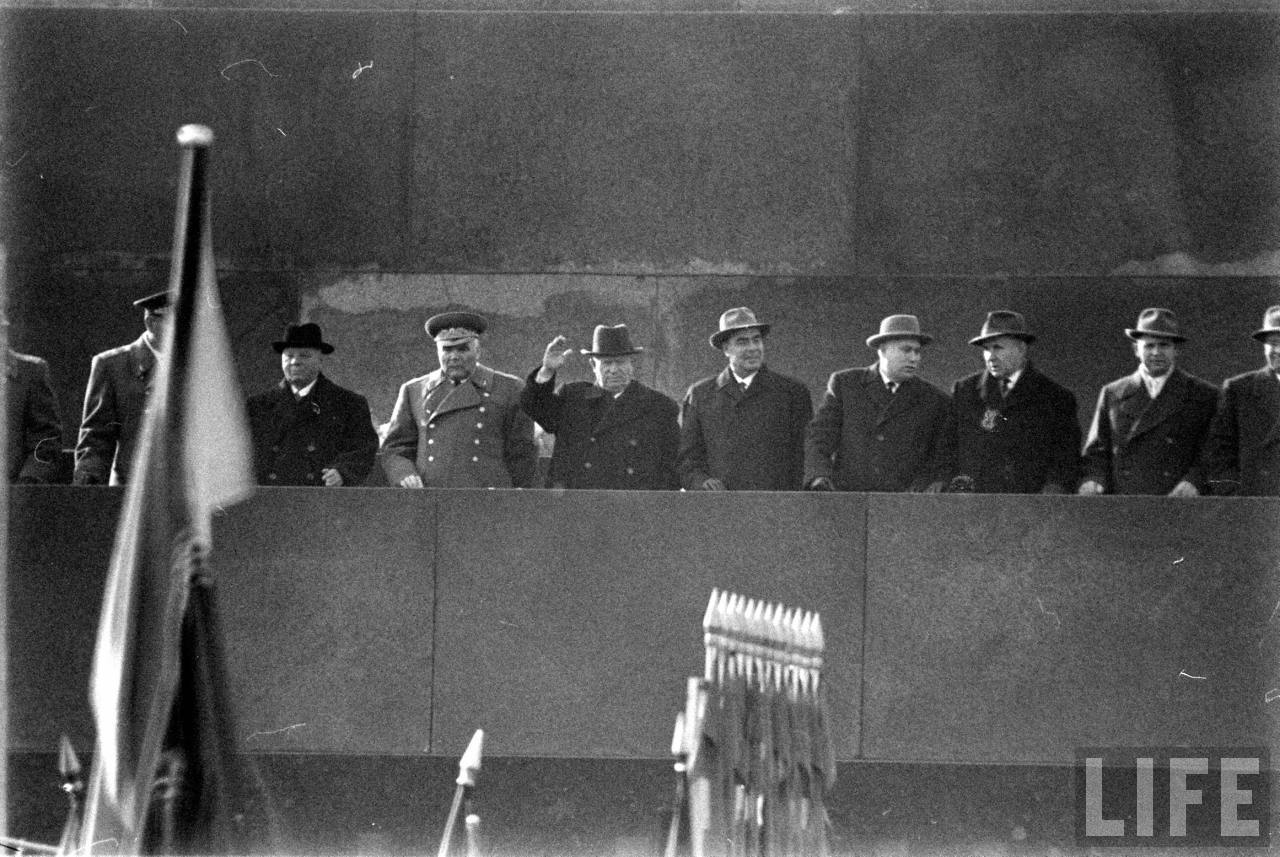
Krushchev, Brezhnev and other Soviet leaders review the Revolution parade in Red Square, 1962.
LIFE magazine photo by Stan Wayman.

It’s not much of an exaggeration to say that the Moscow Trials set the course of 20th century history. If you want to be a dictator in peacetime, this is pretty much how you have to do it — see e.g. every other Communist regime ever. The downside, though, is that you cost yourself a lot of irreplaceable technical expertise. I’m not saying Hitler would’ve called Barbarossa off if Stalin hadn’t purged all his generals — Hitler was, of course, crazy — but he surely would’ve thought twice about it, the plan relying as it did on the utter incompetence of the now-leaderless Red Army.

The show trials also gave birth to “Kremlinology”, the art and science of reading Soviet tea leaves to find out who’s really in charge. Stalin didn’t invent “elimination by promotion”, but he was a master of it. In Stalin’s USSR, being “promoted” to some big, important-sounding position was an all-but-guarantee that you’re going to get shot. Seemingly minor functionaries, on the other hand, really ran things in the countryside. E.g. Khrushchev, a Red Army commissar — not an unimportant position by any means, but hardly a glory post either. Stalin’s generals knew who he was, but few outside the Red Army’s high command did. And since Stalin liked to signal major policy shifts with articles in obscure publications — he once wrote an article on lingustics that previewed some huge change — you had to be very wired in to figure out who was really a comer.

Let’s imagine, then, that somehow the Moscow Show Trials failed. That Zinoviev, say, was acquitted, because (take your pick) he’d obviously been tortured, the charges were ludicrous, there was zero hard evidence against him, or any combination of the above. Stalin staked his entire position on the outcome of the Trials. What if he’d lost? How long do you think the Boss would’ve remained Boss? A few weeks? A few days? Hours, maybe?

Nancy Pelosi is no Stalin, of course, but whoever survives November’s electoral bloodbath had better start working on Secret Speech 2.0 the very second the last vote is counted. I was doubtful about the 2020 presidential election until they actually decided to show-trial Donald Trump. Since there’s no way in hell they’re going to get a 2/3 majority to vote to convict, the whole thing looks like not just a witch hunt, but a botched witch hunt. No one, not even Koba the Dread, is politically strong enough to survive one of those.

January 21, 2020

Those magical couple of weeks when politicians really pretend to care about Iowa

Filed under: Government, Politics, USA — Tags: , , — Nicholas @ 05:00

Colby Cosh discusses some of those puzzling-to-Canadians electoral oddities of our southern neighbours:

The actual, real, honest-to-God voting part of the U.S. presidential nominating process will begin with the Iowa state precinct caucuses on Feb. 3, two weeks from Monday. Every four years, at around this time, I rediscover the astonishing opacity of this process and marvel anew. The Iowa caucuses themselves, which have been the paramount preoccupation of American politics for months, serve as an excellent example.

You may have seen C-SPAN footage of the weird precinct caucus goings-on. These incorporate no balloting. Instead, you see small roomfuls of enthusiasts forming physical groupings, chatting about who they ought to support, and then merging smaller “non-viable” groups until the number of groups matches the number of delegates to be sent further on in the process.

“Further on to where?”, you may ask. To the Iowa Democratic Party county conventions, silly; but those don’t happen until March 21. These conventions send delegates to the party conventions for each congressional district (on the morning of April 25), and also to the state convention (June 13).

The actual makeup of the Iowa delegation to the national convention isn’t fully decided until that last date — yet an estimate of the statewide “result” will be provided magically on the evening of the 3rd. Even if no candidate drops out before the district and state conventions, this guess isn’t exactly set in stone. If there are dropouts, the final Iowa vote in the national roll call may look nothing at all like the estimates from the evening. Yet it’s these semi-fictitious, inferential estimates that will actually influence the course of the race in the other 49 states (and in the non-state delegations).

From a Canadian standpoint it all seems like a hell of a way to run a country.

January 10, 2020

Pierre Poilievre’s bid for federal Conservative leader

Chris Selley on the varying reactions to the notion of Pierre Poilievre as Andrew Scheer’s replacement:

Glee is spreading among Liberal partisans at the thought of Pierre Poilievre succeeding Andrew Scheer as Conservative leader. The theory is he is so pugnacious, so obnoxious, so poisonously, sneeringly partisan as to be literally unelectable.

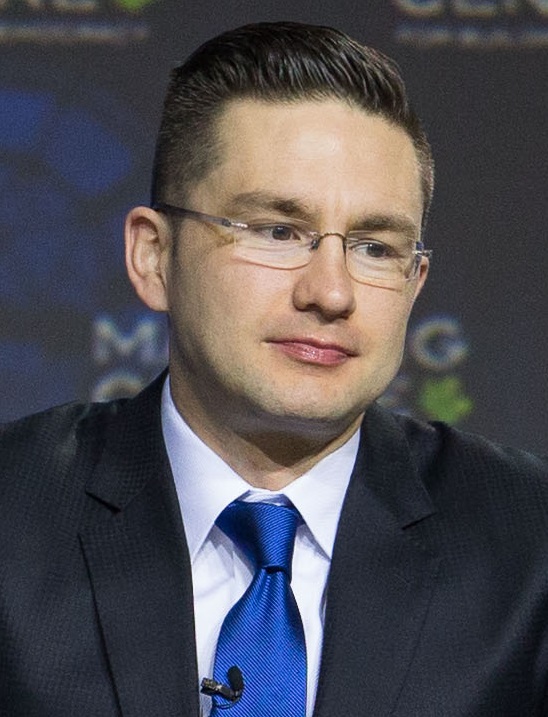
Conservative MP Pierre Poilievre at a Manning Centre event, 1 March 2014.
Manning Centre photo via Wikimedia Commons.

It is true that the man longtime Conservative cabinet minister John Baird nicknamed “Skippy,” in tribute to his enthusiastic Question Period performances, does not suffer from an excess of gravitas — though Poilievre’s reported support for his leadership bid from Baird and Jenni Byrne, a former senior adviser to Stephen Harper, lend him some within party ranks. His candidacy hasn’t made any measurable dent thus far in public opinion polls. And the opposition war rooms would certainly have fun unpacking his baggage.

Never mind Poilievre questioning the value-for-money proposition of compensating residential school victims (for which he apologized), or his use of the term “tar baby” in the House of Commons (for which he did not, and nor should he have, because it was a perfectly apt and inoffensive analogy in the context he used it), or the dreaded Green Light from the Campaign Life Coalition. Having been Harper’s parliamentary secretary, Liberals will blame him for every supposed atrocity of the Harper era.

All that said, the notion that people widely viewed as pugnacious, obnoxious and partisan-to-a-fault can’t win in Canadian politics is belied by reality. A quick glance around the federation brings Jason Kenney, Doug Ford and Justin Trudeau immediately to mind.

That’s not to say they won because of those character traits: Kenney’s and Ford’s leadership opponents would likely have fared just as well. Trudeau hoodwinked many with his Sunny Ways fraud, but he might well have won as the classic born-to-rule Liberal he turned out to be. If his government continues venting credibility at the rate it established late in its first mandate, the next Conservative leader could well become prime minister no matter who he is.

After recounting the dismal tale of Sheer’s “leadership”, Selley recounts a favourite story about Boris Johnson which contrasts strongly with the Milk Dud’s occupancy of the job.

Again, that degree of swagger and eloquence is far too much to ask of Canadian politicians. But it shouldn’t be too much to ask a party leader to have enough confidence in his party, his members, his movement and his ideas to arouse him to at least some degree of annoyance when they’re unfairly deprecated. If Conservative members aren’t excited by the prospect of a Poilievre leadership, they shouldn’t be half as mortified as Liberals think they should be.

January 5, 2020

QotD: Voting for President

Filed under: Humour, Politics, Quotations, USA — Tags: — Nicholas @ 01:00

Voting for president is a lot like sex — and not just because it takes place every four years in the solitude of a semi-private booth. Both are intensely personal activities that nonetheless can have profound public consequences. We might add that both often involve drug-and-alcohol-fueled delusions and morning-after feelings of guilt, shame, and recrimination.

The Editors, “Who’s Getting Your Vote?”, Reason, 2004-11.

December 30, 2019

The federal Conservative Party’s dilemma

Filed under: Cancon, Media, Politics — Tags: , , , , , — Nicholas @ 03:00

Canadians currently have two left-of-centre federal parties (three if we count the Greens), but only one party on the right (Maxime Bernier’s PPC), leaving the right-of-left-of-centre to the hapless, leaderless, useless, spineless, craven Conservative Party. “Conservative” in name only, of course, for those of you who don’t follow Canadian politics (and neither blame nor shame to you if you fall into that happy group). Bernier’s been labouring under an almost complete media blackout except where engineered drama can be used to demonize him or members of his party, so the roughly one-third of Canadian voters who would prefer an actual conservative alternative don’t really have anyone to vote for.

Jay Currie offers his analysis of the Conservative dilemma (but he’s also a known PPC sympathizer, so good Canadians must pay no attention to what he says):

Frank Graves and Michael Valpy ask the question, “What if the Conservatives had a ‘centrist’ leader?” like Rona Ambrose or Peter MacKay. To their credit Graves and Valpy recognize that while a centrist Conservative party would appeal to the media and various elites in Canada it would effectively maroon the 30% of Canadians who might loosely be described as “populist”.

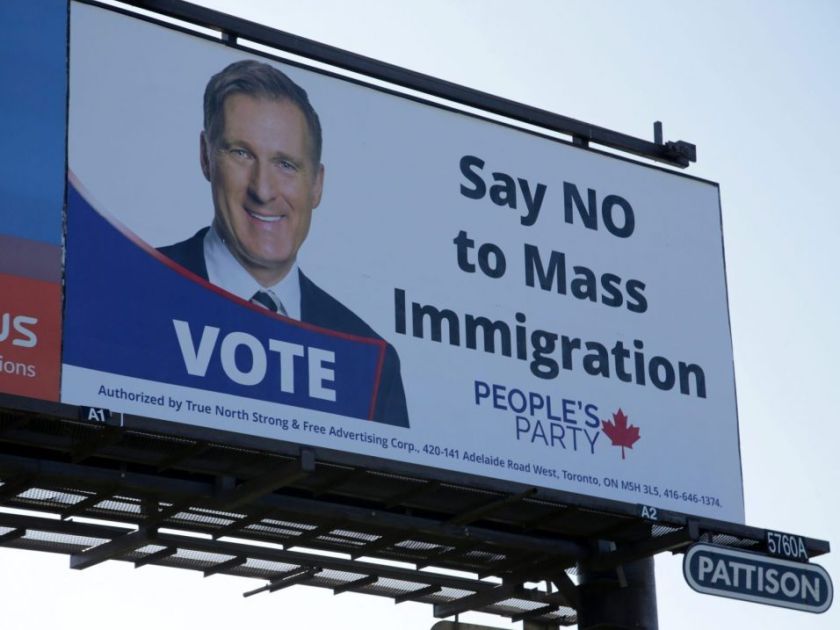
A billboard in Toronto, showing Maxime Bernier and an official-looking PPC message.
Photo from The Province – https://theprovince.com/opinion/columnists/gunter-berniers-legitimate-position-on-immigration-taken-down-by-spineless-billboard-company/wcm/ecab071c-b57d-4d93-b78c-274de524434c

I think Graves and Valpy are right and I can’t wait for that exact outcome.

Scheer managed to hoodwink a lot of natural populists with a combination of Liberal-lite policies and some goofy socon gestures (I am not sure Pride Parade non-attendance really counts for much with the serious socons.)

Graves and Valpy maintain that this was enough to avoid “orphaning the party’s biggest lump, and he more or less cut off oxygen to Maxime Bernier’s People’s Party of Canada (PPC).” It might have been last election but if the CPC goes centrist with its next leader, the lump will be looking elsewhere.

I am fairly certain that the CPC will go for a centrist leader if only because there are really no populist candidates available to it. Pierre Poilievre might fill the bill but it is not obvious that the CPC will be willing to support an MP who is as “direct” as Poilievre.

Which will leave “the lump” looking for a home. Graves and Valpy give a rundown of the lump’s core issues,

    Like the United States, the United Kingdom and sizeable chunks of Western Europe, Canada has a significant portion of citizens — about 30 per cent — who are attracted to the current psychographic and demographic binge of ordered populism. They are profoundly economically pessimistic and mistrustful of science and the elites. They have no interest in climate change, they don’t really see an active role for public institutions and believe there are too many immigrants. Of those immigrants coming to Canada, they think that too many are not white.

Other than the dig about thinking “too many are not white”, that is a pretty good summary. (On the “not white” thing, I suspect it is more nuanced than that: more along the lines of the current Quebec government’s desire to preserve its culture in the face of immigration.)

December 24, 2019

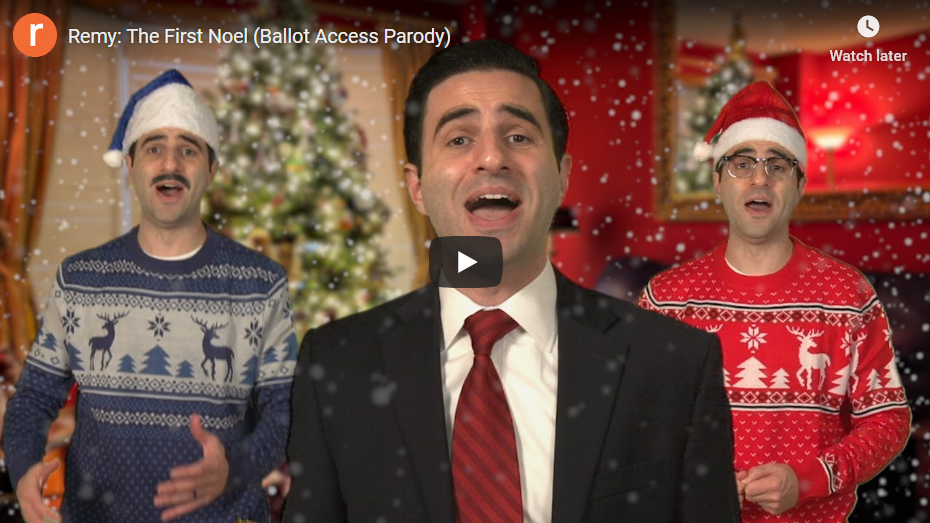
Remy: “The First Noel” (Ballot Access Parody)

Filed under: Humour, Liberty, Politics, USA — Tags: , , , , , — Nicholas @ 04:00

ReasonTV
Published 23 Dec 2019

Remy is creeped out by restrictive ballot access measures. Also by Prince Andrew.

——————
Follow us on Twitter: https://twitter.com/reason
Subscribe to our podcast at Apple Podcasts: https://goo.gl/az3a7a

Reason is the planet’s leading source of news, politics, and culture from a libertarian perspective. Go to reason.com for a point of view you won’t get from legacy media and old left-right opinion magazines.

—————-

Written and performed by Remy.
Produced and edited by Austin Bragg.
Music tracks and mastering by Ben Karlstrom.

LYRICS:

The first Noel I heard early one day
As I tried to run as a new candidate
My cheeks were wetter than Prince Andrew’s shirt
When the man spoke to me and he told me these words:

No “L,” no “L”
No “L,” no “L”
No room for me on the ballot, oh well

I looked up a party wherein
I could join but was told “There’s no room at the inn”
No bed to lay and I heard “take a hike”
Like the time I bought my wife an exercise bike

No “L,” no “L”
No “L,” no “L”
No room for me in the parties, oh well

My wish this year is to feel content
At the ballot and not—to be frank—incensed
Must it be so hard to boot folks we don’t like
But they claim it is lawful and I think that’s right, but …

No “L,” no “L”
No “L,” no “L”
Seriously, how creepy is Prince Andrew?

December 14, 2019

Livingstone announced Labour’s defeat was at least partially down to “the Jewish vote”

Barbara Kay on the British general election results:

Boris Johnson’s Conservatives racked up a stunning victory in the U.K. elections, with numbers so decisive — 365 of 650 seats — we will hear no more rumblings about a “second referendum” on Brexit. You can love Boris or hate him, or struggle with mixed feelings (as I confess I do), but he now has a mandate to get Brexit done.

But I have no mixed feelings about the Labour Party’s humiliating loss, at 203 seats their lowest ebb since pre-World War Two. If ever a party leader deserved a definitive smackdown, it was Jeremy Corbyn, and a victory lap is in order for democracy doing what it does best.

On seeing the results, I said to myself, “Yay!” The second thing I said to myself was, “Who will be the first to pull a Jacques Parizeau and how long will it take?” As it turned out, not long at all, and it was former London mayor Ken Livingstone who reprised Parizeau’s infamous “money and the ethnic vote” blame-shift after the Yes side’s narrow loss in the 1995 Quebec sovereignty referendum.

As soon as it was clear the U.K. Conservatives had crossed the threshold majority number of 326 seats, Livingstone announced Labour’s defeat was at least partially down to “the Jewish vote.” In fact, a Jewish population of 260,000 could not by itself have greatly influenced the result, but it is a mark of the anti-Semitic mindset to constantly exaggerate Jewish power.

Livingstone, who has called allegations of anti-Semitism within the Labour Party “lies and smears,” was himself suspended from Labour in 2016 over an assertion that Hitler supported Zionism. It was by no means Livingstone’s only egregiously insensitive remark. In April, he reportedly told the group Labour Against the Witchhunt that “It is not anti-Semitic to hate the Jews of Israel.”

Disappointed progressives, of course, are handling the Labour defeat with calm resignation, patience, and a spot of rioting.

December 10, 2019

Warren Kinsella, the PPC, and “Operation Cactus”

Filed under: Cancon, Media, Politics — Tags: , , , — Nicholas @ 05:00

Kate at SDA linked to this interesting article by James Di Fiore on the Conservative Party’s contract with Warren Kinsella to smear Maxime Bernier and the PPC in the run-up to the Fall election:

If you were new to this country, or part of our sect of apathetic voters, there was a good chance you walked away from the election believing Bernier and his party were nothing but a bunch of racists who thought they finally found a home. From there, being branded the racist party in Canada, all the media had to do was either ignore the PPC, or only run negative stories, not wanting to be seen as an outlet giving positive coverage to what was deemed as obvious bigotry.

Enter Warren Kinsella.

I sometimes wonder how well-known Kinsella really is. Everyone in the Ottawa and Toronto bubble knows him. The media and party members know him. But he’s not exactly a household name, until now maybe. Kinsella, a throwback operative going back to the Chretien years, still manages to convince people to hire him, despite having a reputation of being hopelessly unsavoury, where the ends always justifies the means as long as you remind everyone along the way how great of a person you are.

Kinsella was hired by the Conservative Party of Canada to execute a campaign painting The People’s Party of Canada as a haven for bigotry and white nationalism. Secretly recorded by an employee, Kinsella was heard giving his team a pep talk on how to effectively destroy Bernier. He even tried to reinforce his motivational speech by bragging about falsely smearing three prominent politicians as racists when he knew they were not. He tries to catch himself by saying how easy it is to smear Bernier as a racist because, as Kinsella put it, “this guy actually is a racist.”

When a strong federal party hires a notoriously unethical operative to smear a new party as a gang of racists and bigots, it can be difficult to define your own brand. I asked Bernier if he thought there was a reason some racists did seem drawn to his party’s platform.

“It happened when Preston Manning started the Reform Party more than 25 years ago. People were saying that party was a racist party. The Conservative Party and Kinsella tried to do the same thing with us. That’s why I am looking at all my options to look at the legal procedures that we can do.”

Bernier might have a very strong case, especially now that Kinsella’s mask has been taken off by his own hand.

“The Conservative Party of Canada is morally and intellectually corrupt, and they proved that with their contract with Kinsella.”

It is still unknown how much the CPC and Kinsella impacted Bernier’s party, but it is reasonable to believe Kinsella was ultimately successful. On September 29th, at an event in Hamilton, several protestors accosted event attendees as they tried to get into the building at Mohawk College. The aggressiveness of the demonstrators was palpable as they screamed at seniors, calling them Nazis and preventing them from entering the building. Instances like this make Kinsella’s contract all the more mysterious. After all, his job, according to his own admission, was to activate Canadians against Bernier by stoking the flames of racial intolerance.

There are questions as to whether Kinsella’s fingerprints are on several other party missteps and controversies, including a rash of resignations earlier this year when former loyalists mysteriously began trashing the party publicly.

Operatives normally do not get caught bragging about having a track history of how their lies about other people’s bigotry have been successfully used to disrupt campaigns. In Bernier’s case, Kinsella, a self-proclaimed, lifelong fighter for racial justice, actually spent a career monetizing racial divisions he helped to stoke. When his shtick was exposed through his own accidental confessions, the hindsight view of Maxime Bernier became less blurry.

December 1, 2019

Tulsi Gabbard versus the Democratic establishment

At Spiked, Tim Black calls the establishment’s anger and rage at the Democratic presidential candidate “Gabbard Derangement Syndrome”:

Tulsi Gabbard speaks at the “People’s Rally” in Washington DC on 17 November, 2016.
Photo by Lorie Shaull via Wikimedia Commons.

… the Democratic establishment and its media cheerleaders seem to have become fixated on her. She annoys them. She riles them. And it’s not just because of her ambivalence towards identity politics and the other aspects of her Sanders-style progressivism – indeed, she endorsed Sanders in 2016, much to the chagrin of the Democratic establishment at the time. No, it’s also because of her uncompromising opposition to the “counterproductive regime-change wars” pursued with such ignorant zeal by the likes of Democratic grandee Hillary Clinton. It’s because of her willingness to question the narratives that have justified Western intervention in Syria, including a secret fact-finding mission to Damascus, and a meeting with Bashar al-Assad in 2017. And it’s because she does all this not as a woolly pacifist, but as a war vet.

So where her small but growing band of supporters see a principled 38-year-old, armed with a progressive policy platform, and, above all, a strong commitment to anti-interventionism, her powerful opponents are determined to present her as something altogether more sinister. They talk of her being a poster girl for white supremacists and the alt-right, of her being a Republican stooge in Democratic clothing, and of her being some sort of Russian asset.

It’s genuinely crazy stuff. Last week, the New York Times even laid into her for wearing a white pantsuit for a TV debate, claiming it was somehow cult-like. But that is as nothing compared to the constant innuendo and sometimes outright claims that Gabbard is being backed by Russia and Putin, the seeming power behind all world disorder.

Gabbard’s chances of winning the Democratic nomination are slim, but her recent online spat with Hillary Clinton probably won her a lot of fans outside the establishment:

Then, of course, there’s Hillary Clinton herself, a woman who, since losing to Donald Trump in the 2016 presidential election, is no longer able to go near a bed without spotting reds under it. Gabbard, unsurprisingly, does not escape Clinton’s conspiracist gaze. “I’m not making any predictions but I think [the Russians have] got their eye on somebody who’s currently in the Democratic primary, and they’re grooming her to be the third-party candidate. She’s the favorite of the Russians”, Clinton continued. “They have a bunch of sites and bots and other ways of supporting her so far.”

That’s right. Clinton thinks Gabbard is a Russian plant. She thinks Gabbard is “being groomed” by the Kremlin. She thinks she is being manoeuvred, by Putin and Co, out of the Democratic Party and into a third-party position, so as to split the Democratic vote in 2020. And she thinks that will hand victory once again to Russia’s Manchurian Candidate, Donald Trump, just as she thinks that Jill Stein, the Green Party’s 2016 presidential nominee, was also a Russian asset, used to split the vote three years ago and deprive Hillary of the election victory she still believes should be hers. The entitlement underwriting her deranged conspiracy theory is breathtaking.

October 24, 2019

QotD: “Binders full of women”

Filed under: Media, Politics, Quotations, USA — Tags: , , , , — Nicholas @ 01:00

Which brings me to another Mitt Romney debate comment that received similar mockery and self-flattering giggling. During the second presidential debate in 2012, Romney was asked about pay equity. In the course of his answer, he said:

    I had the chance to pull together a cabinet, and all the applicants seemed to be men … I went to a number of women’s groups and said, “Can you help us find folks?” and they brought us whole binders full of women.

Now, I’ll happily grant that the phrase “binders full of women” is an awkward one. It sounds like the menus they bring out on Jeffrey Epstein’s plane when Bill Clinton and Harvey Weinstein settle in for a weekend getaway.

But here’s the thing: What Romney did was exactly what feminist groups insist elected politicians should do. He saw that there were “too many” men in the applicant pool, so he reached out to some feminist groups and asked for help. Some feminist groups reached out to him — and he listened to them, too. And then he hired more women.

The monster!

Here’s Jon Stewart mocking him for it. Here’s Ronan Farrow. And here’s Bill Maher, a man who must be sweating like a hooker in church over Hollywood’s post-Weinstein zero-tolerance for piggishness toward women.

Jonah Goldberg, “Binders Full of Asininity”, National Review, 2017-10-13.

October 21, 2019

“On Monday Canadians will have a choice between five left-of-centre social-democratic parties”

Except for Maxime Bernier’s invisible-to-the-mainstream-media PPC, the other parties contesting today’s election are all remarkably similar except for the colour of their signs and the mediocrity of their leaders:

As Mrs Thatcher used to say, first you win the argument, then you win the vote. So not engaging in any serious argument has certain consequences. John Robson puts it this way:

    As Canada’s worst election ever staggers toward the finish line, a theme has finally emerged. Despite the best efforts of the party leaders to say nothing coherent or true at any point, we know what it’s about. Everyone is running against the Tories. Including the Tories. Makes you wonder what they’re so afraid of.

On Monday Canadians will have a choice between five left-of-centre social-democratic parties: the crony left (Liberals), the hard left (NDP), the eco-left (Greens), the secessionist left (Bloc) and the squish left (Conservatives). The only alternative to the crony-hard-eco-secessionist-squish social-justice statism on offer is a disaffected Tory, Maxime Bernier. John Robson again:

    Bernier may be an imperfect human being and a flawed politician. It happens. But whatever his blemishes, his party exists because the Tories abandoned their beliefs and their base long before 2017 on every important conservative issue from free markets to traditional social values to strong national defence.

A billboard in Toronto, showing Maxime Bernier and an official-looking PPC message.
Photo from The Province – https://theprovince.com/opinion/columnists/gunter-berniers-legitimate-position-on-immigration-taken-down-by-spineless-billboard-company/wcm/ecab071c-b57d-4d93-b78c-274de524434c

M Bernier would like to rethink immigration policy, but that makes him a racist so he shouldn’t be allowed in the debates because, per John Tory, while he’s free to rent the Scotiabank Arena, public buildings such as the CBC studios have a “higher responsibility”.

It’s a good thing for the other guys that Bernier was snuck in to a couple of debates because otherwise they’d be running against an entirely mythical beast — a red-meat conservative behemoth stomping the land for which there’s less corroborating evidence than of Justin in blackface but which is nevertheless mysteriously threatening to steamroller your social-justice utopia into the asphalt. Ah, if only that were true: I hope voters in the Beauce will return Max, and I hope our small band of readers in Longueuil-Saint Hubert will persuade their neighbours to turn out for our pal Ellen Comeau; but this is not shaping up as a breakthrough night for the People’s Party.

Nevertheless, sans Max, what’s left? Virtue-Dancing With The Stars: Elizabeth May says Trudeau wants to eliminate CO2 completely, but not until 2030! Justin Trudeau says that Scheer didn’t believe in gay marriage before 2005! Jagmeet Singh says that May’s selling out to the billionaires by promising to balance the budget by 2047, whereas he won’t balance the budget ever! Yves-François Blanchet says Singh’s ten-point plan to eliminate bovine flatulence by last Tuesday is too little too late compared to the Bloc’s plan to reduce Canada’s carbon footprint by declaring Quebec independent … oh, wait, sorry, that was almost an intrusion of something real: I meant “by declaring Quebec fully sovereign when it comes to jurisdiction over selecting its own pronouns for the door of the transgender bathroom: je, moi, mon …”

And at that point in the debate Lisa LaFlamme moves on to the next urgent concern of Canadian voters: Are politicians’ aboriginal land acknowledgments too perfunctory? Should they take up more time at the beginning of each debate? Say, the first hour or two?

John Robson argues that all five candidates are running against proposals that no one’s proposing because deep down inside they know that lurking somewhere out there is not a mythical right-wing Bigfoot but mere prosaic Reality, which sooner or later will assert itself. I’m not so sure. I think it’s more an enforcing of the ground rules, a true land acknowledgment that public debate can only take place within the bounds of this ever shriveling bit of barren sod. Those who want to fight on broader turf – such as M Bernier – cannot be permitted to do so.

October 20, 2019

The conspiracy theorists appear to have been right about this one – “Project Cactus”

Filed under: Cancon, Media, Politics — Tags: , , , — Nicholas @ 05:00

Maxime Bernier and the PPC would have had a tough time getting much attention in this election campaign anyway, but the Laurentian Elite were apparently scared enough to sponsor underhanded actions to keep him and his party out of the debates and on the defensive on social media:

Warren Kinsella’s Daisy Group consulting firm was behind a social media campaign to put the People’s Party of Canada on the defensive and keep leader Maxime Bernier out of the federal leaders’ debates, according to documents provided to CBC News.

The documents outline the work done by several employees of Daisy on behalf of an unnamed client. A source with knowledge of the project told CBC News that client was the Conservative Party of Canada.

The plan was first reported Friday night by the Globe and Mail.

According to a source with knowledge of the project, who spoke to CBC News on condition they not be named, the objective of the plan, dubbed “Project Cactus,” was to make the Conservative Party look more attractive to voters by highlighting PPC candidates’ and supporters’ xenophobic statements on social media.

The source added that Daisy employed four full-time staffers on Project Cactus at one time.

Kinsella is a lawyer, anti-racism activist and former Liberal strategist who has been a vocal critic of Liberal Leader Justin Trudeau.

[…]

In a statement to CBC News on Friday, the executive director of the PPC said “It hardly comes as a surprise that the Conservative Party of Canada would be behind such disgraceful and cowardly tactics.”

“As our Leader Maxime Bernier stated when he left the CPC and repeated on numerous occasions since then, they are ‘morally and intellectually corrupt.’ And today, this story proves it without a doubt,” Johanne Mennie said in an email.

October 15, 2019

Looking past October 21st

Filed under: Cancon, Politics — Tags: , , , , , — Nicholas @ 03:00

Jay Currie has already wasted his vote at the advanced polls (the same way I’m going to waste mine come election day), and now he’s considering what our parliament will look like on October 22nd (here’s a hint … we both know our guy isn’t going to be PM):

On October 22 we’re going to wake up to a politically very different Canada assuming that JT is unable to win a majority. The first thing which will change is Trudeau’s position. He could be Mr. Dressup with a majority but in a minority position – assuming he can form a government at all – his Teflon coating will have worn off. It is just possible that the bought and paid for Canadian media will rouse itself from its slumber and begin to ask slightly harder questions.

The second thing which will change is that third, fourth and even fifth parties will matter. For Trudeau to form a government he will need at least the NDP’s support and, perhaps, the Greens. To get that he is going to have to buy into a lot of nonsense which will be extremely bad for the country. The Liberals have plenty of idiotic policy but they don’t hold a candle to either the NDP or the Greens for economically useless virtue signalling.

Scheer would have an easier time of it in a minority position. His only possible ally would be the Bloc and while the Bloc wants to break up Canada they are financially sound and not nearly as eager as the NDP or the Greens for open borders and looney carbon taxes.

The key thing to remember is that regardless of who forms the government, that government is not going to last very long. In a sense, this election is about the next, more decisive, election. If Trudeau loses as big as he looks to be doing the Liberal Party will be looking for another leader. If Scheer ekes out a workable minority he will be looking to call an early election (in the face of the idiotic Fixed Terms act we have saddled ourselves with) to crush that new leader.

For Singh, especially if he picks up seats as well as popular vote, the election will cement his place as the NDP leader and silence the people who are talking about his unelectability. Lizzie May will be hailed as an emerging force in Canadian politics if she manages to pick up a couple more seats on Vancouver Island and, I suspect, that is exactly what she is going to do. (Old, white, retired, rich people just love a party committed to never changing anything.)

And what about Max? Obviously, he needs to hold his own seat. Which may be tough but I think he will pull through. I very much doubt he will win any other seats for a variety of reasons having nothing to do with Max or his policies. New parties take a while to gain traction. For Max, the biggest issue is how he does in the popular vote. Sitting at 1% is not going to cut it, but pop up over 4% and the table changes. Anything beyond that and Max will be the election night story.

October 13, 2019

Modern journalism encompasses “activism,” “advocacy,” “partisanship,” “satire,” “hoaxing,” “unbearable self-promotional bluster,” “pranks,” “torquing of facts,” “invective,” “demagoguery” and “stunts”

Filed under: Cancon, Media, Politics — Tags: , , , — Nicholas @ 03:00

I’ve always been pretty cynical about the media, so it was no surprise to me when the federal government decided to start explicitly subsidising the rest of the media (they already fund the CBC), and part of the fun was deciding who qualifies for those juicy subsidies. I mean, “journalism” today is a pretty broad category that covers a lot more than the traditional TV, radio, magazine, and newspaper formats. I’m sure everyone is shocked — Shocked! — to discover that the government is playing favourites among the many media outlets over not just who gets subsidies, but even who gets accredited to cover political events.

Jack Layton, leader of the federal New Democratic Party of Canada, on January 2, 2006 in a media scrum outside a campaign rally at the Kent Street legion in Ottawa, Canada.
Photo by Thorfinn Stainforth via Wikimedia Commons.

As we’re in the late stages of a federal election campaign, the question of who is considered to be a “journalist” merits closer attention, as Colby Cosh explains:

Two media outlets of a right-wing character, Rebel Media and the True North Centre for Public Policy, have been denied accreditation for post-debate press appearances at the last minute. The Parliamentary Press Gallery, acting on behalf of the federal Leaders’ Debates Commission, has somehow decided that their delegates are advocates rather than journalists. Oh-ho.

Here, an agent of the state seems to have pushed the “So who’s a journalist?” question really to the forefront, and introduced a distinction between journalism and activism that may not be tenable. The history and practice of journalism, even at the highest levels of public and professional esteem, includes entities and activities that fall into all of the following categories: “activism,” “advocacy,” “partisanship,” “satire,” “hoaxing,” “unbearable self-promotional bluster,” “pranks,” “torquing of facts,” “invective,” “demagoguery” and “stunts.”

If we must march toward state licensing of journalism in double-quick time, and this seems to be happening whether I like it or not, arguments about the definition of journalism will have to recognize these realities. But, of course, the word “journalism” as used from day to day is mostly just a status marker (really, a label concocted for academic use). “Journalism” will resist any historically aware attempt to bound it with a list of scientific-type taxonomic criteria.

This, of course, does not rule out an ignorant or fanciful attempt to set criteria. But most of the concepts in the list I made above, a list of things some people would like to exclude from journalism, are themselves ideas founded on fuzzy judgments of value, or of mere taste.

The media outlaws who found the debate gates shut in their faces got together and sought an injunction requiring the commission to allow them to appear in the magic chamber of questions after the debate. No one had really explained the decision to exclude them; no one could point to a solid pre-existing definition of journalism that they did not meet (surprise!), or to a relevant formal policy of the commission. It really gets the attention of a judge when the state behaves in an arbitrary way, and this proved to be the case, foreseeably, at the oral hearing for the injunction. Which was granted.

But an injunction is a temporary emergency remedy that does not require a full hearing of the facts — only the possibility of immediate incorrigible harm. The question haunting the Dominion — the question of who is a journalist — remains athwart our path.

« Newer PostsOlder Posts »

Powered by WordPress