Quotulatiousness

June 26, 2010

What other “secret laws” did they pass?

Filed under: Cancon, Government, Law, Liberty — Tags: , , , , , , — Nicholas @ 11:37

Much noise and confusion over the discovery of a recently passed law allowing police to arrest anyone who fails to show ID within 5 metres of a “public work”. The law itself isn’t new, but the secret was the silent addition of the area of the G20 meetings as a “public work” for the definition of that law. Hijinks ensue:

Police are now able to jail anyone who refuses to furnish identification and submit to a search while within five metres of a designated security zone in downtown Toronto.

Critics reacted furiously to the new rules, which remained unpublicized until Thursday when a 32 year-old man was arrested in Toronto for refusing to show ID to police.

New Democrat MPP Peter Kormos said Friday the provincial Liberals created a “Kafka-esque” situation where people could be arrested for violating rules they didn’t know existed.

“This is very very repugnant stuff and should be troubling to everybody,” he said.

The Canadian Civil Liberties Association (CCLA) said it was “extremely concerned” that the new measures violate constitutional safeguards.

I’m not a fan of violent protests, but I don’t believe the police need this additional tool in order to arrest people who attempt to breach the barricades or attack other people: this is granting too much arbitrary power to police officers. The way the power was granted is even more disturbing . . . it shows that the government knew there’d be an outcry if they did it in the public view, so they arranged it so that nobody would know about it in time to do anything about it. Nice work, Ontario, got any other nasty legal surprises you want to spring on us?

Update, 29 June: According to a report in the National Post, the Ontario government denies that there was any such regulatory change and that no arrests were made using the authority of this act.

Was the “fake lake” outrage itself fake?

Filed under: Cancon, Media — Tags: , , , , — Nicholas @ 11:17

Andrew Coyne says we’ve all been faked out of our boots over the “fake lake” issue:

It’s not an “indoor lake,” as the first story I read suggested. It is a reflector pool, about the size of a backyard swimming pool, only no more than two inches deep. There can’t be more than 10 gallons of water in it, tops. It is bordered by a small wooden platform simulating a dock, with Muskoka chairs casually strewn about. There’s a bank of canoes on either side, and a large screen showing some quite breathtaking high-def footage of Canadian lakeland scenes. And that’s it.

It’s not extravagant in the slightest. Modest would be closer to the mark. The government puts the cost at about $57,000, which sounds about right: about what it would cost to finish your basement. Or to be precise, it represents just over two 100,000ths of one per cent of federal spending. All in all it’s rather a pleasant spot, a small oasis of calm and comfort away from the conference churn, and shows every sign of being a hit with the foreign press.

So either we all got hoodwinked over the vast cost and outright fakery, or they’ve brainwashed Andew Coyne!

June 25, 2010

Ghost town T.O.

Scott Stinson finds that the constant warnings about disruptions, delays, closures, and protests has had a positive effect: anyone who can avoid downtown Toronto is avoiding the place.

We were to be besieged by The Man, and those who would shake their fists at The Man.

So it was more than a little surprising to find the commute on Thursday morning not one of snarled traffic and honking horns, but one of fast-moving, wide-open freeways. Given the number of vehicles on Toronto’s normally packed roads, you’d think the area had been hit a day earlier not by a mild earthquake, but by a nuclear bomb. From northeast of the city to the western waterfront in 40 minutes? If this is nuclear winter, then sign me up for Armageddon!

I’ve certainly been avoiding going into downtown since the barricades started to go up. I’m apparently one of the majority following the same basic script.

And why wouldn’t residents have made alternate plans? Consider this traffic advisory, issued on Tuesday: “Expect closures and restrictions in and around Toronto resulting in significant delays on major highways such as the 427, 401, Queen Elizabeth Way, Gardiner Expressway, the Don Valley Parkway and connecting roads.”

If you are unfamiliar with Toronto’s highways, a little background about those mentioned in that advisory: That’s pretty much all of them. Other than one highly expensive toll road across the north of the city, there’s no way to cover much ground in this place without traversing those highways that officialdom warns will have “significant delays.” Due to the prevailing security-first practice of releasing as little information as possible — which is to say, nothing — that road closure advisory doesn’t say which highways will be closed when, either. If we knew that, at least we could plan around the delays. Instead we get travel warnings that boil down to this: Seriously, stay away.

Update: Don Martin thinks it’s like a scene from a post-apocalyptic movie:

This is what a billion-dollar security net buys you. Canada’s largest city as a post-apocalyptic movie set. Massive worker inconvenience. Horrific productivity losses. Legions of bored cops on overtime. And a tourist scare-off that makes SARS look like a Halloween prank.

Everywhere in a city core swept clean of garbage collection bins and newspaper boxes, a fence runs through it.

The notorious barricade has gaps too small even for a child’s fingers to grasp and that makes it impossible to scale although, protesters take note, at three metres high it’s only half the world pole vault record so there’s at least one way to leap over it into the waiting hands of riot police.

Speaking of police, they already gather in jawdropping numbers as omnipresent clusters at every intersection or wander aimlessly as enforcement groups around buildings and down streets, wearing bulletproof vests with helmets dangling from their belts and earpieces connected to voices of undetermined origin.

At least there’s the scene set for some great TV and photography moments later in the weekend, when the massed forces of global anarchism (plus every other disgruntled group with both an axe to grind and physically active membership) look for their golden opportunities to induce police over-reaction. The only tourists in town aren’t interested in the sights or the shopping: they’re here for media appearances, protest marching, and (hopefully a tiny minority) a taste of violence.

Update, the second: Kelly McParland points out that the massive security precautions have actually made the protesters redundant:

[. . .] The [Toronto] Star edited out Dave and dwelt instead on the new law, which wasn’t debated in the legislature and resulted from an ‘extraordinary request’ by Toronto Police Chief Bill Blair, who wanted additional policing powers shortly after learning the G20 was coming to Toronto.” Evidently it didn’t occur to Premier Dalton McGuinty that he could say no. And why should he? It’s pretty clear that no one in any government — municipal, provincial or federal — has said no to anything dreamed up by any level of the national security apparatus since the day Stephen Harper told them he’d agreed to hold two summits at once. A billion dollar budget? You got it. New sound blasters for Toronto cops? You got it. An asinine fence snaking through the centre of the city? Done. The country’s financial centre brought to a screeching halt . . . all the major tourist spots closed . . . restaurants emptied . . . hotels commandeered . . . the waterfront shut down on a hot summer weekend . . . a million or so people kept from earning a living? Done, done and done.

This is what happens when you give security people a blank cheque and let them impose whatever paranoid restrictions they can dream up at their most fevered moments. Hey, let’s rip the saplings out of the ground! Let’s get a fork lift and move that three-ton elephant sculpture someplace where less ‘dangerous’! What’s dangerous about a three-ton elephant sculpture? Who knows, but we can do whatever we want! It’s about security!

What the protesters have missed is that they weren’t needed. The government’s done a fine job of making itself look foolish without any help from them. They could have stayed home for the weekend and watched the Michael Jackson testimonials. They sure wouldn’t have missed anything important.

June 24, 2010

It’s a “Failure of its systems for monitoring”

Filed under: Economics, Europe, Greece, Politics — Tags: , , , — Nicholas @ 10:45

Austin Bay thinks he’s identified the elephant in the European parlour:

Greece teeters on the edge. The Wall Street Journal‘s Paul Hannon wrote this week that “the failure of its (EU) systems for monitoring and controlling build-ups in government debt” are why the bailout loans given to Greece by the International Monetary Fund (IMF) and fiscally disciplined EU members like Germany became necessary.

He’s right. “Failure of its systems for monitoring,” however, is a euphemism — economic diplo-speak for a very difficult word: corruption. Greek governments cooked the books (its actual deficit is twice as high as officially reported), violated fiscal agreements and borrowed money they could not repay.

Corruption lies at the dirty core of the Euro-zone’s trouble. Governmental corruption and its cohort, illicit business practices, are a pervasive, multicultural, global affliction.

Corruption coupled with systemic lack of accountability — to include personal accountability, where managers and workers let lackadaisical and lazy work practices slide — eventually produces more than anger, cynicism and financial turmoil. Even among economies in the developed world, it stunts economic productivity, robs the future and sows the seeds of armed conflict. In the developing world it undermines aid efforts, manacles fragile economies and as a result condemns millions to poverty.

The big remaining question is no longer “Will the Euro fail?” but rather “Who’ll bail out first?”

June 22, 2010

QotD: He bestrides the G8 like a Colossus

Filed under: Cancon, France, Germany, Italy, Politics, Quotations — Tags: , , , — Nicholas @ 00:07

. . . things are pretty bad in the mother country when a self-described “Whig” calls Stephen Harper “a magnificent fiscal conservative.” It’s like calling Gordon Brown “a brilliant and charismatic leader,” or Jean Chretien “a visionary and articulate statesman.” In politics, at least practical politics, all truth is relative.

Compared to most G8 leaders Stephen Harper does look like a genius. This is, as you’ve guessed, damning by the faintest of praise. Barack Obama is an avowed socialist, who described his one real job in the private sector as working “behind enemy lines.” Japan has been governed by a series of interchangeable non-entities for the better part of the last decade. In most of Europe, and certainly the English speaking world, Silvio Berlusconi would be awaiting sentencing. Angela Merkel rivals Helmut Schmidt in the visionary department. Sarko is a living embodiment of every mistake the French have made since Diem Bien Phu: A domestic policy summed up by the quintessentially French term “dirigiste,” and a foreign policy consisting of German guilty tripping and sophomore anti-Americanism. If Stephen Harper looks taller than others, it is because he is standing on the shoulders of midgets.

Publius, “Well, at least someone likes him…”, Gods of the Copybook Headings, 2010-06-21

June 10, 2010

“If I had a MBillion dollars”

Filed under: Cancon, Economics, Government, Humour, Politics — Tags: , , , , — Nicholas @ 12:13

June 3, 2010

Toronto Police tougher than the RCMP?

Filed under: Cancon, Law — Tags: , , , , — Nicholas @ 12:48

Kelly McParland notes that even though the RCMP have a lot of tough-guy things on their list of “will do”, there’s one thing Toronto Police will do that the RCMP won’t:

The RCMP will Taser an old lady at the drop of a hat.
They’ll Taser a guy in an airport because he’s holding a stapler and looks upset.
They’ll Taser the disabled.
They’ll Taser a 15-year-old girl in handcuffs.
They’ll Taser an 82-year-old heart patient in a hospital bed.
They’ll Taser someone who’s been hog-tied, pepper-sprayed, handcuffed and manacled.
They’ll Taser just about anything that can be Tasered. But they won’t use “sound cannons” in the middle of a city. Too risky.
Toronto police are buying four of the ear blasters for the G20 summit.

May 28, 2010

Is it too late to cancel?

Chris Selley rounds up the (almost unanimous) pundits’ opinions about the billion-dollar-boondoggle-summit-set:

Is it too late to cancel the G8 and G20 summits?

The National Post‘s Don Martin for the win: “No amount of righteous government bluster about living in post-9/11 protection paranoia, last week’s bank firebombing in Ottawa or the precedent of hosting two back-to-back summits can explain how an $18-million security tab for the G20 in Pittsburgh last September, which involved 4,000 police, must balloon to a billion dollars in Toronto requiring 10,000 cops on the ground.” Yup. It’s outrageous, and the government seems very oddly . . . proud of it. We can hardly wait for the Auditor-General and Parliamentary Budget Officer to find out just where this money went. Especially in a climate where Canadians are thoroughly cheesed off about government spending in the first place, it’s not too much of a stretch to say this is the sort of issue that might bring down a government.

“A case of bureaucracy gone wild,” is Jeffrey Simpson‘s uncontroversial verdict in The Globe and Mail, “or planning gone crazy, of fear sinking itself into every official’s and security person’s heart.” Imagine what we could have bought with that $1-billion! A bunch more Canada Research Chairs, or a whack of “clean-energy projects,” or assistance for “cultural groups” — so sleepy — or, hey, now we’re talking, a massive injection of cash for infrastructure on aboriginal reserves. Or, as Simpson says, “whatever.” Almost literally anything would be better. We’d arguably be better off flushing the $1-billion down the john.

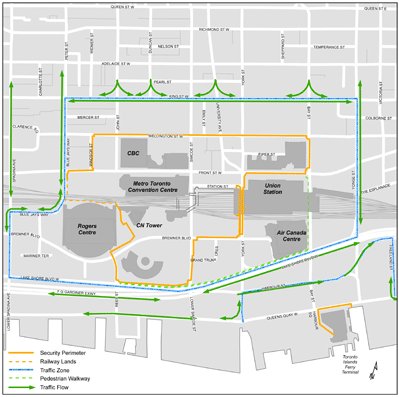
For those of you looking forward to suffering through the event, here’s the official map of the restricted area around the Metro Convention Centre:

The best advice — unless you’re hoping for a run-in with the police — is to avoid Toronto for that weekend (plus a few days in either direction).

May 27, 2010

The absurdity of spending $1 Billion for G20 meeting security

Filed under: Cancon, Economics, Politics — Tags: , , , , — Nicholas @ 13:30

Hard to disagree with anything Rex Murphy says here:

Summits are useless, expensive and potentially dangerous anachronisms.

Let’s take the G20 summit, which will be held June 26-27 in Toronto. No one from the general public will be meeting with the world leaders — summits are not for mingling. So why are the leaders gathering in the middle of Canada’s most populous city when the very idea of interacting with any of the city’s population is absolutely impossible?

Once inside the summit venue the leaders — and their insanely bloated retinues — will be almost antiseptically sealed off from every other bit of Toronto. It’s all fortified meeting rooms and security-proofed hotels for them. Effectively, they will come to Toronto, stay behind a shield of impassable security and talk to leaders they’ve already met. It makes zero sense.

If you’re of a Toronto-centric, anti-Stephen Harper mindset (that would be most Toronto voters), you might attribute it to Harper recreating the famous pacification policy of Henry II: imposing the costs of supporting the royal court by visiting the powerful nobles (that is, the victim can’t refuse the honour of hosting the King, and then has no money or time to plot or scheme against same).

Update: Kelly McParland makes another good point:

Hard as it is to fathom, the Conservatives appear to have successfully created a bigger waste of money than the Liberal gun registry. It took a long time — they’ve had 15 years to study how the Liberals went about wasting so much money on an agency that costs a lot and doesn’t work — but they’ve managed.

In doing so, they’ve disqualified themselves from ever complaining again about money-wasting Liberal schemes, or the gun registry itself for that matter. If Tories can blow a billion forcing everyone in Toronto to find somewhere else to spend the weekend of June 26-27, Liberals can force farmers to get shotgun licences.

April 13, 2010

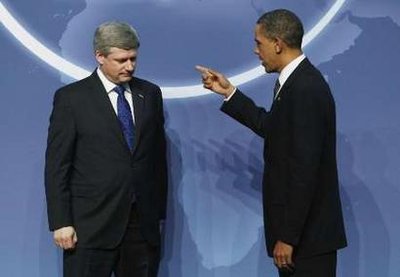
Caption contest

Filed under: Cancon, Humour, USA — Tags: , , — Nicholas @ 11:25


Wonder what’s really being communicated here . . .

March 14, 2010

Far from supporting Britain, US Navy on manouvre with Argentines

Filed under: Americas, Military, USA — Tags: , , , — Nicholas @ 12:02

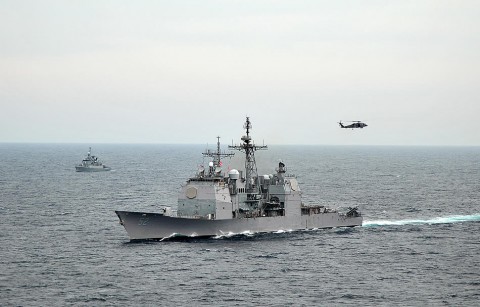
Gordon Brown may have hoped to get some tacit sign of support from the United States in the diplomatic kerfuffle over the Falkland Islands, but if you look closely here, you’ll see which side President Obama prefers:

Courtesy of Strategy Page, that’s the USS Bunker Hill (note the deliberate anti-British choice of name for the ship) and the Argentinian frigate ARA Gomez Roca together for operations recently.

March 9, 2010

QotD: Early America

Early America enjoyed, perhaps, a little more participatory local democracy than Britain, and had a slightly broader electorate and already the highest standard of living in the world. But the revolution so rapturously mythologized by Jefferson, Thomas Paine, Patrick Henry and others, was really, as Washington, Franklin, Hamilton, Madison and Adams did not forget, a somewhat grubby contest over taxes.

In one of the greatest feats of statesmanship of all history, the Americans, and especially Benjamin Franklin, persuaded the British to expel the French from North America, and then persuaded the French to provide the margin of victory in evicting the British themselves. This precocious manipulation of the world’s two greatest powers by a group of colonists showed astounding finesse and precocity, made more piquant and ironic by the fact that their rebellion was against paying the colonies’ share of the cost of removing the French, and the French were recruited to save the Americans their proportionate share of the cost of their own eviction.

All countries swaddle themselves in myths, and the Americans aren’t more self-indulgent than others; only more successful and operating on the grand scale of a country that in two long lifetimes grew to possess completely unprecedented power and influence in the world.

Even without the great pre-eminence of America, the founders of the country possessed a presentational skill that vastly exceeded the procession of demagogues and lunatics that sent and followed each other to the guillotine in the French Revolution. And they were certainly more persuasive and sophisticated than the British spokesmen for constitutional monarchy.

But their unintended legacy of this gift for theatricality is the endless hyperbole and hucksterism of American materialism and individuality.

Conrad Black, “Send in the clowns”, National Post, 2010-03-09

December 10, 2009

Russia does it again, to NATO’s benefit

Filed under: Military, Politics, Russia — Tags: , , , — Nicholas @ 09:19

Sometimes, the Russian approach to diplomacy results in exactly the opposite to the intended outcome:

In the 1990s, when enlarging NATO to take in the ex-communist countries still seemed perilous and impractical, help came from an unexpected source. Yevgeny Primakov, a steely old Soviet spook who became first head of Russia’s Foreign Intelligence Service, then foreign minister and even, briefly, prime minister, liked to say that it would be “impermissible” for the alliance to admit ex-communist states.

His remarks, and others in similar vein by leading Russian politicians, proved counterproductive. The more the Kremlin huffed and puffed about ex-captive nations deciding their own future, the harder it became to dismiss those countries’ fears: if your neighbour terms it “impermissible” for you to install a burglar alarm, people will start taking your security worries seriously. Some wags even suggested that a “Primakov prize” be established to mark the boost he had given to the cause.

But the lesson apparently was not learned:

Instead, Russia is adopting the opposite course. It habitually violates Baltic airspace. It maintains a vocal propaganda offensive (such as a report being launched in Brussels this week by a Russian-backed think-tank, which criticises Baltic language and citizenship laws). This autumn, it scandalised NATO opinion by running two big military exercises, without foreign observers, based on highly threatening scenarios (culminating in a Strategic Rocket Forces drill in which Russia “nuked” Poland). The exercises demonstrated weakness and incompetence, as well as force of numbers and nasty thinking. But they made life hard for peacemongers and strengthened the arguments of NATO hawks and the twitchy eastern Europeans.

« Newer Posts

Powered by WordPress