
Extra Credits
Published on 5 Dec 2017What draws us to Frankenstein, and to sci fi as a whole? As the novel wraps up and our time with its characters draws to an end, Mary Shelley lays out the final theme which shaped the identity of science fiction as a genre: radical alienation and the search for a place to belong.
December 7, 2017
Frankenstein: Radical Alienation – Extra Sci Fi – #6
Comments Off on Frankenstein: Radical Alienation – Extra Sci Fi – #6
December 3, 2017
Command and microcontrol
Ted Campbell relays some thoughts from a recent British criticism of how military operations are now capable — and therefore very frequently are — micromanaged by higher authority:
There is a very useful and, I hope, thought provoking article (written under a nom de plume by a serving British officer) published in the Wavell Room website.* It is entitled “Mission Command; The Fall of the Strategic Corporal; the Rise of the Tactical Minister,” and in it the author laments the fact ~ and it is a fact in Canada, too, I assert ~ that “British Mission Command and performance has regressed, largely as a result of our headquarters incorporating American military information technology as well as replicating American headquarters structures and manning. During recent counterinsurgency operations we have employed increased quantities of manpower, technology and process to try and make sense of the exponentially increasing volumes of information piped into an increasingly static headquarters. These bloated headquarters have bred a culture of over planning and control. The information technology revolution has allowed Ministers and UK based senior officers to directly reach down to the tactical level in distant operational theatres.” As a British general said in a recent speech titled “‘In command and out of control’ [the] creep at the National Level to from Mission Command to Mission Control. Prolonged campaigning in Iraq and Afghanistan has created an expanded bureaucracy with a function of identifying and mitigating risk that has not receded. The advent of ‘lawfare’ and a hysterical media has reduced our Civil Service’s threshold for presentational and reputational risk. This has led to an ever increasing legal and policy oversight and scrutiny of operations. The lack of domestic appetite for wars of choice rather than of national survival has led to a dramatically reduced appetite for risk to life on operations.” I am 99.99% certain that several serving Canadian generals and senior officers (post ship/regiment-battalion and squadron command level) could have and wish they had written the same words.
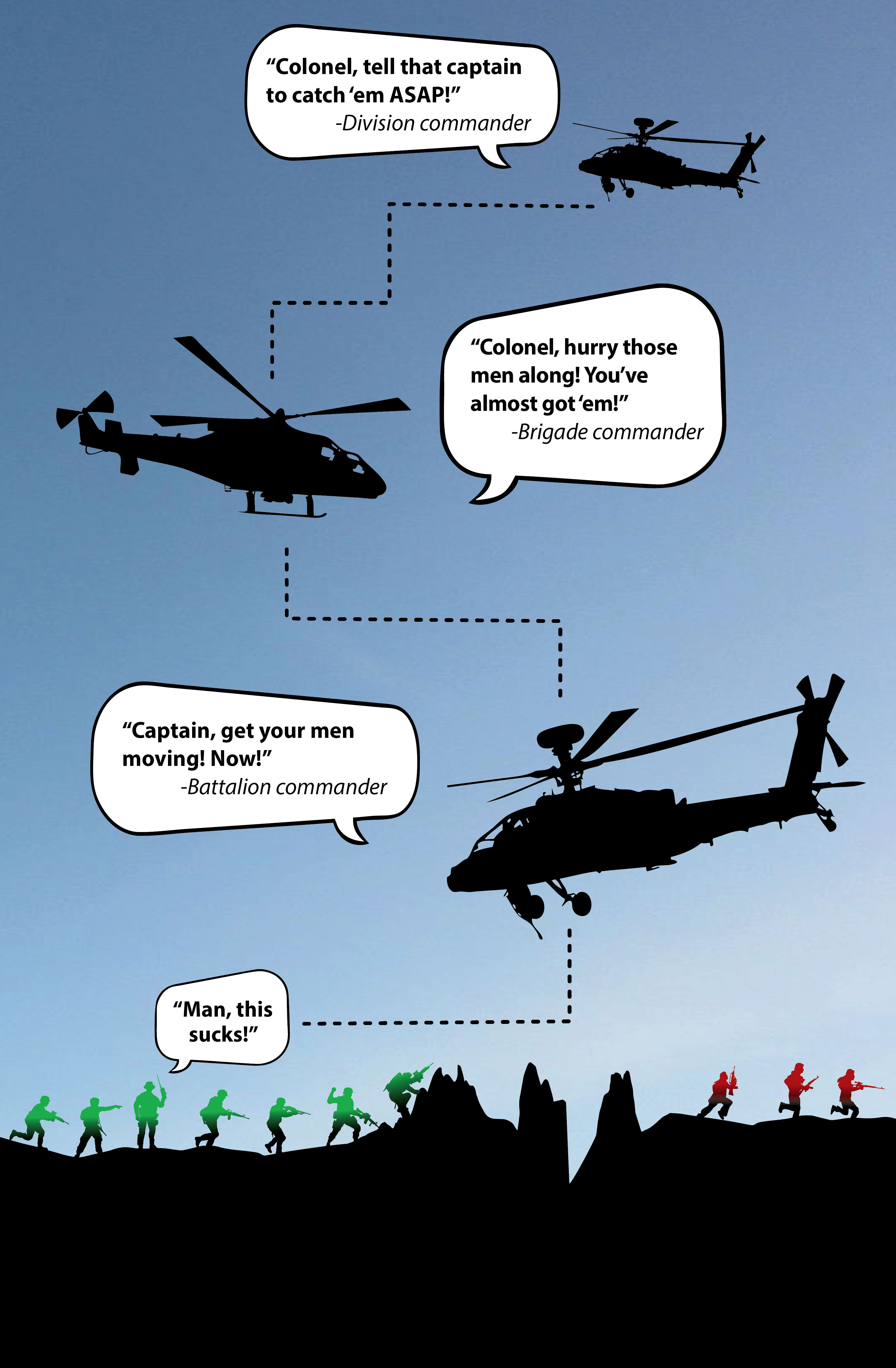
First, the very term “Mission Command” is rubbish. I know there is a whole body of literature about it, but it’s still rubbish ~ just well very documented rubbish. There is, very simply, command which is supported by control. The notion of “Mission Command” came about in the USA when it became clear that too many US senior officers were unable to exercise effective combat command because they were “nervous nellies” (or overzealous careerist) who would not or could not trust their subordinates to get on with the job. The image of a helicopter belonging to the division commander hovering over a helicopter belonging to the brigade commander hovering over the battalion commander’s helicopter that is hovering over the company of men on the ground comes to mind. Then a few other US military leaders decided that a new “concept” and a few PowerPoint presentations featuring gothic lettering and pictures of German generals would put things right … instead things went from bad to worse, but not just in the US military.
[Click to see full-size image]
Second, command and control (C2) is, actually, a quite simple thing to understand … it is the whole process by which a commander receives and analyzes his (or her) orders, does his (or her ~ always presumed from here on in) reconnaissance, makes his appreciation (estimate) of the situation and his plan and then issues the orders that commit his troops to battle. There it is in under 40 words … that’s not too hard to grasp, is it? But it can be bloody hard to do!
Comments Off on Command and microcontrol
December 2, 2017
Great Movie Fighting Techniques as illustrated by Helen of Troy
Lindybeige
Published on 31 Jan 2014This video played fine within Sony Vegas Studio, but very oddly in Windows Media Player. On YouTube it seems to be part way between the two. I just wish my videos would look and sound the way I set them in the editing software. No matter – this will have to be good enough. I have delayed uploading it too long already.
This feature film (also broadcast as a mini-series) has I think enough commentable material in it for one more video.
Comments Off on Great Movie Fighting Techniques as illustrated by Helen of Troy
December 1, 2017
“Maybe Trump’s voters aren’t angry enough yet”
One of the most disturbing phenomena of modern American political discourse is just how badly Trump’s critics are doing their jobs. It’s almost as though they’re collectively trying to get him another term in office. ESR has a bit of a rant:
I have more and more sympathy these days for the Trump voters who said, in effect, “Burn it all down.” Smash the media. Destroy Hollywood. Drain the DC swamp. We’ve all long suspected these institutions are corrupt. What better proof do we need than their systematic enabling of rape monsters?
As a tribune of the people Trump is deeply flawed. Some of his policy ideas are toxic. His personal style is tacky, ugly, and awful. But increasingly I am wondering if any of that matters. Because if he is good for nothing else, he is good for exposing the corruption, incompetence, and fecklessness of the elites – or, rather in their desperation to take him down before he breaks their rice bowls they expose themselves
Yeah. Is there anyone who thinks all these rocks would be turning over if Hillary the serial rape enabler were in the White House? Nope. With her, or any establishment Republican, it’d be cronyism all they way down, because they’d feel a need to keep the corrupt elites on side. Not Trump – his great virtue, perhaps overriding every flaw, is that he doesn’t give a fuck for elite approval.
Maybe Trump’s voters aren’t angry enough yet. It’s not just a large number of women our elites have raped and victimized, it’s our entire country. Our infrastructure is crumbling, our debt is astronomical, our universities increasingly resemble insane asylums, our largest inner cities are free-fire zones terrorized by a permanent criminal underclass. And what’s the elite response? Oh, look, a squirrel – where the squirrel of the week is carbon emissions, or transgender rights, or railing at “white privilege”, or whatever other form of virtue signaling might serve to hide the fact that, oh, look they put remote-controlled locks on their rape dungeons.
It’s long past time for a cleansing fire.
November 30, 2017
Bitcoin
Charles Stross explains why he’s not a fan of Bitcoin (and I do agree with him that the hard limit to the total number of Bitcoins sounded like a bad idea to me the first time I ever heard of them):
So: me and bitcoin, you already knew I disliked it, right?
(Let’s discriminate between Blockchain and Bitcoin for a moment. Blockchain: a cryptographically secured distributed database, useful for numerous purposes. Bitcoin: a particularly pernicious cryptocurrency implemented using blockchain.) What makes Bitcoin (hereafter BTC) pernicious in the first instance is the mining process, in combination with the hard upper limit on the number of BTC: it becomes increasingly computationally expensive over time. Per this article, Bitcoin mining is now consuming 30.23 TWh of electricity per year, or rather more electricity than Ireland; it’s outrageously more energy-intensive than the Visa or Mastercard networks, all in the name of delivering a decentralized currency rather than one with individual choke-points. (Here’s a semi-log plot of relative mining difficulty over time.)
Bitcoin relative mining difficulty chart with logarithmic vertical scale. Relative difficulty defined as 1 at 9 January 2009. Higher number means higher difficulty. Horizontal range is from 9 January 2009 to 8 November 2014.
Source: Wikipedia.Credit card and banking settlement is vulnerable to government pressure, so it’s no surprise that BTC is a libertarian shibboleth. (Per a demographic survey of BTC users compiled by a UCL researcher and no longer on the web, the typical BTC user in 2013 was a 32 year old male libertarian.)
Times change, and so, I think, do the people behind the ongoing BTC commodity bubble. (Which is still inflating because around 30% of BTC remain to be mined, so conditions of artificial scarcity and a commodity bubble coincide). Last night I tweeted an intemperate opinion—that’s about all twitter is good for, plus the odd bon mot and cat jpeg—that we need to ban Bitcoin because it’s fucking our carbon emissions. It’s up to 0.12% of global energy consumption and rising rapidly: the implication is that it has the potential to outstrip more useful and productive computational uses of energy (like, oh, kitten jpegs) and to rival other major power-hogging industries without providing anything we actually need. And boy did I get some interesting random replies!

Comments Off on Bitcoin
November 29, 2017
Frankenstein: Paradise Lost – Extra Sci Fi – #5
Extra Credits
Published on 28 Nov 2017Paradise Lost told the story of Satan, a creation who rejected his creator just like Frankenstein’s monster did. But even Satan had a loving creator, beauty, and friends. The monster had nothing, and his life in Mary Shelley’s eyes was not a horror story, but a tragedy.
Comments Off on Frankenstein: Paradise Lost – Extra Sci Fi – #5
November 23, 2017
Frankenstein: Plutarch’s Lives – Extra Sci Fi – #4
Extra Credits
Published on 21 Nov 2017Mary Shelley drew heavily from the style of biography first pioneered by Plutarch, creating characters like Victor Frankenstein and the monster whose lives parallel each other, but whose differing circumstances lead them to embody very different values.
Comments Off on Frankenstein: Plutarch’s Lives – Extra Sci Fi – #4
November 17, 2017
QotD: Karl Marx and relativism
The most notable philosopher in this tradition was, of course, Karl Marx. He argued that the values of any civilisation — prior, at least, to the socialist culmination — are determined by its mode of production. He says:
In acquiring new productive forces men change their mode of production; and in changing their mode of production, in changing the way of earning their living, they change all their social relations. The hand-mill gives you society with the feudal lord; the steam-mill society with the industrial capitalist. The same men who establish their social relations in conformity with the material productivity, produce also principles, ideas, and categories, in conformity with their social relations. Thus the ideas, these categories, are as little eternal as the relations they express. They are historical and transitory products.
This is a radically subversive claim. It allows any institution, any custom, any set of beliefs — no matter how obviously right or true they might appear — to be dismissed as “ideology” or “false consciousness”. Let this claim be accepted, and our own claims about the naturalness of market behaviour falls to the ground.
With the remaining exception of North Korea and perhaps too of Cuba, the Marxist political experiments of the twentieth century have all long since collapsed, and, bearing in mind their known record of mass-murder and impoverishment, there are few who will admit to regretting their collapse. But Marxism as a critique of the existing order and as a theory of social change, remains alive and well in the universities. In its reformulation by Gramsci, as further developed by Althusser and Foucault among others, it may be called the dominant ideology of our age. Its hold on the English-speaking world has been noted by both conservative and libertarian writers, and is subject to an increasingly lively debate.
Sean Gabb, “Market Behaviour in the Ancient World: An Overview of the Debate”, 2008-05.
Comments Off on QotD: Karl Marx and relativism
November 16, 2017
QotD: Carrier cynicism
If you are a follower of UK defence matters, then it seems to be traditional that you must be find a reason, any reason, to naysay and be downbeat about something good. The recent sailing of QUEEN ELIZABETH (QEC, and of course, not yet an HMS), is a good example of this. There were tweets and moans aplenty about an aircraft carrier supposedly without aircraft, about it being empty for years across a barren flight deck with tumbleweed and adrift deck hockey quoits the sole occupants, and of course that’s assuming a 17-year-old hacker hadn’t somehow taken charge of the ship using its SHOCK HORROR Windows XP system that’s not actually connected to the internet to somehow do something bad. This is without mentioning the near orgasmic levels of excitement the media wound themselves up into with the prospect of the vessel running into the side of the dockyard or being stuck under the Forth Bridge.
In reality the opening days of the QE’s sea trials could not have gone better for the Royal Navy and the MOD. An outstandingly effective PR operation managed to secure a great deal of national media coverage of this event, and most of the main papers had photos of the ship at sea. Some highly astute programming ensured that a pair of Type 23 frigates and a pair of Merlin helicopters were immediately available to ostensibly provide cover, but arguably in reality provided the nation with several years of stock footage of British carrier groups at sea. Within a couple of days the first landing was achieved, thus slaying the ‘but she’ll have no aircraft’ argument, and the internet is awash with glorious photos of the biggest warship ever built outside of the United States of America at sea. To top it all off, some sharply pointed jibes towards the Russians by the Secretary of State for Defence managed to elicit a strong reaction, suggesting the Bear is not as thick skinned as it wishes to portray itself to be.
Sir Humphrey, “Some Brief Thoughts on QUEEN ELIZABETH sailing”, Thin Pinstriped Line, 2017-07-03.
Comments Off on QotD: Carrier cynicism
November 10, 2017
QotD: Dissing model railroaders
I hate it when nonmodelers talk about model trains.
http://www.dailymail.co.uk/news/article-3264325/My-favourite-tracks-ones-trains-says-Rod-Stewart-Singer-reveals-books-second-hotel-room-models-play-tour.html
http://www.therichest.com/expensive-lifestyle/money/rod-stewart-model-train-collection/I’m not a lover of rock music so when Model Railroader did a writeup of Rod Stewart’s layout a few years back, I said who? Then I read the article and said wow, that’s great work. Especially when it was obvious that Mr. Stewart did the work himself. A great model railroad isn’t something you can just buy, no matter how rich you are. It’s a labor of love that involves developing real skills and tens of thousands of hours of painstaking work. Most model railroads are never finished and disappear when their builders pass on, making them more or less ephemeral works of art.
To call what Mr. Stewart does, “playing with trains” is a direct insult. Nobody says about even the crappiest painter or sculptor that they are just “playing with paint” or “playing with clay.” The same for all sorts of hobbies Yet the tone that you get when you admit to modeling trains is almost always the same. Somehow building model train is playing with toys and you are doing something childish. Somehow the idea that trains come in “sets” never seems to go beyond the train around the tree.
Which couldn’t be farther from the truth. Model railroading involves a great number of skills that most hobbies don’t have. For instance, you don’t get too far before you realize that your favorite prototype train is just not being made, or isn’t being made in your railroad’s paint scheme. So you get out the saw and cut up that train set locomotive and add other parts, ending by repainting the engine in your colors. Now you want a spur track on your railroad to service an industry. You might need to learn how to make your own track. That industry, well that might involve digging into historical archives to figure out what the building did before it became a shopping mall. As for how the railroad looks, those train set trees and vacuum formed tunnel get old fast, so you learn how to form hills and rocks, filling the hills with trees, that look like trees. You research that stuff too. In fact model railroading involves researching, photographing and studying far more than just the trains because the train need a reason to run and country to run through.
Almost no other hobby than model trains gets the kind of ridicule that model railroaders do. Some of that is, unfortunately, self-inflicted as model railroaders aren’t above poking a little at each other. Still, I’m not sure what causes the stigma that goes with small trains. Yet no other hobby requires the number of skills that model railroading, if done well does. You work with more kinds of tools, frequently through magnification than just about anything else. I’ve seen hobbyist machinists for instance talk about having to deal with “small parts” that were larger than a typical modeling project.
J.C. Carlton, “Rod Stewart And His Trains”, The Arts Mechanical, 2016-03-17.
November 8, 2017
Nancy Friday, RIP
In the 1970s, one of the most controversial books was Nancy Friday’s My Secret Garden, drawn from interviews with a large number of women about their sexual fantasies:
My Secret Garden exploded on to bestseller lists around the globe in 1973. The work was shocking, deeply sexy in parts and proved that women had erotic imaginations just as men did, and that they, too, masturbated just as men did. It heralded the innocent dawning of what later became known as the sex-positive feminist movement. My Secret Garden came at the beginning of a wave of overtly sexual content written by women. Also in 1973, Betty Dodson penned what was to become the world’s bestseller on masturbation, Sex for One. My Secret Garden didn’t have the gravitas and respectability of say, Shulamith Firestone, but as author Susie Bright, the original “Sexpert” in the 1980s and 90s, says, “it sold millions and millions of copies and was a big wake-up for America’s puritanical, sheltered girls and young women”.
Of course, Friday was attacked by many. Like Dodson, her work was dismissed for being not scientific enough or for being too personal, or too much like soft porn. But an even bigger issue was that she wasn’t, Bright recalls with glee, “the tiniest bit politically correct”.
There is something quite secret about My Secret Garden. All Friday’s interviewees, who talk about fantasies ranging from being sex workers to being urinated on, talk anonymously. One interviewee explains how, when she has sex with her husband, her fantasy is imagining “the bed practically torn apart and us ending up on the floor wet and sticky and happy”. The reality though is that, “All he’s really doing is lying on top of me and thrusting away.
In 1996, Friday told Salon: “I would no more go to a consciousness-raising group and talk about my intimate life with my husband than fly to the moon.” In that same year, while discussing sexual harassment in the office on Bill Maher’s Comedy Central talk show Politically Incorrect, she claimed that men suffered from harassment as much as women.
H/T to Kathy Shaidle, who commented:
This was a very important book, although some will scoff at the idea. I was always struck by the fact that the only two male fantasy “objects” who were named (possibly for overly cautious “legal” reasons; one is clearly Leonard Cohen but not called that) were Mr. Spock and Sherlock Holmes…
The wide-spread (and I believe disingenuous) surprise that greeted the popularity of 50 Shades of Grey was no surprise at all to me. Friday was denounced as “no feminist” for revealing women’s rape fantasies, and she was decidedly non-p.c. in other respects. Whenever anyone dismisses this or that “evidence” as “simply anecdotal,” I think of this book in which anecdote is all, and more revealing and true than any “experiment” or “survey.”
Comments Off on Nancy Friday, RIP
November 7, 2017
Le Corbusier
Theodore Dalrymple could never be called a fan of Le Corbusier’s architecture:
The French fascist architect Charles-Édouard Jeanneret, better known as Le Corbusier, was another of this charmless ilk, though cleaner than Brecht (a Marxist, the latter’s decision not to wash was his tribute, albeit not a very flattering one, to the proletariat). Jeanneret’s inhumanity, his rage against humans, is evident in his architecture and in his writings. He felt the level of affection and concern for them that most people feel for cockroaches.
Like Hitler, Jeanneret wanted to be an artist, and, as with Hitler, the world would have been a better place if he had achieved his ambition. Had he been merely an artist, one could have avoided his productions if one so wished; but the buildings that he and his myriad acolytes have built unavoidably scour the retina of the viewer and cause a decline in the pleasure of his existence.
One of Jeanneret’s buildings can devastate a landscape or destroy an ancient townscape once and for all, with a finality that is quite without appeal; as for his city planning, it was of a childish inhumanity and rank amateurism that would have been mildly amusing had it remained purely theoretical and had no one taken it seriously.
A book has just been published — Le Corbusier: The Dishonest Architect, by Malcolm Millais — that reads like the indictment of a serial killer who can offer no defense (except, possibly, a psychiatric one). The author shares with me an aesthetic detestation of Jeanneret, and also of his casual but deeply vicious totalitarianism; but, unlike me, the author both has a scholarly knowledge of his subject’s life and writings, of which the perusal of only a few has more than sufficed for me, and is a highly qualified structural engineer. Mr. Millais is able to prove not only that Jeanneret was a liar, cheat, thief, and plagiarist in the most literal sense of the words, a criminal as well as being personally unpleasant on many occasions, but that he was technically grossly ignorant and incompetent, indeed laughably so. His roofs leaked, his materials deteriorated. He never grasped the elementary principles of engineering. All his ideas were gimcrack at best, and often far worse than merely bad. To commission a building from Jeanneret was to tie a ball and chain around one’s own ankle, committing oneself to endless, Sisyphean bills for alteration and maintenance, as well as to a dishonest estimate of what the building would cost to build in the first place. A house by Jeanneret was not so much a machine for living in (to quote the most famous of his many fatuous dicta) as a machine for generating costs and for moving out of. In the name of functionality, Jeanneret built what did not work; in the name of mass production, everything he used had to be individually fashioned. Having no human qualities himself, and lacking all imagination, he did not even understand that shade in a hot climate was desirable, indeed essential.
Comments Off on Le Corbusier
October 29, 2017
QotD: Mencken’s revised view of Coolidge
In what manner he would have performed himself if the holy angels had shoved the Depression forward a couple of years — this we can only guess, and one man’s hazard is as good as another’s. My own is that he would have responded to bad times precisely as he responded to good ones — that is, by pulling down the blinds, stretching his legs upon his desk, and snoozing away the lazy afternoons…. He slept more than any other President, whether by day or by night. Nero fiddled, but Coolidge only snored…. Counting out Harding as a cipher only, Dr. Coolidge was preceded by one World Saver and followed by two more. What enlightened American, having to choose between any of them and another Coolidge, would hesitate for an instant? There were no thrills while he reigned, but neither were there any headaches. He had no ideas, and he was not a nuisance.
H.L. Mencken, The American Mercury, 1933-04.
Comments Off on QotD: Mencken’s revised view of Coolidge
October 28, 2017
Loved by outsiders, hated by insiders … differing views of the Pope
In the Guardian, Andrew Brown reports on just how some insiders are eager for the Pope to be promoted out of office:
Pope Francis is one of the most hated men in the world today. Those who hate him most are not atheists, or protestants, or Muslims, but some of his own followers. Outside the church he is hugely popular as a figure of almost ostentatious modesty and humility. From the moment that Cardinal Jorge Bergoglio became pope in 2013, his gestures caught the world’s imagination: the new pope drove a Fiat, carried his own bags and settled his own bills in hotels; he asked, of gay people, “Who am I to judge?” and washed the feet of Muslim women refugees.
But within the church, Francis has provoked a ferocious backlash from conservatives who fear that this spirit will divide the church, and could even shatter it. This summer, one prominent English priest said to me: “We can’t wait for him to die. It’s unprintable what we say in private. Whenever two priests meet, they talk about how awful Bergoglio is … he’s like Caligula: if he had a horse, he’d make him cardinal.” Of course, after 10 minutes of fluent complaint, he added: “You mustn’t print any of this, or I’ll be sacked.”
This mixture of hatred and fear is common among the pope’s adversaries. Francis, the first non-European pope in modern times, and the first ever Jesuit pope, was elected as an outsider to the Vatican establishment, and expected to make enemies. But no one foresaw just how many he would make. From his swift renunciation of the pomp of the Vatican, which served notice to the church’s 3,000-strong civil service that he meant to be its master, to his support for migrants, his attacks on global capitalism and, most of all, his moves to re-examine the church’s teachings about sex, he has scandalised reactionaries and conservatives. To judge by the voting figures at the last worldwide meeting of bishops, almost a quarter of the college of Cardinals – the most senior clergy in the church – believe that the pope is flirting with heresy.
The crunch point has come in a fight over his views on divorce. Breaking with centuries, if not millennia, of Catholic theory, Pope Francis has tried to encourage Catholic priests to give communion to some divorced and remarried couples, or to families where unmarried parents are cohabiting. His enemies are trying to force him to abandon and renounce this effort.
Since he won’t, and has quietly persevered in the face of mounting discontent, they are now preparing for battle. Last year, one cardinal, backed by a few retired colleagues, raised the possibility of a formal declaration of heresy – the wilful rejection of an established doctrine of the church, a sin punishable by excommunication. Last month, 62 disaffected Catholics, including one retired bishop and a former head of the Vatican bank, published an open letter that accused Francis of seven specific counts of heretical teaching.
To accuse a sitting pope of heresy is the nuclear option in Catholic arguments. Doctrine holds that the pope cannot be wrong when he speaks on the central questions of the faith; so if he is wrong, he can’t be pope. On the other hand, if this pope is right, all his predecessors must have been wrong.
It might be worth noting that the doctrine of Papal Infallibility was only formally accepted in the late 19th century … long after the Pope was able to exercise secular power of any note.
H/T to Colby Cosh for the link.
Comments Off on Loved by outsiders, hated by insiders … differing views of the Pope
October 24, 2017
The many false faces of Aleister Crowley
In the latest Libertarian Enterprise, Sean Gabb reviews a new collection of essays about Aleister Crowley:
Turning to practitioners of the occult, I see no evidence of special success. They do not live longer than the rest of us. However they begin, they do not stay better looking. Any success they have with money, or in bed, is better explained by the gullibility of their followers than by their own magical powers.
So it was with Aleister Crowley (1875-1947) — the “Great Beast 666,” or “the wickedest man alive.” He quickly ran through the fortune his parents had left him. He spent his last years in poverty. Long before he died, he had begun to resemble the mug shot of a child murderer. Whether his claims were simply a fraud on others, or a fraud on himself as well, I see no essential difference between him and the beggar woman who cursed me in the street. He had advantages over her of birth and education. But he was still a parasite on the credulity of others.
Nor can I see him as a thinker or writer of any real value. The book that I am reviewing does its best to claim otherwise. Its varied essays are all interesting and well-written. Anything by Keith Preston, who wrote the fourth essay, is worth reading. Mr Southgate has done a fine job on the editing and formatting. But I found myself looking up from every essay to think what a terrible waste of ability had gone into producing the book. Was Crowley a sort of national socialist, or a sort of libertarian? Was he a sex-obsessed libertine, or did he preach absolute self-control? I suspect all these questions have the same answer. The overall theme of the book is that he was a penetrating critic of “modernity,” and each of its writers — all, in my view, men of greater ability than Crowley — has done his best to reduce a corpus of self-serving nonsense to a coherent system of thought.
The truth, I think, is that, beyond a desire to impose on everyone about him, Crowley had no fixed ideas, but he was too bad a writer for this to be apparent. Take these examples of his prose:
We are not for the poor and sad: the lords of the earth are our kinsfolk. Beauty and strength, leaping laughter, and delicious languor, force and fire are of us…” [quoted, p.68]
The sexual act… is the agent which dissipates the fog of self for one ecstatic moment. It is the instinctive feeling that the physical spasm is symbolic of that miracle of the Mass, by which the material wafer… is transmuted into the substance of the body. [quoted, p.151]
In the second of these, he seems to show an influence of D.H. Lawrence — or of the sources that made Lawrence into another bad writer. In the first, he has certainly been reading too much Swinburne. I confess that I have not read anything by Crowley beyond the quotations in this book. Having seen these, though, I am not curious to look further. He was a nasty piece of work in his private life, and a victim of early twentieth century fashion in everything else.
Comments Off on The many false faces of Aleister Crowley


