Quotulatiousness

May 6, 2011

The “orphan works” gap in US copyright law

Filed under: Law, Media, Technology, USA — Tags: , , — Nicholas @ 09:30

Nicole Ciandella writes about so-called “orphan works” under current US copyright law:

Jazz enthusiasts rejoiced when the National Jazz Museum in Harlem purchased the famous Savory Collection last year, but unless Congress fixes a gaping hole in U.S. copyright laws, few people will actually hear the prized recordings.

William Savory was an audio engineer who developed his own method of recording live audio performances in the late 1930s. Up until World War II, most live performances were recorded on 78 rpm records that could capture only about three minutes of music. But Savory used 12- and 16-inch aluminum discs, which enabled him to create and store high quality recordings of longer performances. His collection includes a six-minute version of Coleman Hawkins performing “Body and Soul” in the spring of 1940 and a recording of Billie Holliday singing a rubato-tempo version of “Strange Fruit” in a nightclub only a month after her original version was released.

While he was alive, Savory kept his recordings mostly to himself. He died in 2004. His son, who inherited the recordings, finally agreed last year to sell the whole Savory Collection to the National Jazz Museum.

Museum spokespeople say the museum is eager to share the songs with the public online, but because of the recordings’ murky copyright status, that’s unlikely to happen anytime soon. The performances Savory recorded are now considered “orphan works” — in other words, their copyright owners are unknown and cannot be tracked down. The museum can’t obtain permission to disseminate the recordings; and if the museum were to go ahead without permission, it would risk being hit with a copyright infringement lawsuit, meaning potentially hefty civil penalties.

May 3, 2011

The lawfare threat to bloggers (and anyone else who posts on the web)

Filed under: Law, Liberty, Media, Technology — Tags: , , , — Nicholas @ 18:15

Box Turtle Bulletin lays out the details of a very disturbing development:

By providing blockquotes, we let the source material speak for itself without any inadvertent inaccuracies or biases which may creep in if we were to paraphrase it. And by providing links, we allow you, the reader, to click through for more information. Of course, we cannot copy the source material in its entirety, nor can we copy major portions of it. That would violate copyright laws, which is a very serious issue. But copyright laws do allow us to copy small portions of source material for commentary and discussion purposes.

As I said, copyright laws — or more specifically, copyright lawsuits — are serious business. And now, three newspaper chains have discovered that filing copyright lawsuits can become yet another profit center. The problem is, their definition of copyright infringement not only contradicts copyright law, but also poses a serious threat to bloggers and other online outlets everywhere.

Righthaven LLC is a copyright holding company which acquires “rights” to newspaper content after finding the content published on other web sites without permission, and files lawsuits against those web site. Righthaven was created as a partnership with Stephens Media, publisher of the Las Vegas Review-Journal, and their business model rests entirely on suing web site owners and operators for extravagant “damages” as a shakedown exercise. (“Rights” are in quotes, because, contrary to what is required under copyright law, Righthaven doesn’t actually acquire any legitimate copyright “rights,” which is yet another problem with their business model.) Two other newspaper chains, WEHCO Media and Media News Group have entered into agreements with Righthaven to split the profits from lawsuits stemming from their respective newspapers’ contents.

The three newspaper chains partnering with Righthaven represent some very important voices in the newspaper industry, including the Las Vegas Review-Journal, Denver Post, Salt Lake Tribune, San Jose Mercury News, Oakland Tribune, St. Paul Pioneer Press, Detroit News, El Paso Times, Arkansas Democrat-Gazette, and Charleston Daily Mail.

I had already heard that the Las Vegas Review-Journal had some unusual views on quoting from their website, so I’ve avoided using that site for years. I didn’t know that the St. Paul Pioneer Press had also adopted that highly restrictive view of copyright, and they were one of the newspapers I read regularly for Minnesota Vikings information. I’m going to have to avoid quoting from them, however. Here is how Box Turtle Bulletin will be handling the situation in future:

And so to protect ourselves and this web site, we will no longer cite any content from Denver Post, Las Vegas Review-Journal, Salt Lake Tribune, or any of the other news sources listed no linkhere. There will be no links, no blockquotes, nothing. For the most part, it will be as if these sources simply don’t exist.

But if it happens that, for example, the Denver Post has an exclusive story that no one else has, we will do what the Associated Press does whenever the New York Times breaks a story. We will write about the story by paraphrasing the Post’s article, but we will not quote from it or provide a link to it — just like the Associated Press does. There will be however one tweak from standard AP practice: we will provide a link, but it will be to an explanation as to why there is no link. It will look something like this:

     “The Denver Post (no link) reports blah, blah, blah…”

H/T to Walter Olson for the link.

Michael Geist on what the Conservative majority means for digital policies

In short, he sees it as a mixed bag:

For example, a majority may pave the way for opening up the Canadian telecom market, which would be a welcome change. The Conservatives have focused consistently on improving Canadian competition and opening the market is the right place to start to address both Internet access (including UBB) and wireless services. The Conservatives have a chance to jump on some other issues such as following through on the digital economy strategy and ending the Election Act rules that resulted in the Twitter ban last night. They are also solidly against a number of really bad proposals — an iPod tax, new regulation of Internet video providers such as Netflix — and their majority government should put an end to those issues for the foreseeable future.

On copyright and privacy, it is more of a mixed bag.

The copyright bill is — as I described at its introduction last June — flawed but fixable. I realize that it may be reintroduced unchanged (the Wikileaks cables are not encouraging), but with the strength of a majority, there is also the strength to modify some of the provisions including the digital lock rules. Clement spoke regularly about the willingness to consider amendments and the Conservative MPs on the Bill C-32 committee were very strong. If the U.S. has exceptions for unlocking DVDs and a full fair use provision, surely Canada can too.

The Conservatives are a good news, bad news story on privacy. A fairly good privacy bill died on the order paper that will hopefully be reintroduced as it included mandatory security breach notification requirements. There will be a PIPEDA review this year and the prospect of tougher penalties for privacy violations is certainly possible. Much more troubling is the lawful access package which raises major civil liberties concerns and could be placed on the fast track.

April 4, 2011

Totally underground band loses millions to illegal downloads…or do they?

Filed under: Cancon, Economics, Media, Technology — Tags: , , , — Nicholas @ 09:39

An interesting article looks at a claim by an obscure band that their debut CD had been pirated over 100,000 times:

Late last week, TorrentFreak was contacted by a guy called Wayne Borean who alerted to us to a somewhat heated debate he’d been participating in on the ‘Balanced Copyright For Canada’ Facebook page.

“There’s a Rock Band called One Soul Thrust. They have a debut album, which I like (bought it off iTunes). However the first I heard of the band was when there were complaints that the band had gone Platinum — because of illegal Torrent downloads!” Borean explained.

Indeed, according to a press release from the band’s manager, Cameron Tilbury, the situation is very serious.

“The Canadian Recording Industry Association (CRIA) states that, to achieve Platinum status, an album must achieve sales of 100,000 copies/downloads of an album. Sales…that’s the key. A random polling of several torrent site’s downloads — ILLEGAL downloads — has shown that 1ST, the debut cd by ONE SOUL THRUST has been downloaded over 100,000 times,” he wrote.

That’s really terrible, isn’t it? An obscure band, hoping to make it big by selling their CD have an illegal audience more than 300 times their number of Facebook fans? How did all these illegal downloaders even find out about the band? Well, perhaps they didn’t:

At this point, since we couldn’t find any torrents on any site (Borean tried everywhere too), we have to admit we were beginning to wonder if this 100K download claim was some kind of publicity stunt. Furthermore, since Wayne Borean and Tilbury were starting to publicly tear each other apart (and getting pretty personal at times) it seemed sensible to get to the bottom of this, particularly since the band’s manager claimed that the all-powerful CRIA is supporting the band’s stance.

[. . .]

As many readers will now be aware, there is a huge problem. These results are completely fake and are generated from user input to draw traffic to site advertisers. You can type anything in the search boxes on some of these torrent sites (these apparently came from LimeTorrents) and anyone can appear to be pirated into oblivion [. . .]

We wrote back to Tilbury and explained our findings. We also asked him to comment on how he feels now that he realizes that people aren’t downloading the band’s music at all. He hasn’t responded to that question which is a real shame, because personally I think this is the most important part of the whole story.

I’m absolutely confident that there was no attempt to mislead with the band’s ‘piracy problem’ press release and that the band and their manager sincerely believed that 100K people had downloaded their album without paying for it. However, it would be intriguing to know what happened, when emotions of supposedly being ripped off by 100,000 pirates were replaced by other, perhaps more confused feelings.

Update, 5 April: Apparently you have two choices in a situation like this. 1) Own up to being mistaken and apologize for making a stink about a non-issue. 2) Double-down on stupid:

A day after One Soul Thrust’s manager had the entire Internet explain to him that his band’s music wasn’t being downloaded 100,000 times on BitTorrent sites, he’s still in deep denial. Today’s post is all about how the pirates attacked him “[b]ecause a debut album by an independent Canadian band is listed on torrent sites around the world and we had the audacity to point that out.” Um, no it’s not. It’s not listed on any torrent sites. As far as anyone can tell, not one human being on this planet has torrented this band’s CD. Dude, you made a mistake, you freaked out, you looked a little naive. Now you’re looking like an ass. Quit while you’re ahead, maybe?

Creative comments to that last post include 1) someone, somewhere actually upload the album to a torrent site, just so the band doesn’t look quite as pathetic, and 2) replace each track with varying length versions of a certain Rick Astley tune.

March 31, 2011

Men At Work lose copyright appeal

Filed under: Australia, Law, Media, Pacific — Tags: , — Nicholas @ 10:03

As reported last year, Australian band Men At Work launched an appeal against a judgement requiring them to pay 5% of the royalties on their song “Down Under”. The appeal was dismissed:

Australia’s Federal Court upheld the decision which stated part of the song’s melody came from the tune Kookaburra Sits in the Old Gum Tree.

Record label EMI argued the writers did not plagiarise because the inclusion of two bars from the tune was a tribute.

The music company has also been ordered to pay costs.

The latest decision clears the way for Larrikin Music, the copyright owners for Kookaburra Sits in the Old Gum Tree, to claim millions of dollars in unpaid royalties from Down Under writers Colin Hay and Ron Strykert.

The original judgement was clearly insane: it assessed the damages at up to 60% of the profits earned by the band on that song (for two bars of a three-minute song). The revised judgement was much more proportional: 5%.

February 19, 2011

QotD: “Would Shakespeare Have Survived Today’s Copyright Laws?”

Filed under: Law, Media, Quotations — Tags: , , — Nicholas @ 00:05

Turow, along with Authors Guild executive director Paul Aiken and Authors Guild board member (and apparent Shakespeare expert) James Shapiro, have an op-ed piece in the NY Times that a whole bunch of you have been sending in, in which they assert that Shakespeare might not have been able to survive the web era, because of all of this “piracy.” The argument is quite a bit stretched, but see if you can follow me: because playwrights had physical scarcity, in that they could keep people out of the playhouses unless people paid to enter, it allowed playwrighting to flourish. They call this a “cultural paywall.” Then there’s some sort of bizarre leap about how copyright is really the same thing. It’s not. And, then it leaps to something about how stricter copyright laws are, ipso facto, better. The evidence for this? Shhhh, don’t bother the Authors Guild bosses with logic! And, of course, the inevitable punchline is the idea that Shakespeare wouldn’t have survived in this online era with all this piracy and stuff.

Of course, it’s difficult to think of a worse example than Shakespeare for this argument (and sort of bizarre that Shapiro would sign off on an op-ed that so thoroughly misrepresents Shakespeare). Of course, as most of you know, an awful lot of Shakespeare’s works are copies (sometimes directly) of earlier works. Sometimes they’re derivative, but other times, he copied wholesale from others. So the bigger question might not be if Shakespeare could survive all the file sharing going on today, but whether or not he’d be able to produce any of his classic works, since they’d all be tied up in lawsuits over copyright infringement.

Mike Masnick, “Would Shakespeare Have Survived Today’s Copyright Laws?”, Techdirt, 2011-02-18

February 17, 2011

The Pirates of Oz

Filed under: Australia, Media, Technology — Tags: , , , , — Nicholas @ 07:15

According to a recent study, piracy in Australia has become the biggest industry: one third of all Australians are accused of piracy in the last twelve months.

The study, released by the Australian Federation Against Copyright Theft, claims that piracy sucks $A1.37bn out of the Australian economy.

Direct effects claimed by AFACT amounted to $A575m, the study claims — including $A225m attributed to “secondary piracy”, in which an individual either “views or borrows” pirated material (presumably whether or not the viewer knows the full legal status of what they’re watching).

[. . .]

The economic multiplier effects, for those willing to get past the press release, include reduced spending on recreation, clothing, housing and household goods. So, freetards, hang your heads in shame: not only were more than 6,000 jobs lost due to piracy, but the victims of your crime are now homeless, naked, hungry and bored.

February 12, 2011

Deeper implications of the rise of “3D printing”

Filed under: Economics, Technology — Tags: , , , , — Nicholas @ 10:49

One of the most interesting things happening in the manufacturing world is the rise of a technology that may well make huge swathes of factories obsolete: practical 3D printing. What was originally just a neat way to develop small prototypes for mass production is quickly becoming a viable way to replace the entire mass production step. The technology is still limited to a small range of materials, but the price has been dropping steeply enough that small 3D printers are within the reach of hobbyists already.

The Economist points out that this will not be an unmixed blessing (as technological revolutions ever have been):

Others maintain that, by reducing the need for factory workers, 3D printing will undermine the advantage of low-cost, low-wage countries and thus repatriate manufacturing capacity to the rich world. It might; but Asian manufacturers are just as well placed as anyone else to adopt the technology. And even if 3D printing does bring manufacturing back to developed countries, it may not create many jobs, since it is less labour-intensive than standard manufacturing.

The technology will have implications not just for the distribution of capital and jobs, but also for intellectual-property (IP) rules. When objects can be described in a digital file, they become much easier to copy and distribute — and, of course, to pirate. Just ask the music industry. When the blueprints for a new toy, or a designer shoe, escape onto the internet, the chances that the owner of the IP will lose out are greater.

There are sure to be calls for restrictions on the use of 3D printers, and lawsuits about how existing IP laws should be applied. As with open-source software, new non-commercial models will emerge. It is unclear whether 3D printing requires existing rules to be tightened (which could hamper innovation) or loosened (which could encourage piracy). The lawyers are, no doubt, rubbing their hands.

Just as nobody could have predicted the impact of the steam engine in 1750 — or the printing press in 1450, or the transistor in 1950 — it is impossible to foresee the long-term impact of 3D printing. But the technology is coming, and it is likely to disrupt every field it touches. Companies, regulators and entrepreneurs should start thinking about it now. One thing, at least, seems clear: although 3D printing will create winners and losers in the short term, in the long run it will expand the realm of industry — and imagination.

So, even if you don’t have immediate plans to buy a 3D printer, you could do worse than to dust off your old drafting book and learn a bit of CAD. You may be using those skills sooner than you expect.

There’s more information (from 2009) on the 3D printing process here.

January 15, 2011

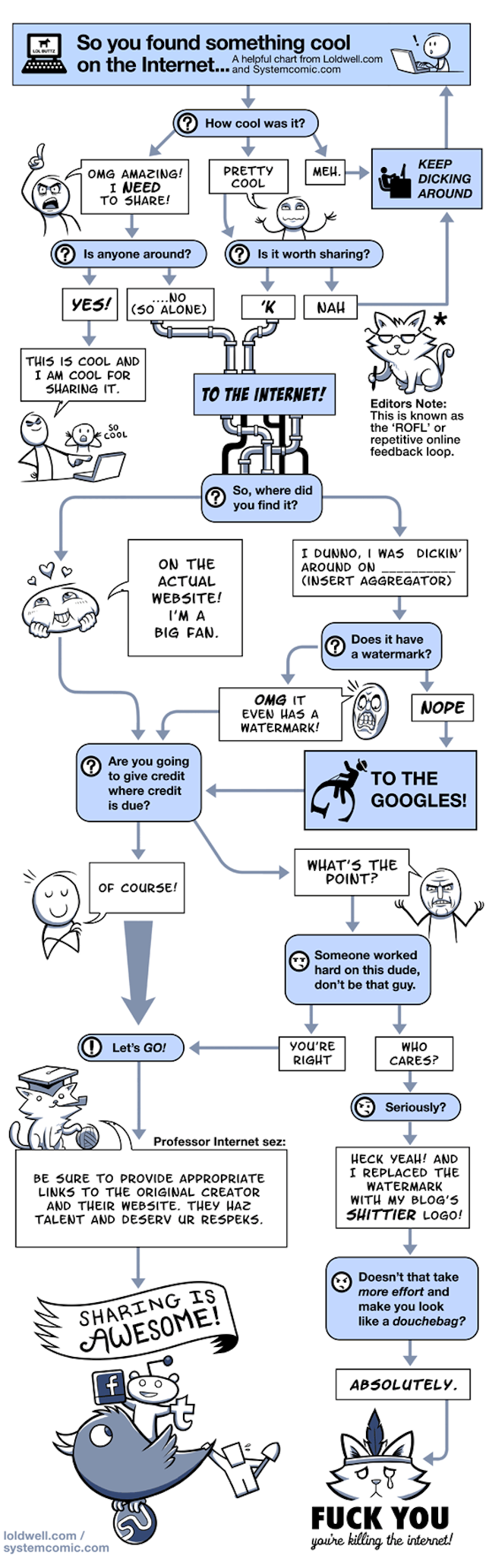
What do you do when you find something cool on the Internet?

Filed under: Humour, Media, Technology — Tags: , , — Nicholas @ 00:04

If you’re cool, you do something like this:

Original work by Caldy and Rosscott. H/T to Royce McDaniels for bringing it to my attention.

Remember, kids, everytime you re-use someone’s creative work on the Internet without giving credit, God (or your Deity of choice) kills a kitten. Don’t make God (or your Deity of choice) kill any more kittens!

November 27, 2010

Anyone remember when Homeland Security got the right to shut down websites?

Filed under: Bureaucracy, Government, Law, USA — Tags: , , , — Nicholas @ 12:24

In addition to their role in defending the homeland, apparently they’re also now copyright enforcers:

The investigative arm of the Homeland Security Department appears to be shutting down websites that facilitate copyright infringement.

Immigration and Customs Enforcement (ICE) has seized dozens of domain names over the past few days, according to TorrentFreak.

ICE appears to be targeting sites that help Internet users download copyrighted music, as well as sites that sell bootleg goods, such as fake designer handbags.

The sites are replaced with a note from the government: “This domain named has been seized by ICE, Homeland Security Investigations.”

H/T to Ace of Spades HQ for the link.

It would be nice to know what part of the act of Congress that set up the Department of Homeland Security permits this kind of action. So that I can know whether to thank George Bush or Barack Obama.

[. . .]

First they were grabbing crotches in airports…

This overrreach by the DHS is breathtaking and clearly violates the spirit of the act of Congress that created it and the public’s understanding of the rationale for the creation of DHS. I’m not saying the domains were not involved in copyright infringement. I’m saying the DHS involvement is odd and the method — seizure of the domains — lacks a certain due process.

It’s ugly and ham-fisted. And it is difficult to see how it could be aimed at drawing the public’s attention away from the travails of the TSA. Rather, it looks like another run-of-the-mill stupid move on the part of Obama and Napolitano. It will be interesting next week to see the reaction of Representatives and Senators.

November 11, 2010

Even more reason to believe that ACTA is a bad deal

Filed under: Bureaucracy, Law, Liberty, Media — Tags: , , , , , — Nicholas @ 08:45

From the folks at BoingBoing:

New revelations on ACTA, the Anti-Counterfeiting Trade Agreement (ACTA), a secretive global copyright being privately negotiated by rich countries away from the UN: ACTA will require ISPs to police trademarks the way they currently police copyright. That means that if someone accuses you of violating a trademark with a web-page, blog-post, video, tweet, etc, your ISP will be required to nuke your material without any further proof, or be found to be responsible for any trademark violations along with you. And of course, trademark violations are much harder to verify than copyright violations, since they often hinge on complex, fact-intensive components like tarnishment, dilution and genericization. Meaning that ISPs are that much more likely to simply take all complaints at face-value, leading to even more easy censorship of the Internet with nothing more than a trumped-up trademark claim.

November 4, 2010

Chutzpah, or the new Cook’s Source plagiarism service now open

Filed under: Food, Law, Media — Tags: , — Nicholas @ 12:19

Did you know that the internet is not public domain? The editors at Cook’s Source apparently thought it was, because they printed an article without the permission of the original author, and then told her that she should be happy they didn’t bill her for editing it. (It’s an article on medieval cooking, with original spelling preserved from the source texts: of course it would look weird to a modern eye.)

The exchanges between the original author and the editor make for amusing reading:

After the first couple of emails, the editor of Cooks Source asked me what I wanted — I responded that I wanted an apology on Facebook, a printed apology in the magazine and $130 donation (which turns out to be about $0.10 per word of the original article) to be given to the Columbia School of Journalism.

What I got instead was this (I am just quoting a piece of it here:)

“Yes Monica, I have been doing this for 3 decades, having been an editor at The Voice, Housitonic Home and Connecticut Woman Magazine. I do know about copyright laws. It was “my bad” indeed, and, as the magazine is put together in long sessions, tired eyes and minds somethings forget to do these things.

But honestly Monica, the web is considered “public domain” and you should be happy we just didn’t “lift” your whole article and put someone else’s name on it! It happens a lot, clearly more than you are aware of, especially on college campuses, and the workplace. If you took offence and are unhappy, I am sorry, but you as a professional should know that the article we used written by you was in very bad need of editing, and is much better now than was originally. Now it will work well for your portfolio. For that reason, I have a bit of a difficult time with your requests for monetary gain, albeit for such a fine (and very wealthy!) institution. We put some time into rewrites, you should compensate me! I never charge young writers for advice or rewriting poorly written pieces, and have many who write for me… ALWAYS for free!”

H/T to John Scalzi for the link.

September 29, 2010

QotD: “Never attribute to malice that which can be explained by malice and incompetence”

Filed under: Media, Quotations — Tags: , , , , — Nicholas @ 13:11

I used to publish in the National Post back in the day Conrad Black ran the show. It was a business run with integrity. The last time I had a call from their editorial board I had to explain the Post paid me 40 cents a word. The man was genuinely scandalized — I mean audibly taken aback and offended — when I told him I would not hand my work over to him for free (btw, Adam, how did selling your integrity work out for you? Looks like you got what it was worth).

These days they don’t bother to call. Last week, they took my Margaret Atwood story and ran with it uncredited. They lacked the decency to do something that would have cost them nothing.

[. . .]

I am a writer. I don’t expect to get paid much. But I do expect to get paid. If this country aspired to be something more than a grasping, pissant kleptocracy celebrating third-raters and UCC school ties my work — this blog and others like it — would be understood as part of the real Canadian cultural establishment.

Fortunately, I don’t require their acknowledgement.

Nicholas Packwood, “Neither honour nor courage: The National Post”, Ghost of a Flea, 2010-09-29

July 6, 2010

Men at Work to pay 5% for infringement

Filed under: Australia, Law, Media — Tags: , — Nicholas @ 07:37

Following up from a post earlier this year, an Australian judge has avoided penalizing Men At Work the maximum for using a riff from another song:

A judge in Sydney has ordered the Australian band Men at Work to hand over a portion of the royalties from their 1980s hit Down Under, after previously ruling its distinctive flute riff was copied from a children’s campfire song.

But the penalty he imposed of 5% of the song’s royalties was far less than the 60% sought by publishing company Larrikin Music, which holds the copyright for the song Kookaburra Sits in the Old Gum Tree.

Kookaburra was written more than 70 years ago by Australian teacher Marion Sinclair for a Guides competition, and the song about the native Australian bird has been a favourite around campfires from New Zealand to Canada.

That seems like a remarkably sensible judgement: the song clearly does infringe, but only for a small portion of the entire recording: it’s not critical to the success of the song, but it does contribute to its overall atmosphere.

June 23, 2010

Bunch of “radical extremists”

Filed under: Cancon, Law, Media, Technology — Tags: , , , , , , — Nicholas @ 09:09

Protest groups at the G20? No, the Heritage Minister’s sweeping characterization of the people and organizations opposed to the new copyright bill:

So when Moore warns about radical extremists opposing C-32, who is he speaking of? Who has criticized parts of the bill or called for reforms? A short list of those critical of the digital lock provisions in C-32 would include:

* Liberal MPs
* NDP MPs
* Bloc MPs
* Green Party
* Canadian Consumer Initiative
* Association of Universities and Colleges of Canada
* Canadian Association of University Teachers
* Canadian Federation of Students
* Canadian Library Association
* Business Coalition for Balanced Copyright
* Retail Council of Canada
* Canadian Bookseller Association
* Documentary Organization of Canada

While there are bound to be a few individual “radical extremists” in any organization, these particular groups aren’t known for their bomb-throwing agitator ways.

« Newer PostsOlder Posts »

Powered by WordPress


