Quotulatiousness

June 9, 2010

Glee as piracy central

Filed under: Law, Media — Tags: , , , — Nicholas @ 13:13

Christina Mulligan points out that a popular mainstream TV show is not only encouraging illegal behaviour, it’s actually indulging in it:

The fictional high school chorus at the center of Fox’s Glee has a huge problem — nearly a million dollars in potential legal liability. For a show that regularly tackles thorny issues like teen pregnancy and alcohol abuse, it’s surprising that a million dollars worth of lawbreaking would go unmentioned. But it does, and week after week, those zany Glee kids rack up the potential to pay higher and higher fines.

In one recent episode, the AV Club helps cheerleading coach Sue Sylvester film a near-exact copy of Madonna’s Vogue music video (the real-life fine for copying Madonna’s original? up to $150,000). Just a few episodes later, a video of Sue dancing to Olivia Newton-John’s 1981 hit Physical is posted online (damages for recording the entirety of Physical on Sue’s camcorder: up to $300,000). And let’s not forget the glee club’s many mash-ups — songs created by mixing together two other musical pieces. Each mash-up is a “preparation of a derivative work” of the original two songs’ compositions — an action for which there is no compulsory license available, meaning (in plain English) that if the Glee kids were a real group of teenagers, they could not feasibly ask for — or hope to get — the copyright permissions they would need to make their songs, and their actions, legal under copyright law. Punishment for making each mash-up? Up to another $150,000 — times two.

I’ve never watched Glee, but I find this quite an amusing juxtaposition, as the corporate owners of Fox are among the loudest and most active copyright enforcement goons around.

June 2, 2010

New copyright bill introduced

Filed under: Cancon, Law, Media, Technology — Tags: , , , , , , — Nicholas @ 16:21

It’s not yet online, so I haven’t read it myself (and, not being a lawyer, it might not be a good use of my time). Michael Geist has, however, and provides a useful summary of the good and the bad:

The bill contains some important extensions of fair dealing, including new exceptions for parody, satire, and (most notably) education. It also contains more sensible time shifting and format shifting provisions that still feature restrictions (they do not apply where there is a digital lock) but are more technology neutral than the C-61 model. There is also a “YouTube exception” that grants Canadians the right to create remixed user generated content for non-commercial purposes under certain circumstances. While still not as good as a flexible fair dealing provision, the compromise is a pretty good one. Throw in notice-and-notice for Internet providers, backup copying, and some important changes to the statutory damages regime for non-commercial infringement and there are some provisions worth fighting to keep.

Yet all the attempts at balance come with a giant caveat that has huge implications for millions of Canadians. The foundational principle of the new bill remains that anytime a digital lock is used — whether on books, movies, music, or electronic devices — the lock trumps virtually all other rights. In other words, in the battle between two sets of property rights — those of the intellectual property rights holder and those of the consumer who has purchased the tangible or intangible property — the IP rights holder always wins. This represents market intervention for a particular business model by a government supposedly committed to the free market and it means that the existing fair dealing rights (including research, private study, news reporting, criticism, and review) and the proposed new rights (parody, satire, education, time shifting, format shifting, backup copies) all cease to function effectively so long as the rights holder places a digital lock on their content or device.

It’s not quite the total surrender to the entertainment rights holders that many feared, but it’s certainly not the best deal for consumers. Bottom line:

For the glass half-full, the compromise positions on fair dealing, the new exceptions, and statutory damages are not bad — not perfect — but better than C-61. For the glass half-empty, the digital lock provisions are almost identical to C-61 and stand as among the most anti-consumer copyright provisions in Canadian history. Not only are they worse than the U.S. DMCA, but they undermine much of the positive change found in the rest of the bill. In the days and weeks ahead, Canadians must speak out to ensure that the compromise positions found in C-32 remain intact and that the digital lock provisions move from the no-compromise category to the compromise one.

May 28, 2010

The copyright issue in Canadian law

Filed under: Cancon, Law, Technology — Tags: , , , — Nicholas @ 12:05

I’ve always understood that under Canadian copyright law, as long as you bought the original CD, you were allowed to rip the tracks to play on iPods and other MP3 players. I was wrong — that sort of thing breaks Canadian copyright law:

Industry Minister Tony Clement has an admission to make: He built his impressive music library on his iPod in part by breaking Canada’s copyright law.

Mr. Clement, stickhandling the copyright file for the Conservative government along with Heritage Minister James Moore, is poised to introduce new copyright legislation within days. But until the law is updated to permit Canadians to transfer music onto MP3 players from CDs they have purchased, Mr. Clement stands on the wrong side of Canada’s copyright law.

“Well you see, you know I think I have to admit it probably runs afoul of the current law because the current law does not allow you to shift formats. So the fact of the matter is I have compact discs that I’ve transferred, I have compact discs from my children or my wife that I’ve transferred onto my iPod. None of that is allowable under the current regime,” Mr. Clement, a music buff who also legally purchases songs from iTunes to build a digital database that now stands at 10,452 songs.

If the guy in charge of the relevant ministry admits that he’s breaking the law, are the media providers going to slap him with a lawsuit, claiming their traditional multi-millions per track in damages? If not, why not?

Update: Amusingly, the first piece of spam that someone attempted to post on this article said “The compilation of all content on this site is the exclusive property of WaySpa and protected by Canadian and international copyright laws.” So I guess now we know who to blame . . .

May 22, 2010

Copyright suits . . . and profanity

Filed under: Humour, Law, Technology — Tags: , , — Nicholas @ 11:27

Cory Doctorow finds fulfilling both interests easy in this case:

You know what I’m interested in? Copyright lawsuits.

And profanity.

Lucky for me, Google and Viacom have provided both today, in the form of a series of emails released through the discovery process in Viacom’s billion-dollar lawsuit against YouTube. In these emails, the two companies take turns cussin’ and spittin’ and swearin’ about each other. Hilarity ensues. Ars Technica rounds up some of the highlights.

May 21, 2010

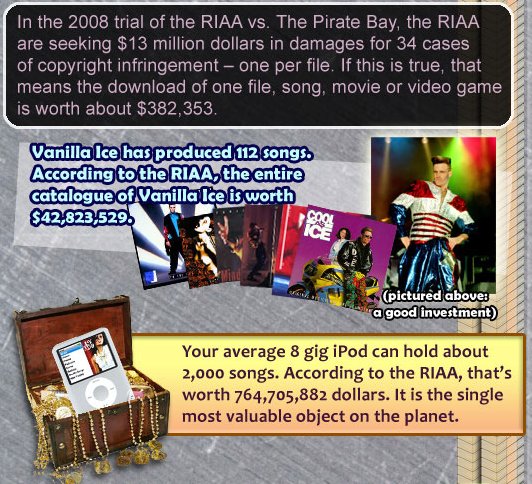
Your iPod is even more valuable than you think

Filed under: Economics, Law, Media, Technology — Tags: , , , , — Nicholas @ 12:54

Sing along with the RIAA:


Full image here

May 18, 2010

QotD: Time to kill the “information wants to be free” meme

Filed under: Economics, Media, Quotations, Technology — Tags: , , — Nicholas @ 12:06

“Information wants to be free” (IWTBF hereafter) is half of Stewart Brand’s famous aphorism, first uttered at the Hackers Conference in Marin County, California (where else?), in 1984: “On the one hand information wants to be expensive, because it’s so valuable. The right information in the right place just changes your life. On the other hand, information wants to be free, because the cost of getting it out is getting lower and lower all the time. So you have these two fighting against each other.”

This is a chunky, chewy little koan, and as these go, it’s an elegant statement of the main contradiction of life in the “information age”. It means, fundamentally, that the increase in information’s role as an accelerant and source of value is accompanied by a paradoxical increase in the cost of preventing the spread of information. That is, the more IT you have, the more IT generates value, and the more information becomes the centre of your world. But the more IT (and IT expertise) you have, the easier it is for information to spread and escape any proprietary barrier. As an oracular utterance predicting the next 40 years’ worth of policy, business and political fights, you can hardly do better.

But it’s time for it to die.

Cory Doctorow, “Saying information wants to be free does more harm than good”, The Guardian, 2010-05-18

May 5, 2010

Three reasons not to remove the Downfall parodies

Filed under: History, Law, Media, WW2 — Tags: , , , , — Nicholas @ 12:50

3 Reasons YouTube Shouldn’t Censor Downfall Parodies

[. . .]

It’s understandable why Downfall’s production company, Constantin Film, might be upset that such a serious movie is being burlesqued, but pushing YouTube to ban the parodies is a terrible idea for at least three reasons:

1. It’s fair use! The parodies, which transform a few minutes of a three-hour movie, are clearly legit under existing copyright laws. Because they clearly transform the original and have no possibility of confusing viewers, the parodies are clearly protected speech.

2. This is free promotion! As George Lucas could tell the filmmakers, fan-generated videos help keep the original source material vital and relevant. Lucas used to try to police all Star Wars knock-offs, until he realized that his audience was promoting his films more effectively than he ever could. More people have surely seen Downfall due to the popularity of the parodies.

3. Let’s keep the Internet creative! The greatest cultural development over the past 20 or so years has been technologies that allow producers and consumers to create and enjoy an ever-increasing array of creative expression in an ever-increasing array of circumstances. This development is nowhere more powerful than on the Internet, which has unleashed a whole new universe of writing, music, video, and more. Indeed, YouTube is itself one of the great conduits of cyberspace. Pulling down the Downfall parodies may be within YouTube’s rights, but it nonetheless strikes a blow to the heart of what is totally awesome about the Internet.

April 29, 2010

Did Bruno Ganz do too good a job playing Adolf Hitler?

Filed under: History, Media, Technology — Tags: , , , , , , — Nicholas @ 12:11

Now that you actually have to work at it to find some of the Downfall parodies on YouTube, John Naughton looks at the cultural power of remix culture, which has been most recently popularized by Bruno Ganz in his mesmerizing performance as Adolf Hitler:

Ganz’s performance is a real tour de force, so much so that the New Yorker critic wondered aloud if it would have the effect of humanising Hitler. But the scene had another, equally extraordinary, side-effect. It became the basis for a wildly successful and entertaining comic virus, in which people used everyday video-editing software to remix the scene in modern contexts (politics, sports, technology, popular culture). The German soundtrack was left unchanged, but new subtitles were added and then the results were posted on YouTube.

[. . .]

Some of these parodies are tiresome. But many are side-splittingly funny, a testimony to the power of remixing as a way of enlivening cultural life. Nevertheless, not everyone is delighted by this new art form. Jewish organisations have been understandably disturbed by the way the architect of the Holocaust has been turned into a comic turn. “Hitler,” said the director of the Anti-Defamation League, “is not a cartoon character”.

[. . .]

The YouTube remix culture is thus a new take on a venerable tradition. I wouldn’t argue that the Downfall spoofs are high art, but they are evidence of bottom-up creativity and intelligence in a new medium. And if we allow narrow considerations of intellectual property to stifle this creativity, then we may all, except for the lawyers, live to regret it.

April 21, 2010

When copyright goes bad

Filed under: Law, Media, Technology — Tags: , , , , — Nicholas @ 12:09

H/T to Cory Doctorow.

“The biggest defeat for internet freedom in the UK since it opened for business”

Filed under: Britain, Law, Media, Technology — Tags: , , , , — Nicholas @ 10:12

Andrew Orlowski looks at the overwhelming legislative victory for the music industry in the UK:

Back in January, a senior music business figure explained to me that Clause 17, which gave open-ended powers to the Secretary of State, was unlikely to survive the wash-up. But he didn’t much care; the other sections which compelled the ISPs to take action against infringers were good enough. Anything else was a bonus – possibly even a distraction. Yet to the amazement of the music business, web blocking is now legislation.

I think this is a watershed in internet campaigning. It’s not just a tactical defeat, it’s a full-on charge of the light brigade, and the biggest defeat for internet freedom in the UK since it opened for business. I’ve spent time talking to legislators and protagonists, and concluded that it was avoidable. Much of the argument was already lost when the Bill was introduced last November, admittedly, but campaigners’ tactics made a bad situation worse. This explodes the idea — sometimes called the ‘Overton Window’ in the jargon — that by adopting an extreme position, you pull the centre ground your way. The digital rights campaigners forced waverers into the music business camp, and hardened their support for tougher measures against file sharers.

In the end, the BPI wiped the floor with the Open Rights Group.

April 16, 2010

QotD: Blog Post EULA

Filed under: Humour, Law, Quotations, Technology — Tags: , , , — Nicholas @ 09:05

READ CAREFULLY. By reading this blog post, you agree, on behalf of your employer, to release me from all obligations and waivers arising from any and all NON-NEGOTIATED agreements, licenses, terms-of-service, shrinkwrap, clickwrap, browsewrap, confidentiality, non-disclosure, non-compete and acceptable use policies (“BOGUS AGREEMENTS”) that I have entered into with your employer, its partners, licensors, agents and assigns, in perpetuity, without prejudice to my ongoing rights and privileges. You further represent that you have the authority to release me from any BOGUS AGREEMENTS on behalf of your employer.

Cory Doctorow, “Video-game shoppers surrender their immortal souls”, BoingBoing, 2010-04-16

April 15, 2010

The technical term is “totally insane”

Filed under: Law, Media, Technology — Tags: , , , , — Nicholas @ 12:12

Cory Doctorow has a horrible dystopian future in mind. No, it’s not the background to his next science fiction novel — it’s what the MPAA and RIAA think our future should be like:

The MPAA and RIAA have submitted their master plan for enforcing copyright to the new Office of Intellectual Property Enforcement. As the Electronic Frontier Foundation’s Richard Esguerra points out, it’s a startlingly distopian work of science fiction. The entertainment industry calls for:

* spyware on your computer that detects and deletes infringing materials;
* mandatory censorware on all Internet connections to interdict transfers of infringing material;
* border searches of personal media players, laptops and thumb-drives;
* international bullying to force other countries to implement the same policies;
* and free copyright enforcement provided by Fed cops and agencies (including the Department of Homeland Security!).

There’s a technical term for this in policy circles. I believe it’s “Totally insane.”

I find the audacity of (as Cory calls ’em) “Big Content” to be breathtaking: it’s as if they’ve never heard of fairness or privacy. If they get their wish, we’ll never hear of ’em again either.

As Greg Sandoval points out, there’s almost no reliable data to quantify the problem all this draconian lawmaking and enforcement is supposed to address:

“Three widely cited U.S. government estimates of economic losses resulting from counterfeiting cannot be substantiated due to the absence of underlying studies,” the GAO said. “Each method (of measuring) has limitations, and most experts observed that it is difficult, if not impossible, to quantify the economy-wide impacts.”

In what appears to be a setback for Hollywood and the recording industry, the government said that it sees problems with the methodology used in studies those sectors have long relied on to support claims that piracy was destructive to their businesses. The accountability office even noted the existence of data that shows piracy may benefit consumers in some cases.

[. . .]

“Consumers may use pirated goods to ‘sample’ music, movies, software, or electronic games before purchasing legitimate copies,” the GAO continued. “(This) may lead to increased sales of legitimate goods.”

Properly defining what are “public goods”

Filed under: Economics, Law, Media, Technology — Tags: , , , , — Nicholas @ 07:50

Milena Popova, guest-blogging while Charles Stross is out experiencing Japan, has a long discussion up about public goods and why content (digitally speaking) is a classic example:

There’s a theory in economics about things called “public goods”. To understand the distinction between private goods, public goods and the couple of shades of grey in between, you first need to get your head around two concepts: rival and excludable.

Rival: (Wikipedia seems to call this “rivalrous”, but when I were a young economist lass we used to call it rival so I’ll stick with that.) A good is rival if my consumption of it diminishes the amount of the good that you can consume. Say we had 10 apples, and I ate one. There would now be 9 apples left which you could eat. If we had one apple and I ate all of it, tough luck, no apples for you. Knowing whether a good is rival or not tells you whether you want to use the market (if I were a good economist that would possibly be capital-M Market 😉 to allocate access to that good. If it’s rival, then the market is an efficient way of allocating the good; if it’s not, then you might want to think about other ways of getting your good to people. Remember that scary anti-piracy clip at the start of your DVDs which says “You wouldn’t steal a handbag”? Hold that thought for a minute.

Excludable: A good is excludable if you physically have a way of stopping people from consuming it. Back to the apples: if they’re in my fridge, inside my locked house and you don’t have a key, you can’t have my apples. (Yes, yes, you could break in. The law provides additional protection here, but ultimately there’s probably a better way for you to obtain an apple than breaking into my house, right?) Knowing whether a good is excludable tells you whether you can use the market to distribute the good. If your good is excludable, go ahead and sell it on the open market; if it’s not — you might struggle because you can’t stop people from just taking it for free.

So. Most of the goods you deal with in your day-to-day life are both rival and excludable. We call them pure private goods. But there’s a few things here and there that aren’t as clear-cut, and this is where it gets a little messy.

April 13, 2010

Why you should be worried about ACTA

Filed under: Law, Liberty, Media — Tags: , , , , — Nicholas @ 12:33

H/T to BoingBoing.

April 1, 2010

Charles Stross announces new book series

Filed under: Books, Humour, Media — Tags: — Nicholas @ 07:48

It’s a busy day for Mr. Stross. In addition to his work with Cory Doctorow in the Atlas Shrugged sequel, he’s announced a new book series:

My agent issued a proposal package and deadline for auction among the most likely-to-be-interested New York publishing houses. One thing led to another, by way of one of those whirlwind romances for which the publishing industry is famous, and we’re now engaged: I’m pleased to announce my new five book deal, for a very strong six-digit sum, with one of the largest publishers in the United States!

Harlequin Romance will publish my first paranormal romance, “Unicorn School™: The Sparkling”, in Q1/2012. US:TS is the first book of the projected series, and introduces Avril Poisson, who moves with her family from Phoenix, Arizona, to Forks, Washington with her divorced father, and finds her life in danger when she falls in love with a Sparkly Unicorn™ called Bob. Stalked by and in fear of a mysterious horse-mutilator, Avril must practice her dressage skills with Bob and qualify her steed for a scholarship to the elite Unicorn School™, where he will be safe to grow (and sparkle) without fear of the vampires who infest the senior’s common room. In the second book, “Unicorn School™: The Exsanguination” Bob and Avril must stalk a Vampire Unicorn™ who is draining her fellow pupils of the will to live back to the rocky outcrop where he lives. In book three, “Unicorn School™: The Deflowering”, Bob and Avril confront their most ghastly foe yet, a moustache-twirling villain who is intent on seducing all the pupils (as we all know, unicorn/human relationships are only possible if the human party is a virgin) in order to sell their heart-broken steeds to evil French multinational meat conglomerate Hachette. In book four, “Unicorn School™: The Big Chill” the swindle that is global warming is exposed and, as glaciers pounce on the Louisiana Bayou, Avril and Bob are hunted by monstrous black-and-white swimming birds. And in book five, “Unicorn School™ Forever”, our young lovers are going to get married — but not if the evil, bigoted anti-unicorn Sheriff Osama gets his anti-unicorn-marriage by-law passed first!

« Newer PostsOlder Posts »

Powered by WordPress


