Quotulatiousness

May 1, 2025

Canada’s Conservative Party – every silver lining has a cloud

Filed under: Cancon, Media, Politics — Tags: , , , , , — Nicholas @ 05:00

In the National Post, Colby Cosh considers the state of the party for the federal Conservatives after an election campaign that looked radically different than the one they had prepared to fight for more than a year:

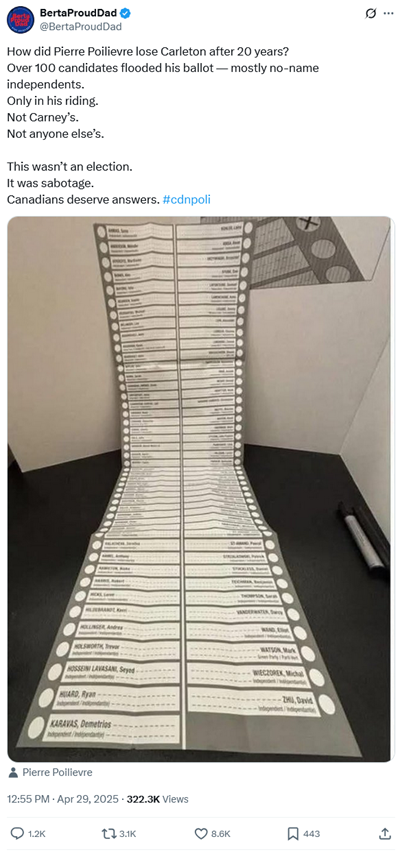
Pierre Poilievre’s riding had an insane number of protest candidates registered for the election. Oddly, the same wasn’t true in any other riding in the country. This was an organized protest for electoral reform, supposedly.

The Conservative opposition is now bound to have a difficult year, with their leader inexplicably, inexcusably ejected from the Commons. Dedicated haters of Pierre Poilievre won’t find anything at all inexplicable about the Carleton disaster, but there will need to be a proper autopsy. Especially since Poilievre’s party gathered more vote share nationally than any right-wing party — or combination thereof! — has achieved since the days of Mulroney.

Even in Ontario, Poilievre’s Conservatives got over a million more votes than the hyper-critical Ford PCs did in a provincial election 60 days earlier, and they are headed toward a higher vote share within the province. So is Poilievre a generational leader potentially on the brink of a dynasty, or an unloved boob who got caught flat-footed by a change in public mood? I promise you that the quarrelling over that question is well underway.

I assume the CPC will keep its unlucky leader, which leaves only the question, “So then what?” The Liberals don’t have to call a by-election until six months after someone decides to resign to make way for Poilievre. And maybe I ought to say “if someone decides”. It’s not essential for a party leader to have a Commons seat, but it would certainly be ideal, especially with the Commons hung.

The Conservatives are bound to find themselves adopting more of a team approach to the Opposition job by default, and maybe this ought to have been considered while it was still optional. Even by Canadian standards, the CPC campaign was very leader-focused, and was obviously predicated on the idea that the people really wanted Poilievre and would like him more as they saw more of him. (And, again, this may actually have happened!) Now there’s a chance the CPC’s House leadership performs well over the next year or so — and then has to fade into the wallpaper behind the guy who already lost.

April 29, 2025

Canadian federal election result

April 28, 2025

QotD: “Redpill poisoning”

Filed under: Media, Politics, Quotations, USA — Tags: , , — Nicholas @ 01:00

    Hunter Ash @ArtemisConsort
    There is a phenomenon I call redpill poisoning where someone sees through the establishment matrix, but then starts assuming the exact opposite of that narrative is always true. This oneshots a lot of smart people.

Absolutely. Among other things, I think this explains why a large minority of conservatives have become suckers for Russian propaganda about the Ukraine war.

I like your term “redpill poisoning” and will adopt it.

ESR, Twitter, 2025-01-25.

April 27, 2025

“[T]he practical reality of electoral politics throughout the west: the choice is between a Leftward Ho! party and a Ratchet party”

Filed under: Australia, Britain, Cancon, Media, Politics — Tags: , , — Nicholas @ 03:00

Mark Steyn on the steady leftward march of pretty much every western nation that never, ever stops and only rarely slows down:

A ratchet allows rotation in one direction, but prevents rotation in the other direction. That’s been a common explanation of most western governments for decades … leftward motion occurs, but can only be stopped, never reversed.

In a shrewd assessment of the current campaign Down Under, Paul Collits cites a certain “niche Canadian”:

    Mark Steyn says that we cannot vote our way out of the Western mess. The 2025 Australian election is living proof of the truth of his claim. Whoever wins here will inherit an unholy mess, and will not have the will to address it.

Of course, he could be talking about next week’s Canadian election or last month’s German election. As we have noted, Fred Merz, the incoming chancellor in Berlin, has yet to take office but what Americans call the honeymoon is over before the coalition has been officially pronounced man and wife. Hermann Binkert, head honcho of Germany’s INSA polling agency, says the country has never seen loss of approval on this scale between the election and the formation of the government. The so-called “far-right” AfD is now leading in multiple polls. Which would be super-exciting if voting hadn’t already taken place.

In America, the new administration certainly has the “will to address” the “unholy mess” but the Trumpian Gulliver is beset on all sides by District Court Lilliputians whose position is that what a Democrat president has done cannot “lawfully” be undone. This is a pseudo-“constitutional” recognition of the practical reality of electoral politics throughout the west: the choice is between a Leftward Ho! party and a Ratchet party. If the Left wins, they dissolve the border and trannify your kids. If the “Right” wins (Stephen Harper, Scott Morrison), they may pause some of the more obviously crazy stuff but they never actually reverse the direction of travel. Unless they’re the UK Tories (Cameron, May, Johnson, Sunak), in which case they stay in the leftie lane without even shifting down to third gear.

So “politics”, as increasingly narrowly defined, is less and less likely to save you. Because the gap between “politics” and reality grows ever wider. Consider the instructive example of one Hashem Abedi. Mr Abedi and his brother plotted the Ariana Grande concert bombing in Manchester. It was, from the Abedi viewpoint, a huge success: twenty-two dead, half of them kids, plus a thousand injured. It was a big deal at the time: lots of flowers, teddy bears, and heart-rending renditions of “Don’t Look Back in Anger”.

So you’d have thought even the British state would have at least pretended to take it seriously. Hashem Abedi was detained at His Majesty’s Pleasure, and under one of the three supposedly toughest prison regimes in England and Wales. Nevertheless, on April 12th he put three of his guards in hospital with what were described as “life-threatening injuries“. A fortnight later, two are still there. How did a maximum-security prisoner manage to do that? Well, he used boiling cooking oil and weaponised kitchen utensils.

So how did he get hold of boiling cooking oil? Was he a finalist for Maximum Security Masterchef? Ah, well. The details remain vague, and as usual the worthless UK media has shown not the slightest curiosity in how the Ariana Grande perp came close to bulking up his death toll by fifteen per cent.

April 8, 2025

Free trade, the once-and-future left wing cause

Let’s join Tim Worstall on a brief trip into economic history, when free trade was a pet issue for the left (because it helped the poor and the working class) and protectionism was the position of the right (because it helped the wealthy and the aristocracy):

The people who suffer here are the consumers in the US. The people who benefit are the capitalists in the US. Which is why free trade always has been a left wing position. True, many lefties in recent decades have somewhat strayed from the one true path but given that it’s Trump imposing them some seem to be coming back. Although how much of that is about TDS and how much about reality is still unknown.

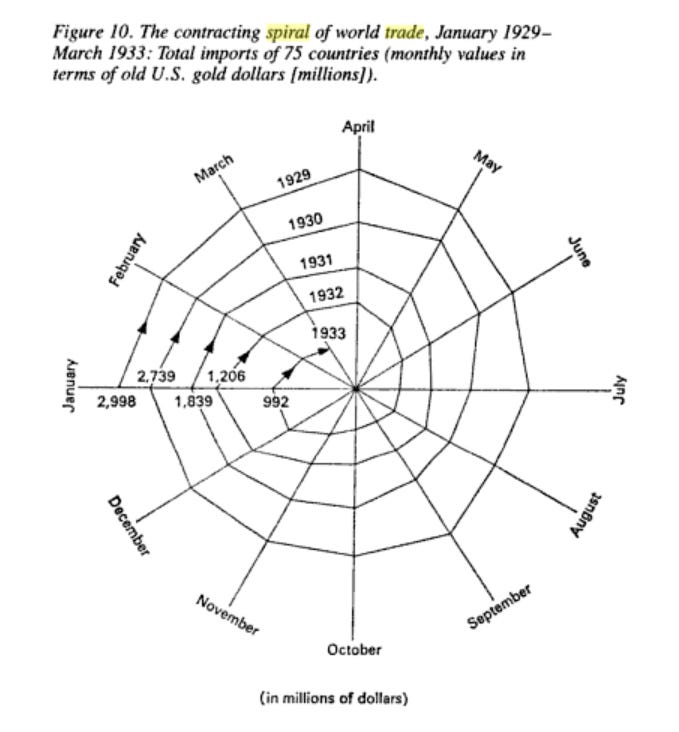
We’ve also got that little point about what happened last time around:

That all started with eggs. There’s fuss about eggs in the US at present. My, how history echoes, eh?

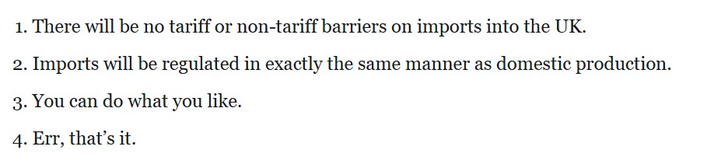
There’s only the one logical, moral or ethical position to have upon trade. As I’ve pointed out before with my model trade treaty:

Note that this applies to all ideas about tariffs — with the one exception of national security where we are indeed willing to give up direct economic benefit in order to keep the French at bay. To tariffs for industrial policy, tariffs for Green, tariffs for trade wars, tariffs as revenue raisers, tariffs, see?

We should remind ourselves that the opposition to Adam Smith and his ideas came from the conservatives. Cobden and the Manchester Liberals were the left wing betes noires of their day. The Guardian was actually set up as a newspaper to push their ideas including that dread free trade.

We did actually get free trade too, in 1846. Which, not by coincidence, is when the Engels Pause stopped happening. Which was, itself, the observation by Karl’s buddy that while the British economy had grown lots — industrialisation, capitalism, etc. — the living standards of the base people hadn’t, not very much. Of course, he was missing a bit — that ability to have a change of cotton underwear even for skivvies (aha, skivvies for skivvies even …) would only feel like an advance to those who had, previously, had to wear woollen knickers. This changed, living standards for the oiks began to rise, strongly, once we had free trade.

Now, there are a few of us still keepers of that sacred flame. But just to lay out the basic argument.

Average wages in an economy are determined by average productivity in that economy. Trade doesn’t, therefore, change wages — not nominal wages that is. Trade does change which jobs are done. That working out of comparative advantage means that we’ll do the things we’re — relative to our own abilities — less bad at and therefore are more productive at. Trade increases domestic productivity and thereby, in the second iteration, raises wages.

Trade also — obviously — gives us access to those things that J Foreigner is more productive at than we are — those things that are cheaper if Foreign, J, does them. This raises real wages again because we get more for our money. We’re better off. This is true whatever the tariffs our own exports face.

Finally, trade doesn’t affect the number of jobs in an economy — that’s determined by the balance of fiscal and monetary policy.

So, who benefits from trade restrictions? Well, the people who lose out from free trade are the domestic capitalists. Pre-1846 it was the still near feudal landlords in fact. What killed those grand aristocratic fortunes was not war nor tax — pace Piketty et al — it was free trade which destroyed agricultural rents.

The same is true today. The people who benefit from tariffs are the domestic capitalists who get to charge higher prices, make larger profits, as a result. The people who lose are all consumers plus, over time, all domestic workers as well. Tariffs increase the capitalist expropriation of the wages of the workers that is.

Tariffs are a right wing, neo-feudal, impoverishment of the people. Free trade is the ultimate leftypolicy to beat back the capitalists.

April 6, 2025

German democracy takes another blow as extremely extreme right pulls level with the extreme right!

Filed under: Germany, Media, Politics — Tags: , , , , — Nicholas @ 03:00

Despite the heroic efforts of the progressives in the Bundestag (and the media and in the EU bureaucracy), the dangerous demagogues of the extremely extreme extreme right AfD are now equally popular with those benighted, detested, dunderheaded “voters” as the almost-as-dangerous extreme right in the CDU:

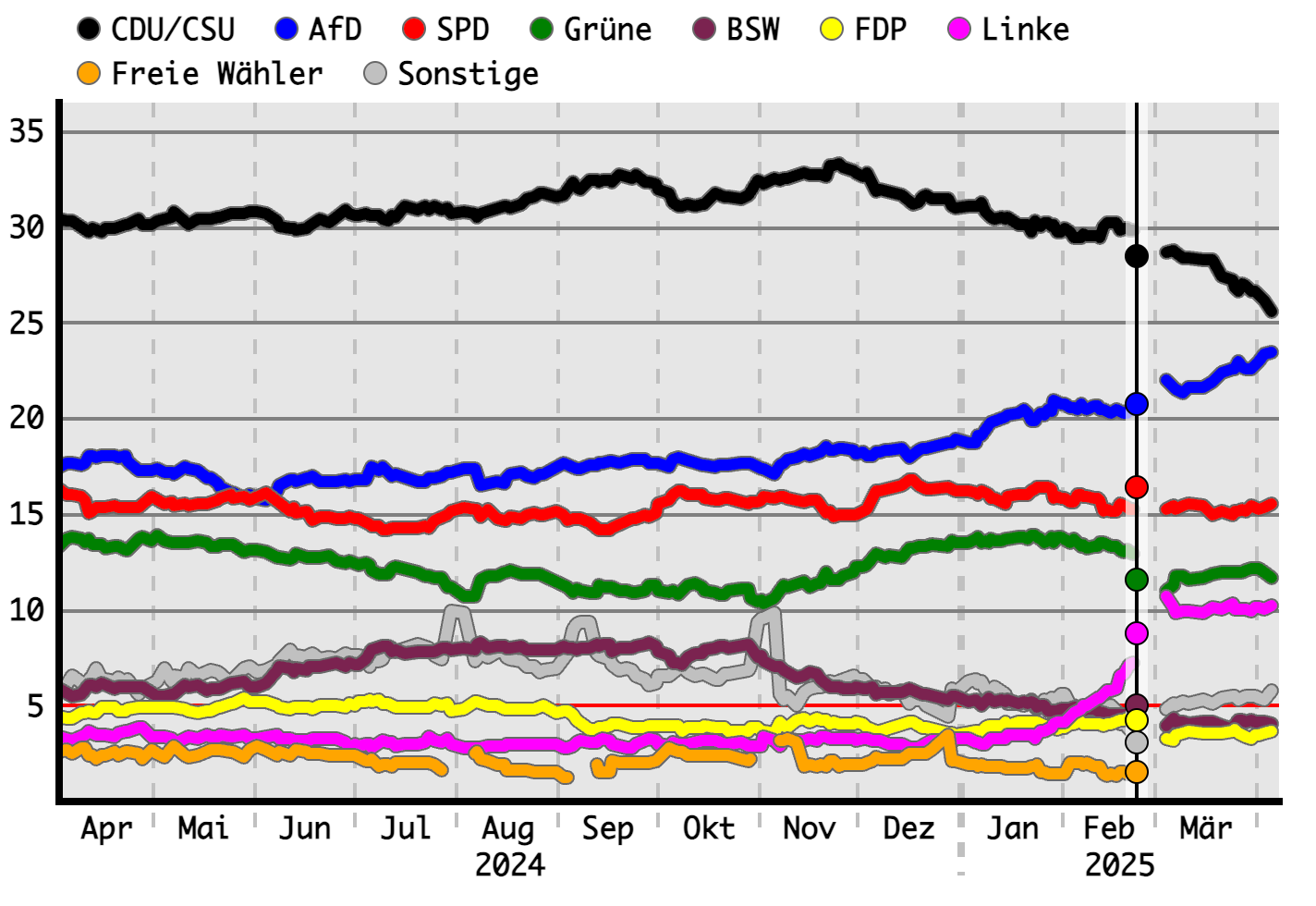
It has finally happened: Alternative für Deutschland are no longer the second-strongest party in Germany; for the first time ever, they have pulled dead-even with CDU/CSU in a representative poll. Both claim 24% support in the latest INSA survey, conducted for BILD between 31 March and 4 April. It is the strongest poll result the AfD have ever received.

The results are partly symbolic and well within the margin of error (2.9 percentage points), but the trend is clear, and nobody seriously doubts that in the coming weeks AfD will assume the lead and become the strongest-polling party across the Federal Republic.

The running average of all major polls – which lags a week or two but yields the clearest view possible of the trend – looks like this:

The Union parties have been experiencing a slow but steady collapse in support as their voters abandon them in ever greater numbers for their hated blue rival. The erosion began after Friedrich Merz struck a deal with the disgraced Social Democrats (SPD) to overhaul the debt brake with the outgoing Bundestag, contrary to one of his primary campaign promises. Everything we’ve heard about the disastrous coalition negotiations with the SPD in the weeks since have confirmed the image of a careless, inexperienced yet ambitious CDU chancellor candidate, desperate to ascend to the highest political office, whatever the cost. Back in 2018, Merz pledged he would cut support for the AfD in half and drive his party back to 40% supporter or higher. He has achieved very nearly the opposite, plunging his future government to the depths of unpopularity before it is even formed and ceding first place to his most hated rivals. It is a farce beyond what even I could’ve imagined.

There is no plan or strategy here; Merz has no idea what he is even doing. He and CDU/CSU leadership did have a brief flash of insight back in January, when they reached across the firewall to vote with the AfD on legislation to restrict migration. Back then at least, they knew they had to show the left parties they had other options, or they would be destroyed in coalition negotiations with any potential “democratic” partner. Leftist activists took to the streets and Merz rapidly retreated, returning to his standard denunciations of the AfD and pledging never to vote with them again. In return for a measure of mercy from Antifa, Merz voluntarily led his party into a trap, ceding all possible leverage over a radicalised SPD, who will force the Union parties to swallow one poison pill after the other. It is a win-win for them. They get what they want and they get to grind the CDU and the CSU to dust at the same.

The election might be over, but make no mistake – these poll results matter. First, collapsing support deprives the CDU options in the present. They can’t walk away from the negotiating table and seek new elections, because they know they’d come out of them vastly worse. Their terrible numbers further strengthen the negotiating position of the SPD, who will force the CDU to accept still more damaging compromises, driving CDU support even lower. Then we must remember that federal elections are not the only game in town. The rank-and-file of the CDU have to contend in an array of district elections in the coming months, and five state elections are approaching in 2026, including two in East Germany (Mecklenburg-Vorpommern and Sachsen-Anhalt) that may well end in the collapse of the firewall at the state level. Dissatisfaction with Merz inside the CDU is widespread and growing.

March 31, 2025

The infighting among the Conservatives is becoming a story in this election

Listening to Jen Gerson and Matt Gurney on The Line podcast a few days ago, I was surprised to hear that the Ontario Progressive Conservatives seem to be trying to actively torpedo the federal Conservative election campaign. While internecine combat among conservative factions is pretty normal, it isn’t quite as normal for it to be happening in the middle of a federal election campaign. It’s almost as if Ontario Premier Doug Ford’s team would rather throw the election to the Liberals than to let Pierre Poilievre’s team score a win. Some friction, sure, but this level of conflict is almost unheard of.

At Acceptable Views, Alexander Brown mulls the chatter he’s been hearing from the campaign trail:

“Something’s really going on here,” says word from on the ground in once-Liberal-safe Toronto.

“The polls say one thing, but we’ve never given out so many signs. We’ve had to print thousands more than usual.”

“We’re actually doing just fine,” says another source high up on the federal campaign trail.

“Don’t believe the chatter from disgruntled so-called conservatives … Nobody here is hanging up their skates. We’ve had a very good week — long days notwithstanding! — and are beginning to inflict solid brand damage on Carney.”

“The best is yet to come. We are running the campaign we should be running. One that’s true to conservative values and principles.”

On that “chatter”, this non-profit campaigner and writer has no qualms about going weapons-hot.

For those unaware, Ford-“conservative” insiders in Ontario have been taking to the media circuit, issuing complaint after complaint, as both anonymous and named sources, in an effort to pull the Conservatives off of major pocketbook issues such as immigration, housing, affordability, and crime, and on to, all but exclusively, Trump, Trump, Trump.

It matters to them not, apparently, that the Liberals have lucked into booby-trapping both sides of the Trump issue, and that it forces the Conservatives onto uneven terrain.

Drag this out and make it worse, as Carney has largely chosen to do? His elbows are up!

Get shoved around by the administration to the south? See, this is why he’s the one to deal with it. He’s Trump’s enemy!

(Apparently, it also matters not that Carney has received repeated pats on the head and quasi-endorsements from #45, and now, #47.)

The real story here? Allegedly embittered that they were left out of the war-room for reasons of not being all that conservative and being untrustworthy (a point they are now proving over and over again), and wanting to neglect a youth vote they were incapable of turning out, a select few in an Ontario crew think they know best, and would rather engage in public displays of industrial sabotage than keep it private and above the belt.

It’s a ridiculous little consultant slap-fight, at a time when 5000 people are standing out in the rain, to tell a man they don’t know that their Canadian Dream is now a nightmare, that they’re now drowning in debt and don’t feel hope for the future.

“These guys have no idea what they’re talking about. When this is all over, I hope they regret ever weighing in like this.”

For Doug Ford’s campaign manager Kory Teneycke, who has been working the Liberal podcast and media circuit the hardest, it might be worth noting that not every campaign has the advantage — nor indulgence — of being able to run on Liberal-lite and solely Trump.

The Ontario PCs were granted the easy road of being able to cut the corner to the polls in February, in an election no one asked for, while running Carney-adjacent messaging, and they still couldn’t pick up a seat against the worst Ontario Liberal leader of a generation.

The Line‘s Gerson and Gurney both seem quite taken with the attacks on Poilievre by Ford’s right-hand spokes-hatchetman, but others are reporting lots of enthusiasm on the campaign trail and contrasting it with Carney’s handlers deliberately keeping the PM away from the press as much as they can.

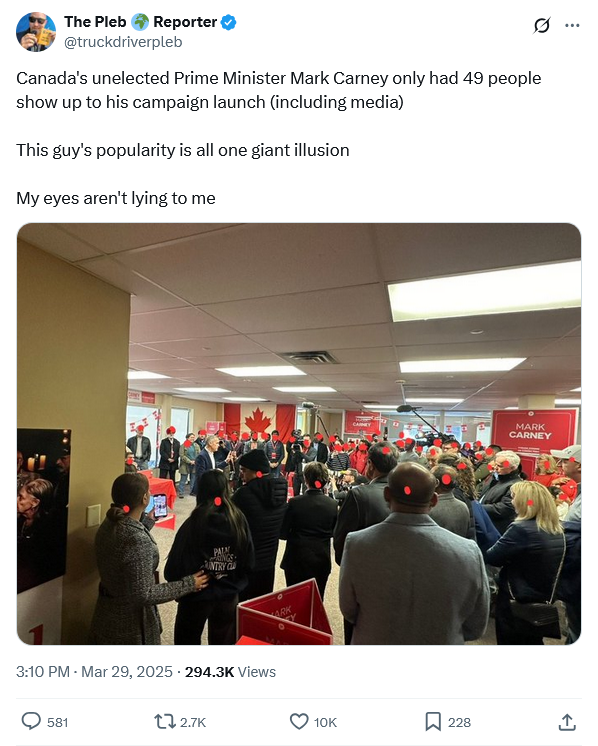
The numbers of people who show up to political events isn’t a dependable metric, but if the disproportion gets to the point that you’re able to hand-count the number of supporters at a given venue, it might be a useful bit of anecdata:

March 30, 2025

The Conservatives “must perform all kinds of popular pantomimes, hide their conservative values, and they cannot act on principle”

Filed under: Cancon, Media, Politics — Tags: , , — Nicholas @ 03:00

James Pew on the trouble Canada’s Conservatives and right wing parties across the western world face in trying to get elected:

Trump vs. Poilievre
Image by Grok

“Knock it off.” That is Poilievre’s message to Trump concerning the so-called “trade war”. Honestly, I think Poilievre should take his own advice. I don’t think he can though. Rightwing parties, in all Western nations, with the sole exception of the U.S., are strategically unable to be honest. They must perform all kinds of popular pantomimes, hide their conservative values, and they cannot act on principle. Not if they want to win in general elections. In the current Canadian election, you absolutely must be seen as adversarial to Trump if you are to have a hope in hell of winning.

While someone like me, who is constantly yelling at the radio, or the newspapers, when I read or hear about the stupidity that passes for political analysis in mainstream Canada, would love a principled leader (like Maxime Bernier) to tell it like it is, to stick to conservative values, to defend the traditions of the Western world, this is just not going to happen anytime soon in Canada.

Let me take this opportunity to dress down the entire edifice of Canadian elites. The ones of today and of the past half-dozen decades. From the business leaders, to politicians (including Poilievre), to the media (the absolute worst), they have all shown that principles are not something they prioritize. I’m not even sure if the majority of Canadians care. I know readers of this newsletter do, but there aren’t enough of us. The country is literally full of low-information, unprincipled partisans. Many are unstable emotional wrecks. Things that should be approached logically, sensibly and analytically, are almost always treated instead with histrionics.

What responsibility does the media (Canadian, American, and other media around the world) hold for both creating and escalating what should more accurately be considered trade negotiations, maybe even a trade dispute, not “trade war”!? This is exactly what Trump wants (at least I think it is, there is no way to really know). He is a master provocateur. He is playing the media, and as a consequence, the public too. The media are reacting in the way Trump and everyone else expects. I think far too many of us secretly love the drama; things are getting exciting, instead of boring as usual. The whole mess, which really should be a major bore of a story involving trade policy wonks, diplomats and business leaders, has been artificially amplified and exaggerated into an existential economic crisis. Pearl-clutching on the fainting couch has been the anticipated response of literally all involved, most importantly, Trump himself (again, this is little more than an educated guess). And the public eats it up (no guessing about that).

All of this is not to insincerely or callously downplay the very serious implications on Canadian businesses and workers. I absolutely put Canada first. Although, I see no sense in engaging in anything that can be construed as a “war”, against a nation we rely on economically and that protects us militarily in a world that grows more hostile by the day. It is the Chinese Communist Party and expansionist Islam whom I see as existential threats to Canadians (and the West). And, while I do not agree with or appreciate Trump’s rhetoric and actions towards Canada one bit, I cannot help pondering the situation Canada’s past leaders have placed us in, which makes us utterly reliant on American economic and military strength — is that not our own fault? Everything Trump is doing in the world, or at least everything he thinks he is doing, is meant to bolster the two things Canada relies on most: the American economy and military. This reality makes Canadian fightin’ words directed at America ring hollow.

Paradoxically, since the failure of Canada’s elites has rendered the country unable to stand on its own, anything Trump can do to strengthen America (including hurting Canada unfortunately) is in Canada’s overall best interests. What a tragic circumstance for any sovereign nation to find itself in. This would not have been the case, if over the lost Trudeau decade, and many decades before that, the country had been led by nation-builders engaged in ambitious nation-building. In the modern period, we have failed at nation-building. Maybe not miserably, but the overall effort has been inadequate. The post-national era of Trudeau being the height of this failure, and the absolute depths of our current despair. And now, sadly, pathetically, we are at the mercy of the orange one.

March 3, 2025

QotD: Arguments around “spontaneous order” and “divine intervention”

Filed under: Economics, Quotations, Religion — Tags: , , — Nicholas @ 01:00

A libertarian economist I read fairly often once noted that he found it interesting that many people on the political left who believe in natural selection without any kind of guidance cannot accept the idea that economical order can arise without their guidance. And, likewise, many on the right are completely comfortable with spontaneous order in free markets but can’t conceive of it in the natural world.

It seems to me that this is a bit like the old “irresistible force versus immovable object” paradox. On the one hand, the universe, life, human life, seem impossibly complex to have happened randomly. On the other hand, the universe is actually very large. Perhaps there are enough monkeys banging away at typewriters to produce not just Shakespeare, but the script of every Seinfeld episode.

Esteban, “Evolution, Economies And Spontaneous Order”, Continental Telegraph, 2020-01-22.

February 4, 2025

QotD: The American political spectrum

I tend to think of the American political spectrum as broadly dividing into six major groups (political “tribes” we might say), arranged very roughly from left to right, though I must note that there are serious differences within tribes as much as between them. Going left-to-right, there is first (1) The Left, who are the sort of left-leaning folks who get upset if you call them liberals and are committed to more aggressive forms of socialism that envision and end to or massive curtailment of things like markets. Your actual Marxists go here. Then moving right there are (2) Progressives, who are generally committed to liberalism as a philosophy, but favor large-scale government intervention inside that framework to reshape society (“progressivism”), which they believe can be reshaped for the better. Bernie Sanders, Elizabeth Warren and AOC go here; some of these folks will call themselves social democrats, evoking the form of this ideology in Europe. Then you have (3) Left-Liberals (“Social Liberals”), who have the same ideological components as the progressives (progressivism+liberalism), but with an inversion of the emphasis, where the individual liberty claim of liberalism is the dominant strain over the society-reshaping goals of progressivism. This is where the mainstream and especially moderate wings of the Democratic party sits.

Then on the right you have (4) Right-liberals (“Classical liberals”), who share liberalism with groups (2) and (3) but reject (or at least substantially challenge) the idea that society can be “engineered” with positive results. This group largely left the Republican party between 2016 and the present (though some were already libertarians). Notably, (3) and (4) in the United States tend to share hawkish anti-authoritarian, anti-communist foreign policy views; this is where the foreign policy “blob” lives. To their right are (5) Traditionalist Conservatives. Because the United States was founded as a liberal country, they tend to still hold some liberal views (and respond well to liberal, “freedom-centered” framing) but their main ideological commitment is generally conservative in its literal meaning of being traditionalist, desiring things to not change or to recover that which has changed and there is a willingness to compromise on liberalism in the pursuit of that. This, I’d argue, is where the core of the Republican Party currently exists. Finally, you have (6) Right-Authoritarians, who come in various forms based on the authority they believe ought to structure society, e.g. populist authoritarians are fascists, whereas Catholic religious authoritarians are integralists and so on. But the core idea here is that there exists an authority, be it the “national will” (invariably channeled by an individual charismatic leader and often herrenvolk in nature) or tradition or the church or whatever else, which has a right to structure society which supersedes individual liberties. For our purposes, they key is they generally despise liberalism because it places limits on that authority. They tend to insist that liberalism makes societies weak even as liberal societies pound their favorite dictators into dust over and over again.

To put the spectrum another way, we might think in terms of publications: Jacobin (1) <-> Vox (2) <-> The Atlantic (3) <-> The Bulwark/Dispatch (4) <-> National Review (5); few major publications openly identify as being in (6) in the United States, but you can see editors at The Federalist or First Things platform political visions that [derive] from it. To the degree to which “horse-shoe theory” works it is because the thing that The Left and the Right-Authoritarians have in common is that they believe in an effectively unlimited claim on the individual by the community, whereas the core of liberal ideology is that the social claim on the individual is and must be limited.

Bret Devereaux, In a footnote to “Collections: The Philosophy of Liberty – On Liberalism”, A Collection of Unmitigated Pedantry, 2024-07-05.

December 13, 2024

Kemi Badenoch … a Thatcher for the 2020s?

Filed under: Britain, Media, Politics — Tags: , , , , — Nicholas @ 05:00

In The Free Press, Oliver Wiseman wonders if new British Conservative Party leader Kemi Badenoch will do for her party what Margaret Thatcher did after she was elected leader in 1975:

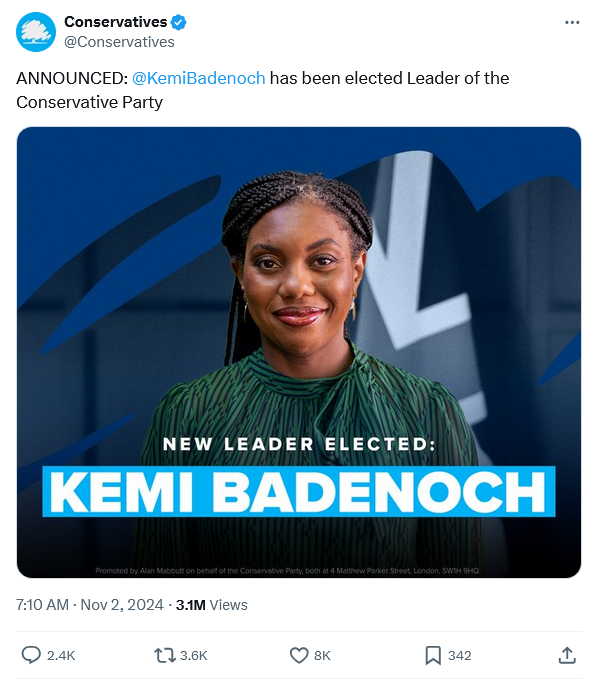
“I like fixing things that are broken,” says Kemi Badenoch in her interview with Bari on the latest episode of Honestly. Badenoch, 44, was elected as the new leader of the UK’s Conservatives last month. And luckily for her, there are a lot of things that are broken.

One of them is her party.

In July, after fourteen years in office, the Tories were unceremoniously booted from power. They lost more than 250 of their Members of Parliament in the biggest electoral defeat in the party’s history. On the long road back to power, Badenoch must contend not only with a Labour government with a huge majority in Parliament, but also Nigel Farage — the Brexit-backing populist is on a mission to supplant the Conservative Party as the main alternative to Labour.

If Badenoch somehow manages to fix her party and return to power, she must then figure out a way to fix Britain — a country where wages have stagnated for a generation, public debt has ballooned, and there’s widespread anger at high rates of immigration. As another Brit, Free Press columnist Niall Ferguson, put it recently in these pages: “Lately it seems that mine is a country with a death wish.” (Read his full account of what ails the UK here.)

In other words, Badenoch has a daunting in tray. And yet many — including Niall — are bullish on Badenoch, who he believes could be a “black Thatcher”.

As a woman in charge of the Conservative Party, Badenoch was bound to be compared to the Iron Lady. But in this case there are undeniable parallels. Much like Thatcher, Badenoch mixes steely determination with charm and charisma. She also, like Thatcher, knows what she believes. Her diagnosis of her party’s problems is straightforward: It has strayed too far from the values that have historically made it — and Britain — so successful.

And while Thatcher and Badenoch’s backgrounds are very different — one grew up in provincial England, the other spent most of her childhood in Nigeria — they are both self-made women with an appetite for hard work. Badenoch’s own story, and her family’s, is central to her politics. “I know what it is like to be wealthy and also to be poor,” she says today on Honestly.

There’s one other Badenoch–Thatcher parallel: the circumstances in which they took over their party’s leadership. Thatcher became Tory leader in 1975 — then, like today, a malaise had descended over the country, one that would lift during her time in office. These comparisons may be unavoidable, but does Badenoch welcome them? Bari asked her that in their conversation. “She is a heroine of mine. So it’s very flattering,” said Badenoch. “But it’s also quite heavy and she’s a different person. I admire her. But I want people to recognize that I’m not a pastiche of this person, that I am my own person.”

November 3, 2024

Kemi Badenoch replaces Rishi Sunak as UK Conservative leader

In the National Post, Michael Murphy discusses the new British Tory leader and why she could be a viable challenger to Two-tier Keir’s Labour government:
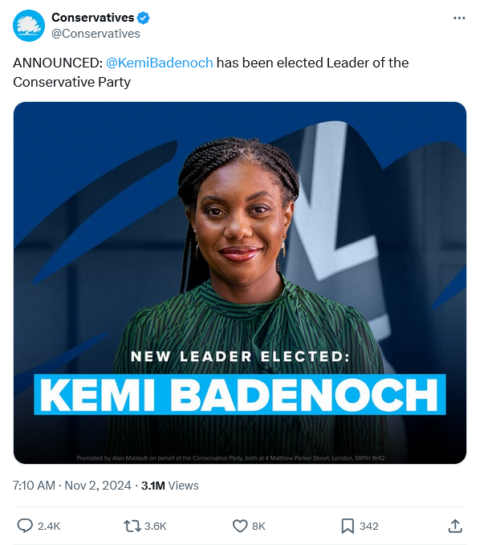
… in July, the Tories were ousted by Labour after 14 years in power, limping on with only 121 seats in the 650 seat House of Commons. But the honeymoon period for Sir Keir Starmer’s Labour government ended almost immediately, as its popularity plummeted faster than that of any administration in recent memory. This has made the Tories interesting once again at precisely the moment when they’ve chosen a new leader: Kemi Badenoch.

The Nigerian-raised mother of three, elected today to lead the Conservative party, threatens to be kryptonite for a Labour party wedded to identity politics. A black, female immigrant at the dispatch box is apt to leave Labour frontbenchers — particularly Sir Keir, a one-time BLM kneeler — somewhat stumped. To make matters worse, Badenoch is a persuasive speaker, commanding a charisma and eloquence that Sir Keir — a dull, po-faced lawyer — does not possess.

These qualities have given Badenoch cross-party appeal within the Tories, rallying endorsements from both the left and right. By endorsing her, however, the party has effectively signed a blank cheque, as Badenoch, unlike her opponents, has made few specific pledges. She has chosen instead to reflect on the election loss and the party’s ideological roots; she is prepared to play the long game, hoping this will allow the Tories to “earn back trust”.

On some issues, though, Badenoch is clear. “The government is doing far too much and it is not doing any of it well — and it is growing and growing,” she declared recently. “The state is too big; we need to make sure there is more personal responsibility.” These ideas are common fare among Conservatives, especially in bloated welfare states like Britain — but her zeal for them evokes, for many, memories of Margaret Thatcher. As the political commentator Simon Heffer wrote, “Mrs Badenoch is the politician who most reminds me of Mrs Thatcher since I last saw Mrs Thatcher”. He noted both women’s hard-mindedness, “deep principles”, and grasp of the “art of the possible”.

Badenoch’s Conservatism can be traced, as the writer Tom Mctague has argued elsewhere, to her beginnings in Africa. Having fled Nigeria during a 1996 military coup, she has a keen, outsider’s appreciation for Britain’s core ideals — not least the rule of law and policing by consent. She is therefore a champion of Britain, of both “the good” and “bad” of its former empire, at a time when it is fashionable to denigrate it, precisely because of her first hand experience that these norms are rare and fragile.

Like Thatcher, Badenoch studied a hard science (computing), marking them out in a Parliament filled with lawyers and humanities graduates. And the swift rise of both women, from modest beginnings through the ranks of the Conservative party, suggests that the “art of the possible” is indeed etched into their stars.

The Armchair General has a few suggestions for Badenoch’s agenda to turn the British economy around:

The new leader of the Conservative Party (image: www.kemibadenoch.org.uk)

My one reservation [about Badenoch] was that, being a software engineer, instead of espousing liberty or slashing laws and regulations, Kemi might reach for more tinkering technocratic solutions — and your humble General is surely not alone in his opinion that we have had quite enough, thank you, of technocratic governments.

However, the more that I consider the severe problems that afflict this country, the more I believe that a process-driven leader, who can focus on the details, might make the biggest difference in the short to medium term.

The immigration issue

As we know, uncontrolled immigration has seized the public imagination greatly — and, indeed, Jenrick centred his campaign around leaving the European Convention on Human Rights (ECHR). We should almost certainly do this anyway — simply because, like the Americans, we should refuse to sign any treaties that raises foreign courts above our own Parliament.

But leaving that aside, the stated problems with mass immigration can largely be divided into two halves:

  • cultural differences — these are not insignificant, and it is claimed that they lead to an increase in crime (especially sexual crimes) and an undermining of our high-trust society;
  • economic issues — the evidence shows that a massive net influx of low-skilled immigrants depresses wages at the lower end, puts a strain on public services (which cannot expand swiftly enough to accommodate the increase in demand), raises the demand for houses (of which there is a shortage) and thus pushes up prices, and, ultimately, only increases nominal GDP whilst per capita GDP has barely shifted in a decade and a half.

For the purposes of this post, I shall address only the latter issue; given where we are right now, the former is a much thornier problem — at least politically — and probably cannot be solved without radical (and some might say “authoritarian”) action.

The second problem is easier to solve because it is caused, essentially, by the single biggest drag on our economy — our planning system.

[…]

Planning: the Conservatives’ political agenda

The core of the new Conservative manifesto must be a growth agenda; it needs to set out the following core principles:

  1. if we carry on the current trajectory, the British government will be effectively bankrupt in the next 50 years — so something needs to change;
  2. therefore, in order to pay for all the goodies that we have promised ourselves (now and in the future), we need to massively accelerate economic growth;
  3. unless we can build the roads, railways, power stations, research labs, data centres, and homes that we need, then our economy will not grow at the required rate — and spending will need to be cut to the bone;
  4. given the above, the only way to grow is to reform planning laws;
  5. removing the barriers to building will lead to greater investment, lower energy prices (leading to even greater investment), greater social mobility, regeneration of all the regions (so-called “levelling up”), and vast increases in per capita GDP;
  6. where the state invests in infrastructure, then it will cost considerably less than it does currently — meaning that not only will those projects undertaken provide more value for money, but also that many more projects will be viable;
  7. this prosperity and increased mobility will remove even the perceived need for immigrants to perform low-wage jobs (including in our public services), and remove the economic pressures of those that we have already taken in;1
  8. if we do it right, then we will also be able to cut taxes without drastically cutting the size of the state.2

The argument needs to be as stark and inevitable as that.

What this means is that the Conservatives need not stand on a platform of slashing state spending — thus addressing the huge numbers of people in this country who, incredibly, still believe in the benevolent state.

Except for one caveat, there really is no downside to adopting Foundations [discussed here], in full, as the core of the next Conservative manifesto (although it should not be the full extent of said manifesto — there are many other areas that need to be addressed, which I shall write about later).


    1. As I say, the cultural issues are for another time.

    2. Obviously, as a classical liberal, I believe that the size of the state should be drastically cut — but this is not a popular argument in a country that has been raised and educated on socialist doctrine for decades.

October 17, 2024

Democratic Germany considers banning 2nd-largest political party “to save democracy” of course

Filed under: Germany, Government, Media, Politics — Tags: , , , , , — Nicholas @ 05:00

It’s totally a normal democratic urge to try to outlaw the second-largest political party in Germany and not in the least bit “authoritarian”, right?

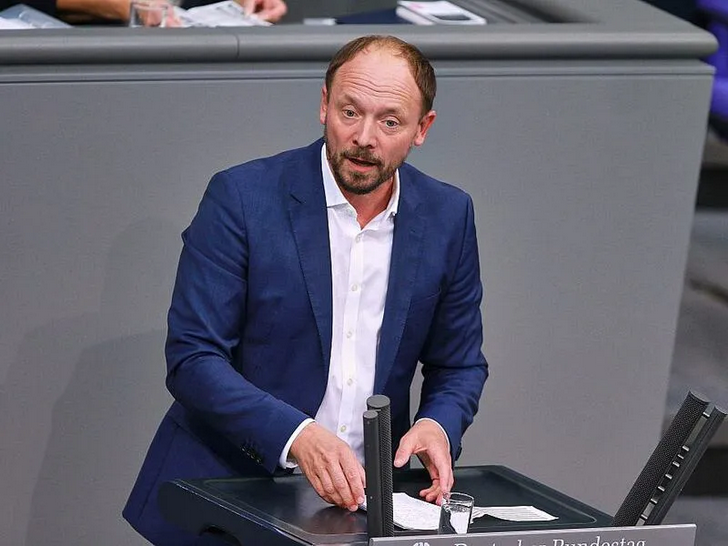
This man is named Marco Wanderwitz. He is a member of the nominally centre-right Christian Democratic Union, and he’s been in the German Bundestag – our federal parliament – since 2002. He reached perhaps the apex of his career late in the era of Angela Merkel, when he was made Parliamentary State Secretary for East Germany. Wanderwitz has been complaining about Alternative für Deutschland for years, and his screeching only gained in volume and shrillness after he lost his direct mandate in the last federal election to Mike Moncsek, his AfD rival. Above all, Wanderwitz wants to ban the AfD, and he has finally gathered enough support to bring the whole question before the Bundestag. Thus we will be treated to eminently democratic debate about how we must defend democracy by prohibiting the second-strongest-polling party in the Federal Republic.

Now, I try not to do unnecessary drama here at the plague chronicle, so I must tell you straightaway that this won’t go anywhere. Even were the Bundestag to approve a ban, which it won’t, the whole matter would end up before the Federal Constitutional Court in Karlsruhe, where I suspect it would fail in any case. Basically, the AfD are accumulating popular support faster than our ruling cartel parties can summon their collective will for overtly authoritarian interventions, and as long as this dynamic continues, the AfD will scrape by.

A great many influential people nevertheless really, really want to outlaw the opposition and effectively disenfranchise 20% of the German electorate. Our journalistic luminaries in particular have become deeply radicalised over the past three years. They got everything they ever wanted in the form of our present Social Democrat- and Green-dominated government, only to have their political dream turn into an enormous steaming pile of shit. Because the establishment parties, including the CDU, have no answers to the crises besetting Germany, they have had to watch popular support for the AfD grow and grow. All their carefully curated talkshow tut-tutting, all their artfully coordinated diatribes about “right wing extremism”, all their transparently hostile reporting, has done nothing to reverse the trend. If establishment journalists were running the show, the AfD would’ve long been banned and many of their politicians would be in prison.

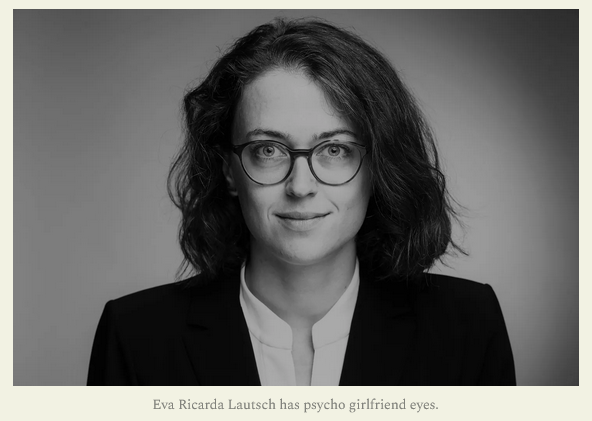
Today, Germany’s largest newsweekly, Die Zeit, has published a long piece by political editor Eva Ricarda Lautsch, in which she explains to 1.95 millions readers exactly why “banning the AfD is overdue“. The views she expresses are absolutely commonplace among elite German urbanites, and for this reason alone the article is sobering.

Let’s read it together.

Lautsch is disquieted that many in the Bundestag fear banning the AfD is “too risky”, “too soon” and “simply undemocratic”, and that “the necessary political momentum is not materialising”.

    The problem … is not the lack of occasions for banning the AfD. Sayings like “We will hunt them down,” Sturmabteilung slogans, deportation fantasies: we have long since become accustomed to their constant rabble-rousing. And this is to say nothing of the most recent and particularly shocking occasion – the disastrous opening session of the Thuringian state parliament a week ago, in which an AfD senior president was able to effectively suspend parliamentary business for hours. Those with enough power to generate momentum don’t have to wait for it; what is missing across the parties is political courage.

What really distinguishes Lautsch’s article (and mainstream discussion about the AfD in general) is the constant grasping after reasons that the party is bad and unconstitutional, and the failure ever to deliver anything convincing. That “we will hunt them down” line comes from a speech the AfD politician Alexander Gauland gave in 2017, after his party entered the Bundestag with 12.6% of the vote for the first time. As even BILD reported, he meant that the AfD would take a hard, confrontational line against the establishment. He was not promising that AfD representatives would literally hunt down Angela Merkel, although the quote immediately entered the canonical list of evil AfD statements and has been repeated thousands of times by hack journalists ever since. As for the “Sturmabteilung slogans“, the “deportation fantasies” and the “opening session of the Thuringian state parliament” – I’ve covered all of that here at the plague chronicle. They are lies and frivolities, and what’s more, they are so obviously lies and frivolities that it is impossible to believe even Lautsch thinks very much of them. These are things that low-information readers of Die Zeit are supposed to find convincing; they aren’t real reasons.

October 9, 2024

QotD: The hijacking of the Canadian identity

The anniversary of that first May 27, 2021 unmarked-graves announcement came and went a few weeks ago, with barely a peep from prominent figures in the Canadian progressive firmament. And the same Trudeau who’d recently served up lurid sermons about our status as a blood-stained genocide state has now switched into proto-campaign mode, gushing manically about the Liberal horn of plenty set to deluge this nation with riches. According to the latest Liberal agitprop, in fact, patriotic Trudeauvian boosterism isn’t merely permissible — why, it’s obligatory. So light up those Canada Day backyard barbecues. Canuck Yom Kippur is finally over.

But before we dismiss this three-year interregnum as a dystopian fever dream, it’s worth asking how our collective Canadian identity could be hijacked — even temporarily — in such a radicalized manner. And the truth is that it isn’t just progressive ideologues who bear responsibility; but also their counterparts on all parts of the political spectrum, few of whom exhibited any inclination to offer pushback while these falsehoods took root in the media. Even many writers at this newspaper, generally held to be a right-leaning outlet, greeted the unmarked-graves claims by heaping shame on their country.

In every other comparably advanced society, there exists a natural tension between conservative nationalists who reverentially sentimentalize their history, and the progressive critics who reflexively denounce it. And it is from out of that tension that something approaching the historical truth emerges. Or, at least something close enough to the historical truth that it provides a stable and coherent basis upon which a society can confidently pin its collectively embraced national identity.

What we learned in 2021 is that this necessary tension doesn’t exist in Canada, because traditionalists can no longer describe their nation’s history in a way that gives voice to their emotionally felt patriotism without attracting claims of racism and neocolonialism. As a result, our marketplace of ideas lacks the checks and balances required to inure us against — oh, gee, I don’t know, let’s take a crazy example — apocalyptic medieval fables in which legions of Indigenous children are thrown into furnaces and shallow graves by cackling nuns and diabolical priests.

So yes, shame on Trudeau for lowering the Canadian flag on federal buildings for half a year to honour victims entombed in non-existent mass graves. But shame on the rest of us for staring at our shoes while this blood libel was being signal-boosted. And now that Trudeau seems on his way out — and, with him, the maudlin, tear-soaked, bent-knee political shtick that accompanied this descent into hysteria — we might turn our attention toward developing a national self-identity sufficiently robust that it doesn’t fall to pieces the next time someone claims to have found genocide’s residue under an old tetherball court.

Jonathan Kay, “Don’t let politicians misinform you. Learn about Canada’s true history for yourself”, National Post, 2024-07-01.

October 8, 2024

Young Canadians turn right – “the average Canadian 21-year-old is more conservative than the average Canadian 65-year-old”

Filed under: Cancon, Media, Politics — Tags: , , — Nicholas @ 03:00

I don’t have a lot of contact with twenty-somethings, as my son’s friends are now in their 30s, so I’m just as surprised as anyone else to hear that younger Canadian voters seem to be switching their preferences to the right unlike most young voters around the world:

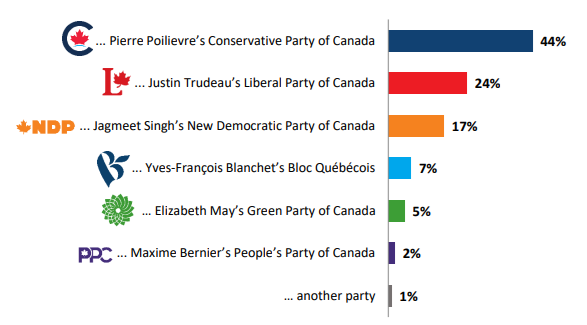
Voting intentions among Canadians, September 2024.
Detail from a recent Leger poll.

In one of the more surreal twists of sky-high Canadian public dissatisfaction, the country now ranks as one of the world’s only places in which young people are supporting conservative parties at rates well beyond those of their parents.

A Leger poll from last month found that Conservative support was stronger among voters aged 18-34 than any other age cohort. The under-34s backed the Tories by 47 per cent, as compared to 45 per cent for those aged 35-54, and 41 per cent for voters over 55.

The phenomenon has also started to show up at the provincial level. With about two weeks to go until the B.C. election, the B.C. Conservatives have been put in sight of a majority government due largely to an unexpected wave of youth support.

According to a Sept. 30 Leger poll, voters under 34 were backing the B.C. Conservatives by 47 per cent as compared to the 39 per cent who intended to vote NDP. Among voters over 55, the allegiances were reversed: 48 per cent supported the NDP against 43 per cent for the Conservatives.

Nothing like this has really happened before — at least as long as Canada has had age-stratified opinion polling.

It’s not the first time that a majority of young voters have flocked to a conservative option. The Progressive Conservative landslides of 1958 and 1984 were both secured in part by winning over voters under 30.

But what’s happening now appears to be the first time that the average Canadian 21-year-old is more conservative than the average Canadian 65-year-old.

For now, at least, the phenomenon is somewhat unique to Canada. In the rest of the Anglosphere, political sentiments are still hewing to their traditional pattern of young people leaning progressive, with old people leaning conservative.

The current U.S. presidential election has Democratic candidate Kamala Harris commanding up to 60 per cent of the under-30 vote, as compared to roughly one third of young voters who said they would vote for Republican nominee Donald Trump.

In the U.K., the July general election found that support for right-wing options was directly proportional to the age of the voter. A mere 17 per cent of British voters under 24 voted either for the Conservatives or the populist Reform UK. Among Brits over 70, those same parties commanded a smashing 61 per cent.

In Australia, a recent YouGov poll asking voters if they wanted “more socialism” found that 53 per cent of Australians under 24 did.

« Newer PostsOlder Posts »

Powered by WordPress