
The whole modern world has divided itself into Conservatives and Progressives. The business of Progressives is to go on making mistakes. The business of Conservatives is to prevent mistakes from being corrected. Even when the revolutionist might himself repent of his revolution, the traditionalist is already defending it as part of his tradition. Thus we have two great types — the advanced person who rushes us into ruin, and the retrospective person who admires the ruins. He admires them especially by moonlight, not to say moonshine. Each new blunder of the progressive or prig becomes instantly a legend of immemorial antiquity for the snob. This is called the balance, or mutual check, in our Constitution.
G.K. Chesterton, Illustrated London News, 1924-04-19
April 3, 2013
QotD: Conservatives and Progressives
March 10, 2013
British Tories float the notion of leaving the European Convention on Human Rights
It’s not a declared aim — yet — but when a senior government minister even mentions this as an option, you have to assume it’s being discussed:
The Conservatives would consider leaving the European Convention on Human Rights if they won the 2015 election, the home secretary has said.
Theresa May told an event organised by the ConservativeHome site the party would also scrap the Human Rights Act.
She said it restricted the UK’s ability “to act in the national interest”.
A private poll by ex-party treasurer Lord Ashcroft, meanwhile, suggested the party would lose 93 marginal seats to Labour if the election was held now.
The BBC understands Mrs May was putting forward ideas for the next Conservative manifesto, and such a move was not current government policy.
[. . .]
Mrs May told the gathering she was sceptical whether the convention limited human rights abuses in other countries and suggested it restricted Britain’s ability to act in its own interests.
“When Strasbourg constantly moves the goalposts and prevents the deportation of dangerous men like Abu Qatada, we have to ask ourselves, to what end are we signatories to the convention?” she said.
“Are we really limiting human rights abuses in other countries? I’m sceptical.”
She said that “by 2015, we’ll need a plan for dealing with the European Court of Human Rights”.
“And yes, I want to be clear that all options — including leaving the convention altogether — should be on the table.”
November 10, 2012
“We’re here, we’re queer, and that shouldn’t really matter”
A profile of Conservative activist Roy Eappen:
You’re not really gay.
That’s a phrase that Roy Eappen hears quite a bit.
“I’m a gay Tory. That’s apparently not acceptable,” he says between giggles. “I find it kind of funny.”
Eappen is a bit of a curious case. Indian by birth, he now lives in Quebec, where he splits his time between advocating for a new centre-right consensus in the province, stumping for the federal Conservatives and hobnobbing with Republican heavyweights down south. A quick Google search will turn up pictures of Eappen alongside George W Bush, Newt Gingrich and Paul Ryan.
But he’s becoming increasingly known for his parties.
Recently, Eappen was in Tampa for the Republican National Convention, where he helped organize for conservative gay group GOProud. Before that, he started the Fabulous Blue Tent party for the Conservative convention here in Canada. “It’s a funny little secret that Tory parties all over the world are full of gay people,” he says.
Eappen’s recent 800-person party in Ottawa was met with accolades and positive reviews from partygoers and pundits. It attracted Foreign Affairs Minister John Baird, Citizenship and Immigration Minister Jason Kenney and MP Rick Dykstra, as well as staffers from all parties. Even Laureen Harper was supposed to come, but she couldn’t make it.
He laughs again. “She’s an Evangelical Christian, and she’s cool with us.”
September 22, 2012
“I can no longer shock [conservatives] when I tell them I’m gay – but I can shock gay people when I tell them I’m Conservative”
Of all the political changes you might have expected to see in Canada, having Stephen Harper’s Conservatives become pro-LGBT must be one of the least likely:
A mere seven years ago, the Tories were famously the opponents of same sex marriage. Now, the Harper Conservatives freely push gay rights abroad and even host an annual gathering of gay Tories. While they remain the favourite punching bag for Canadian LGBT activists, have the Harper Tories become unlikely warriors for gay rights?
“I can no longer shock people in the conservative movement when I tell them I’m gay – but I can shock gay people when I tell them I’m Conservative,” said Fred Litwin, and former vice-president of the Ottawa Centre Conservatives.
In June, Mr. Litwin was one of the organizers of the Fabulous Blue Tent Party, a gathering of approximately 800 gay Conservatives at Ottawa’s Westin Hotel that went until 3 a.m.
[. . .]
“It’s no secret that the Conservative Party hasn’t always been the biggest champion of gay rights, but public pressure, and quite frankly, society evolving has changed their views,” said Jamie Ellerton, an openly gay former staffer for Mr. Kenney.
“The Conservative Party, like the rest of society, has moved to be more supportive of gay rights in recent years, and I see that trend continuing,” he said.
[. . .]
After the 2011 suicide of gay Ottawa teen Jamie Hubley, Mr. Baird told the House that homophobia has no place in Canadian schools, and then appeared with other Tory MPs in a video for the “It Gets Better Project,” an online campaign looking to curb the disproportionately high suicide rates among LGBT youth.
In June, members of the Tory caucus even came to the rescue of a transgendered rights bill put forward by NDP MP Randall Garrison. Promising to protect transgender people under the Canadian Human Rights Act and make anti-transgender violence a hate crime, the bill passed second reading thanks to the support of 15 Conservative MPs, including Jim Flaherty and Lisa Raitt.
September 14, 2012
Colby Cosh on Peter Lougheed
An appreciation of the late Peter Lougheed at Maclean’s:
The leadership of the federal Progressive Conservatives was Peter Lougheed’s for the asking from about 1973 onwards. Bob Stanfield approached him almost immediately after his 1974 election defeat, and Joe Clark, who had started political life as a gopher for Lougheed’s election team, made sure to get his all-clear before launching his own campaign. Later, after Clark’s vote-counting powers failed him in 1983, Lougheed was drafted again. That time, he thought about it a little longer. He concluded — and notice how little self-delusion the man exhibited, compared to many who came after him — that his lack of French was a dealbreaker. Even a man who had once been well-organized enough to combine professional football with law school was unlikely to be able to remedy that in his fifties.
In truth, he could sincerely see no more satisfying use of his abilities than to be Premier of Alberta. That probably still sounds ridiculous to some. It sounded half-crazy to everybody, when Lougheed was a young man. But his political comrades remember him talking about it when he was still nothing but a bundle of ambition — before he had even decided what the particular vehicle for his political ascendancy was going to be.
Look at our constitution, he would tell them. Who has more power, more specific ability, to guard and improve the welfare of the people — a prime minister, or a premier? Forget which job comes with more glory. Who can do the most good? Very well, a prime minister makes treaties and commands armies. But the premier of a province must decide on the wise use of natural resources; he must set policy for schools, and hospitals, and the care of the aged. One does not sense that Lougheed made this argument out of any particular abundance of saintliness. The less glamorous job just seemed more interesting as a business proposition, more gratifying as a way to pass the time.
August 22, 2012
Nash the (gay, conservative) Slash
I’ve always liked the music of Nash the Slash, but I didn’t know much about him — but that’s not uncommon when the artist performs his music while wrapped in bandages so you can’t see his face. Apparently he’s that rarest of creatures: a gay Canadian conservative:
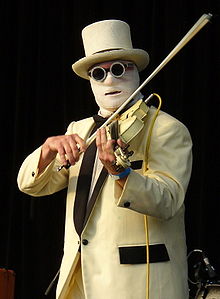
The music industry has been dominated by left-leaning causes since the days of Woody Guthrie and Pete Seeger, not to mention the countless artists who’ve been influenced by Bob Dylan and Neil Young. In Canada, rock stars came out in droves for the funeral of NDP leader Jack Layton, but it’s hard to find one musician who would openly admit to supporting Stephen Harper. While country star Paul Brandt performed at the 2008 Conservative convention and Nova Scotia’s The Trews have a song called Highway of Heroes that’s been adopted by the Tories, neither would agree to an interview about their political views.
“I feel that conservatives are pragmatic and more fiscally responsible [than the Liberals],” says Nash the Slash, the late-’70s-era experimental Canadian artist who has recorded with Neil Young’s famed producer, Daniel Lanois. “I think the left is more carved into stone in some of their intractability and I may get flack for that, but I don’t care. You never see conservatives out there parading at the G20 summit — we tend to be less demonstrative.”
Politically, Nash the Slash’s career tells an interesting story, as he’s also an outspoken gay musician who lives in Leslieville (a Toronto neighbourhood often painted as left-leaning) and used to hoist the occasional beer with Layton. Still, the musician voted for the conservative-minded Rob Ford over gay liberal candidate George Smitherman in Toronto’s 2010 mayoral election, and isn’t afraid to flaunt his right-wing leanings.
“I voted for Rob Ford because I believe in fiscal responsibility and you can call him a bumbling fool, but guess what? We’re not going to have any money to support the gay Pride parade unless we get our books straight,” he says. “If we don’t conserve our money, eventually, we’re all going to turn into Greece.”
It’s not surprising that outspoken right-wing rockers such as Nash the Slash are hard to find, though. Even when conservative politicians reach out to the music world, they tend to find their hands slapped back.
Wikipedia entry for Nash the Slash.
Since 1979 Nash has always performed with surgical bandages covering his face. “During a gig at The Edge in the late ’70s to raise awareness of the threat from the Three Mile Island disaster, he walked on stage wearing bandages dipped in phosphorus paint and exclaimed: “look, this is what happens to you”. The bandages became his trademark.” Prior to 1979, Nash performed three times on TV Ontario’s Nightmusic Concert, first as a solo artist (a live broadcast which was never re-aired), then with FM (Nash and Cameron Hawkins), then again as a solo artist. In all of these appearances Nash wore his typical black tuxedo, top hat, and dark sunglasses, but wore no bandages.
Born Jeff Plewman (as given in copyright depositions at the Library of Congress), he has attempted to keep his true identity the subject of some speculation. In a 1981 interview with the UK magazine Smash Hits, Nash’s response to a question about his real name was “Nashville Thebodiah Slasher”. By never officially confirming or denying his name, some fans came to believe Nash to be an alter ego of Ben Mink, who replaced him as FM’s violinist in 1978. This is a common misconception but he has been photographed onstage with Ben Mink.
August 3, 2012
Chris Selley: Ideology is anathema to Harper’s Conservatives
Prime Minister Stephen Harper cast out the libertarians several years ago. He’s more recently stamped out the last of the actual conservatives. So who’s left in the Conservative Party? Harperites and devoted non-ideologues:
It is time to retire the word “ideological” from Canada’s political lexicon. It doesn’t seem to mean anything anymore. In recent weeks, Tony Clement, a Conservative cabinet minister, has chided NDP leader Thomas Mulcair for “taking an ideological approach” to oil-sands development; Prime Minister Stephen Harper has deplored the New Democrats’ “ideological aversion to trade”; various New Democrats have accused the Conservatives of being “ideological” for their plans to contract out post-office services, eliminate Canada Revenue Agency counter service, cut funding for scientific research and limit health-care benefits for refugee claimants, which Liberal critic Kevin Lamoureux also deplored as “ideological.” Interim Liberal leader Bob Rae denounced the Conservatives’ entire “wrong-headed ideological agenda” — which is apparently “hidden” in various places around Ottawa, though he and Mr. Mulcair seem to have no difficulty discerning how awful and ideological it is.
I wonder how evocative the word “ideological” is to people who aren’t political junkies. Is it so bad, so uncommon, to have — as the Oxford dictionary defines it — “a system of ideas or way of thinking” that one regards “as justifying actions, especially one that is held implicitly or adopted as a whole and maintained regardless of the course of events”?
Among political junkies, the term is sometimes — though not always (see above) — meant to imply pigheaded rigidity. For a Canadian politician, that’s very bad. Weirdly, it’s also very bad when a Canadian politician changes his mind — the dreaded “flip-flop.” But is there any politician in Ottawa anywhere near power who can usefully be described as consistently ideological? Since the Reform days, Mr. Harper and his mates have been on a public policy magical mystery tour. Now they say whatever they need to say on Friday, contradict it completely on Monday, and think nothing of it. To call them ideological is to miss an opportunity to call them shameless hypocrites.
May 7, 2012
“Small-c” conservatives reach stage five in the grieving process
You’ve probably heard of the Kübler-Ross model of grieving, where sufferers pass through five stages in coping with their loss (denial, anger, bargaining, depression, and acceptance). Gerry Nicholls is apparently approaching stage five over the state of conservatism in Canada:
You know how in the The Wizard of Oz, the Wicked Witch of the East gets squished by Dorothy’s falling house? Well, today the hopes and dreams of Canada’s conservative movement are in pretty much the same flattened condition as that unfortunate witch. Basically all that remains now is for a Munchkin coroner to examine what’s left of conservative aspirations and proclaim, “they’re not only merely dead, they’re really most sincerely dead.”
Time of death: April 23, when Alberta’s conservative-leaning Wildrose Party, after being swept up high on the winds of the polls, came crashing down to Earth with a disappointing thud. What made this event the equivalent of an ideological house crushing is not so much the result of the vote, but rather how that result is being interpreted. Experts are blaming the Wildrose loss on its conservative agenda. They say Wildrose was just too radical to win.
[. . .]
Of course, such theorizing is now academic. In politics, perception is reality and right now the perception is that conservatism won’t sell in Canada. That means other provincial conservative parties in places such as Ontario will move to the “centre” so as to avoid Wildrose’s fate.
The perception will also severely undermine efforts by small “c” conservative MPs in the Conservative party caucus to push the federal Tory government to the right. And so the Harper government will continue to offer Canadians more big spending, more big government and little in the way of ideological or fiscal conservatism.
April 19, 2012
The (richly deserved) end of the Tory era in Alberta
Unless all the polls are way off, the election in Alberta will see the eternal rule of the Progressive Conservatives finally come to an end. But as desperate times call for desperate measures, the Tories have unleashed the last of their secret weapons to hold back the Wildrose barbarians — perhaps the most embarrassing political video ever posted. David J. Climenhaga saves you the pain of watching the video:
If you have any doubts left there are only four more sleeps before the end of the Progressive Conservative Era in Alberta, look no further than the video and website called “I never thought I’d vote PC.”
Whether or not the PCs under Alison Redford had anything to do with this vain effort to encourage hip, edgy young people to vote for the clapped out Conservative party in a last-ditch effort to prevent a Wildrose Apocalypse, there could be no surer sign of the imminent demise of the once mighty Tory dynasty.
I mean, really, telling young voters you understand why they’d “rather gouge their eyes out than vote Conservative” in an effort to get them to vote Conservative is just … embarrassing.
[. . .]
After this pathetic excuse for a Tory campaign, the tattered remnants of the Alberta Conservatives have less dignity left than Saddam Hussein when he was hauled out of his hidey-hole in Tikrit by the soldiers of the U.S. Fourth Infantry Division! This little video squib is just the final excruciating evidence before our eyes notice that the moribund Conservatives’ best-before date has passed.
I’m not kidding about the quality of the video — I couldn’t make it past the first minute before feeling too humiliated on behalf of the folks who made it and I had to shut it off. If you want to watch it in all its cringe-inducing glory, David has it embedded on his site.
April 2, 2012
Kelly McParland: Judge Harper not on what he says, but what he does
In the National Post, Kelly McParland scrutinizes the entrails of the federal budget to determine what Prime Minister Stephen Harper is really thinking:
It’s pretty self-evident that prime ministers reveal a lot of their own character in the content of their budgets, but it may be particularly so for Stephen Harper. The guy is an economist, after all. Messing around with graphs and figures was what he planned to do with his life, if seizing control of the country’s government didn’t work out. And since we know he’s a bit of a micro-manager, it’s probably safe to say there’s at least as much Harper as there is Jim Flaherty in the nitty gritty of the latest budget document. So let’s use it to figure out what Stephen Harper believes — really believes — when it comes to running the country.
We know what he says he believes in: smaller government, fewer bureaucrats, restrained spending, less intrusion, an end to taxpayer-financed welfare for businesses and governments. Accountability, prudence, fairness. Individual responsibility rather than the smothering embrace of the nanny state. No more currying favour with every special-interest advocacy group that captures the attention of congenitally correct.
Maybe on some plane he does honestly hold those values dear to his heart. But we all profess to believe in ideals we never quite get around to displaying. Mr. Harper has been Prime Minister for six years, and since last May has had the majority needed to have his way with legislation. Yet, as Andrew Coyne has so clearly demonstrated on more than one occasion, Mr. Harper’s actions habitually belie his words. If he were applying for membership in the True Conservative Believers Club of Canada, they’d turn him away as unqualified.
March 31, 2012
QotD: Conservatives
I do not doubt that conservatives are, in their heart of hearts, jugheaded buffoons who simply want to will away inconvenient truths by plugging their ears and covering their eyes when faced with cognitive dissonance. I’m confident that they argue from authority when it serves their purpose and then are muy skeptical when confronted with authority they don’t like. I’m metaphysically certain that many are repllent and repulsive and altogether awful and that they tend to love dogs and cats in the abstract more than their fellow human beings. In all this, I suspect, they are incredibly similar to liberals and, alas, libertarians and everyone else.
Nick Gillespie, “Why Don’t Conservatives Trust Scientists Like They Used To? Are They Just Anti-Evolutionary, Anti-Global Warming Jag-Offs or Could There Be Other Explanations?”, Hit and Run, 2012-03-30
March 13, 2012
Still no reason to get excited about robopocalypse, says Kelly McParland
Oh, good. I’m not alone in finding the robocall armageddon to be a bit less than exciting:
I have a confession to make. I have not been following the robocalls “scandal” with all the fervency it calls for.
It’s possible my inability to get excited results from six years … oops, make it seven … of the Liberals leaping to their feet every 18 seconds to accuse the Conservatives of plotting to pervert Canadian values, undermine democracy and display their contempt for the laws of the country. There’s this old morality tale about a kid who cried “wolf” too many times, so when a real wolf showed up, no one believed it any more. Maybe that’s why I have a hard time believing this is the real wolf.
It could also be that I find the premise hard to accept. To wit: a top-level conspiracy of Conservative grandees to steal the election by disrupting the vote, sending voters to incorrect polls or discouraging them from turning up at all. This would indeed be a major scandal if it was true, but think about it: Would a nation-wide exercise in disruptive phone calls have any chance of going undetected? Does anyone really believe (outside the fetid confines of the Toronto Star) that the senior ranks of any sane government would take such an extreme risk going into an election it expected to win anyway?
I could see some local bozos getting it into their heads that robocalling the opposing candidate’s supporters might be a great idea, but your cynicism has to be a lot deeper than mine (which would take some doing) to believe anyone could get to be Prime Minister, or his national campaign chairman, and still be either dumb enough, irresponsible enough or reckless enough to sign on to such a plan
Update, 15 March: In the comments, Saskboy strongly disagrees with my lack of excitement over the robocall scandal, and he’s been covering the story on his blog (that’s one of several posts on the topic).
March 10, 2012
Canadian Conservatives: “You are not that party”
Andrew Coyne’s presentation to the Manning Centre conference in Ottawa:
What I believe in are a set of principles having to do with the freedom of the individual, the usefulness but not infallibility of markets, and the legitimate but limited role of the state. There are, in brief, a few things we need government to do, based on well-established criteria on which there is a high degree of expert consensus. The task is simply to get government to stick to those things, rather than waste scarce resources on things that could be done as well or better by other means: that is, government should only do what only government can do.
As I say, these ideas are not novel, or controversial. Indeed, you would find support for them, to a greater or lesser degree, across the political spectrum.
Nevertheless, there was a party, once, that believed in these things, to a somewhat greater extent than the other parties. That party called itself conservative, whether with a small or a large C, so I suppose you could call the things it believed conservatism. But you are no longer that party.
For example, that party favoured balanced budgets. But you are not that party. In fact, you boast of how your decision to add $150-billion to the national debt saved the economy.
That party favoured cutting or at least controlling spending, after the massive spree of the Liberals’ last years. But you are not that party. In fact, you boast of how you have increased spending by 7% per year — $37-billion in one year!
That party favoured a simpler, flatter tax system, that left people free to decide how to spend, save or invest their money for themselves. But you are not that party. In fact, you boast of the many gimmicks and gew-gaws with which you have festooned the tax code.
That party favoured abolishing corporate welfare. But you are not that party. In fact you boast of the handouts you make, often accompanied by ministers or indeed MPs bearing outsized novelty cheques. In some cases, you even put the Conservative logo on them.
The story of the last decade is how the rock-ribbed small-c conservatives of the old Reform Party were tamed, neutered, and blinkered into becoming a blue-painted Liberal Party. It worked, in the sense of getting their hands on the levers of power, but their souls were tainted, corrupted, and eventually disposed of in the process.
March 6, 2012
Michael Kinsley: Of course it’s insincere
I don’t listen to Rush Limbaugh and I’m not likely to start listening in the near future, so my concern about “Slutpocalypse” is neither deep nor lasting. Limbaugh used the term “slut” to describe a Georgetown law student who was pleading for free or subsidized birth control. He then was forced to apologize, and the apology was deemed insincere by media commentators far and wide. Michael Kinsley points out that they went about it in the wrong way to garner a sincere apology:
The people who want to drive Rush Limbaugh off the air are not assuaged or persuaded by his apology over the weekend. They say he was not sincere: He only apologized, for calling a Georgetown University law student a “slut” and a “prostitute,” because of pressure from advertisers.
Well, of course he wasn’t sincere. And of course he was only apologizing to pacify advertisers — who were getting pressured to pressure Limbaugh by these very critics. Oh, there might have been a political calculation, too, that he’d gone too far for the good of his ratings or his celebrityhood. But any apology induced in these circumstances is almost by definition insincere. You can’t demand a public recantation and then expect sincerity along with the humble pie. If they wanted a sincere apology, Limbaugh’s critics would have had to defend his right to make these offensive remarks, and then attempt to change his mind using nothing but sweet reason. Go ahead and try.
[. . .]
Of course, the insincerity is on both sides. The pursuers all pretend to be horrified and “saddened” by this unexpected turn of events. In fact, they are delighted. Why not? Their opponent has committed the cardinal political sin: a gaffe.
A gaffe, as someone once said, is when a politician tells the truth. This is a bit imprecise. The term “politician” covers any political actor, certainly including Rush. And the troublesome statement needn’t be the truth, as it certainly wasn’t in this case: more like “the truth about what he or she is really thinking.” The typical gaffe is what they used to call a “Freudian slip.” But, with all due respect to Freud, why should something a politician says by accident — and soon wishes he or she never said, whether true or not — automatically be taken as a better sign of his or her real thinking than something he or she says on purpose?
H/T to Radley Balko for the link.
This is why I haven’t been covering the robocallpocalypse
Margaret Wente in the Globe & Mail brings a sense of proportion to the robo-call “crisis” in Canadian politics:
What’s happened to my country? I went away for a couple of weeks and all hell broke loose. I came back to find that someone named Poutine stole the last election. At first I thought this was a typo, that they meant Putin. But no. It turns out that Russia is a shining beacon of democracy compared to Canada. Apparently, our country has been hijacked by “the most comprehensive electoral fraud in our nation’s history” (Pat Martin, NDP critic). Voter suppression — lying, cheating and general chicanery — has driven us into “uncharted waters” (Bob Rae, Liberal Leader).
I certainly don’t wish to make light of voter fraud. But this fraud seems to have been engineered by the Keystone Kops. Not a single voter claims to have been prevented from voting. No ballot boxes appear to have been stuffed. Nobody was fraudulently elected. There weren’t even any hanging chads. Elections Canada says 31,000 Canadians have complained, but the vast majority of these complaints (“somebody called me at 10 p.m.”) seem trivial.
The dirty trickster at the heart of this evil scheme turns out to be someone with the nom de plume of Pierre Poutine (real identity unknown). Mr. Poutine and his henchmen were not personally directed by Stephen Harper but are widely thought to have been channelling him. In Guelph, Ont., they engineered a bunch of robo-calls that directed people to show up at non-existent voting stations. This tactic was evidently intended to discourage people who didn’t support the Conservatives from voting. It was so effective that the Liberal candidate won by a margin of 11 per cent.


