TimeGhost
Published on 23 Nov 2017On October 24, 1962 the US led blockade on Cuba goes into effect, but it’s not the be the showdown that it looks like! In the same time the US Navy starts flying RF8 Crusader reconnaissance jets 400 feet over the missile sites on Cuba, to see what’s really going on. As the jets roar over the heads of the Cuban and Soviet soldiers, the crisis deepens.
January 24, 2018
Day 9 Cuban Missile Crisis – Blockade starts and low altitude flybys over Cuba
January 23, 2018
Day 8 Cuban Missile Crisis – Kennedy and Khrushchev face reality
TimeGhost
Published on 20 Nov 2017On October 23, 1962 as the blockade on Cuba is being prepared, US President John F. Kennedy and USSR Chairman Nikita Khrushchev question their own actions realising that they might have gone a step too far. By now the dice have been rolled and it’s too late to stop the wheels from spinning. Both leaders try to justify their decisions to maintain their political power.
January 22, 2018
Day 7 Cuban Missile Crisis – USA announces a blockade on Cuba
TimeGhost
Published on 16 Nov 2017On October 22, 1962 the world is shocked to find out that the US and the USSR are facing off with nuclear arms in the Caribbean. In the world’s first televised announcement of an international military crisis, US President John F. Kennedy sets off panic and sudden fear of a third world war, with nuclear arms involved.
January 21, 2018
Day 6 Cuban Missile Crisis – Mr. President did you say blockade, or invade Cuba?
TimeGhost
Published on 13 Nov 2017On October 21 1962, politicians and military in both the US and in the USSR seem to have contradictory views on what to do next. The questions on the table; blockade AND invade Cuba, or just a quarantine? Should the Soviet local commanders on Cuba get to play with the little nukes as they like, or rather wait for permission? When it’s only the world as we know it that’s at stake…
January 19, 2018
Day 4 Cuban Missile Crisis – Soviet nukes ready to strike the US
TimeGhost
Published on 6 Nov 2017On the 19th of October 1962, the Soviet nuclear forces on Cuba are working on getting the warheads for their SS4 missiles combat ready. In Washington, President John F. Kennedy faces off with the Joint Chiefs of Staff, including General Curtis LeMay (his arch enemy), who demand more freedom for military action.
January 18, 2018
Day 3 Cuban Missile Crisis – The Soviet Nuclear Forces on Cuba
TimeGhost
Published on 2 Nov 2017On October 18 1962, President Kennedy meets with USSR Foreign Minister Andrei Gromyko, one of the architects of placement of missiles on Cuba. While the two beat around the bush, Khrushchev and Gromyko’s execution of the Soviet military and nuclear build up on Cuba continues.
January 17, 2018
Day 2 Cuban Missile Crisis – Preparing to Invade Cuba
TimeGhost
Published on 30 Oct 2017On October 17th, 1962, preparations for an invasion of Cuba under the codename Ortsac were set in motion. The U2 Dragon Lady spy plane continued to yield more alarming pictures of Cuban missile sites and President Kennedy was urged to restrain his dogs of war.
January 16, 2018
Day 1 Cuban Missile Crisis – Shall we destroy Cuba, Mr. President?
TimeGhost
Published on 26 Oct 2017On 16 October 1962. the Cuban Missile Crisis begins. President Kennedy assembles his advisors in EXCOMM to find an adequate response to the threat posed by Soviet nuclear missiles on Cuba.
On October 14 1962, Air Force pilot Richard Heyer flies over the island of Cuba in a U2 spy plane. The photos he brings back show three installations of Soviet nuclear Medium Range Ballistic Missile launch sites, with SS-4 and SS-5 missiles waiting to be made deployable. Russia now has nuclear first strike capacity and could launch an attack on the US mainland just as quickly as the Americans could on Russia from Turkey.
Spartacus Olsson
Camera by: Jonas Klein
Edited by: Spartacus Olsson, Jonas KleinA TimeGhost chronological documentary produced by OnLion Entertainment GmbH
January 15, 2018
Day 0 Cuban Missile Crisis – Atomic Tests and Missiles Discovered
TimeGhost
Published on 24 Oct 2017In the summer of 1962, a war of words between the United States and the Soviet Union and a number of nuclear tests on both sides increased tensions that had been mounting for years. Both sides were living under increasing panic that the other would ‘press the button’ and launch a preemptive nuclear strike, possibly destroying the world in the process. When on October 14 1962 the US discovered missiles on Cuba, that fear increased and almost came true.
Simulate a nuclear bomb anywhere: http://nuclearsecrecy.com/nukemap/
Support us on Patreon: https://www.patreon.com/TimeGhostHistory
Hosted by: Indy Neidell
Written by: Spartacus Olsson
Produced and Directed by: Astrid Deinhard
Executive Producers: Bodo Rittenauer, Astrid Deinhard, Indy Neidell, Spartacus Olsson
Camera by: Jonas Klein
Edited by: Jonas Klein, Spartacus OlssonA TimeGhost chronological documentary produced by OnLion Entertainment GmbH
The postwar “international order”
Niall Ferguson on the notion of a post-1945 international liberal order:
The phrase international order reminds me of the phrase Western civilization. As Indian independence icon Mahatma Gandhi wittily replied when asked about Western civilization, “It would be a good idea.” The notion that international order exists or has ever existed seems highly questionable to me. The notion of a liberal international order is even more questionable because it is neither liberal, nor international, nor very orderly.
It is often claimed by political scientists that the liberal international order came into existence in 1945. The argument goes that American and British statesmen, having learned from the terrible mistakes of the 1930s and 1940s, decided to make the world anew by creating a series of remarkable international institutions: the United Nations, the International Monetary Fund and later the World Bank. According to this narrative, Donald Trump’s election as US president in 2016 was a wrecking ball directed at the liberal international order created by the generation of 1945.
Yet this is a fairy tale. For one thing, there was nothing very liberal about the economic order that was established in 1945. It was devised by people – notably John Maynard Keynes – who had repudiated classical liberal economics and believed that international trade should be limited and capital movements controlled.
It was also not a truly international order. After 1945, it very quickly became a bipolar order that divided the world. There was nothing international about the Cold War. It was a battle between two empires and two ideologies, and the rest of the world’s nations had to choose sides.
In short, the notion of a liberal international order, born in 1945, is a historical fantasy. The reality is that it was only in 1991 when the Soviet Union collapsed and the Cold War ended that it was possible to create a liberal international order. The era of truly free trade, truly free capital flows and large-scale migration across borders did not begin until the 1990s.
January 14, 2018
Prologue 2 Cuban Missile Crisis – The Cold War Heats Up
TimeGhost
Published on 19 Oct 2017For 13 days in October 1962 the world came closer to nuclear holocaust than ever before, but the Cuban Missile Crisis didn’t start in Cuba – it had its roots in Berlin, Italy and Turkey, the domestic political situation in the US facing the newly elected President John F Kennedy, and in the USSR, where Premier Nikita Khrushchev had taken leadership of the Soviet through a harsh four year power struggle after Stalin’s death in 1953.
Hosted by: Indy Neidell
Written by: Spartacus Olsson
Produced and Directed by: Astrid Deinhard
Executive Producers: Bodo Rittenauer, Astrid Deinhard, Indy Neidell, Spartacus Olsson
Camera and editing by: Jonas KleinA TimeGhost chronological documentary produced by OnLion Entertainment GmbH
January 13, 2018
Prologue 1 Cuban Missile Crisis – The Cold War Begins
TimeGhost
Published on 17 Oct 2017This series follows the Cuban Missile Crisis day, by day. In this initial prologue we explore some of the background to the crisis. During the 1950s the ideological divide between totalitarian Communism and democratic capitalism pits the USSR against the US as both super powers try to expand their sphere of influence. In parallel a series of misunderstandings and false assumptions heats up the nuclear arms race and sees the US pull further ahead of the USSR in military dominance. The increasing pressure on both sides eventually brings them head to head during several covert operations, proxy wars and, direct confrontations including the Berlin Crisis and eventually the Cuban Missile Crisis.
Fast Food – Would You Like Capitalism With That? I THE COLD WAR
IT’S HISTORY
Published on 8 Jul 2015A city that is not plastered with branches of US Fast Food chains is a rare sight nowadays. That wasn’t always the case. Fast Food, as we know it today, is a child of the economic boom after World War 2. Taking your new car for a ride to the Drive-In restaurant and getting a fresh burger; that’s the American Dream right there. Ultimately the concept of identical taste and identical manufacturing steps is one thing: pure capitalism. Food chains keep wages and costs as low as possible and that is why Fast Food is not nearly as glamorous today as it once was. So put down that Hamburger and find out all about the history of Fast Food with Guy on IT’S HISTORY.
Big Mac Index: http://bit.ly/TheBIGMACIndex
December 9, 2017
Berlin Airlift: The Cold War Begins – Extra History
Extra Credits
Published on 7 Dec 2017Tension between the Soviet Union and their former World War 2 Allies escalated into a hostile blockade of Berlin. All sides wanted to avoid another war, but the United States, Great Britain, and France refused to bend to Stalin’s pressure. They came up with a daring plan to supply Berlin by air.
November 22, 2017
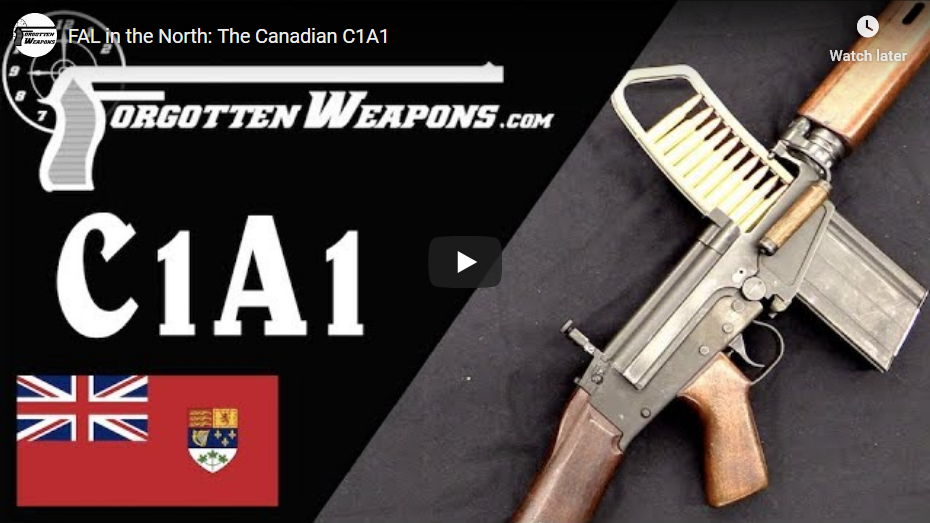
The Canadian version of the Sterling submachine gun
The Canadian army kept the Sten as their standard SMG for several years after the war, but eventually had to come up with a replacement weapon. The selection committee eventually settled on Sterling SMG, which the British army had been using, with a few modifications. Historical Firearms has the details:
…in November 1956, the first Anglo-Canadian Submachine Gun Steering Committee meeting was held. The Canadians liked the Sterling and requested a manufacturing license. They did, however, wish to make some changes to the weapon before they adopted it.
These changes included a small bayonet boss and redesigned lug reinforcement for the L1A1 rifle bayonet, a simpler trigger mechanism designed by Sterling engineer Les Ruffell, a height adjustable front sight taken from the L1A1, an adjustable rear sight with wider sight protectors. In early 1957, these changes were encapsulated in a sample model assembled from Fazakerly-made L2A3s, these were re-designated the L2A4. Later changes were also made to simplify the Canadian Sterling’s end cap and a squarer brass deflector and hand stop.The primary internal departures from Patchett’s original design were the decision to have a single rather than double return spring and to use a non-helically grooved bolt. Instead using an improved Sten breech block, this had a number of advantages including being able to use existing tooling, avoiding paying royalties for Patchett’s bolt and simplifying production. Compared to the Sterling-made guns the C1 was certainly simpler using stampings and spot-welding.
However, the C1 retained a surprising level of parts commonality with many parts interchangeable between both Canadian and British weapons. This commonality included magazines, however, the Canadians also simplified the magazine’s design. They dispensed with Patchett’s roller system and designed their own magazine which held 30, rather than 34 rounds, but could be used in all Sterling-pattern guns.
Two experimental suppressed C1s were made by Long Branch to replace the Sten MkII(s) and the MkVI, but the Sterling-Patchett L34A1/Mk5 was adopted instead. Canada purchased at least 5 L34A1s.
The Long Branch Arsenal was just west of Toronto along Lakeshore Road in what is now Mississauga (my cadet hall was adjacent to the former factory site):
I didn’t realize the site had been active that late … I’d assumed it was demolished shortly after the Korean War.