
The blunt teaching of history is that socialism is not an advanced stage in the evolution of human society but one of its most primitive stages. A highly articulated form of socialism was practiced among the Incas, the tribe which Pizarro found in control of Peru when he landed there in 1527. All produce, whether agricultural, pastoral or industrial, was the property of the state … In fact, the Incas had not only “communal ownership of the means of production” but a “planned economy”. All the basic features of socialism were present, and the feature which has specially attracted the attention of the archaeologist is that the Incas were in effect a huge bureaucracy … [T]he lesson of history is clear that communal ownership is normal among primitive people, and the institution of private property in the “means of production” is the first big step on the road to civilization.
Ivor Thomas, The Socialist Tragedy, 1951.
March 4, 2026
October 13, 2025
September 27, 2025
QotD: Utopian revolution
This illustrates a point that Professor Chirot makes clear in his discussion as to why the Vietnamese communist regime, though often brutal, never descended to anything like the level of horror of neighbouring Cambodia. Among the factors must surely have been the character and personality of the leaders as well as of the countries themselves. In other words, the fate of countries cannot be reduced, either in prospect or in retrospect, to an invariable formula. Human affairs will, to an extent, always be incalculable.
Still, some degree of regularity is possible. I was rather surprised that Professor Chirot overlooked one such. He writes the following of the corruption endemic under communist regimes: “a function of a deliberately exploitative, thieving elite that staved the general economy by its dishonesty than it was the essence of the system itself. Avoiding corruption was impossible because without it the society could not function.”
What is surprising here is that he does not mention why it could not function, but the answer seems to me perfectly obvious: it was because the communist system abolished the price system and substituted political decision-making in its place. This explanation is sufficient, for where there are no prices, and the economy is thereby largely demonetarised, goods and services can be distributed only by corruption. This is not to say that where there is a price system there will automatically be no corruption, obviously this is not the case; but such corruption will be limited by the very need for money to retain its value where such a price system exists. To that extent, it imposes at least a degree of honesty. The mystery of the Soviet Union or any other communist country is not why it produced so little, but why it produced anything at all: and here Professor Chirot is quite right. The answer is because of corruption: an “honest” communist state would produce nothing. It could not survive.
Theodore Dalrymple, “Longing for Revolution”, New English Review, 2020-05-13.
September 13, 2025
“It was about control before green policy became popular, and it is about control now”
In the National Post, Carson Jerema identifies the common thread among all of Prime Minister Mark Carney’s efforts since becoming Liberal party leader:

Then-Governor of the Bank of Canada Mark Carney at the 2012 Annual Meeting of the World Economic Forum in Davos, Switzerland.
WEF photo via Wikimedia Commons.
Prime Minister Mark Carney may not be as obnoxiously progressive as Justin Trudeau, but that doesn’t mean he isn’t stubbornly left wing in his own right, though he has managed to convince many critics otherwise.
Over the past decade, the Liberals were particularly self-righteous over climate policy, so much so that the deviations made by Carney since assuming office have been met with praise — or, on the left, with scorn — that he is somehow pro-business and represents the return of the centre-right Liberals. Some even think he’s a conservative. Others have suggested that Conservative Leader Pierre Poilievre is now entirely redundant.
This narrative is just more proof of how utterly captured the media is in this country by the Liberal party. It is true that Carney gives the appearance that he is abandoning many of the government’s environmental policies. He set the carbon tax rate to zero, paused the EV mandate and, on Thursday, he refused to endorse his government’s own carbon-emissions targets.
None of this, however, should be taken as evidence that Carney represents some sort of rightward or pro-business shift in the Liberal party. He is not proposing to let markets determine what infrastructure projects get built. Nor is he proposing to minimize regulations to attract investment.
Instead, Carney wants to command the economy by himself, laying bare the reality that what attracts left-wing politicians to climate policy is not saving the planet from carbon, but using environmental objectives to manage the economy. It was about control before green policy became popular, and it is about control now. For Carney specifically, before he entered politics, “decarbonizing” markets was quite remunerative in his various banking roles.
Noticeably absent from the five infrastructure projects that the prime minister said on Thursday would be fast-tracked under the Major Projects Office was an oil and gas pipeline. Also noticeable was the fact that all five of the projects had already been approved, but the government tried to pass them off as something new anyway.
Even if the projects had been all brand new, the lack of a pipeline would still be of no surprise, as what private investor would be willing to back a pipeline when the Liberals’ Impact Assessment Act, tanker ban and emissions cap all exist to conspire against energy projects of any kind?
One thing that became incredibly obvious early in Justin Trudeau’s premiership was that the prime minister — and his ministers in general — really did seem to believe that talking about doing something was as effective in solving problems as actually doing the thing. Many had hoped that Mark Carney would be different … but as Dan Knight points out, he may actually be worse:
From there, [Poilievre] broadened the attack. He spoke of an entire generation priced out of homeownership, of immigration growing “three times faster than housing and jobs”, of crime rising, and of what he called “the worst economy in the G7”. And then he turned squarely on Carney: “Mr. Carney is actually more irresponsible than even Justin Trudeau was“, citing an 8% increase in government spending, 37% more for consultants, and 62 billion dollars in lost investment — the largest outflow in Canadian history, according to the National Bank.
The message was simple: Liberals talk, Conservatives build. Poilievre painted Carney as a man of speeches and promises, not results. “The mistake the media is making is they’re judging him by his words rather than his deeds“, he said.
It was an opening statement designed less to introduce policy — those details came later — and more to frame the battle. For Poilievre, Carney isn’t just Trudeau’s replacement. He’s Trudeau’s sequel, and in some ways worse.
[…]
Pierre Poilievre didn’t hold back when asked about Mark Carney’s record. His words: “Mr. Carney is actually more irresponsible than even Justin Trudeau was“. That’s not a throwaway line, he backed it with numbers.
According to Poilievre, Carney inherited what he called a “morbidly obese government” from Trudeau and made it worse: 8% bigger overall, 37% more for consultants, and 6% more bureaucracy. He says Carney’s deficit is set to be even larger than Trudeau’s.
Then the jobs number: 86,000 more unemployed people under Carney than under Trudeau. That, Poilievre argued, is the real measure, not the polished speeches Carney gives. His line: “The mistake the media is making is they’re judging him by his words rather than his deeds“.
August 26, 2025
“One of the top tips for having a decent country is never, ever, allow the fuckwits to gain power”
If you need to drop someone off at London’s Gatwick Airport, you’ll find yourself facing a £7 charge for the privilege, no matter what day of the week or time of day you choose. Tim Worstall explains why:
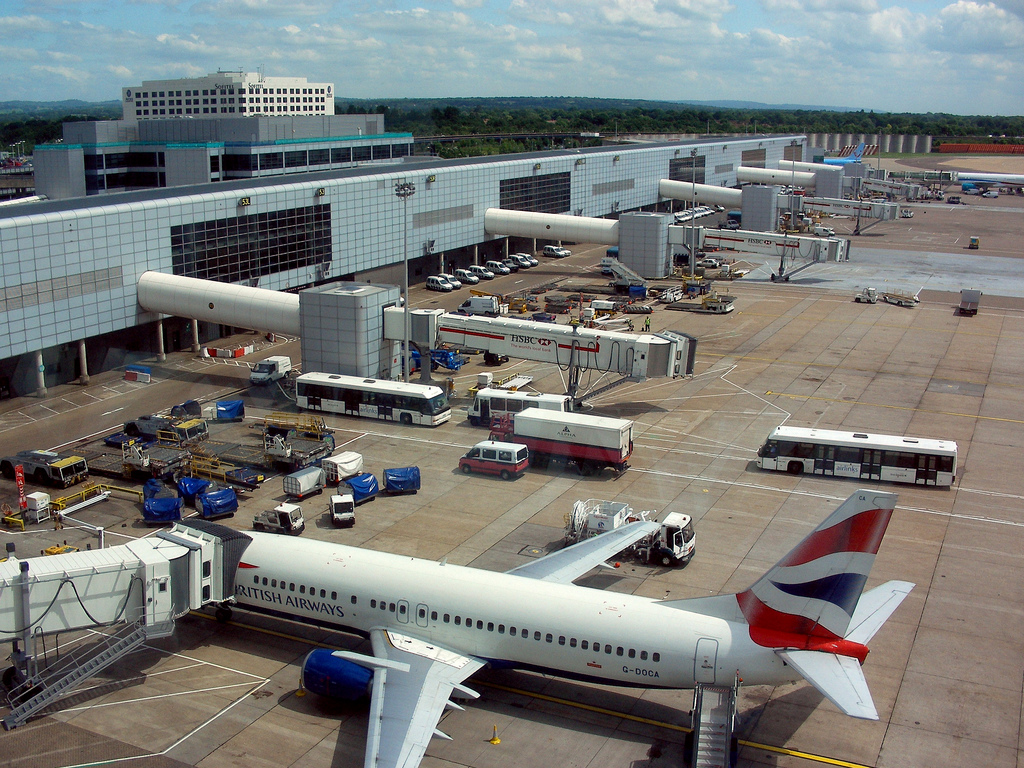
“Gatwick Airport, North Terminal” by Martin Roell from Berlin, Germany is licensed under CC BY-SA 2.0 

 .
.
It’s sod all to do with congestion and everything to do with the tractor production statistics the fuckwits have imposed upon the airport.
The conditions attached by the transport secretary included national landscape provisions as per the Levelling Up and Regeneration Act 2023, more consideration for sustainability in buildings design and additional pollution-related mitigation measures.
The government said in its formal response to the Planning Inspectorate’s recommendations on the Gatwick DCO that it wanted more detail on how it would achieve its commitment of 54% of passengers arriving at the airport via rail within the first year of dual runway operations, which could be by the end of this decade.
The government has a target. That 54% of the arrivals at an airport — yes, an airport, where people get on jet planes — must be by public transport. Therefore the airport is charging for car drop offs in order to decrease the number of car drop offs. There is no more reason than that. Or, as up at the top, the reason there’s a £7 drop off charge at Gatwick Airport is because we are ruled by the fuckwits who have a target for public transport to an airport where people then get on jet planes.
London Gatwick has also accepted a requirement to have 54% of passengers using public transport prior to bringing the Northern Runway into operation and has reiterated the need for third parties, including the Department for Transport, to support delivery of the necessary conditions and improvements required to meet this target. This would include, for example, reinstating the full Gatwick Express train service.
Given the reliance on other parties to achieve this 54% target, should it not be achieved then London Gatwick has also proposed an alternative cars-on-the-road limit to be met before first use of the Northern Runway to address concerns about possible road congestion. Furthermore, if neither the 54% transport mode share or the cars-on-the-road limit are met, then use of the Northern Runway would be delayed until £350m of road improvements have been completed. This would make sure any additional road traffic flows can be accommodated and any congestion avoided.
It’s all fuckwit targets set by fuckwits.
Of course, there are those who think that fuckwit targets set by fuckwits are a good idea. For one of the problems of life is that there are always fuckwits:
When we talk about airport expansion, we often focus on runways, terminals, and the physical infrastructure. But what about how people actually get to the airport?
The journey begins long before passengers step foot in a terminal, and their choices about transport can have a significant impact on congestion, carbon emissions, and overall passenger experience.
One of the conditions set for Gatwick’s expansion is a legally binding guarantee that 54% of passengers will travel by public transport, up from today’s 44%. On the surface, it sounds like a simple shift. But transport isn’t just about availability — it’s about behaviour, convenience, and incentives.
One of the top tips for having a decent country is never, ever, allow the fuckwits to gain power. But we have done so therefore there is this £7 charge for a drop off at Gatwick Airport. That’s it, there is no other reason. There are fuckwits buried in the belly of the British state and they’re making the rules now.
August 4, 2025
The EU still dominates in one key area – over-regulation
At the Foundation for Economic Education, Cláudia Ascensão Nunes identifies the one area that the EU has carved out a unique niche for itself … and it’s global in scope:

EU regulations delenda est
In a world where global power is measured by military strength, technological innovation, or cultural influence, it is striking that the European Union, without housing major tech giants or centers of disruptive innovation, has turned bureaucracy into a tool of global power. It shapes the behavior of global companies, including American big tech firms, which adapt their products to comply with European norms. This phenomenon is known as the “Brussels Effect” and has positioned the EU as the world’s regulatory superpower, fueling growing tensions, particularly with the United States following the re-election of Donald Trump.
The European market comprises 450 million consumers with significant purchasing power, making it an essential destination for global companies. However, access to this attractive market comes with detailed regulations based on the precautionary principle, ostensibly prioritizing consumer and environmental protection, and enforced by an efficient bureaucracy capable of implementing and enforcing rules with precision. This combination encourages companies to align their global operations with European standards, as maintaining different product versions for each region is costly and complex. In practice, this exports European standards worldwide.
American big tech companies such as Apple, Google, and Meta exemplify the impact of the “Brussels Effect,” as they face the requirements of legislations like the Digital Markets Act (DMA) and the Digital Services Act (DSA). These laws have forced companies to overhaul their business models, often at high cost and with significant implications. The DMA, for instance, forced Apple to allow alternative app stores and third-party payment systems on iOS, leading the company to announce, in 2024, global changes to its app policy affecting users even outside Europe, with cost estimates in the billions of dollars to restructure its infrastructure and address revenue losses from the App Store.
Google, under the same regulation, was required to offer alternatives to its search engine on Android and to unbundle services such as YouTube, impacting its global strategy and requiring significant investments in new operating systems and interfaces. The company faced potential fines of up to 10% of its global revenue for non-compliance.
Meanwhile, Meta, under the DSA, was required to invest billions in content moderation systems, a serious imposition that openly seeks to control freedom of expression on a global scale. Operational costs increased by around 20%, according to market analysts. These costly adjustments are ultimately coercive due to the weight of the European market, demonstrating how Brussels shapes corporate behavior on a global scale.
These successive impositions and forced adaptations illustrate precisely Friedrich Hayek’s warning about the dangers of central planning. By replacing spontaneous order with top-down, uniform rules imposed by a technocratic authority, the capacity for local adaptation and respect for market complexity is lost. In this scenario, the European Union increasingly takes on the features of a regulatory Leviathan, a body concentrating disproportionate power in the hands of bureaucrats far removed from citizens, reducing freedom of choice and stifling innovation.
July 23, 2025
Britain’s housing crisis has roots as far back as 1947
Tim Worstall on the deep reasons Britain can’t seem to build any new housing:
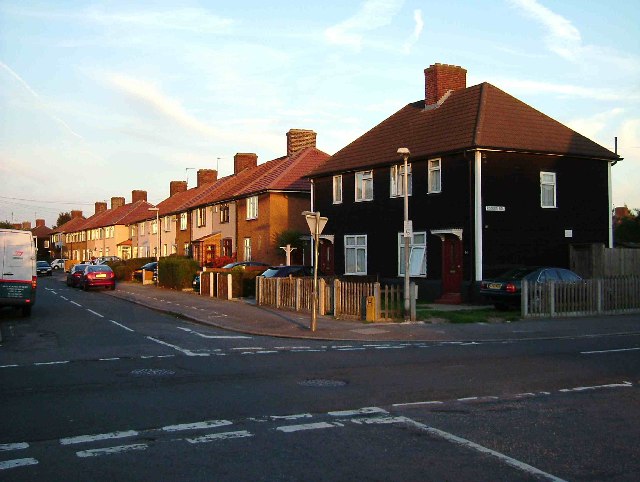
Homes Fit for Heroes – Dagenham
“These are typical examples of the housing on the Becontree Estate. Initially 25000 homes were built by the London County Council between 1921 and 1934. These homes fit for the heroes of WW1 had all mod cons gas, water and electricity with inside toilets and bathrooms. A further 2000 homes were built before WW2. The Becontree estate was the biggest council estate in the world.”
Image and description from geograph.uk. Photo by Glyn Baker – CC BY SA 2.0
The real problem Britain faces is that it’s no longer legal to build the housing we thought was the bare minimum acceptable a century ago.
The more apposite point is that a couple of hundred yards up the road are those post-WWI homes for heroes. Here. Semi detached, not huge to be fair. But kitchen, living room, parlour, 3 beds and indoor bathroom. They’re still highly desirable houses in fact. Note, they’ve front gardens. They’ve also back ones too.
Now, we’ve heard this, even heard it from someone on Bath City Council (who had heard it, we’re not quite old enough to know anyone who was on BCC in the 1920s), and never, quite tracked it down officially. But the statement was made that the Homes for Heroes needed to be on 1/4 acre gardens. The working man needed the space to grow vegetables for his family and to keep a pig. These houses, the 1920s ones, do have substantial gardens as the 1960s ones don’t.
As I pointed out:
But Homes for Heroes? We’ve done this before. And those Homes for Heroes? Right now, today, it’s illegal to build them. No, really. What was considered the basic minimum that the local council should provide to the working man is illegal to build now. Those decent sized houses were on those decent gardens d’ye see? You can get perhaps 9 dwellings with 1/4 acre gardens on a hectare of land. Last we saw the current insistence is that we must have no less than 30 dwellings per hectare in order to gain planning permission. Even though Englishcombe – as with so much other land – is there and ripe for the taking.
It’s actually illegal to build houses that were regarded as the proper minimum a century ago.
The reason we cannot is that Green Belt, itself stemming from the Town and Country Planning Act 1947. The point of which — no, really, the stated purpose — was to make sure that no one would ever be allowed to build housing for proles — sorry, stout Britons — anywhere anyone ever wanted to live.
Which is a bit of a problem. For, outside my own head, there’s no constituency for repealing the TCPA and abolishing the Green Belt.
However, there is a large constituency for plastering farmland with solar cells.
Waller-Barrett’s farm has been targeted for a massive solar plant, which will be called Glebe Farm, and now his landlord plans to take his land away, replacing potato crops with thousands of giant glass panels.
The decision, backed by edicts from Ed Miliband, the Energy Secretary, favouring solar farms over food production on UK farmland, means his flourishing food business will shrink – and staff will be out of work.
Meanwhile the distant landlord will be quids in, potentially quadrupling their rent with virtually no effort.
Oh.
And now one of those little wrinkles of the law. Those solar farms will last 20 years maximum. No, really, that’s tops. The wrinkle being that the land underneath them will be, in that 20 years’ time, defined as brownfield land. Been previously developed, see? And brownfield land to housing is usually pretty easy as a development path. Certainly wholly unlike greenfield (or even Green Belt) to housing.
The land area Ed wants to cover with these things is 2 to 3% of the land area of the country. Which, as it happens, is about the land area currently covered by housing — including their gardens.
So, therefore we can see that Ed is, in fact, playing the long game. He’s going to solve the housing problem by not having to take on the Campaign for the Preservation of Rural England and every LibDem middle-ager with too few grandchildren to occupy her time. He’s going to do an end run around that problem by building solar first.
June 18, 2025
Canada’s Supply Management system – protecting us from cheaper milk, eggs, and chicken
On the social media site formerly known as Twitter, The Food Professor celebrates the latest achievement in Canada’s omni-competent supply management system:
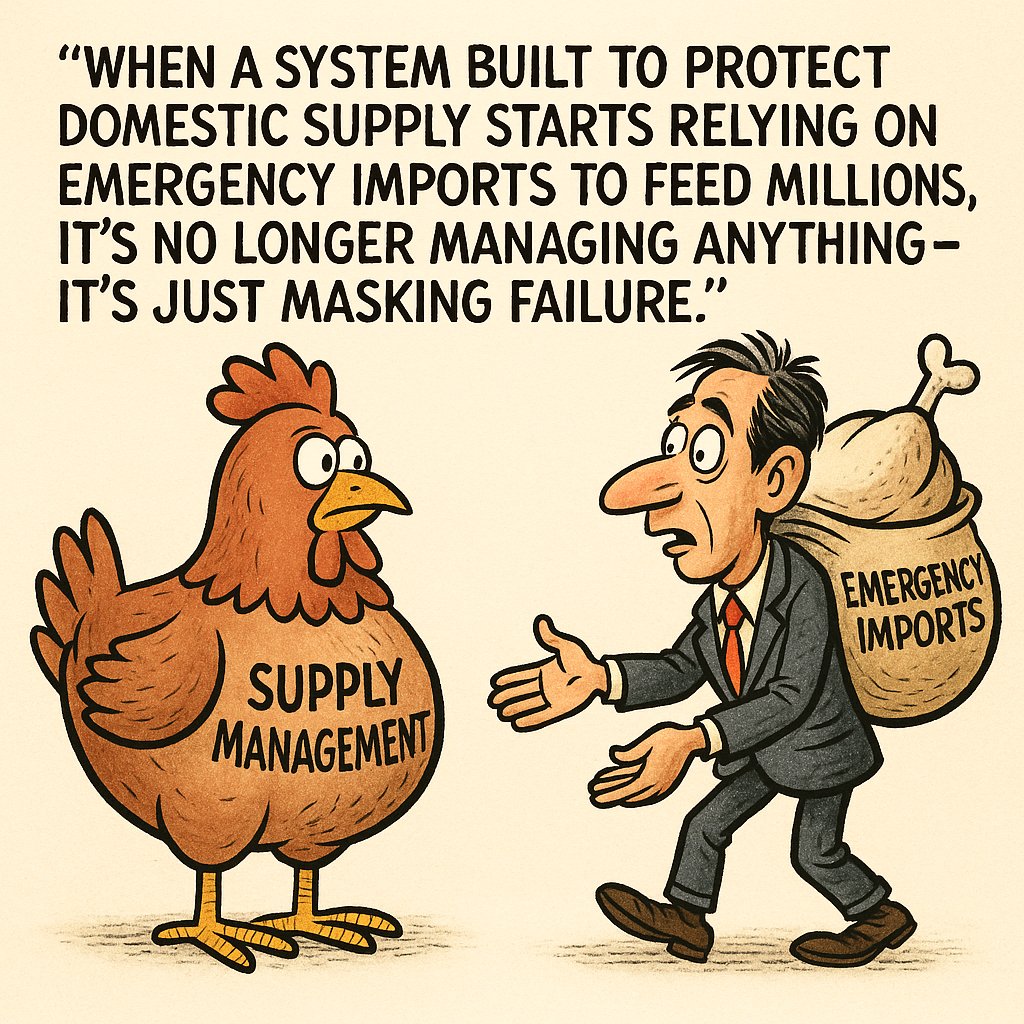
The Chicken Crisis Supply Management Won’t Admit
Canada’s supply management system—once heralded as a pillar of food security and agricultural self-sufficiency—is failing at its most basic function: ensuring reliable domestic supply.
According to the latest figures from the Canadian Association of Regulated Importers (CARI), Canada imported over 66.9 million kilograms of chicken as of June 14 — a 54.6% increase from the same period last year. To put that in perspective, this volume could feed 3.4 million Canadians for an entire year, based on per capita poultry consumption. That’s roughly 446 million individual meals — meals that, under a tightly managed quota system, were meant to be produced domestically.
To be fair, the avian influenza outbreak in Canada has disrupted poultry production, and it partially explains some of the shortfall. But even accounting for that disruption, the numbers are staggering. Imports under trade quotas established by the WTO, CUSMA, and CPTPP are all running at or near pro-rata levels, signaling not just opportunity — but urgency. Supplementary import permits — meant to be emergency tools — have already surpassed 48 million kilograms, exceeding the total annual import volumes of some previous years. This is not a seasonal hiccup. It is systemic failure.
Canada’s poultry sector is supposed to be insulated from global volatility through supply management. Yet internal shocks — like the domestic avian flu outbreak — have shown how fragile the system truly is. When emergency imports become routine, we must ask: what exactly is being managed?
The original intent of supply management was to align production with domestic demand while stabilizing prices and farm incomes. But that balance is clearly off. The A195 production period, ending May 31, 2025, showed one of the worst underproduction shortfalls in more than 50 years. Producers remain constrained by rigid quota allocations, while consumers continue to face rising poultry prices. More imports. Higher costs. Diminished confidence.
Some defenders will insist this is an isolated event. It’s not. This is the second week in a row Canada has reached pro-rata import levels across all chicken categories. Bone-in and processed poultry products — once minor parts of emergency programs — are now central to keeping the market supplied.
The dysfunction extends beyond chicken. Egg imports under the shortage allocation program have already topped 14 million dozen, up 104% from last year. Just months ago, Canadians were criticizing high U.S. egg prices — yet theirs have fallen. Ours haven’t.
All this in a country with $30 billion in quota value, intended to protect domestic production and reduce reliance on imports. Instead, we are importing more — and paying more.
Meanwhile, Bill C-202, now before the Senate, aims to shield supply management from future trade negotiations, making it even harder to adapt or reform. So we must ask: is this what we’re protecting? A system that fails to meet demand, relies on foreign supply, and costs Canadians more at the checkout?
Our trading partners are seizing the moment. Chile, for instance, has increased its chicken exports to Canada by over 63%, now representing nearly 96% of CPTPP-origin imports. While we double down on rigidity, others are gaining long-term footholds in our market.
It’s time to face the facts. Supply management no longer guarantees supply. And when a system meant to ensure resilience becomes the source of fragility, it’s no longer an asset — it’s an economic liability.
June 7, 2025
QotD: The decline and fall of the Soviet experiment
The early communists, including Marx, looked at work and the pursuit of material goods as a burden on mankind. Capitalism turned men into slaves to their own desires for wealth and property. This crude desire for material goods made them easy to exploit by the capital class. The point of overthrowing the capitalist system and replacing it with communism was to free man from that burden. The resulting material prosperity of communism would allow mankind to reach its full creative potential.
The Soviet empire that emerged from the Second World War was noticeably short on talk about mankind reaching its full potential. The practical necessity of feeding, housing and clothing its people consumed the regime. The great dream of a post-scarcity world of mankind united in brotherhood had given way to figuring out how to produce enough necessities to prevent rebellion. The last half of the 20th century was communism trying to keep pace with capitalism in the production of consumer goods.
The Z Man, “Human Progress”, The Z Blog, 2020-04-27.
June 5, 2025
QotD: Political institutions of the late western Roman Empire
Roman rule as effectively codified under the first emperor, Augustus (r. 31BC – 14AD) was relatively limited and indirect, not because the Romans believed in something called “limited government” but because the aims of the Roman state were very limited (secure territory, collect taxes) and the administrative apparatus for doing those things was also very limited. The whole of the central Roman bureaucracy in the first century probably consisted of just a few hundred senatorial and equestrian officials (supported, of course, by the army and also several thousand enslaved workers employed either by the state directly or in the households of those officials) – this for an empire of around 50 million people. Instead, day to day affairs in the provinces – public works, the administration of justice, the regulation of local markets, etc. – were handled by local governments, typically centered in cities (we’ll come back to them in a moment). Where there were no cities, the Romans tended to make new ones for this purpose. Roman officials could then interact with the city elites (they preferred oligarchic city governments because they were easier to control) and so avoid having to interact directly with the populace in a more granular way unless there was a crisis.
By contrast, the Roman governance system that emerges during the reigns of Diocletian (r. 284-305) and Constantine (r. 306-337) was centralized and direct. The process of centralizing governance had been going on for some time, really since the beginning of the empire, albeit slowly. The Constitutio Antoniniana (212), which extended Roman citizenship to all free persons in the empire, in turn had the effect of wiping out all of the local law codes and instead extending Roman law to cover everyone and so doubtless accelerated the process.
During the Crisis of the Third Century (235-284) this trend accelerates substantially; the sources for this period are relatively poor, making it hard to see this process clearly. Nevertheless, the chaotic security situation led Roman generals and usurpers to make much greater demands of whatever local communities were in their reach, while at the same time once in power, emperors sought to draw a clearer distinction between their power and that of their subordinates in an effort to “coup proof” their regimes. That new form of Roman rule was both completed and then codified by Diocletian (r. 284-305): the emperor was set visually apart, ruling from palaces in special regalia and wearing crowns, while at the same time the provinces were reorganized into smaller units that could be ruled much more directly.
Diocletian intervened in the daily life of the empire in a way that emperors before largely had not. When his plan to reform the Roman currency failed, sparking hyper-inflation (whoops!), Diocletian responded with his Edict on Maximum Prices, an effort to fix the prices of many goods empire wide. Now previous emperors were not averse to price fixing, mind you, but such efforts had almost always been restricted to staple goods (mostly wheat) in Rome itself or in Italy (typically in response to food shortages). Diocletian attempted to enforce religious unity by persecuting Christians; his successors by the end of the century would be attempting to enforce religious unity by persecuting non-Christians. Whereas before taxes had been assessed on communities, Diocletian planned a tax system based on assessments of individual landholders based on a regular census; when actually performing a regular census proved difficult, Constantine responded by mandating that coloni – the tenant farmers and sharecroppers of the empire – must stay on the land they had been farming so that their landlords would be able to pay the taxes, casually abrogating a traditional freedom of Roman citizens for millions of farmers out of administrative convenience. Of course all of this centralized direction demanded bureaucrats and the bureaucracy during this period swelled to probably around 35,000 officials (compared to the few hundred under Augustus!).
All of this matters here because it is this kind of government – centralized, bureaucratic, religiously framed and interventionist, which the new rulers of the fifth century break-away kingdoms will attempt to emulate. They will mostly fail, leading to a precipitous decline in state capacity. This process worked differently in different areas: in Britain, the Roman government largely withered away from neglect and was effectively gone before the arrival of the Saxons and Angles, a point made quite well by Robin Flemming in the first chapter of Britain after Rome (2010), while in Spain, Gaul, Italy and even to an extent North Africa, the new “barbarian” rulers attempted to maintain Roman systems of rule.
This is thus an odd point where the “change and continuity” and “decline and fall” camps can both be right at the same time. There is continuity here, as new kings mostly established regimes that used the visual language, court procedure and to a degree legal and bureaucratic frameworks of Late Roman imperial rule. On the other hand, those new kingdoms fairly clearly lacked the resources, even with respect to their smaller territories, to engage in the kind of state activity that the Late Roman state had, for instance, towards the end of the fourth century. Instead, central administration largely failed in the West, with the countryside gradually becoming subject to local rural magnates (who might then be attached to the king) rather than civic or central government.
The problem rulers faced was two-fold: first that the Late Roman system, in contrast to its earlier form, demanded a large, literate bureaucracy, but the economic decline of the fifth century (which we’ll get to next time) came with a marked decline in literacy, which in turn meant that the supply of literate elites to staff those positions was itself shrinking (while at the same time secular rulers found themselves competing with the institutional Church for those very same literate elites). Second – and we’ll deal with this in more depth in just a moment – Roman rule had worked through cities, but all over the Roman Empire (but most especially in the West), cities were in decline and the population was both shrinking and ruralizing.
That decline in state capacity is visible in a number of different contexts. Bryan Ward-Perkins (Rome and the End of Civilization (2005), 148ff) notes for instance a sharp decline in the size of Churches, which for Christian rulers (both the post-Constantine emperors and the new “barbarian” kings) were major state building projects meant to display either royal or local noble wealth and power; Church size really only reaches Late Roman equivalent in the west (an important caveat here, to be sure) in the ninth century. In this kind of context it is hard to say that Visigothic or Merovingian rulers are actually just doing a different form of rulership because they’re fairly clearly not – they just don’t have the resources to throw at expensive building projects, even when you adjust for their smaller realms.
Nor is it merely building projects. Under Constantine, the Romans had maintained a professional army of around 400,000 troops. Much of the success of the Roman Empire had been its ability to provide “public peace” within its borders (at least by the relatively low standards of the ancient world). While the third century had seen quite a lot of civil war and the in the fourth century the Roman frontiers were cracking, for much of the empire the legions continued to do their job: war remained something that happened far away. This was a substantial change from the pre-Roman norm where war was a regular occurrence basically everywhere.
The kingdoms that emerged from the collapse of Roman rule proved incapable of either maintaining a meaningful professional army or provisioning much of that public peace (though of course the Roman state in the west had also proved incapable of doing this during the fifth century). Instead those kingdoms increasingly relied on armies led by (frequently mounted) warrior-aristocrats, composed of a general levy of the landholding population. We’ve actually discussed some of the later forms of this system – the Anglo-Saxon fyrd and the Carolingian levy system – already; those systems are useful reference points because they’re quite a bit better attested in our evidence and reflect many of the general principles of how we suppose earlier armies to have been organized.
The shift to a militia army isn’t necessarily a step backwards – the army of the Middle Roman Republic had also been a landholder’s militia – except that in this case it also marked a substantial decrease in scale. Major Merovingian armies – like the one that fought at Tours in 732 – tended to be around 10,000-20,000 men (mostly amateurs), compared to Late Roman field armies frequently around 40,000 professional soldiers or the astounding mobilizations of the Roman Republic (putting around 225,000 – that is not a typo – citizen-soldiers in the field in 214BC, for instance). Compared to the armies of the Hellenistic Period (323-31BC) or the Roman Empire, the ability of the post-Roman kingdoms to mobilize force was surprisingly limited and the armies they fielded also declined noticeably in sophistication, especially when it came to siege warfare (which of course also required highly trained, often literate engineers and experts).
That said, it cannot be argued that the decline of “public peace” had merely begun in the fifth century. One useful barometer of the civilian sense of security is the construction of city walls well within the empire: for the first two centuries, many Roman cities were left unwalled. But fresh wall construction within the Empire in places like Northern Spain or Southern France begins in earnest in the third century (presumably in response to the Crisis) and then intensifies through the fifth century, suggesting that rather than a sudden collapse of security, there had been a steady but significant decline (though again this would thus place the nadir of security somewhere in the early Middle Ages), partially abated in the fourth century but then resumed with a vengeance in the fifth.
Consequently the political story in the West is one of an effort to maintain some of the institutions of Roman governance which largely fails, leading to the progressive fragmentation and localization of power. Precisely because the late Roman system was so top-heavy and centralized, the collapse of central Roman rule mortally wounded it and left the successor states of Rome with much more limited resources and administration to try to achieve their aims.
Bret Devereaux, “Collections: Rome: Decline and Fall? Part II: Institutions”, A Collection of Unmitigated Pedantry, 2022-01-28.
May 17, 2025
QotD: Suburbs and their critics
It gets a lot of bad press, it has got a lot of influential haters, ridiculers and deriders. There are the urbanists, the town planners, the architects, most of whom can’t abide the sprawl. It’s ugly, inefficient, unsustainable, it lacks amenities and it lacks a sense of community, it prioritises – or privileges, as they would say – cars over pedestrians, it wastes space and it wastes resources, it’s barbaric. Those much smarter and more creative than us have offered a lot of alternatives: high-density living, modernist spaces, Le Corbusier’s houses as “machines for living”. They tore down the slums and erected high rise projects, council flats, banlieues and osiedla. They designed and built whole new districts, rich in concrete and wide bare expanses of public space.
Then there are the cultural as opposed to professional haters, and they too are as old as the suburbs themselves. The sprawl is a prison, a conformist hell. It deadens imagination and stifles creativity. It’s full of dumb people leading dumb lives. It’s a triumph of materialism, selfishness and narrow mindedness over selflessness, community and commonweal. From literature through movies and music to TV shows, suburbs don’t get a break; they are the hotbed of reaction, sexism, racism, homophobia, xenophobia, intolerance, prejudice, oppression and kitsch. “Revolutionary Road”, “Stepford Wives”, “American Beauty”, “Weeds”, “Little Boxes”, Stephen King novels, the list is endless, but you get the drift.
There are many differences between the suburbanites and the suburbs haters, but the one big one is this: the suburbanities are the live-and-let-live crowd – they know what they like but they don’t give a shit if you don’t like it. It’s your business and it’s your life – you can do whatever you like. The suburbs haters, on the other hand, not only know what they like but they believe that everyone else should like it to, and if they don’t, tough luck, they should be forced to change for the sake of what’s really good for them and for the whole community. Suburbs are not something that can be tolerated as an option; they should be destroyed, land reclaimed, ideally by nature, their former residents corralled and concentrated.
In many ways it’s yet another example of the old elite versus the masses cultural clash. The masses essentially just want to be left alone. The elites want to remake the whole world so it accords to their vision of what’s good and useful. The masses’ is not to question why …
Arthur Chrenkoff, “In praise of sprawl”, Daily Chrenk, 2020-05-21.
April 13, 2025
QotD: The 15-minute city
Jane Psmith, “REVIEW: The Wizard and the Prophet, by Charles C. Mann”, Mr. and Mrs. Psmith’s Bookshelf, 2024-01-22.
March 8, 2025
QotD: India’s post-independence economic mistake
Strong and centralised control is something that only a rich country can afford because only a rich economy can weather the costs – the inefficiencies, the politically directed nonsenses – that such control insists upon.
Of course, rich countries shouldn’t make themselves poorer in this manner either but an already poor place can’t afford to have them – because if it does then people die.
India’s poor because of that attempt at socialist development. Something we can prove by the manner in which development sped up when even some portion of the socialism was dropped. Sure, the Webbs set up the LSE, the place I started to learn my economics but they were responsible for far greater evils than my views as well.
Tim Worstall, “A Sad Lesson About India’s History”, Continental Telegraph, 2020-05-01.
February 27, 2025
QotD: The ANC, the Inkatha Freedom Party, and the Zulus during Apartheid
Those lessons were enthusiastically put into practice — the ANC set up a network of death camps in Angola at which traitors and enemies and just plain inconvenient people were worked or tortured to death. They also founded a paramilitary terrorist army called uMkhonto we Sizwe (MK) that waged a brutal dirty war, supposedly against the apartheid government but actually against anybody they didn’t like. The vast majority of the victims of MK were black people who happened not to support the ANC, especially Zulus in their tribal homeland in what’s now KwaZulu-Natal province, who were subjected to regular massacres in the 80s and early 90s.
The ANC and the MK had a special hatred for the Zulus. In part, because the ANC’s leadership was disproportionately Xhosa, and their ancestors had suffered during King Shaka’s wars of expansion in the 19th century. But this ancient ethnic grudge wasn’t the fundamental problem, and indeed it was later papered over. The real problem was that the Zulus dared to engage in political organization outside the ANC and its subsidiary, the South African Communist Party (SACP). The preferred Zulu political vehicle was the Inkatha Freedom Party (IFP), which was associated with the Zulu monarchy and the traditional amakhosi (chieftains). This made it an independent base of power within black South Africa, and a competing claim on the loyalty of Zulu citizens. The ANC considered this situation unacceptable.
Like many avowedly communist organizations, the ANC was allergic to political competition of any sort. Internally, the party practiced an especially harsh form of democratic centralism — most policy decisions were made by a tiny and incestuous central committee, and members were expected to be totally submissive in the face of party discipline. This extended even to the point of party permission being necessary for senior members to marry. Externally, the party had an entitled attitude common to successful revolutionary organizations from North Korea to Albania — they were the incarnation of the aspirations of the South African people and the vanguard of their brilliant future, so all other political organizations were ipso facto illegitimate. Can you guess what happened when these people were handed power?
John Psmith, “REVIEW: South Africa’s Brave New World, by R.W. Johnson”, Mr. and Mrs. Psmith’s Bookshelf, 2023-03-20.
February 21, 2025
QotD: Why does it cost so much to build modern infrastructure?
But one reason all these things are so expensive is because we’re not doing them on terra nullius. If we start with a bare field a ground source heat pump might well not be that bad an idea. Communal heating systems into an entirely new development, maybe.
But putting ground heat pumps into central London? Can’t do that ‘ere mate, someone’s already built central London right where you want to dig up. HS2 goes right through some of the most expensive — and inhabited by the highly vocal — countryside in the nation. Edinburgh, minor though it is, still has that central London problem.
This also explains why Mercury Comms employed the ferrets. The tubes already existed and fibreoptic could be stuffed down them. They didn’t have to dig up central London, see?
Agreed, this isn’t one of the world’s truly great insights but it is something to keep in mind. The reason building the infrastructure for the next level of civilisation costs so much is because we already have a civilisation. The existence of which gets in the way of the building men …
Tim Worstall, “Why Is Infrastructure So Damn F’n Expensive?”, It’s all obvious or trivial except …, 2024-11-18.


