Quotulatiousness

January 11, 2013

British forces to replace venerable Browning 9mm with new Glocks

Filed under: Britain, Military, Weapons — Tags: , , , , — Nicholas @ 10:22

Lewis Page on the recently announced retirement of the Browning 9mm from British military service:

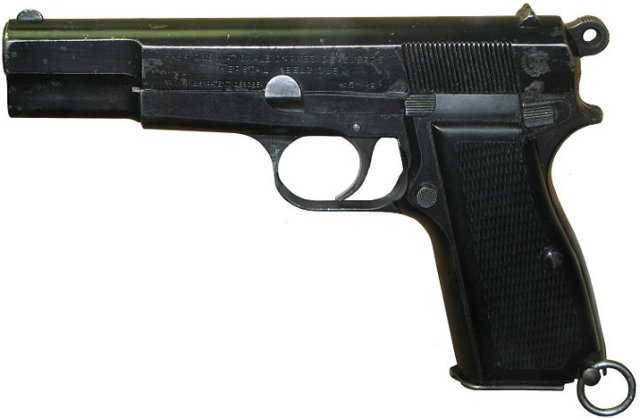
The new pistol is the Glock 17 Gen4, which fires the same NATO standard 9x19mm cartridge as its illustrious predecessor. However the Glock holds 17 rounds as opposed to the Browning’s 13 — and even more crucially the new weapon can be carried with a round in the chamber ready to shoot at a moment’s notice due to its modern safety mechanisms, a practice which was normally forbidden with the Browning.

[. . .]

The now superseded weapon was designed way back in the 1920s by the legendary weapons engineer John Browning and first manufactured by Fabrique Nationale of Belgium in 1935. It was known commercially as the “Browning Hi-Power”. It was first issued to British forces during World War II, and gradually replaced all other pistols then in service to become the UK’s standard military sidearm. In its day it was a great weapon, and pistol design has evolved only incrementally since then, but today’s handguns are measurably superior and it was surely time for a change — the more so as the existing Brownings must have been pretty worn out by now.

The wars in Iraq and Afghanistan have enabled the British forces to slowly and belatedly sort out their dire personal-weapons situation of the 1990s. The crappy Royal Ordnance/BAE Systems SA80 (L85A1) rifle was rebuilt in German factories so that it is now a good weapon, and proper belt-fed light machine guns and 40mm grenade launchers were procured. Other popular pieces of kit such as the L115A1 sniper rifle (from the famous Portsmouth firm Accuracy International, perhaps better known under its commercial name Arctic Warfare Super Magnum), the new combat shotgun and the new 7.62mm Sharpshooter rifle have also appeared in response to battlefield needs. Now with the new Glocks, at last, pretty much all the personal weapons carried by British troops today can be said to be first-class.

The Browning 9mm was first handgun I ever fired, and is still one of my favourites:

September 15, 2011

Belgium “without a government may be remembered as an economic and political golden age”

Filed under: Europe, Government, Politics — Tags: , — Nicholas @ 12:00

Doug Saunders looks at the situation in Belgium, which has gone without a government for over 450 days so far:

To look around the elegant city of Antwerp, you wouldn’t know that Belgium has now gone longer without a government than any country in modern history.

The trains still run on time, the teachers show up in their classrooms, museums are packed, taxes are collected, welfare is paid, and the country’s F-16 fighter jets are dropping bombs in Libya — even though Belgium has now gone a year and a quarter without a federal government, after the June 13, 2010 elections produced no majority and the feuding parties became locked in perpetual disagreement over coalition plans.

[. . .]

For some, this might sound like a libertarian’s idea of utopia: A country with nobody to raise taxes, or to slash spending, or to introduce major new government programs.

And indeed, Belgium has just managed, despite having only a largely powerless caretaker government, to post second-quarter economic growth rates — of 0.7 per cent — that exceeded neighbouring Germany, France and Britain. The country’s world-leading beer industry, analysts say, has remained aloft as the world drinks away its financial sorrows. And the government deficit has even been cut somewhat.

Well, it’s rather short of an anarchist’s utopia, but it’s a bit closer to a minarchist’s version. The “government” in question is, of course, the political one: the bureaucracy is still ticking over as before (one wonders if they’ve noticed the lack of politicians and their sometimes malign influence over the everyday activities of the bureaucracy).

It should be no surprise that the lack of new political initiatives has had a moderating influence on the business environment: it has reduced some of the “normal” instability of government activity. The European market and the world markets are still providing sufficient distortion and uncertainty, of course, but at least for some businesses they are not having to make business decisions with a wary eye on the current prime minister’s whim.

May 11, 2011

Belgian newspapers win appeal against Google

Filed under: Europe, Law, Liberty, Media — Tags: , , , , — Nicholas @ 07:45

Apparently, even a short summary and a hyperlink are considered to be a violation of copyright in Belgium:

A Belgian appeals court has upheld an earlier ruling that Google infringes on newspapers’ copyright when its services display and link to content from newspaper websites, according to press reports.

The search engine giant is responsible for infringing the copyrights of the papers when it links to the sites or copies sections of stories on its Google News service, the Belgian Court of Appeals said, according to a report in PC World.

Google must not link to material from Belgian newspapers, the court said, according to the report (in French). No translation of the ruling is yet available.

[. . .]

The newspapers argued that they were losing online subscriptions and advertising revenue because Google was posting free snippets of the stories and links to the full article on Google News.

Google’s search engine offers links to the websites it indexes but also to “cached” copies of those pages. The copies are stored on Google’s own servers.

April 11, 2011

Political grandstanding at the expense of Muslim women

Filed under: Europe, France, Law, Liberty, Religion — Tags: , , , , — Nicholas @ 09:22

Josie Appleton points out the logical inconsistencies of the various European “Ban the Burkha” movements:

In spite of the grave crisis of the Euro, the French cabinet will today (19 May[, 2010]) find the time to discuss a draft law banning the wearing of full-face veils in public places. Spain has just slashed public wages and is on the verge of economic collapse, yet the minister of work yesterday made the effort to visit Lleida and voice his support for the mayor’s plan to prohibit full Islamic facewear in the streets. Last month, Belgium’s coalition government had dissolved and there was talk of splitting up the country, yet the parliament managed to unite 136 out of 138 deputies to vote through a law banning the burqa and niqab.

How is it that European leaders, in such difficult times, have invested such energy in the matter of women’s facewear? Why was a Spanish schoolgirl who insisted on wearing a headscarf so fascinating as to draw the media’s attention away from government cuts? Why such detailed discussions on the intricacies of Islamic veils? Newspapers feature pullouts on the different forms of Islamic veil, and commentators explain why the niqab is so much worse than the shayla or the chandor, and indeed how the hijab is fine and even liberating for Muslim women.

The burqa-ban laws were introduced with such displays of speechmaking that anybody would think the fate of these countries hung on this single point of principle. One Belgian deputy admitted that ‘the image of our country abroad is more and more incomprehensible’, but said this near-unanimous vote banning the burqa and niqab rescued ‘an element of pride to be Belgian’. A French commission on the veil said the veil was ‘contrary to the values of the Republic’ and the parliament should make it clear that ‘all of France is saying “no” to the full veil’. The Spanish work minister said this clothing ‘clashes fundamentally with our society and equality between men and women. The values of our society cannot go into retreat.’

Lovely sounding stuff in front of the microphones, to be sure. Good photo ops for ambitious politicians, to a clamour of general approval and risking the loss of very little: there were so relatively few women wearing these articles of clothing — and few of them or their husbands/fathers/brothers likely have the vote anyway.

Now, pay heed to the Law of Unintended Consequences. Many of these women now have a choice: disobey the family head by going out in public without wearing the niqab/hijab/burkha (and risk beatings or even honour-killing), or follow the dictates of the family head and risk being arrested by the gendarmes.

How, exactly, is this going to benefit those poor women?

Update: The ban in France was passed in October and goes into effect today:

The centre-right government, which passed the law in October, has rolled out a public relations campaign to explain the ban and the rules of its application that includes posters, pamphlets and a government-hosted website.

Guidelines spelled out in the pamphlet forbid police from asking women to remove their burqa in the street. They will instead be escorted to a police station and asked to remove the veil there for identification.

[. . .]

In Avignon, Vaucluse, Reuters TV filmed a woman boarding a train wearing a niqab, unchallenged by police.

“It’s not an act of provocation,” said Kenza Drider. “I’m only carrying out my citizens’ rights, I’m not committing a crime … If they [police] ask me for identity papers I’ll show them, no problem.”

France has five million Muslims, but fewer than 2,000 women are believed actually to wear a face veil.

Many Muslim leaders have said they support neither the veil nor the law banning it.

March 25, 2010

The Belgian version of “asking for it”

Filed under: Europe, Law — Tags: , , — Nicholas @ 00:34

A recent Belgian court decision is remarkable:

The crime victim, a businessman named only as Laurent, had been living in a suburb of Charleroi, in Belgium’s depressed French-speaking southern region of Wallonia.

He moved north after a series of violent attacks and robberies on his family but was taken to a local court because he had not paid back a grant to renovate his house in 1998.

It sounds fair that you’d be expected to repay a grant for renovations if you leave the area without good reason. I’d have said that these incidents would qualify for the “good reason” criterion:

In 2001, the victim was attacked and his BMW car was stolen. Shortly after it was recovered, armed men stormed his home and stole it a second time.

In 2006, his wife and children were threatened by armed raiders, who stormed his home at night and dragged him away in his pyjamas while his horrified family looked on.

He was later freed and dumped on a industrial estate as the thieves made off with another one of his cars, a Jaguar.

It might be questioned how someone who was able to own multiple expensive cars would be able to qualify for this kind of grant, but that’s a separate issue. But maybe not, as the presiding judge implied:

“It is perhaps not sensible to draw attention to oneself by driving a Jaguar and living in a big house, making an ostentatious display of one’s wealth in a poor and damaged region like Charleroi,” said the judge.

The businessman’s lawyer accused the civil court of supporting “hooligans”.

“In Charleroi, you must drive in a Trabant, wear a tracksuit and live in a slum to be safe from criminals and above reproach from judges,” said Clément de Clety

In other words, the judge really does think he was “asking for it”.

« Newer Posts

Powered by WordPress