
The Laurier Centre for Military Strategic and Disarmament Studies will be starting a series of “live tweets” to remember the 1943 Battle of Ortona. Follow @BattleOfOrtona to get the full story, as narrated by Terry Copp.
December 3, 2011
December 1, 2011
Grim situation for North Korean civilians gets grimmer
Strategy Page reports that the North Korean government is trying to distract the population from a declining economy with talk of an invasion from South Korea:
North Korean media is taking an ominous turn. For much of the year, the big story was that everything would change in 2012, with new housing and more of everything. That failed, as it is obvious to all that the 2012 promises are not going to be fulfilled. The new pitch urges North Koreana to eat less and save food. That military is being praised, as is the artillery attack on South Korea (Yeonpyeong Island) a year ago.
The most visible aspects of the 2012 promises (and the centennial of North Korean founder Kim Il Sung) are many new construction projects in the capital. This effort is not only way behind schedule, but is putting up poorly built structures and killing hundreds of students and others who have been conscripted as unskilled labor. The government puts a positive spin on the construction, but darker views get around, despite government efforts to control the news.
While North Koreans are warned about hunger, the government is silent on why they are going to be cold. The government has greatly increased coal exports to China, meaning prices have doubled in some parts of North Korea. The government denies that exports are up sharply, but won’t say anything about the rising prices. Meanwhile, illegal tree cutting is increasingly common as people seek fuel with which to survive the cold weather. Satellite photos show the sharp difference between forestation in the north and south. Foreign aid groups believe that at least three million North Koreans are in danger of starvation. Many more North Koreans are eating less. But many North Koreans are living better. The market economy, but the legal markets and the black market, increasingly thrive.
Comments Off on Grim situation for North Korean civilians gets grimmer
November 16, 2011
Don’t expect China to save your economy
Jon, my former virtual landlord, sent along this link which should pour cold water on the notion that China will step in to save the economies of other countries:
China’s economy has a reputation for being strong and prosperous, but according to a well-known Chinese television personality the country’s Gross Domestic Product is going in reverse.
Larry Lang, chair professor of Finance at the Chinese University of Hong Kong, said in a lecture that he didn’t think was being recorded that the Chinese regime is in a serious economic crisis — on the brink of bankruptcy. In his memorable formulation: every province in China is Greece.
The restrictions Lang placed on the Oct. 22 speech in Shenyang City, in northern China’s Liaoning Province, included no audio or video recording, and no media. He can be heard saying that people should not post his speech online, or “everyone will look bad,” in the audio that is now on Youtube.
In the unusual, closed-door lecture, Lang gave a frank analysis of the Chinese economy and the censorship that is placed on intellectuals and public figures. “What I’m about to say is all true. But under this system, we are not allowed to speak the truth,” he said.
Despite Lang’s polished appearance on his high-profile TV shows, he said: “Don’t think that we are living in a peaceful time now. Actually the media cannot report anything at all. Those of us who do TV shows are so miserable and frustrated, because we cannot do any programs. As long as something is related to the government, we cannot report about it.”
China, for all its amazing growth and rising economic prospects for (some of) its population, is still not a modern economy. The government — specifically the military — is too deeply involved at far deeper levels than other governments and the reported economic figures may or may not have any relationship with reality. When your boss is a general, he has ways of ensuring that you report the “right” results that a civilian CEO cannot match. It’s not just your job you risk by reporting unwelcome results.
I’ve ridden this hobby horse, as Jon calls it, many times over the years.
Comments Off on Don’t expect China to save your economy
November 14, 2011
Retired Gurkha soldiers changing the face of security services in Britain
An interesting article at the BBC website details how many retired Gurkha soldiers have found civilian careers in security a good follow-up to their military service:
It has been suggested that some Gurkhas are struggling to cope with the cost of living in the UK, with the British Gurkha Welfare Society saying about 25,000 of those who retired before 1997 still only receive a third of the pension of their British and Commonwealth former comrades.
But a recent study suggested that Gurkhas of working age are the most economically active and self-reliant social group in Britain.
The University of Kent research found the employment rates among Gurkha men and women are particularly high, at 95% for men under 60 and 93% for women under that age.
It also showed that security is the most popular job for male veterans. Ex-military people joining the security industry is nothing new, but security companies are capitalising on the Gurkhas’ formidable reputation.
G4S set up Gurkha Services in 2007 and it now employs at least 600 people across 27 contracts.
They are involved in guarding the UK’s “critical infrastructure”, such as power stations and railways, from vandals, protesters and thieves. Rarely a day goes by without some story about how cable theft has disrupted a train journey or caused a power outage. Now Gurkhas are the new front line against the crime wave.
Comments Off on Retired Gurkha soldiers changing the face of security services in Britain
November 11, 2011
In memorium
A simple recognition of some of our family members who served in the First and Second World Wars:
The Great War
- Private William Penman, Scots Guards, died 1915 at Le Touret, age 25
(Elizabeth’s great uncle) - Private David Buller, Highland Light Infantry, died 1915 at Loos, age 35
(Elizabeth’s great grandfather) - Private Walter Porteous, Northumberland Fusiliers, died 1917 at Passchendaele, age 18
(my great uncle) - Corporal John Mulholland, Royal Tank Corps, died 1918 at Harbonnieres, age 24
(Elizabeth’s great uncle)
The Second World War
- Flying Officer Richard Porteous, RAF, survived the defeat in Malaya and lived through the war
(my uncle) - Able Seaman John Penman, RN, served in the Defensively Equipped Merchant fleet on the Murmansk Run (and other convoy routes), lived through the war
(Elizabeth’s father) - Private Archie Black (commissioned after the war and retired as a Major), Gordon Highlanders, captured at Singapore (aged 15) and survived a Japanese POW camp
(Elizabeth’s uncle)
In Flanders fields the poppies blow
Between the crosses row on row,
That mark our place; and in the sky
The larks, still bravely singing, fly
Scarce heard amid the guns below.We are the Dead. Short days ago
We lived, felt dawn, saw sunset glow,
Loved and were loved, and now we lie
In Flanders fields.Take up our quarrel with the foe:
To you from failing hands we throw
The torch; be yours to hold it high.
If ye break faith with us who die
We shall not sleep, though poppies grow
In Flanders fields.Lieutenant Colonel John McCrae, MD (1872-1918)
Comments Off on In memorium
November 8, 2011
Every infantryman a machine-gunner
Lewis Page on the new lightweight ammunition the US Army is considering introducing:
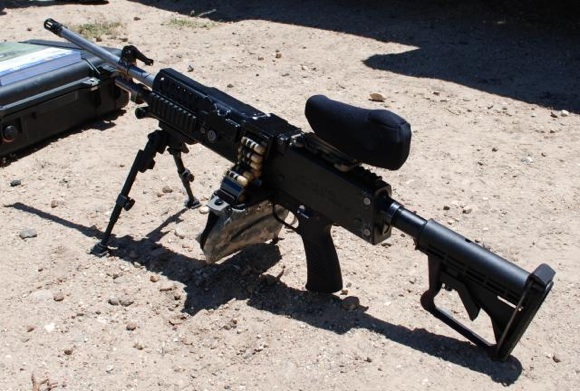
The US Army has announced successful tests of a new, lightweight portable machine-gun which fires special plastic ammunition. The gun and ammo are so much lighter than current weapons and their brass-cased cartridges that some soldiers are suggesting that every infantryman could in future pack the sort of firepower reserved today for heavy-weapons specialists.
[. . .]
[M]ost soldiers are armed with assault rifles not intended to deliver sustained automatic fire and holding less ammo. These lighter weapons are handier for close-in fighting and permit other kit to be carried.
But US military boffins at the famous Picatinny Arsenal have been working on this situation for some time. Since ammo weight and bulk is much of the problem, they have come up with a new kind of ammunition: Cased Telescoped cartridges.
In a cased telescoped round, the bullet is no longer attached to the tip of a brass case full of propellant powder. The new case is shorter, fatter and made of plastic, so weighing substantially less, and the bullet is sunk into the middle of the propellant which makes the whole round shorter — it has been “telescoped”. A shorter round weighs less itself, and also means that the gun’s action, feed equipment etc is smaller and thus lighter as well. It’s a trick originally developed for tanks, to make the turret smaller and easier to protect.
According to the Picatinny scientists, their new LMG and a thousand rounds of its plastic-cased-telescoped ammo weigh no less than 20.4 pounds less than the current M249 (a version of which is also used by British troops) and a thousand ordinary 5.56mm brass cartridges. The new LMG shaves no less than 8.3 pounds off the 15.7-lb M249, coming in at just 7.4lb — actually lighter than a standard British SA80 assault rifle! This, perhaps, explains Specialist Smith’s opinion that it would be reasonable for all soldiers to carry such weapons, rather than just heavy-weapons specialists.
October 24, 2011
Government to freeze Canadian Forces at current size and sell off surplus properties
David Pugliese reports on the federal government’s announced freeze-and-sell-off in the Department of National Defence:
The size of the regular Canadian Forces will be frozen at 68,000 people for the next several years and the military and Defence Department will look at selling off property and shutting down facilities as part of its belt-tightening, according to documents obtained by the Ottawa Citizen.
The new directive from Chief of the Defence Staff Gen. Walter Natynczyk and Deputy Minister Robert Fonberg outlines in broad terms how DND and the Canadian Forces plan to deal with a tighter fiscal situation between now and 2016.
A national plan will be developed for DND’s property holdings, putting emphasis on only keeping sites that support operations, the directive notes.
[. . .]
DND’s property holdings are massive, comprising of approximately half of all federally owned buildings. They include various bases across the country. In total DND has 21,000 buildings and 800 parcels of land covering 2.25 million hectares.
That portfolio also includes a large number of buildings with cultural and historical significance to local communities. There are 318 buildings that are considered as heritage structures, including the Cartier Drill Hall in Ottawa, La Citadelle in Quebec City and the Seaforth Armoury in Vancouver.
But the reference to dumping property has some wondering whether base closures could be coming.
Comments Off on Government to freeze Canadian Forces at current size and sell off surplus properties
October 6, 2011
Britain suffered higher proportional casualties than the US in Afghanistan
A brief item from Strategy Page on the relative casualties suffered by the major allied combatants over the course of the Afghanistan campaign:
In ten years of combat in Afghanistan, some 2,700 foreign troops have died. Most (67 percent) were American. The next two nations in terms of combat losses were Britain (14.1 percent) and Canada (5.8 percent). Adjusted for population size, Britain suffered five percent more combat deaths than the United States. On the same basis, Canada suffered about 80 percent as many deaths as the United States.
All three of these nations had their troops in the south (Kandahar and Helmand provinces, where most of the heroin came from) or along the southeast border (mainly Pakistan’s North Waziristan area, long a sanctuary for Islamic terror groups). There were a few other NATO nations, plus Australia, that had small contingents in the south, but most NATO nations put their troops in more peaceful north, with orders to stay out of trouble and avoid casualties.
Comments Off on Britain suffered higher proportional casualties than the US in Afghanistan
October 3, 2011
September 27, 2011
Britain (finally) admits it will “never again be among the global superpowers”
For something that’s been obvious to casual observers since 1945 (1956 if you’re generous), it’s taken a while to admit:
The warning comes from the Royal United Services Institute (RUSI) thinktank in a tough report which questions whether Britain’s defence crisis is really over.
Last year’s Strategic Defence and Security Review led to sweeping redundancies across all three services, and the early mothballing of, among others, the aircraft carrier Ark Royal, and the fleet of Harrier jets.
In a brutally frank assessment of the British military, the report states: “The UK will never again be a member of the select club of global superpowers. Indeed it has not been one for decades.
“But currently planned levels of defence spending should be enough for it to maintain its position as one of the world’s five second-rank military powers (with only the US in the first rank).”
Many in the military are likely to bridle at the analysis; last week the former head of the Royal Navy, Admiral Lord West, struck a completely different tone, causing a furore when he said the UK should not consider itself a second-tier power like “bloody Belgium or Denmark”.
Except for brief wartime surges, Britain’s military strength has rarely been the army: it’s been the Royal Navy that provided Britain with both military and economic clout. Gutting the striking power of the navy (HMS Ark Royal and the Harriers) was merely the final admission that the government had higher priorities domestically than internationally. As Admiral Cunningham once said, “It takes three years to build a ship; it takes three centuries to build a tradition. It’s remarkable how quickly one can destroy a tradition.
September 24, 2011
Canadian military: “the bureaucratic tail is wagging the Parliamentary dog”
Christie Blatchford looks at the amazing ability of the military bureaucracy to frustrate, delay, obfuscate, and disobey their parliamentary masters:
Written by distinguished military scholar and veteran Dr. Jack English, it shows how the bureaucracy in Ottawa — an incestuous nest of regular army bosses with turf to protect and intractable civil servants — has consistently ignored or thwarted government directives to increase the size of the reserves.
What’s more, either those defence ministers whose pledges came to nought had the collective attention span of gnats, or they failed to grow a set of nuts sufficient to demand their instructions be followed, or they were simply shifted within Cabinet and the new fellow came in.
Any way you look at it, Dr. English says, the bureaucracy is calling the shots.
In the result, despite pledges to grow the reserves, the militia part-time head count remains still at about 16,500, or, as Dr. English wryly notes, about the size of National Defence Headquarters, or NDHQ as it’s called.
By the way, just getting the damn numbers out of NDHQ is a trick.
[. . .]
Virtually everyone who has studied the Canadian army, and their number is legion, agrees on a couple of things: The bureaucracy is obscenely bloated, far out of proportion for the size of the army; the citizen soldier, who until called up to full-time service costs only about 20% of the regular one, is a bargain for the taxpayer; the militia is more diverse, ethnically and otherwise, than the regular army.
Comments Off on Canadian military: “the bureaucratic tail is wagging the Parliamentary dog”
September 21, 2011
Report shows military bureaucracy defied government orders
It’s not really a surprise that the bureaucrats don’t want to increase the size of the militia, but it is surprising that they’ve been willing to ignore direct government orders on the subject:
Canada’s bloated military bureaucracy has consistently defied explicit orders from government ministers and failed to increase the size of the army militia as directed.
The accusation is made in a scorching but carefully documented report done by pre-eminent military scholar Jack English for the Canadian Defence and Foreign Affairs Institute and obtained in advance of its release Wednesday by only a few media outlets, including Postmedia.
It is a “wretched saga” that Mr. English describes as marked by “sandbagging, obstruction, futile wheel-spinning, and endlessly wasted staff effort.”
Using statements made by a series of defence ministers and recommendations either from special commissions or in government “White Papers” — all of them pledging or urging that the part-time militia or reserves, whose members most proudly call themselves citizen-soldiers, would grow — Mr. English shows how bureaucrats and leaders within the regular army, who saw any move to increase the militia as a threat, stubbornly stymied the wishes of their political masters.
In the numbers game, NDHQ has drawn level with the entire militia force, and like all bureaucracies, wants to continue to grow.
Comments Off on Report shows military bureaucracy defied government orders
September 20, 2011
Finnish MP calls for military coup in Greece
I guess somebody felt they needed a bit of international headline stimulant:
Jussi Halla-aho, an MP for the populist True Finns party, wrote on social networking website Facebook on Wednesday that the Greek government should use military force against workers on strike.
“What Greece needs at this particular point in time is a military junta that would not have to worry about its popularity and could use tanks to enforce some order among strikers and rioters,” Halla-aho wrote.
The Facebook entry soon sparked outrage, with Halla-aho removing it and retracting his comment.
Comments Off on Finnish MP calls for military coup in Greece
September 18, 2011
The Pentagon’s current big fear: the sequester
George F. Will explains why Leon Panetta, the secretary of defense, is very worried about the outcome of the “supercommittee” deliberations:
This would take from military budgets nearly $500 billion, in addition to a minimum of $350 billion cuts already scheduled. An almost trillion-dollar trimming, Panetta says flatly, “cannot take place.” Actually, he knows it can: “The gun to the head could really go off.” Even without a sequester, the military “is going to be a smaller force.” And with a sequester? The 1.5 million active-duty members of the armed services and 700,000 civilian employees of the Defense Department depend on an industrial base of more than 3.8 million persons. According to the Pentagon, a sequester would substantially shrink those three numbers, perhaps adding a point to the nation’s unemployment rate. The cuts would leave the smallest Army and Marine Corps in more than a decade and the smallest tactical Air Force since this service became independent of the Army in 1947. The Navy has already shrunk almost to its smallest fleet size since World War I.
Time was, when Democrats looked at the defense budget with a skeptical squint, Republicans rallied ’round it. No more. Few tea partyers remember Washington’s hawk-versus-dove dramas. They live to slow spending, period. They are constitutionalists but insufficiently attentive to the fact that defense is something the federal government does that it actually should do. And when they are told that particular military expenditures are crucial to force projection, they say: As in Libya? Been there, don’t want to do that.
Much of the defense budget is consumed by pay and health care for uniformed personnel, who have been abused enough by repeated deployments. The priciest new weapon, the stealthy F-35 Joint Strike Fighter (at least $90 million per plane), is vital for the continued salience of aircraft carriers, which are the basis of the U.S. strategic presence in the Western Pacific. Inferring China’s geopolitical intentions from its military purchases is difficult, but Panetta says guardedly that in five years China’s force projection will be “much better.” The Marines, with their smaller carriers, need a short-takeoff model F-35. Cut the number of planes built, the cost per plane rises, and the ability to recoup costs through sales to allies declines.
Comments Off on The Pentagon’s current big fear: the sequester
September 15, 2011
Is the end of the manned fighter plane at hand?
Yes, I know we’ve gone through this discussion before (and the comment thread on that first entry is still a good summary of the counter-arguments). Air-to-air combat has become only a small part of what the air forces of the world are expected to do: ground support, while generally disdained by air force brass hats, is the most common combat task now. Here’s the state of play, according to Strategy Page, as far as the future of air combat is concerned:
The last decade has revolutionized air warfare, and air forces. This revolution was brought about by two technologies (smart bombs and UAVs) that have been around for decades but, over a decade ago, became reliable and capable enough to have a decisive effect on warfare. Now UAVs armed with smart bombs are poised to replace manned aircraft. Moreover, the proliferation of GPS guided weapons and short range guided missiles have greatly reduced the need for ground strikes by manned or unmanned aircraft. Since World War II, air forces have demanded, and obtained, a disproportionate share of military budgets. No more.
[. . .]
Underlying all of this is the appearance of so many cheaper, reliable, precision weapons in the last decade. This has changed tactics on the ground. While the air force doesn’t like to dwell on this, it’s the war on the ground that is decisive, not what’s going on in the air. This proliferation of precision has also changed the way smart bombs were designed. With the ability to put a weapon within a meter of the aiming point (using laser guidance) or 5-10 meters (using GPS), smaller is now better, at least in urban areas where there are a lot of civilians about, troops have changed the way they fight. There is more movement in urban warfare because of all this precision firepower, and fewer friendly fire casualties from bombs and artillery. But it’s not just the air force and their smart bombs that have brought this on. The army had precision missiles on the ground long before JDAM came along. Now the army has more of them. Thus, over the last five years, there has been a competition between the army and air force to develop smaller, cheaper and more precise, missiles and bombs.
[. . .]
The air force is not happy about the army having a large force of armed UAVs. Many air force generals believe the army should not have the MQ-1C, or at least not use them with weapons. That has already caused some spats in the Pentagon over the issue, but so far the army has prevailed.
The army argument is that these larger UAVs work better for them if they are under the direct control of combat brigades. The air force sees that as inefficient, and would prefer to have one large pool of larger UAVs, that could be deployed as needed. This difference of opinion reflects basic differences in how the army and air force deploy and use their combat forces. The army has found that a critical factor in battlefield success is teamwork among members of a unit, and subordinate units in a brigade. While the air force accepts this as a critical performance issue for their aircraft squadrons, they deem it irrelevant for army use of UAVs. Seeing army MQ-1Cs doing visual and electronic reconnaissance and firing missiles at ground targets, the air force sees itself losing control of missions it has dominated since its founding in 1948.
[. . .]
Meanwhile, the navy has taken the lead in developing larger, jet propelled UAVs like the 15 ton, X-47B. This UAV uses a F100-PW-220 engine, which is currently used in the F-16 and F-15. The X-47B can carry two tons of bombs or missiles and maneuver like a jet fighter. The X-47B is fast and agile enough to carry out air-to-air missions. With the right software, it can do this autonomously (without human intervention). This is being worked on, and the navy already has perfected the software that enables a UAV to land on aircraft carriers.
The coming decade will see more and more UAVs replacing manned aircraft. Thus after only a century in action, manned combat aircraft are on their way out.


