Quotulatiousness

March 27, 2011

QotD: One-minute Imperialism

Filed under: Africa, Military, Quotations — Tags: , , , , — Nicholas @ 10:17

It is the height of recklessness, a kind of blasé barbarism, to start a war without knowing what the war is for. We are witnessing the transformation of Libya into a giant laboratory for a zany, unpredictable experiment to see what happens when you mix Tomahawk missiles with a volatile Arab uprising. It makes even the ill-considered debacles in Iraq and Afghanistan look like the height of rationality in comparison.

The made-up nature of the war, its speedy and brainless cobbling together by Western leaders keen to make a quick point by firing a few hundred missiles at Gaddafi, explains why the so-called Western alliance is so spectacularly flimsy. This must be the most shortlived alliance in human history. It lasted about 24 hours — at a push 36 hours — before Washington announced that it would ‘tone down’ its involvement and agitate for NATO to take over. Perhaps keen to satisfy the needs of the 24-hour rolling news agenda, America has just overseen the world’s first-ever outburst of 24-hour imperialism.

Brendan O’Neill, “The most shortlived alliance in human history”, Spiked!, 2011-03-22

March 25, 2011

Libya operations do not support UK’s recent defence decisions

Filed under: Africa, Britain, Military — Tags: , , , , , — Nicholas @ 12:15

Lewis Page is doing an analysis of the current British involvement in Libya. He points out that many of the recent decisions by the British government are not being proven by the actual pattern of combat:

Recent combat operations by British and allied forces in Libya are beginning to tell us a lot: not so much about the future of Libya, which remains up for grabs, but about the tools one actually needs for fighting real-world wars against real-world enemy armed forces.

The vast bulk of our own armed forces are set up, equipped and focused on this type of mission — rather than the hugely more common one of battling guerillas and insurgents, as seen in Afghanistan — so the Libyan operations of the last week are very important to us at a time of shrinking budgets and worldwide turbulence. Libya is telling us how well the Coalition government did in its recent Strategic Defence and Security Review — and bluntly, it is showing that the Review was a fiasco.

Mr. Page has not been a fan of the Eurofighter, and sees the initial stages of the Libyan campaign as proving the investment is so much wasted money:

. . . highly advanced specialist air-to-air combat capability has not been necessary here. The RAF has rushed Eurofighter Typhoons to Italy — they were the first British aircraft to arrive there, in fact — but they are pure air-to-air planes at the moment (the RAF doesn’t expect to have them properly ready for use as bombers until 2018). The odds are that they will not fire a shot — and if they do it will be to swat down some rusty old MiG flown by a suicidal pilot. For this job, much cheaper fighters would have been more than adequate: say American F-18s or F-16s, or even our previous embarrassing Tornado F3, now retired.

So, point one: buying the Eurofighter remains a stupid idea on our part.

Canada’s F-18 aircraft have seen more combat in Libyan airspace than the RAF’s Eurofighters, because the F-18 has a ground-attack capability.

On the other hand, Mr. Page rejoiced at the overdue decision to scrap the Nimrod, but the ancient-but-terribly-expensive aircraft appear to have a valid role to play in Libya:

Point two: electronic warfare and AWACS planes are useful, even against the minor regimes who we might genuinely fight in the real world. The decision to keep both in the recent UK Defence Review was sensible (the Nimrod R1 Elint planes were marked for the bin — and have been temporarily been reprieved for duty in the Libyan situation — but replacement “Rivet Joint” aircraft are on order).

The use of the Tornado aircraft for very long range attacks seems like a waste of time and resources:

We are told in official announcements that some 112 Tomahawk cruise missiles were used in the initial strike at the weekend, launched from US and British warships and submarines off the Libyan coast. We are also told that “a number” of Storm Shadow shorter-ranged cruise missiles were launched from Tornado bombers. The Tornadoes had flown 3,000 miles from Kent Norfolk to do so, requiring the aid of repeated air-to-air refuelling assistance both on the way out and on the way back.

We can be pretty sure what the unspecified number of Storm Shadows was, as the Tornado can carry only one Storm Shadow into combat and we are told that a total of four Tornadoes have been assigned to Operation ELLAMY, the British contribution to the Libyan fighting. Some accounts suggest that in fact only three Storm Shadows were fired in the initial long-range Tornado raid.

[. . .]

Our lesson from a shooting war against a national air force — the first we have fought since 1982 — is that you don’t suppress enemy air defences of the sort you actually meet in the real world with deep penetration bombers and clever air-launched weapons (far less with stealth planes). You do it with AWACS and Elint planes and Tomahawks launched from the sea.

And speaking of the sea . . . what about the Royal Navy contribution to the Libya campaign?

Don’t we just wish we had a carrier off Libya now? Shame we scrapped ours just months ago. Nice work, Mr Cameron

There can be little doubt that the Harrier would also have been better for Libya. The Harrier fleet actually had more aircraft modernised to drop the latest smart weaponry — it was a superior battlefield strike plane — and it was cheaper to run. Best of all, it could operate from our also-recently-axed pocket aircraft carriers right off the coast and thus reach the theatre of action in minutes rather than hours. France and the USA both have carriers operating off the Libyan coast right now, but our foolish decisions in the recent review have left us on the sidelines.

Mr. Page still thinks the Royal Navy got royally shafted by the RAF:

Point four: The decisions taken over many years to whittle down the Harrier force to the point where it was barely viable – and then finally axe it in the Review — were totally wrong. Instead the Tornado should have been scrapped. Our present-day fleet of more than 130 of these cripplingly expensive-to-run, slow, lumbering low-altitude jets, assisted by similarly costly tanker planes, has offered us an utterly pathetic capability to deliver three or four dodgy missiles into Libya and a minimalist air support capability thereafter.

Even by the time of the Review, when the Harrier fleet was down to an almost unviable 44 jets, it would have made more sense to keep them, scrap the Tornado and buy or lease some nice cheap F-18s from America to bulk up our strike forces somewhat. The RAF should be ashamed of itself for manipulating the Prime Minister into keeping Tornado; heads should roll.

Is it too late to save the Ark Royal and Invincible? Yes:
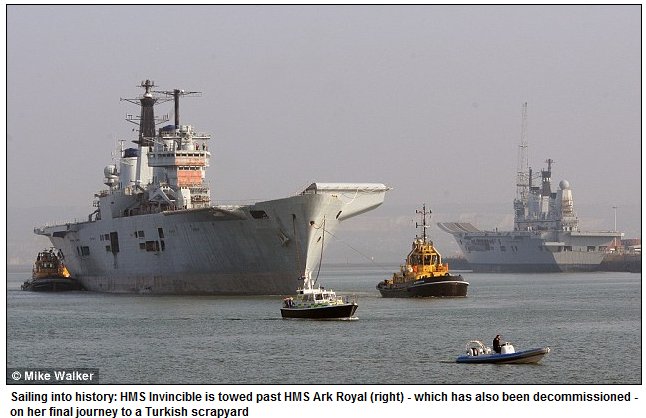
To make the situation even more pathetic:
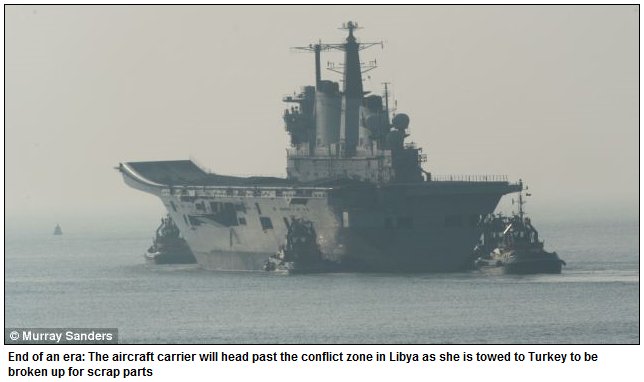
Once, this would have been a sight to strike fear into the hearts of any enemy fleet, a vivid portrait of the naval clout of this island nation.

But, today, these are two ghost ships. This depressing photograph taken yesterday is merely a reminder of the current state of the Royal Navy. Until recently, Britain had three aircraft carriers. The latest round of defence cuts means we have just one carrier — HMS Illustrious — and no planes on board. It only does choppers these days.

Invincible is bound for the Middle East. But Colonel Gaddafi need have no fears about this gallant old warhorse. In a few days’ time she will be off the coast of Libya but she won’t be stopping. She’ll be pressing straight on for Turkey where she is due to be cut up — or ‘recycled’ as an MoD spokesman insisted yesterday.

Back to Mr. Page’s conclusions (not that there should be any surprises based on the examples I’ve included):

Summing up, the lesson of Libya is that the recent Defence Review was, indeed, a dismal failure. RAF empire-preservation saddled us with the useless Tornado at the cost of our carrier capability. The army insisted on preserving pointless tanks and big guns and as a result we are not pulling our weight in Helmand — a war we more or less unilaterally started in 2005 — and we have no option to intervene on the ground in Libya seriously.

The navy made no real effort to help matters. It might have managed to preserve a carrier capability by making concessions on its pointless frigate flotilla, but this it refused to do.

[. . .]

But the chance to change things is not gone yet. So badly fudged were the Strategic Defence and Security Review’s figures that more reorganisation remains on the cards; in effect, a review of the Review is now very likely. The chance is still there to scrap the cripplingly expensive Tornado and Eurofighter altogether and replace them with cheap, excellent F-18s — so getting our carrier capability back in just a few years, as well. When the F-35C actually becomes affordable at last around 2025 we can buy some — by that point its Stealth and other new technologies might actually be becoming relevant for wars that might really happen, along the lines of Libya.


March 23, 2011

Naming conventions, military style

Filed under: Africa, France, Military, USA — Tags: , , — Nicholas @ 12:44

Jon sent me this link on the highly inappropriate name given to the military actions against Libya:

As Jonah Goldberg wrote, the name approved by Barack Obama, Odyssey Dawn, sends a slightly different message than perhaps intended:

Odyssey, after all, is a term for a very long and involved adventure. If memory serves, Odysseus took a very long time to come home. Maybe it’s just a coincidence that the Pentagon came up with a label that basically says this is beginning of an extended, seemingly endless, journey.

I had the exact same thought — and shouldn’t a man with a classical Ivy League education have caught that reference? Even if Obama was not familiar with The Odyssey, the dictionary definition of “odyssey” should have raised a red flag:

Definition of ODYSSEY
1: a long wandering or voyage usually marked by many changes of fortune

For a mission that is supposed to be counted in “days, not weeks,” it looks like Obama’s choice of mission names is an epic failure.

I’d written, quite some time back, about the national differences in how Anglosphere nations named their military operations:

I often note with amusement the significant differences in naming conventions for military operations between the US and the rest of the “Anglosphere”. A typical US Army operation might be “Operation Devastating Earthshatterer”, while a British or Canadian equivalent might be “Operation Broken Teaspoon” or “Operation Goalie Glove”. (I’ll pass up on the urge to attribute something mockery-tinged to French codenames . . . but only because Babelfish didn’t give me a useful translation for “Operation Wet Knickers” or “Operation Big Girl’s Blouse”).

Not that there’s anything wrong with a dose of belligerant overkill in your naming conventions. . .

How quickly things change: the former “cheese-eating surrender monkeys” have become the leaders of the military coalition, while the Americans were on the verge of transforming into “burger-eating surrender monkeys”.

March 16, 2011

Japan’s plight distracts the world from Libya

Filed under: Africa, Europe, Media, Military, USA — Tags: , , , , — Nicholas @ 07:43

As we all feverishly check the media reports for updates on rescue efforts for survivors of the earthquake and tsunami in Japan, or even more urgently try to figure out the actual situation in and around the crippled nuclear reactors at Fukushima, it’s a huge boon to Moammar Gadhafi as he works on crushing the rebellion in Cyrenaica:

The megalomaniacal Gadhafi entertains many fantasies. Not so long ago, taking control of Egypt, via assassination or divine acclamation, was among them. Now, as he and his corrupt clique fight for survival, his loyalist and mercenary forces need only take Benghazi and Tobruk.

Crack Tobruk, and the Libyan rebels have three choices: surrender, seek asylum in Egypt or head for the deep southern desert and wage a longshot guerrilla war. Surrender is defeat, followed by mass executions and mass gravesites. Asylum is defeat — as the rebels hole up in Cairo, Gadhafi will launch bloody reprisals against Cyrenaica’s people. As for a guerrilla war waged from the Sahara? Gadhafi will have an air-power advantage. The coastal cities will also provide him with thousands of hostages (the guerrillas’ relatives) to torture and kill.

Rebel options, post-Tobruk, are dreadful. The mass graves outside the cities will be hideous. The long-term strategic implications of a Gadhafi victory are also hideous.

Why can’t NATO or the UN or the G-8 agree to impose a no-fly zone on Libya’s dictator? The Obama administration, whatever its latest rhetoric, has willingly enmeshed itself in a multilateral spider’s web of narrow interests, fear and greed. At some level, Gadhafi serves Russian and Chinese commercial arrangements. Europe fears the appearance of colonialism. The pertinent phrase here is, “Gadhafi is the devil we know.”

Update: George Jonas thinks the crowding-out of Libyan affairs is a boon to Barack Obama’s administration:

The disaster also gives Barack Obama and colleagues some breathing space. Based on past performance, that’s not necessarily a good thing. Instead of talking softly and carrying a big stick, our leaders bluster and carry nothing. By letting Gaddafi know they’ll be merciless to him in a defeat they aren’t lifting a finger to inflict, they’re only telling the strongman that standing firm is his best bet.

When Gaddafi takes their advice, Obama and his mates first cry foul, then develop a sudden urge to examine their fingernails. Having shown themselves to be large of mouth, short of sight and faint of heart, the earthquake in Japan offers them a reprieve.

Can’t they use a reprieve for something constructive? In fairness, at this juncture there isn’t a whole lot anyone can do. Certain problems are solved only by hugs or bear-hugs, and the Middle East isn’t conducive to either. The West’s enemies are too numerous to maul, and who, in God’s name, is there to embrace?

March 4, 2011

“Secret space warplane” to launch on secret mission with secret payload

Filed under: Military, Space, USA — Tags: , — Nicholas @ 10:10

Anything that gets Iran’s leadership all worked up into a panic can’t be all bad:

The US Air Force is set to launch its second X-37B miniature unmanned spaceplane — the type famously dubbed a “secret space warplane” by the Iranian government — on Friday.

[. . .]

Once in orbit the X-37B deploys a solar panel array, unlike its bigger cousin the Space Shuttle which uses fuel cells for electrical power. Thus the little robot spaceplane can remain in orbit for much longer periods unsupported before re-entering the atmosphere to make a runway landing. The previous OTV-1 mission, carrying a payload which remains secret, lasted 224 days and ended with a successful landing at the Vandenberg military space base in California.

As yet the USAF has not revealed the planned duration of the OTV-2 mission launching tomorrow, and again details of the payload are not being revealed.

There has been extensive speculation among space watchers regarding just why the USA needs a small robotic spaceplane. For most purposes a more normal spacecraft, unburdened by heat shields for re-entry, would be more economical. Even supposing a need to return to Earth, there would seem to be no need for the X-37B’s Shuttle-style delta wings, which add weight unnecessarily — a capsule design could be used, or a lifting body if runway landing was regarded as essential.

March 3, 2011

Eurofighter Typhoon sets new standard for “bloated expense” and “limited usefulness”

Filed under: Britain, Europe, Military, Technology — Tags: , — Nicholas @ 12:41

Lewis Page is on record as thinking the Eurofighter Typhoon was a bad bargain, but even he is shocked at just how bad a bargain the plane is:

Probably the most dismal figure we are given is that the RAF will actually put into service just 107 Typhoons. At the moment it has received 70: the last of the 160 planes ordered by the UK will be delivered in 2015. But, we are told, “by 2019” all the Tranche 1 jets (which were still being delivered to the RAF at the start of 2008) will be “retired” — that is, thrown away. We’ll pay for 160 jets (actually we’ll pay for 232), but we’ll only ever get a fleet of 107.

This shows the acquisition cost of the Eurofighter/Typhoon in an even worse light than it had previously appeared, when an RAF fleet of 160 had been expected. It is now acknowledged that the development and production cost to the UK of Eurofighter will be £23bn with planned upgrades.

This means that we UK taxpayers will have shelled out no less than £215m for each of our 107 jets — that’s $350m at today’s rates, rather more than the US taxpayers have been made to pay for each of their 185 Raptor superfighters, almost all of which will be used operationally. And the Raptor has third-generation Stealth: the Eurofighter has no stealth features at all. The Raptor has thrust vectoring for unbeatable manoeuvrability in a dogfight: the Eurofighter doesn’t.

But, for all the expense, at least the RAF has a fine, modern, fully in-service fleet? Well, almost:

The lack of planes actually fit to fly is serious — the NAO reports that of the 70 Eurofighters the RAF currently possesses, just 42 are actually available to flying squadrons. And the lack of flight hours has meant that some flyboys haven’t been able to get into the cockpit at all [. . .]

The RAF currently has eight pilots who are capable of undertaking ground attack missions on Typhoon … The Department plans to have sufficient numbers of trained pilots to conduct a small scale ground attack mission by 2014 and aims to deliver sufficient flying hours to train enough pilots to undertake the full range of planned tasks by 2016.

What a joy it is to think that we paid £119m to upgrade the Tranche 1 planes back in 2008 so that they could do ground attack. In 2016 the RAF will finally have the pilots it needs to use this capability: but by then the Tranche 1s will already be being thrown away – all of them will be gone by 2019, remember.

We paid all that money upgrading the Tranche 1s and now we’ll dispose of them without ever having pilots trained to use the upgrade! The Eurofighter story really just gets better and better.

February 21, 2011

RAF cuts pilot training numbers

Filed under: Britain, Bureaucracy, Education, Military — Tags: , — Nicholas @ 10:57

I’ve mentioned this before . . . when a big bureaucracy is forced to cut back, the instinct of most bureaucrats is to cut the “frontline”: if they have extensive public contact, cutting back there to cause the greatest disruption to the public is a common (and often effective) way to protest. The public react to the cuts in service and complain to the politicians, and (too often) the politicians soften or even rescind the cutbacks.

Britain’s Royal Air Force is having to cut back from their current numbers, and have chosen a way that will (they hope) cause some public outcry:

Britain is planning massive cuts in its armed forces, and while exact numbers are still being debated, the Royal Air Force (RAF) has gone ahead and dismissed 25 percent of 400 pilot officers currently in training. This means 20 fighter, 30 helicopters and 50 transport student pilots halt their training and become civilians again. Some of the pilot trainees are only weeks away from completing their training. Over a hundred million dollars has already been spent on the training of those dismissed, and the former officers can probably use that training to quickly complete a civilian flying course, so they can get jobs as civilian pilots.

It will also mean that the almost fully trained pilots will displace an equal number of civilian pilot trainees, and the civil aviation scene in Britain is already over-supplied with willing pilots.

February 11, 2011

Taming the US defence budget

Filed under: Bureaucracy, Economics, Military, USA — Tags: , , , , — Nicholas @ 07:29

The US government is in a financial bind — that’s not exactly news. What is new, however, is that the military may actually have to take cuts, not just smaller increases in the annual budget:

On one side of the argument are fiscal hawks like Rand Paul, newly elected senator from Kentucky, who fear that a national debt heading towards 100% of GDP by the end of the decade is in itself a menace to the nation and defence must take its share of the pain. The sheer size of America’s defence budget puts it in the crosshairs. At around $700 billion a year including war expenditures, it as big as those of the world’s next 20 highest military spenders combined. Last year American defence spending exceeded the average spent during the cold-war years by 50% (adjusted for inflation), while in the past 10 years it has grown by 67% in real terms.

[. . .]

Mr Gates, a canny operator whom Barack Obama retained after he took over from George Bush, began to sniff which way the wind was likely to turn in 2008. He calculated that if he took the initiative, he might stave off deeper and more unwelcome cuts. So he curbed or cancelled more than 30 weapons systems including the army’s Future Combat System, the F-22 Stealth fighter, two missile defence systems and the Zumwalt-class destroyer. Last year he went further, proposing the closure of the Joint Forces Command in Virginia and a 10% reduction in the budget for contract workers for each of the next three years. He asked the armed services to find at least $100 billion worth of “efficiency savings” over the next five years, which he promised to reinvest in other programmes.

[. . .]

Buck McKeon, the Republican who now leads the House Armed Services Committee, has responded with predictable fury to the Gates plan, saying it was “a dramatic shift for a nation at war and a dangerous signal from the commander-in-chief”. Mr Gates can take some comfort from the fact there has been at least as much “incoming” from critics who say he has not gone nearly far enough. They point out that what is being planned is not so much a cut as a small reduction on what the Pentagon had been planning to spend over the next four to five years. The budget will still creep up in real terms until it flattens off in 2015. Given his intention to retire from office later this year, Mr Gates may not have the stomach for attempting anything more radical on his watch.

February 10, 2011

No more manned fighters?

Filed under: Military, Technology, USA — Tags: , , , , , , , — Nicholas @ 12:24

As I said the last time this topic came up, “This is not a repost from 1957”. We may actually be looking at the last generation of manned fighters, if this update from Strategy Page is true:

On February 4th, the U.S. Navy X-47B UCAV (unmanned combat air vehicle) made its first flight. It was three years ago that the navy rolled out its first combat UAV; the 15 ton X-47B. This pilotless aircraft has a wingspan of 20 meters/62 feet (whose outer 5 meter/15 foot portions fold up to save space on the carrier). It carries a two ton payload and will be able to stay in the air for twelve hours. The U.S. is far ahead of other nations in UCAV development, and this is energizing activity in Russia, Europe and China to develop similar aircraft.

[. . .]

All of these aircraft are stealthy and can operate completely on their own (including landing and takeoff, under software control). The UCAVs would be used for dangerous missions, like destroying enemy air defenses, and reconnaissance. Even air force commanders are eager to turn over SEAD (Suppression of Enemy Air Defenses) missions to UAVs. SEAD is the most dangerous mission for combat pilots. But until quite recently, all these projects had either been cancelled, or were headed in that direction.

Now, the U.S. Department of Defense wants the new UAV combat aircraft in service by the end of the decade, some twenty years ahead of a schedule that was planned in the 1990s. The F-35 is expected to cease production in 2034, more than a decade after the first combat UAVs, that can match F-35 performance, enters service.

Unable to buy new aircraft designs (because they are too expensive, or simply take too long to get into service), and facing the prospect of unmanned aircraft (UAVs) displacing more and more manned ones, the American military is spending a growing chunk of its budgets on upgrading and refurbishing the combat aircraft they already have. This was not a deliberate, long term plan, but simply a reaction to shortages of new aircraft. A lot of the new electronics and weapons involved in these upgrades can also equip UAV designs still in development, so such efforts are a double win.

More and more, it looks like the new 36 ton F-22 and 27 ton F-35 are the end of the road for manned fighter-bombers. Not just because the F-22 and F-35 cost so much to develop, but because so much new tech has arrived on the scene that it simply makes more military, and economic, sense to go with unmanned aircraft. Meanwhile, the existing F-15s, F-16s, F-18s, A-10s and all American heavy bombers are being equipped with new targeting pods and combat Internet connections, along with new radars and all sorts of electronics. Older aircraft are having worn out structural components rebuilt or replaced. This buys time until the unmanned aircraft are ready. F-35s will also fill the gap, which may be a very small one.

Usual caveats apply of course, and you could do worse than reading the comment thread on that original post for some of the caveats spelled out.

November 19, 2010

The A400M is a “Euro-wanking make-work project”

Filed under: Britain, Military, Politics — Tags: , , — Nicholas @ 10:32

Gotta love those unbridled opinions in British politics:

A peer and former defence minister has described the A400M military transport plane — which is being bought by the cash-strapped UK armed forces for a secret but outrageous amount of money — as a “Euro-wanking make-work project” in the written Parliamentary record.

The straight talk came from Lord Gilbert, who held various ministerial portfolios in the 1970s – including a defence one – and did another spell in the MoD as a peer in the first years of the Blair government. Last week he made the following remarks in the House of Lords:

I regard the decision on the A400M as the most bone-stupid in the 40 years that I have been at one end or other of this building. It is an absolutely idiotic decision. We have a military airlift fleet of C-17s and C-130s. We have total interoperability with the United States… six or seven countries altogether will be flying the A400M. Flying the C130, which it is intended to replace, are 60 countries, with 2,600 or so C130Js currently being used. That is the interoperability that we are losing…

November 18, 2010

How to actually implement the lessons of combat

Filed under: Bureaucracy, Education, History, Military — Tags: , , , — Nicholas @ 09:24

Strategy Page has an excellent short article on how the “lessons learned” in battle are used (and sometimes abused):

American operations in Afghanistan and Iraq brought out the military historians and survey teams in force. The Department of Defense was determined to avoid the usual wartime pattern and not make the same mistakes twice during the War on Terror. This is not easy to do. As far back as World War II, there were organizations in the U.S. military that looked for “lessons learned” and tried to get the information passed around to everyone as quickly as possible. This was difficult because the training all the troops (be they army, navy or air force) received was laid down in manuals and training courses. It was exceedingly difficult to change training manuals, if only because of the time required to rewrite them and publish new ones. The training courses were based on the manuals and the military, like any bureaucracy, lives to do things “by the book.”

Although the image of military leaders always preparing to fight “the last war” is deeply embedded in popular culture, it isn’t universally true. Some leaders certainly do think and act as if the next battle will be much like the last one. Others go too far the other way and seem to feel that the next battle will have nothing in common with the last one. Neither extreme is accurate for most military leaders (at least in western armies).

Most generals don’t actually command troops in the field — in effect, they’re uniformed managers, directors, and other bureaucratic functionaries — and those generals will be the ones most likely to expect tomorrow to be a clone of today. Bureaucracies operate best when “business as usual” is the pattern. Generals in the field don’t have that luxury.

It’s easier to identify a lesson than to get an organization to act on it and implement a useful solution. For that reason, the British like to use the phrase “lessons identified” to make clear that just noting a problem does not solve it. When you uncover a problem, you are calling into question the wisdom of some earlier decisions. Large organizations do not take kindly to such criticism. Excuses and creative explanations will emerge if a lesson learned threatens some cherished program. For example, before the invasion of Iraq, the attitude in the Department of Defense was that heavy forces (tanks and all their accompanying armored vehicles) were on their way out. But what led the dash to Baghdad? Tanks. Embedded journalists made it pretty obvious how useful the tanks and other armored vehicles were. The Department of Defense had a hard time absorbing this lesson. Another example occurred when many helicopter gunships got shot up when they flew, according to current doctrine, deep into enemy territory to attack Iraqi tanks and troops. This “lesson learned” has sparked a major debate in the army aviation community, for billions have been spent to build an attack helicopter force that can “go deep.” Now that it’s been tried on a real battlefield, and failed, painful decisions are called for. Such decisions may not be made. It’s happened before.

Getting the right equipment in the hands of the troops in the field is very important, but how the troops use those tools matters at least as much. A classic example of this is the differences between the French and British armoured formations in the early part of World War Two and their German opponents. The allied tanks were at least as good as the German tanks, but the way they were used wasted almost all of their strong points. The early German tanks were not designed for tank-to-tank slugging matches: they were just good enough to engage enemy tanks. The task of killing enemy tanks fell to the German anti-tank forces, who were used much more aggressively than their French or British counterparts.

The British cavalry units (equipped with faster, more lightly armoured tanks) were used like Napoleonic cavalry, charging forward to engage German tanks (and their usually hidden-from-sight anti-tank units). In most cases, the British tanks would be decimated in the process, but didn’t realize it wasn’t the Panzers doing the damage.

British leadership took the wrong lesson from the experience, and as late as the fall of 1944, were still using medium tanks like the Earl of Cardigan’s Light Brigade, and still losing them in droves. The British tanks had improved, but their doctrine was still faulty, and many soldiers died as a result.

In a more modern vein, even leaders on the same side can take very different interpretations from the same experiences:

But there are other problems as well. “Lessons learned” often become twisted to support pet projects. The air force has, since 1991, come up with quite different “lessons learned”, than the army, for the very same battles. Air force doctrine sees air power becoming the dominant combat force, while the army sees the primacy of ground forces unchanged. The air force also has a hard time accepting the fact that in Afghanistan and Iraq, their contribution was to have aircraft circling overhead, dropping smart bombs at the command of army troops down below. Air force “lessons learned” play up the traditional air force use of complex combat missions, using highly trained pilots and expensive electronic equipment. The air force does not want to dwell on the valuable contribution of their heavy bombers acting as delivery trucks for smart bombs ordered by combat troops.

I’m sometimes amused that it was always the aristocratic cavalry looking down on the lowly peasant infantry and the bourgeoisie in charge of them. The classes have faded in importance, but it was cavalry officers who took to flying in WW1, and now it’s the aristocratic air force looking down on the peasant army. Patterns repeat.

Afghanistan forced everyone to take a closer look at Afghan history, which revealed some interesting local customs (tribalism, corruption and the great honor bestowed on those who take loot.) But Afghan history also reveals an acceptance of change, a desire to get away from the constant warfare and blood feuds, and the willingness of traditionalists and warlords to resist those changes. Another lesson re-learned was one the British noted over a century ago; “you can’t hustle the East.”

Normally, no one really wants a totally dispassionate look at the lessons learned. No one wants the chips to fall where they may. Too much collateral damage that way. Yet, in the end, truth and logic will rule. The true meaning of each lesson learned will be there on the next battlefield, whether you have come up with the best implementation of the lesson or not. In wartime, the lessons identified are quickly followed by learning and solutions. In peacetime, you can put off the reckoning. But not when an enemy is trying to kill you, and failure to react to lessons identified and learned can get you killed.

November 12, 2010

Another call to keep the Harrier in operation

Filed under: Britain, Economics, Military — Tags: , , , , — Nicholas @ 08:33

The Economist sums up the arguments in favour of retaining the Harrier over the RAF’s preferred Tornado:

Francis Tusa of Defence Analysis, a newsletter, reckons that retiring the much more maintenance-heavy Tornados instead of the Harriers would have saved £4 billion-5 billion, while keeping Ark Royal going would cost only about £120m a year. He adds that getting out of the strike-carrier business for ten years means that critical skills will be lost. Others, including the letter’s authors, fear that the “carrier gap” will mean Britain loses the ability to carry out autonomous expeditionary missions. Among other things, that would, they say, leave the Falkland Islands (and their valuable oilfields) vulnerable to attack.

What appears to have changed the new (and inexperienced) National Security Council’s mind at the last moment was the air force’s claim that the Tornado was more effective than the Harrier in Afghanistan. It is odd that this was regarded as a clinching argument, as there are more than enough jets in Afghanistan. It is true that in terms of range, payload, speed and its ability to hit moving targets, the Tornado wins. On the other hand, the Harrier can operate from makeshift landing sites, is more flexible and reliable and could easily be equipped with the advanced Brimstone anti-tank missiles carried by the Tornado. And for five months of the year in Afghanistan, when the weather is hot, the Tornado can only take off with a similar weapons load to the Harrier.

The RAF’s enthusiasm for the Tornado is understandable. It does not have to share it with the navy (the Harrier is operated by a Joint Strike Wing) and it needs a lot more people to operate it (saving air-force jobs). Mr Tusa suggests a sensible compromise that would still save billions of pounds: get rid of half the Tornados, keeping 60 until they are not needed in Afghanistan; retain 20 Harriers for carrier duty until their replacements arrive in 2020; and accelerate the deployment of the strike version of the Typhoon. Time for a rethink.

November 11, 2010

In memorium

Filed under: Britain, History, Military, WW1, WW2 — Tags: , , — Nicholas @ 08:03

A simple recognition of some of our family members who served in the First and Second World Wars:

The Great War

  • Private William Penman, Scots Guards, died 1915 at Le Touret, age 25
    (Elizabeth’s great uncle)
  • Private David Buller, Highland Light Infantry, died 1915 at Loos, age 35
    (Elizabeth’s great grandfather)
  • Private Walter Porteous, Northumberland Fusiliers, died 1917 at Passchendaele, age 18
    (my great uncle)
  • Corporal John Mulholland, Royal Tank Corps, died 1918 at Harbonnieres, age 24
    (Elizabeth’s great uncle)

The Second World War

  • Flying Officer Richard Porteous, RAF, survived the defeat in Malaya and lived through the war
    (my uncle)
  • Able Seaman John Penman, RN, served in the Defensively Equipped Merchant fleet on the Murmansk Run (and other convoy routes), lived through the war
    (Elizabeth’s father)
  • Private Archie Black (commissioned after the war and retired as a Major), Gordon Highlanders, captured at Singapore (aged 15) and survived a Japanese POW camp
    (Elizabeth’s uncle)

In Flanders fields the poppies blow
Between the crosses row on row,
That mark our place; and in the sky
The larks, still bravely singing, fly
Scarce heard amid the guns below.

We are the Dead. Short days ago
We lived, felt dawn, saw sunset glow,
Loved and were loved, and now we lie
In Flanders fields.

Take up our quarrel with the foe:
To you from failing hands we throw
The torch; be yours to hold it high.
If ye break faith with us who die
We shall not sleep, though poppies grow
In Flanders fields.

Lieutenant Colonel John McCrae, MD (1872-1918)

November 4, 2010

The continuing dramedy of the A400M

Filed under: Bureaucracy, Economics, Europe, Germany, Military — Tags: , , — Nicholas @ 12:09

Remember when the opposition were up in arms that Canada wasn’t going to be buying the new A400M for the Canadian Forces? That decision is looking better and better:

Germany has cut its order for A400M transports from 60 to 57. This was in response to demands from the manufacturer for more money. This is not a new problem, but for those who have already ordered the A400M, it’s getting old. The new European military transport, the A400M, is already three years late and billions of dollars over budget. Those who have already placed orders (for 180 aircraft) have been told that the price they thought they were going to pay ($161 million per aircraft) will go up twenty percent. In response, some major buyers said they were considering cancelling their orders. In turn, the manufacturer said that such actions would force the cancellation of the project. With the German reduction of its order, it looks like the A400M will be getting more expensive, to the point where it will be twice what the new C-130J costs. The A400M made its first flight 11 months ago.

[. . .]

During the Cold War, such air transports were very low priority in Europe, because if there was a war, the mighty Red Army of the Soviet Union was going to home deliver it. But now all the action is far away, and the military needs air freight for emergencies and other urgent missions. For that reason, the Russian An-124s get a lot of work from NATO nations. This aircraft can carry up to 130 tons of cargo, as well as outsized and extremely large cargo. The more numerous American C-17 can only carry up to 84 tons, while the new A400M can lift a maximum of 40 tons. The advantage of the two smaller airlifters is the ability to operate from shorter unpaved runways, which makes them less dependable on existing infrastructure. Russia has put the An-124 back into production, partly because of the delays in the A400M project.

October 28, 2010

It’s “like asking an alcoholic to run a distillery”

Filed under: Cancon, Economics, Military, Politics — Tags: , , , — Nicholas @ 13:26

The dissent on the announced purchase of F-35 fighter jets continues to gain traction:

In an interview on CBC’s Power and Politics last night, Industry Minister Tony Clement admitted we are buying the F-35s because the military wants them. “It is the best plane on the market. I will say on your program, I’m not the expert. The military are the experts. Why don’t the Liberals take the word of the Canadian military on that?” he asked.

Let me count the ways. A brief read of the A-G’s report on the purchase of military helicopters suggests a host of reasons why allowing the Department of National Defence to dictate procurement is like asking an alcoholic to run a distillery.

Sheila Fraser’s report concluded that National Defence knew, but did not tell the politicians, that the helicopter it wanted was not an “off-the-shelf “ model, with a relatively low risk of cost and time overruns.

In the event, the total cost for the 15 Chinook heavy lift helicopters more than doubled to $4.9-billion from the $2-billion price tag when the project was presented to the Conservative government and approved. Helicopters that were initially scheduled to be delivered last July, now won’t be ready until June 2013 — a state of affairs Ms. Fraser decried as “totally inappropriate”.

I’m not convinced that the F-35 is the aircraft Canada actually needs, and the DND’s track record on equipment purchases combined with the ultra-spendy pricetag on the F-35 make me concerned that they’re going to put themselves in the same state as the British armed forces by over-committing to kit that they (that is, we) can’t afford.

« Newer PostsOlder Posts »

Powered by WordPress

