Quotulatiousness

May 18, 2012

SpaceX Dragon smuggling secret cargo to ISS

Filed under: Space, Technology, USA — Tags: , , , , — Nicholas @ 08:35

At The Register, Brid-Aine Parnell gets all conspiracy theorized:

Just to add some icing to the SpaceX Dragon launch cake, the cargoship may be carrying a secret payload that nobody knows about.

The first ever commercial spacecraft to dock with the International Space Station, due to go up tomorrow, will already be carrying nonessential food, student science projects, clothes and other supplies for the ISS crew, but Elon Musk’s firm has also hinted there could be something else aboard.

On the last test flight of the Dragon, the craft carried a Top Secret cargo SpaceX refused to reveal to anyone until after mission, which turned out to be a lovely big wheel of cheese in an homage to the classic Monty Python sketch in the cheese shop.

On a slightly more serious level, Jonathan Amos has this report at the BBC News site:

Although billed as a demonstration, the mission has major significance because it marks a big change in the way the US wants to conduct its space operations.

Both SpaceX and another private firm, Orbital Sciences Corp, have been given billion-dollar contracts to keep the space station stocked with food and equipment. Orbital hopes to make its first visit to the manned outpost with its Antares/Cygnus system in the coming year.

Lift-off for the Falcon is timed for 04:55 EDT (08:55 GMT; 09:55 BST). It is going up from Cape Canaveral Air Force Station.

The ascent phase should last a little under 10 minutes, with the Dragon capsule being ejected just over 300km (185 miles) above the Earth.

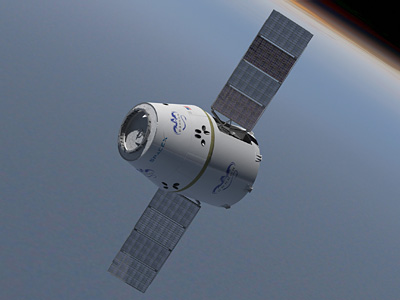
The conical spaceship will then deploy its solar panels and check out its guidance and navigation systems before firing its thrusters to chase down the station.

A practice rendezvous is planned for Monday when Dragon will move to within 2.5km (1.5 miles) of the station.

If Nasa and SpaceX are satisfied that the vehicle is performing well, it will be commanded to fly up and over the outpost in preparation for close-in manoeuvres on Tuesday.

May 14, 2012

Dragon flight now scheduled for May 19

Filed under: Space, Technology — Tags: , , , — Nicholas @ 09:24

Brid-Aine Parnell at The Reg updates us on the SpaceX flight schedule:

The flight of the Falcon 9 has once more been rescheduled, with a new launch date of 19 May, as Elon Musk’s SpaceX decided to tweak the software one more time.

The first commercial craft to restock the International Space Station, a Dragon capsule strapped to a Falcon 9 rocket, has seen more than its fair share of push-backs for the test flight, but it will all pay off if the cargo ship can dock with the station.

SpaceX has already shown it can release and retrieve the Dragon, but getting it to motor alongside the fast-moving ISS and accurately berth with it is no mean feat and the firm has tested and retested the necessary software in the hopes it won’t end up with egg on its face.

[. . .]

Providing this test flight is successful, the Dragon will start to fulfil the contract for a minimum of 12 flights to resupply the ISS. Since the ship is reusable, it will be the only spacecraft capable of bringing cargo back with it as well. And, ultimately, SpaceX hopes that a version of the Dragon will be its first manned spaceship as well.

May 9, 2012

Incrementally privatizing the space program

Filed under: Space — Tags: , , , — Nicholas @ 09:04

April 25, 2012

Identifying the potential profits from asteroid mining

Filed under: Economics, Space — Tags: , — Nicholas @ 09:06

In his Forbes column, Tim Worstall spins a tale that is worthy of Dr. Evil or other movie bad guy multi-billionaires:

We’ve now had the announcement of the business plans of Planetary Resources. Enough to excite everyone who read Heinlein or Jerry Pournelle as a teenager. But the big problem is how might they actually turn a proft? To which the answer is manipulation of the futures markets.

[. . .]

So, imagine that they have reached one of the nickel iron asteroids, it is high in the platinum group metals, they can mine it and they can deliver those pgms to Earth. The moment everyone knows that there is some hundreds of tonnes of these metals on the way down the price will collapse. The answer? Sell the metals in advance, through the futures markets. Get today’s price for delivery in the future.

In fact, sell many more futures than the amount of metal which is to be delivered: go short. As an example, say platinum is $2,000 an ounce (not far off the real price, $62 million a tonne). Planetary Resources is going to deliver 100 tonnes. But instead of selling $6 billion’s worth of platinum for delivery in three months, sell 10 times as much: $60 billion’s worth*. When that 100 tonnes splashes down, in fact when the market knows that the 100 tonnes is likely to splash down, then the market price will fall. Substantially but for illustration we’ll say to $200 an ounce.

The company then delivers that 100 tonnes for which it is paid the $6 billion agreed on those futures deliveries. It still owes the market another 900 tonnes but it can now cover its short at $200 an ounce having sold the futures at $2,000 an ounce. Use the $6 billion that’s going to be incoming to do so and what do we have at the end?

The company has $60 billion incoming from having sold futures. It has delivered 100 tonnes at $6 billion and covered the short for that $6 billion. Net profit $54 billion minus the cost of the space program. Which is pretty good really.

But it gets better … and more Bond-villainous.

April 18, 2012

Reason.tv: The Space Shuttle Era is Over (Thank God!)

Filed under: Government, Liberty, Space — Tags: , , , , — Nicholas @ 09:49

So the space shuttle Discovery has flown its last mission; it’s been towed over the nation’s capital like a bruised Chevy after a demolition derby before being deposited at the Udvar-Hazy air and space museum in northern Virginia.

Other space junkers — Atlantis and Endeavour — are being retired like Brett Favre in a pair of Crocs, too, bringing to end an underwhelming three decades of fruitless and tragic exploration of low-earth orbiting patterns.

Let’s face it: Once we beat the Russians to the moon, the national rocket grew limper than Liberace at a speculum convention. NASA has been dining out on a single 1969 hit longer than Zager and Evans.

The good news is that amateur hour is now over and the private space race has begun. Where two Cold War superpowers failed, let a thousand business plans bloom!

April 17, 2012

SpaceX Dragon cleared for April 30 flight to ISS

Filed under: Science, Space, Technology — Tags: , , , , — Nicholas @ 09:28

Brid-Aine Parnell updates the status of the SpaceX Dragon re-supply flight to the International Space Station at the end of the month:

The cargoship test flight, assuming it goes off without a hitch, will mark the first time a commercially made spacecraft has ever blasted off to visit the ISS.

NASA and SpaceX officials met yesterday in Houston for the Flight Readiness Review, a typical part of pre-launch prep at the agency, and confirmed that the Dragon and its SpaceX Falcon 9 rocket were on track for the end of this month.

“Everything looks good heading to the April 30 launch date,” said Bill Gerstenmaier, NASA’s associate administrator for Human Exploration and Operations, in a canned statement.

The Dragon is due to blast off from Cape Canaveral at 12.22 EDT (16.22 GMT) carrying 1,200 pounds of cargo.

Because this is a test flight, the cargo isn’t critical stuff for the astronauts, but NASA and SpaceX are still hoping to see the ship fly close enough to the station for its robotic arm to grab it and berth it, which is the tricky bit.

April 13, 2012

Filling in for Envisat: “the CSA’s Radarsats 1 and 2 will try to fill some of the gaps”

Filed under: Cancon, Europe, Science, Space — Tags: , — Nicholas @ 08:43

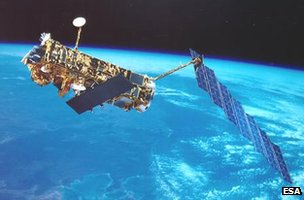
The European Space Agency is still at a loss on why their flagship Envisat satellite suddenly went silent, but while they’re trying to diagnose and hopefully fix the problem, the Canadian Space Agency is helping to cover some of the gaps:

Controllers say the eight-tonne spacecraft appears to be in a stable condition, but they are not receiving any data at all from it.



Contact was lost with Envisat at the weekend shortly after it downloaded pictures of Spain’s Canary Islands.

A recovery team, which includes experts from industry, is now trying to re-establish contact with the craft.

Mission managers said on Friday that they were working through a number of possible fault scenarios but conceded they had little to go on.

[. . .]

Of more immediate concern are the operational and scientific projects that rely on Envisat data.

The satellite’s information is used daily to monitor for oil spills at sea, to check on iceberg hazards, and to provide information for meteorological forecasts, among a wide range of services.

All this had now been disrupted, said Prof Liebig.

“What we have done is [activate] the contingency agreement we have with the Canadian Space Agency (CSA) which we have had for many, many years. Canada has responded very positively. So, for a certain time, the CSA’s Radarsats 1 and 2 will try to fill some of the gaps.”

March 19, 2012

The PR problem of NASA

Filed under: Bureaucracy, Media, Politics, Space, USA — Tags: , , , , , — Nicholas @ 09:49

L. Neil Smith explains why and how NASA has managed to become so uninspiring (hint: it was deliberate).

The truth is, there are three kinds of people in the world, those to whom traveling to, landing on, settling, and terraforming the planet Mars requires no explanation, those for whom no explanation of any kind will ever suffice, and those who remain to be convinced.

Our job in that respect really amounts to putting the romance back into space exploration that the National Aeronautics and Space Administration carefully throttled out of it over the past half century. I think their secret motto was, “If you’re having any fun, you’re not doing it right.”

All that time, NASA and its supporters seemed to be asking desperately, why is the American public losing interest in what we’re doing? But the answer was in the mirror before them. In a desperate bid for false respectability, in a misplaced desire not to evoke visions of Flash Gordon or Buck Rogers or Captain Video, they ended up not evoking any visions at all, and thereby destroyed any reason for the average individual, the average man, woman, or child, to support their program.

I have also come to think — very reluctantly, believe me — that there has been a secret agenda, probably in echelons much higher than NASA itself, to prevent that average individual from ever getting into space, which may be why they opposed the whole “space tourism” idea so hysterically.

March 17, 2012

Schiaparelli’s ambiguous word choice and the lasting obsession with Mars

Filed under: Books, History, Italy, Media, Science, Space — Tags: , , — Nicholas @ 11:09

Scott Van Wynsberghe reviews the hold that fictitious Mars has held on the imagination since “canals” were observed:

Mars, the most obsessed-about extraterrestrial body in the universe, has come our way again. On March 9, Hollywood unveiled John Carter, the first film adaptation of a famous series of Martian adventures written by Edgar Rice Burroughs, better known as the creator of the jungle hero Tarzan. Burroughs’s Martian yarns act as a portal to 135 years of cultural history that really is out of this world.

The bizarre story of humanity’s modern entanglement with the Red Planet began in 1877, when Italian astronomer Giovanni Schiaparelli reported the existence of “canali” on the Martian surface. In Italian, that word can mean both “channels,” which are natural formations, and “canals,” which are not. According to science writer John Noble Wilford, that ambiguity was never cleared up.

[. . .]

Caught between science fiction and the supernatural, actual scientists were in trouble. French astronomer Camille Flammarion, for example, alternately wrote about Mars and reincarnation (1889) and Mars and science (1892). In 1900, the inventor Nikola Tesla announced that he had monitored transmissions from either Mars or Venus, but he was jeered (biographer Margaret Cheney thinks he was just detecting natural electromagnetic patterns in space). In 1921, radio pioneer Guglielmo Marconi thought he had received a signal from Mars, but that, too, went nowhere. The biggest offender, however, was American astronomer Percival Lowell.

In 1895, Lowell released the first of a series of books proclaiming that Mars was inhabited. The canali, he said, really were canals, supporting a civilization struggling to survive on a dying globe. Although rightly scorned by other astronomers, Lowell was a superb writer and a frequent lecturer — Robert Goddard, the father of American rocketry, heard him speak — so his message spread. (And, in a way, it is still spreading: Think of that recent, much-debunked conspiracy theory about a giant, sculpted face on the Martian surface.)

February 11, 2012

Yet another theory on the solar effect on the Earth’s climate

Filed under: Environment, Science, Space — Tags: , , — Nicholas @ 12:14

You’d automatically assume that the sun is a major factor in the climate, but this theory is non-intuitive:

That man is the Danish physicist Henrik Svensmark, who seems to have discovered the most important factor that actually regulates Earth’s climate, and who is quietly in the process of proving it.

[. . .]

Let me briefly sum up Svensmark’s theory. The temperature of the Earth, he argues, is regulated by the intensity of solar radiation, but not in the obvious way. It is not that the increase is solar radiation heats the Earth directly. (It does, of course, but not to a sufficient degree to explain climate variations.) Rather, an increase in solar radiation extends the Sun’s magnetic field, which shields Earth from cosmic rays (highly energetic, fast-moving charged particles that come from deep space). How does this affect the climate? Here is the crux of Svensmark’s argument. When cosmic rays hit the atmosphere, he argues, their impact on air molecules creates nucleation sites for the condensation of water vapor, leading to an increase in cloud-formation. Since clouds tend to bounce solar radiation back into space, increased cloud cover cools the Earth, while decreased cloud cover makes the Earth warmer.

So if Svensmark is right, lower solar radiation means more cosmic rays, more clouds, and a cooler Earth, while higher solar radiation means fewer cosmic rays, fewer clouds, and a warmer Earth.

Those who have followed the global warming controversy over the years may recall that cloud-formation is one of the major gaps in the computerized climate “models” used by the consensus scientists to predict global warming. They have never had a theory to explain how and why clouds form or to account accurately for their effect on the climate. Svensmark has smashed through this glaring gap in their theory.

January 30, 2012

Researching how to stop asteroids from “just dropping in”

Filed under: Europe, Science, Space, Technology — Tags: , , , — Nicholas @ 10:08

Brid-Aine Parnell in The Register on some of the technologies being explored to reduce or eliminate the chance of unpleasantly close encounters with celestial objects:

A new international consortium has been set up to figure out what Earthlings could do if an asteroid came hurtling towards the planet on a path of imminent destruction.

The project will look at three methods of averting disaster: the Hollywood-sanctioned solutions of sending up a crack team of deep drillers with a nuclear bomb to sort it out, or frantically hurling of all our nukes at it; dragging it to safety with a Star Trek-inspired tractor beam; or hitting it with something we have more control over, like a spaceship.

Sporting the cool moniker NEOShield, the project will explore the possibilities for kinetic impactors, gravity tractors and blast deflection as ways to save our planet from oblivion.

[. . .]

“In the light of results arising from our research into the feasibility of the various mitigation approaches and the mission design work, we aim to formulate for the first time a global response campaign roadmap that may be implemented when an actual significant impact threat arises,” NEOShield boldly stated.

The anti-Moonbase chorus

Filed under: Space, USA — Tags: , , , — Nicholas @ 09:46

Natalie Rothschild on the (non-political) opposition to the very notion of a manned space program:

Suspicion towards space exploration is not new, of course. Since the 1970s, it has variously been decried as a danger to peace and security, as a chauvinist enterprise, as a wasteful pursuit and as a threat to the environment. Yet pessimism and indifference to space discoveries are at an all-time high today. This became clear in the reaction — or lack of reaction, rather — to NASA’s announcement in December 2009 that water had been discovered on the moon. As Sean Collins pointed out on spiked at the time, this was ‘a giant leap towards fulfilling one of our collective fantasies, something only dreamed about in science fiction: humans living somewhere other than Earth’. It also made the moon a more likely base for manned missions to other parts of the solar system and NASA suggested the lunar water could hold a key to the history and evolution of the solar system. Yet, as Collins pointed out then, neither online pundits nor the mainstream media nor the authorities made a big deal out of the ground breaking discovery.

Seen in this context it was no surprise that Gingrich’s boasts were ridiculed. His plans for a space colony might have sounded like a good idea when he touted it to Florida’s struggling Space Coast. After all, when the Obama administration cancelled George W Bush’s plans to return American astronauts to the moon by 2020, it prompted protests from the communities that depend on NASA for their livelihood as well as from Apollo veterans. But it was no surprise that he was met with put-downs from most other quarters and that his ideas were entirely dismissed.

By and large, human achievements tend to be downplayed today. Exploring the unknown is seen as, at best, impractical and, at worst, reckless. When it comes to manned space exploration, the prevailing attitude is ‘been there, done that’. That’s why there’s been an unwillingness to separate Gingrich’s more wacky ideas — launching a new space race and establishing a permanent American outpost on the moon within eight years — from his sensible reminder that if we are to have any chance of making new discoveries and advances in the near or distant future, then we need to be willing at least to imagine that it’s possible and desirable to overcome the limits we face today.

January 27, 2012

NASA Moonbase by 2020: not likely

Filed under: Bureaucracy, Science, Space, Technology, USA — Tags: , , , — Nicholas @ 09:30

I’m just as eager to see more manned exploration of the solar system as the next person, but Newt Gingrich’s announcement the other day is just so much moonshine:

The basic idea is not actually as far-fetched as it sounds. NASA in 2006 announced plans to set up a colony on the south pole of the moon, in around 2020, as a base for further manned exploration of the solar system.

The problem for Gingrich, a space enthusiast with ideas dating back decades for zero-gravity honeymoons and lunar greenhouses, is that the 2008 financial crisis came along and turned feasible projects into pipe dreams.

“A lunar base by 2020 is a total fantasy,” John Logsdon, professor emeritus at George Washington University’s Space Policy Institute, told AFP.

“We got to the moon in the 1960s by spending over 4% of the federal budget on Apollo. NASA’s now at one-tenth of that level.”

The initial problem is both financial and organizational: for all the money being poured into NASA, each dollar is producing much less in the way of science and technology because of the calcified bureaucracy. NASA achieved great things during the Apollo program, but the bureausclerosis was setting in even before the first shuttle flew. To get the kind of results that the “old” NASA achieved, you’d have to blow it up and start from scratch — or better yet, privatize the whole shebang and get the bureaucracy out of the way of the entrepreneurs.

As Robert Zubrin pointed out in the February issue of Reason magazine, NASA has become far too concerned about safety — less out of genuine concern about the astronauts and other employees, but more because of the negative effects of bad PR on the next year’s budget. Under the current NASA management, none of the pre-shuttle launches would have been allowed because they were too dangerous (and we know how dangerous the shuttle was, in hindsight).

January 9, 2012

DARPA appoints former astronaut to lead 100-year starship project

Filed under: Space, Technology, USA — Tags: , , , — Nicholas @ 09:56

Brid-Aine Parnell works the Star Trek angle on the appointment of former NASA astronaut Dr Mae Jemison as the head of the 100-year Starship project:

The agency had not responded to a request for comment at the time of publication, and has not yet announced the appointment publicly.

Dr Jemison, who has a degree in chemical engineering and a doctorate in medicine, was the science mission specialist on the STS-47 Spacelab-J in 1992 and logged over 190 hours in space.

As well as being a bona fide boffin, Jemison also spent time in the IT trenches, working in computer programming, among other things, before joining NASA.

She’s also no stranger to the ideas behind a starship, since, as a long-time Star Trek fan, she had a bit part in one episode of Star Trek: The Next Generation.

The episode, entitled Second Chances, must surely go down as evidence of her remarkable patience and forbearance, since it featured the two most irritating TNG characters, Commander Riker and Deanna Troi, rather prominently.

December 25, 2011

The top 100 images from ESA/Hubble

Filed under: Science, Space — Tags: , — Nicholas @ 00:06


Click for full-size image

Some breathtaking images from everyone’s favourite vantage point in space.

H/T to Lois McMaster Bujold for the link.

« Newer PostsOlder Posts »

Powered by WordPress