At The Register, Lewis Page discusses the first successful launch-and-hover by SpaceX’s Grasshopper:
SpaceX, the upstart space startup founded and bankrolled by famous internet nerdwealth kingpin Elon Musk, says it has carried out the first test of a new rocket craft which could lead to development of fully reusable spacecraft.
[. . .]
Grasshopper uses the fuel tank of the Falcon 9 first stage, but has only one Merlin rocket engine (as opposed to 9 on the real deal), so it is only a test vehicle. It is evidently intended to prove the technology needed to let a rocket descend to a vertical hovering landing. Such kit has already been proven in Moon and Mars lander missions, but is seldom employed for setdowns on Earth — and the job of putting down a towering 100-foot tall booster as opposed to a relatively handy capsule could be particularly challenging.
The idea would be that in future a Falcon 9 rocket stack would lift off as normal: but rather than waiting until the first stage had run out of fuel to separate and fire up the second stage, the lower booster would break away while it still had fuel left — enough to come down to a hovering pad landing. This would rob the whole stack of some lifting power, but on the other hand it would avoid the need to crash the pricey first stage into the sea and destroy it every time. This could potentially slash the costs of space launch: which is the avowed mission of SpaceX.
Comments Off on SpaceX Grasshopper completes first (tiny) hop
As we all know, Star Trek‘s faster-than-light warp engines were mere plot devices, not actual ones. There’s no way to travel faster than light, so even our great-grandkids won’t be tripping off to distant (or even nearby) star systems. But wait … NASA’s Harold White looks poised to become the latest hero of the “we wanna go faster than light” brigade:
A top NASA boffin has outlined ongoing lab experiments at the space agency aimed at first steps towards the building of a warp-drive spacecraft theoretically capable of travelling at 10 times the speed of light.
The latest developments at the “Eagleworks” super-advanced space drive lab at NASA’s Johnson Space Center were outlined by NASA physicist Harold White at a conference on Friday. The Eagleworks lab was set up at the end of last year to look into such concepts as the Quantum Vacuum Plasma Thruster and also so-called “warp drives” along the lines proposed by Mexican physicist Miguel Alcubierre in the 1990s.
[. . .]
Unfortunately, subsequent investigation appeared to show that while the warp drive might work it would be unfeasibly power hungry: it would require a minimum amount of energy equivalent to completely annihilating the mass of the planet Jupiter.
However White and his NASA Eagleworks colleagues say that’s not necessarily so: it’s all down to the shape of the ring. An improved doughnut design, as opposed to a flat ring, would get the requirement down to something more like just annihilating the Voyager One probe craft.
Voyager masses in the region of 800kg, so by our calculations one would still need a lump of antimatter (or other reasonably compact super power source) which — if it were mishandled — would explode with a force of some 17,000 megatons, equivalent to several global nuclear wars all in one (or 600-odd Tunguska meteor strikes etc). This would inconveniently take humanity’s current atom labs billions of years to make, and there would be other practical issues (see our previous antimatter-bomb analysis here, and then there’d be the exoto-doughnut to fabricate etc).
Comments Off on Don’t give up hope for warp engines just yet
On March 16, 1966, Armstrong and future Apollo 15 moonwalker David R. Scott became the first human beings to dock an orbiting spacecraft with an independently launched satellite, the Agena. (As proofs-of-concept go, this one has been more important to spaceflight than the moon landings.) The procedure proved surprisingly unchallenging; when the Gemini capsule nosed into place, Armstrong blurted out, “It’s really a smoothie!” The Gemini-Agena combo — mankind’s first “space station” — moved out of radio contact with mission control 28 minutes later. When it came back in range after another 15, Armstrong’s first words were, “We have serious problems here.” A wiring problem had left one of the attitude thrusters on Gemini stuck in the “on” position — firing continuously and causing an increasing left roll. Unsure what was causing the problem, Armstrong made the snap decision to separate from the Agena. But the problem was on their side, and without the Agena’s inertia, the Gemini craft began to spin even faster.
Press accounts said the pair were spinning at about one revolution per second. Senior mission controller Chris Kraft has since noted that their peak rotation was actually 550 degrees a second. Only a trained test pilot could make good decisions while whirling around in freefall 90 times a minute — and Armstrong justified the use of test pilots in space for all time by using Gemini’s re-entry thrusters to dampen the roll and save himself and Scott. By rule, the use of those thrusters meant the mission had to be aborted early. Armstrong and Scott suffered tense hours as they waited to see if they would splash down short of their Pacific landing zone, on the soil of Communist China.
Armstrong was rueful about the abort, which cost Scott the chance to make a spacewalk and cut short the experiment with Agena. But NASA was impressed. One of the agency’s main concerns before the moon missions was that astronauts trying to set down the lunar module would refuse to abort the landing, even if they ran too short on fuel to leave the moon. Armstrong, alone among astronauts of the time, had established a record of outstanding sanity in the face of an emergency. He would probably like to be remembered for that — for making the right choice, a pilot’s choice — at least as much as for the trail he left in the dust of the moon.
sp!ked reposted an older article by James Woudhuysen on the long-term importance of space exploration and the stay-at-home attitudes that oppose further development of the “final frontier”:
One thing unites the critics of lunar exploration. Forty years after man first landed on the moon — on 20 July 1969 — they share a disdain for the grandeur of extra-terrestrial endeavour; for the scale of human ambition involved; for the very idea that human beings should climb into space, as up a mountain, ‘because it is there’.
I have no special preference for size, thrust during lift-off, or the traverse across vast distances. The development of the integrated circuit in the late 1950s, so important to the Apollo programme, was a tribute to miniaturisation rather than to high energy or physical scale. No, my admiration for both Saturn boosters and tiny electronics grows from a respect for open-ended curiosity, for human achievement, and for taking risks. With space travel, a lot of bravery was also at stake. And with both space and the development of semiconductors, there is much teamwork to celebrate — teamwork that, in the case of Apollo, involved not just three astronauts, but the efforts of hundreds of thousands of people.
From Buzz Aldrin, an official statement on the death of Neil Armstrong:
I am deeply saddened by the passing of my good friend, and space exploration companion, Neil Armstrong today. As Neil, Mike Collins and I trained together for our historic Apollo 11 Mission, we understood the many technical challenges we faced, as well as the importance and profound implications of this historic journey. We will now always be connected as the crew of the Apollo 11 mission to the moon, yet for the many millions who witnessed that remarkable achievement for humankind, we were not alone.
Whenever I look at the moon I am reminded of that precious moment, over four decades ago, when Neil and I stood on the desolate, barren, yet beautiful, Sea of Tranquility, looking back at our brilliant blue planet Earth suspended in the darkness of space, I realized that even though we were farther away from earth than two humans had ever been, we were not alone. Virtually the entire world took that memorable journey with us. I know I am joined by many millions of others from around the world in mourning the passing of a true American hero and the best pilot I ever knew. My friend Neil took the small step but giant leap that changed the world and will forever be remembered as a historic moment in human history.
Even copyright-free NASA footage can be taken down for copyright infringement. Brid-Aine Parnell at The Register explains the fast-trigger-finger-goof:
YouTube was a bit keen in the prosecution of copyright laws during NASA’s victorious Curiosity rover landing yesterday morning, booting the first video excerpt of the livestream off its site for infringing a news service.
NASA’s video coverage and pics are actually generally copyright-free, which made the overzealous bot takedown even more ironic as it pulled the video from the space agency’s channel for infringing on the rights of Scripps Local News.
The problem, which took a few hours to fix, was flagged by online magazine Motherboard, which spotted a message on the video declaring: “This video contains content from Scripps Local News, who has blocked it on copyright grounds”.
“You’re saying that you’re going to give up four billion dollars to avoid a one in seven chance of killing an astronaut, you’re basically saying an astronaut’s life is worth twenty-eight billion dollars,” says astronautical engineer and author Dr. Robert Zubrin.
Zubrin, the author of a popular and controversial article in Reason‘s space-centric February 2012 Special Issue, argues that the risk of losing one of the seven astronauts who repaired and rescued the Hubble Space Telescope was well worth it. “If you put this extreme value on the life of an astronaut…then you never fly, and you get a space agency which costs seventeen billion dollars a year and accomplishes nothing.”
NASA’s role, according to Zubrin, should be in the pursuit of ambitious missions such as “opening Mars to humanity,” rather than a bloated, safety-obsessed bureaucracy. “The mission has to come first.”
Chris Brandrick on the first civilian recruitment drive for Martian colonization:
Just as NASA’s latest rover prepares to land on the surface of Mars, one Dutch company is looking to up the ante, with plans to send humans to the distant red planet. But before you sign up for travels to faraway lands, you may want to take note that the trip is a one-way deal, meaning you’ll never be able to return home to Earth.
Mars One, the ambitious company behind the planned mission, is hoping that a number of brave civilians will be willing to embark upon the mission to be the first to occupy the planet.
The company, founded by Bas Lansdorp, wants to send a number of humans to live on our neighboring planet indefinitely by 2023. The timeline for the mission will see Mars One send out a communications satellite in 2016, with a rover being sent in 2018 to find a suitable site for a settlement. Once the company finds a suitable location, it’ll send settlement units to Mars in 2020, which the existing rover will then set-up.
Once it gets the settlement established, Mars One hopes to send a small crew that would leave Earth in December of 2022, and arrive in April of 2023.
Visiting Mars would be fantastic, but I think I’ll wait until a return booking is possible.
Comments Off on Seeking Mars colonists for one way trip
In The Register, Phil Muncaster reports on what is rumoured to be the next stage of India’s space program:
Not to be outdone by China in the space race, India is set to flex its muscles on the world stage, planning a mission to Mars late next year.
K Radhakrishnan, Chairman of the Indian Space Research Organisation (ISRO), told reporters on Saturday that there will be a definitive announcement on the scientific research-based project by the government soon.
“A lot of studies have been done on the possible mission to Mars. We have come to the last phase of approvals,” he said, according to Times of India.
The proposed Mars mission will apparently be focussed on the Red Planet’s origins and evolution, its climate and geography and whether life can be sustained there.
Comments Off on Aggressive target for India’s space program: Mars
What followed Echo 1 was a space race within a space race, this one determining whether government or industry would send up the first active non-military communications satellite. In 1961, NASA awarded a contract for such a satellite to the company RCA, but Pierce and Bell Labs were undeterred. According to Calvin Tomkins, Bell Labs spent US$50-million (at early-1960s rates) for research and development and devoted about 700 of its personnel to the project.
The baby that was born of it all was a sphere weighing 170 pounds (77 kilograms), called Telstar 1. Going by specifications collected by Bill Yenne, an authority on U.S. spacecraft, Telstar 1 received signals at 6,390 megacycles, re-transmitted them at 4,170, and boasted of 600 voice channels and one channel for television.
Perched atop a Thor-Delta booster — paid for by Bell Labs but launched by NASA — Telstar 1 ascended on July 10, 1962. It did not go far, parking itself in an elliptical orbit less than 2,000 miles (3,220 kilometers) away. Within hours, Bell Labs arranged what was previously impossible — transatlantic television. As described by T.A. Heppenheimer, the ensuing video exchange humorously followed national stereotypes. The United States sent France and the U.K. taped material heavy on patriotic themes, the French responded with footage of actor Yves Montand and other cultural figures, and the British muddled about for a few days before getting things straight.
Humour aside, the achievement left the world stunned. In just the month of the launching of Telstar 1, the New York Times ran almost 100 articles related to the satellite. Joe Meek’s Telstar composition stormed the pop charts later in the year, and that 1963 New Yorker profile of Pierce ran for 29 pages. Telstar 1 did not outlast some of this acclaim, as it ceased transmission in early 1963, but it had blazed a path. Today, anyone using satellite TV or radio is honouring that decades-old triumph of engineering.
Arthur C Clarke is often credited with inventing the idea of satellite communications, though in fact his contribution was to point out that three birds in geostationary orbit could provide global coverage. Geostationary orbit is more than 35,000km up, beyond the reach of radios in 1962, so Telstar’s orbit peaked at less than 6,000km up and dipped down to less than 1,000km during its two-and-a-half-hour circumnavigation.
That dip is also what caused Telstar’s downfall. Its repeated drops into the Van Allen radiation belt did allow the satellite to gather information about the belt (which was part of the plan) but the information it gathered was largely the havoc such radiation plays with electronic circuits. If Wikipedia is to be believed then US nuclear tests at the time had left the Van Allen particularly charged, but either way the satellite failed intermittently for a few months and finally stopped relaying signals entirely in February 1963. However, it remains in orbit to this day, faithfully tracked by the US government as required by international treaties.
Telstar was solar powered, with 3,600 solar cells feeding 19 nickel-cadmium batteries which received a 6GHz signal and retransmitted it with 2.25w of power at 4GHz. The electrics necessary were all suspended by shock-absorbent nylon cords in the middle of the spherical body, which had to spin at 180 rpm for stabilisation (gyroscopes perform the same function on modern satellites, but weren’t reliable enough back then).
A blog post at New Scientist compares the achievement of the Chinese space program, which just successfully placed three astronauts aboard the ISS and the highly mysterious X-37B spaceplane which just completed a 469-day mission:
China’s space agency took the plaudits for successfully docking its crewed Shenzhou-9 spacecraft with its orbiting lab Tiangong-1 today, but the feat was slightly overshadowed by the weekend landing of the US X-37B spaceplane, which after a record-breaking orbital flight of 469 days showed just how far China has to go to catch up with advanced spacefaring nations.
At around noon local time, the Beijing Aerospace Control Centre relayed live pictures of Shenzhou-9’s docking on state broadcaster China Central Television. The space capsule held off at a distance of 62 kilometres from Tiangong-1 before making its docking approach just before 2pm — and once the crew had manually locked on to the latter’s cruciform docking target it took only eight minutes to latch the spacecraft together safely.
[. . .]
This Boeing-built spaceplane, roughly one quarter the size of the space shuttle, is equally mysterious. It flies to orbit on a regular rocket and when there deploys a solar array that gives its sensors the power they need for extended missions. It also has enough propellant to fire thrusters that make small changes to its orbit in a bid to foil surveillance. The vehicle re-enters the atmosphere just like the shuttle but lands entirely autonomously, making it a space drone.
At no point has the USAF revealed the craft’s purpose: in addition to spacecraft surveillance, it could deploy a robot that repairs (or disables) satellites in orbit, say some, while at the darker end of the spectrum of possibilities — it was a DARPA project in its early days — it could carry a warhead, using its drone homing capability to provide surprise precision strike from orbit.
In Wired, Dave Mosher has a profile of a fascinating little group with a sky-high goal:
Co-founders von Bengtson, an aerospace scientist and former NASA contractor, and Madsen, an entrepreneur and aerospace engineer, have a lot to be proud of since they founded their non-profit space program four years ago. In June 2011, for example, Copenhagen Suborbital’s army of volunteers successfully built, launched and recovered a 31-foot-tall rocket — the largest “amateur” launcher ever built — with a crash-test dummy tucked inside.
That first prototype ended its flight two miles up, and the organization has yet to check off their ultimate goal: sending a person more than 60 miles above the Earth, a height widely considered the boundary of outer space. But now they are creating a bigger, better and badder space vehicle to get there.
“We have gone from having a crazy idea on a submarine to a smoothly run organization that builds rockets and spacecraft, and has experience with big launches,” said von Bengtson, who also blogs about the project for Wired at Rocket Shop. “It feels like we have become a part of a new era in space. I wouldn’t trade that for anything. Not for millions of dollars.”
Comments Off on To go where no DIY project has gone before
Brid-Aine Parnell at The Register on today’s successful rendezvous with the ISS:
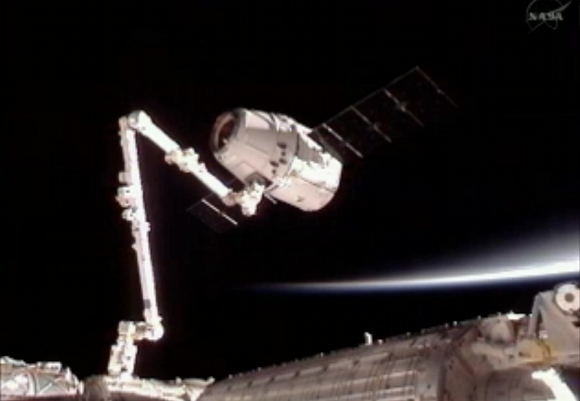
Elon Musk’s SpaceX has just made history with the first ever commercial cargoship to be captured by the International Space Station’s robotic arm.
Image from NASA TV
Flying above northwestern Australia, flight engineer Don Pettit aboard the ISS reached out with the Canadarm and grabbed the Dragon at 9.56am EDT, 14.56 GMT.
Reg staff are not sure if astronauts are given cheesy lines to say at these big moments, but Pettit had a great one ready.
“Looks like we’ve got a dragon by the tail,” he announced to Mission Control Centre in Houston.
“Looks like this sim went really well, we’re ready to turn it around and do it for real,” he joked.
Lewis Page at The Register on the successful Dragon fly-by of the ISS:
It’s another moment of truth for upstart space startup SpaceX as once again the company attempts to do something that has only ever been accomplished to date by major government space agencies: docking one spacecraft to another in orbit and transferring cargo.
Having launched its new Dragon spacecraft on Tuesday — on only its second flight — SpaceX is now seeking to bring the ship to a docking with the International Space Station on Friday. Many boxes must be ticked before this can happen, however: but today the first was checked off as the Dragon made a close pass within 1.5 miles of the station, and ‘nauts aboard the orbiting outpost confirmed that their remote-control console was able to command the new ship. This was done by ordering the Dragon to illuminate its strobe lights as it flew by the Station.
In fact the station’s crew — the Dragon tests were handled by André Kuipers of the ESA and NASA’s Don Pettit — couldn’t see that the lights were on owing to bright sunlight illuminating the still quite distant Dragon. However telemetry confirmed that the capsule had received the radio command from the ISS and activated its lights, and viewers of NASA TV were treated to video of the Dragon as it gradually overhauled the station from beneath, passing above South Africa and the Indian Ocean as it did so.
Comments Off on Next step in Dragon/ISS drill: close fly-by