Quotulatiousness

December 12, 2011

SpaceX Dragon to dock with ISS in February

Filed under: Space, Technology — Tags: , , , , , — Nicholas @ 09:31

Lewis Page on the recent announcement from NASA and SpaceX:

NASA has announced that — all being well — the first mission to the International Space Station by a privately built and operated spacecraft will lift off on February 7. The craft will be a Dragon capsule launched atop a Falcon 9 rocket, both made and handled by techbiz visionary Elon Musk’s new company SpaceX.

“We look forward to a successful mission, which will open up a new era in commercial cargo delivery for this international orbiting laboratory,” said NASA honcho William Gerstenmaier in tinned quotes announcing the planned date. However he didn’t stick his neck out, adding cautiously:

“There is still a significant amount of critical work to be completed before launch, but the teams have a sound plan to complete it and are prepared for unexpected challenges. As with all launches, we will adjust the launch date as needed to gain sufficient understanding of test and analysis results to ensure safety and mission success.”

November 24, 2011

The shot that started the First Interplanetary War?

Filed under: Space — Tags: — Nicholas @ 08:25

Yes, it may not happen for a few more decades, but we were the instigators of what might be the most long-distance war in human history:

The new habitability study has involved the collaborating scientists devising two different indexes for rating worlds, in proper scientifiction style*. We now have the Earth Similarity Index (ESI), showing how much like Earth a body is, on which Earth is 1, Mars is 0.7 and our Moon is 0.56.

The scientists have also worked out a Planet Habitability Index (PHI), based on such things as planetary magnetic fields, atmosphere, likely local temperatures etc. Titan, icy natural-gas slush moon of Saturn, scores high on this at 0.64.

But, very worryingly, the planets of the dim, red M-class star Gliese 581 — lying just 20 light-years away in the constellation Libra — score high up the listings in both systems. Under ESI, the exoplanets Gliese 581g, d and c are the next three most habitable known worlds after Earth: and they are also well up under PHI.

Normally this would not be cause for alarm, but — as regular readers of Reg exoplanet coverage will know — should there be intelligent aliens at Gliese 581 they will soon have an intense and well-justified grievance against us.

It was a deliberate and evil provocation we gave, and our fate may already be sealed.

October 29, 2011

Canadian Air and Space Museum to be evicted in favour of ice rinks

Filed under: Cancon, History, Space, Technology, WW2 — Tags: , , — Nicholas @ 12:20

A sad tale at the CBC website about the impending eviction of the museum and other tenants of the historic (but not historically designated) DeHavilland plant in Downsview:

A building that played a major role in the production of aircraft for the Allies in their fight against Hitler during the Second World War is facing the wrecking ball.

It’s located in Toronto’s Downsview Park and is described in federal heritage documents simply as “CFB Plant .1, Building .1.”

Just one month after the federal government celebrated Canada’s aviation history by reintroducing the name, “Royal Canadian Air Force,” it was sending an eviction notice to a building where RCAF planes were assembled.

Built in 1929, the plant housed the operations of the de Havilland Aircraft company which provided 17 per cent of Canada’s planes during the war years.

[. . .]

David Soknacki, the chairman of Parc Downsview Park, says the building at 65 Carl Hall Road is not currently classified as a heritage building.

Up until Oct. 26., the Canada’s Historic Places website listed the facility as “a recognized Federal Heritage Building because of its historical associations and its architectural and environmental value.”

Then the listing disappeared.

H/T to Michael O’Connor Clarke for the link.

October 23, 2011

DARPA’s new project: space vampires

Filed under: Military, Space — Tags: , , , — Nicholas @ 12:04

Yep. DARPA is hoping to release “swarming robot space vampires”* in geosynchronous orbit:

More than $300 billion worth of satellites are estimated to be in the geosynchronous orbit (GEO—22,000 miles above the earth). Many of these satellites have been retired due to normal end of useful life, obsolescence or failure; yet many still have valuable components, such as antennas, that could last much longer than the life of the satellite. When satellites in GEO “retire,” they are put into a GEO disposal or “graveyard” orbit. That graveyard potentially holds tens to more than a hundred retired satellites that have components that could be repurposed — with the willing knowledge and sanction of the satellite’s owner. Today, DoD deploys new, replacement satellites at high cost — one of the primary drivers of the high cost is the launch costs, which is dependent on the weight and volume of antennas. The repurposing of existing, retired antennas from the graveyard represents a potential for significant cost savings.

DARPA’s Phoenix program seeks to develop technologies to cooperatively harvest and re-use valuable components from retired, nonworking satellites in GEO and demonstrate the ability to create new space systems at greatly reduced cost. “If this program is successful, space debris becomes space resource,” said DARPA Director, Regina E. Dugan.

[. . .]

“Satellites in GEO are not designed to be disassembled or repaired, so it’s not a matter of simply removing some nuts and bolts,” said David Barnhart, DARPA program manager. “This requires new remote imaging and robotics technology and special tools to grip, cut, and modify complex systems, since existing joints are usually molded or welded. Another challenge is developing new remote operating procedures to hold two parts together so a third robotic ‘hand’ can join them with a third part, such as a fastener, all in zero gravity. For a person operating such robotics, the complexity is similar to trying to assemble via remote control multiple Legos at the same time while looking through a telescope.”

* “Swarming robot space vampires”, courtesy of jwz.org.

July 25, 2011

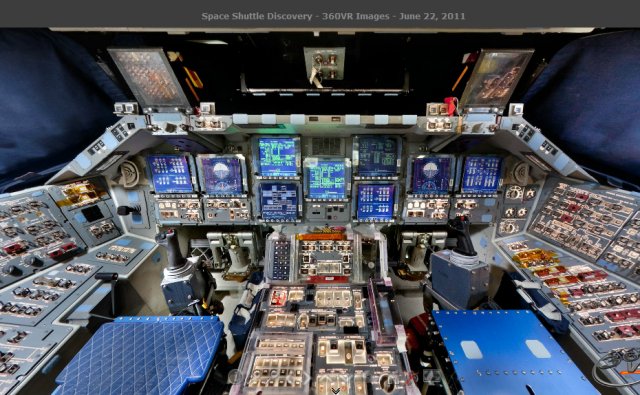
Unique view of the shuttle cockpit

Filed under: Space, Technology, USA — Tags: , , — Nicholas @ 10:05


Click to embiggen

Link provided by Chris Greaves.

Update: There’s a big comment on this shuttle post from Chris Taylor, discussing what the shuttle was originally intended to be, and why it ended up being significantly larger and more expensive than the first proposal.

July 24, 2011

Farewell Space Shuttle . . . you massive boondoggle

Filed under: Bureaucracy, Space, Technology — Tags: , , , — Nicholas @ 12:25

I’ve been ambivalent about the space shuttle program for decades — not because I’m anti-space, but because I think the shuttle was government methadone to replace a real space program. At that, I hadn’t connected all the dots the way Scott Locklin has here:

The Space Shuttle, an object lesson in the Sunk Cost Fallacy, has been with us since my early youth. This preposterous boondoggle was originally supposed to make manned space flight cheaper: to the point where getting a pound of matter into space would be as cheap as sending it to Australia. That was the only purpose for building the damn thing in the first place. The idea was, if your spaceship was reusable, it would be cheaper to send people and heavy things into space. If using the same thing multiple times isn’t cheaper, well, what’s the point? Conspicuous consumption, perhaps?

In one of its original incarnations, the Shuttle was supposed to launch like an ordinary aircraft. A jet + rocket powered “first stage” heavy lifter would propel the craft into the upper atmosphere, and the rocket propelled second stage would send the thing into space. Seems like a good idea to me. Jets are pretty easy to fly and maintain cheaply. Jets also don’t have to carry vast quantities of oxidizer. Plus; you get to reuse the whole mess.

Unfortunately, the politicians decided that building the first stage heavy lifter would cost “too much.” Instead they changed the design, and strapped a couple of solid rockets to a beefed up “orbiter” and giant non-reusable fuel tank. That wasn’t the worst of it: those pieces should have still in principle provided for a cheap launch vehicle. In practice, the silica tiles and engines turned out to have very high maintenance costs involving substantial labor, and turn around times were 1/6 of what they should have been, making the thing 6 (though more like 10) times as expensive as it was designed to be.

The goal of the space shuttle program was to have safe, re-usable spacecraft that could lift heavy loads to low earth orbit at a cost of about $50 per pound. What they ended up with was a dangerous fleet of hangar queens that took loads to orbit at an estimated cost of $50,000 per pound. That’s quite a missed set of goals.

June 20, 2011

SpaceX and the rogue consultant

Filed under: Law, Space — Tags: , — Nicholas @ 08:48

SpaceX is going to court over a would-be consultant’s claims that their rockets are unsafe:

According to SpaceX’s filing with the Fairfax County circuit court in Virginia, Joseph Fragola, veep at tech consulting firm Valador, tried to obtain a hefty deal from SpaceX at the beginning of June:

     Fragola attempted to obtain a consulting contract from SpaceX worth as much as $1 million. He claimed that SpaceX needed an “independent” analysis of its rocket to bolster its reputation with NASA based on what he called an unfair “perception” about SpaceX. SpaceX did not respond favorably to Fragola’s offer.

The rocket company — which as everyone knows is helmed, CTO’d and in part bankrolled by famous nerdwealth kingpin Elon Musk — says it then found out that Fragola had subsequently done his level best to create such a perception:

     SpaceX subsequently leamed that Fragola has been contacting officials in the United States Government to make disparaging remarks about SpaceX, which have created the very “perception” that he claimed SpaceX needed his help to rectify.

     For instance, in an email he wrote on June 8, 2011, to Bryan O’Connor, a NASA official at NASA’s headquarters in Washington, DC, Fragola falsely stated: “I have just heard a rumor, and I am trying now to check its veracity, that the Falcon 9 experienced a double engine failure in the first stage and that the entire stage blew up just after the first stage separated. I also heard that this information was being held from NASA until SpaceX can ‘verify’ it.”

SpaceX for its part says that this rumour is “blatantly false… as a purported ‘expert’ in the industry, he should have known that the statements were false.”

May 30, 2011

NASA’s changing goals for Orion

Filed under: Politics, Space, USA — Tags: , , , , — Nicholas @ 09:56

The ever-sarcastic Lewis Page looks at how NASA has been trying to reposition their planned Orion spaceship:

NASA has declared that its pork-tastic Orion moonship — whose primary mission disappeared with President Obama’s decision that there will be no manned US return to the Moon — is now to be a “deep space transportation system”, suggesting that the agency plans to send it on missions beyond Earth orbit.

It remains unclear how the newly-renamed Multi Purpose Crew Vehicle (MPCV) will travel into space, when it will do so and what its destination might be — though a near-Earth asteroid is a likely possibility. A major reason for Orion’s continued survival appears to be ignoble porkbarrel politics — but there is a tantalising possibility that it might fly beyond Earth orbit in the relatively near future.

What Page calls NASA’s “pork map” shows why the MPCV has strong, bi-partisan political support regardless of its actual utility for the space program:

Regardless of the political support, however, the most likely view of US federal government finances indicates that Orion/MPCV won’t be viable in the proposed timeframe. There’s a non-governmental choice, however:

Famous geekbiz-kingpin Elon Musk and his upstart rocket company SpaceX have come from nowhere in just eight years to successfully test-fly their brand new and very cheap Falcon 9 rocket and Dragon capsule, already apparently quite capable of performing the ISS supply mission. Only a few years ago, many in NASA and the established industry were arguing that this would never happen.

It’s also no secret that Musk and SpaceX are working on a new Merlin 2 rocket engine, much bigger than the current Merlin 1 which propels the Falcon 9. A multicore heavy lifter based on Merlin 2 would be in the 100-tonne-plus realm required to mount a Mars mission, and will surely be the cheapest offering competing at the 2015 heavy lift Mars-rocket decision.

May 24, 2011

Britain’s entry in the new race to space

Filed under: Britain, Space, Technology — Tags: , , — Nicholas @ 09:12

Jonathan Amos reports on the UK Space Agency (UKSA) long-simmered design/proposal called Skylon:

Skylon has been in development in the UK in various guises for nearly 30 years.

It is an evolution of an idea first pursued by British Aerospace and Rolls Royce in the 1980s.

That concept, known as Hotol, did have technical weaknesses that eventually led the aerospace companies to end their involvement.

But the engineers behind the project continued to refine their thinking and they are now working independently on a much-updated vehicle in a company called Reaction Engines Limited (REL).

Realising the Sabre propulsion system is essential to the success of the project.

The engine would burn hydrogen and oxygen to provide thrust — but in the lower atmosphere this oxygen would be taken directly from the air.

This means the 84m-long spaceplane can fly lighter from the outset with a higher thrust-to-weight ratio, enabling it to make a single leap to orbit, rather than using and dumping propellant stages on the ascent — as is the case with current expendable rockets.

Update: Lewis Page has more on the Skylon project.

April 28, 2011

Learning from mistakes, Martian style

Filed under: Space, Technology — Tags: , , , — Nicholas @ 08:56

I have to admit it’s doubly amusing finding articles like Mars ate my spacecraft!, once for the content and once for the amusing title:

The investigation board made the not-terribly-earth-shaking observation that tired people make mistakes. The contractor used excessive overtime to meet an ambitious schedule. Mars is tough on schedules. Slip by just one day past the end of the launch window and the mission must idle for two years. In some businesses we can dicker with the boss over the due date, but you just can’t negotiate with planetary geometries.

[. . .]

NASA’s mantra is to test like you fly, fly what you tested. Yet no impact test of a running, powered, DS2 system ever occurred. Though planned, these were deleted midway through the project due to schedule considerations. Two possible reasons were found for Deep Space 2’s twin flops: electronics failure in the high-g impact, and ionization around the antenna after the impacts. Strangely, the antenna was never tested in a simulation of Mar’s 6 torr atmosphere.

While the DS2 probes were slamming into the Red Planet things weren’t going much better on MPL. The investigation board believes the landing legs deployed when the spacecraft was 1,500 meters high, as designed. Three sensors, one per leg, signal a successful touchdown, causing the code to turn the descent engine off. Engineers knew that when the legs deployed these sensors could experience a transient, giving a false “down” reading… but somehow forgot to inform the firmware people. The glitch was latched; at 40 meters altitude the code started looking at the data, saw the false readings, and faithfully switched off the engine.

A pre-launch system test failed to detect the problem because the sensors were miswired. After correcting the wiring error the test was never repeated.

H/T to Paula Lieberman for the link.

April 22, 2011

Houston loses space shuttle sweepstakes

Filed under: History, Space, USA — Tags: , , — Nicholas @ 16:26

Houston has a problem with the allocation of the soon-to-be retired space shuttles:

Which city, in the whole of the United States, would the average person associate most clearly with America’s towering achievements, and no few sorrows, over the past half century of sending men and women into space? Why, Houston, of course — home of the Johnson Space Centre, where NASA’s mission control is located. We know this from all that has been said and done in the past. The first words Neil Armstrong uttered as Apollo 11 touched down on the Moon in 1969 were: “Houston, Tranquility base here — the Eagle has landed.”

The name of Houston will forever be associated with the manned exploration of space. No astronaut ever radioed laconically back from a crippled spaceship, “Manhattan, we have a problem”. Yet, in NASA’s recent selection of the final destinations for its four extant space shuttles, now that the last operational ones are about to be pensioned off, New York City will get Enterprise, the first of the shuttles that was rolled out in 1976, while Houston gets snubbed.

A score or more of museums and other institutions around the country competed for the honour of having a shuttle in their permanent collection. Apart from offering an appealing display, each had to be ready to stump up $28.8m to cover the cost of preparing and transporting the winged spacecraft to its new location. Of the three other remaining shuttles, Discovery is destined for the Smithsonian’s National Air and Space Museum annexe outside Washington, DC. After the launch in late June of the 135th (and last) mission in the shuttle programme, Atlantis will remain in Florida to be exhibited at the Kennedy Space Centre’s visitor centre.

Meanwhile, after its own final mission later this month, Endeavour, the youngest of the shuttles, will be ferried to Los Angeles to end its days in the California Science Centre, alongside existing exhibits of the Mercury, Gemini and Apollo spacecraft, and close to the old Rockwell plant in Palmdale where the shuttle was developed. Meanwhile, just up the road, at Edwards Air Force Base, is the runway where nearly half of all shuttle flights touched down.

April 21, 2011

Elon’s Dragon may “land on Mars”

Filed under: Space, Technology — Tags: , , , , , — Nicholas @ 12:35

While you’re talking up your own private space venture, you can probably be excused for a bit of boasting:

Famous upstart startup rocket company SpaceX, bankrolled and helmed by renowned internet nerdwealth hecamillionaire Elon Musk, has once again sent its goalposts racing ahead of its rapidly-advancing corporate reality.

The plucky challenger has stated that its “Dragon” capsule is not merely capable of delivering supplies to the International Space Station: it is — potentially — also capable of carrying astronauts to the space station and back down to Earth again.

In a statement released yesterday, Musk and SpaceX also make the bold claim that the Dragon, once fitted with modifications that the company is now developing under NASA contract, would also be able to land “almost anywhere on Earth or another planet with pinpoint accuracy, overcoming the limitation of a winged architecture that works only in Earth’s atmosphere” (our emphasis).

April 8, 2011

The economics of Falcon Heavy

Filed under: Economics, Space — Tags: , , — Nicholas @ 09:44

Charles Stross runs the numbers on the new SpaceX Falcon Heavy:

SpaceX announce Falcon Heavy. It’s been expected for some time — it’s been on their road map for a few years — but it’s worth repeating: man-rated and with a payload of 53 tons to Low Earth Orbit, Falcon Heavy has the largest payload of any space launcher since Energiya and the Saturn V, and it’s dirty-cheap by EELV standards at $80M-120M per launch. Moreover, it can’t easily be dismissed as vapourware because it’s an evolutionary development of a real, flying launch vehicle (Falcon 9) — a Falcon 9 core with two extra first stages strapped to the sides as boosters (and some fancy cross-stage plumbing to run the central core motors off fuel bled from the strap-ons, so that at BECO the central stage still carries a full fuel load). With the giant Iridium NEXT contract SpaceX have landed (the largest commercial launch contract in history), not to mention the ISS resupply contract, SpaceX looks likely to have the cash flow to build and fly this thing.

[. . .]

Note that these days the budget for a big Hollywood blockbuster — Avatar, for instance — can push over the $0.3Bn mark. It’s hard to say what the media rights to the second! ever! manned Moon program! would be, but it’s hard to see them going for much less than a major blockbuster movie. I think it unlikely that the expedition could be run entirely on the media rights, but they should certainly make a double-digit percentage contribution to the budget. Add the opportunity to tout for the science budget of some major agencies (by carrying lunar orbiter packages as payload, perhaps?) and it might be possible to raise $250-500M towards the costs of a $600-1000M expedition.

Is Elon Musk planning on being the 13th man on the moon?

More on Falcon Heavy at The Register.

March 4, 2011

“Secret space warplane” to launch on secret mission with secret payload

Filed under: Military, Space, USA — Tags: , — Nicholas @ 10:10

Anything that gets Iran’s leadership all worked up into a panic can’t be all bad:

The US Air Force is set to launch its second X-37B miniature unmanned spaceplane — the type famously dubbed a “secret space warplane” by the Iranian government — on Friday.

[. . .]

Once in orbit the X-37B deploys a solar panel array, unlike its bigger cousin the Space Shuttle which uses fuel cells for electrical power. Thus the little robot spaceplane can remain in orbit for much longer periods unsupported before re-entering the atmosphere to make a runway landing. The previous OTV-1 mission, carrying a payload which remains secret, lasted 224 days and ended with a successful landing at the Vandenberg military space base in California.

As yet the USAF has not revealed the planned duration of the OTV-2 mission launching tomorrow, and again details of the payload are not being revealed.

There has been extensive speculation among space watchers regarding just why the USA needs a small robotic spaceplane. For most purposes a more normal spacecraft, unburdened by heat shields for re-entry, would be more economical. Even supposing a need to return to Earth, there would seem to be no need for the X-37B’s Shuttle-style delta wings, which add weight unnecessarily — a capsule design could be used, or a lifting body if runway landing was regarded as essential.

February 7, 2011

James May’s U-2 ride

Filed under: Media, Space — Tags: , , — Nicholas @ 12:38

Not at all Top Gear-ish.

H/T to Jon for the link.

« Newer PostsOlder Posts »

Powered by WordPress