
It is now forty-five summers since, at age eighteen, I stood myself in the ruins of Ninevah — across the Tigris from Mosul in post-modern Iraq, the seat of Christian Assyria. Gentle reader may be aware that the Assyrians, Yazidis, Armenians, Turkmen, Shabaki, and for that matter, a portion of the Arabs who once lived around that town have been slaughtered or exiled over the last two years by the Daesh. The self-styled “Islamic Caliphate” has also made a show of demolishing Mosul’s remarkable Museum, and the more celebrated ancient monuments, starting with the purported tombs of Jonah and several other Old Testament prophets.
How one wishes that the French and British, rivals for archaeological glory from the early Victorian age, had succeeded in floating more of the treasures they had uncovered, on great rafts down the Mesopotamian rivers to Basrah and the sea — and then by ship to safe new homes in the Louvre and British Museum. That was the heroic age of “Orientalism,” when under the burning sun, and the noses of Ottoman administrators, and in the face of Arab raids and depredations — goaded by an excited popular interest in the recovery of deep Biblical history — the lost kingdoms and empires of the Near and Middle East were being rediscovered. Not only the tireless spadework, but the ingenious decoding of ancient tablets found in subterranean libraries of clay, extended our detailed knowledge of the human past by thousands of years.
This was a gentleman’s contest, and I am struck by the way, without rules or treaties, the French and the British (later joined by Germans, and eventually Americans, Poles, Italians, and even Canadians) peacefully recognized each other’s stakeholdings and claims, and honoured each other’s adventurers and scholars. So much of what we now reflexively condemn as “European Imperialism” was conducted at a level of civilization that is unimaginable today. We ritually sneer at digging practices that were primitive and inexact, forgetting that our own “modern methods” were being devised by these men, as they went along, starting only from rumour and wild surmise.
David Warren, “With Layard to Ninevah”, Essays in Idleness, 2016-07-05.
March 10, 2018
QotD: The beginnings of archaeology
March 9, 2018
Bad news about the Peltzman Effect and opiate use
Megan McArdle recounts the US federal government’s attempt to improve automobile safety in the 1960s and the surprisingly mixed results of those efforts on overall safety for drivers (better), pedestrians (worse) and the frequency of non-fatal accidents (higher). Those results were summarized by Sam Peltzman as indicating that most of us have an innate tendency to take more risks when we’re less likely to suffer the costs of those risks (hence, the “Peltzman Effect”). She then talks about a tragic new instance of this in the opiate crisis:
A chemical called naloxone acts as an “opioid antagonist” — which is to say, it reverses the drug’s effects on the body. It can thus save people who have overdosed.
As opioid usage has worsened in the United States, more and more jurisdictions have acted to increase access to naloxone. Not only first responders but also friends, family and even librarians have started to administer it. These state laws were passed at different times, giving researchers Jennifer Doleac and Anita Mukherjee a sort of a natural experiment: They could look at what happened to overdoses in areas that liberalized naloxone access and compare the trends there to places that hadn’t changed their laws.
Their results are grim, to say the least: “We find that broadening Naloxone access led to more opioid-related emergency room visits and more opioid-related theft, with no reduction in opioid-related mortality.”
You can never assume that the results of one study, however well done, are correct. But these results look pretty robust. If they hold up, they would mean that naloxone is not saving lives; all we’re doing is spending a lot of money on naloxone to generate some increase in crime.
It makes a certain amount of sense that the Peltzman Effect would show up particularly strongly in drug users; after all, drugs hijack the brain’s reward system, redirecting it toward drug-seeking even at high personal risk. Drug users, one would think, would be highly likely to recalibrate their risk-taking so that the risk of death remains constant, while the frequency and potency of drug use increases.
The coldly logical response to this would seem to be to discontinue naloxone use. But there’s something repulsive about that conclusion, and Doleac and Mukherjee can’t bring themselves to go there. “Our findings do not necessarily imply that we should stop making Naloxone available to individuals suffering from opioid addiction,” they write, “or those who are at risk of overdose. They do imply that the public health community should acknowledge and prepare for the behavioral effects we find here.”
QotD: Contempt for science
The waging of a “war on science” by right-wing know-nothings has become part of the conventional wisdom of the intelligentsia. Even some Republican stalwarts have come to disparage the GOP as “the party of stupid.” Republican legislators have engaged in spectacles of inanity, such as when Sen. James Inhofe, chair of the Committee on Environment and Public Works, brought a snowball to the Senate floor in 2015 to dispute the fact of global warming, and when Rep. Lamar Smith, chair of the House Committee on Science, Space, and Technology, pulled quotes out of context from peer-reviewed grants of the National Science Foundation so he could mock them (for example, “How does the federal government justify spending over $220,000 to study animal photos in National Geographic?”).
Yet a contempt for science is neither new, lowbrow, nor confined to the political right. In his famous 1959 lecture “The Two Cultures and the Scientific Revolution,” C.P. Snow commented on the disdain for science among educated Britons and called for a greater integration of science into intellectual life. In response to this overture, the literary critic F.R. Leavis wrote a rebuttal in 1962 that was so vituperative The Spectator had to ask Snow to promise not to sue for libel if they published the work.
The highbrow war on science continues to this day, with flak not just from fossil-fuel-funded politicians and religious fundamentalists but also from our most adored intellectuals and in our most august institutions of higher learning. Magazines that are ostensibly dedicated to ideas confine themselves to those arising in politics and the arts, with scant attention to new ideas emerging from science, with the exception of politicized issues like climate change (and regular attacks on a sin called “scientism”). Just as pernicious is the treatment of science in the liberal-arts curricula of many universities. Students can graduate with only a trifling exposure to science, and what they do learn is often designed to poison them against it.
Steven Pinker, “The Intellectual War on Science”, Chronicle of Higher Education, 2018-02-13.
February 28, 2018
Psychology’s replication failures – “many casualties of the replication crisis do indeed bear a strong resemblance to voodoo”
In Psychology Today, Lee Jussim says that once upon a time in the benighted, ignorant past, we generally believed in magic. In these more scientific, advanced, de-mystified days, we believe in psychology. He wonders if there’s actually much of a difference between the two:
Are some of the most famous effects in psychology – priming, stereotype threat, implicit bias – based on smoke and mirrors? Does the widespread credibility given such effects in the face of very weak evidence have a weird kinship with supernatural beliefs?
Many findings in psychology are celebrated in part because they were shocking and seemed almost magical. So magical that psychiatrist Scott Alexander argued that many casualties of the replication crisis do indeed bear a strong resemblance to voodoo — the main difference being an appeal to mysterious unobserved unconscious forces rather than mysterious unobserved supernatural ones.
Belief in the efficacy of voodoo itself can by psychologized: Curses work, some say, because believing you are hexed can kill you. There are similar mind-over-matter tales involving implausibly strong effects from placebos and self-affirmations. Priming studies claim that even thinking about the word “retirement” can transfer the weakness of old age into a young body, and make young people walk slower. The idea that people gravitate toward occupations that sound like their names bears a strange resemblance to sympathetic magic: If you name your daughter Suzie, she’s now more likely to wind up selling shells by the seashore, whereas your son Brandon will be a banker.
Supernatural beliefs are a universal feature of human societies. For people in many tribal societies, magic is serious business — a matter of life and death. Sorcerers can make good money by selling their services, while those accused of sorcery might be killed. The same was true in medieval Europe, where many were executed for supposedly using evil magic against their neighbors.
Belief in magic has retreated in modern times. Science has rendered the world less mysterious, technology has given us more effective control over it, and bureaucratic rules make life more predictable. Magic retreated.
Or did it? Any belief as universal as magic may be marvelously adapted to well-worn ruts in the human brain and encouraged by common structures and rhythms of human interaction.
February 27, 2018
The notion of “uploading” your consciousness
Skeptic author Michael Shermer pours cold water on the dreams and hopes of Transhumanists, Cryonicists, Extropians, and Technological Singularity proponents everywhere:
It’s a myth that people live twice as long today as in centuries past. People lived into their 80s and 90s historically, just not very many of them. What modern science, technology, medicine, and public health have done is enable more of us to reach the upper ceiling of our maximum lifespan, but no one will live beyond ~120 years unless there are major breakthroughs.
We are nowhere near the genetic and cellular breakthroughs needed to break through the upper ceiling, although it is noteworthy that companies like Google’s Calico and individuals like Abrey deGrey are working on the problem of ageing, which they treat as an engineering problem. Good. But instead of aiming for 200, 500, or 1000 years, try to solve very specific problems like cancer, Alzheimer’s and other debilitating diseases.
Transhumanists, Cryonicists, Extropianists, and Singularity proponents are pro-science and technology and I support their efforts but extending life through technologies like mind-uploading not only cannot be accomplished anytime soon (centuries at the earliest), it can’t even do what it’s proponents claim: a copy of your connectome (the analogue to your genome that represents all of your memories) is just that—a copy. It is not you. This leads me to a discussion of…
The nature of the self or soul. The connectome (the scientific version of the soul) consists of all of your statically-stored memories. First, there is no fixed set of memories that represents “me” or the self, as those memories are always changing. If I were copied today, at age 63, my memories of when I was, say, 30, are not the same as they were when I was 50 or 40 or even 30 as those memories were fresh in my mind. And, you are not just your memories (your MEMself). You are also your point-of-view self (POVself), the you looking out through your eyes at the world. There is a continuity from one day to the next despite consciousness being interrupted by sleep (or general anaesthesia), but if we were to copy your connectome now through a sophisticated fMRI machine and upload it into a computer and turn it on, your POVself would not suddenly jump from your brain into the computer. It would just be a copy of you. Religions have the same problem. Your MEMself and POVself would still be dead and so a “soul” in heaven would only be a copy, not you.
Whether or not there is an afterlife, we live in this life. Therefore what we do here and now matters whether or not there is a hereafter. How can we live a meaningful and purposeful life? That’s my final chapter, ending with a perspective that our influence continues on indefinitely into the future no matter how long we live, and our species is immortal in the sense that our genes continue indefinitely into the future, making it all the more likely our species will not go extinct once we colonize the moon and Mars so that we become a multi-planetary species.
February 25, 2018
Masculinity and homicidal violence (aka “Not all men…”)
In Quillette, William Buckner looks at the violence inherent in the (biological) system. “Help, help, we’re being repressed!”
Understanding patterns of lethal violence among humans requires understanding some important sex differences between males and females. Globally, men are 95 percent of homicide offenders and 79 percent of victims. Sex differences in lethal violence tend to be remarkably consistent, on every continent, across every type of society, from hunter-gatherers to large-scale nation states. In their 2013 study on lethal violence among hunter-gatherers, Douglas Fry and Patrik Söderberg’s data showed that males committed about 96 percent of homicides and were victims 84 percent of the time. In her study on violence in non-state societies, criminologist Amy Nivette shows that, across a number of small-scale pastoralist and agriculturalist societies, males make up 91-98 percent of killers. To illustrate the consistency of this relationship even further: we see the same pattern among chimpanzees, where males make up 92 percent of killers and 73 percent of victims.
To be sure, there is some cross-cultural variation. While I can find no well-studied population where women are known to commit more lethal violence than men, there are some societies where women make up an equal number, or even the majority, of homicide victims. These societies generally seem to have low rates of homicide overall, as the United Nations Office on Drugs and Crime mentions in their 2013 study on global homicide:
Available data suggest that in countries with very low (and decreasing) homicide rates (less than 1 per 100,000 population), female victims constitute an increasing share of total victims and, in some of those countries, the share of male and female victims appears to be reaching parity.
Hong Kong, with a low homicide rate overall, has a comparatively smaller sex difference in homicide offending, and women make up a majority of homicide victims at 52 percent. Yet even in Hong Kong, males commit 78 percent of reported homicides. The world over, the majority of homicide offenders and victims tend to be reproductive-age males, between their late teens and early 40s.
To understand why this pattern is so consistent across a wide variety of culturally and geographically diverse societies, we need to start by looking at sex differences in reproductive biology.
[…]
Predictably, among humans, males engage in more direct, violent competition for mates than females do, and females provide more caregiving than males do. However, humans are unique in that some male participation in caregiving is ubiquitous across cultures. Human infants are particularly helpless during early development, requiring extensive provisioning and caregiving. Human males face the same tradeoff between securing mating opportunities and providing parental care that males of other species face, and the extent to which males utilize either of these strategies can vary significantly due to social and ecological factors.
Noting these sex differences in reproductive biology and parental investment is important because they help explain why males tend to engage in more violence than females. Aggressively engaging in violent conflict is more likely to reduce a female’s fitness, as it may bring unnecessary danger to her offspring, or cause an injury that may prevent her from reproducing in the future. For a male, however, violent conflict can potentially increase his reproductive success through increases in status, or by aggressively monopolizing access to key resources. Among the Yanomami of the Amazon, and the Nyangatom of East Africa, for example, males who participate in more violence and warfare have increased reproductive success. Even in the contemporary United States, there is evidence that more violent males have more sexual partners.
February 24, 2018
QotD: The use of the [awkward silence] in conversation
And then there’s [awkward silence]. I learned this one from the psychoanalysts. Nobody likes an awkward silence. If a patient tells you something, and you are awkwardly silent, then the patient will rush to fill the awkward silence with whatever they can think of, which will probably be whatever they were holding back the first time they started talking. You won’t believe how well this one works until you try it. Just stay silent long enough, and the other person will tell you everything. It’s better than waterboarding.
The only problem is when two psychiatrists meet. One of my attendings tried to [awkward silence] me at the same time I was trying to [awkward silence] him, and we ended up just staring at each other for five minutes until finally I broke down laughing.
“I see you find something funny,” he said. “Tell me more.”
Scott Alexander, “3/4”, Slate Star Codex, 2016-07-12.
February 22, 2018
DicKtionary – E is for Eugenics – Otmar von Verschuer
TimeGhost
Published on 21 Feb 2018E for eugenics, pseudo science about race,
Selective breeding of humans can make the world a purer place,
When saying, “that’s scary”, those words are ne’er truer,
Then of the main man today, Otmar von Verschuer.Hosted by: Indy Neidell
Written by: Spartacus Olsson
Produced and Directed by: Astrid Deinhard
Executive Producers: Bodo Rittenauer, Astrid Deinhard, Indy Neidell, Spartacus Olsson
Camera by: Jonas Klein
Edited by: Spartacus Olsson, Jonas KleinA TimeGhost chronological documentary produced by OnLion Entertainment GmbH
Dieting and mental health
Kaitlin Ugolik discusses her own recent experience of trying a new diet:
We don’t often discuss the mental impact of restrictive diets like Whole30 (no “inflammatory” foods), keto (low carb, high fat) or paleo (foods supposedly eaten during the Paleolithic era). People like to tout the weight loss and mood-boosting effects of these diets, but experts say they can push some of us toward disordered eating.
I tried Whole30 this January, and at first I kind of enjoyed it. I tend to get overwhelmed by options and confused about what’s the latest “right” thing to eat for breakfast, so it was nice to have guidelines. It gave me an excuse to make smoothies and try some new dinner recipes, too.
A few days in, though, I started noticing some disconcerting thoughts. I was reading the labels on everything and starting to think of anything that had any kind of processed sugar — cane sugar, brown rice syrup, anything — as “bad.” I also noticed that some of Whole 30’s carceral language was starting to stick in my head. Foods are labeled as “compliant” or “non-compliant,” for example. Knowing several people who have struggled with eating disorders, I wondered if diets like this, that say you can’t even eat beans or quinoa, might be a gateway to disordered eating for some people. The consensus among the experts I spoke to is that they are.
“All weight-loss diets work against learning to eat ‘normally’ according to appetite cues, which is also called intuitive eating,” said Karen Koenig, a Florida-based social worker who counsels people with eating disorders. “The more we restrict eating—by food type, weighing food, or by counting calories or fat grams—the more we ignore and override our body’s signals for hunger, satisfaction and fullness.”
While some people do benefit from restrictive diets because of their choice-limiting nature, like I did at the beginning, many have a hard time not taking it to the extreme. Most people are taking part in these diets as part of some kind of goal, whether it’s to lose weight, clear up their skin, or just feel better. If (and more likely when) it doesn’t work, it’s normal for anyone to get frustrated. But for people who are already prone to anxiety and obsessive thinking (*raises hand*) or those who have “addictive personalities,” a detox or diet can actually lead to something much more dangerous.
February 18, 2018
The legal loophole that allows profiteering scumbags like Martin Shkreli to gouge the public
The US pharmaceutical market is a long way from a freely competitive environment, largely due to the amount of regulatory oversight required by lawmakers and enforced by the Food and Drug Administration (FDA). Among all the regulatory checks and balances, there’s one weird trick that allows predatory companies to reap excess profits legally — the “restricted distribution” loophole:
For immunocompromised adult patients who have the toxoplasmosis parasite, the FDA recommends taking 50 to 75 milligrams of Daraprim a day for up to three weeks, followed by half that dosage for an additional four to five weeks. So at the high end, an adult course of Daraprim therapy for a U.S. patient used to cost around $1,350 total.
While that might not seem cheap, it was a drop in the bucket compared to the cost after Turing Pharmaceuticals, Shkreli’s company, bought the rights to Daraprim and jacked the price up to $750 per pill in 2015. That move increased the cost of one course of treatment to around $75,000.
At that point you might have expected another company to jump in and start offering a generic version of the drug. But Shkreli used a regulatory loophole to keep that from happening.
You see, when a generic manufacturer wants to create a cheap version of a branded drug, it has to buy thousands of doses from the manufacturer in order to run comparison tests. Generic manufacturers use the results of these tests to prove to the FDA that their version is identical to the branded drug that the agency has already approved.
More often than not, the company that holds the marketing and distribution rights to a branded drug will sell those comparison doses to the generic manufacturer without being obstructionist, because that’s the trade-off for receiving a 20-year monopoly by way of a drug patent: The branded manufacturer gets to charge whatever they want for years and years without facing competition, and in exchange for that government-backed monopoly, it’s supposed to sell equivalency samples to generic companies.
But what if the company is run by an unscrupulous asshole like Martin Shkreli? Then it might opt to put the drug into what’s called “restricted distribution,” which means no distributor anywhere can sell comparison samples to a generic manufacturer.
The FDA originally created the concept of restricted distribution to limit the availability of drugs that might be dangerous. Methadone, for instance, was first approved in the 1940s as a painkiller. In the 1970s, the FDA restricted its availability because regulators didn’t want the opioid used for anything other than the treatment of opioid dependence. Even today, methadone can be dispensed only in highly regulated settings and only for one approved reason.
In 2007, Congress empowered the FDA to create an entire system of safety controls beyond restricted distribution, and the agency now requires the manufacturers of certain substances to develop Risk Evaluation and Mitigation Strategies (REMS) to prevent misuse and abuse of potentially problematic compounds.
The list of approved drugs that the FDA says must have an REMS is here. Daraprim is not on that list. You can’t get high off it. It’s not habit forming. Yes, the FDA label says it can be carcinogenic after long periods of use, and that it might cause birth defects if used in high doses by pregnant women. These potential effects are serious, but there is no post-market data suggesting that Daraprim is causing more harm than benefit in the intended patient population. Shkreli’s company put Daraprim into restricted distribution to boost their profits, not protect patients.
February 16, 2018
Differences in interest drives gender disparity in STEM fields
David C. Geary and Gijsbert Stoet examine the STEM fields’ renowned gender disparities:
Many academics in the modern world seem obsessed with the sex difference in engagement with science, technology, mathematics, and engineering (STEM) fields. Or rather they are obsessed with the fact that there are more men than women in some of these fields. There is particular concern about the lack of women in prestigious STEM fields, such as Ph.D.-level faculty positions, but surprisingly there is no concern about the under-representation of women in lower-level technical jobs, such as car mechanics or plumbing.
The concerned academics have been especially effective in convincing others, or at least intimidating them, into accepting their preferred interpretations regarding the source of these sex differences (as illustrated in the Google memo debate). These interpretations are not surprising and they include sexism, stereotype threat, and more recently implicit bias and microaggression. Each of these ideas has gained traction in the mainstream media and in many academic circles but their scientific foundations are shaky. In this essay, we’ll provide some background on the STEM controversy and consider multiple factors that might contribute to these sex differences.
[…]
We’ve recently found that countries renowned for gender equality show some of the largest sex differences in interest in and pursuit of STEM degrees, which is not only inconsistent with an oppression narrative, it is positive evidence against it. Consider that Finland excels in gender equality, its adolescent girls outperform boys in science, and it ranks near the top in European educational performance. With these high levels of educational performance and overall gender equality, Finland is poised to close the sex differences gap in STEM. Yet, Finland has one of the world’s largest sex differences in college degrees in STEM fields. Norway and Sweden, also leading in gender equality rankings, are not far behind. This is only the tip of the iceberg, as this general pattern of increasing sex differences with national increases in gender equality is found throughout the world.
The recent uptick in interest in concepts such as stereotype threat, implicit bias, and microaggression may be a reaction to the low female STEM participation in highly developed nations. At one time, there were substantive social and educational impediments to women’s participation in these (and other) fields, but as explicit sexism and restricted educational opportunities faded into history, the sex differences (e.g., fewer women than men physicists) attributed to them should have faded as well. Some of them have even reversed, such that more women than men attend and graduate from college and women may now have structural advantages (e.g., hiring practices) in STEM fields. Even with these changes, many other sex differences remain or have become larger over time. The latter are serious problems for anyone with strong beliefs about purely or largely social influences on sex differences; if the obvious social causes have been addressed, then there must be other, more subtle oppressive factors afoot. This is where stereotype threat, implicit bias, microaggression and related concepts enter the oppression narrative.
We believe that with economic development and advances in human rights, including gender equality, people are better able to pursue their individual interests and in doing so more basic sex differences are more fully expressed. The differences in STEM are related in part to student’s personal and occupational interests and relative academic strengths. Sex differences in occupational interests are large, well-documented, and reflect a more basic sex difference in interest in things versus people. Men prefer occupations that involve working with things (e.g., engineering, mechanics) and abstract ideas (e.g., scientific theory) and women prefer working with and directly contributing to the wellbeing of others (e.g., physician, teacher). The sex difference in interest in people extends to a more general interest in living things, which would explain why women who are interested in science are much more likely to pursue a career in biology or veterinary medicine than computer science.
Programs designed to steer women into inorganic STEM fields would in effect steer these same women away from the life sciences. Such programs would, in our opinion, only be justifiable if women are not provided a fair opportunity to pursue inorganic STEM fields (for which there is no good evidence). The main argument from gender activists is that inorganic STEM fields are a better choice for women either because these jobs lead to higher incomes or that there is a labor market demand for them. Both arguments are fundamentally capitalist and dehumanizing in the sense that considerations of personal interest are overridden by considerations of societal demand. This is ironic, given that the agenda arguing for more women in STEM seems most popular among left-leaning people.
February 13, 2018
Elon Musk as Heinlein’s Delos D. Harriman – “Selling the moon is just what Musk is doing”
I suspect I’d recognize a lot of the books in Colby Cosh‘s collection, as we’re both clearly Robert Heinlein fans. In a column yesterday, he pointed out the strong parallels between Heinlein’s fictional “Man Who Sold the Moon” and his closest counterpart in our timeline, Elon Musk:
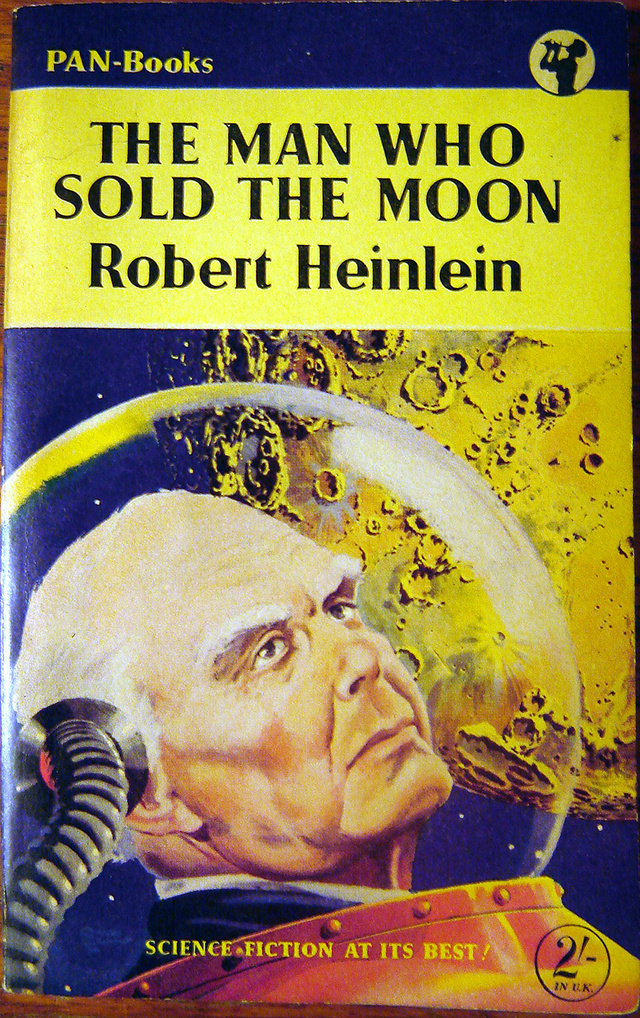
Written between 1939 and 1950 for quickie publication in pulp magazines, the Future History is a series of snapshots of what is now an alternate human future — one that features atomic energy, solar system imperialism, and the first steps to deep space, all within a Spenglerian choreography of social progress and occasional resurgent barbarity. It stands with Isaac Asimov’s Foundation trilogy as a monument of golden-age science fiction.
[…]
The result, in the key story of the Future History, is an uncannily accurate description of the design and launch of a Saturn V rocket. (Written before 1950, remember.) But because Heinlein happened not to be interested in electronic computers, all the spacefaring in his books is done with the aid of slide rules or Marchant-style mechanical calculators (which, in non-Heinlein history, had to become obsolete before humans could go to Luna at all). Heinlein sends people to colonize the moon, but nobody there has internet, or is conscious of its absence.
Given that his ideas about computers were from the pre-computer era and even the head of IBM thought there’d be a worldwide demand for a very small number of his company’s devices, that’s not surprising at all. In one of his best novels, a single computer runs almost all of the life support, heat, light, transportation and communication systems on Luna … and is self-aware, but lonely. In later works where computers appear, they tend to be individual personalities or even minor characters, but they’re anything but ubiquitous: powerful, but rare.
I suspect the lack of an internet-equivalent derives both from the nature of his conception of how computing would progress and a form of the Star Trek transporter problem – it solves too many plot issues that could otherwise be usefully woven into stories.
The “key story” I just mentioned is called “The Man Who Sold The Moon.” And if you’re one of the people who has been polarized by the promotional legerdemain of Elon Musk — whether you have been antagonized into loathing him, or lured into his explorer-hero cult — you probably need to make a special point of reading that story.
The shock of recognition will, I promise, flip your lid. The story is, inarguably, Musk’s playbook. Its protagonist, the idealistic business tycoon D.D. Harriman, is what Musk sees when he looks in the mirror.
“The Man Who Sold The Moon” is the story of how Harriman makes the first moon landing happen. Engineers and astronauts are present as peripheral characters, but it is a business romance. Harriman is a sophisticated sort of “Mary Sue” — an older chap whose backstory encompasses the youthful interests of the creators of classic pulp science fiction, but who is given a great fortune, built on terrestrial transport and housing, for the purposes of the story.
Forensic (junk) science
In The Nation, Meehan Crist and Tim Requarth report on a solved-by-forensic-science case that opens a lot of valid questions about the “science” part of forensic science:
Today, Genrich is 55 years old and has been in prison for nearly 25 years for crimes he says he didn’t commit. His latest appeal has been taken up by the Innocence Project, in the hopes of not only freeing Genrich, but getting the courts to recognize recent scientific challenges to forensic pattern-matching techniques that affect hundreds of thousands of people at all levels of the criminal-justice system. In our investigation, we comprehensively reviewed the literature on handheld toolmarks published in forensic trade journals, dug through past legal rulings, pored over nearly 7,000 pages of trial transcripts, and conducted dozens of interviews with prosecutors, defense attorneys, forensic practitioners, judges, academics, and scientists, from Grand Junction to the Department of Justice. What we found was a startling lack of scientific support for forensic pattern-matching techniques such as toolmark analysis; a legal system that has failed to separate nonsense from science even in capital cases; and a consensus among prosecutors all the way up to the attorney general’s office that scientifically dubious forensic techniques should be not only protected, but expanded. With Donald Trump in the White House and Jeff Sessions at the helm of the DOJ, the nominal momentum for forensic-science reform spurred by the two major reports is slowing. Genrich’s case reveals a system that makes it nearly impossible to throw unproven forensic science out of courts and may be keeping thousands of innocent people behind bars.
[…]
Firearm and toolmark analysis emerged out of a national push in the early 20th century to professionalize police investigative techniques at a moment when Americans were particularly enamored with science. Law enforcement borrowed terms from science, establishing crime “laboratories” staffed by forensic “scientists” who announced “theories” cloaked in their own specialized jargon. But forensic “science” focused on inventing clever ways to solve cases and win convictions; it was never about forming theories and testing them according to basic scientific standards. By adopting the trappings of science, the forensic disciplines co-opted its authority while abandoning its methods.
Amid the swirl of new forensic techniques, the courts realized there had to be a gatekeeping mechanism to filter out quackery. In 1923, the DC Court of Appeals provided that mechanism in Frye v. United States. The judges rejected a doctor’s dubious claim that he could use a polygraph to detect when a person was lying from a rise in their blood pressure. In the ruling, the court said that in order for scientific evidence or expert testimony to be admitted, it must be offered by an experienced practitioner making inferences from a “well-recognized scientific principle” that has “general acceptance in the particular field in which it belongs.” In Frye, the judges deemed the scientists in the “particular field” relevant to polygraph use to include psychologists and physiologists—not just polygraph practitioners who would, presumably, be biased toward preserving the technique’s reputation. The effectiveness of Frye in keeping dubious science out of the courts depends on whom judges include in their definition of the “relevant scientific community.” But as the decades wore on, and the forensic disciplines gained influence, judges tended to restrict their definition of the “relevant scientific community” to the forensic examiners themselves. Judges began taking advice on what counted as good forensics from the very people who invented the techniques and made a living off of them.
In the American criminal-justice system, where prosecutors regularly battle defense attorneys over what constitutes valid evidence, judges’ rulings on admissibility are the final word. Once a technique has made it into court and survived appeals, subsequent judges, most of whom have no scientific training and little ability to assess the scientific validity of a technique, will continue to allow it by citing precedent. Forensic examiners, in turn, cite precedent in order to claim that their techniques are reliable science. Prosecutors point to guilty verdicts as evidence that the science brought to court was sound. In this circular way, legal rulings — which never really vetted the science to begin with — substitute for scientific proof. This is Frye’s fatal flaw: Nowhere in this process is anyone required to provide empirical evidence that the techniques work as advertised. Frye aimed to keep pseudoscience out of the courts, but instead has helped create the perfect conditions to keep it in.
[…]
No human endeavor is perfect, yet many forensic examiners claim “zero” or near-zero error rates. In a widely cited 1984 paper in the Journal of Forensic Sciences, bite-mark examiners claimed a coincidental match would occur less than one in 10 quadrillion times. But when actually tested, even the most experienced examiners were wrong about one in six times, and in one study they struggled to distinguish a child’s bite mark from an adult’s. In 2009, the chief of the FBI Firearms-Toolmarks Unit wrote that a qualified examiner will “rarely if ever commit a false positive error (misidentification).” In practice, error rates for matching bullets to firearms can be dramatically higher: In 2008, the Detroit Police Department’s crime lab was shuttered when auditors found that its examiners made one error in every 10 cases. The head of the FBI’s fingerprint laboratory testified that its error rate was one in 11 million—because he knew of only one error in the FBI’s 11 million comparisons—but subsequent tests of fingerprint examiners show error rates ranging from one in 680 to one in 24.
February 12, 2018
Is glass really made from sand? – James May’s Q&A (Ep 11) – Head Squeeze
BBC Earth Lab
Published on 14 Mar 2013James May delves into what glass is actually made from. Is it really made from sand?
QotD: Science on the brink
Present reality is that science is on the verge of a nervous breakdown. That’s the not-so-tongue-in-cheek message in Science on the Verge, a new book by European scientist Andrea Saltelli and seven other contributors. Science on the Verge is a 200-page indictment of what to the lay reader appears to be a monumental deterioration across all fields, from climate science to health research to economics. The mere idea that “most published research results are false” should be cause for alarm. But it is worse than that. The crisis runs through just about everything we take for granted in modern science, from the use of big data to computer models of major parts of our social, economic and natural environment and on to the often absurd uses of statistical methods to fish for predetermined conclusions.
Terence Corcoran, “Science is on the verge of a nervous breakdown”, Financial Post, 2016-06-13.


