
Of all the sound, fury, and quiet voices of reason in the storm of controversy about tech culture and what is to become of it, quiet voice of reason Zeynep Tufekci’s “No, Nate, brogrammers may not be macho, but that’s not all there is to it” moves the discussion farther forward than any other contribution I’ve seen to date. Sadly, though, it still falls short of truly bridging the conceptual gap between nerds and “weird nerds.” Speaking as a lifelong member of the weird-nerd contingent, it’s truly surreal that this distinction exists at all. I’m slightly older than Nate Silver and about a decade younger than Paul Graham, so it wouldn’t surprise me if either or both find it just as puzzling. There was no cultural concept of cool nerds, or even not-cool-but-not-that-weird nerds, when we were growing up, or even when we were entering the workforce.
That’s no longer true. My younger colleague @puellavulnerata observes that for a long time, there were only weird nerds, but when our traditional pursuits (programming, electrical engineering, computer games, &c) became a route to career stability, nerdiness and its surface-level signifiers got culturally co-opted by trend-chasers who jumped on the style but never picked up on the underlying substance that differentiates weird nerds from the culture that still shuns them. That doesn’t make them “fake geeks,” boy, girl, or otherwise — you can adopt geek interests without taking on the entire weird-nerd package — but it’s still an important distinction. Indeed, the notion of “cool nerds” serves to erase the very existence of weird nerds, to the extent that many people who aren’t weird nerds themselves only seem to remember we exist when we commit some faux pas by their standards.
Even so, science, technology, and mathematics continue to attract the same awkward, isolated, and lonely personalities they have always attracted. Weird nerds are made, not born, and our society turns them out at a young age. Tufekci argues that “life’s not just high school,” but the process of unlearning lessons ingrained from childhood takes a lot more than a cap and gown or even a $10 million VC check, especially when life continues to reinforce those lessons well into adulthood. When weird nerds watch the cool kids jockeying for social position on Twitter, we see no difference between these status games and the ones we opted out of in high school. No one’s offered evidence to the contrary, so what incentive do we have to play that game? Telling us to grow up, get over it, and play a game we’re certain to lose is a demand that we deny the evidence of our senses and an infantilising insult rolled into one.
This phenomenon explains much of the backlash from weird nerds against “brogrammers” and “geek feminists” alike. (If you thought the conflict was only between those two groups, or that someone who criticises one group must necessarily be a member of the other, then you haven’t been paying close enough attention.) Both groups are latecomers barging in on a cultural space that was once a respite for us, and we don’t appreciate either group bringing its cultural conflicts into our space in a way that demands we choose one side or the other. That’s a false dichotomy, and false dichotomies make us want to tear our hair out.
Meredith Patterson, “When Nerds Collide: My intersectionality will have weirdoes or it will be bullshit”, Medium.com, 2014-04-23.
June 22, 2016
QotD: “Weird nerds are made, not born”
June 14, 2016
QotD: Romantic love … what is it for?
It’s all about the encephalization, really. Millions of years ago our hominid ancestors stumbled onto a novel adaptive strategy: be smart, adaptable, and capable of learning rather than purely instinct-driven. Make tools; use fire; invent language.
This strategy required much, much more of our nervous systems. Because intelligence was in fact a winning strategy, we were selected for growing more complex brains capable of doing more information processing. But increasing the logic density of brains is hard; there probably isn’t a path to it through the design space that is rapidly exploitable by small point mutations. So selective pressure made our brains larger, instead.
The fossil record shows that the hominid line encephalized at a breakneck speed compared to the usual leisurely pace of evolutionary change. This had huge consequences; much of human biology is a series of hacks and kluges to support that encephalization, often in stupidly suboptimal ways.
The one that’s relevant here starts from the limited width of the birth canal. Limited, that is, by the pelvic girdle surrounding it. A skull that’s too large won’t fit through. Therefore, the genetic lines that survived were those in which babies are born with small skulls but the ability to grow them much larger by maturity. (And even so, the size of a baby’s skull pushes that limit pretty hard; this is why birth is so much more difficult and dangerous for human females than it is for other primates).
That design (be born with a small skull and upgrade it outside the womb) implied a long juvenile period between birth and physical maturity. In fact the human brain doesn’t completely finish configuring and rewiring itself until around age 25. And the long juvenile period probably also explains the exceptionally long human lifespan; whatever had to be altered in the development clock to defer stabilization into the final adult configuration probably also delayed the inset of senescence. (Direct evidence for this theory is the rare disease “progeria”).
And the dominoes kept falling. The long juvenile period implied offspring that would be incapable of fending for themselves for an unprecedently long time – on the order of decades rather than the few months to a year typical for other mammals. Consequently the selective value of extended cooperation between the parents went way, way up relative to even our nearest animal kin.
Romantic love works as an an evolved mechanism for keeping mated pairs cooperating long enough to raise multiple children. Here again, selection favors those who love more because they get to launch more offspring. We are, in fact, made to fall in love – and it would only be surprising if the mechanism for establishing it were not simple, robust, and easily triggered.
Eric S. Raymond, “Love is the simplest thing”, Armed and Dangerous, 2015-01-15.
June 12, 2016
Discovering the “Pompeii of Peterborough”
In The New Yorker, Charlotte Higgins describes the Bronze Age archaeological dig near Peterborough in the fens:
… from time to time, the soil pushes up clues, particularly in the fens, where the waterlogged earth creates anaerobic conditions that slow decay. One summer day in 1999, a local archeologist was walking at Must Farm, along the edge of a disused clay pit; at one time it was filled with water, but the water level had dropped enough to reveal some wooden stakes poking out. The Cambridge Archaeological Unit, which operates out of the university, an hour’s drive away, did some exploratory work and found, through radiocarbon dating, that the material dated from about 900 B.C. The site was monitored for several years, until Historic England, a government agency devoted to preserving the country’s heritage, began to press for it to be properly excavated. Last September, with funding from Historic England and the brick-making company Forterra, a team of about a dozen archeologists went to work.
Each day, they are making discoveries that are radically expanding the knowledge of Bronze Age Britain. The site is unparalleled in the U.K. for its wealth of artifacts and the pristine state of their preservation. Three thousand years ago, it was a settlement of wooden roundhouses, but life there ended abruptly: a fire tore through it, and the buildings collapsed, sank into the marshland, and were quickly entombed by silt and mud. “In archeology, very occasionally, there is the feeling that you have turned up just a week too late, that the people who were here have just moved on,” Mark Knight, the archeologist in charge of excavation at Must Farm, told me when I visited for a day in April. “This site has that feeling to it. Normally in Britain, when you dig, three thousand years of history seems manifest in the remains, because the most you tend to find is a few postholes and a potsherd. Here, somehow, the time span feels short. It’s so intact, so three-dimensional.” Inevitably, perhaps, the site has been nicknamed the Pompeii of Peterborough.
[…]
We stood on a low rise, and in the dip below us was a white tent about a quarter the size of a football field, erected to cover the archeological site and keep it from drying out in the harsh East Anglian wind. Knight led me down a path toward it. At the top of the slope, marking the present day, were fragments of bricks, rejects from the nearby factory. Farther down, he indicated a dark layer of earth. “This is Iron Age peat,” he said. And a few steps later: “This is where the sea came in, in the early Roman period, the first century A.D.” As we approached the tent, he said, “Now we’re down into the period where we’re excavating, around 900 B.C.—river channels. Can you see the shells of freshwater mussels?” Inside the tent, the excavation was being conducted two metres below the surface; had we been able to continue down another eighteen metres, to the level of the base of the quarry, we would have arrived at the Jurassic, a hundred and forty-five million years earlier.
From a viewing platform, we could look down on the whole excavation: a large, muddy, roughly rectangular area from which a number of wooden stakes poked up. Gradually, some of the stakes resolved themselves into the shape of a palisade that had once encircled the whole settlement. Inside this enclosure, I could make out individual objects—a human skull, the spine of a horse, something that looked like a woven-willow fence, the lips of pots, all half-buried. “There are some bowls,” Knight said. “There’s a wooden platter. There’s a big wooden trough. Over there, a storage vessel.”
Also within the perimeter of the palisade were three large shapes, each comprising a number of wooden rafters radiating unevenly outward from a central point, like the spokes of a broken umbrella. These were the collapsed roofs of the roundhouses. Several archeologists were working on excavating a fourth. They had already lifted and removed its roof timbers and were uncovering the dwelling’s contents, now compressed by three millennia of mud. They scraped with their trowels methodically, emptying the dirt into buckets that would later be sifted for small finds. One researcher, who looked to be in his twenties, wore a sweatshirt with the words “MY FUTURE LIES IN RUINS.”
June 10, 2016
A breakthrough in our understanding of the causes of depression
Scott Alexander takes a quick look at a recent discovery in medication for depression:
A few weeks ago, Nature published a bombshell study showing that ketamine’s antidepressant effects were actually caused by a metabolite, 2S,6S;2R,6R-hydroxynorketamine (don’t worry about the name; within ten years it’ll be called JOYVIVA™®© and you’ll catch yourself humming advertising jingles about it in the shower). Unlike ketamine, which is addictive and produces scary dissociative experiences, the metabolite is pretty safe. This is a big deal clinically, because it makes it easier and safer to prescribe to depressed people.
It’s also a big deal scientifically. Ketamine is a strong NMDA receptor antagonist; the metabolite is an AMPA agonist – they have different mechanisms of action. Knowing the real story behind why ketamine works will hopefully speed efforts to understand the nature of depression.
But I’m also interested in it from another angle. For the last ten years, everyone has been excited about ketamine. In a field that gets mocked for not having any really useful clinical discoveries in the last thirty years, ketamine was proof that progress was possible. It was the Exciting New Thing that everybody wanted to do research about.
Given the whole replication crisis thing, I wondered. You’ve got a community of people who think that NMDA antagonism and dissociation are somehow related to depression. If the latest study is true, all that was false. This is good; science is supposed to be self-correcting. But what about before it self-corrected? Did researchers virtuously say “I know the paradigm says NMDA is essential to depression, and nobody’s come up with a better idea yet, but there are some troubling inconsistencies in that picture”? Or did they tinker with their studies until they got the results they expected, then triumphantly declare that they had confirmed the dominant paradigm was right about everything all along?
June 1, 2016
QotD: The evolutionary advantage of conformity
In the environment of evolutionary adaptedness (EEA) an individual could not survive outside the group of their birth and so conformity was a matter of life and death. Conform or be cast out. Conformity to arbitrary convention was not in fact arbitrary but signalled affiliation. Conformity banded groups together.
Today, however, conformity is often counter-productive. Trying to enforce the arbitrary conventions of one’s in-group impedes social cooperation on the scale that makes modernity possible. Conformity also slows the development of new ideas and new ways of doing things — the essence of growth and progress. Even though conformity is now counter-productive the desire to conform and to enforce conformity is buried deep–the atavism of social justice.
Individualism and liberalism are foundational ideas for modernity but these adult ideas battle the desire to conform in our childish hearts.
Alex Tabarrok, “The Developmental Roots of Conformity Bias”, Marginal Revolution, 2016-05-20.
May 28, 2016
QotD: “Farm-to-table” food
We all love farm-to-table food, don’t we? The freshness, the warm sense of environmental sustainability, the delights of spending your money in the local economy. Of course we all love it.
Or … maybe we just think we love it. An exhaustive investigation by a Tampa Bay Times food critic reveals just how little of the food advertised as organic, locally sourced, non-GMO fare actually fits that description. The article is a slightly painful read, as restaurant after restaurant sheepishly tries to cover for their, um, “menu anomalies” by explaining that they totally used to buy some stuff from a local producer, then they forgot to change the chalkboard when they switched suppliers, and besides, the bus was late and the dog ate their homework. Some of these claims may even be true, but given the ubiquity of these “anomalies,” it’s hard to believe that there isn’t considerable calculation behind these unidirectional mistakes.
And it’s not hard to figure out why: Consumers don’t really want to buy farm-to-table food. What they want to buy is the moral satisfaction of farm-to-table food.
A consumer who is actually looking for vegetables picked no later than yesterday morning and trundled to their table at the peak of freshness probably isn’t going to be satisfied with the corn that just spent a few weeks bouncing around in the back of a truck somewhere; the products will be noticeably different in flavor. On the other hand, for a consumer who’s just looking for moral satisfaction — well, the nice thing about selling intangible qualities is that there’s no discernible difference to the consumer between being told that they’re consuming locally grown foods and actually doing so.
Megan McArdle, “Dining Out on Empty Virtue”, Bloomberg View, 2016-04-15.
May 26, 2016
Eighty percent of Americans surveyed favour banning things they know nothing about
Don’t get too smug, fellow Canuckistanis, as I suspect the numbers might be just as bad if Canadians were surveyed in this way:
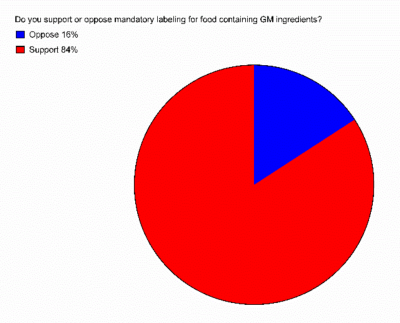
You might have heard that Americans overwhelmingly favor mandatory labeling for foods containing genetically modified ingredients. That’s true, according to a new study: 84 percent of respondents said they support the labels.
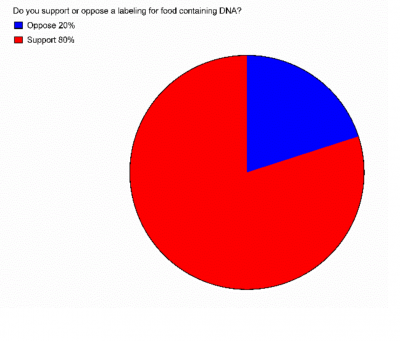
But a nearly identical percentage — 80 percent—in the same survey said they’d also like to see labels on food containing DNA.
The study, published in the Federation of American Societies for Experimental Biology Journal last week, also found that 33 percent of respondents thought that non-GM tomatoes “did not contain genes” and 32 percent thought that “vegetables did not have DNA.” So there’s that.
University of Florida food economist Brandon R. McFadden and his co-author Jayson L. Lusk surveyed 1,000 American consumers and discovered [PDF] that “consumers think they know more than they actually do about GM food.” In fact, the authors say, “the findings question the usefulness of results from opinion polls as motivation for public policy surrounding GM food.”
My summary for laymen: When it comes to genetically modified food, people don’t know much, they don’t know what they don’t know, and they sure as heck aren’t letting that stop them from having strong opinions.
May 17, 2016
Green Party policies
In a comment on a post about the leader of the British Green Party stepping down, David Thompson explains why he finds the party’s policies to be distasteful:
Green Party policy […] advocates massive and unbudgeted state spending, crippling eco-taxes, forced “organic” food production, and a deliberate shrinking and discouragement of international trade in order to curb the evils of consumerism. Curiously, they denounce ‘austerity’ (i.e., modest reductions in the growth of public spending), while envisioning a world in which no-one can buy anything too fancy, or from too far afield. And they see no need to retain an army or navy or air force, all of which they dismiss as “unnecessary.”
In policy NY203, the party says its goal is “to see the concept of legal nationality abolished.” Apparently, they want a Citizen’s Income, in which everyone is subsidised simply for being, while abolishing any notion of actual, legal citizenship. They imply that a country, a society, having some control of its borders, however partial, is racist, and that the world and its wives should be free to breeze into Britain and avail themselves of our already overstretched benefits system.
This dissolving of our territorial and cultural boundaries, and the abandonment of our ability to defend ourselves or anyone else, along with uncontrolled mass migration from the shitholes of the Earth, and the subsequent collapse of our welfare infrastructure and general economy, to say nothing of social unrest, riots and other unpleasantness… all of this would, we’re told, create “a world more equal, more balanced.”
And yet they ask, “What are you afraid of, boys?”
I think this may be where entrenched, impervious idiocy becomes… well, something close to evil.
May 13, 2016
May 9, 2016
QotD: Towards a theory of pedestrian behaviour
One of the things I enjoy is urban running — i.e., running through the streets of cities. When we travel, this is one of my favorite ways to see cities, and it also helps me run further because I do not get bored. But trying to run through sometimes crowded pedestrian areas can be frustrating, since one is trying to move faster than the crowd and the crowd typically does not expect a runner coming up behind them on the sidewalk. As a result of many such runs, I have developed two laws of pedestrian behavior:
- Groups of pedestrians will expand to fill the width of the space allotted. If the width changes, groups of pedestrians will respond very quickly and expand their group spacing to fill that width. While this behavior is almost certainly natural, it is almost impossible to distinguish a group walking naturally from one purposefully trying to block passage by a faster pedestrian. Corollary: Groups too small to fill the width of a passage or sidewalk will weave.
- Groups of pedestrians, everything else being equal, will choose to pause and congregate at the bottleneck in any sidewalk, thus constricting an already narrow passage. DisneyWorld is a great location for spotting this behavior. Corollary: A disproportionate number of people will choose to stop right at the exit door from an jetway when exiting an aircraft.
Warren Meyer, “My Contributions to Social Science”, Coyote Blog, 2015-01-06.
May 5, 2016
All regulations have obvious costs and hidden costs
J.C. Carlton explains why the US government’s latest regulatory intervention in the dishwasher market is pretty much guaranteed to make dishwashers more expensive and less capable:
… it’s amazing how much doesn’t work, or works poorly because of the rules that bureaucrats come up with. Yet time and again the bureaucrat’s solution is always more cowbell. For some reason they think that because something may have worked before, it will always work as long as you just do it more. The fact is that no matter what you do, that 24% energy “savings” and 38% less water use are going to have to come from somewhere. My guess is that it will come from making dishwashers that do a very lousy job of actually washing dishes or are terribly expensive.
There’s only so much you can do. 24% less electricity means that you will have to use a smaller motor, a smaller heating element, or both. You might have to use different heating elements or motors that work at different times during the cycle. More than likely you will have to use complicated electronics to run it all. Even when you are all done with meeting the mandate, you will end up with a machine that just doesn’t work very well. Which also costs more and has to be serviced more often to boot. How much savings to you get it the reliability is halved and the truck has to keep coming out for service calls. That’s the problem with those one-dimensional rules. They tend to cost more in compliance than they actually save.
[…]
Of course the endless quest for false efficiencies does have its costs. Somehow the bureaucrats never seem to have to pay those costs in their lives, or at least aren’t effected enough by the pain to notice. I have to wonder if whoever came up with the 1 gallon toilet ever flushes. Does the Energy Star guy never have to go shopping for appliances and when he gets home finds out that it barely works?
April 30, 2016
QotD: “SETI is a religion”
Cast your minds back to 1960. John F. Kennedy is president, commercial jet airplanes are just appearing, the biggest university mainframes have 12K of memory. And in Green Bank, West Virginia at the new National Radio Astronomy Observatory, a young astrophysicist named Frank Drake runs a two-week project called Ozma, to search for extraterrestrial signals. A signal is received, to great excitement. It turns out to be false, but the excitement remains. In 1960, Drake organizes the first SETI conference, and came up with the now-famous Drake equation:
N=N*fp ne fl fi fc fL[where N is the number of stars in the Milky Way galaxy; fp is the fraction with planets; ne is the number of planets per star capable of supporting life; fl is the fraction of planets where life evolves; fi is the fraction where intelligent life evolves; and fc is the fraction that communicates; and fL is the fraction of the planet’s life during which the communicating civilizations live.]
This serious-looking equation gave SETI a serious footing as a legitimate intellectual inquiry. The problem, of course, is that none of the terms can be known, and most cannot even be estimated. The only way to work the equation is to fill in with guesses. And guesses — just so we’re clear — are merely expressions of prejudice. Nor can there be “informed guesses.” If you need to state how many planets with life choose to communicate, there is simply no way to make an informed guess. It’s simply prejudice.
As a result, the Drake equation can have any value from “billions and billions” to zero. An expression that can mean anything means nothing. Speaking precisely, the Drake equation is literally meaningless, and has nothing to do with science. I take the hard view that science involves the creation of testable hypotheses. The Drake equation cannot be tested and therefore SETI is not science. SETI is unquestionably a religion. Faith is defined as the firm belief in something for which there is no proof. The belief that the Koran is the word of God is a matter of faith. The belief that God created the universe in seven days is a matter of faith. The belief that there are other life forms in the universe is a matter of faith. There is not a single shred of evidence for any other life forms, and in forty years of searching, none has been discovered. There is absolutely no evidentiary reason to maintain this belief. SETI is a religion.
Michael Crichton, “Aliens Cause Global Warming”: the Caltech Michelin Lecture, 2003-01-17.
April 28, 2016
QotD: That’s why they call it “Sex Education”
I’m on the road in Thailand, speaking at a U.N. conference on sustainable A development in the Third World. Earlier today I listened to a presentation on the effects of sex education for women. The presentation mentioned some cultural value conflicts about sex education, but it occurred to me that it didn’t touch the biggest one. To wit: worldwide, the teachers want the kids to learn abstinence, but what the kids [want] to learn is technique.
Eric S. Raymond, “That’s Why They Call It ‘Sex Education'”, Armed and Dangerous, 2002-05-20.
April 26, 2016
QotD: Sadly, looks do matter
If you’re a woman who wants to land a man, there’s this notion that you should be able to go around looking like Ernest Borgnine: If you’re “beautiful on the inside,” that’s all that should count. Right. And I should have a flying car and a mansion in Bel Air with servants and a moat.
Welcome to Uglytopia — the world reimagined as a place where it’s the content of a woman’s character, not her pushup bra, that puts her on the cover of Maxim. It just doesn’t seem fair to us that some people come into life with certain advantages — whether it’s a movie star chin or a multimillion-dollar shipbuilding inheritance. Maybe we need affirmative action for ugly people; make George Clooney rotate in some homely women between all his gorgeous girlfriends. While we wish things were different, we’d best accept the ugly reality: No man will turn his head to ogle a woman because she looks like the type to buy a turkey sandwich for a homeless man or read to the blind.
[…]
It turns out that the real beauty myth is the damaging one Wolf and other feminists are perpetuating — the absurd notion that it serves women to thumb their noses at standards of beauty. Of course, looks aren’t all that matter (as I’m lectured by female readers of my newspaper column when I point out that male lust seems to have a weight limit). But looks matter a great deal. The more attractive the woman is, the wider her pool of romantic partners and range of opportunities in her work and day-to-day life. We all know this, and numerous studies confirm it — it’s just heresy to say so.
Amy Alkon, “The Truth About Beauty”, Psychology Today, 2010-11-01.
April 24, 2016
The “secret” of Indian food
In an article in the Washington Post last year, Roberto Ferdman summarized the findings of a statistical study explaining why the flavours in Indian foods differ so much from other world cuisines:
Indian food, with its hodgepodge of ingredients and intoxicating aromas, is coveted around the world. The labor-intensive cuisine and its mix of spices is more often than not a revelation for those who sit down to eat it for the first time. Heavy doses of cardamom, cayenne, tamarind and other flavors can overwhelm an unfamiliar palate. Together, they help form the pillars of what tastes so good to so many people.
But behind the appeal of Indian food — what makes it so novel and so delicious — is also a stranger and subtler truth. In a large new analysis of more than 2,000 popular recipes, data scientists have discovered perhaps the key reason why Indian food tastes so unique: It does something radical with flavors, something very different from what we tend to do in the United States and the rest of Western culture. And it does it at the molecular level.
[…]
Chefs in the West like to make dishes with ingredients that have overlapping flavors. But not all cuisines adhere to the same rule. Many Asian cuisines have been shown to belie the trend by favoring dishes with ingredients that don’t overlap in flavor. And Indian food, in particular, is one of the most powerful counterexamples.
Researchers at the Indian Institute for Technology in Jodhpur crunched data on several thousand recipes from a popular online recipe site called TarlaDalal.com. They broke each dish down to its ingredients, and then compared how often and heavily ingredients share flavor compounds.
The answer? Not too often.


