
Julian Simon, the economist who was legendarily skeptical about environmental doom, once posed a question at an environmental forum: “How many people here believe that the earth is increasingly polluted and that our natural resources are being exhausted?” Almost every hand shot up. He then said, “Is there any evidence that could dissuade you?” There was no response, so he asked again, “Is there any evidence I could give you — anything at all — that would lead you to reconsider these assumptions?” Again, no response. Simon concluded, “Well, excuse me. I’m not dressed for church.”
Jeremy Carl, “The Church of Environmentalism”, Claremont Review of Books, 2016-02-25.
May 13, 2019
QotD: The Church of Environmentalism
Comments Off on QotD: The Church of Environmentalism
April 29, 2019
Banning single-use plastics won’t make much (if any) difference
My local high school is suddenly all about the proposed ban on single-use plastics — where student-made posters used to proclaim their dedication to gender equality, they’re now all about the evils of plastics. It’s almost like it’s a co-ordinated campaign that originated somewhere else…
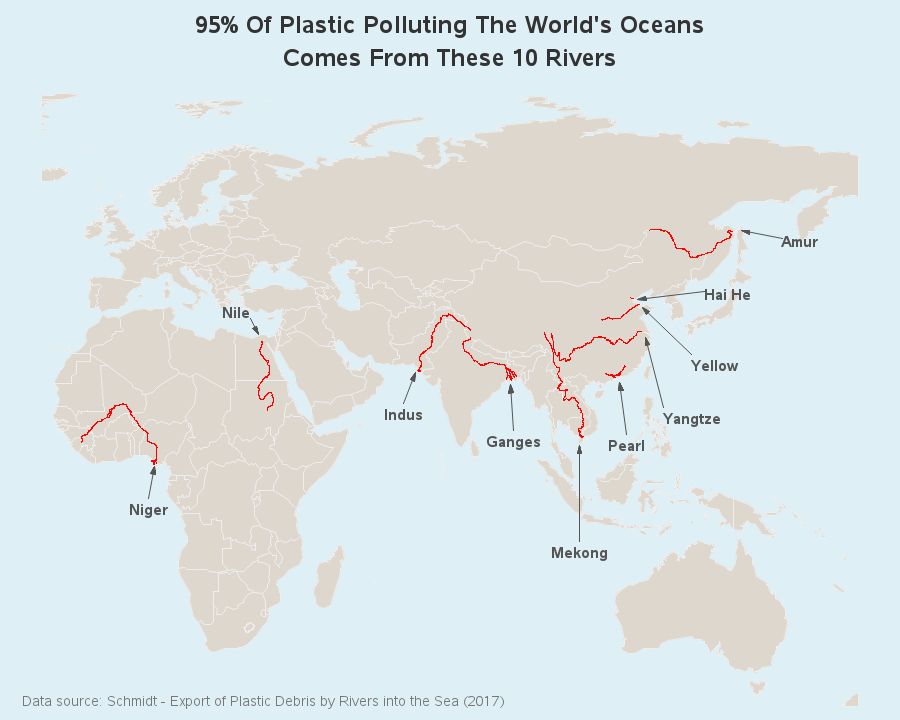
But despite the students’ new-found environmental awareness, the ban they favour would make little or no difference to plastic items ending up in the oceans, because the vast majority of the plastic there comes from only ten rivers, none of them in North America (this is from a World Economic Forum report). Jason Unrau reports on his trip up the Yangtze River in China twenty years ago that illustrates the breadth of the problem:
Beginning in Shanghai in the summer of 1999, I boarded a large flat-bottom boat with around 300 other passengers. It would be the first of about a dozen different vessels, that over two weeks ferried me 2500 kilometres to Chongqing.
After taking my first meal in the ferry’s mess hall, served in a Styrofoam box, I searched everywhere for a garbage can. There were none – passengers simply tossed their garbage overboard and without an alternative, I joined in the littering.
The banks of the Yangtze are home to more than 200 million Chinese who treat the waterway as commuter corridor and as I soon discovered, a dump. I took the trip to get a glimpse the fabled Three Gorges, before a hydro-electric project and dam would change the watershed forever. As my trip progressed, however, so did my treatment of this historic river as trash receptacle.
The closer I got to Chongqing, the narrower the river became and the smaller the ferries got. About 10 days into the trip, I exited the dining hall of a different vessel to engage in the daily ritual of reckless Styrofoam abandonment, but to my surprise there was a garbage bin.
Delighted at the prospect that my littering ways on the Yangtze were through, enthusiastically I added my box to a near overflowing bin. As if on cue a kitchenhand exited the dining hall, gathered up the bag and heaved the entire thing overboard.
Like I experienced and begrudgingly participated in creating, the World Economic Forum’s report describes “rivers of plastic” – its analyses of respective outputs and comparisons to garbage island and other samples, could be traced back to their source.
According to the economic forum eight of these rivers are in Asia: the Yangtze; Indus; Yellow; Hai He; Ganges; Pearl; Amur; Mekong; and two in Africa – the Nile and the Niger.
Comments Off on Banning single-use plastics won’t make much (if any) difference
April 25, 2019
QotD: “Science”
Ah, science. If you’re even loosely engaged in the wild and dark art that is politics these days, you know by now that “science,” as a word, has taken on an almost mystical meaning. “Science,” in many of its modern incantations, now serves as a form of code, as vague and fuzzy as a Wiccan chant. For a growing number of political activists, the meaning is simple: Science, you see, is a lively mix of standard progressive hobbyhorses, tossed wild-eyed and cranky into one cantankerous bag.
Heather Wilhelm, “The Left’s New Cure-All: ‘Science’”, National Review, 2017-04-12.
Comments Off on QotD: “Science”
April 16, 2019
‘Tis Eastertide, and so the professional miserablists are going after Easter Eggs, of course
In the Continental Telegraph, Tim Worstall tells the worried environmentalists that no, it does not make sense to ban Easter eggs — for their “wasteful” packaging — on environmental grounds:

One of the more silly of the current environmental concerns is the worrying about the quantity of packaging that goes into – or around – Easter eggs. There’s an underlying mistake being made here, one which none of the proponents of action have bothered to recognise, let alone think about. Which is, well, what’s the purpose? The point of all this human activity we call an economy?
As any economist could and would tell you we’re after the maximisation of human utility. Given the constraints placed upon us by reality – the availability of stuff with which to do things, technologies we know about to do things to stuff with – we want humans to be as happy as they can be. We want, in short to maximise the amount of joy in the world.
At which point, packaging. Sure, no doubt there’s a certain harm that befalls us all from the creation of packaging and its disposal. Why not? There are costs and benefits to everything of course. But that’s the point, while there may be costs there are also benefits. So, yes, OK, there are costs to packaging.
[…]
At no point is even consideration given to the idea that the packaged egg might produce that joy. Which, given that we do indeed go buy these things each year to give to each other, is odd, isn’t it? Why are we giving each other expensive – as opposed to cheap – chocolate? Because, obviously enough, the dressing of the chocolate is something that produces that joy.
We can even have a stab at quantifying matters.
The cost is 3,000 tonnes of packaging. We know what that costs us, the value of the landfill tax. Around £80 a tonne. So, call it quarter of a million pounds. Spending upon Easter eggs is some £400 million a year. The joy produced must be of greater value than that £400 million otherwise we’d not be spending it in the first place. And yes, £400 million is more than £250,000.
We thus have our answer to the prodnoses worrying about the cost of Easter egg packaging. Piss off matey, you’ve missed the point entirely.
Comments Off on ‘Tis Eastertide, and so the professional miserablists are going after Easter Eggs, of course
April 3, 2019
QotD: Veganism has its drawbacks
Evangelical vegans will tell you that following a purely ‘plant-based’ diet is not only morally commendable, it’s also much better for your health. But if my experience is anything to go by, the opposite is true.
I felt absolutely fine for the first few days. I didn’t miss meat at all, certainly not in terms of taste or flavour. The only thing I really felt an absence of was eggs. Since I embarked on my mammoth weight-loss project, eggs have become a dietary staple for me: nothing fills me up as well or gives me quite as much long-lasting energy as an egg.
I also found I had to eat larger portions to feel full — and I felt hungry again after a shorter period of time. But even that didn’t bother me, since what I was eating was so wholesome.
No, the real issue became apparent after the third or fourth day. Not to put too fine a point on it: wind.
My stomach was, quite literally, in ferment. All those legumes and pulses and generalised vegetable matter appeared to have turned into a giant internal compost heap. It wasn’t too bad in the mornings; but by early afternoon I was like a cow who had overdosed on clover.
At first, I palmed the outcome off on our three dogs. But after a while the problem became so severe that even they could not be expected to account for the frequency and potency of aromas emerging from my lower digestive tract.
One of the key arguments of vegans against livestock farming is the harm animals cause to the planet through the amount of methane they produce; if my experience was anything to go by, a vegan human is capable of producing just as much, if not more. I was a one-woman global warming hazard.
My children, of course, thought it was hilarious. But from my point of view, it was not only unpleasant and occasionally embarrassing, it was also incredibly uncomfortable. I felt bloated, soggy and sluggish, and began to dread meal times.
Following the advice of the nutritionist, I took to soaking nuts, oats and seeds overnight. But it made no difference. If anything, the problem began to get worse. The more healthy vegan food I put into my body, the worse my stomach problems became.
As for the much-vaunted ‘vegan glow’, no sign. Instead, my skin felt dry and dehydrated, and there was a distinctly greyish tinge to my complexion. But still, I persisted.
Sarah Vine, “Going vegan sent me off my trolley! Exhausted, irritable and don’t even start of the tummy troubles – SARAH VINE’s bid to join the health revolution left her VERY green around the gills”, Daily Mail, 2019-02-22.
Comments Off on QotD: Veganism has its drawbacks
April 2, 2019
The not-so-ancient extinction of Madagascar’s megafauna
At The Conversation, Nick Scroxton, Laurie Godfrey, and Stephen Burns discuss their new theory on the megafauna extinction in Madagascar just over a thousand years ago:
Giant 10-foot-tall elephant birds, with eggs eight times larger than an ostrich’s. Sloth lemurs bigger than a panda, weighing in at 350 pounds. A puma-like predator called the giant fosa.
They sound like characters in a child’s fantasy book, but along with dozens of other species, they once really roamed the landscape of Madagascar. Then, after millions of years of evolution in the middle of the Indian Ocean, the populations crashed in just a couple of centuries.
Scientists know that over the past 40,000 years, most of Earth’s megafauna – that is, animals human-size or larger – have gone extinct. Woolly mammoths, sabre tooth tigers and countless others no longer roam the planet.
What’s remarkable about the megafaunal crash in Madagascar is that it occurred not tens of thousands of years ago but just over 1,000 years ago, between A.D. 700 and 1000. And while some small populations survived a while longer, the damage was done in a relatively short amount of time. Why?
Over the last three years, new investigations into climate and land use patterns, human genetic diversity on the island and the dating of hundreds of fossils have fundamentally changed scientists’ understanding of the human and natural history of Madagascar. As two paleoclimatologists and a paleontologist, we brought together this research with new evidence of megafaunal butchery. In doing so we’ve created a new theory of how, why and when these Malagasy megafauna went extinct.
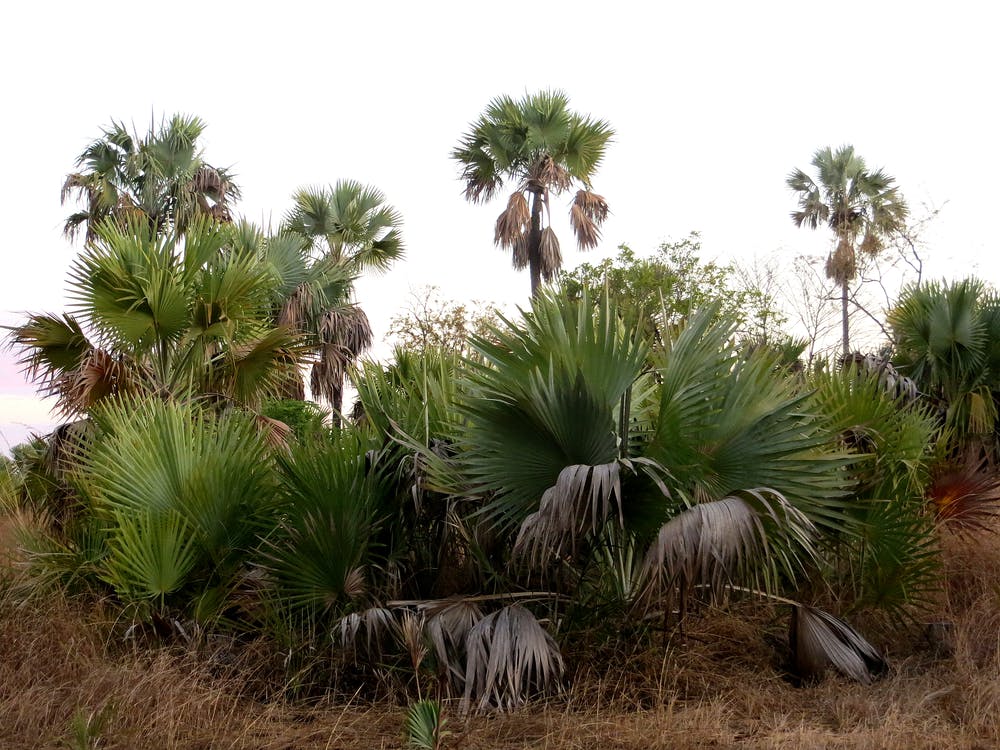
Many of the forests that originally existed on Madagascar are now replaced by more open, human-modified landscapes, like this palm savanna at Anjohibe.
Laurie Godfrey, CC BY-ND
Comments Off on The not-so-ancient extinction of Madagascar’s megafauna
March 30, 2019
QotD: Organic spices are a racket
There’s a whole other piece to be written about organic spices, but the short version is that demanding organic spices is never going to be good for the farmers growing them. The U.S. standards for organic products amounts to ridiculously expensive and oftentimes unnecessary practices for small farmers who just don’t have the resources to do it. There are plenty of ways to arrive at ethical treatment of animals and land that are not part of our complicated organic laws. And that’s not to mention the people who demand organic products but will also freak out at the sight of a bug or won’t buy something that’s even a little bit misshapen or with a tiny brown spot on it. You can have pesticides or you can have pests.
Caitlin PenzeyMoog, “Salt grinders are bullshit, and other lessons from growing up in the spice trade”, The A.V. Club, 2017-04-06.
Comments Off on QotD: Organic spices are a racket
March 24, 2019
Trust in scientific findings decreasing among the general public
In Scientific American, Louise Lief discusses the problem of rising public distrust of science:
We live in a moment when preventable infectious diseases like measles are spreading because parents distrust vaccines, and scientists at government agencies are being told not to use terms like “evidence-based.” The president dismisses the findings of a National Climate Assessment by more than 300 scientists and 13 federal agencies that warns of massive economic and environmental damage totaling hundreds of billions of dollars, crop failures, disrupted supply chains and multiple threats to human health, saying, “I don’t believe it.”
But when I argued in favor of the proposition (Resolved: “Science writers are responsible for building public trust in science”) during a debate at the National Association of Science Writers’ 2018 annual conference last fall, the majority of science writers and science journalists present voted that building public trust in science was not the responsibility of science writers.
[…]
Kathleen Hall Jamieson, director of the Annenberg Public Policy Center at the University of Pennsylvania’s Annenberg School for Communication also tackled the science trust question at the NASW conference, and researchers at Cardiff University have traced credibility and accuracy problems to press releases from scientists’ own academic institutions.
If a problem is discovered or a study is retracted, said Jamieson, the scientist or scientific journal needs to explain to journalists and the public how the error was discovered, what the problem is, and what steps are being taken to ensure it doesn’t happen again.
Scientists often make it hard for journalists to cover these three interrelated issues, she says. Scholarly journal publication protocols may cause scientists to write one article on the problem they’re investigating, and a second or third article on processes and solutions, resulting in coverage that emphasizes problems and shortchanges corrective action.
For their part, researchers at Cardiff University found that press releases from scientists’ own academic institutions about their work were a significant source of exaggerated claims and spin, even though most scientists can approve their wording.
Their study of press releases from 20 leading British universities on health-related science news found that when the press releases exaggerated, it was likely the news stories would too.
An analysis of 41 news articles on randomized controlled trials based on 70 press releases showed only four articles that contained exaggerated claims not included in the press release or journal abstract. Interestingly, they also found the hype and spin intended to tempt the media did not result in more news coverage.
H/T to Blazing Cat Fur for the link.
Comments Off on Trust in scientific findings decreasing among the general public
March 22, 2019
Understanding the Great Depression
Marginal Revolution University
Published on 23 May 2017In this video, we examine the causes behind the Great Depression with the help of the aggregate demand-aggregate supply model.
In 1929, the stock market crashed and an air of pessimism swept across America — making bank depositors nervous. What would you do if you thought your money might not be safe with the bank? You’d probably want it back in your own hands. What happened next? A run on the banks.
Along with the Stock Market Crash of 1929, it’s one of the iconic moments of the early days of Great Depression. However, the Great Depression was an incredibly complex downturn in which the economy experienced a series of aggregate demand shocks. By the end of this video, you’ll walk away with a better understanding of the many factors behind the Great Depression and how to apply the AD-AS model to a real-world scenario.
Comments Off on Understanding the Great Depression
March 9, 2019
QotD: “Scientific” urban planning versus messy, unscientific, evolved town growth
Natural organically-evolved cities tend to be densely-packed mixtures of dark alleys, tiny shops, and overcrowded streets. Modern scientific rationalists came up with a better idea: an evenly-spaced rectangular grid of identical giant Brutalist apartment buildings separated by wide boulevards, with everything separated into carefully-zoned districts. Yet for some reason, whenever these new rational cities were built, people hated them and did everything they could to move out into more organic suburbs. And again, for some reason the urban planners got promoted, became famous, and spread their destructive techniques around the world.
Ye olde organically-evolved peasant villages tended to be complicated confusions of everybody trying to raise fifty different crops at the same time on awkwardly shaped cramped parcels of land. Modern scientific rationalists came up with a better idea: giant collective mechanized farms growing purpose-bred high-yield crops and arranged in (say it with me) evenly-spaced rectangular grids. Yet for some reason, these giant collective farms had lower yields per acre than the old traditional methods, and wherever they arose famine and mass starvation followed. And again, for some reason governments continued to push the more “modern” methods, whether it was socialist collectives in the USSR, big agricultural corporations in the US, or sprawling banana plantations in the Third World.
Traditional lifestyles of many East African natives were nomadic, involving slash-and-burn agriculture in complicated jungle terrain according to a bewildering variety of ad-hoc rules. Modern scientific rationalists in African governments (both colonial and independent) came up with a better idea – resettlment of the natives into villages, where they could have modern amenities like schools, wells, electricity, and evenly-spaced rectangular grids. Yet for some reason, these villages kept failing: their crops died, their economies collapsed, and their native inhabitants disappeared back into the jungle. And again, for some reason the African governments kept trying to bring the natives back and make them stay, even if they had to blur the lines between villages and concentration camps to make it work.
Why did all of these schemes fail? And more importantly, why were they celebrated, rewarded, and continued, even when the fact of their failure became too obvious to ignore? Scott gives a two part answer.
The first part of the story is High Modernism, an aesthetic taste masquerading as a scientific philosophy. The High Modernists claimed to be about figuring out the most efficient and high-tech way of doing things, but most of them knew little relevant math or science and were basically just LARPing being rational by placing things in evenly-spaced rectangular grids.
But the High Modernists were pawns in service of a deeper motive: the centralized state wanted the world to be “legible”, ie arranged in a way that made it easy to monitor and control. An intact forest might be more productive than an evenly-spaced rectangular grid of Norway spruce, but it was harder to legislate rules for, or assess taxes on.
The state promoted the High Modernists’ platitudes about The Greater Good as cover, in order to implement the totalitarian schemes they wanted to implement anyway. The resulting experiments were usually failures by the humanitarian goals of the Modernists, but resounding successes by the command-and-control goals of the state. And so we gradually transitioned from systems that were messy but full of fine-tuned hidden order, to ones that were barely-functional but really easy to tax.
Scott Alexander, “Book Review: Seeing Like a State”, Slate Star Codex, 2017-03-16.
Comments Off on QotD: “Scientific” urban planning versus messy, unscientific, evolved town growth
March 1, 2019
Dune – Wandering in the Desert – Extra Sci Fi – #3
Extra Credits
Published on 26 Feb 2019Dune is an ecological novel. Nature isn’t just the background setting, but firmly integrated into the science and systems of the world. Frank Herbert explores big ideas around environmental conservation, through the spice that must flow.
Comments Off on Dune – Wandering in the Desert – Extra Sci Fi – #3
February 25, 2019
QotD: Defining mineral reserves
The European chemists organisation – EuChemS – has just added to the torrent of environmental drivel with their new periodic table. They’re trying to tell us which elements are going to run out when and thus tell us all that we’ve got to recycle. The entire process is bunkum because they’ve not understood the first thing about the supply of minerals. They simply do not know the meaning of mineral reserve that is.
Just for the edification of anyone who does drool when contemplating their own nasal effluvia – you know, a member of Greenpeace, that sort of person – a mineral reserve is something we’ve proven, yes proven, that we can extract from using today’s technology, at today’s prices, and make a profit. It costs a lot of money to prove these facts. Thus we only prove for what we’re likely to use in the next few decades. Mineral reserves are, to a reasonable level of accuracy, just the working stock of current mines.
There is no relationship, no relationship at all, between our mineral reserves and how much of that element or mineral is available to us to use. Really do grasp this point. It’s not that the amount is larger. It’s not that the multiple is high. It’s that there is no relationship at all. There are, for example, absolutely no mineral reserves of hafnium anywhere on the planet. Nothing, absolutely nada. At current rates of usage we might run out some few billion years after the Sun goes Red Giant. The European Chemical Society tries to tell us that there’s a serious risk of running short of Hafnium in the next 100 years. This is so gibberingly stupid that it would get a laugh from German geologists – I know because I told some this once and they giggled. Seriously, German – German – geologists, giggling.
Tim Worstall, “More Environmental Drivel With New Periodic Table – We’re Going To Run Out Of Helium”, Continental Telegraph, 2019-01-23.
Comments Off on QotD: Defining mineral reserves
February 23, 2019
How a statistical error became the key argument in the “everyone must turn vegan” movement
At The Conversation, Frank M. Mitloehner explains how a flawed statistic — comparing numbers derived from non-parallel bases — evolved into one of the most widely quoted arguments for governments forcing people to give up meat in their diet:
As the scale and impacts of climate change become increasingly alarming, meat is a popular target for action. Advocates urge the public to eat less meat to save the environment. Some activists have called for taxing meat to reduce consumption of it.
A key claim underlying these arguments holds that globally, meat production generates more greenhouse gases than the entire transportation sector. However, this claim is demonstrably wrong, as I will show. And its persistence has led to false assumptions about the linkage between meat and climate change.
[…]
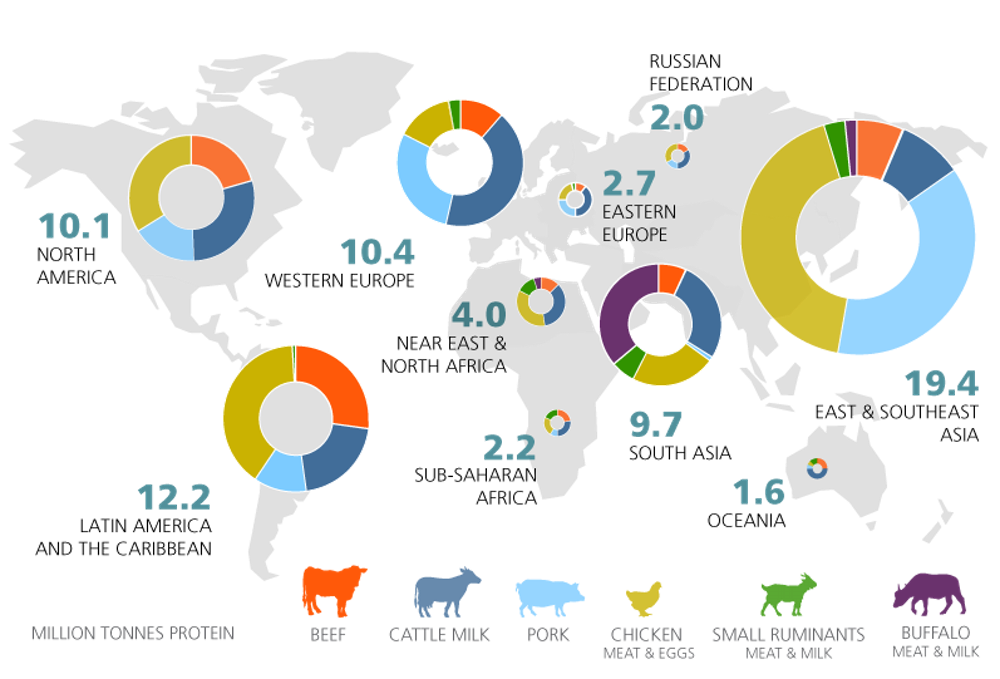
Global livestock production by region (milk and eggs expressed in protein terms).
Source: United Nations Food and Agriculture Organization.Setting the record straight on meat and greenhouse gases
A healthy portion of meat’s bad rap centers on the assertion that livestock is the largest source of greenhouse gases worldwide. For example, a 2009 analysis published by the Washington, D.C.-based Worldwatch Institute asserted that 51 percent of global GHG emissions come from rearing and processing livestock.According to the U.S. Environmental Protection Agency, the largest sources of U.S. GHG emissions in 2016 were electricity production (28 percent of total emissions), transportation (28 percent) and industry (22 percent). All of agriculture accounted for a total of 9 percent. All of animal agriculture contributes less than half of this amount, representing 3.9 percent of total U.S. greenhouse gas emissions. That’s very different from claiming livestock represents as much or more than transportation.
Why the misconception? In 2006 the United Nations Food and Agriculture Organization published a study titled “Livestock’s Long Shadow,” which received widespread international attention. It stated that livestock produced a staggering 18 percent of the world’s greenhouse gas emissions. The agency drew a startling conclusion: Livestock was doing more to harm the climate than all modes of transportation combined.
This latter claim was wrong, and has since been corrected by Henning Steinfeld, the report’s senior author. The problem was that FAO analysts used a comprehensive life-cycle assessment to study the climate impact of livestock, but a different method when they analyzed transportation.
For livestock, they considered every factor associated with producing meat. This included emissions from fertilizer production, converting land from forests to pastures, growing feed, and direct emissions from animals (belching and manure) from birth to death.
However, when they looked at transportation’s carbon footprint, they ignored impacts on the climate from manufacturing vehicle materials and parts, assembling vehicles and maintaining roads, bridges and airports. Instead, they only considered the exhaust emitted by finished cars, trucks, trains and planes. As a result, the FAO’s comparison of greenhouse gas emissions from livestock to those from transportation was greatly distorted.
Comments Off on How a statistical error became the key argument in the “everyone must turn vegan” movement
No matter which “global crisis” they cry up, their answer is always “more government”
Alex Noble on the remarkable consistency of the proffered solution to any and all “global” problems:
Climatechangers are really just watermelons – green on the outside but red on the inside. You’ll notice that none of their ideas about how to prevent climate change involve anything other than bigger government.
For them, climate change is just a pretext – an irrefutable argument (“if you disagree that we need to save the planet you must want people to die!”) that enables them to demand more taxes and more power for them and their friends so they can set the world to rights.
And out here in the real world, they have their army of useful innocents – voters fearful of tackling the real world on their own without help from a cosseting State, all too ready to swallow any argument for bigger government.
Climate change largely consists of menacing them with stories about rising water and melting ice and starving polar bears, so they will allow our civil rights to be ridden over to keep us all safe. They demand it, in fact.
As H.L Mencken said, “The whole aim of practical politics is to keep the populace alarmed (and hence clamorous to be led to safety) by menacing it with an endless series of hobgoblins, all of them imaginary”
Comments Off on No matter which “global crisis” they cry up, their answer is always “more government”
February 12, 2019
QotD: Weather
[W]ho wants to be foretold the weather? It is bad enough when it comes, without our having the misery of knowing about it beforehand.
Jerome K. Jerome, Three Men in a Boat (To Say Nothing of the Dog), 1889.
Comments Off on QotD: Weather


