
Published on 6 Jul 2017
WW1 Flying Event with Indy & the Crew: http://bit.ly/TGWStowMaries
The German home front is shaken by a political scandal this week 100 years ago. A member of the Center party reveals that the German unrestricted submarine warfare is not achieving what the German high command had hoped for. Paul von Hindenburg and Erich Ludendorff, who pretty much run Germany as a military dictatorship by now, also dispose of chancellor Theobald von Bethmann Hollweg. Hollweg was actually secretly involved in peace negotiations but that chance is gone with him too. Russia unleashes their Kerensky Offensive on the Eastern Front and puts further pressure on the Central Powers.
July 7, 2017
Turmoil In The Reichstag – The Kerensky Offensive I THE GREAT WAR Week 154
Comments Off on Turmoil In The Reichstag – The Kerensky Offensive I THE GREAT WAR Week 154
July 2, 2017
Fighting Without A Country – Czechoslovak Legions of World War 1 I THE GREAT WAR Special
Published on 1 Jul 2017
Czechs and Slovaks were minorities with the Austro-Hungarian and Russian Empire. Even before the outbreak of the war they demanded more rights as industrious citizens but were often overheard. During the war, they decided to take matter into their own hands and fight. And that they did in many armies across Europe.
Comments Off on Fighting Without A Country – Czechoslovak Legions of World War 1 I THE GREAT WAR Special
June 30, 2017
Russia’s New Offensive – The Russian Women’s Battalion of Death I THE GREAT WAR Week 153
Published on 29 Jun 2017
After the Russian Revolution, fresh optimism is gripping the troops at the front line and another offensive is planned. The first American troops arrive in France and Greece officially joins the Entente.
Comments Off on Russia’s New Offensive – The Russian Women’s Battalion of Death I THE GREAT WAR Week 153
June 29, 2017
[Winter War] Motti Tactics – How The Finns Destroyed Soviet Divisions
Published on 18 Nov 2016
» SOURCES & LINKS «
Mountain Operations FM 3 97.6
https://archive.org/details/Mountain_Operations_FM_3-97.6Chew, Allen F.: Fighting the Russians In Winter – Three Case Studies
https://archive.org/details/FightingTheRussiansInWinter-nsiahttps://en.wikipedia.org/wiki/Climate_of_Finland
» CREDITS & SPECIAL THX «
Song: Ethan Meixsell – Demilitarized Zone
Comments Off on [Winter War] Motti Tactics – How The Finns Destroyed Soviet Divisions
June 27, 2017
Armoured Trains of World War 1 I THE GREAT WAR Special feat. Military History Visualized
Published on 26 Jun 2017
Check out Military History Visualized and his video on armoured trains: https://www.youtube.com/watch?v=dvHTR-5n2_E
Armoured Trains were heavily armed and armored trains operating the vast rail networks of Europe, especially on the Eastern Front of World War 1. Their tactics and design evolved considerably during the First World War and the later Russian Civil War. From rather improvised locomotives to sophisticated designs specially built for combat purposes.
June 11, 2017
Mark Steyn’s reaction to the Comey hearing
Full disclosure: I didn’t watch the Comey hearing. I didn’t watch people watching the Comey hearing. I would rather have actively gone wandering around town, looking for some freshly painted surfaces to watch instead. If we ignore my dereliction of “duty”, perhaps Mark Steyn can fill in for me, and provide his thoughts on the “Comeytose State”:
Readers have demanded to know what I think of the James Comey hearing. In the words of Daffy Duck, shoot me now.
Okay, the slightly longer answer is: I don’t think about it. And there isn’t enough money in the world to pay me to think about it. But, if you insist, I will make a couple of points:
1) The FBI should not be in the counter-intelligence business. There are, as Democrats never tire of pointing out, “17 intelligence agencies”, which is, by my count, 15 too many. We should at least get it down to 16, by eliminating what’s meant to be a domestic policing agency.
2) As I’ve pointed out in recent weeks, someone seems to be holding the US Constitution upside down: We have courtrooms presuming to be legislatures, and the legislature pretending to be a courtroom. Both perversions are part of the systemic dysfunction that obstructs proper representative government. The allegedly Republican Congress should investigate less, and try legislating some of the President’s agenda.
3) On October 19th last year I called Comey “a 6′ 8″ gummi worm“. That was very much on display on Thursday, as the straight arrow writhed and agonized over what he might have done had he been a “stronger man”. He is far too psychologically weird and insecure ever to have got close to being FBI Director (far weirder than Hoover, even if you believe every single story about the guy), and the fact that he did ought to be deeply unnerving to Americans.
4) As everyone more sentient than an earthworm should know by now, “the Russia investigation” is Deep State dinner-theatre. I wrote a while back that, in today’s Hollywood, what Hitchcock used to call “the MacGuffin” – the pretext that sets the caper afoot, the secret papers, the microfilm – has degenerated into a MacNuffin: there’s no longer even a pretense that are about anything. The “Russia investigation” is the ne plus ultra of MacNuffins, so smoothly transferred from Los Angeles to Washington that one vaguely suspects some studio vice-prez who bundled for Hillary came up with the idea as a reality-show pilot that accidentally bust out of the laboratory.
Comments Off on Mark Steyn’s reaction to the Comey hearing
June 9, 2017
QotD: The post-war world and (relative) peace
Between 1945 and about 1965, atom bombs and then hydrogen bombs were devised and demonstrated by the two biggest Great Powers, and then manufactured and attached to rockets in sufficient numbers to cause any all-out war between these two superpowers very probably to be a catastrophic defeat for both, to say nothing of being a similar catastrophe for all other humans, within a few hours. This new kind of destructive power also spread to a small club of lesser Great Powers.
This did not happen overnight. It didn’t all come about in 1945. But it happened pretty quickly, historically in the blink of an eye. It changed the world from a place in which Great Wars between Great Powers had to be prepared for, at all costs, to a place in which Great Wars between Great Powers had to be avoided, again, at all costs. That is a very big change.
I do not assert that all wars have ended. Clearly they have not, as one glance through a newspaper or news website will tell you. Small powers still have small wars, and Great Powers regularly join in, in small ways. Sometimes, Great Powers start small wars, like the one in the Ukraine now. But even these small wars have been getting less numerous and smaller in recent decades. Small wars can get big, so even small wars are now discouraged by Great Powers.
Nor do I assert that all preparations for war by Great Powers have ceased, or that they should. But more than ever, the purpose of such preparations is to enable mere confrontations to be emerged from victoriously or failing that satisfactorily, rather than for such preparations — such weapons — constantly to be “used”, in the sense of being fired, fought with, and so on. The purpose of weapons is to scare, as well as to win fights, and they are being “used” whenever anyone is scared by them. Great Powers will still spend lots of money on weaponry.
But what has not happened, for many decades now, and what still shows no sign of happening despite all kinds of diplomatic, ideological and financial turbulence, is an all-out fire-every-weapon-we-have war involving two or more Great — by which I of course mean nuclear — Powers. In this sense, countries like mine, and almost certainly yours too given that you are reading this, have become peaceful in a way that they have never experienced before in all of human history before 1945.
Brian Micklethwait, “From the Great Peace … to the ordeal of Adam Lyth at the Oval cricket ground”, Samizdata, 2015-08-20.
Comments Off on QotD: The post-war world and (relative) peace
June 5, 2017
What is Maskirovka? Russian Military Deception #Military 101
Published on 5 May 2017
A short introduction into Russian Military Deception – called Maskirovka. “Maskirovka is most simply defined as a set of processes designed to mislead, confuse, and interfere with accurate data collection regarding all areas of Soviet plans, objectives, and strengths or weaknesses.” (Smith, Charles L.: Soviet Maskirovka, in: Airpower Journal – Spring 1988)
Military History Visualized provides a series of short narrative and visual presentations like documentaries based on academic literature or sometimes primary sources. Videos are intended as introduction to military history, but also contain a lot of details for history buffs. Since the aim is to keep the episodes short and comprehensive some details are often cut.
» SOURCES «
Maier, Morgan: A Little Masquerade: Russia’s Evolving Employment of Maskirovka
http://cgsc.contentdm.oclc.org/cdm/singleitem/collection/p4013coll3/id/3507/rec/1Smith, Charles L.: Soviet Maskirovko, in: Airpower Journal – Spring 1988
http://www.airpower.maxwell.af.mil/airchronicles/apj/apj88/spr88/smith.htmlLindley-French, Julian: NATO: Countering Strategic Maskirovka. Canadian Defence & Foreign Affairs Institute. (2015)
Glantz: The Red Mask: The Nature and Legacy of Soviet Military Deception in the Second World War
https://en.wikipedia.org/wiki/Russian_military_deception
Keating, Kenneth: The Soviet System of Camouflage
http://www.dtic.mil/dtic/tr/fulltext/u2/a112903.pdfKrueger, Daniel: Maskirovka – What’s in it for us?
http://www.dtic.mil/dtic/tr/fulltext/u2/a190836.pdf
May 19, 2017
Tenth Battle of The Isonzo River – Trotsky Arrives in Petrograd I THE GREAT WAR Week 147
Published on 18 May 2017
The Italian Front has been quiet over the winter and while the Austrians used the time to improve their defences, the Italian Army prepared another offensive near the Isonzo River. At the same time, Leon Trotsky arrives in Petrograd which will ensure the further complication of the situation in Russia after the Revolution.
Comments Off on Tenth Battle of The Isonzo River – Trotsky Arrives in Petrograd I THE GREAT WAR Week 147
May 9, 2017
US Joins WW1 – Spring Offensives 1917 I THE GREAT WAR Summary Part 9
Published on 8 May 2017
After a rather quiet winter, the war erupts into action in 1917. Not only do the United States join the war after weeks of unrestricted submarine warfare and the uncovering of the Zimmermann Telegram. The British and French launch their own spring offensives. In the East, chaos spreads in post-revolutionary Russia and Lenin returns from exile. And in Mesopotamia the British take Baghdad.
Comments Off on US Joins WW1 – Spring Offensives 1917 I THE GREAT WAR Summary Part 9
May 8, 2017
Spanish Civil War – Lessons NOT Learned – The British, French & US
Published on 28 Mar 2017
The Spanish Civil War (1936-1939) was probably the most significant war between the First and the Second World War. [M]any important lessons were learned and NOT learned by the British, French, US, German, Italian and Soviet Forces.
Military History Visualized provides a series of short narrative and visual presentations like documentaries based on academic literature or sometimes primary sources. Videos are intended as introduction to military history, but also contain a lot of details for history buffs. Since the aim is to keep the episodes short and comprehensive some details are often cut.
Comments Off on Spanish Civil War – Lessons NOT Learned – The British, French & US
April 28, 2017
The Battle of Doiran – Turmoil In The French Army I THE GREAT WAR Week 144
Published on 27 Apr 2017
The Salonica Front had been quiet over the winter, but much like the recent battles on the Western Front, it erupted this week. The British Army tried to take the Bulgarian positions at Doiran – these positions might have been some of the best defences of the entire war. After the failed Nivelle Offensive, some French soldiers start to question the whole war.
Comments Off on The Battle of Doiran – Turmoil In The French Army I THE GREAT WAR Week 144
April 15, 2017
Charles Joseph Minard
I first encountered Charles Joseph Minard’s best-known work in Edward Tufte’s The Visual Display of Quantitative Information in the late 1980s:
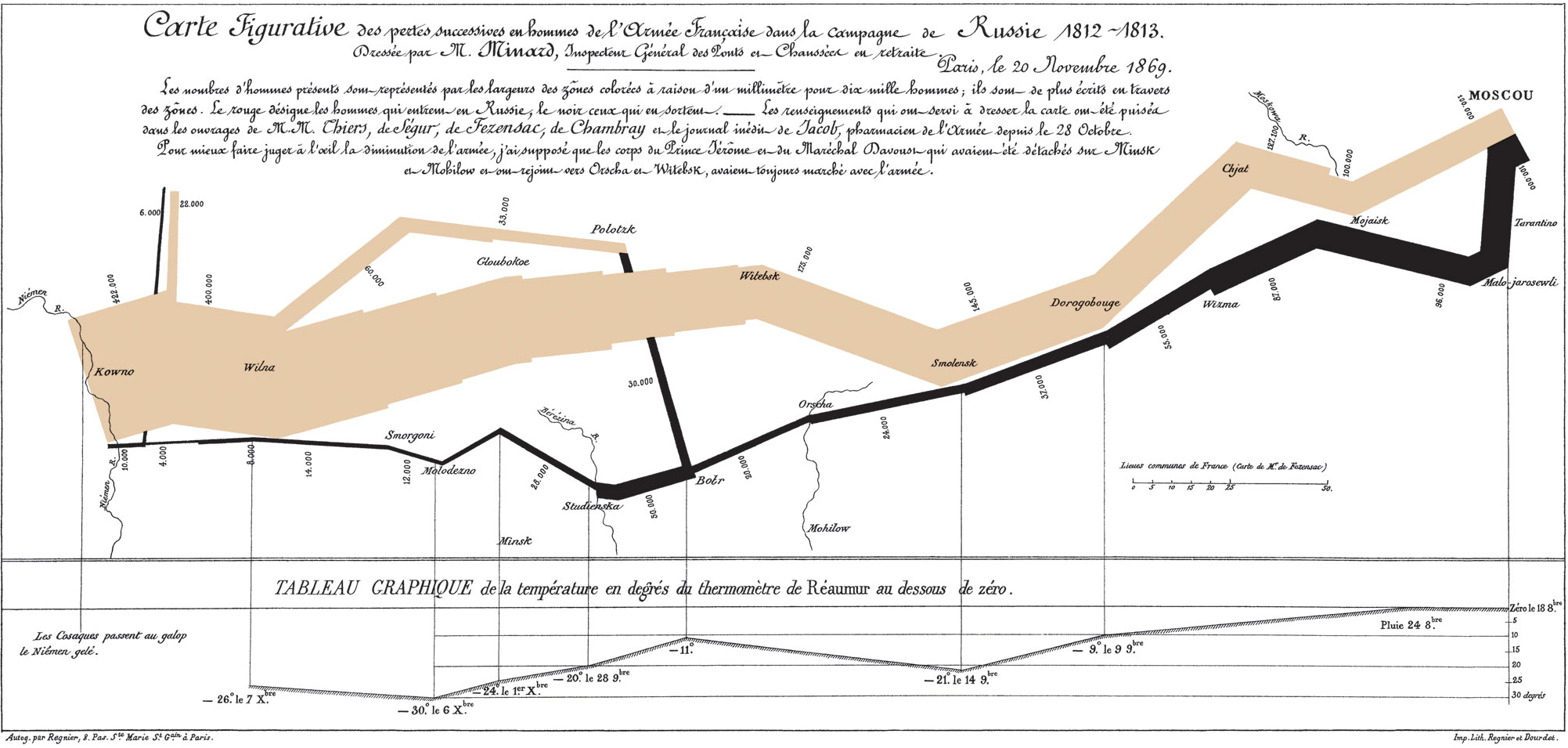
The map’s French caption reads:
Figurative Map of the successive losses in men of the French Army in the Russian campaign 1812-1813.
Drawn up by M. Minard, Inspector General of Bridges and Roads in retirement. Paris, November 20, 1869.
The numbers of men present are represented by the widths of the colored zones at a rate of one millimeter for every ten-thousand men; they are further written across the zones. The red [now brown] designates the men who enter into Russia, the black those who leave it. —— The information which has served to draw up the map has been extracted from the works of M. M. Thiers, of Segur, of Fezensac, of Chambray, and the unpublished diary of Jacob, pharmacist of the army since October 28th. In order to better judge with the eye the diminution of the army, I have assumed that the troops of prince Jerome and of Marshal Davoush who had been detached at Minsk and Moghilev and have rejoined around Orcha and Vitebsk, had always marched with the army.
The scale is shown on the center-right, in “lieues communes de France” (common French league) which is 4,444m (2.75 miles).
The lower portion of the graph is to be read from right to left. It shows the temperature on the army’s return from Russia, in degrees below freezing on the Réaumur scale. (Multiply Réaumur temperatures by 1¼ to get Celsius, e.g. −30°R = −37.5 °C) At Smolensk, the temperature was −21° Réaumur on November 14th.
(Image and translation from Wikimedia)
In National Geographic, Betsy Mason reveals more about the man who created the “best graphic ever produced”:
Charles Joseph Minard’s name is synonymous with an outstanding 1869 graphic depicting the horrific loss of life that Napoleon’s army suffered in 1812 and 1813, during its invasion of Russia and subsequent retreat. The graphic (below), which is often referred to simply as “Napoleon’s March” or “the Minard graphic,” rose to its prominent position in the pantheon of data visualizations largely thanks to praise from one of the field’s modern giants, Edward Tufte. In his 1983 classic text, The Visual Display of Quantitative Information, Tufte declared that Napoleon’s March “may well be the best statistical graphic ever produced.”
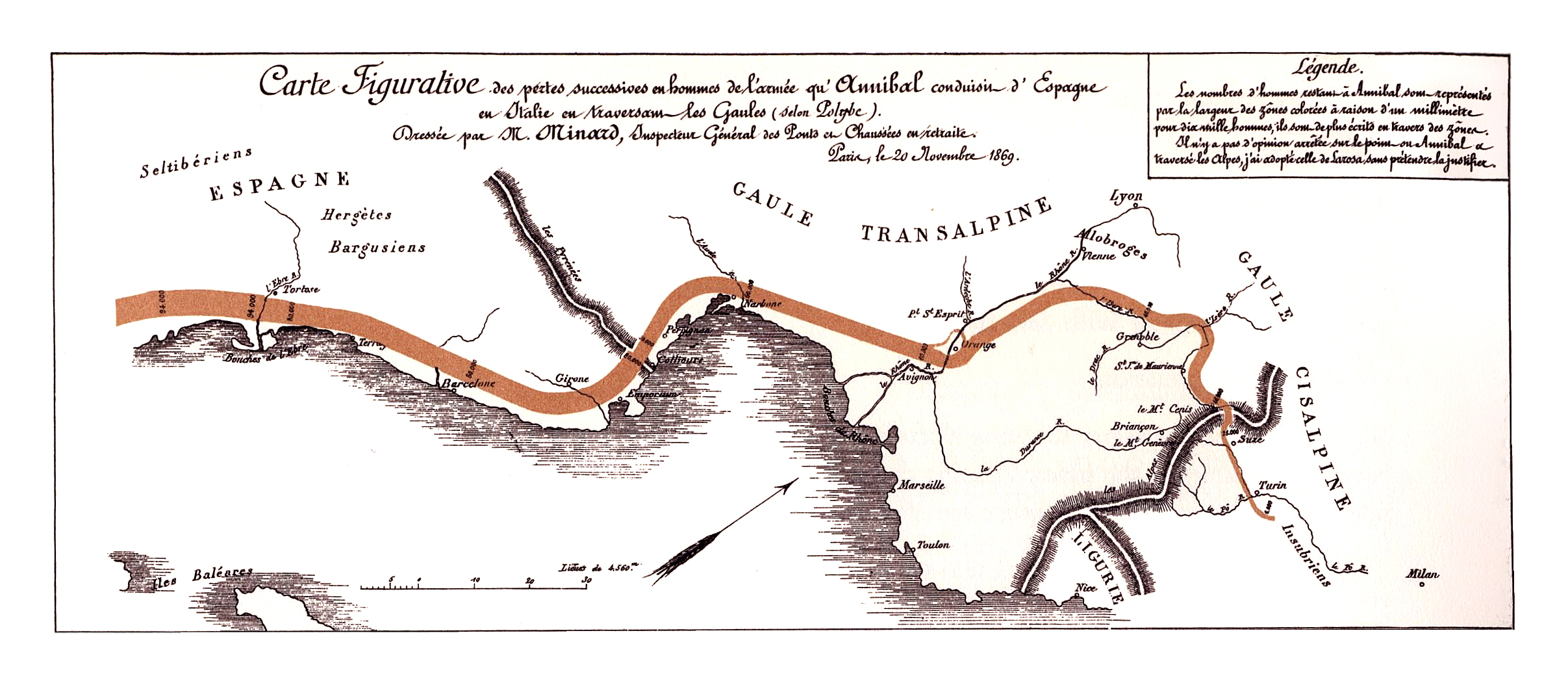
Today Minard is revered in the data-visualization world, commonly mentioned alongside other greats such as John Snow, Florence Nightingale, and William Playfair. But Minard’s legacy has been almost completely dominated by his best-known work. In fact, it may be more accurate to say that Napoleon’s March is his only widely known work. Many fans of the March have likely never even seen the graphic that Minard originally paired it with: a visualization of Hannibal’s famous military campaign in 218 BC, as seen in the image below.
Graphic information of the men losses in the raid of the troops of Hannibal from Spain to Italy (Wikimedia)
On its face, it may not seem remarkable that Minard is remembered for this one piece of work; after all, many people owe their fame to a single great achievement, and the Napoleon graphic is certainly worthy of its reputation. But Minard was most definitely not a one-hit wonder.
Comments Off on Charles Joseph Minard
April 11, 2017
April 4, 2017
Tank Chats #4 Vickers Armstrongs Type E
Published on 15 Apr 2015
The fourth in a series of short films about some of the vehicles in our collection presented by The Tank Museum’s historian David Fletcher MBE.
Alongside their work for the British armed forces Vickers-Armstrongs produced military equipment for foreign buyers. Their earliest commercial tank designs failed to sell but in 1928 they produced a masterpiece. Known as the 6-ton or ‘six-tonner’, it was a remarkable design, with a rear-mounted, air-cooled engine driving to a gearbox and track sprockets at the front of the tank. There were two main variants; some tanks were supplied with two machine-gun turrets (Type A) while others carried a larger single turret (Type B) like our exhibit.
Following trials the British Army turned it down but the tank was a major export success. It sold all around the world, from South America to Japan and was even studied by the United States Army. It was built under licence in Russia (see our T-26 exhibit) and influenced tank design in many other countries. Our exhibit is displayed in the fancy camouflage style adopted by Vickers for their commercial offerings; it is seen at a mythical army equipment exhibition some time in the thirties.
Shortly before World War II Vickers built a new version, powered by a Rolls-Royce engine (the Mark F) but this failed to sell. Subsequent to this the government of Siam (Thailand) placed a repeat order but specified the original Armstrong-Siddeley engine. These were completed closer to the Mark F design but few, if any, reached their destination. With the outbreak of war the British Government impounded all commercial tanks still in the factories and the remaining stock of six-tonners, of which this is one, were used by British forces for training.
Comments Off on Tank Chats #4 Vickers Armstrongs Type E


