
Epic History
Published on 29 Dec 2015The Franco-Prussian War or Franco-German War, often referred to in France as the War of 1870 (19 July 1870 – 10 May 1871), was a conflict between the Second French Empire and the German states of the North German Confederation led by the Kingdom of Prussia. The conflict was caused by Prussian ambitions to extend German unification. Prussian chancellor Otto von Bismarck planned to provoke a French attack in order to draw the southern German states — Baden, Württemberg, Bavaria and Hesse-Darmstadt — into an alliance with the North German Confederation dominated by Prussia.
November 8, 2018
The Franco-Prussian War
Comments Off on The Franco-Prussian War
November 7, 2018
Romagne 14-18 Museum Tour
Forgotten Weapons
Published on 4 Nov 2018http://www.patreon.com/ForgottenWeapons
Jean-Paul de Vries runs a very interesting private World War One museum in the village of Romagne-sous-Montfaucon in the Meuse region of northeastern France. It is the exact opposite of typical modern museums, as it has a massive number of artifacts on display with almost no printed explanation. It is also unusual in displaying almost exclusively recovered artifacts of the war, the majority of them have been left on the fields or buried for decades. You will not find new specimens here; you will find remnants of war and weather.
That may sound dreary to some, but to me it is a very interesting way to approach the war and its history. You know that every item in this museum was actually used on the field of battle, and that can provide some interesting insights. For example, the American .30-06 Chauchat automatic rifles here indicate, contrary to most printed sources, that those guns were actually used in combat actions by American soldiers and not just for training. Tired of museums that have great open rooms with a single item on a glass case in the center? Then this is one place you will really appreciate!
The museum is an entirely private operation, and includes a small restaurant for sandwiches and such, and a shop offering books, reproduction items, and original artifacts for sale. If it located near the huge American Meuse-Argonne Cemetery, and I would highly recommend it to anyone traveling in the area with an interest in the Great War.
You can see the museum’s web site here:
https://romagne14-18.com/index.php/en/
Contact:
Forgotten Weapons
PO Box 87647
Tucson, AZ 85754
Comments Off on Romagne 14-18 Museum Tour
November 6, 2018
Viking Expansion – Rollo the Walker – Extra History – #2
Extra Credits
Published on 3 Nov 2018Rollo the Walker led the Great Heathen Army and had his sights set on sacking Paris, in a time when relations between the Vikings and the Franks had become, essentially, getting paid to raid. Eventually his sights would turn to stability — and he became the founder of Normandy.
Join us on Patreon! http://bit.ly/EHPatreon
Comments Off on Viking Expansion – Rollo the Walker – Extra History – #2
November 5, 2018
French Tanks of World War 1 I THE GREAT WAR Special
The Great War
Published on 3 Nov 2018Check Out Supremacy 1914: https://www.supremacy1914.com/index.p…
French tank development started almost simoultaneously with the British. The French tanks were very different in design based on a different understanding of the role of the tank on the battlefield. Arguably, the first modern tank, the Renault FT was a result of this development.
Comments Off on French Tanks of World War 1 I THE GREAT WAR Special
November 4, 2018
Molotov’s Heel on Finland and Nobody to Fight in the West – WW2 – 010 3 November 1939
World War Two
Published on 3 Nov 2018Ten weeks into World War Two, and the Allied ground forces are bored in France. In North-Eastern Europe, Poland’s suffering has no end and Finland is in the crosshairs of the USSR.
WW2 day by day, every day is now live on our Instagram account @World_war_two_realtime https://www.instagram.com/world_war_t…
Between 2 Wars: https://www.youtube.com/playlist?list…
Join us on Patreon: https://www.patreon.com/TimeGhostHistory
Or join The TimeGhost Army directly at: https://timeghost.tvWritten and Hosted by: Indy Neidell
Produced and Directed by: Spartacus Olsson and Astrid Deinhard
Executive Producers: Bodo Rittenauer, Astrid Deinhard, Indy Neidell, Spartacus Olsson
Research by: Indy Neidell
Edited by: Wieke Kapteijns and Spartacus OlssonColoring by Spartacus Olsson and Sarvesh
Archive by Screenocean/Reuters https://www.screenocean.com
A TimeGhost chronological documentary produced by OnLion Entertainment GmbH
Comments Off on Molotov’s Heel on Finland and Nobody to Fight in the West – WW2 – 010 3 November 1939
October 27, 2018
The architecture of modern Paris
In the latest issue of City Journal, Theodore Dalrymple laments the degraded state of Parisian architecture, particularly the post-1945 monstrosities visible from the Boulevard Périphérique, celebrated in a recent New York Times article by David McAninch:
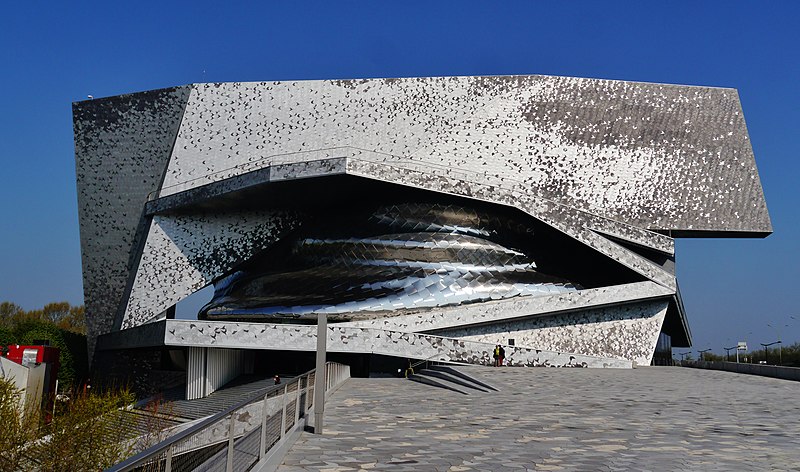
Philharmonie at the Parc de la Villette, Paris.
Photo by Zairon via Wikimedia Commons.
What is startling about McAninch’s description of his tour is its non-mention of what was perfectly obvious to my visitor on first glance, and which never fails to appall me each time I take the B.P., as regrettably often as I do: namely, that practically everywhere the eye looks beyond the confines of central Paris, it is greeted by a modernist mess of gargantuan proportions, and that every occasional building that is not a total eyesore was built before 1945. In other words, there has been a total and utter collapse of aesthetic ability, judgement, and appreciation in France, a country with one of the world’s greatest architectural heritages, extending back many centuries.
McAninch acts as a kind of handmaiden or praise-singer to this collapse, perhaps from fear of making an unequivocal judgment that might cause him to be labelled conservative, backward-looking, or naive. His article commences with a picture of the new philharmonic hall, built at a pharaonic cost, which resembles nothing so much as a vulgar Brobdingnagian silver lamé dress crumpled on the floor after a night of debauchery, as clear an example of modern architectural psychopathy as I know.
The article is full of equivocations, such as “I gazed in awe at some of the most ugly-beautiful Brutalist buildings I’d ever seen” and “I stared open-mouthed for a long while at the modular-looking Neo-Brutalist structure housing the Centre National de la Danse. Designed as a municipal building in 1972 by Jacques Kalisz, the gray concrete behemoth somehow radiated childlike exuberance and dystopian menace at the same time.”
The brutalist buildings at which the author stared in awe (horror would have been a more appropriate reaction) are not ugly-beautiful; they are just ugly, without any possible aesthetic qualification, and grossly dysfunctional, to boot. And anyone who can see childlike exuberance in the building by Jacque Kalisz is capable of seeing the milk of human kindness in a Nuremberg Rally.
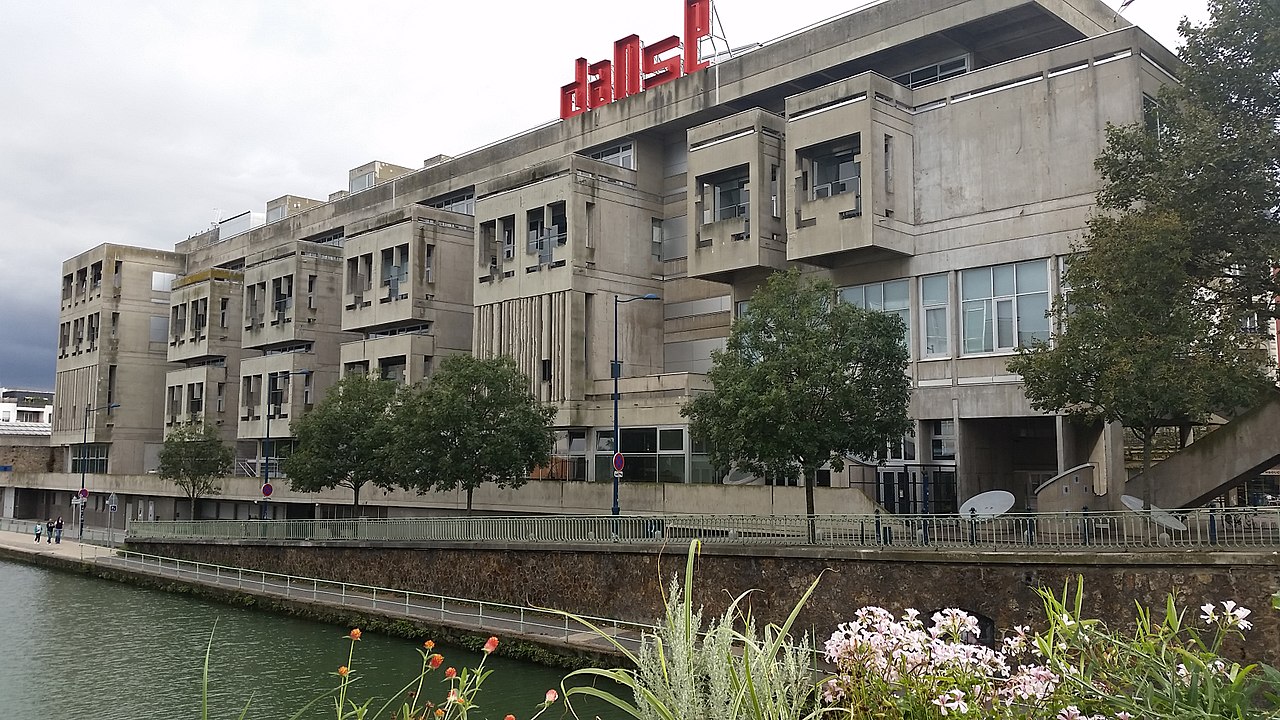
The Centre national de la danse in Pantin (Seine-Saint-Denis), designed by Jacques Kalisz.
Photo by Cinerama14 via Wikimedia Commons.
Comments Off on The architecture of modern Paris
October 17, 2018
How Toronto got its name
Colby Cosh on the origins of the name of Canada’s largest city (which, surprisingly, isn’t the Mississauga name for “big stink on the water”):
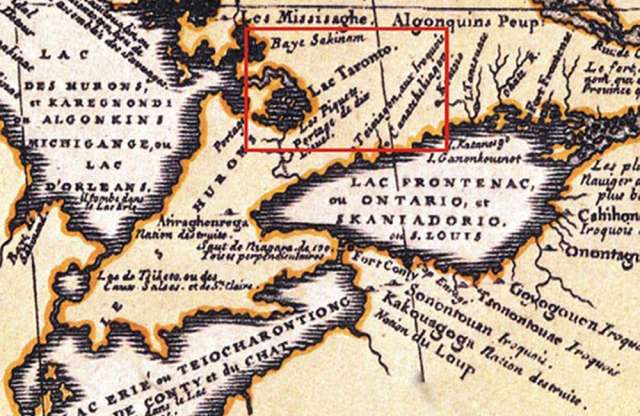
Detail from a 1688 map of western New France by Vincenzo Coronelli that locates “Lac Taronto” at Lake Simcoe.
City of Toronto Culture Division/Library and Archives Canada via the National Post
By the time of Franquelin, “Tkaronto” had already become “Taronto,” a generic name for the highway between Lake Simcoe and Lake Ontario. The Humber River was called the Toronto River by the French before Gen. John Graves Simcoe and the British got hold of everything. The word, in turn, became attached to a trading settlement at the southern end of the trail — a pretty crummy place, by all accounts, but one destined for bigger things as part of a global seafaring empire.
The miracle is that it held on to the name. Simcoe insisted that “Toronto,” on being anointed as the site of the new capital of Upper Canada in 1793, be dubbed “York” in honour of Prince Frederick (1763-1827), Duke of York and second son of George III. This Duke of York is the “Grand Old Duke of York” from the satirical verse about military futility. He was also commander-in-chief of the British armies that helped to chase Napoleon out of Europe twice, and is thought to deserve genuine credit for this, so be careful who you write insulting rhymes about.
Simcoe dubbed Toronto “York” just because he was sucking up to a very identifiable future boss, and for no other reason. The people of Toronto seem to have understood this and resented it. In the decades to come, it was occasionally observed that there were something like a dozen other places in Upper Canada called “York.” Moreover, Simcoe’s “Little York,” as it was often called, seems to have presented an increasingly embarrassing parallel with the Americans’ bustling New York.
In 1834, when the Legislative Council of Upper Canada decided that the capital needed to be formally incorporated as a city, the citizenry remembered that they belonged to “Toronto” and appealed to the council to have the more musical old name restored. Over four decades their annoyance had not receded. Diehards who wanted York to remain York for imperial-grandeur reasons were outvoted, and Toronto’s formal Act of Incorporation observes that “it is desirable, for avoiding inconvenience and confusion, to designate the Capital of the Province by a name which will better distinguish it.” The appellation “Toronto,” of course, had actually been nicked from a spot some way off, but the white settlers had mislaid that information, and didn’t check with anyone who would know better.
Comments Off on How Toronto got its name
October 16, 2018
Julie d’Aubigny – Duelist, Singer, Radical – Extra History
Extra Credits
Published on 13 Oct 2018Julie d’Aubigny lived during an unusual time in 17th-century France when political and cultural norms were shifting. She was allowed to exist openly as a bisexual woman pursuing her swordsmanship and singing talents in the court of King Louis XIV.
Join us on Patreon! http://bit.ly/EHPatreon
Comments Off on Julie d’Aubigny – Duelist, Singer, Radical – Extra History
October 15, 2018
Forgotten History: Glade of the Armistice
Forgotten Weapons
Published on 25 Sep 2018http://www.patreon.com/ForgottenWeapons
Here at a forested railroad crossing outside Compiègne in Picardy, France, two rail cars met in November of 1918 – one with members of the Allied/Entente high commend and ones with representatives of Imperial Germany. They met here to end 5 years of slaughter; the German delegation being presented terms for armistice by the Allies. Faced with no other viable option, they would accept these terms, and the fighting officially ended at the 11th hour of the 11th day or the 11th month of 1918. More than a year would go by before the Treaty of Versailles was fully ratified, but it was here that the decision to end the death was made.
The rail car in which the papers were signed was kept as a monument here, along with a rather pointed monument to the French dead, featuring a slain German Imperial eagle. A large stone message was also put up in the center of the clearing, reading (in translation):
“Here on the 11th of November 1918 succumbed the criminal pride of the German reich, vanquished by the free peoples which it tried to enslave.”
When France signed an armistice with Germany in 1940, Hitler would have those papers signed here as well, in that very same rail car. The car was then taken to Berlin as a trophy, and the monuments here destroyed. The car itself was burned accidentally in 1945, but the monuments were rebuilt by the French following the war, and a sister car is now on display here with many of the original artifacts of the Armistice (which were hidden from the Germans in 1940).
Thanks to Military History Tours for making this video possible!
If you enjoy Forgotten Weapons, check out its sister channel, InRangeTV! http://www.youtube.com/InRangeTVShow
Contact:
Forgotten Weapons
PO Box 87647
Tucson, AZ 85754
Comments Off on Forgotten History: Glade of the Armistice
October 6, 2018
The Tank That Time Forgot – Vimoutiers Tiger
Mark Felton Productions
Published on 14 Sep 2018A video for all big cat lovers – the interesting story of Tiger 231, the Vimoutiers Tiger. Left behind in France by the retreating Germans in August 1944, this rare beast has had fascinating life. Discover the story here.
Comments Off on The Tank That Time Forgot – Vimoutiers Tiger
September 29, 2018
8mm M1915 Chauchat Fixing and Range Testing
Forgotten Weapons
Published on 9 Sep 2018http://www.patreon.com/ForgottenWeapons
Well, my 8mm French Chauchat finally cleared transfer, as did my application to reactivate it. This was a “dewat”, or “Deactivated War Trophy” – a machine gun put on the NFA registry but modified to be non-firing. This is not the same as legal destruction, as the receiver of the gun remained intact. The method of deactivation on such things can very significantly; in this case the chamber was plugged with weld, the bolt face welded up, and the barrel extension welded to the receiver. I did have an intact spare bolt and barrel assembly, however.
I removed the weld holding the barrel assembly in place, cleaned it up a bit, and dropped in my new parts.
Legal note: this was done after the receipt of an approved Form 5 from ATF, complete with tax stamp.
Today I took it out to the range for the first time, to see if any further work would be needed. And yeah, there was a bit of tweaking necessary. The feeding and extraction are solid, but the ejection requires some work. So, after swapping in a better extractor, I headed back to the range for another test run.
This time it ran great, with the exception of one bad magazine (3 of 4 being 100% reliable is better than I expected, given their age and construction). So now, I have a fully functioning Chauchat and three known-good magazines. Next up? Two-gun match! Stay tuned…
If you enjoy Forgotten Weapons, check out its sister channel, InRangeTV! http://www.youtube.com/InRangeTVShow
Comments Off on 8mm M1915 Chauchat Fixing and Range Testing
September 27, 2018
France moves toward the Soviet system of psychological “treatment” for dissidents
You may not agree with much that prominent French nationalist politician Marine Le Pen stands for, but the recent court order that she must undergo a psychological evaluation as part of the investigation of a “hate crime” should worry everyone. Jacob Sullum writes:

Marine Le Pen speaking in Lille during the 2017 French presidential election
Photo by Jérémy-Günther-Heinz Jähnick via Wikimedia Commons
France ranked 12 notches above the United States in this year’s World Press Freedom Index, produced by Reporters Without Borders. But such ratings can be misleading, as illustrated by the prosecution of Marine Le Pen, head of the right-wing National Rally party (formerly the National Front), for posting images of ISIS atrocities on Twitter. Last week Le Pen revealed that she had been ordered to undergo a psychiatric examination as part of the investigation into her speech crime, which added another layer of Soviet-style thought control to the story.
It is inconceivable that an American politician, no matter how extreme his views, would be prosecuted for doing what Le Pen did, because a law like the one she is charged with violating would be clearly inconsistent with the First Amendment. That law, Article 227-24 of the French Criminal Code, makes it a crime, punishable by a fine of €75,000 (about $88,000) and up to three years in prison, to distribute “a message bearing a pornographic or violent character or a character seriously violating human dignity…where the message may be seen or perceived by a minor.” Le Pen allegedly ran afoul of that prohibition in 2015 by posting three pictures of men murdered by ISIS—one beheaded, one burned alive, and one run over by a tank—in response to a Twitter user who likened her party to the terrorist organization. “Daesh [the Arabic acronym for ISIS] is this!” she tweeted.
This case vividly illustrates why Article 227-24 would never pass constitutional muster in the United States. Le Pen’s tweet is indisputably political speech, sitting at the core of the expression protected by the First Amendment. The terms of Article 227-24 (especially the phrase “seriously violating human dignity”) are broad and vague, encouraging self-censorship and inviting politically motivated prosecution of people who irk the powers that be. Le Pen, who unsuccessfully ran against Emmanuel Macron in a presidential runoff last year, was stripped of her parliamentary immunity six months later, leaving her open to prosecution.
Comments Off on France moves toward the Soviet system of psychological “treatment” for dissidents
September 23, 2018
30 Years War | 3 Minute History
Jabzy
Published on 28 Oct 2015Thanks to Xios, Alan Haskayne, Lachlan Lindenmayer, William Crabb, Derpvic, Seth Reeves and all my other Patrons. If you want to help out – https://www.patreon.com/Jabzy?ty=h
Comments Off on 30 Years War | 3 Minute History
September 12, 2018
Forgotten History: The Americans Take Blanc Mont Ridge, October 1918
Forgotten Weapons
Published on 11 Sep 2018http://www.patreon.com/ForgottenWeapons
Cool Forgotten Weapons merch! http://shop.bbtv.com/collections/forg…The German army captured Blanc Mont Ridge in the early months of World War One and occupied it throughout the years of fighting, fending off repeated French assaults throughout 1915 and 1916. While the ridge looks far from imposing, it is a piece of high ground which overlooks a large part of the front in the Champagne region of France, and was a very valuable outlook for artillery observation. Its continuous occupation allowed it to be heavily fortified by the Germans as a major strong point in their defensive lines.
In October of 1918, the task would fall to the American Expeditionary Force to take the ridge as part of the ongoing offensive that was finally pushing the Germans back all along the front lines. Years of war had gradually sapped the strength of the German forces, and the last gasp spring offensive earlier in the year had destroyed the last remaining units of elite German troops. And yet, they still had their fortifications here, armed with more than 350 machine guns on this ridge alone.
On the morning of October 3rd, 1918, a combined force of US Army and Marines (the 2nd and 36th Infantry Divisions) set off on an attack up the gradual slope towards the ridge. The attack was preceded by only a few minutes of artillery fire and then a creeping barrage behind which the men advanced. A thick layer of ground fog was perhaps their best ally, as they began the assault of the German position. A fierce fight left the positions on the front of the ridge in American hands by the end of the day, although the fighting would be tenacious for several days, as the Americans advanced well beyond the supporting French units on their flanks, and were left exposed on the reverse slope of the ridge.
By October 7th, the ridge position was consolidated, and the French and American forces continued their advance towards the next objective, the town of Saint-Étienne-à-Arnes. American casualties in the assault would come to approximately 7,800 men – this was not a position relinquished easily by the Germans. The battle was considered a major accomplishment at the time, although it has been largely forgotten in the century since.
Today, the summit of the ridge is the site of a major American war memorial:
https://www.abmc.gov/cemeteries-memor…
Thanks to Military History Tours for making this video possible! https://www.miltours.com
If you enjoy Forgotten Weapons, check out its sister channel, InRangeTV! http://www.youtube.com/InRangeTVShow
Comments Off on Forgotten History: The Americans Take Blanc Mont Ridge, October 1918
August 31, 2018
The American First Army Gears Up – Germany Retreats I THE GREAT WAR – Week 214
The Great War
Published on 30 Aug 2018As the German Army withdraws along the Western Front, the Entente prepares for ever more offensives. This includes the newly founded American First Army which will have the task to attack the Germans in the Meuse-Argonnes area.
Comments Off on The American First Army Gears Up – Germany Retreats I THE GREAT WAR – Week 214


