
I’d already been tinkering with the idea of writing a YA story, something for Ranger’s Apprentice fans to move on to.
Commercially, the idea was, “They’re going to read Bernard Cornwell when they are older; let’s take some money off them now.” However, my main motivation was wanting to write something my son could read — the magnum opus my agent was shopping owed too much to the War of the Powers (Am I the only person who remembers that series?). I also wanted to follow in the footsteps of Ronald Welch, the YA writer I read when I was a kid.
Welch was a WWII veteran turned grammar school teacher. He wrote what we would now call YA books about young officers finding their place, and he did it in just about every major conflict involving English combatants from the Horns of Hattin, through Marlborough’s campaigns, to his chronologically last book, Tank Commander, which is an utterly awesome tale of World War One, culminating in the Battle of Cambrai, the first modern tank assault.
We’re not talking trash here. Each book was well researched, the writing is good — he even won a Carnegie Medal for Knight Crusader, which puts him in the same ballpark as Rosemary Sutcliff. As far as I can see, his star faded after his death, not because of his quality as a writer, but because he became unfashionable:
- His books simply have boy cooties. They are about young men learning leadership and responsibility while being shot at and shooting back without qualms … doing their job in adverse circumstances.
- He’s not an anti-imperialist. I don’t think he’s pro-imperialist either. He just tells things as they were with people accepting the ethos of the time. His characters generally show matter-of-fact respect for other cultures, but don’t question their own right to be in Palestine or India or wherever, or question very much at all.
- He’s not anti-war. His fight scenes also go all the way up to 11 on the Conan Scale. I don’t think he likes war, but — having fought in WWII — he sees it as necessary, and the experience itself as worthy of writing about.
This last, bears further examination.
Modern war books aimed at younger people tend towards:
OMG my best friend just got killed. Look at that dying horse. War is Hell. At least I and my friends will (drum roll) Preserve Our Humanity.
Ronald Welch, who pulls absolutely no punches, by the way, is more:
OMG my best friend just got killed. You there, put that dying horse out if its misery. War is Hell. Watch the left flanks chaps and some of us will get to live through it. I said WATCH THE DAMNED LEFT FLANK!!
It’s all about taking responsibility, keeping presence of mind, in just about the most hostile human environment.
Very few young readers will grow up to be soldiers. Many of them, however, will face crappy situations. At work when a project implodes. Socially when people turn on them. In a family when a child is very sick, or when a marriage breaks down or turns abusive…
In all those circumstances, there are points neither for maintaining a personal moral hygiene nor for being sensitive. If everybody is going to get through this thing, somebody has to watch the left flank. That person may well be you.
And that’s the kind of book I wanted to write.
M Harold Page, “Shieldwall: Barbarians! Writing and self-publishing an old school boy’s young officer story set in Attila’s invasion”, Charlie’s Diary, 2015-06-03.
June 16, 2015
QotD: The Young Adult fiction of Ronald Welch
June 12, 2015
The long-lasting impact of the “Little House” books
Jason Kuznicki on the deep emotional grasp Laura Ingalls Wilder’s “Little House” books are still having today:
“Not ‘Harry Potter’!” says Alice, age five. “I want ‘Little House’!”
It’s the age of negotiated bedtime reading. My husband and I oblige, and tonight we read from Little House in the Big Woods, the first installment of Laura Ingalls Wilder’s fictionalized autobiography. We take turns reading: Alice reads, then I do, then Scott does. Then Alice reads again. It’s never enough.
What draws her in? A lot of things. The characters are mostly female, young, and strong. Laura herself begins “Little House” at four, an age that wins our daughter’s ready empathy. Not unlike the first volume of “Harry Potter,” Little House in the Big Woods introduces an unknown world; done properly, that’s always exciting. As generations already know, the story is clean and earnest, without affectation or smarm. And it’s told in words that Alice can read all on her own — a great confidence builder.
It’s sometimes hard to fathom, though, just how different Laura’s life was from our own: churning butter, salting meat, boiling down maple syrup… Megan McArdle discussed all this in a recent piece for Bloomberg. The “Little House” books open up a lost world for today’s kids — and for today’s adults:
[A]s an adult… what really strikes you is how incredibly poor these people were. The Ingalls family were in many ways bourgeoisie: educated by the standards of the day, active in community leadership, landowners. And they had nothing.
We’re not just talking a different skill set, then. The skills came of necessity, and of hardships almost wholly unknown today: “Little House” contains the actual sentence, “They had never seen a machine before” — because, well, they hadn’t.
June 10, 2015
June 4, 2015
QotD: The debt we owe to ancient Greece
What more to say? Well, I could say that I am jealous of Jack’s choice of period. My choice of early Byzantium is a good one. Contrary to the general view, this was an age of heroism and genius. The fight the Byzantines put up against the barbarians and Persians and Moslems saved Western civilisation. There are few stories more inspiring than the defeat of the Arabs outside the very walls of Constantinople in 678 and 717. At the same time, nothing compares with what the Athenians achieved a thousand years earlier.
Forget the Egyptians and the Jews. Forget what we are told about the ancient Indians and Chinese. Forget even the Romans. Between about 600 and 300 BC, the Greeks of Athens and some of the cities of what is now the Turkish coast were easily the most remarkable people who ever lived. They gave us virtually all our philosophy, and the foundation of all our sciences. Their historians were the finest. Their poetry was second only to that of Homer – and it was they who put together all that we have of Homer. They gave us ideals of beauty, the fading of which has always been a warning sign of decadence; and they gave us the technical means of recording that beauty. They had no examples to imitate. They did everything entirely by themselves. In a world that had always been at the midnight point of barbarism and superstition, they went off like a flashbulb; and everything good in our own world is part of their afterglow. Every renaissance and enlightenment we have had since then has begun with a rediscovery of the ancient Greeks. Modern chauvinists may argue whether England or France or Germany has given more to the world. In truth, none of us is fit to kiss the dust on which the ancient Greeks walked.
Richard Blake, “Review of Jack England, Sword of Marathon“, RichardBlake.me.uk, 2013.
June 2, 2015
Lois McMaster Bujold’s early writing career
In Kirkus, Andrew Liptak talks about the early publishing experiences of Lois McMaster Bujold:
In the 1970s, science fiction began to fragment into smaller subsets: the New Wave fizzled out, leaving its own imprint on the genre, while new subgenres grew in the aftermath. One author of the time looked back to her roots for inspiration for her stories, developing her own brand of science fiction that at once revered the classics of the genre while using the same building blocks to subvert them.
Lois McMaster Bujold was born in Columbus, Ohio, on November 2, 1949. Her father, Robert Charles McMaster, an engineering professor, was an avid reader of science-fiction magazines and stories and passed them along to his daughter. Throughout Bujold’s youth, she devoured every science-fiction novel she could get her hands on. In high school, she began writing along with a friend of hers, Lillian Stewart, and when she entered college in 1968, she began studying English. Her passion for the academic subject waned, but her “heart was in the creative, not the critical end of things.” According to Bujold’s official website, she noted that the New Wave “left me cold; I found it, much like the ‘alternative comics’ I encountered in my college years, to seem dreary, ugly, and angry.” From college, she went on to work as a pharmacy technician at the Ohio State University Hospital. She left to get married and had two children: good for reading, not for writing. Throughout this time, she read voraciously.
When her friend Lillian Stewart Carl published her first short story in 1982, Bujold found a renewed commitment to writing. In 1983, she completed her first novel, Shards of Honor, and an additional two in as many years: Warrior’s Apprentice and Ethan of Athos. Initially, major publishers rejected her unagented manuscripts. In an interview for the Baen Books website, Bujold said that “[Warrior’s Apprentice] had been rejected by Tor and Ace; on the advice of the Ace editor, who said it was a YA (Young Adult, what used to be called “Juvenile Fiction” back in my day — think early Heinlein), probably because the protagonist was 17, I sent it to YA publisher Atheneum, who plainly disagreed; the manuscript came back in about eight weeks.” Dejected, she spoke with friends about what her next step should be. Carl recommended that she send it to a recently founded publisher, Baen Books. Bujold followed her advice, and shortly thereafter, “in late October of 1985, was Jim Baen calling me on the phone, there in my kitchen in Marion, Ohio, and offering to buy all three volumes. I was completely flummoxed by the acceptance being a phone call; I would at the time have assumed any word would travel by mail.”
June 1, 2015
The place of “The Marys” in feminist and literary history
In the June issue of Reason, Amy Sturgis reviews a new book by Charlotte Gordon, Romantic Outlaws: The Extraordinary Lives of Mary Wollstonecraft and Her Daughter Mary Shelley:
Mary Wollstonecraft and her daughter, Mary Shelley, shared life on earth for a mere 11 days. But though fate kept them apart, the two women together managed to change the Western world’s conception of women’s rights, human reason, education theory, and romantic love. Not to mention invent modern science fiction. In Romantic Outlaws, biographer Charlotte Gordon makes a compelling case that each woman’s intellectual legacy has been underappreciated. She also argues persuasively that the two were linked by more than just blood: Wollstonecraft’s life and principles had a profound impact on her daughter, an influence critics largely have ignored.
Both Marys led lives that captured the public imagination at least as much as their path-breaking writings did. Their dramatic personal stories, coupled with well-meaning family members’ attempts to manage their reputations after their deaths, help explain how their ideas got lost in the sensationalist shuffle. But Gordon sees the Marys’ private lives not as obstacles to be overcome but as extensions of their philosophies. Mother and daughter, she argues, tried to craft independent and meaningful lives of the mind in times when a self-supporting, freethinking woman wasn’t just an oddity but a scandal.
“Without knowing the history of the era, the difficulties Wollstonecraft and Shelley faced are largely invisible, their bravery incomprehensible,” Gordon writes. “Even those who revere mother and daughter do not fully realize how profoundly they challenged the moral code of the day. Yet both women were what Wollstonecraft termed ‘outlaws.’ Not only did they write world-changing books, they broke from the strictures that governed women’s conduct, not once but time and again. Their refusal to bow down, to be quiet and subservient, to apologize and hide, makes their lives as memorable as the words they left behind.” Gordon’s admiration for the two is clear and contagious.
May 31, 2015
Alice’s sesquicentennial
In Maclean’s, Brian Bethune talks about the 150th anniversary of the publication of Lewis Carroll’s Alice in Wonderland:
On July 4, 1862, Rev. Charles Dodgson, an Oxford lecturer in mathematics better known now as Lewis Carroll, author of Alice’s Adventures in Wonderland and Through the Looking-Glass, rowed up the Thames to a picnic spot. He had with him four of his favourite people: his friend Robinson Duckworth and the three young Liddell girls — Lorina, 13, Edith, 8, and 10-year-old Alice. From the sparse evidence of Carroll’s diary, it was hardly a memorable occasion; perhaps it was the weather that July day: cloudy and damp, with a high of 20° C.
The embellishments began 10 months later — when Carroll went back to the entry and added, “On which occasion, I told them the fairy tale of Alice’s Adventures Under Ground, which I undertook to write out for Alice” — and didn’t stop for decades. By the time 80-year-old Alice Hargreaves (nee Liddell) was telling the tale on her triumphant visit to New York — the “original Alice” was greeted at the dock by more than 30 reporters — her recollection of a “blazing summer afternoon with heat haze shimmering over the meadows” was already established fact.
It is the perfect creation myth for a singular event in English literature — and yes: historians, recognizing it as such, have pored over the meteorological records. It’s a story that involves Carroll’s crucial place in a continuum stretching from the Victorian era to modernity, encompassing the earlier era’s near-incomprehensible — to modern eyes — concepts of childhood and of sexuality, and the birth of photography. But whatever its particulars, when Carroll finally got his story down on paper 150 years ago and published it under its now familiar title, Wonderland — a shape-shifting tale that is both a love letter to the English language and an extended metaphor for childhood — changed children’s literature forever.
Alice’s sesquicentennial — how Lewis Carroll would have loved that word — will be marked globally by events large and small. She has been published in 7,600 editions in 174 languages, including Tajik and Esperanto; many will be on display in London and New York. The popular ballet will be staged around the world, a marionette theatre in Austria will recreate the story, Vancouver Playhouse promises Alice flamenco, and on and on.
And there will be books, of course, including a catalogue raisonné of Carroll’s 1,000 surviving photographs (out of 3,000 taken). With the notable exception of Canadian writer David Day’s eagerly awaited Alice’s Adventures in Wonderland Decoded, out in September, few are liable to be as compulsively readable as Robert Douglas-Fairhurst’s The Story of Alice. The latter is informative on what went into the making of Wonderland, from the Victorians’ intense focus on the underground — both literal (the tube) and fantastic (Jules Verne’s Journey to the Centre of the Earth) — to Carroll’s anxiety about rapid change (like the Red Queen, he always thought he had to run faster and faster, just to stay where he was). And it’s brilliant in the way it mirrors Carroll’s own protean nature, offering no overarching theme, except to establish that its subject was not a man to provide two possible meanings for all he did and said, not so long as he could stuff in three or more.
Speaking from Oxford, where he is an English professor at Magdalen College, Douglas-Fairhurst makes it clear that was his aim. “I’m trying to restore a kind of innocence to biography. I don’t have strong opinions about Carroll, a man whose details are fragmentary. There is no one story, or even genre, that can give us all the answers about Alice and him. What we have are the books, masterpieces in their complexity, serious and funny, with a playful surface lying over a desperate yearning for logic and order. For 150 years, Alice has been a blank screen onto which we project all we want to throw at her.”
May 29, 2015
“Lean in” may not be the best advice for women to follow
In The Observer, Amy Alkon suggests that following the “lean in” advice may lead to unanticipated problems for a lot of women:
Remember junior high? Well, the reality is, if you’re a woman, you never really get to leave.
This rather depressing truth about adult mean girls isn’t one you’ll read in Facebook COO Sheryl Sandberg’s best-selling book, Lean In.
Unfortunately, according to a near mountain of research on sex differences, the “You go, career girl!” advice Ms. Sandberg does give is unrealistic and may even backfire on women who take it.
The problem starts with her book’s title, unreservedly advising women to “lean in” — to boldly assert themselves at the office — without detailing the science that lays out the problems inherent in that.
Ms. Sandberg goes clueless on science throughout her book; for example, never delving into what anthropological research suggests about why women are not more supportive of one another and why it may not be reasonable for a woman to expect other women in her workplace to be supportive of her in the way men are of other men and even women.
Joyce Benenson, a psychologist at Emmanuel College in Boston, doesn’t have Sandberg’s high profile, but she’s done the homework (and research) that’s missing from Sandberg’s book, laying it out in a fascinating science-based book on sex differences, Warriors and Worriers: The Survival of the Sexes.
May 28, 2015
The copyright fight over Sherlock Holmes … again
At Techdirt, Mike Masnick explains why the estate of Sir Arthur Conan Doyle is still trying to fight the public domain availability of anything Sherlock Holmes, even though they’ve lost at each stage of the legal proceedings:
And thus, Sherlock Holmes is considered to be mostly in the public domain. One might argue that a US federal court outside of the 7th Circuit might find otherwise, but it appears that the Estate has given up the fight and now will readily admit that the earlier works are in the public domain. That does not mean, however, that it is done suing. Not at all. The Estate has now sued over a book and movie that purport to tell the story of Holmes’ retirement. The author, Mitch Cullin, wrote the book A Slight Trick of the Mind about a decade ago, and that’s now been adapted into a film called Mr. Holmes, being released by Miramax.
First, the Conan Doyle Estate at least seems willing to admit that the earlier works are now fully in the public domain:
The first fifty of Conan Doyle’s Sherlock Holmes short stories and novels are in the public domain. But the last ten of his original Sherlock Holmes stories, published between 1923 and 1927 (the Ten Stories), remain protected by copyright in the United States. These copyrighted ten stories develop the details of Holmes’s fictional retirement and change and develop the character of Holmes himself.
And that’s where the trouble comes in. The Conan Doyle Estate makes some reasonable claims that Cullin used a few details from the stories that are still under copyright in developing the ideas for his book and the subsequent movie (where he worked on the screenplay). As the complaint notes, the public domain works mention Sherlock Holmes’ retirement just twice, without that much detail. The works still under copyright delve into it much more. The complaint also notes some pretty clear similarities in certain scenes. For example, it points to this passage from the (still under copyright) Holmes story “Blanched Soldier”:
It is my habit to sit with my back to the window and to place my visitors in the opposite chair, where the light falls full upon them. Mr. James M. Dodd seemed somewhat at a loss how to begin the interview. I did not attempt to help him, for his silence gave me more time for observation. I have found it wise to impress clients with a sense of power, and so I gave him some of my conclusions.
“From South Africa, sir, I perceive.”
“Yes, sir,” he answered, with some surprise.
And contrasts it with the following from Cullin’s work:
As was my usual custom, I sat with my back to the window and invited my visitor into the opposite armchair, where — from his vantage point — I became obscured by the brightness of the outside light, and he — from mine — was illuminated with perfect clarity. Initially, Mr. Keller appeared uncomfortable in my presence, and he seemed at a loss for words. I made no effort to ease his discomfort, but used his awkward silence instead as an opportunity to observe him more closely. I believe that it is always to my advantage to give clients a sense of their own vulnerability, and so, having reached my conclusions regarding his visit, I was quick to instill such a feeling in him.
“There is a great deal of concern, I see, about your wife.”
“That is correct, sir,” he replied, visibly taken aback.
Certainly a similar setup, but is it infringing? That’s where things get pretty tricky, and why I still have trouble with the idea of using copyright to cover “a character.” After all, copyright is supposed to only protect the specific expression, rather than the idea. That’s why it’s never made sense to see courts accept the idea that someone writing a different story using the same characters should be seen as infringing. The courts here seem to handle different cases differently, allowing something like The Wind Done Gone (a retelling of Gone With The Wind from another character’s perspective) but not allowing Coming Through the Rye, an unauthorized sequel to Catcher in the Rye. For reasons that are not entirely clear, judges seemed to feel that The Wind Done Gone was more acceptable as a commentary on the original, rather than just a new work building off of the original.
May 26, 2015
Ilya Somin’s new book on eminent domain
The book is being published in time to mark the tenth anniversary of the Supreme Court’s dreadful Kelo decision:
My new book, The Grasping Hand: Kelo v. City of New London and the Limits of Eminent Domain is now in print. It is the first book about the Kelo decision and the massive political backlash it generated, written by a legal scholar. The Grasping Hand is coming out just in time for the tenth anniversary of Kelo on June 23.
Here is a summary from the University of Chicago Press website (the book is also co-published by the Cato Institute):
In 2005, the Supreme Court ruled that the city of New London, Connecticut, could condemn fifteen residential properties in order to transfer them to a new private owner. Although the Fifth Amendment only permits the taking of private property for “public use,” the Court ruled that the transfer of condemned land to private parties for “economic development” is permitted by the Constitution – even if the government cannot prove that the expected development will ever actually happen. The Court’s decision in Kelo v. City of New London empowered the grasping hand of the state at the expense of the invisible hand of the market.
In this detailed study of one of the most controversial Supreme Court cases in modern times, Ilya Somin argues that Kelo was a grave error. Economic development and “blight” condemnations are unconstitutional under both originalist and most “living constitution” theories of legal interpretation. They also victimize the poor and the politically weak for the benefit of powerful interest groups, and often destroy more economic value than they create. Kelo itself exemplifies these patterns. The residents targeted for condemnation lacked the influence needed to combat the formidable government and corporate interests arrayed against them. Moreover, the city’s poorly conceived development plan ultimately failed: the condemned land lies empty to this day, occupied only by feral cats.
The Supreme Court’s unpopular ruling triggered an unprecedented political reaction, with forty-five states passing new laws intended to limit the use of eminent domain. But many of the new laws impose few or no genuine constraints on takings. The Kelo backlash led to significant progress, but not nearly as much as it may have seemed.
Despite its outcome, the closely divided 5-4 ruling shattered what many believed to be a consensus that virtually any condemnation qualifies as a public use under the Fifth Amendment. It also showed that there is widespread public opposition to eminent domain abuse. With controversy over takings sure to continue, The Grasping Hand offers the first book-length analysis of Kelo by a legal scholar, alongside a broader history of the dispute over public use and eminent domain, and an evaluation of options for reform.
May 23, 2015
The Hitch
H/T to Open Culture.
A quick note: Kristoffer Seland Hellesmark was looking for a documentary on Christopher Hitchens to watch, but could never find one. So, after waiting a while, he said to himself, “Why don’t I just make one?” The result is the 80-minute documentary about Hitchens, lovingly entitled The Hitch, which features clips from his speeches and interviews.
May 18, 2015
Death rides a pale horse … called “Binky”
In the June issue of Reason, Scott Shackford talks about the work of the late, great Terry Pratchett:
Terry Pratchett may not have been the first writer to personify Death as a walking, talking skeleton tasked with reaping the souls of the living, but he was the first to give him a horse named Binky and a granddaughter named Susan.
This Death was no less efficient or inevitable despite all the whimsy, of course. As various characters in Pratchett’s long-lasting, wildly popular series of fantasy novels passed on, Death traveled across Discworld — a flat planet resting on the backs of four elephants who stood on a giant turtle that swam through the universe — to ferry the newly deceased to whatever came afterward.
So it was highly appropriate that after Pratchett’s death at age 66 on March 12, following a long and deliberately public faceoff with early-onset Alzheimer’s disease, the novelist’s official Twitter account described his passing as Death gently escorting Pratchett from our rounder, less turtle-dependent world.
But let’s not dwell on Death. Pratchett’s Discworld books, all 40 of them (not counting short stories and related works), teemed with messy, disorganized life. And because he wrote in the fantasy genre, they were also packed with wizards, witches, dwarves, dragons, vampires, zombies, demons, werewolves, and the occasional orangutan. His books were humorous in tone, but tackled weighty matters of self-determination, identity, innovation, and, above all else, liberty.
“Whoever created humanity left in a major design flaw. It was the tendency to bend at the knee.” That piece of insight came from Feet of Clay, a book from right in the middle of his series, published in 1996. The witticism encapsulates a consistent theme in his books approaching how humans (and other sentient species) struggle between the desire to be free and the comfort of letting somebody more powerful or smarter (or claiming to be smarter, anyway) call the shots. In Pratchett’s books, both the heroes and the villains tended to be people in positions of authority. What separated his heroes — people like police commander Samuel Vimes, witch Esme “Granny” Weatherwax, and even Patrician Havelock Vetinari, an assassin turned ruler of the sprawling city of Ankh-Morpork — from the villains was their insistence on letting people live their own lives, whatever may come of it, even when they made a mess of things.
May 16, 2015
Charles Murray and Jonah Goldberg on civil disobedience in America
Published on 11 May 2015
The American ideal of limited government on life support. Is it time for civil disobedience? Charles Murray says yes. Murray has been writing on government overreach for more than 30 years. His new book, By The People, is a blueprint for taking back American liberty. Jonah Goldberg sits down with Murray to discuss civil unrest in Baltimore, the scope of the government, and why bureaucrats should wear body cameras.
According to AEI scholar, acclaimed social scientist, and bestselling author Charles Murray, American liberty is under assault. The federal government has unilaterally decided that it can and should tell us how to live our lives. If we object, it threatens, “Fight this, and we’ll ruin you.” How can we overcome regulatory tyranny and live free once again? In his new book, By the People: Rebuilding Liberty Without Permission (Crown Forum, May 2015), Murray offers provocative solutions.
May 12, 2015
Step aside, Sun Tzu, Heinlein’s Starship Troopers is the new guide to warfare
In Popular Mechanics, Joe Pappalardo makes the claim that Robert Heinlein’s 1959 novel Starship Troopers is replacing Sun Tzu’s Art of War due to its greater relevance to 21st century warfare:
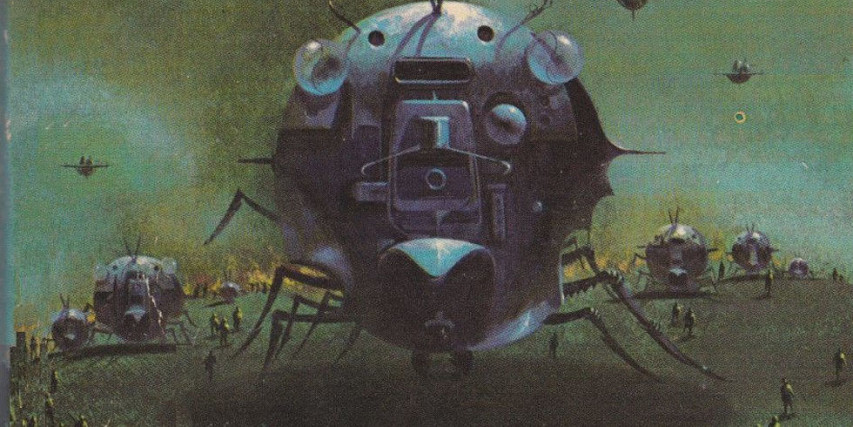
It’s not just generals and soldiers who keep the The Art of War in print. Businessmen, coaches, and lawyers all seem to get something out of Sun Tzu’s 6th century military tome — memorizing and repeating passages that speak to the tactics and strategy of success, whether that’s on Wall Street or in a war zone.
But for all its long-lasting cultural influence, the book is limited by its lack of specifics. “Know your enemy” and “win without fighting” are all well and good, but such axioms don’t really help today’s GI prepare to deploy with a robotic squadmate or decide what information to place on a digital head’s-up display. Modern warriors, surrounded by sophisticated gear and nuanced rules of engagement, need to meditate on the balance between technology and soldier, man and machine, civilian and veteran. For that kind of wisdom, they must go to military science fiction — and one great book in particular.
Robert A. Heinlein’s Starship Troopers, published in 1959, is aging remarkably well. The tome chronicles the early military career of Johnnie Rico, who fights alien arachnids while clad in a heavily armed exoskeleton. The troopers drop from orbit one by one to wreak havoc on whatever target the Sky Marshal deems worthy of the attention. It’s a cool adventure novel with a soldier’s eye view that doubles a treatise on modern warrior culture, the limits of military technology, and the awful glories of fighting infantry. There’s a reason military academies like West Point recommend cadets read the book.
Like Sun Tzu’s masterpiece, Heinlein’s abounds with quotable axioms. You may not hear overly intense car salesman quoting from Starship Troopers anytime soon, but here are six reasons why the book is a practical guide to 21st century warfare.
May 10, 2015
“…the Venn diagram circles of ‘scientists’ and ‘Lord of the Rings fans’ have a large overlap”
In The Atlantic, Julie Beck wonders “What has it got in its academic journals, precious?”
Though at first glance, science and fantasy seem to be polar opposites, the Venn diagram circles of “scientists” and “Lord of the Rings fans” have a large overlap. One could (lovingly!) label that region “nerds.”
Fight me on that if you want, but there’s plenty of evidence that suggests scientists love J.R.R. Tolkien’s epic. Several newly discovered animal species have been named after characters from the books — a genus of wasps in New Zealand is now called Shireplitis, with species S. bilboi, S. frodoi, S. meriadoci, S. peregrini, S. samwisei and S. tolkieni. The wasps bear the names of the hobbits because they too are “small, short, and stout,” according to a press release. On the other side of the size spectrum, paleontologists named a 900-pound ancient crocodile Anthracosuchus balrogus, after the Balrog, a giant whip-wielding fire monster from The Lord of the Rings. There is also a dinosaur named after Sauron, which seems kinda harsh to me. And many, many more, if the website “Curious Taxonomy” is to be believed.
“Given Tolkien’s passion for nomenclature, his coinage, over decades, of enormous numbers of euphonious names — not to mention scientists’ fondness for Tolkien — it is perhaps inevitable that Tolkien has been accorded formal taxonomic commemoration like no other author,” writes Henry Gee in his book The Science of Middle Earth.


