
I wouldn’t say I’ve been closely following the Canadian Patrol Submarines Project (CPSP), but I was interested enough to do a bit of reading about both of the contending bidders and their offerings. Based on my understanding of the RCN’s needs, I expected the South Korean KSS-III submarine to be the final winner, but I was wrong: Prime Minister Mark Carney announced that the German/Norwegian TKMS Type 212CD submarine had been selected instead.
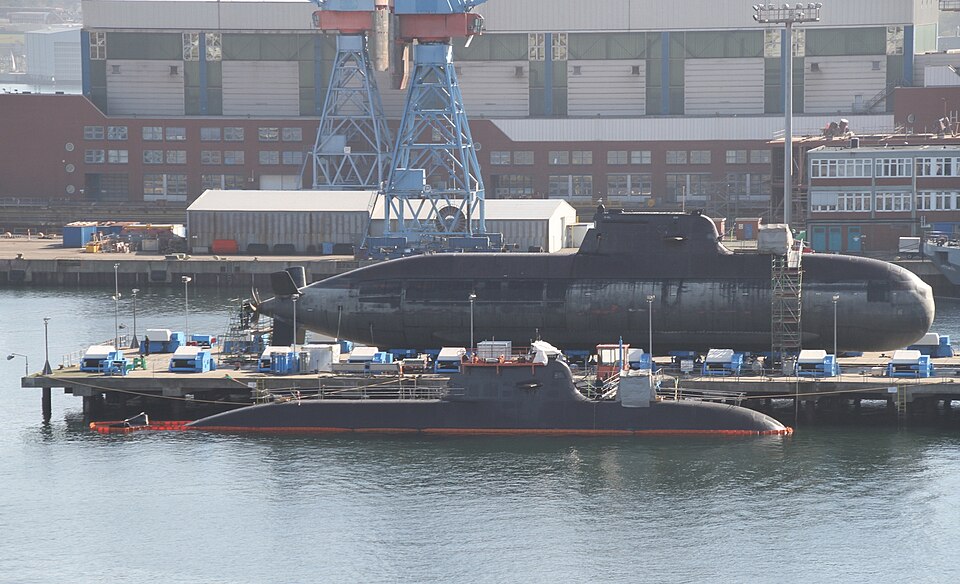
Type 212 submarines at the HDW shipyard in Kiel, Germany, 1 May 2013.
Photo by Bjoertvedt via Wikimedia Commons.Submarines enable the Royal Canadian Navy (RCN) to defend threats near and far from Canada’s shores. Yet, our current fleet is aging, with only one of four submarines seaworthy. With the longest coastline in the world, Canada’s ability to deploy underwater surveillance capability is critical. Our security and sovereignty depend on them.
Today, at Canadian Forces Base Halifax, the Prime Minister, Mark Carney, announced that Thyssenkrupp Marine Systems (TKMS) has been selected as the preferred supplier to begin negotiations for delivering Canada’s next fleet of submarines to the RCN. This will be the largest defence procurement in Canadian history, and it will equip the RCN with the capabilities they need to keep Canadians safe.
With ultra-low acoustic and magnetic signatures, TKMS’ 212CD is one of the stealthiest submarines in the world. It is capable of Arctic patrol, undersea surveillance, special forces deployment, and it is fully NATO-interoperable. These submarines provide an unparalleled combination of advanced technology and lethality that will enable the RCN to detect, track, deter and, if necessary, defeat adversaries in all three oceans bordering Canada. This procurement will bolster Canadian security through a platform shared by Germany and Norway, two of Canada’s closest Allies.
The Government of Canada and TKMS will now enter into negotiations to finalise the contracts and all arrangements required to deliver the requirements of the CPSP. Canada will conclude contracting no later than the end of 2027, with the first four submarines to be delivered ahead of schedule, in 2034. In the event that negotiations with the preferred supplier are unsuccessful, Canada may designate Hanwha Ocean as the preferred supplier and enter into negotiations.
The CPSP is being advanced by the Defence Investment Agency and aligns with Canada’s Defence Industrial Strategy. Under the Build-Partner-Buy framework, the project demonstrates the Partner approach, with collaborations with trusted Allies to develop and deliver capabilities while ensuring industrial and economic benefits for Canada. The CPSP will prioritise investments across the Canadian supply chain, to create high-paying jobs, leverage Canadian defence industries, and maximise benefits for Canadian workers and businesses.
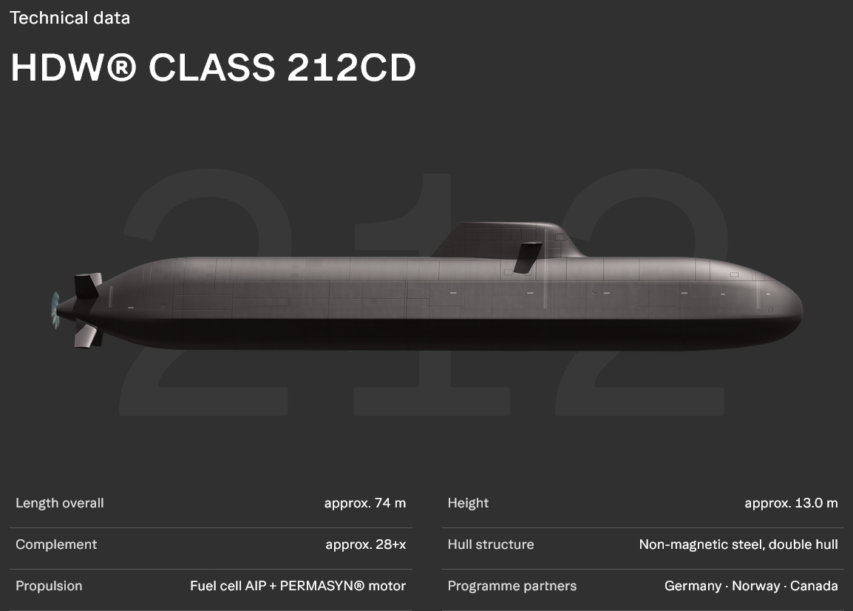
Noah comments on the press release information and some wider issues to do with the CPSP:
And with this, the long-awaited Canadian Patrol Submarine Project finds its home. What started as an ambitious RFI back in 2024 has quickly turned into one of the most consequential, publicized, and dynamic projects, I would say, in Canadian history.
TKMS and Kongsberg, operating as Team GERNOR, have claimed the preferred supplier designation from the federal government. As always, there is no contract today. The selection of a preferred supplier merely sets the table for negotiations to a final contract.
While the federal government will want to move quickly, and I’m sure that the Navy would like to see the contract signed, it is highly likely that comes in 2027. The typical “quick” timeframe is about a year. Keeping in mind, of course, that CPSP will be the largest procurement contract in federal history,1 and in this case also includes additional negotiations on build slots for submarines from both Germany and Norway.
[…]
There was no universal consensus, and I know this choice didn’t come easy for anyone. Both sides put all they could into it. Yet in the end, the GERNOR option pulled ahead. The European focus was championed heavily by those in the PMO as an opportunity to open doors and integrate Canadian industry into the wider European ecosystem, especially as European interest in Canadian expansion grows.
At the end of the day, that ecosystem came out on top. In the final weeks and months of the competition especially, the banner of Europe rallied to the call of unity, to stand with their hands at the back of Team GERNOR. That push, and that united front, is very likely what pushed that sense of alignment forward.
You don’t need to look far for it. Just after CANSEC, Italy’s Fincantieri, a noted ally of TKMS, signed a new MOU with Magellan Aerospace to investigate the potential production of heavyweight torpedoes and undersea countermeasures, building off the proposed investment TKMS plans to make.
While not in the 212CD network, Fincantieri is in the family, and they, among others, are also looking to Canada and our choices. It is the first example of the TKMS family taking notice and making proactive moves to jump in and secure capacity in a future Canadian submarine industry; and, as I understand it, far from the only one being discussed.
Another outside addition: Navantia of Spain and TKMS have also recently signed an MOU to investigate collaboration on naval shipbuilding. While this new agreement is young, I am also led to believe that Navantia is looking to Canada with interest, building off some of their previous engagements with industry.
Increasingly, the European front is united in industry, in the political sphere, and diplomatically to present the 212CD not as a German-Norwegian partnership but as a foundational Canada-Europe partnership that will build off the foundation of agreements like SAFE and the EU-Canada Security and Defence Partnership to create a united Atlantic front that promotes collaboration and joint investment, and opens the European market to Canadian industry.
- NR – “the largest procurement contract in federal history” … Canada’s major military purchases happen so rarely and always taking as long as bureaucratically/politically possible, so every ship, aircraft, helicopter, or tank purchase has a good chance of being the next “largest procurement contract in federal history”.



Does it come with an Enigma Machine?
Comment by Clayton Barnett — July 7, 2026 @ 06:52