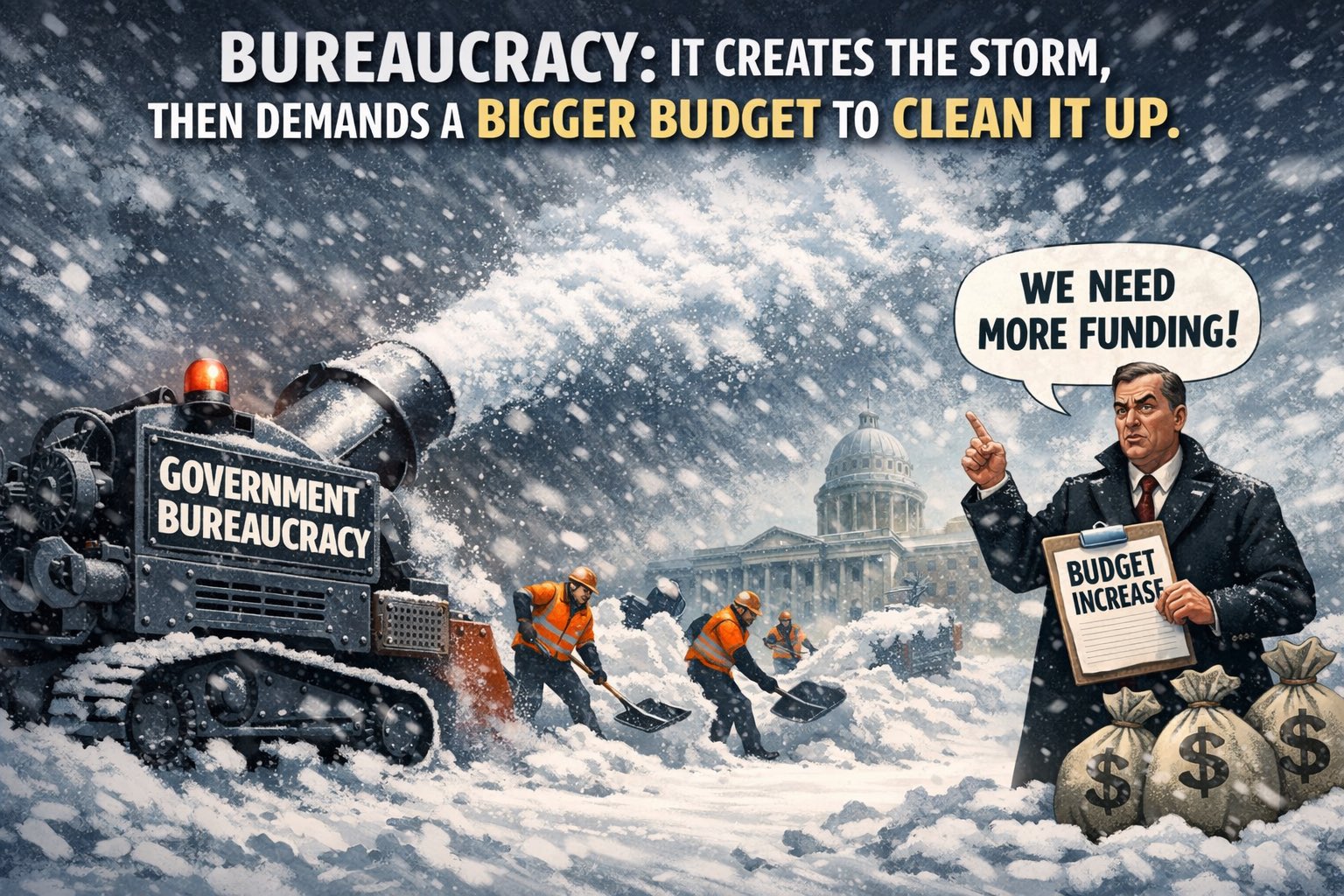
On the social media site formerly known as Twitter, L. Wayne Mathison explains the vast drawbacks of asking governments to solve problems:
Government bureaucracy is like a snow machine that keeps blasting, then hires more people to shovel the mess it just made.
We’re told it exists to help. To protect. To serve. Nice story. But in practice, it behaves more like a self-preserving organism. It doesn’t solve problems cleanly. It multiplies them, then offers to manage the mess it helped create.
Here’s the part most people miss. Bureaucracies don’t grow because problems get bigger. They grow because complexity gets rewarded. The more tangled the system, the more valuable the people who run it. That’s not a bug. That’s the incentive structure.
William Niskanen called this decades ago. Bureaucrats maximize budgets, not results. Bigger department, bigger influence. If a problem gets solved too efficiently, the machine loses a reason to exist. So problems don’t disappear. They get “managed”.
Then comes the language game.
Confusion gets dressed up as compassion.
A program no one understands becomes “comprehensive”.
A policy that creates dependency becomes “support”.
Failure becomes “underfunding”.It’s like hiring a mechanic who loosens parts just to bill you for tightening them later.
Now zoom in on Canada. Then zoom in tighter on Manitoba.
We don’t just have bureaucracy. We have an oversized public sector that’s crowding out the very engine that pays for it. In Manitoba especially, government employment makes up a huge slice of the workforce compared to the private sector that actually generates wealth. More administrators, fewer producers.
And here’s the quiet problem. Public sector growth doesn’t face the same discipline as the private sector. If a business bloats, it dies. If a department bloats, it asks for more funding.
So the balance drifts.
More people administering. Fewer people building, investing, risking.
More rules. Less output.
More spending. Slower growth.It creates a kind of economic inversion. The part of society that redistributes wealth starts to outweigh the part that creates it. That’s not sustainable. It’s like living off the interest of a bank account you’ve stopped contributing to.
Politicians don’t fix this because growth is easy to sell. Cuts are not. No one gets applause for saying, “We’re going to do less”. So the system expands in one direction only.
Forward. Always forward. Never back.
Meanwhile, taxpayers are handed the bill and told it’s the price of caring.
Here’s the hard reframe. Bureaucracy isn’t malfunctioning. It’s doing exactly what it’s rewarded to do. Expand. Protect itself. Justify its existence.
If you want a different outcome, you need different incentives.
Measure outcomes, not spending.
Reward efficiency, not headcount.
Shrink what doesn’t work, no matter how “important” it sounds.Because if you don’t trim the machine, it doesn’t stay the same size.
It learns to eat.