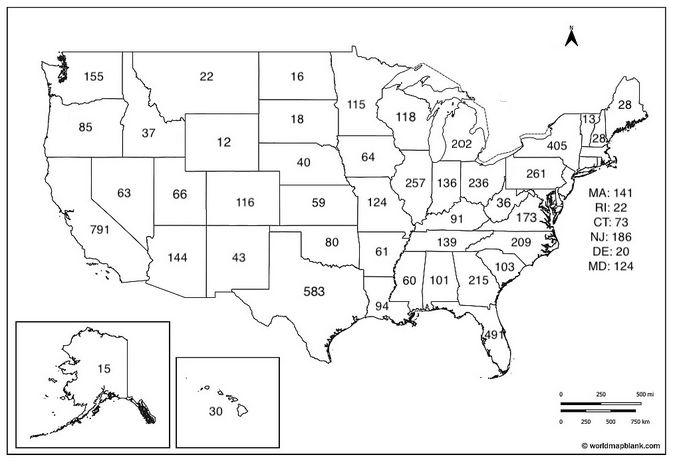
At Astral Codex Ten, guest writer David Speiser discusses the two “extra” proposed amendments that didn’t make it into the Bill of Rights, but crucially, didn’t have an expiration date. The 11th did eventually make its way into the Constitution as the 27th Amendment in 1992, leaving only the 12th original still in limbo. The proposed 12th was a doozy:
Here is the text of the Congressional Apportionment Amendment, the sole unratified amendment from the Bill of Rights:
After the first enumeration required by the first article of the Constitution, there shall be one Representative for every thirty thousand, until the number shall amount to one hundred, after which the proportion shall be so regulated by Congress, that there shall be not less than one hundred Representatives, nor less than one Representative for every forty thousand persons, until the number of Representatives shall amount to two hundred, after which the proportion shall be so regulated by Congress, that there shall not be less than two hundred Representatives, nor more than one Representative for every fifty thousand persons.
In other words, there will be one Representative per X people, depending on the size of the US. Once the US is big enough, it will top out at one Representative per 50,000 citizens.
(if you’ve noticed something off about this description, good work — we’ll cover it in the section “A Troublesome Typo”, near the end)
The US is far bigger than in the Framers’ time, so it’s the 50,000 number that would apply in the present day. This would increase the size of the House of Representatives from 435 reps to 6,6412. Wyoming would have 12 seats; California would have 791. Here’s a map:
This would give the U.S. the largest legislature in the world, topping the 2,904-member National People’s Congress of China. It would land us right about the middle of the list of citizens per representative, at #104, right between Hungary and Qatar (we currently sit at #3, right between Afghanistan and Pakistan).
Would this solve the issues that make Congress so hated? It would be a step in the right direction. Our various think tanks identified three primary reasons behind the estrangement of Congress and citizens: gerrymandering, national partisan polarization, and the influence of large donors. This fixes, or at least ameliorates, all of them.
Gerrymandering: Gerrymandering many small districts is a harder problem than gerrymandering a few big ones. Durable gerrymandering requires drawing districts with the exact right combination of cities and rural areas, but there are only a limited number of each per state. With too many districts, achievable margins decrease and the gerrymander is more likely to fail.
We can see this with state legislatures vs. congressional delegations. A dominant party has equal incentive to gerrymander each, but most states have more legislature seats than Congressional ones, and so the legislatures end up less gerrymandered. Here are some real numbers from last election cycle1:
So for example, in Republican-dominated North Carolina, 50.9% of people voted Trump, 60% of state senate seats are held by Republicans, and 71.4% of their House seats belong to Republicans. The state senate (50 seats) is only half as gerrymandered as the House delegation (14 seats).
In many states, the new CAA-compliant delegation would be about the same size as the state legislature, and so could also be expected to halve gerrymandering.
As a bonus, the Electoral College bias towards small states would be essentially solved. Currently, a Wyomingite’s presidential vote controls three times as many electoral votes as a Californian’s. Under the CAA, both states would be about equal.
Money: This one is intuitive. If you can effectively buy 1/435 elections, you’ve bought 0.23% of Congress. If the same money only buys you 0.02% of Congress, you’re less incentivized to try to buy House elections and more incentivized to try to buy Senate seats or just to gain influence within a given political party. Money in politics is still a thing, but it becomes much harder to coordinate among people. This makes it easier for somebody to run for Congress without having to fundraise millions of dollars. Because it’s less worth it to spend so much money on any one seat, elections to the House become cheaper2.
Polarization: Some of the think tanks that want to increase the size of Congress by a few hundred members rather than a few thousand claim that this increase will fix political polarization by making representatives more answerable to their constituents who tend to care more about local issues than national ones.
I’m more skeptical of this claim, mainly because it seems that all politics is national politics now. There’s one newspaper and three websites and all they care about is national politics. My Congressional representative ran for office touting her background in energy conservation and water management, arguing that in a drying state and a warming climate we really need somebody in Congress who knows water problems inside and out. Now that she’s actually in Congress, it seems that her main job is calling Donald Trump a pedophile3. The incentives here are to get noticed by the press and to go viral talking about how evil the other side is, so that people who are angry at the evil other side will give you money and you can win your next election.
But maybe Big Congress can solve that. Maybe in a district of less than 50,000 there will be less incentive to go viral and more incentive to connect with your constituents. At the very least, it seems that people trust their state representatives more. And when my state representative and my state Senator tell me about the good work that they’ve done and ask for me to vote for them again, they point to legislation that they’ve passed, not clips of them calling their opponents pedophiles.
- In case this smacks of cherry-picking, here is a breakdown of the “error” in every state’s Congressional delegation, state house delegation, and state senate delegation. “Error” here is defined as the difference between the representation of each state’s delegation and the percentage of that state that voted for Trump over Harris (or vice versa). In only two states, Florida and Virginia, is the error greatest in the largest body, and both of those states would have Congressional delegations larger than that largest body. In the case of Florida, their delegation would be nearly quadruple the size of their state house.
- There could also be an effect from the structure of the TV market. Stations sell ads by region, and each existing media region is larger than the new Congressional districts. So absent a change in market structure, a candidate who wanted to purchase TV advertising couldn’t target their own district easily; they would have to overpay to target a much larger region.
- And just to harp on this more, we just blew by the Colorado River Compact agreement deadline and now the federal government is going to start mandating cuts; everybody’s going to sue everybody else. Lake Powell is quite possibly going to dead pool this year, and as far as I can find the congressperson who ran on water issues is saying nothing about it.