
Quotulatiousness

February 22, 2026

“[T]he trans cult … attracted many mentally ill people [offering] instant visibility, attention, and status”

Filed under: Health, Media, Politics, USA — Tags: , , , , , , , — Nicholas @ 05:00

In the visible-to-cheapskates portion of his Weekly Dish post, Andrew Sullivan tries to point out how the Democrats can salvage something from their decade-long, all-in approach to all things trans (warning, contains Andrew Sullivan):
I had dinner this week with a young gay man who was castrated and had his endocrine system permanently wrecked as a result of “gender-affirming care” for minors. He was super girly as a kid and had an undiagnosed testosterone deficiency which delayed his male development. He liked playing with girls, seemed to act like one, and when he socially transitioned as a teen, he passed easily. Suddenly all the sneers of “faggot” he’d endured as a boy went away. In today’s “gender-affirming care” environment, that was enough.

“Compassion” and “science” took a gay boy, flooded his young male body with estrogen, and removed his genitals — because the docs and the shrinks determined he was too effeminate to be a “real man”. Only when he personally figured this out as an adult and got himself off estrogen and onto testosterone did everything change. He felt energy and mental clarity for the first time. And his life as a man could finally begin — although his body will never be fully repaired.

Readers keep telling me to shut up about this topic (I can hear your groans now). I’m obsessed, you say, and this is a trivial (boring) matter. I’ve lost some good friends who feel very much that way, and my social life has shrunk. But then I meet someone like Mike (a pseudonym) — and I’ve met many others, gay and lesbian — and realize not a single gay group or resource is on his side. In fact, the “LGBTQIA+” lobby all but denies he exists, or dismisses him as transphobic — a dreaded “detransitioner”.

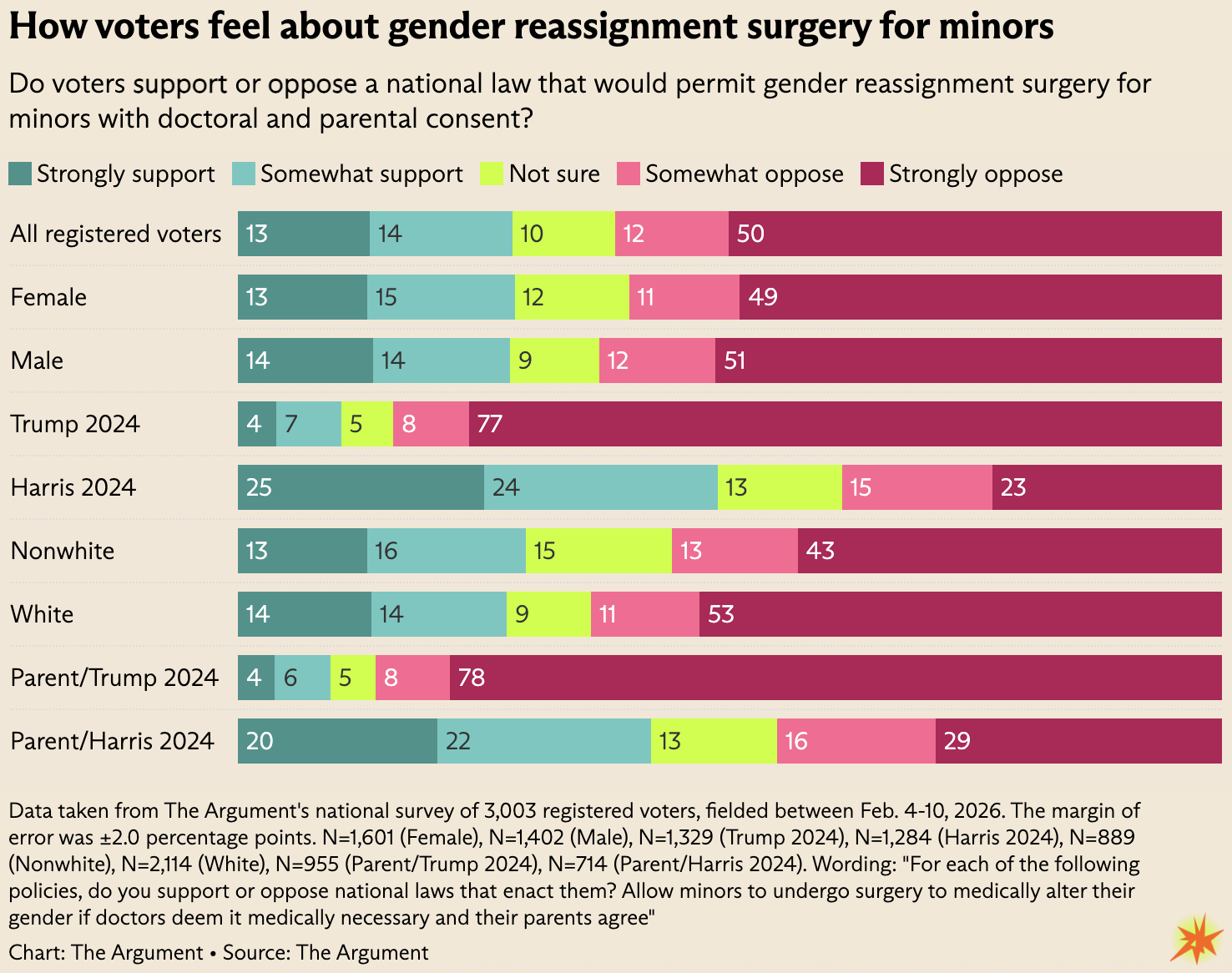
I was thinking about Mike as I read the latest polling — out this week in a liberal online mag, The Argument. The poll shows what we well know: 63 percent of Americans want to protect trans people from discrimination. This isn’t a transphobic country. But, equally, 62 percent oppose transing minors (50 percent strongly), 60 percent support banning transwomen competing against women in sports, and 53 percent want to ban gender ideology in elementary schools. These numbers have gone up the more the debate has raged. The backlash is so intense it has even reversed the public’s previous opposition to bathroom bills.

Now check out the liberal response. Bluesky erupted in fury that the poll was published at all. “Please help us,” one X member tweeted with direct appeals to Tim Cook and McKenzie Scott, who have bankrolled this campaign. Jill Filipovic complained that the “Dems … should have focused on things like ending discrimination in housing and employment”, rather than sports and kids, unaware that the Bostock decision already did that with employment. Most liberals have literally no idea that trans people already have civil rights. Off-message.

In this air-tight ideological bubble, where Bostock is unknown, the Dems flounder. “This isn’t happening” was the first gambit. Good try. Then: “this has all been ginned up by the far right, and Dems did nothing”. Did they miss the Obama and Biden Title IX diktats, Admiral Levine’s removal of lower age limits for transing kids, Biden’s “nonbinary” official Sam Brinton stealing dresses, or other embarrassments like the White House invite to Dylan Mulvaney? Then they say it’s a tiny issue. But it helped Trump massively in 2024. And if it’s tiny, why not compromise? After that, it’s just MLK-envy all the way down, the desire to be the next Rosa Parks. But it’s odd to campaign for “civil rights” when you already have them.

After trying to debate, you come to realize it’s pointless. The woke mind is not really a mind; it’s more like a bunch of synapses. Presented with an actual argument, they snap shut. This is part of what Eric Kaufmann calls the “sacralization” of minorities. For the woke, the “oppressed” are sacred. And in the social justice hierarchy, no minority is as oppressed and thereby as sacred as trans.

And so what sacred trans people say they want — or rather, what a tiny group of trans activists say they want — is all that matters. Anything else is illegitimate or “hate”. And any opponent is a bigot. Try arguing your way out of that dogmatic thicket. It’s like trying to disprove the Holy Trinity. I’ve given up.

But the real world keeps intervening. We just saw a ground-breaking lawsuit that won a $2 million judgment for a double mastectomy at 15. And this month saw two awful mass shootings by mentally unwell men caught up in the trans craze. Between Tumbler Ridge, Canada, and a Rhode Island hockey match, 12 people are now dead, including 6 children. And this is no longer a shock. Ask yourself what the 2023 Nashville Covenant School shooting, the 2025 Annunciation Catholic Church shooting, and even the 2024 attempted assassination of Trump, have in common.

Yes, it’s categorically wrong to link trans people to mass killings. That’s false and dangerous. But you’d be dumb not to worry that the trans cult of the last decade may have attracted many mentally ill people into a space where they have instant visibility, attention, and status. We have set up an open-ended subjective category — anyone who says they’re trans is trans, period — almost designed to attract delusional narcissists, and, with every safeguard thrown away, there’s no way to distinguish the nutters from the genuinely in need.

How to Use a Tariff War to Disrupt the World – Death of Democracy 04 – Q4 1933

World War Two and Spartacus Olsson
Published 21 Feb 2026

In Q4 1933 Hitler pivots Nazi Germany from internal takeover to outward defiance. The London Economic Conference collapses and the tariff truce unravels, Hitler withdraws from the Disarmament Conference and the League of Nations — then stages the November 12 plebiscite and one‑party Reichstag election to claim the nation stands behind him. As Goebbels tightens propaganda and press control through the Editors’ Law (Schriftleitergesetz) and daily directives, the Winter Relief campaign turns “charity” into social pressure and Volksgemeinschaft theater. In December, Reichsbank president Hjalmar Schacht hardens the transfer moratorium to conserve foreign currency for raw materials and rearmament. Using contemporary voices, this episode shows how isolation, manipulation, and “unity” accelerate Europe toward a pre‑war era.
(more…)

Britain’s recovery after a punishing existential war against a colossal European tyrant

Filed under: Britain, France, History — Tags: , , , , — Nicholas @ 03:00

The American Tribune considers how war-exhausted Britain staged a brilliant recovery after the decades of war against Republican and then Imperial France culminating in the exile of Napoleon to a remote island in the south Atlantic:

The grinding war is finally over after what feels like decades of bitter conflict on an inconceivably large scale. The entire world had become a battlefield in which the British had fought desperately to keep their imperial possessions secure in the face of vast hordes of enemies of all sorts, with the Navy and Army strained to the breaking point as battalions launched expeditionary raids and grinding, years-long campaigns everywhere from the steamy Orient to the Mediterranean, the bitter cold of the North to the coast and shores of Northern Africa.

Truth be told, victory, though it came in the end, had strained everything nearly to the breaking point. High taxes had driven the landed element to the breaking point. The necessity of convoys, of relying on domestic agriculture, of keeping the empire intact from an island the size of Michigan … had strained the British people and British society to the breaking point. Class tensions were high, taxes were already ruinously high, and to many elements, rich and poor alike, victory hardly seemed worth the immense cost in gold and blood.

And that was before considering the debt. The ruinous, mountainous, inconceivable debt. Well over 200% of GDP, it would later be calculated … and not at the negative interest rates of modernity either. Over 200% of GDP priced in real, somewhat gold-backed currency, with those who bought it demanding a real return. Ruinous, it was, ruinous! For this final conflict had been preceded not by many long years of peace, but by a similarly large, long conflict that had also involved campaigns across every corner of the earth, mutinous colonials, immense expense, and heavy taxation.

So victory had come. The war against an immense continental hegemon had been won, the international order was stabilized to the liking of and in accord with the ideology of the political elite, and the empire kept together in a hugely expanded state. But the cost had been high. Perhaps the cost had been ruinous …

I am, of course, describing Britain circa 1815, after its final victory over Napoleon at Waterloo. What followed was its century atop Olympus, the century where it ruled a quarter of the Earth’s surface, dominated all the sea lanes, was the world’s reserve currency, and became the world’s financial capital. Despite the expense, the defeat of Napoleon did not bring ruin, but success on an unimaginably immense scale.

What happened? Why did the Britain that defeated Napoleon become the hugely successful nation of the Victorian Age, but the Britain that followed the defeat of Hitler became a wrecked backwater, a miserable shell of its former self? The post-war debt load was similar. The human cost had been higher, but not remarkably so, particularly if the immigration outflows of the 19th century are considered.1 The logistical strains were similar, the social strains similar, and the fractious politics of the wars similar.

But the Britain of the 19th century became the hegemon of note, whereas that of the 20th century became essentially irrelevant. Mindset makes all the difference in the world, as I’ll show in this article, along with why this matters for Americans.

Britain after Napoleon

It is important to note that Britain’s immense imperial and economic success after the defeat of Napoleon was no sure thing. Yes, unlike much of Europe, it hadn’t been ravaged by invading armies. But it had lost its best colonies in the disastrous rebellion that followed the immensely expensive Seven Years’ War, a world war in all but name. It was staggering under a ruinous mountain of debt that could scarcely have been imagined earlier in the century: the national debt stood at somewhere around 210% of GDP, after post-war deflation had been accounted for, with somewhere around 10% of national GDP going just toward paying the interest on that debt.

Perhaps, worse, the population was restive. During the war, farmers and landlords had been pushed into embarking on extremely expensive schemes to drain and enclose land, schemes costing millions of dollars per thousand acres in today’s money; while that worked tolerably well during the war itself, as grain prices remained high, the expense and the cost of the debt used to achieve it was a crushing burden after the end of the war meant renewed trade and a fall in grain prices. That expense and the pain caused by it meant that not only were the farmers and the landlords struggling to make ends meet, but they had little left to pay agricultural laborers, who had their wages cut as a result, putting that bottom rung of the social ladder in an immensely precarious and dire economic position.

Much the same situation played out in the nascent industrial sector, where the end of war meant falling prices for finished goods and thus both lower profits and lower wages, angering industrialists and workers alike. As food remained expensive compared to wages, this meant major unrest, too. Thus, other than perhaps some financiers who were doing well off the debt, particularly given post-war deflation, most segments of society were unhappy at how the government was being run.

A high debt load that could only be maintained with high taxes, a highly restive and discontented population, and an economy-punishing bout of deflation are not the stuff of which great empires are typically made.

But the British figured it out, and did so without massive inflation, government default, or authoritarian societal repression.


  1. This is noted by AJP Taylor in his The First World War and Its Aftermath

An Interesting Silenced Bulgarian Makarov

Filed under: Europe, History, Weapons — Tags: , , , , — Nicholas @ 02:00

Forgotten Weapons
Published 29 Sept 2025

Today we are taking a look at an interesting silenced Bulgarian Makarov with a mechanism added to lock the slide. This sort of feature is usually thought of as a sneaky way to avoid ejecting brass and leaving it behind, but it actually serves a much more practical purpose. One of the loudest elements of a suppressed pistol firing subsonic ammunition is actually the noise of pressurized gas escaping when the empty case is extracted and then the slide chambering a new round. A slide lock eliminates these sources of noise by preventing the slide from opening. While this is not a factory-made variant of the Makarov, it is an interesting mechanism that I thought worth covering.
(more…)

QotD: The shift from “motte-and-bailey” construction to stone castles

As we move to stone construction and especially full stone construction (which we’ll define as the point when at least one complete curtain wall – don’t worry, we’ll define that in a second – is in stone) in the 12th century, we’re beginning to contemplate a different kind of defense. The wooden motte and bailey, as we’ve seen, mostly served to resist both raids and “hasty” assaults, thus forcing less coordinated or numerous attackers to set in to starve the castle out or go home. But stone walls are a much larger investment in time and resources; they also require a fair bit more careful design in order to be structurally sound. For all of that expense, the builder wants quite a bit of a security, and in the design of stone castles it is hard not to notice increasing attention towards resisting a deliberate assault; stone castles of the 12th century and beyond are increasingly being designed to stand up to the best that the “small army” playbook can throw at them. Of course it is no accident that this is coming at the same time that medieval European population and wealth is beginning to increase more rapidly, leaving political authorities (read: the high nobility) with both the resources for impressive new castles (although generally the number of castles falls during this period – fewer, stronger castles) and at the same time with more resources to invest in the expertise of siegecraft (meaning that an attacker is more likely to have fancy tools like towers, catapults and better coordination to use them).

To talk about how these designs work, we need to clear some terminology. The (typically thin) wall that runs the circuit of the castle and encloses the bailey is called a “curtain wall“. In stone castles, there may be multiple curtain walls, arranged concentrically (a design that seems to emerge in the Near East and makes its way to Europe in the 13th century via the crusades); the outermost complete circuit (the primary wall, as it were) is called the enceinte. Increasingly, the keep in stone castles is moved into the bailey (that is, it sits at the center of the castle rather than off to one side), although of course stone versions of motte and bailey designs exist. In some castle design systems, with stone the keep itself drops away, since the stone walls and towers often provided themselves enough space to house the necessary peacetime functions; in Germany there often was no keep (that is, no core structure that contained the core of the fortified house), but there often was a bergfriede, a smaller but still tall “fighting tower” to serve the tactical role of the keep (an elevated, core position of last-resort in a defense-in-depth arrangement) without the peacetime role.

While the wooden palisade curtain walls of earlier motte and bailey castles often lacked many defensive features (though sometimes you’d have towers and gatehouses to provide fighting positions around the gates), stone castles tend to have lots of projecting towers which stick out from the curtain wall. The value of projecting towers is that soldiers up on those towers have clear lines of fire running down the walls, allowing them to target enemies at the base of the curtain wall (the term for this sort of fire is “enfilade” fire – when you are being hit in the side). Clearly what is being envisaged here is the ability to engage enemies doing things like undermining the base of walls or setting up ladders or other scaling devices.

The curtain walls themselves also become fighting positions. Whether on a tower or on the wall itself, the term for the fighting position at the top is a “battlement”. Battlements often have a jagged “tooth” pattern of gaps to provide firing positions; the term for the overall system is crenellation; the areas which have stone are merlons, while the gaps to fire through are crenals. The walkway behind both atop the wall is the chemin de ronde, allure or “wall-walk”. One problem with using the walls themselves as fighting positions is that it is very hard to engage enemies directly beneath the wall or along it without leaning out beyond the protection of the wall and exposing yourself to enemy fire. The older solution to this were wooden, shed-like projections from the wall called “hoarding”; these were temporary, built when a siege was expected. During the crusades, European armies encountered Near Eastern fortification design which instead used stone overhangs (with the merlons on the outside) with gaps through which one might fire (or just drop things) directly down at the base of the wall; these are called machicolations and were swiftly adopted to replace hoardings, since machicolations were safer from both literal fire (wood burns, stone does not) and catapult fire, and also permanent. All of this work on the walls and the towers is designed to allow a small number of defenders to exchange fire effectively with a large number of attackers, and in so doing to keep those attackers from being able to “set up shop” beneath the walls.

[I]t is worth noting something about the amount of fire being developed by these projecting towers: the goal is to prevent the enemy operating safely at the wall’s base, not to prohibit approaches to the wall. These defenses simply aren’t designed to support that much fire, which makes sense: castle garrisons were generally quite small, often dozens or a few hundred men. While Hollywood loves sieges where all of the walls of the castle are lined with soldiers multiple ranks deep, more often the problem for the defender was having enough soldiers just to watch the whole perimeter around the clock (recall the example at Antioch: Bohemond only needs one traitor to access Antioch because one of its defensive towers was regularly defended by only one guy at night). It is actually not hard to see that merely by looking at the battlements: notice in the images here so far often how spaced out the merlons of the crenellation are. The idea here isn’t maximizing fire for a given length of wall but protecting a relatively small number of combatants on the wall. As we’ll see, that is a significant design choice: castle design assumes the enemy will reach the walls and aims to prevent escalade once they are there; later in this series we’ll see defenses designed to prohibit effective approach itself.

As with the simpler motte and bailey, stone castles often employ a system of defense in depth to raise the cost of an attack. At minimum, generally, that system consists of a moat (either wet or dry), the main curtain walls (with their towers and gatehouses) and then a central keep. Larger castles, especially in the 13th century and beyond, adopting cues from castle design in the Levant (via the crusades) employed multiple concentric rings of walls. Generally these were set up so that the central ring was taller, either by dint of terrain (as with a castle set on a hill) or by building taller walls, than the outer ring. The idea here seems not to be stacking fire on approaching enemies, but ensuring that the inner ring could dominate the outer ring if the latter fell to attackers; defenders could fire down on attackers who would lack cover (since the merlons of the outer ring would face the other way). As an aside, the concern to be firing down is less about the energy imparted by a falling arrow (though this is more meaningful with javelins or thrown rocks) and more about a firing position that denies enemies cover by shooting down at them (think about attackers, for instance, crossing a dry moat – if your wall is the right height and the edges of the moat are carefully angled, you can set up a situation where the ditch never actually offers the attackers any usable cover, but you need to be high up to do it!).

Speaking of the moat, this is a common defensive element (essentially just a big ditch!) which often gets left out of pop culture depictions of castles and siege warfare, but it accomplishes so many things at such a low cost premium. Even assuming the moat is “dry”! For attackers on foot (say, with ladders) looking to approach the wall, the moat is an obstacle that slows them down without potentially providing any additional cover (it is also likely to disorder an attack). For sappers (attackers looking to tunnel under the walls and then collapse the tunnel to generate a breach), the depth of the ditch forces them to dig deeper, which in turn raises the demands in both labor and engineering to dig their tunnel. For any attack with siege engines (towers, rams, or covered protective housings made so that the wall can be approached safely), the moat is an obstruction that has to be filled in before those engines can move forward – a task which in turn broadcasts the intended route well in advance, giving the defenders a lot of time to prepare.

Well-built stone castles of this sort were stunningly resistant to assault, even with relatively small garrisons (dozens or a few hundred, not thousands). That said, building them was very expensive; maintaining them wasn’t cheap either. For both castles and fortified cities, one ubiquitous element in warfare of the period (and in the ancient period too, by the by) was the rush when war was in the offing to repair castle and town walls, dig out the moat and to clear buildings that during peace had been built int he firing lines of the castle or city walls.

Bret Devereaux, “Collections: Fortification, Part III: Castling”, A Collection of Unmitigated Pedantry, 2021-12-10.

Powered by WordPress


