
Quotulatiousness

January 16, 2026

Rapidly declining democracy in the home of the “Mother of Parliaments”

As I’ve mentioned before, it sometimes seems that Australia, Britain, and Canada are in a three-way race to de-democratize themselves as fast as they possibly can. Here’s the free-to-cheapskates portion of Ed West‘s essay on the return of liberal authoritarianism:
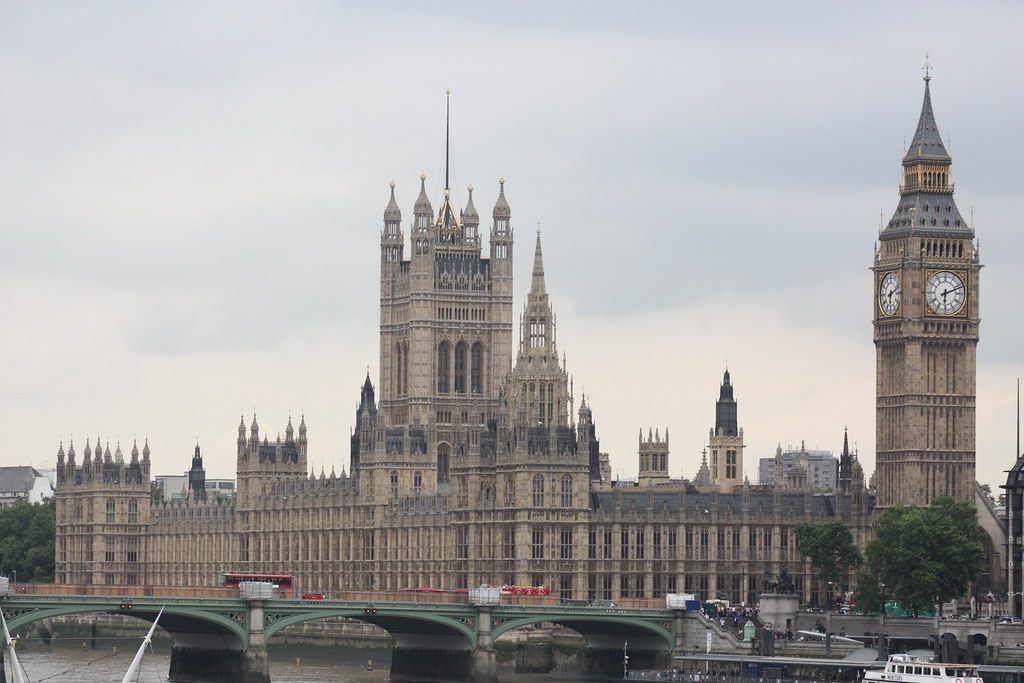
“Palace of Westminster” by michaelhenley is licensed under CC BY-NC-SA 2.0

It’s around this time of year that various NGOs give their assessment on the state of democracy and freedom of the world. The Fraser Institute’s Human Freedom Index was published earlier in December and Freedom House’s next report will arrive in February. It was at the start of last year that Romania was downgraded to a “hybrid democracy” by another body, the Economist Intelligence Unit (EIU), while France is now merely a flawed democracy. Sacré bleu!

What about our own beloved island, the mother of Parliaments? It will be interesting to see where Britain features in this year’s reports, and whether recent developments will impact on our rating.

Just recently, for instance, the British government postponed four mayoral elections until 2028, elections they are certain to lose. The Electoral Commission warned that it risked undermining “the legitimacy of local decision making and damaging public confidence”, while the chairwoman of the Labour Party even refused to rule out delaying the next General Election, leading Nigel Farage to accuse her of having “total contempt for democracy”.

Keir Starmer has also taken effective control of the House of Lords and will almost entirely eliminate opposition among peers by 2027, which he is able to do to the second chamber thanks to Tony Blair’s constitutional reforms. While the government extends the franchise to children, and even plans to place voting booths in schools, a clear violation of rules about politicising the education system, they’re also keen to restrict who can stand in elections.

As the i reported, Emily Darlington, Labour MP for Milton Keynes Central, “is seeking to make the Electoral Commission recommend enhanced DBS checks for candidates and then publish whether or not parties have agreed to the vetting. The aim is to ensure political parties justify whether their candidates are fit for office and name and shame those who refuse to participate.”

This is troubling when one considers that DBS (Disclosure and Barring Service) checks include not just criminal history but “non-crime hate incidents“, which may even appear on the records of people who haven’t been contacted by police. These highly-political charges are far more likely to be directed at those with Right-wing opinions.

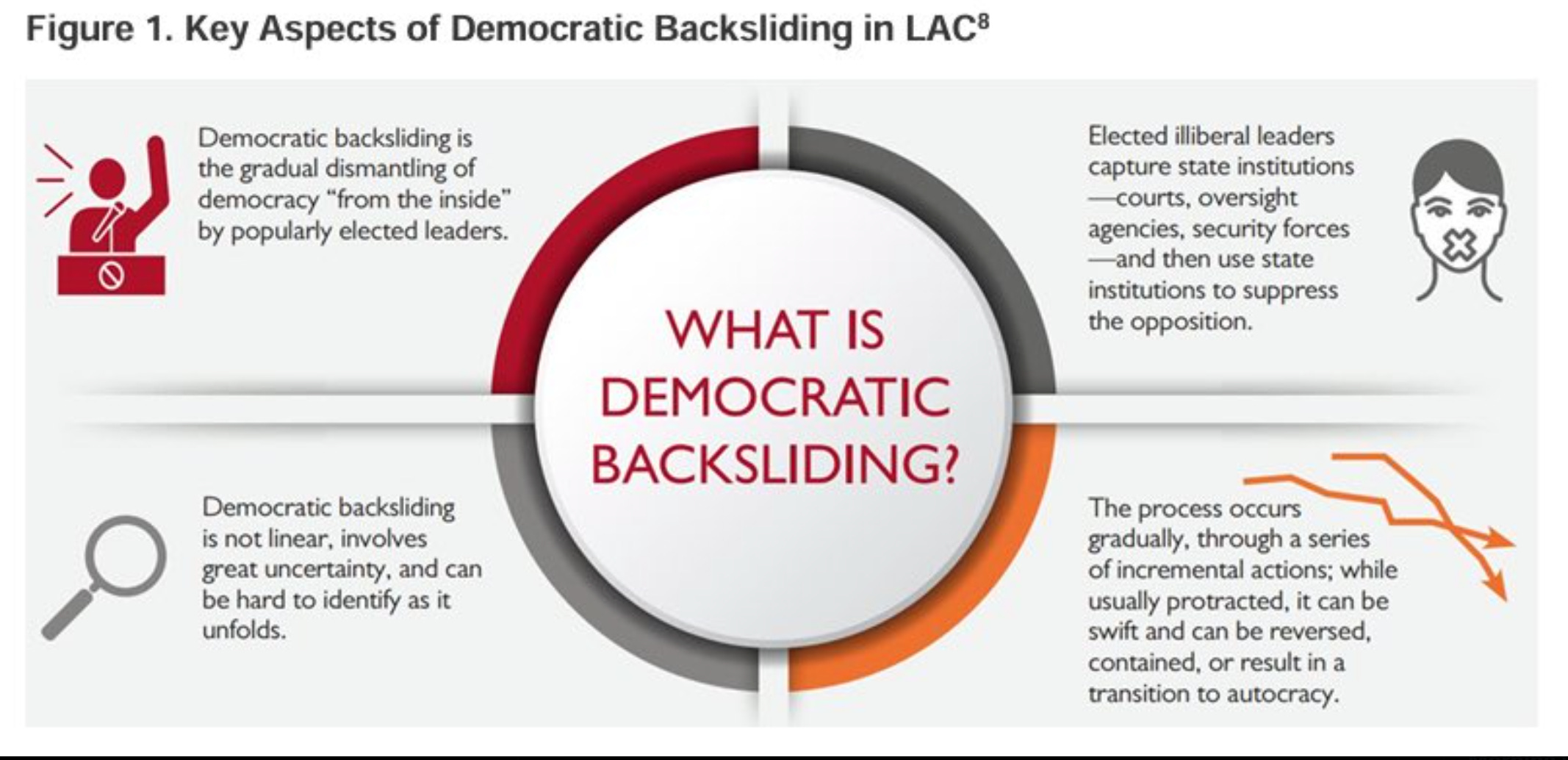
When western European countries do things like this, I try to gauge whether this is normal by asking the question: what if Hungary did this? In most of these cases, I imagine the assessment would be that it was an assault on liberalism and democratic norms. In which case, what if Britain is undergoing the sort of “democratic backsliding” usually levelled at central European countries with conservative governments? What if Keir Starmer is actually one of these illiberal “strongmen” we read about, just not a very effective one.

There are a number of accepted symptoms of democratic backsliding, among the most commonly listed being rejection of democratic rules, a disregard for constitutional norms, attempts to use legal mechanism to sidestep democracy, which is described as “stealth authoritarianism”, denial of opponents’ legitimacy, and the tendency to characterise them as outsiders or a threat to national security; on top of this, one might consider a willingness to curtail civil liberties, restricting the power of the media, and violating freedom of speech and association. Finally, and worst of all, is the toleration or encouragement of violence against opponents.

Credit: the National Opinion Research Center at the University of Chicago

By these broad definitions, Britain arguably meets many of these criteria (but not, most importantly, the last). There is certainly censorship, which has increased with the Online Safety Act, designed to combat “hate” as well as “misinformation”. Misinformation, of course, is everywhere, but its existence certainly provides a convenient excuse for governments to clamp down on the sort of information they dislike. The Government has also pondered banning Twitter, and while I feel that the widespread disgust at the Grok “deepfake” feature is reasonable, such a ban would completely cripple opposition, returning control of the discourse to the old media.

As for the British state’s definition of “hate”, there is a widespread belief that people motivated by hostility to mass immigration are extreme and dangerous, so the full force of the law must be used to stop them gaining support among a public who are totally guileless when it comes to absorbing information. This belief has grown more entrenched with the rise of populism, and makes western European governments increasingly sceptical of democracy itself.

It’s obvious that many people are concerned about the prospect of Nigel Farage becoming prime minister, and as the election date comes closer, and if he’s still in a position to win, the tone will become more shrill. Starmer admitted to this terror when he said, tellingly, that “If there is a Conservative government I can sleep at night. If there was a right-wing government in the United Kingdom, that would be a different proposition.”
Update, 17 January: Welcome, Instapundit readers! Have a look around at some of my other posts you may find of interest. I send out a daily summary of posts here through my Substackhttps://substack.com/@nicholasrusson that you can subscribe to if you’d like to be informed of new posts in the future.

“During the 1990s, the midlist disappeared at major publishing houses”

Filed under: Books, Business, Economics — Tags: , , , — Nicholas @ 03:00

It’s no secret that the publishing industry has changed substantially — and from most readers’ point of view, for the worse — but when did it happen, and why? Ted Gioia points to the mid-1990s in New York City:

Everybody can see there’s a crisis in New York publishing. Even the hot new books feel lukewarm. Writers win the Pulitzer Prize and sell just few hundred copies. The big publishers rely on 50 or 100 proven authors — everything else is just window dressing or the back catalog.

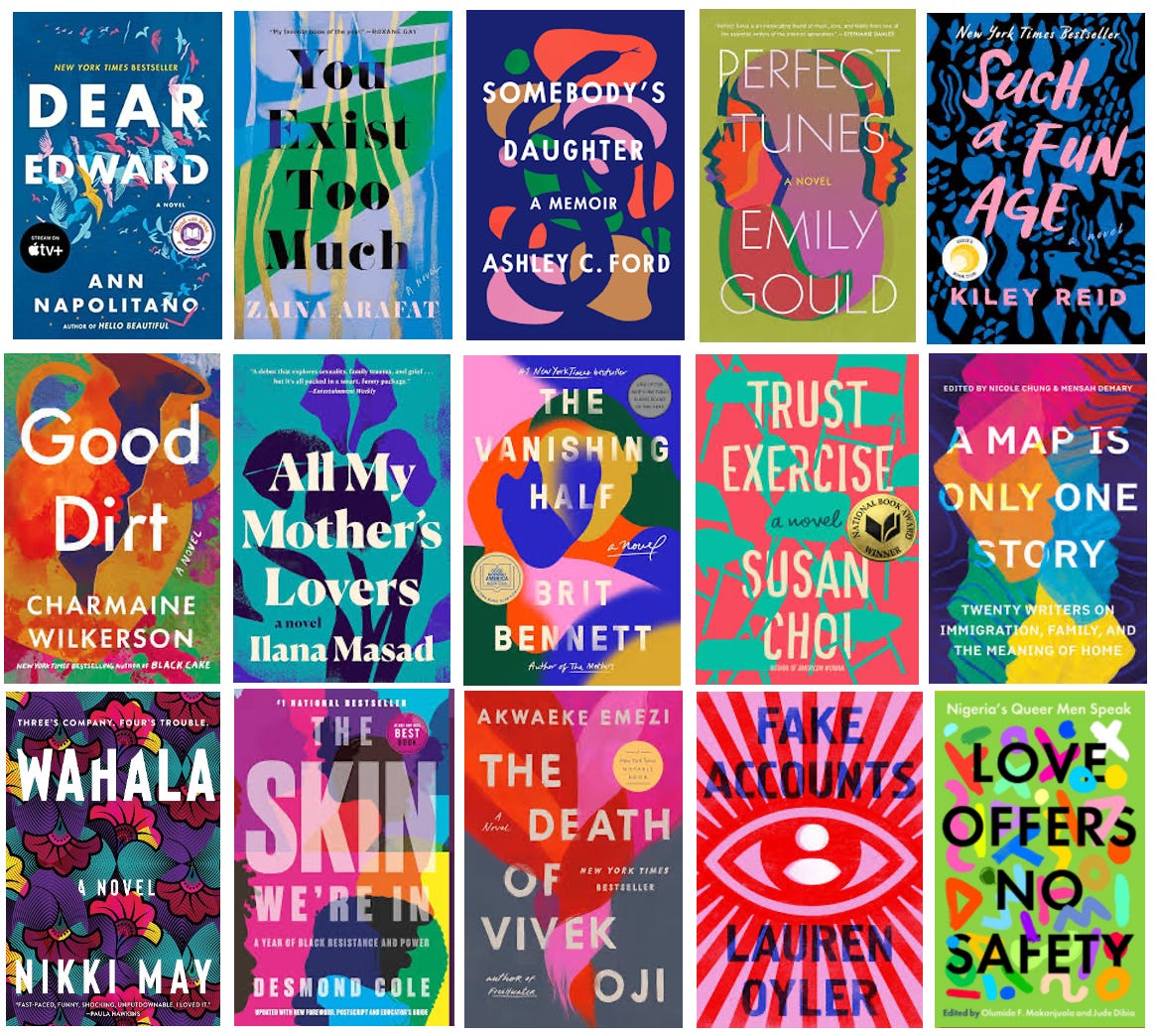
You can tell how stagnant things have become from the lookalike covers. I walk into a bookstore and every title I see is like this.

They must have fired the design team and replaced it with a lazy bot. You get big fonts, random shapes, and garish colors — again and again and again. Every cover looks like it was made with a circus clown’s makeup kit.

My wife is in a book club. If I didn’t know better, I’d think they read the same book every month. It’s those same goofy colors and shapes on every one.

Of course, you can’t judge a book by its cover. But if you read enough new releases, you get the same sense of familiarity from the stories. The publishers keep returning to proven formulas — which they keep flogging long after they’ve stopped working.

And that was a long time ago.

It’s not just publishing. A similar stagnancy has settled in at the big movie studios and record labels. Nobody wants to take a risk — but (as I’ve learned through painful personal experience) that’s often the riskiest move of them all. Live by the formula, and you die by the formula.

How did we end up here?

It’s hard to pick a day when the publishing industry made its deal with the devil. But an anecdote recently shared by Steve Wasserman is as good a place to begin as any.

He’s describing a lunch with his boss at Random House in the fall of 1995. Wasserman is one of the smartest editors I’ve ever met, and possesses both shrewd judgment and impeccable tastes. So he showed up at that lunch with a solid track record.

But it wasn’t good enough. The publishing industry was now learning a new kind of math. Steve’s boss explained the numbers:

    Osnos waited until dessert to deliver the bad news … First printings of ten thousand copies were killing us. It was our obligation to find books that could command first printings of forty, fifty, even sixty thousand copies. Only then could profits be had that were large enough to feed the behemoth — or more precisely, the more refined and compelling tastes — that modern mainstream publishing demanded.

Wasserman countered with infallible logic:

    I pointed out, if such a principle were raised to the level of dogma, none of the several books that were then keeping Random House fiscally afloat — Paul Kennedy’s The Rise and Fall of the Great Powers, John Berendt’s Midnight in the Garden of Good and Evil (eventually spending a record two hundred and sixteen weeks on the bestseller list, and adapted into a film by Clint Eastwood), and Joe Klein’s Primary Colors (published anonymously and made into a movie by Mike Nichols in 1998) — would ever have been acquired. None had been expected to be a bestseller, and each had started out with a ten-thousand copy first printing.

But it was a hopeless cause. And I know because I’ve had similar conversations with editors. And my experience matches Wasserman’s — something changed in the late 1990s.

The old system offered more variety. It took greater risks. It didn’t rely so much on formulas. So it could surprise you.

In a post about the jinned-up anger about CEO pay versus average worker pay, Tim Worstall briefly touches on the plight of writers:

Or even more fun perhaps.

    In 2006, median author earnings were £12,330. In 2022, the median has fallen to £7,000, a drop of 33.2% based on reported figures, or 60.2% when adjusted for inflation.

That’s median earnings so 50% of all authors earn less than £7,000. And note this is only among those taking it seriously enough to join the Society of Authors (a number which does not include me). Even at my level of scribbling 5x to 10x, depends upon the year, of those median earnings can be gained.

But top level authors, well, they do earn rather more. No, not thinking of the JK Rowling level of global superstardom. But it would astonish me if Owen Jones is earning less than 50x those median earnings (yes, Guardian column, books, Patreon, YouTube and whatever, £350k would be my lower guess).

Writers display that similar sort of income disparity and range, no? Because we’re not about to suggest that Owen is top rank earning now, are we, even if it is a damn good income there.

Which shows us what is wrong with the Cardiganista’s1 initial calculation. They’re pointing only to the incomes of the very tippy toppy of the income distribution for that job. If we apply the same sort of reasoning to writers or footie players (and it’ll be the same for actors and all sorts of other peeps) we find very similar distributions.


  1. They all seem to be Guardian retirees and their byline pictures have them wearing cardigans — or did — therefore …

WW1: The Slaughter Starts | EP 2

Filed under: Britain, Europe, France, Germany, History, Military, WW1 — Tags: , , , , — Nicholas @ 02:00

The Rest Is History
Published 28 Aug 2025

What was Britain’s first military move following the outbreak of the First World War? Where did the French launch their initial attack on the Germans? Whose army was the biggest and best of all the participants in the war? And, what unfolded at the pivotal Battle of the Ardennes in August 1914, on the frontiers of France, between the Germans and the French, and what would be the consequences of the outcome for the war as a whole?

Join Dominic and Tom as they discuss, in riveting, unsparing detail, the dramatic early engagements of the First World War, and the bloody Battle of Ardennes.

00:00 Who was Aubrey Herbert? The MP offered the throne of Albania
02:24 Expectations of WW1: catastrophe foretold
04:50 Britain’s war council: should the BEF go to France?
14:12 The French: splendid uniforms uniforms, and a daring plan …
20:05 Battle of the Frontiers
26:37 Charleroi: Lanrezac’s warnings ignored, French collapse begins
30:20 The Battle of Mons
42:00 French retreat as well: Joffre forced to abandon offensives
44:44 The Battle of Le Cateau: Smith-Dorrien decides to stand and fight
47:35 Le Cateau outcome: heavy losses, but strategic British success
49:04 The Great Retreat: exhaustion, refugees, collapse of morale
51:05 Sir John French proposes pulling back behind Paris
53:12 London & Paris reactions
56:09 Paris prepares for siege
(more…)

QotD: Another unintended consequence of conscription

Filed under: Britain, History, Military, Quotations — Tags: , , , , , — Nicholas @ 01:00

From 1948 to 1963 (which is when the very last left the forces) Britain had National Service. Two years in the forces and damn near everyone was in the Army. It’s the only period of peacetime conscription we’ve ever had. It was also the only period of near universal conscription we’ve ever had. Public schoolboys generally became officers, a portion of grammar school lads too. Everyone else got to be a private.

The big social revolution started in the mid-1960s and had really taken root by 1980. I don’t mean drugs and shagging around I mean a proper social revolution. The British working classes no longer took what they were being told by the poshoes as being true. Questions, as we might put it, were being asked.

My theory, backed up by reality and all the obvious facts of the case, is that as all young men had spent two years being run by the poshoes up front and directly therefore no one believed the poshoes any more. Actual experience, see?

National Service led to the downfall of the posh classes. Simply because direct exposure to said posh was always going to do that.

This is not just a jeu d’esprit. I really do insist that Britain’s social revolution was driven by conscription. Being told to jump by some chinless 6 months out of Eton is going to do that.

Tim Worstall, “National Service Led To The Uppity Proles Of the 1960s”, It’s all obvious or trivial except …, 2025-10-14.

Update, 17 January: Welcome, Instapundit readers! Have a look around at some of my other posts you may find of interest. I send out a daily summary of posts here through my Substackhttps://substack.com/@nicholasrusson that you can subscribe to if you’d like to be informed of new posts in the future.

Powered by WordPress

