Janice Fiamengo laments a recent British change to family law that “family courts will no longer work on the presumption that having contact with both parents is in the best interests of a child”. This is merely the latest move in a long-running legal and political struggle to alienate fathers from their children:
“Even today most people will refuse to believe that one of feminism’s main aims is, and always was, to give women the power to rid their families of men.” — William Collins, The Empathy Gap (2019)
“‘The person who is least likely to abuse a child is a married father,’ notes Canadian Senator Anne Cools. ‘The person who is most likely is a single, unmarried mother.'” — quoted in Stephen Baskerville, Taken Into Custody: The War Against Fathers, Marriage and the Family (2007)
[…]
It is a truism that feminists seek to destroy the father-led family and have long worked to do so through anti-father propaganda, legal chicanery, and evidence-free allegations of abuse.
Those who have not read feminists’ own words on this subject may have difficulty appreciating the depth of their desire to deny fathers any legally- or socially-recognized familial role.
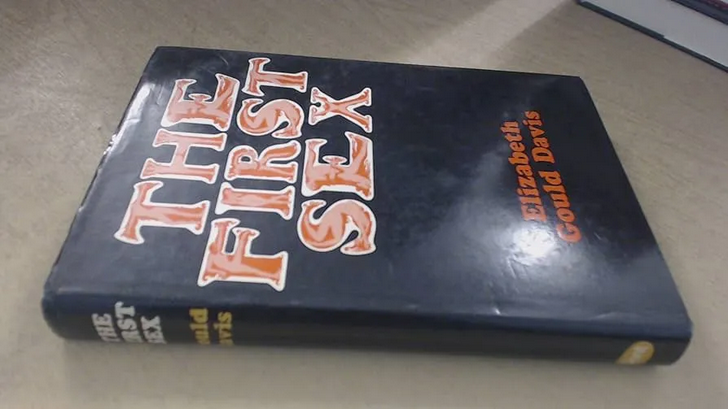
Elizabeth Gould Davis’s The First Sex (1971) provides a compelling example. Written at the height of the Second Wave of feminism, and published three years before the author’s death by suicide, it was a popular female-supremacist treatise. In it, Davis rhapsodized about goddess worship and female power in the ancient world, detailing a time when societies allegedly recognized and revered women as the superior sex.
In these societies, according to mythographer Robert Graves, “Men feared, adored, and obeyed the matriarch” (quoted p. 121). In thrall to women, men were peripheral, their roles as fathers non-existent: “[The woman] took lovers, but for her pleasure,” writes Davis, “not to provide her children with a father, a commodity early woman saw no need for” (p. 121). In this matriarchal sexual utopia, “Sexual morals were a matter of personal conscience, not of law” (p. 116), and the sole familial bond was between the mother and her offspring.
A chapter on “Mother-Right” made the case for a return to such a system, explaining that fathers contribute nothing good to their children’s lives. “The father is not at all necessary for a child’s happiness and development” (p. 117). Even children allegedly know this to be so: “In nearly every child’s experience, it is the mother, not the father, who loves all the children equally, stands by them without regard to their worth or lack of it, and forgives without reservation” (p. 118).
The father’s irrelevance is rooted, Davis explained, in men’s inability to love. “Maternal love was not only the first kind of love. For many millennia it was the only kind” (p. 119). Man has merely “learned to appreciate and be grateful for woman’s love, even though he was not emotionally equipped to return it in kind” (p. 119). She quoted Freudian psychoanalyst Theodor Reik to support her view that when men speak of love, they are actually speaking of a mere ‘scrotal frenzy'” (p. 119).
This rhapsody to female power and assertion of male uselessness continues for hundreds of pages in Davis’s ludicrous yet impressively-detailed book. Many feminists at this period made similar claims, attacking fatherhood and calling for the destruction of the patriarchal family. Author and activist Kate Millett, for example, argued in Sexual Politics (1970) that women’s oppression could not be ended without a transformation of “patriarchy’s chief institution […] the family” (p. 33).
In the same year, feminist radical Shulamith Firestone excoriated the patriarchal nuclear family as the “most rigid class/caste system in existence” (The Dialectic of Sex, p. 15). Two years earlier, would-be killer Valerie Solanas had expressed the sentiment crudely in her SCUM Manifesto: “The effect of fathers, in sum, has been to corrode the world with maleness. The male has a negative Midas touch — everything he touches turn to shit” (p. 45).
These were not simply sad cranks penning screeds in cat-piss-scented rooms (though many of them were mentally ill). They were acknowledged leaders of a movement that would, within a few decades, shape and control the core institutions of western civilization.