
Quotulatiousness

November 23, 2025

John Cage’s 4’33” meets the anti-clanker protest song

Ted Gioia on Paul McCartney’s latest single — his first in several years — and what he’s protesting against … clankers in music and the arts:
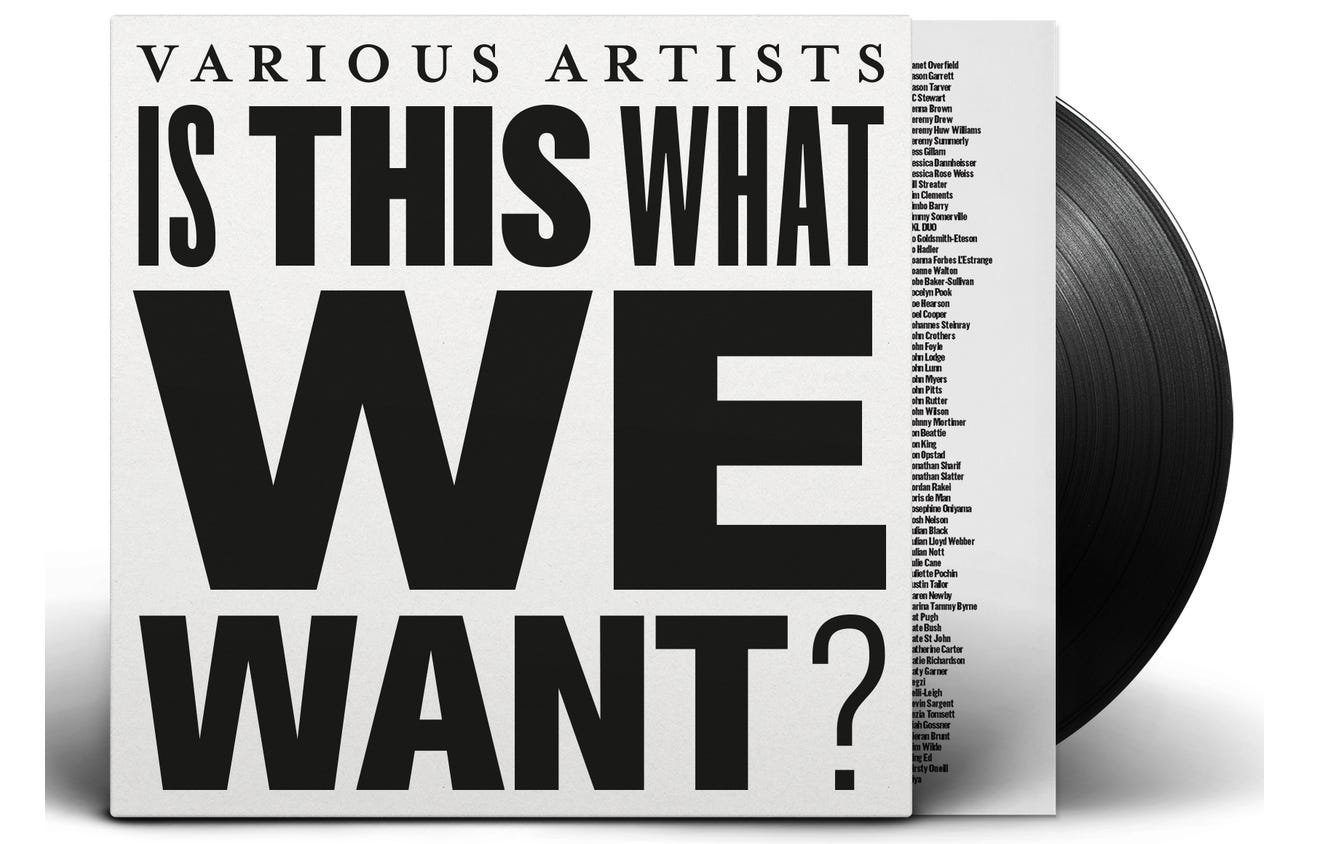
Paul McCartney is releasing a new track. It’s his first new song in five years — so that’s a big deal. But there’s something even more significant about this 2 minute 45 second release.

The song is silent. It’s a totally blank track — except for a bit of hiss and background noise.

What’s going on? Has Paul McCartney run out of melodies at age 83? Is he nurturing his inner John Cage. Did he simply forget to turn on the mic?

No, none of the above.

Macca is releasing this track as a protest against AI.

His new “music” is part of an album entitled Is This What We Want? It’s already available on digital platforms, and is now coming out on vinyl. All proceeds will go to the non-profit organization Help Musicians.

“The album consists of recordings of empty studios and performance spaces,” according to the website. In addition to McCartney, more than a thousand musicians are participating, including:

    Kate Bush, Annie Lennox, Damon Albarn, Billy Ocean, Ed O’Brien, Dan Smith, The Clash, Mystery Jets, Jamiroquai, Imogen Heap, Yusuf / Cat Stevens, Riz Ahmed, Tori Amos, Hans Zimmer, James MacMillan, Max Richter, John Rutter, The Kanneh-Masons, The King’s Singers, The Sixteen, Roderick Williams, Sarah Connolly, Nicky Spence, Ian Bostridge, and many more.

I keep hearing that protest music is dead — and has been losing momentum since the Vietnam War. But there’s now a new war, and it’s stirring up creators in every artistic idiom.

They are fighting for their livelihoods and IP rights. And, so far, it’s been a losing battle.

You can see the new battle lines across the entire creative landscape.

Vince Gilligan, one of the most brilliant minds in TV, admits that he “hates AI”. He calls it the “world’s most expensive plagiarism machine”. For his new show Pluribus, he has added this disclaimer to the credits:

    This show was made by humans.

AI represents the exact opposite of creativity, Gilligan warns. It steals the work of others. So any attempt to legitimize it as a creative tool is built on lies. A bank robber might just as well pretend to be a financier. Or an art forger claim to be Picasso.

[…]

This is the new culture war.

And it’s very different from the old culture war — which was a dim reflection of politics. This new battle is happening inside the culture world itself, and threatens to cut off artists from their own longstanding partners and support systems.

This new culture war will only escalate. The stakes are too high, and artists can’t afford to stay on the sidelines. But they face heavy odds, with the richest people on the planet opposed to their efforts.

How will this battle get decided? It really comes down to the audience. If they prefer AI slop, we will witness the total degradation of arts and entertainment.

I’d like to think that people are too smart to fall for this crude simulation of human creative expression. Who wants to hear a bot sing of love it has never experienced? Who wants a nature poem from a digital construct that exists outside of nature? Who wants a painting made by something with no eyes to see?

Will the public find this charming. Or even plausible? Maybe a few twelve year olds and fools, but not serious people. That’s my hunch.

In any event, we will soon find out.

North Africa Ep. 9: Rommel tightens the Noose around Cyrenaica

Filed under: Africa, Britain, Germany, History, Italy, Military, WW2 — Tags: , , , , , — Nicholas @ 04:00

World War Two
Published 22 Nov 2025

April 1941, North Africa. The British forward line at Mersa Brega has collapsed, 2nd Armoured Division is in retreat, and Erwin Rommel’s Afrika Korps is on the move. What was supposed to be a cautious blocking force has turned into a fast-moving desert offensive threatening Benghazi, Mechili, and all of Cyrenaica.

In this episode of our WW2 in Real Time – North Africa miniseries, we follow:

  • Rommel as he ignores Hitler’s orders and pushes east after Mersa Brega
  • The chaotic British retreat and fuel-starved tanks abandoning the desert
  • The fall of Benghazi without a fight
  • Wavell’s misjudgements and late reactions from Middle East Command
  • The race for Mechili, a vital crossroads and supply dump
  • The brutal reality of desert logistics – where sand and distance destroy more vehicles than enemy shells

While Rommel drives his reconnaissance units toward Benghazi and Mechili, British commanders try to trade ground for time and avoid encirclement. At the same time, Italian commanders warn Rommel about overstretch, and German divisional leaders complain about fuel and breakdowns – warnings he largely ignores.

By the end of this week in 1941, the Desert Fox is deep inside Cyrenaica, the British are burning their own supply dumps, and both sides are racing for the next key position. A clash at Mechili is imminent – and so is a showdown at the Er Regima pass with the “Devil’s Own” Australians waiting in ambush.

This is Episode 9 of our North Africa 1941 miniseries – part of our larger effort to cover WW2 week by week, in real time.

If you want to support this work and get deeper into the war in the desert and beyond, join the TimeGhost Army at timeghost.tv or patreon.com.

Excelsior!

Do older Canadians really hate their children and grandchildren? The fiscal evidence says “yes”

Filed under: Cancon, Economics, Government, Media, Politics — Tags: , , , — Nicholas @ 03:00

As I posted a few days back, the real political divide in Canada is no longer the left versus the right: it’s the old financially parasitizing the younger generations. At The Line, Ben Woodfinden discusses how the smug, comfortable boomers are being confronted by, for lack of a better term, a “new right” of far less comfortable younger voters:

eLbOwS uP!

The specific complaints from people like d’Entremont and other grumbling voices are less about ideology and more the tone and style of Pierre Poilievre (though perhaps the two are connected). Poilievre’s temperament and style rubs certain people, including some Conservatives, the wrong way. Now, full disclosure, I worked for Poilievre for a few years, and I can confirm he’s a demanding boss. But so is the prime minister, reportedly. And Poilievre is also in my experience the hardest working person I’ve ever met.

The tone battle is not a revival of Red vs. Blue. It’s not clear those terms are even relevant today. “Red Tory” is often used pejoratively to describe a “Liberal Lite” voter who identifies as a conservative but is indistinguishable from a Liberal — those who fit the “social progressive, fiscal conservative” moniker. This is not what Red Toryism historically meant; it’s actually the opposite of this. Red Toryism is a distinctly Canadian tradition of conservatism that was focused on the preservation of Canada contra a liberal United States, and emphasized the role of the state in this. It blended conservatism and elements of socialism in a distinctly anti-liberal synthesis that rejected radical individualism — that’s what the “red” part actually means, not liberalism but socialism. This kind of Toryism — “conservatism with a conscience” — is committed to public institutions and is pro-market but not entirely libertarian.

But Red Toryism is no longer a dominant force in Canadian conservatism; today it’s a remnant, largely in Atlantic Canada. What we’re really looking at here is a generational fault line that cuts right through the heart of Canadian conservatism.

Many older Canadians are conservative, and these older Tories are (in general) fairly well off. They are retired, or well advanced into their careers. They own homes that are paid off, or will be in the near future, and worth a lot more than what they paid for them. Many of them have been able to help their children get started in their own careers, or with down payments on homes of their own. They value stability — it is essential if they are to continue enjoying their prosperous lives. These people have long enough memories to remember the political battles that led to the creation of the modern Conservative Party of Canada in 2003 — some of them were no doubt even participants, and may still identify with one faction or the other.

Now contrast this with many of the leading voices on the other side of the debate. They call themselves “the new right”. In the absence of a better term, I’ll use that. Canada’s new right tends to be younger, and this matters not just because the old PC/Reform divide means very little to them, it matters because they are much angrier with our general state of affairs, and for good reason.

The emerging flagship publication for this collection of young conservatives is the Substack Without Diminishment. In some ways, the emerging conservative opposition in Ontario to Premier Doug Ford centred around an organization called Project Ontario (discussed in last week’s On The Line podcast here) is also a good representation of it.

The voices and figures involved in this movement are younger, often very online, and eager to pick fights with this older generation of conservatives. For some of the writers at Without Diminishment, the archnemesis of their conservatism is Globe and Mail columnist Andrew Coyne. He represents, for them, an outdated kind of “Boomer conservatism” that does not speak to them or the issues they care about. New conservatives have also recently written, after Ford ran ads featuring Ronald Reagan in America, that it’s time for “the gatekeepers of the Canadian right … to move on from 1984” — namely Reagan-era conservatism.

Twenty years ago, I’d often quote Andrew Coyne’s columns, but at some point he had a significant change of heart and one of the first Without Diminishment articles I linked to was what I characterized as “The Anti-Coynist Manifesto“.

Battle for the Mediterranean, 1940

Real Time History
Published 4 Jul 2025

In the summer of 1940, the British Empire faces German attacks against the home islands a new Italian adversary in the Mediterranean Sea, the lifeline to its colonies around the globe. In a series of campaigns the British beat back the Italians and eliminate parts of the French fleet. But the service of its overseas subjects won’t come for free.
(more…)

QotD: “Operation Atlas Shrugged”

Filed under: Books, Economics, Politics, Quotations — Tags: , , — Nicholas @ 01:00

It’s increasingly clear that Millennials are like the Eloi in The Time Machine by H.G. Wells. Ignorant, pampered, incompetent, lazy, short attention span and incapable of productive work. They long for the continuance of the protective arm of government originally provided by their misguided parents.

Ayn Rand foretold such a circumstance in Atlas Shrugged. It’s time for us all to go away into the mountains and let the Millennials and their boosters face life without a productive economy. It won’t take long for it to all collapse, but we should wait another generation before returning to rebuild civilisation. Certainly there will be no Millennial worthy of a statue – it will be a reprise of the dark ages following the collapse of Mycenae.

Lucius Quinctius Cincinnatus, “Operation Atlas Shrugged”, Catallaxy Files, 2020-06-12.

Powered by WordPress



