
Quotulatiousness

November 9, 2025

Sir Arthur Currie, commander of the famous Canadian Corps in WW1

Filed under: Britain, Cancon, History, Military, WW1 — Tags: , , , , , , , — Nicholas @ 05:00

As a counterpoint to the OTT summary of Sir Arthur posted last week, here’s The Black Horse with part one of a two-part look at the man’s early career before joining the Canadian Expeditionary Force in Europe:
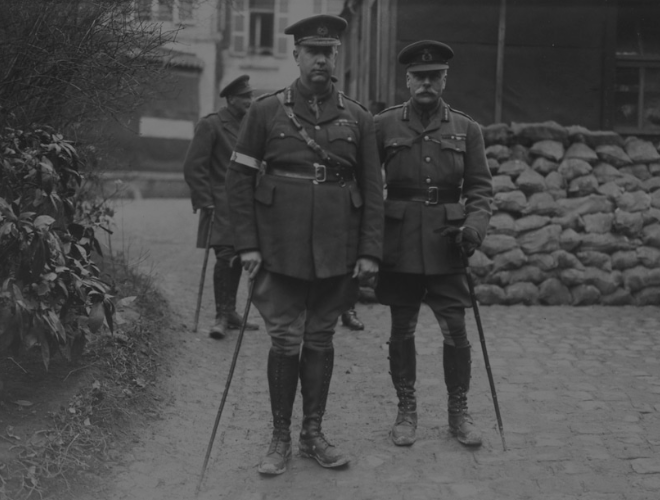
Sir Arthur Currie with Field Marshal Sir Douglas Haig, February 1918.
Libraries and Archives Canada item ID number 3404878.

The Red Ensign is a publication deeply interested in leadership; the good, the bad, and the ugly. For this reason, this Remembrance Day, I have chosen to draw the audience’s attention to the life and times of Sir Arthur Currie, the first Canadian commander of the Canadian Corps during the Great War. This presents an opportunity to both on honour and reflect upon the courage and sacrifice of the men who have fought under the flag of this great nation, but also offers the language to articulate the task facing any who would attempt to lead Canada today. As Currie’s war was defined by the challenge [of] leadership of Canadians in the context of the shifting priorities of the late British Empire, any who would seek to lead Canadians today face will struggle to harmonize efforts on behalf of the Canadian people and the priorities and policies of the American power block which he cannot eschew.

Dulce et decorum est pro patria mori; but when your country is an Imperial Dominion, who and what is “pro patria“, and how can one spend their life for them?

The Man Before the Great Man:

Arthur Currie was born in 1875 in Napperton, Ontario [50 km West of London], the third of eight children living on a homestead belonging to his grandfather. Raised with a the vigorous discipline of a Methodist home, Currie would remain a convicted Christian for his entire life, though he converted to Anglicanism as an adult. Currie was a good student, intending to pursue a career in law or medicine but dropped out of school twice, first temporarily because of the financial constraints brought on by the death of his father, and then for a second time at 19 because of a quarrel with one of his teachers. After leaving school he went West; after a string of failed efforts to establish himself via entrepreneurship and real-estate speculation he joined the Canadian militia as a gunner in 1897 in Victoria B.C. at the age of 23. A giant man (6’3″ at a time when the average Canadian height was 5’7″) with a noted eye for technical detail and, in the words of his son, a “tremendous command of profanity”, he quickly distinguished himself and was promoted to corporal before earning a commission as an officer in 1900. As an officer in peace time Currie was noted for his detailed inspections and his rapid transformation from “one of the boys”, into a rigid disciplinarian. This duality, an officer raised from the ranks, who could both embody the rigid tradition of the British military and who had an intimate familiarity with the life and ways of the enlisted men would become a defining feature of his career.

During Currie’s peace-time career as an officer he maintained a second career as a real-estate [agent]. After becoming head of Matson Insurance Firm 1904, he and the firm invested aggressively in the Victoria real-estate market. In 1913 Currie’s financial situation began to rapidly deteriorate as a consequence of price declines in the real-estate market. Currie’s financial problems nearly led him to refuse to stand up the 50th Regiment Gordon Highlanders of Canada in 1913. In July 1914 Curry used $10,833.34 of regimental funds intended for the purchase of uniforms and kit to pay his personal debts, and found himself facing forcible retirement just as the Canadian Army was being mobilized for war. At the intervention of one of his subordinates, Major Garnet Hughes, he instead accepted promotion as brigadier-general of the 2nd Brigade of the 1st Canadian Division, and ignored correspondence from the new commander of the 50th regiment, Major Cecil Roberts, about the missing funds until he was overseas.

Currie arrived at camp Valcartier on September 1st, 1914 to find himself charged with 10x as many men as he had ever led before, no staff, a shared tent as a command center, and the duty to prepare these men for one of the most difficult theatres of war the world has ever seen. The six months between taking command and the arrival of his brigade in the trenches near Ypres were marked by two mud besotted poorly supplied training camps, shoddy kit, rampant disease, and the company of a certain bear that was to become beloved by children around the world. Through this period Currie was well liked by the men, but known as a disciplinarian with an eye for technical detail. In March 1915 the brigade was deployed to what was expected to be a quiet part of the front with the intent of allowing the men to gain some experience with trench warfare before they were relied upon for action. Nobody anticipated what would happen next.


North Africa Ep. 7: Hitler says No! Rommel doesn’t care!

Filed under: Africa, Australia, Britain, Germany, History, Italy, Military, WW2 — Tags: , , , , — Nicholas @ 04:00

World War Two
Published 8 Nov 2025

Rommel is called to Berlin, where he’s told to wait until May and settle for Benghazi, but he rejects that plan and decides to strike sooner. In Cairo, Wavell reads ULTRA decrypts and realizes the Luftwaffe is preparing something, while admitting he has almost nothing left to hold Cyrenaica. On the ground, the Australians storm Giarabub in a sandstorm, El Agheila is snatched after a botched British ambush, and Rommel orders preparations to hit Mersa Brega before the British can dig in.
(more…)

When “research shows” in a headline indicates “bullshit here”

Filed under: Books, Media, Science — Tags: , — Nicholas @ 03:00

At Science Is Not The Answer, William M. Briggs says we should never trust stories headlined with “research shows X” (although if you’re a regular reader, you probably already know this):

Research Shows headlines are generated from papers by academics, and these all have explicit or tacit claims of cause, all purporting to explain some set of observations (whether gathered in history, the world, or by experiment). To explain is to state or to tacitly point to a cause.

The problem is that the methods science has developed to affirm or claim cause are often wrong: they are not right; they are in error; they are incorrect; they are fallacious; they sometimes make the right decisions, but only accidentally. By which I mean, cause is arrived at not by the methods, but by other means, yet the methods are credited.

I hope it is clear when I say that these methods are not to be used.

But are.

The worst tool, and one whose use is always and every instance a fallacy, is the so-called hypothesis test. We have done (“wee Ps”) in Class so many times, we’re sick of it (or I am). But I want to prove to you “tests” are fallacious another way, using one familiar example and one common situation. And with no math!

The idea is simple: a researcher makes observations, runs a “test”, and makes a pronouncement the cause he thought of is the one correct explanation for the observations.

He might be right about this, but it will only be accidentally, and not because of the “test”. For that same “test” could be used in support of an infinite number of other possible causes. That is the proof against “tests”: that they can support anything.

This will always be the case. As in every time. As in it is inescapable.

Our familiar example comes from A Global Enlightenment: Western Progress and Chinese Science by Alexander Statman (his surname guaranteeing I would read the book). It is mostly a review of the 18th Century Jesuit mission to China, and those Jesuits’ interactions with major figures of the so-called Enlightenment.

An important observation Statman makes is man’s proclivity to look for wisdom in the past or the future. One believes those in the past had superior knowledge, knew more secrets and could communicate with God (or the gods) with greater ease and facility, yet somehow that knowledge was lost (possibly wiped away in the flood; China, having the oldest extant civilization was thought to hold vast repositories). Or one believes those to come will be better than we, will know more, and will lead easier and happier lives, if only they are not held back by those who look to that past (China was also by others thought to have stagnated and could only copy their betters).

Samopal vz 38: Czechoslovakia’s Interwar Drum-Fed SMG in .380

Filed under: Europe, History, Military, Weapons — Tags: , , , , — Nicholas @ 02:00

Forgotten Weapons
Published 25 Jun 2025

Military interest in a submachine gun was late in Czechoslovakia, but by the late 1930s a development program was put into place. Interestingly, the main use case for an SMG was seen as being a replacement for a rifle-caliber LMG in fortification mounts. The thought process seems to have been that a large volume of fire was the necessary element to keep invaders away from border fortresses, and the ballistic power of the fire was not so important.

The vz38 was designed by František Myška, chambered for the 9x17mm (.380) cartridge used by the vz22/24 pistol then in service. It was tested against the ZB26 light machine gun. It proved reliable and effective, and its 96-round drum magazine (copied from the Finnish Suomi) was a particularly nice element. An initial order was placed and the gun was formally adopted into service, but production never began. Instead, German occupation of the country put an end to the project and only 20 preproduction examples were ever made.

Many thanks to the VHU — the Czech Military History Institute — for giving me access to this very rare example to film for you. The Army Museum Žižkov is a part of the Institute, and they have a three-story museum full of cool exhibits open to the public in Prague. If you have a chance to visit, it’s definitely worth the time! You can find all of their details (including their aviation and armor museums) here:

https://www.vhu.cz/en/english-summary/
(more…)

QotD: Historical training is not “spending 7 years memorizing dates”

Filed under: Education, History, Quotations — Tags: , , , — Nicholas @ 01:00

    James @TTJamesG
    The fact that you spent 7 years memorizing dates and the culmination of that is arguing semantics on X is depressing. Is it too late for a refund? You wrote an entire thread addressing a point I never made, a point you intentionally misconstrued.

Another thing that has come up a fair bit here recently is the idea that historical training consists of “spend[ing] 7 years memorizing dates” which is a severe misunderstanding of what historians do.

It confuses the job of reading history books for the job of writing them.

While any historian is going to end up knowing a lot of names and dates simply as a byproduct of teaching and working with their material, raw memorization is not a significant part of the PhD training process.

Instead, the focus is on research skills and analysis.

In practice, we can divide a lot of historical training into three components: the historical method, “theory”, and then field-specific training.

The historical method is the process and heuristics we use to assess historical sources.

While history students work from history books that are “pre-chewed” as it were, historians work with their evidence in its raw, unprocessed form: archives of documents, ancient texts, inscriptions, memoirs, archaeological remains and so on.

The historical method is how we approach that raw material: who produced it? What information would they have had (eyewitness? second hand?), what sources might they have had? What might their own aims have been?

And how can we most plausibly fill in gaps in our evidence?

Then there is historical theory. No good historian is a doctrinaire follower of a single theory of history — rather these are toolboxes of ideas we use to frame the research questions we’re asking.

But to use those ideas, you must know and understand them first.

So “critical theory” is interested in power relationships, while an Annales framework is interested in long-term structures and cultural assumptions, while a materialist framework focuses on material conditions and so on.

Each would imply different questions of the evidence.

Part of the point of learning theory, of course, is that each theory lens is, in and of itself, incomplete. Cultural structures matter, individual choices matter, material conditions matter, etc. etc.

You learn and think about a bunch of these to know the blindspots of each.

Finally, historians are going to learn a bunch of research skills specific to our period and place. For ancient Roman history, that’s Latin, Greek, epigraphy, paleography, some philology and a lot of archaeology.

For a more modern field, archive research methods are huge.

On top of that, you’re also going to develop knowledge in other disciplines — sciences, social sciences — that touch on your topic of interest. I work on the costs of warfare, so military science and theory, along with economics and a bit of demographics, matter to me.

What the historian is actually doing is taking that skillset to the raw evidence of the past — sometimes asking new questions of old material, frequently asking old questions of material no one has studied intensively before — to discover new information about the past.

Of course we also assemble a broad knowledge of the societies we study (like how Roman citizenship works), which we’d need to understand our sources and our evidence.

Roman citizenship, for instance, matters a lot for understanding the Roman army!

That broad knowledge is what we’re drawing on in teaching and for that we are relying on the work of our colleagues in the discipline: each historian is doing their own original discovering-the-past work, but also keeping up-to-date on our colleagues’ work.

The end result is both a steadily improving understanding of the past but also the ability, as our own conditions and interests change, to ask new questions, rather than simply endlessly rehash old questions and old (potentially flawed) answers.

“Online Rent-a-Sage” Bret Devereaux, Twitter, 2025-08-05.

Powered by WordPress


