On her Substack, Janice Fiamengo addresses the unpalatable contention that female power leads to civilizational disaster:

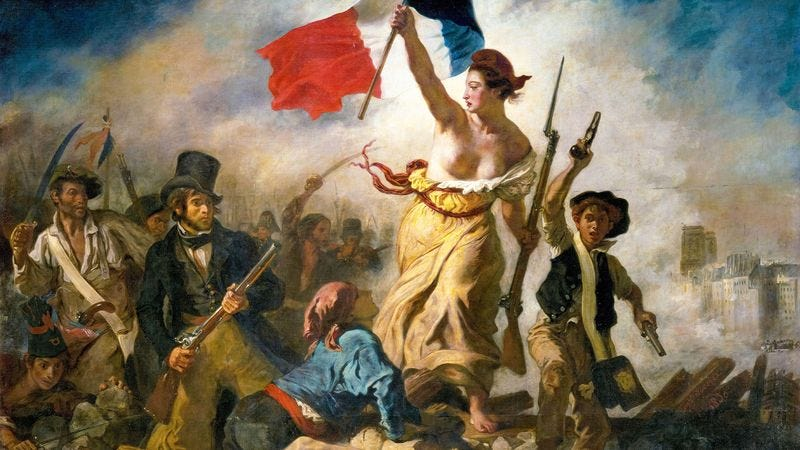
Liberty Leading the People by Eugene Delacroix
Multiple surveys (see, for example, with thanks to James Nuzzo, here, here, here, here, here and here) suggest that when women hold power, they pursue typically feminine preferences and policies. Female-led institutions become more oriented to social justice than objective truth. Feelings matter above facts, context above law, and victimhood above expertise.
Protecting and promoting the allegedly vulnerable — through censorship, shaming, coercion, or lawbreaking/lawfare — becomes a greater priority than excellence or impartiality. Truth-tellers find themselves cancelled, Nobel prize winners reduced to tears, laws and policies applied unequally, white men accused and vilified, criminals cossetted, mental illnesses affirmed, and destructive policies embraced. No one who has paid attention over the past 20 years can be surprised by the findings.
Moreover, our ability to discuss this feminine revolution in values is hampered by the very logic of the revolution, as I will show. Both women and men, deeply disinclined to “harm” women, fail to confront the problem adequately.
Two discussions of the subject — an essay by two social psychologists at Quillette and, more recently, a conference speech by a feisty conservative woman — draw a line under the seeming inevitability of the west’s collapse. Even faced with that alarming prospect, most pundits cannot bear to imagine an alternative to the female-led assault on our core institutions.
Cheering on Women’s Empowerment
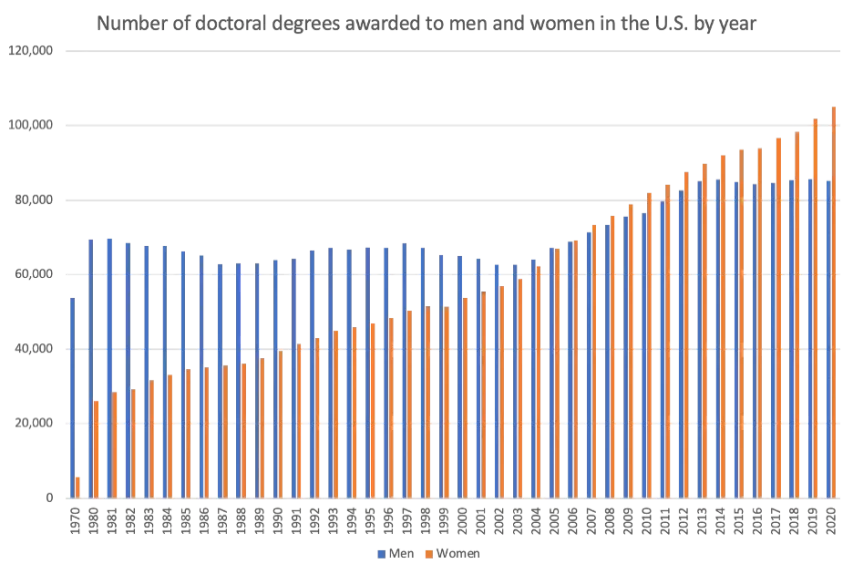
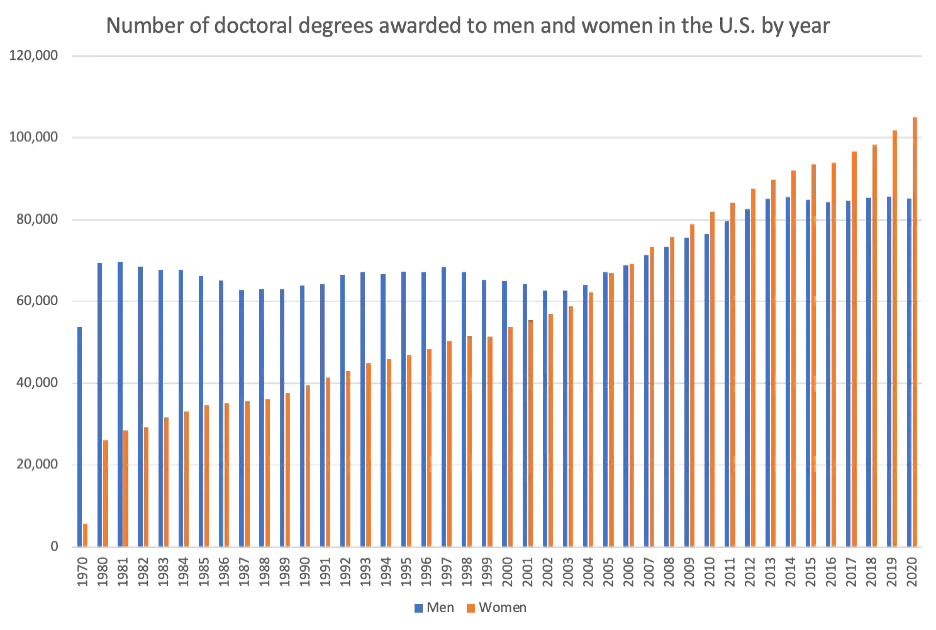
A 2022 article in Quillette, “Sex and the Academy“, provides a stark illustration of my thesis. The subtitle rules out the very conclusion the data supports, with the authors emphasizing that “The inclusion of women in higher education is a great achievement for Western liberal societies. How is this changing academic culture?”
The “great achievement”, as it turns out, will almost certainly be a lethal one.
The article was written by two academics, Cory Clark and Bo Winegard, both PhDs in social psychology. Winegard, a male scholar, had an unfortunate run-in with academic orthodoxy that led to his loss of employment; Clark, a female scholar, has a secure academic position. Both authors express enthusiasm for the takeover of academia by women even as they point out its damaging consequences. Neither one advocates any form of resistance, no matter how mild, to feminine academia’s assault on truth.

Summarizing the results of many surveys, Clark and Winegard demonstrate that while a majority of men favor free speech and the advancement of knowledge over emotional comfort, a majority of women prefer conformity, safety, and the protection of victim groups’ feelings. Not all women are indifferent to the traditional underpinnings of western civilization (and not all men support those underpinnings), but the general trends are clear.
Women are significantly more likely than men to support the cancellation of controversial speakers or the suppression of controversial research.
Women also tend to favor the existence of snitch lines to report people who cause offence. Women are more supportive than men of diversity quotas that exclude white men from consideration for prizes, positions, and promotions. (It would be interesting to know how many white women support diversity quotas that exclude white women from consideration for prizes, positions, and promotions.)
[…]
Asserting that both sides are pursuing worthy goals, the authors downplay the shock value of the findings, which show that women are, overall, less interested in truth and accuracy than men are. Imagine assessing such a finding as anything but catastrophic. Imagine calling the disregard for truth moral.
In place of truth, women value a utopian ideology that they perceive — usually without any consistency or adherence to fact, but nonetheless granted by Clark and Winegard — as “morally desirable”. But morally desirable for whom, and to what end? The use of the phrase, a misnomer, demonstrates how thoroughly the authors themselves are in thrall to the corrosive feminine culture they examine.
There is nothing moral (or generally desirable) about the suppression of truth-seeking research when it conflicts — or is perceived to conflict — with an allegedly emancipatory social goal. There is nothing morally desirable or indeed “protective” about shouting down an academic speaker because of the alleged harm of the speech. Naturally, social justice proponents would be outraged if their speeches were shouted down or their research blocked and censored.
I saw a link to this Helen Andrews article which seems to go well with Janice Fiamengo’s article linked above describing the “Great Feminization”:
… Cancel culture is simply what women do whenever there are enough of them in a given organization or field. That is the Great Feminization thesis, which the same author later elaborated upon at book length: Everything you think of as “wokeness” is simply an epiphenomenon of demographic feminization.
The explanatory power of this simple thesis was incredible. It really did unlock the secrets of the era we are living in. Wokeness is not a new ideology, an outgrowth of Marxism, or a result of post-Obama disillusionment. It is simply feminine patterns of behavior applied to institutions where women were few in number until recently. How did I not see it before?
[…]
The substance fits, too. Everything you think of as wokeness involves prioritizing the feminine over the masculine: empathy over rationality, safety over risk, cohesion over competition. Other writers who have proposed their own versions of the Great Feminization thesis, such as Noah Carl or Bo Winegard and Cory Clark, who looked at feminization’s effects on academia, offer survey data showing sex differences in political values. One survey, for example, found that 71 percent of men said protecting free speech was more important than preserving a cohesive society, and 59 percent of women said the opposite.
The most relevant differences are not about individuals but about groups. In my experience, individuals are unique and you come across outliers who defy stereotypes every day, but groups of men and women display consistent differences. Which makes sense, if you think about it statistically. A random woman might be taller than a random man, but a group of ten random women is very unlikely to have an average height greater than that of a group of ten men. The larger the group of people, the more likely it is to conform to statistical averages.
Female group dynamics favor consensus and cooperation. Men order each other around, but women can only suggest and persuade. Any criticism or negative sentiment, if it absolutely must be expressed, needs to be buried in layers of compliments. The outcome of a discussion is less important than the fact that a discussion was held and everyone participated in it. The most important sex difference in group dynamics is attitude to conflict. In short, men wage conflict openly while women covertly undermine or ostracize their enemies.
Bari Weiss, in her letter of resignation from The New York Times, described how colleagues referred to her in internal Slack messages as a racist, a Nazi, and a bigot and—this is the most feminine part—”colleagues perceived to be friendly with me were badgered by coworkers.” Weiss once asked a colleague at the Times opinion desk to get coffee with her. This journalist, a biracial woman who wrote frequently about race, refused to meet. This was a failure to meet the standards of basic professionalism, obviously. It was also very feminine.
Men tend to be better at compartmentalizing than women, and wokeness was in many ways a society-wide failure to compartmentalize. Traditionally, an individual doctor might have opinions on the political issues of the day but he would regard it as his professional duty to keep those opinions out of the examination room. Now that medicine has become more feminized, doctors wear pins and lanyards expressing views on controversial issues from gay rights to Gaza. They even bring the credibility of their profession to bear on political fads, as when doctors said Black Lives Matter protests could continue in violation of Covid lockdowns because racism was a public health emergency.
[…]
The Great Feminization is truly unprecedented. Other civilizations have given women the vote, granted them property rights, or let them inherit the thrones of empires. No civilization in human history has ever experimented with letting women control so many vital institutions of our society, from political parties to universities to our largest businesses. Even where women do not hold the top spots, women set the tone in these organizations, such that a male CEO must operate within the limits set by his human resources VP. We assume that these institutions will continue to function under these completely novel circumstances. But what are our grounds for that assumption?
The problem is not that women are less talented than men or even that female modes of interaction are inferior in any objective sense. The problem is that female modes of interaction are not well suited to accomplishing the goals of many major institutions. You can have an academia that is majority female, but it will be (as majority-female departments in today’s universities already are) oriented toward other goals than open debate and the unfettered pursuit of truth. And if your academia doesn’t pursue truth, what good is it? If your journalists aren’t prickly individualists who don’t mind alienating people, what good are they? If a business loses its swashbuckling spirit and becomes a feminized, inward-focused bureaucracy, will it not stagnate?
If the Great Feminization poses a threat to civilization, the question becomes whether there is anything we can do about it. The answer depends on why you think it occurred in the first place. There are many people who think the Great Feminization is a naturally occurring phenomenon. Women were finally given a chance to compete with men, and it turned out they were just better. That is why there are so many women in our newsrooms, running our political parties, and managing our corporations.
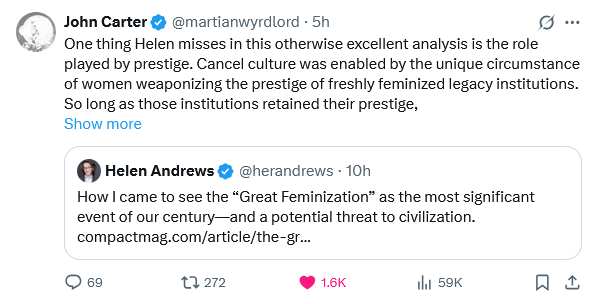
On the social media site formerly known as Twitter, John Carter comments on Helen Andrews’ article:
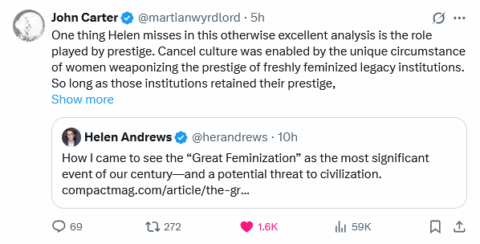
One thing Helen misses in this otherwise excellent analysis is the role played by prestige. Cancel culture was enabled by the unique circumstance of women weaponizing the prestige of freshly feminized legacy institutions. So long as those institutions retained their prestige, what the people who ran them said really mattered.
Unfortunately for the ladies (but luckily for civilization), this is self-limiting, because prestige is fundamentally an emergent property of masculine competence hierarchies. We see this demonstrated whenever a profession becomes coded as women’s work: its prestige immediately crashes. Feminists have complained about this for years, though of course they misunderstand the mechanism (prestige is a component of male sexual attractiveness, but not of female, and this is biologically hard-wired).
This prestige collapse is now affecting essentially every coopted, feminized institution — universities, news media, publishing houses, movie studios, large corporations, various government agencies, hospitals, courts, churches, all of them wield far less cultural power than they did even a few years ago. The only people who really care what these legacy institutions say are the women who took them over. To everyone else, the angry sounds they make are nothing more than background noise.
This is probably the main reason for the vibe shift. Once the prestige of feminized institutions declined below a certain threshold, their ability to enforce social consensus began to evaporate.
It’s also probably no accident that the Trump administration seems to care a lot more about what the anons of the Online Right say than it does about the opinion of the universities or the news media. All the intelligent young men got pushed out of the institutions, and those ionized particles of free male energy then began to self-assemble online into an ad hoc competence hierarchy where prestige is measured by clout rather than professional degrees, job titles, or institutional affiliations. The anon swarm is entirely informal, meaning that its outcomes are not amenable to antidiscrimination legislation or to procedural manipulation; you can screw with the algo all you want but you can’t actually force people to care what women say just because they’re women (thereby placing women into the position of openly trading in thirst, which gets them attention but certainly doesn’t mean that anyone has to pretend to take them seriously).
All that’s happened so far is that people’s attention has been redirected away from crazy woke females and towards the influencers of the online right. The fever has broken but society is a long way from recovered. The institutions are still under the control of crazy woke females, and this is extremely bad, especially because they are – for biological reasons related to childlessness — only going to get crazier as time goes on. Fortunately no one really cares what they say anymore, so as they throw tantrums as the institutions are reclaimed over the next decade or so, their protests won’t register as anything but irrelevant toddler noise.