Quotulatiousness

October 4, 2025

Rapid onset gender dysphoria (ROGD)

Filed under: Cancon, Health, Media, Politics — Tags: , , , , , , — Nicholas @ 05:00

At Woke Watch Canada, Igor Stravinsky tells the story of “Jane and John”, a distressing tale of rapid onset gender dysphoria:
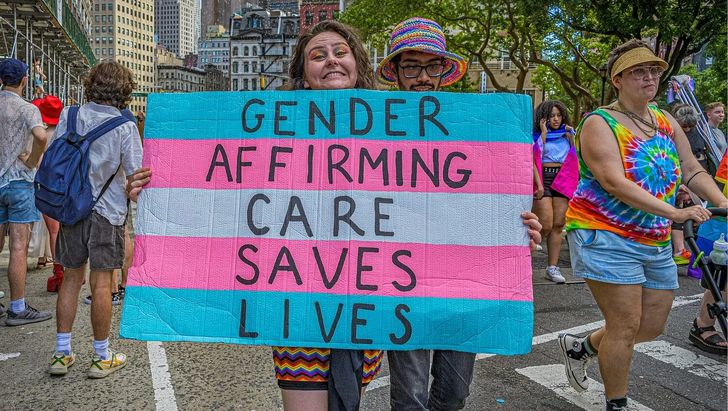
Image via the Boston Medical Center

In Ontario elementary schools, students are taught that whether you’re a boy or a girl is not determined by your physical body. Kids are encouraged to “explore their identity”. You may have a girl’s body. But how do you feel about it?

These kinds of discussions are going on because schools have accepted what rational people call “gender ideology”, but I prefer the term “gender mythology” because an ideology usually has to do with political systems. In my view the idea that a person’s sex is unrelated to their physical body, that they have a kind of soul sex, if you will, is clearly a myth.

[…]

Jane and John

This is a true story. The names have been changed to protect the privacy of this person.

Jane was a happy, clever, talented, and expressive girl who always wanted to help others. She displayed precocious empathy and enjoyed teaching younger kids various skills. Jane became socially conscious at an early age and was bothered by the fact that she enjoyed a middle-class, Western quality of life while so many others were clearly struggling. As an elementary student, she canvassed her neighbourhood collecting donations for disadvantaged kids. She came to identify with groups she saw as persecuted or oppressed.

Her school was very racially diverse, but she did not observe much racial discrimination. What she did notice was a fair bit of homophobia. She quickly took every opportunity to be an ally to the LGBT cause. In her middle school, there was an LGBT club, which she joined. Jane would often arrive home from school in an angry state because another student had said something that upset her, like, “being gay is a sin”, for example.

Jane’s parents were progressives who made it clear that she would be loved and accepted if she were a lesbian. Jane laughed at that and replied that she “dreamed about boys”.

Jane was a high achiever who was active in athletics and music. At 16, she became a vegan. She was in most ways a typical high school student, but her allyship with LGBT people gradually moved towards activism.

At university she quickly gravitated towards Indigenous and Gender Studies. Her close friends were all LGBT people. Her best friend was a transwoman (a man who identified as a woman). Jane came out as “bisexual” but her main romantic relationship was with a man.

Then, abruptly at the age of 20, she announced to her parents that she was to be called “John” and that she was going to transition to male.

By her own admission, Jane had been perfectly happy as a girl/woman for 20 years- “until I wasn’t”. This does not fit the Gender Mythology narrative. There is simply no way you can reasonably argue that she had, at this late age, suddenly realized what she truly was. She herself did not even claim that. So, what happened?

[…]

It was pretty obvious to me that Jane’s “transition”, like [trans-race activist Rachel] Dolezal, was the result of a combination of personal qualities and social influences. All the stars aligned to point her in that direction. She desperately wanted to be part of the community she had connected with and was tired of just being an ally. Claiming to be bisexual did not really cement her position as an insider. But becoming trans was her ticket.

Due to the extreme nature of taking on that identity — lifelong drug regimens and a number of surgeries, all of which presented serious health risks, going down that road reflected a true commitment and not only made her a part of the LGBT tribe but catapulted her to the top of the hierarchy.

What Jane experienced is known as Rapid Onset Gender Dysphoria (ROGD) and was first identified by the physician/researcher Lisa Littman. Learn more about it here. If you want to get a 2SLGBTQ++ (plus whatever other letters and numbers they’re using now — I can’t keep up) activist spitting mad mention ROGD. The phenomenon proves beyond a reasonable doubt that gender dysphoria can be induced in vulnerable people by social circumstances and aligns well with the research and clinical practice of Dr. Kenneth Zucker from the Centre for Addiction and Mental Health (CAMH) in Toronto.

Zucker ran the clinic for some 20 years and was pushed out due to his refusal to accept “affirmative care” as the only acceptable treatment for gender dysphoria. Zucker found that about 80% of kids would eventually grow out of their dysphoria and thus did not believe in affirming kids’ identities but rather focused on helping them cope with their condition.

Since affirmative care (an oxymoron!) has been adopted, we thus know that 80% of the kids who have been put on the road to gender transitions (and most carry through to the end) would have seen their gender dysphoria dissipate naturally over time. But once the first step — puberty blocking drugs, is taken, kids almost always go on to cross sex hormones and many continue with various surgeries.

Gender clinics do not do follow up nor do they support de-transitioning, but it is clear that the number of young people out there who have seriously harmed themselves through “affirmation” treatments is significant, and more harm is being done day by day as long as affirmative care remains the standard treatment for gender dysphoria.

What did poor Liverpool do to deserve “the worst speech in modern British political history”?

In The Conservative Woman, Sean Walsh wonders why his home city of Liverpool was chosen to be the site of a modern political crime-against-humanity in the form of a Two-Tier Keir speech to the Labour faithful:

LIVERPOOL happens to be my city of birth, and my family is generational CIA (Catholic, Irish, Alcoholic). I get back there when I can, usually for funerals family reunions. I can confirm that if you don’t mention Thatcher, the Sun, any Manchester band, the Wirral, or ask a native to pronounce the word “chicken”, you will be made to feel more than welcome as a visitor there. Scousers are rightly celebrated for a quick, if chippy, wit and unique sense of humour. Not least by ourselves.

Hopefully that last quality will help the city survive this week’s invasion by activist lawyers, Islington familiars, boilerplate career MPs, lanyard fetishists, lobbyists, and the process algorithm who was slush-funded to the Labour leadership.

For years Liverpool dodged hosting the Labour conference and was probably resentful at the snub. Now its rejuvenated docklands are the go-to venue for this annual festival of enforced fun/confected joyfulness. It’s probably resentful at that as well.

I’m not sure British politics has seen a speech as bad as the one the Prime Minister gave to this year’s wake gathering. And before you mention Enoch Powell and “rivers of blood”, that speech was “bad” only in the minds of those who never read it or were unable or unwilling to appreciate the deep truths Powell was advancing behind the veil of metaphor.

The Prime Minister was vindictive and politically maladroit in equal measure. Powell, a genuine member of the British working class, was a trained classicist who thought, spoke and wrote in the languages and metaphors of the ancient world. Powell’s lack of condescension and unwillingness to dumb down created room for bad faith and mischievous interpretation.

Starmer, who thinks and speaks the language of the petty bureaucrat, has no such defence. Where Powell made his predictions in poetry (which have proven correct, let’s not forget), Starmer rams home his malevolence in bullet points and crass soundbites.

I make this unhappy comparison partly to draw attention to the decades-long decline in the culture of political speechcraft, which TCW recently wrote about, and to affirm that even by the standards of today Starmer was awful.

We expect our political speeches to be unlovely now. Starmer’s went beyond that and managed to be offensive and yet boring all at once. As I said, the Prime Minister is an algorithm, and there are three things you can say about algorithms: they lack memory, have no sense of humour, and are unaware that they are, well, an algorithm.

On his Substack, Christopher Gage offers “A forward-thinking manifesto to deliver change for stakeholders”. That’s just the sort of bafflegab progressive thinkers think the general public wants to hear, apparently:

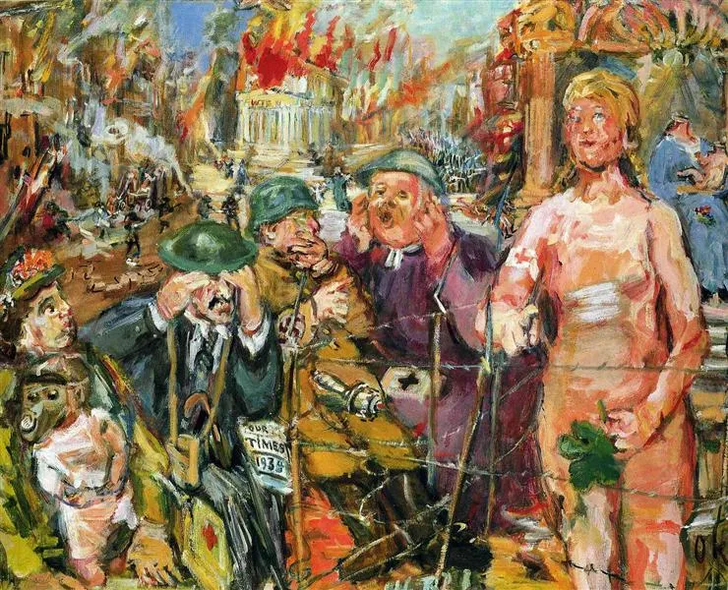
Alice in Wonderland by Oskar Kokoschka (1942)

This year’s Labour Party conference kicked off in the idiosyncratic style befitting its more excitable, green-haired cohort: confusion, contradiction, and faux contrition.

On Sunday, Sir Keir Starmer, our accidental prime minister, condemned Reform’s plan to deport migrants as “racist and immoral”. By Tuesday, it was Labour policy.

Politicians will say anything to keep suckling on the erect nipples of eternal power. And Labour politicians, despite their holier-than-thou affectations, are no different. They’ve seen the polls. Reform has led with room to spare in the last one hundred.

Labour has changed its spots. Starmer’s new Home Secretary, the combative and admirable Shabana Mahmood, is one foot on planet earth, at least.

At the conference, Mahmood warned the Guardian-reading element that they “won’t like the things I do”. She duly unveiled plans to ensure migrants “earn the right” to stay here: speak English, pay their way, and don’t expect their family to follow.

These once radioactive proposals are now common sense — two-thirds support immigration restrictions, whilst one-half wants not only the door welded shut but for many recent arrivals to be ushered politely through it. If Labour wants to win another election, they’d better listen to Wetherspoon Man over Performative Male.


As the week spluttered on, Starmer opted in to opting out to opting in to opting out. But Labour is listening. Nigel Farage, the Wetherspoon Man high priest, must feel his pockets lightened this week. Just glance at the swathes of Labour members waving the Union Jack, faces stretched incredulously like those masks from The Purge.

One impression emerges from this blancmange of bodily fluids: Farage has won the argument. Labour loves Britain, mate. Britain, big tits, Stella Artois, and XL Bullies.

Starmer even took it to Boris Johnson, onetime prime minister and two-time shagger of the year. The epithet “Boriswave” leapt from Starmer’s tongue with pace-sticked regularity. According to the prime minister, letting in four million people in two years — the Boriswave in Twitter slang — is an affliction so terrible that to reverse it would be, erm, even worse.

To be fair, such logic is not so much witless as it is anti-sense. And anti-sense has defined the Labour Party since I was spermatozoa.

One thing is clear. The Labour party, which presides over the sputtering, worn-out appendage known as Great Britain, needs some dire advice.

Here are a few proposals, the wholesale adoption of which would solve every problem befalling broken Britain.

The “nation of shopkeepers” is now the nation of problematic “Centrist Dads”

Filed under: Books, Britain, Germany, History, Military, WW2 — Tags: , , — Nicholas @ 03:00

Dr. Robert Lyman on the common misunderstanding of the nature of war and even their own imperial history among British voters:

I’ve been involved with the practice and study of war for the past 44-years. I have five degrees in history and the study and practice of war, and I have written 19 books on the subject and have contributed to the writing of 10 more, with 3 more of my own in train. The net result of this, observing international events and Britain’s response to them over recent times, is to conclude that Britain – and Britons – have a problem about war. The problem is that at a very fundamental or essential level we simply don’t understand it. I see eyebrows rising everywhere at this assertion, protests arising in the usual places to suggest that if we don’t understand war, how on earth did we create an empire? Worrying swathes of academia and our impressionable young – I know, I’ve taught them – believe that Britain is and has been a nation of rapacious warlords that conquered a major part of the world by the use of violence and disrespect for others. We don’t have time to refute that silly nonsense here, apart from observing that the primary nature of the British Empire wasn’t one that was secured or maintained by violence.

But, to the subject at hand. A product of long decades readying, studying, teaching and writing about war has led me to the conclusion that as a nation, both politically and culturally, we are too squeamish about the practice of war to be any good at either preventing it, or preparing for it. Put simply, our problem is that we are just too nice. Centrist Dads spend their entire lives seeking compromise, and worrying when a middle way cannot be found. It is only when, deep into a war we hoped wouldn’t wash up against our shores, that we come to the shocking realisation that people are trying to destroy us and as a result we find ourselves forced into the process of trying to master the business of organizing violence on a massive scale, and unleashing it as effectively as we can against our enemies. We always seem to be playing catch up, because we haven’t prepared adequately in the first place for the inevitability of war in a fractious world.

[…] Kit Kowol’s superb (and recent) Blue Jerusalem describes in embarrassing detail the ignorance evinced by politicians and military thinkers in the 1930s who hoped to avoid the sharp end of war by buying only bombers, or ships, or of relying on persuading the enemy population to coerce their leaders into ending a war they had themselves started. Perhaps if we dropped leaflets on Herr Hitler he would see the error of his ways, and end all this silliness? Very few people in Britain on the eve of the Second World War could bring themselves to comprehend the extent of the fascist animus either for democracy in general, or the Jews in particular, both seen by the Nazis as preventing the creation of a Grosse Deutschland and allowing Germany to regain her status as primus inter pares in continental Europe. It was only as Belsen was liberated nearly six-years later that the penny seemed to drop in the befuddled British mind that these people were bad, really bad, after all. It is one of the accepted reasons for the Allied failure to destroy the railways feeding Auschwitz: decision-makers in London or New York never truly comprehended the scale of the slaughter then underway across Occupied Europe.

This is where are again. Evidence for the worryingly widespread intellectual softness that dominated political thinking through the 1930s, which I would describe as a Centrist Dad problem, is everywhere. At an event last year with General Lord Dannatt where he gave what I considered to be a pretty straight forward talk on the security threats facing the UK, and what we should do about them, I overheard a comfortable middle class couple at the end complaining that he was being “too pessimistic”. They couldn’t see any cause for alarm. I was almost too shocked to reply. These are the sort of people who cannot quite understand why Hamas and Israel don’t just kiss and make up. It must therefore be Israel’s fault that there is no two-state solution in the Middle East. I read this sort of commentary every day in the broad sheets. It is particularly well expressed by the weekly output of two well-known podcast blatherers, archetypical Centrist Dads, one a retired politician – you know the two I mean – who consistently demonstrate that they have a fragile grasp on the animus that is generated in the hearts of those who despise us, no real understanding of the security steps we need to take to prevent it, nor of the kind of war required to eliminate such threats.

The starting point of these blatherers is what the journalist Jake Wallis Simon and the security commentator Andrew Fox describe as the “Wykehamist proposition”, which is that we should treat all people, hostile or otherwise, on the basis of our own benign ideological predilections. Accordingly, if we want to prevent someone attempting to kill us, regardless of the enemy’s motives, all we need to do is to sit round a table together, assume we all want the same positive outcomes from our conversation, and proceed amicably to resolve our differences. The sad reality is that this is not how the world works, nor is it how humans behave. If they have been to taught from childhood to despise you and everything about you, to the extent that they want to kill you – as Hamas and its ilk see Jews – no amount of so-called Wykehamism is going to persuade them to do otherwise. I suggest that the opposite approach is required. We need to treat threats to ourselves and our friends seriously, both in political and in military terms, and prepare accordingly. As General Lord Dannatt and I suggest in our book, stern, decisive military active to prevent Herr Hitler from remilitarising the Rhineland may well have prevented the entire Second World War from breaking out at all. To understand how to deal with war and threats of war, we need a political class that understands the scale of the threat we face and is prepared to undertake decisive action to nip hostility in the bud when it might occur. If we can resolve our differences amicably then of course we must always do so. But where an enemy does not want to play this game we must be determined to use force – and if necessary extreme violence – to protect our interests, and our people. This might involve dropping leaflets over the Ruhr but it might also entail dropping incendiaries on Berlin. In other words, to defend ourselves as a country, we must have the capability and the willingness to exercise the full-throated management of violence. We must also accept that it is the legitimate function of other democracies – like Israel – to do the same.

Warner Carbine

Filed under: France, History, Military, USA, Weapons — Tags: , , , , — Nicholas @ 02:00

Forgotten Weapons
Published 8 Sept 2015

The Warner carbine was another of the weapons used in small numbers by the Union cavalry during the Civil War. It is a pivoting breechblock action built on a brass frame. These carbines were made in two batches, known as the Greene and Springfield. The first guns were chambered for a proprietary .50 Warner cartridge, which was replaced with .56 Spencer in the later versions (for compatibility with other cavalry arms).

This particular Warner shows some interesting modification to its breechblock, which has been converted to use either rimfire or centerfire ammunition. This was not an uncommon modification for .56 Spencer weapons, as the centerfire type of Spencer ammunition could be reloaded (unlike the rimfire cartridges). With this modification, the firing pin can be switched from rimfire to centerfire position fairly easily.

QotD: Roman … democracy?

Filed under: Europe, History, Quotations — Tags: , , — Nicholas @ 01:00

Rome’s popular assemblies – for unlike most poleis, Rome has not one but four major assemblies, three of which matter – are the subject of something of a paradox in Roman political history which has in turn served as the hub around which a fairly active debate on the nature of Roman politics has rotated now for decades. The paradox is this: on the one hand, legally the Roman assemblies are sovereign. Their decisions, once rendered, are final and cannot be overridden by any other part of the res publica. That would seem to make Rome quite democratic, but to the contrary: apart from a few very notable exceptional moments, the assemblies are largely the dog that did not bark. They have vast power, but in part because of the traditional conventions of Roman politics (the mos maiorum, the “customs of the ancestors”) and in part because of how they are structured, the power of the assemblies often sleeps.

And today we’re going to look at why it is that the assemblies never roar quite so often as you’d expect and in the process begin developing the arguments of perhaps the central scholarly debate currently about the Roman Republic: how democratic was it really?

Bret Devereaux, “Collections: How to Roman Republic 101, Part II: Romans, Assemble!”, A Collection of Unmitigated Pedantry, 2023-07-28.

Powered by WordPress