Quotulatiousness

September 22, 2025

Materially well-off but downwardly mobile

Filed under: Media, Politics, USA — Tags: , , , , — Nicholas @ 05:00

Rob Henderson considers the plight of an entire generation of kids raised in privilege, but economically incapable of improving or even barely maintaining their material condition … the downwardly mobile children of wealthy parents:

“Free Palestine/Anti-Israel protest” by Can Pac Swire is licensed under CC BY-SA 2.0 .

For generations, Americans assumed that their children would live better than they did. Today, that assumption no longer holds. In fact, the higher your parents’ income, the less likely you are to match it.

According to The Pew Charitable Trusts, fewer than four in 10 children born into the richest fifth of households stay there; more than one in 10 fall all the way to the bottom fifth. Similarly, a 2014 study in The Quarterly Journal of Economics found that while 36.5 percent of children born to parents in the top income quintile remain there as adults, 10.9 percent fall to the bottom quintile.

Sociologist Musa al-Gharbi, in his 2024 book, We Have Never Been Woke, argues that this downward mobility of children born into wealth is the psychological engine of contemporary politics. This may look like a trivial problem — the petty disappointments of a small slice of America — but the unhappiness of this group, raised to expect the world and denied it, has outsize consequences.

To be clear, this cohort has never faced genuine poverty. Still, they have experienced the sting of loss: They came of age after the Great Recession, watched job security fade as the digital economy made their skills obsolete, and learned that highly coveted jobs in academia, media, and politics were far fewer than promised. These disappointments, al-Gharbi writes, helped power the Great Awokening. Many disillusioned strivers aimed their anger at the system they believed had failed them, and at the lucky few who did manage to retain or enhance their class position.


Unlike the working classes they so often claim to represent, these downwardly mobile elites remain armed with the tools of their upbringing: degrees, contacts, cultural fluency. They may no longer have the bank accounts their parents did, but they retain platforms in media, academia, and politics through which to broadcast their grievances. Given these advantages — or perhaps the right word is privileges — it should come as no surprise that their concerns, which seem to the average American profoundly niche, have dominated the cultural conversation.

Some of this downward mobility is voluntary. Al-Gharbi notes that many young, college-educated people would prefer “to be a freelance writer or a part-time contingent faculty member rather than work as a manager at a Cheesecake Factory”. The dream is artistic freedom and flexible work. The reality is disillusionment when prosperity does not follow.

Such disappointment isn’t totally new. George Orwell’s Keep the Aspidistra Flying follows a Cambridge-educated poet who abandons his advertising career, squanders his inheritance, and slides into genteel poverty. HBO’s Girls replayed the same theme for a new generation: Brooklynites with cultural capital but precarious incomes, simultaneously privileged and resentful. The details change, but the shape of the story remains the same — raised in affluence, buoyed by expectation, they discover too late that their choices and the system cannot sustain them.

What is different today, however, is how the disillusion now manifests itself. When reality disappoints those raised in privilege, the gap between expectation and outcome produces rage. Behavioral economics has long recognized this dynamic: Satisfaction depends less on objective conditions than on whether outcomes match or exceed expectations. And today, those expectations are far from being met.

Two years before Girls ended, sociologist Lauren Rivera, in her book Pedigree, found that graduates of lesser-ranked colleges who landed jobs at elite firms were far happier than Harvard and Stanford graduates who landed the same jobs. The reason was simple: Those jobs exceeded the expectations of the former, while for the latter they fell short. The higher the expectation, the sharper the disappointment. The harsh reality, then, is that privilege itself can encourage feelings of decline. When you’re born to — and surrounded by — overachievers, even respectable achievements can feel second-rate.

In a 2018 study, Duke sociologist Jessi Streib explored why many middle-class kids falter in school and work. Her finding was counterintuitive: Entitlement often dragged them down.

It’s not too hard to see why. Success in school requires showing up, meeting deadlines, and tolerating authority. Success at work requires completing projects on time, absorbing criticism, and cooperating with colleagues. Yet the downwardly mobile, Streib found, were often convinced such requirements were beneath them. Their grandiosity and defiance hastened their slide.

Elite overproduction is real, and has real world ramifications …
Dien Bien Phu: The Battle that Ended French Indochina – W2W 45

Filed under: Asia, France, History, Military — Tags: , , , , , — Nicholas @ 04:00

TimeGhost History
Published 21 Sept 2025

The First Indochina War reaches its climax at Dien Bien Phu. In late 1953 the French parachute into the valley, build a fortress under Christian de Castries, and plan to smash the Viet Minh with artillery and air power. Võ Nguyên Giáp answers with a siege: anti-air guns on the surrounding hills, trenches creeping forward, and relentless assaults on strongpoints Beatrice, Gabrielle, and Isabelle.

After weeks of bombardment and failed resupply, the fortress collapses in May 1954. At Geneva, the great powers draw the ceasefire lines: Vietnam is divided (North–South), and the Indochina War ends.

#DienBienPhu #IndochinaWar #Vietnam #ColdWar #Geneva1954 #VoNguyenGiap #FrenchIndochina
(more…)

The Liberals fervently believe that saying something is the same as doing something

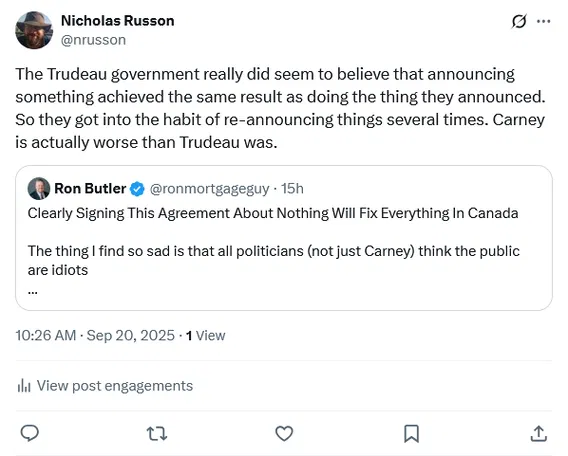
One of the most irritating aspects of Justin Trudeau’s long reign of error was his evident joy in making announcements about this or that topic. It got to the point that even the pro-Liberal media started to notice that the same policy would be announced several times over a few months but no actual progress was made (except where they could start setting up a new government program … they’d hire the staff very quickly, but little or nothing would get done beyond that). Mark Carney was supposed to be a clean break from the Trudeau years — even though most of his ministers were Trudeau retreads — but Carney may actually be worse than Trudeau in that he just loves photo ops with pretty props for the cameras. As Dr. Sylvain Charlebois notes, we need a lot fewer photogenic Potemkin Villages in how our federal government operates:

In recent weeks, we have witnessed politicians lean on powerful visuals to make their case on food and trade. But these staged moments rarely serve the public interest. Worse, they often deepen food illiteracy in a country where understanding how our system works is already fragile.

Take Ontario Premier Doug Ford’s stunt. Upset with Diageo’s decision to close its bottling plant in Ontario, he theatrically dumped a bottle of Crown Royal and urged Ontarians to boycott the brand. What he didn’t mention is that the bottle in question was made in Manitoba and bottled in Quebec by unionized Canadian workers — jobs unaffected by the Ontario closure. The Windsor facility mainly serviced the U.S. market, and Diageo’s decision was years in the making. Ironically, the boycott risks punishing Canadian workers who will continue producing Crown Royal for Canadians. And for future investors, the message is chilling: why put capital into Ontario if a government will trash your brand on television for a corporate restructuring decision?

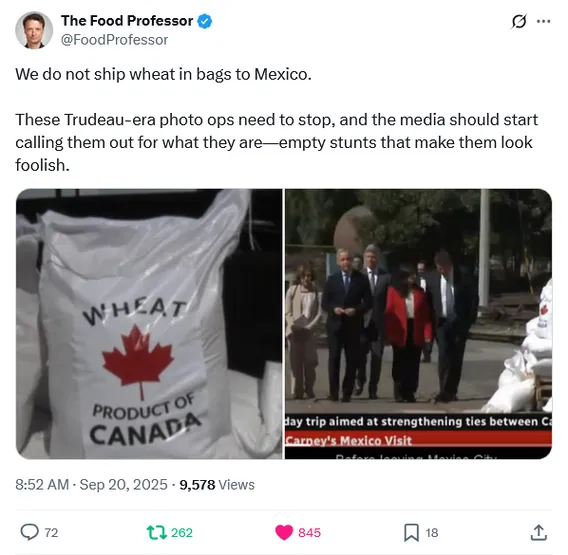
The federal stage brought us another head-scratcher. During a trade visit to Mexico, Prime Minister Mark Carney posed with bags of Canadian wheat stamped with a maple leaf. The problem? Canada doesn’t export wheat in bags. We are among the most efficient bulk grain exporters in the world, shipping millions of tonnes through rail networks and ocean vessels designed for efficiency, safety, and traceability. Bagged wheat is a relic of less mechanized economies. For Canada to present itself this way trivializes our status as a modern agri-food powerhouse. Beyond being misleading, the image suggests to global partners that our system is less advanced than it truly is — a dangerous misrepresentation for a nation that depends on reputation as much as price.

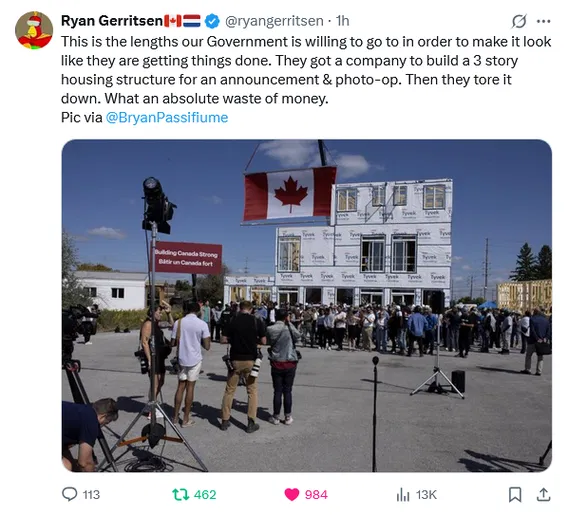
Even I didn’t realize how bad it got until the feds paid contractors to put up a fake building site for Mark Carney to pose in front of, then tore it all down:

HBO’s Rome – Ep 12 “Kalends of February” – History and Story

Filed under: History, Media, Military — Tags: , , , , , , , — Nicholas @ 02:00

Adrian Goldsworthy. Historian and Novelist
Published 30 Apr 2025

Today, we look at the final episode of Season One, which deals with the last days of the conspiracy against Julius Caesar and his murder on the Ides of March — not that the date gets a mention. There is quite a lot of soap-opera stuff in this one, the culmination of character arcs, so less time for politics.

One day, we may do Season Two, but for the moment, that’s all folks!

QotD: Tactical combat on the pre-modern battlefield

Filed under: Europe, Gaming, History, Media, Military, Quotations — Tags: , , , , , , — Nicholas @ 01:00

Pre-modern armies certainly do demand a considerable degree of coordination. In film and even sometimes in video games armies clash together in a confused melee with friends and foes all intermixed at random. Indeed, I have been asked by students more than once “What happens when X type of soldier ends up in a confused melee?” and had to explain that the answer is “they don’t”. Because no one fights that way, at least not intentionally.

In a fight, after all, a combatant is extremely vulnerable to attacks from behind or in their peripheral vision, especially if they are focused forward on the foe in front of them. A confused melee would thus produce extreme casualties and produce them extremely quickly. But fighters want to survive their combats and their leaders would like not only to win the battle but to have an army at the end of it. Remember: the purpose of the battle is to deliver a siege: if you win the battle but with only a pathetic handful of survivors, you haven’t really won much of anything.

The battle line is the obvious solution: each fighter is only responsible for a few feet of frontage directly in front of them, a small enough area that they can focus on it visually and direct whatever shield or armor or weapons they have towards it, giving them a greater margin of safety. Adding depth to the formation (that is, increasing the number of ranks, that is a row of fighters right to left) both secures each fighter against the possibility of being flanked due to the death of the fellows to their right or left (as now they’ll just be replaced by the next rank moving up) and adds a morale reinforcement which we’ll come back to […] But now you have a formation that consists essentially of a large number of files (that is, a single row of fighters front-to-back) which need to move together to create that unbroken, mutually supporting front line so that no one is being attacked from many sides at once. Again, all of this is before we start adding fighting styles like pike-formations or shield-walls that are designed to excel in this environment (and fare poorly out of it).

As an aside, this is one dynamic that I find games like Mount and Blade or the Total War series that simulate individual soldiers struggle to get quite right. In most games the line of formation either remains almost perfectly rigid (think units on “pike phalanx” in Rome: Total War) or units the moment they come into contact form rough blobs of models all pushing forward. But actually you are going to have men in the rear ranks trying to keep their relative position to the front ranks so the formation neither holds rigidly steady nor dissolves but is going to almost flex and bend (and if you are lucky, not tear or break). This is only an aside though because we’re not well informed about these sorts of dynamics, so it is hard to speak about them in-depth.

But to fight this way now means that all of your soldiers (really here we are talking about infantry; cavalry must also be coordinated but in different ways and because they are often composed of elites that coordination may be produced through different training methods) need to move in the same direction at the same speed in order to retain that front line where they can support each other. Again, we are not yet to something like a shield-wall or a sarisa-phalanx which demands tight coordination; even in a rough skirmish line you need to get everyone moving together just to maintain that unbroken front. A break in the front, after all, would be dangerous: enemies filtering into it uncontrolled could then flank and defeat individually the members of the broader line (two-on-one contests in melee combat typically end in seconds and are very lopsided), causing collapse.

Now the good news is that if all you need an army to do is form up in a rough line a few ranks deep and then move more or less forward, the coordination demands are not insurmountable. We’ve already discussed using marching formations to create the line of battle so all you need is a way to regulate speed (since forward is a fairly easy direction for everyone). It isn’t quite ideal for everyone to simply self-regulate their speed by looking around (at least not for a contact infantry line; for missile-skirmish troops moving in a “cloud” rather than a line they can absolutely do that) because that will produce a lot of stagger-start-stopping and accordioning which at best will slow you down and at worst will eventually turn your neat line into a rough crowd – one easily defeated if it is opposed by a line of infantry in good order. Keeping everyone in the same speed can be handled with music: the regular beat regulates the footsteps. That can be a marching song or it can be an instrument (ideally one easy to hear).

We’ve talked about armies – or components of armies – like this. I’ve described hoplite phalanxes through much of the classical periods, for instance, as essentially unguided missiles for this reason: the general hits “go” and the line moves forward. Likewise a shield-wall formation like the early English fyrd doesn’t need to do complex maneuvers. And for many armies, that was enough: a body of infantry which either held a position or moved forward in a single line, in some cases with a body of aristocratic cavalry which might be capable of more complex maneuvers (that the aristocrats had trained in since a young age). And you can see, if your culture has armies like this, why the general might be focused on either leading the cavalry in particular or else being the motivating “warrior-hero” general – such an army isn’t capable of much command once the advance starts in any event. They haven’t trained or prepared for it.

Bret Devereaux, “Collections: Total Generalship: Commanding Pre-Modern Armies, Part IIIa”, A Collection of Unmitigated Pedantry, 2022-06-17.

Powered by WordPress