
Quotulatiousness

September 16, 2025

No sensible person wants to start a civil war

Filed under: Media, Politics, USA, Weapons — Tags: , , , — Nicholas @ 04:00

There are always angry folks online who take any current event as a conversational pretext for talking about taking up arms against … whoever they always seem to want to take up arms against. In decades past, you could more easily find tantrums like that among the conspiratorial right but today it seems that the left is leading the charge, so to speak. As a bit of a follow-on to this post, here’s more from Tom Kratman and Harry Kitchener on what might need to be done to start that unwanted-by-all-sensible-folks conflict:

Let’s assume, though, that you people want to kick off what we might call a hard debate – that you plan to use organized and precise violence to combat your enemies and promote your views.

Actually doing it is pretty easy – a patsy with a hunting rifle has a pretty good chance, assuming a bit of talent, to take out any given public figure (assuming no Secret Service protection, that makes things much more difficult). He’ll almost certainly be caught, of course; in a best case, arrested, tried and sentenced to life … or death, in a worst case, killed during the arrest. If you’ve got an inexhaustible supply of these patsies I suppose that’s sustainable – it’s meaningless, of course, as it’ll just bring the other side to the conclusion that if this is the game in future, they’ll happily play along (and they have more guns, more training and probably more immediate support than you do. And they’re starting to really hate you, too).

If you actually *want* to kick off a low-level civil war (I have to say I can’t understand why you would want this, but, hey ho, your call), you need to think in more sustainable terms. Read back on our pieces for some hints on the operational, logistic and security considerations you need to establish a covert, violent organization. Particularly consider the issue of finance – this stuff costs big money to organize and execute and I’m not sure you have access to the sort of volumes of laundered cash you’re going to need.

You’re also going to need to be tough, properly tough in order to cope with the immense pressure you’re going to feel from government and the Right alike, to say nothing of the moral (and morale) impact of inevitable casualties, not just those arrested and sentenced, but also those killed and maimed. Don’t underestimate the impact on one of your “active service units” losing one or two of their members, or of the occasional need just to abandon them in order to get away.

Assuming – and, to be frank, I don’t see this working – but, assuming you do manage to organize some sort of covert violent organization, what would it be *for*? What’s the end state you’re looking to achieve? Proletarian revolution, the righteous rage of the mobilized working class? Not a fucking chance, not in the USA. Every historical example we have of the left trying this kind of thing to raise an oppressive right wing government, to mobilize the masses for the left, shows, instead, massive cheering from those masses for the government that then proceeds to exterminate you.

Cowing the Right through violence? Again, not a hope – the Right (as you call it, a better term might be “the majority of the US population”) tends to be pretty much OK with justified violence, tends to have a larger proportion of people who’ve seen the elephant (this is military slang for “the greatest show on earth”, which is to say, war) and tends to be much better armed than your folks are. On the plus side, you’re in America so becoming better armed is easy. Becoming better armed without leaving a trail pointing straight at you, on the other hand, is hard. And you don’t have the criminal connections to avoid this.

Your base is relatively small and relatively concentrated in certain areas and in certain sectors – soft states, academia, the media, that kind of thing. Don’t believe a word big tech says, they’ll drop you and switch immediately as their share price is adversely affected. And note that the “disciplines” your sort of people tend to undertake in college – gender studies, ethnic studies, gay studies, feminist interpretive dance – are great for motivation to act for the left, but not very good for competence in action.

This makes your base incredibly vulnerable. No matter how effective your “active service units” might be in doing dreadful things to individuals on the Right, you’ll always be outgunned – and every single successful operation you carry out will generate greater support for your opponents. What’s that? Yes, of course it’s unfair and unjust. Deal with it.

What you have, always, to remember is that however important some things are to you, most people are either indifferent to them, or actively hostile to them. No amount of killing is going to change that, probably quite the contrary.

Update, 17 September: Welcome, Instapundit readers! Please do have a look around at some of my other posts you may find of interest. I send out a daily summary of posts here through my Substackhttps://substack.com/@nicholasrusson that you can subscribe to if you’d like to be informed of new posts in the future.

A rare thing … Canada’s Parliament in session

Filed under: Cancon, Media, Politics — Tags: , , — Nicholas @ 03:00

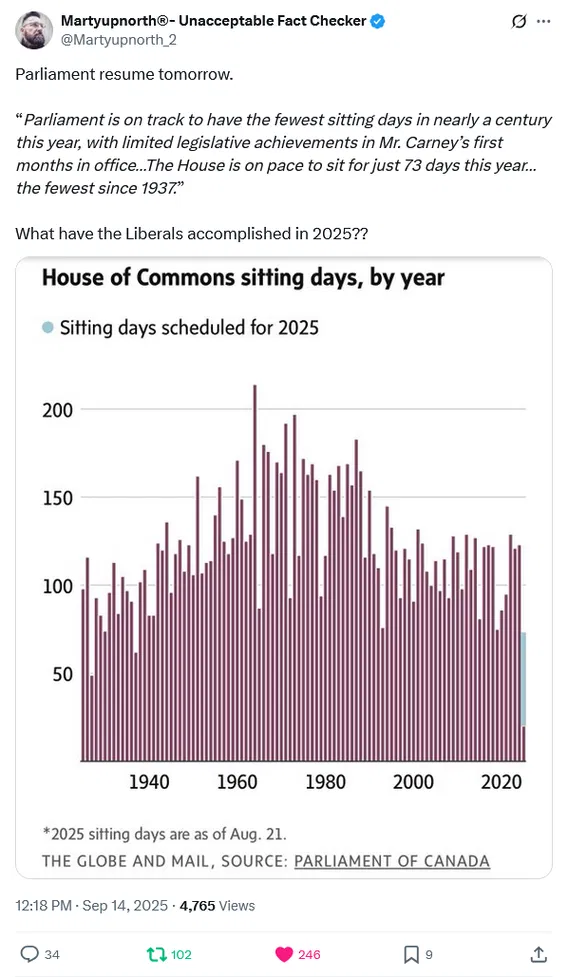
On his Substack, Brian Lilley noted on Monday that we’ve had very little chance to see the Canadian Parliament in action so far in 2025:

Parliament returns for the fall sitting today, it’s the first time the House of Commons has met since June 20. What’s remarkable is that in the 257 days that we’ve counted in 2025, the House has only met for 20 of them.

As it stands now, the House has not met in 87 days.

More remarkable, the House didn’t sit between December 17, 2024 and May 2025, all during a time of national crisis. Add to that the fact that between the end of September 2024 and the opening of the new Parliament on May 26, 2025 no government business was conducted due to the green slush fund scandal and the Trudeau government’s refusal to release documents to the House.

To say our democratic institutions haven’t been well served over the last year would be an understatement.

Over the last year, the oversight function of the House of Commons hasn’t been working as it should in our system. We’ve either had inaction by government or for most of this year, government by decree with little to no oversight by the people’s representatives.

Hopefully that changes today with a new sitting.

A change in tone…

One thing we’ve heard lots of chatter about is the need for a new tone, but primarily that’s been aimed at Conservative Leader Pierre Poilievre. Let me point out that Prime Minister Mark Carney is also new to this and we didn’t get the full measure of the man back in the spring.

The relationship between Justin Trudeau and Pierre Poilievre was acrimonious to say the least.

Trudeau towards the end was despised by Canadians and Poilievre couldn’t hit him hard enough in Question Period. Canadians would cheer as Poilievre would use his formidable Parliamentary skills to skewer Trudeau in the House of Commons.

Of course, Trudeau was part of the demise of the relationship and civility in the House as he showed utter contempt for the opposition, for Parliamentary rules and by extension to millions of Canadians.

Well, it’s a new government, a new leader in Carney and so yes, we can expect a new tone coming from both sides. We’ve already seen it from Poilievre in his many media appearances and news conferences over the past several months.

Poilievre has said that he and his party will oppose the government on issues where they disagree, support them on areas where they agree and offer practical solutions to the problems facing the country. That’s exactly what you want from an opposition party, which should in fact operate as a government in waiting.

Fenian Needham Conversion: Just the Thing for Invading Canada

Filed under: Britain, Cancon, History, Military, USA, Weapons — Tags: , , , , — Nicholas @ 02:00

Forgotten Weapons
Published 10 May 2025

The Fenian Brotherhood was formed in the US in 1858, a partner organization to the Irish Republican Brotherhood. The groups were militant organizations looking to procure Irish independence from the British, and they found significant support among the Irish-American immigrant community. In November 1865 they purchased some 7500 1861- and 1863-pattern muskets left over from Civil War production, and used them to invade Canada in April 1866. The idea was to capture the country and then trade it to the British in exchange for Irish independence … but the invasion went quite badly. The Fenians briefly held Fort Erie, but were pushed out after a few hours and largely arrested by American forces.

The Fenians’ muskets were confiscated, but all returned by the end of 1866 in exchange for promised Irish-American support of embattled President Johnson. By 1868, the group was making plans for another attempt at conquering Canada. This time they would have better arms — they obtained a disused locomotive factory in Trenton NJ and set up the Pioneer Arms Works to convert 5,020 muskets into centerfire Needham Conversion breechloaders. These were given chambers that could fire standard .58 centerfire ammunition, or the .577 Snider ammunition that the Fenians expected to be able to procure once in Canada. Most of the guns also had their stocks cut, to allow them to be packed in shorter crates for transit. These usually have a distinctive “V” cut in the stock, which was spliced back together before use.

When the second invasion came in April 1870, it was again a failure. Only 800-1000 men turned out of the 5,000+ expected. They were scattered among several different muster points on the border, and the Canadians were once again aware of their plans. The most substantial fight was at a place called Eccles Hill, where the Missisiquoi Home Guard was ready and waiting for them with good Ballard rifles. Upon crossing the border, the Fenians were soundly defeated.

This second time, the guns were confiscated and not returned. Instead, the Watervliet Arsenal sold them as surplus in 1871. They were purchased by Schuyler, Hartley & Graham for commercial resale, and thanks to that several hundred remain in collector hands today.
(more…)

QotD: The Dictatorship in the late Roman Republic

I’d also argue that the office [of Dictator as created by Sulla and then by Caesar] didn’t work for the goals of either of the men that recreated it.

For Sulla, the purpose of using the dictatorship was to offer his reforms to the Republic some degree of legitimacy (otherwise why not just force them through purely by violence without even the fig leaf of law). Sulla was a reactionary who quite clearly believed in the Republic and seems to have been honestly and sincerely attempting to fix it; he was also a brutal, cruel and inhuman man who solved all of his problems with a mix of violence and treachery. While we can’t read Sulla’s mind on why he chose this particular form, it seems likely the aim here was to wash his reforms in the patina of something traditional-sounding in order to give them legitimacy so that they’d be longer lasting, so that Sulla’s own memory might be a bit less tarnished and to make it harder for a crisis like this to occur again.

And it failed at all three potential goals.

When it comes to the legitimacy of Sulla’s reforms and the memory that congealed around Sulla himself, it is clear that he was politically toxic even among many more conservative Romans. A younger Cicero was already using Sulla’s memory to tarnish anyone associated with him in 80, casting Chrysogonus, Sulla’s freedman, as the villain of the Pro Roscio Amerino, delivered in that year. In the sources written in the following decades at best Sulla is a touchy subject best avoided; when he is discussed, it is as a villain. Our later sources on Sulla are uniform in seeing his dictatorship as lawless. Moreover, his own reforms were picked apart by his former lieutenants, with key provisions being repealed before he was even dead (in 78 BC so that’s not a long time).

Finally, of course, far from securing the Republic, Sulla’s dictatorship provided the example and opened the door for more mayhem. Crucially, Sulla had not fixed the army problem and in fact had made it worse. You may recall one benefit of the short dictatorship is that no dictator – indeed, no consul or praetor either – would be in office long enough to secure the loyalty of his army against the state. But in the second and early first century that system had broken down. Gaius Marius had been in continuous military command from 107 to 100. Moreover, the expansion of Rome’s territory demanded more military commands than there were offices and so the Romans had begun selecting proconsuls and propraetors (along with the consuls and praetors) to fill those posts. Thus Sulla was (as a result of the Social War in Italy) a legate in 90, a propraetor in 89, and consul in 88 and so had been in command for three consecutive years (albeit the first as a legate) when he decided to turn his army – which had just, under his command, besieged the rebel stronghold of Nola – against Rome in 88, precisely because his political enemies in Rome had revoked his proconsular command for 87 (by roughing up the voters, to be clear). And then Sulla has that same army under his command as a proconsul from 87 to 83, so by the time he marches on Rome the second time with the intent to mass slaughter his enemies, his soldiers have had more than half a decade under his command to develop that ironclad loyalty (and of course a confidence that if Sulla didn’t win, their service to him might suddenly look like a crime against the Republic).

Sulla actually made this problem worse, because one of the things he legislated by fiat as dictator was that the consuls were now to always stay in Italy (in theory to guard Rome, but guard it with what, Sulla never seems to have considered). That, along with Sulla having butchered quite a lot of the actual experienced and talented military men in the Senate, left a Senate increasingly reliant on special commands doled out to a handful of commanders for long periods, leading (through Pompey‘s unusual career, holding commands in more years than not between 76 and 62) to Julius Caesar being in unbroken command of a large army in Gaul from 58 to 50, by which point that army was sufficiently loyal that it could be turned against the Republic, which of course Caesar does in 49.

For Caesar, the dictatorship seems to have been purely a tool to try to legitimate his own permanent control over the Roman state. Caesar is, from 49 to 44, only in Rome for a few months at a time and so it isn’t surprising that at first he goes to the expedient of just having his appointment renewed. But it is remarkable that his move to dictator perpetuo comes immediately after the “trial balloon” of making Caesar a Hellenistic-style king (complete with a diadem, the clear visual marker of Hellenistic-style kingship) had failed badly and publicly (Plut. Caes. 61). Perhaps recognizing that so clearly foreign an institution would be a non-starter in Rome – unpopular even among the general populace who normally loved Caesar – he instead went for a more Roman-sounding institution, something with at least a pretense of tradition to it.

And if the goal was to provide himself with some legitimacy, the effort clearly catastrophically backfired. The optics of the dictatorship were, at this point, awful; as noted, the only real example anyone had to work with was Sulla, and everyone hated Sulla. Many of Caesar’s own senatorial supporters had probably been hoping, given Caesar’s repeatedly renewed dictatorship, that he would eventually at least resign out of the office (as Sulla had done), allowing the machinery of the Republic – the elections, office holding and the direction of the Senate – to return. Declaring that he was dictator forever, rather than cementing his legitimacy clearly galvanized the conspiracy to have him assassinated, which they did in just two months.

It is striking that no one after Caesar, even in the chaotic power-struggle that ensued, no one attempted to revive the dictatorship, or use it as a model to institutionalize their power, or employ its iconography or symbolism in any way. Instead, Antony, who had himself been Caesar’s magister equitum, proposed and passed a law in 44 – right after Caesar’s death – to abolish the dictatorship, make it illegal to nominate a dictator, or for any Roman to accept the office, on pain of death (App. BCiv, 3.25, Dio 44.51.2). By all accounts, the law was broadly popular. As a legitimacy-building tool, the dictatorship had been worse than useless.

So what might we offer as a final verdict on the dictatorship? As a short-term crisis office used during the early and middle republic, a tool appropriate to a small state that had highly fragmented power in its institutions to maintain internal stability, the dictatorship was very successful, though that very success made it increasingly less necessary and important as Rome’s power grew. The customary dictatorship withered away in part because of that success: a Mediterranean-spanning empire had no need of emergency officials, when its military crises occurred at great distance and could generally be resolved by just sending a new regular commander with a larger army. By contrast, the irregular dictatorship was a complete failure, both for the men that held it and for the republic it destroyed.

The real problem wasn’t the office of dictator, but the apparatus that surrounded it: the short duration of military commands, the effectiveness and depth of the Roman aristocracy (crucially undermined by Sulla and Marius) and – less discussed here but still crucial in understanding the collapse of the Republic – the willingness of the Roman elite to compromise in order to maintain social cohesion. Without those guardrails, the dictatorship became dangerous, but without them any office becomes dangerous. Sulla and Caesar, after all, both marched on Rome not as dictators, but as consuls and proconsuls. It is the guardrails, not the office, that matter.

Bret Devereaux, “Collections: The Roman Dictatorship: How Did It Work? Did It Work?”, A Collection of Unmitigated Pedantry, 2022-03-18.

Powered by WordPress


