Quotulatiousness

September 15, 2025

A few thousand deplorable “gammons” disrupt the peace in London

Filed under: Britain, Media, Politics — Tags: , , , — Nicholas @ 05:00

At least, the headline is how I assume most establishment types in Britain would try to describe the Unite the Kingdom march in London over the weekend (all photos by Esmeralda Weatherwax of the New English Review):

As I said earlier I have never seen a crowd like it – the police were overwhelmed with the numbers and I think even the organisers were pleasantly surprised at the turnout.

I gave up all hope early on of getting near enough to a screen to see or hear the speakers. But you can catch them up on line. I’m sure there are already links to Katie Hopkins, Laurence Fox, Tommy himself, Elon Musk by video link and the others.

I decided I was of most use photographing the numbers and variety, talking to people and following events away from the stage.

The march was scheduled to muster at Waterloo on the south bank. Knowing the turn out would be good attendees were advised to leave at Blackfriars Station and cross Blackfriars Bridge to join the march in Stamford Street east of Waterloo Station. The route was to be along the South Bank, over Westminster Bridge and into Whitehall at the south end. Antifa and Stand up to Racism were expected to march from Russell Square and would be rallying in the north end of Whitehall by Trafalgar Square with a long corden sanitaire between. Well that worked well last time.

I went straight to Whitehall and went to greet friends who were involved as marshals. Already the area was filling up fast and there were queues for the portaloos. They had to be provided as Westminster Council had shut and locked the public ones outside Westminster Station and on Westminster Pier. I don’t know why they do this. There will be mess afterwards.


The Cold War in Latin America Begins: Coups, Communists, and Castro – W2W 44

Filed under: Americas, History, USA — Tags: , , , , , , , , — Nicholas @ 04:00

TimeGhost History
Published 14 Sept 2025

Spy rings, covert operations, coups, street violence, and sudden regime changes. This is the turmoil that awaits Latin America after the Second World War. As new ideas from the East gain momentum, the United States tries to hold on to its role as the region’s self-appointed guardian. Which side will ultimately shape the future of this rich and populous region?
(more…)

When folks built their houses from Sears, Roebuck & Co. kits

Filed under: Business, History, Railways, USA — Tags: , , — Nicholas @ 03:00

I thought I’d discussed the Sears kit homes about a decade back, but perhaps it wasn’t for the blog. Anyway, there’s a nice summary by Katrina Gulliver of how Sears and other companies made home-building great a century ago:

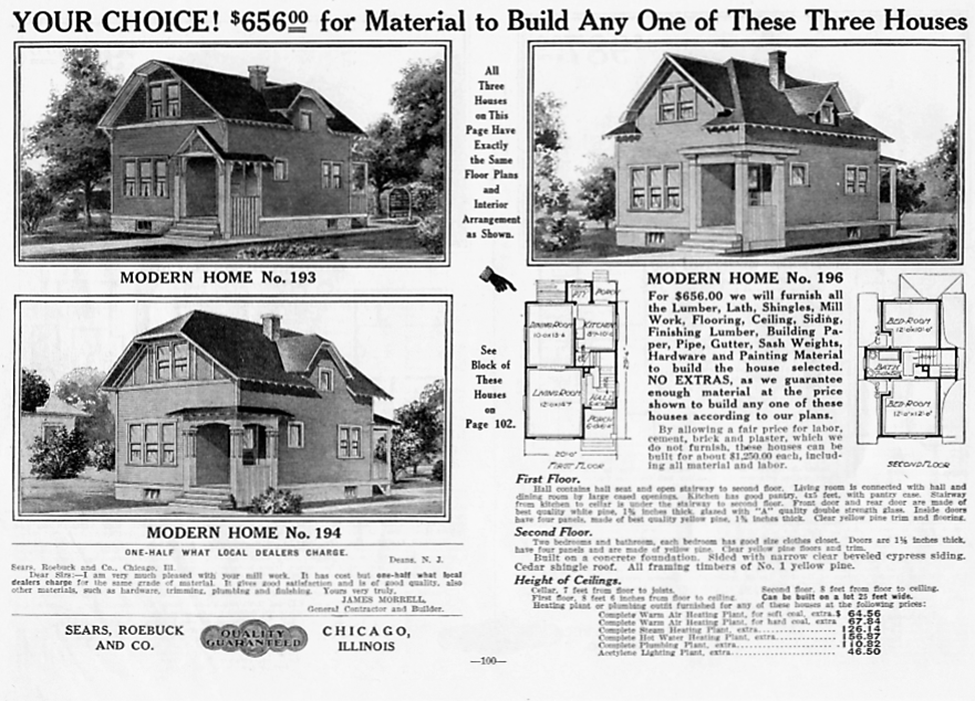
A hundred years ago, kit homes were more common in the US. Sold by Sears, Montgomery Ward, and other local firms, buyers received the plans and the pieces for a house and put it together themselves. Economies of scale made these a viable option for someone looking to build a house in the expanding suburbs.

The 1914 Sears Modern Homes catalog shows three homes that could each be bought for $656 (in the small print, they admit your outlay would be more like $1,250 all-in, including brick, cement, plaster — which they don’t supply — and labor). Your kit house would be delivered by rail; it was generally assumed householders would be handy enough (or know whom to hire) to put it all together from the supplied plans.

According to a 1930 report by the National Bureau of Economic Research, National Income and Its Purchasing Power, in 1914, the average clerk could be making $1,000, and a factory manager earning $2,300. That means these houses were within reach of lots of people — especially bearing in mind that land costs in many cities were also relatively low. In Chicago, lots within 5 miles of downtown were available for less than 50¢/square foot in 1914.

Those kit homes included wood, metal, and glass, and reflected both the tastes of consumers and the economies of bulk production. The various styles in the catalog over the years included craftsman, Dutch colonial, Federal, and cottage — styles that have continued to be popular in residential architecture of the US.

The Sears catalog of 1936 states: “This is the age of modern efficiency. No longer can human hands compete with machine precision and production. ‘Speed with accuracy’ is the watchword in any department of our great factories.”

(For those curious about such houses, fans of Sears kit homes put together lists of examples still standing.)

HBO’s Rome – Ep 11 “The Spoils” – History and Story

Filed under: History, Media, Military — Tags: , , , , , , — Nicholas @ 02:00

Adrian Goldsworthy. Historian and Novelist
Published 23 Apr 2025

This time we look at episode 11 — and only this episode as there is more to talk about when it comes to the historical background. Some of the plot doesn’t fit too well to the actual history, but there are some nice details that crop up and make it worthwhile. In the main, I get excited about a coin and a court.

QotD: Federal equalization payments

Filed under: Cancon, Economics, Government, Quotations — Tags: , , — Nicholas @ 01:00

Perhaps the most fascinating component of [Prof. Thomas] Courchene’s paper is his subtle discussion of what, precisely, equalization is for. Is it meant to render every province in Canada equally well off in general? Or is it meant only to correct inequities introduced by the provinces’ different geographic and natural circumstances? Or is it meant even more narrowly, as a scheme to ensure that the federal government doesn’t accidentally worsen those inequities? Or it is meant merely to discourage culturally harmful labour migration?

There is no official answer to this question, and all the possible answers lead to moral and mathematical absurdities. It’s not just that we don’t know whether equalization works, as Terence Corcoran observed in the Financial Post yesterday. We literally don’t even know what it’s meant to accomplish

Colby Cosh, “Economist plays ethicist”, National Post, 2005-09-01.

Powered by WordPress