Quotulatiousness

July 3, 2025

Bill Slim, the most forward-looking British commander of WW2

Filed under: Britain, History, India, Japan, Military, WW2 — Tags: , , , , , , — Nicholas @ 05:00

At The War Room, Dr. Robert Lyman explains how and why General (later Field Marshal) William Slim was able to turn around British and allied military fortunes in Burma and drive the Japanese out of India to their eventual defeat:
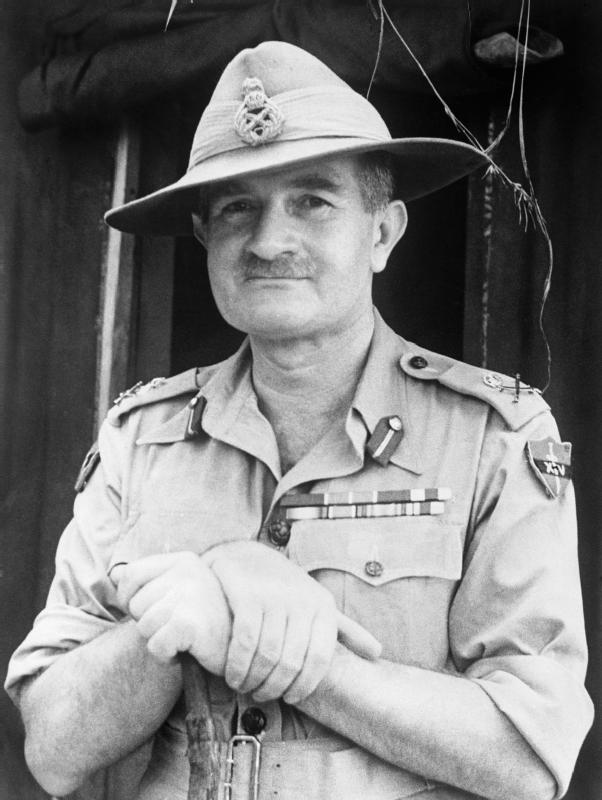
Field Marshal Sir William Slim (1891-1970), during his time as GOC XIVth Army.
Portrait by No. 9 Army Film & Photographic Unit via Wikimedia Commons.

“Burma and the Birth of Modern Warfare” is the subtitle to my 2004 book and PhD about General Slim’s command of the 14th Army in Burma during the last war, titled Slim, Master of War, a use of Sun Tzu’s description of a “heaven-born” commander. It may appear a rather grand claim, and perhaps it is, but the purpose of the subtitle reflects that fact that Slim’s conduct of operations in India and Burma in 1944 and 1945 represented an entirely new style of warfighting to that experienced by the British Army during the war. Instead of looking back to the lessons of World War One, Slim’s conduct of operations looked forward to reflect a style of warfare that would only be adopted as formal doctrine by the British Army in the 1980s. In the mid-1940s it remained alien to the vast bulk of similar British military experience and understanding.

My argument wasn’t that Slim was the best general who had ever commanded men in the history of warfare. That may or may not be true, but for the sake of my argument is irrelevant. My proposition, rather, is that:

    Slim was the foremost British exponent in the Second World War of the “indirect approach” and that in his conduct of operations in 1944 and 1945 he provided a clear foreshadowing of “manoeuvre warfare”.

My idea, which first saw expression in my 2004 book, has been developed since then in my subsequent writings, including that of Japan’s Last Bid for Victory, which deals with the great events in the Assam and Manipur in 1944 (2011) and A War of Empires (2021). A major reason for the continuing amnesia in British military thinking about the warfighting characteristics of the Burma Campaign – apart from the fact that it is a long way to go for a staff ride – seems to be the fact that Slim’s style of warfighting remained largely alien to the British Army’s doctrinal precepts until the late 1980s. Until then, Slim’s strategic conceptions had been considered an aberration, and Slim himself regarded merely as the epitome of a fine military leader, and nothing more. Then, in a doctrinal revolution which began in the 1980s, the old firepower-based foundations – which themselves were largely a product of Montgomery’s approach to war in 1944 and 1945 – in which the supreme military virtue was the effective and coordinated application of force, were replaced. This revolution in doctrine and thinking about warfighting exchanged the old foundations with new ones based on an entirely different conception, that of manoeuvre at the operational level of war, in which notions of subtlety, guile and psychological dislocation came to be emphasised in an entirely new and refreshing way. My belief is that it was the effective and pragmatic employment of manoeuvre at the operational level of war by Slim in Burma that was the direct cause of the extraordinary victories the 14th Army achieved in 1944 and 1945 and which led to the two greatest defeats the Japanese Army suffered in the field in the Second World War, the first at Imphal-Kohima in India in 1944 and the second at Mandalay-Meiktila in Burma in 1945. My argument I suppose is that Slim’s exercise of command in Burma makes him not merely a fine example of a “manoeuvrist” commander but in actuality the template for modern manoeuvrist command.

[…]

First, the 14th Army was the only truly joint formation in the British armed forces during WW2. Nothing else, in North Africa, Italy or North-West Europe came close to it. Slim insisted on nothing less than full integration. Not only were headquarters joint, but operational and tactic delivery was also joint. At every level of command air and land headquarters were completely interlinked. I became convinced of this fact when I discovered that the RAF and the Army even shared messes! Strategic air transport, winning the air war, the operational reach and flexibility provided by air power underwrote Slim’s conception of battle, to the extent that the senior RAF officer in the theatre ruefully concluded in 1945, and I quote, that:

    Slim was quicker to grasp the potentialities and value of air support in the jungles of Burma than most Air Force officers.

There was no snobbery and no shibboleths with Slim: if it worked, it was pressed into action.

[…]

Professor Dixon argues [in On the Psychology of Military Incompetence] that, unusually for a senior commander of his ilk in WW2, Slim was non-ethnocentric. He had no intrinsic prejudices about the virtues of one race over another. Slim, after all, was an officer of the Indian Army, and I have yet to come across any evidence that British regimental officers of the Indian Army regarded their soldiers in any way inferior to themselves. He was commonly known to those who served under him as “Uncle Bill” from the special affinity British troops had to him: the remarkable fact, however, was that at least 87% of his Army of several hundred thousand men recalled him as “Cha Cha Slim Sahib”: 14th Army was, after all, very largely Indian, Gurkha and West and East African. I certainly cannot think of any other Indian Army general who had such an impact on British troops. He became, of course, Chief of the Imperial General Staff following Field Marshal Montgomery, in 1948, which securely establishes this feat. On that note, I cannot conceive of “Uncle Bernard” when referring to Field Marshal Montgomery!

The Burma campaign was as much a struggle for mastery of logistics as it was a struggle for mastery on the battlefield, and it was about risk as much as it was about adherence to logistical principles. Slim had an implicit understanding of the constraints placed on warfare by the demands of logistics. Great efforts were made to increase the quantity of supplies to Burma. Railways were extended, roads built and surfaced, sunken ferries refloated and repaired, barges and rafts built for use on the numerous waterways. In this regard Archibald Nye, the VCIGS under Alan Brooke, regarded Slim’s mastery of logistics to be the most significant measure of his greatness as commander of 14 Army in Burma:

    He never had enough to do what he had to do and this … is the measure of his greatness.

The practice of war in Burma by Slim was so startling in its modernity, and unlike any other pattern of warfighting by operational level British commanders in the war. My view of Slim as a commander can be interpreted at two levels. He was, first of all, a great commander and leader. Being a master of strategy, of logistics, of technical proficiency and so on are important in themselves when considering the nature of leadership in war, but by themselves they remain insufficient. Successful military command requires someone who can, through dint of personality and inspirational leadership, wield all of the components of fighting power together so that an extraordinary result transpires. What marks Slim out from the crowd was much more than just his winning of a succession of extraordinary battles. His strength lay in his ability to produce a decisive effect from scratch; to mould thousands of disparate individuals together into a single team with a single goal; to persuade a defeated army that it had the potential to turn the tables on their enemies; to master the complexities of terrain, climate and administrative deficiency so that self-help, resourcefulness and ingenuity could become as much prized as fighting skill. In these individual areas, and more, Slim proved the master. His genius for war was the consequence of his ability to bring together all of these elements to create an extraordinary result, the visible sign of which was the greatest defeat suffered by the Japanese on land during the Second World War.

“[T]he old Fleet Street … would not have foregone the pleasures of a story involving the words ‘prime minister’, ‘firebombings’ and ‘quartet of male models'”

Filed under: Britain, Government, Media, Politics — Tags: , , , — Nicholas @ 04:00

Mark Steyn notes the amazing disinterest the British press has been showing for Prime Minister Keir Starmer’s recent firebombing “male model” troubles:

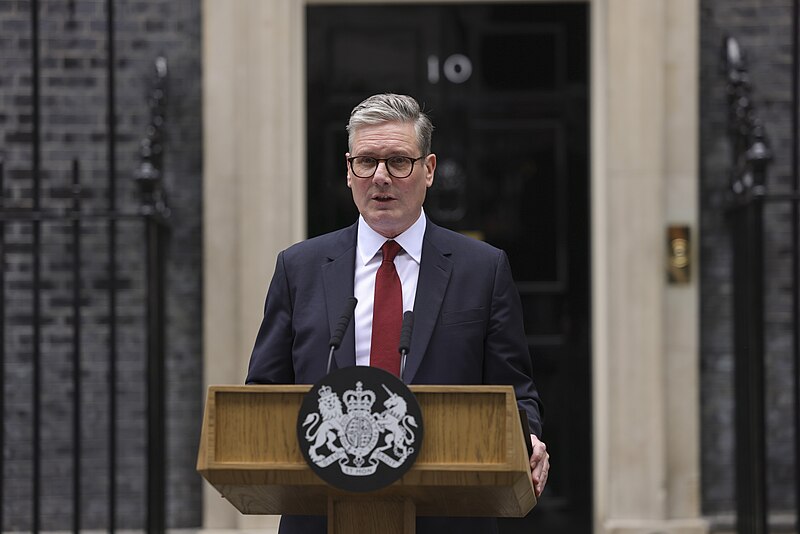
Sir Keir Starmer speaking to the media outside Number 10 Downing Street upon his appointment.
Picture by Kirsty O’Connor/ No 10 Downing Street via Wikimedia Commons.

Meanwhile, “Two-Teir Keir” gave an extraordinary interview to a friend from The Observer, in which he reveals that, other than his war on the remnants of UK free speech, he’s spent the last year getting everything wrong. It’s a weird and psychologically unhealthy confessional that one could not imagine from any of his predecessors, whether the wretched David Cameron or the Marquess of Salisbury. If you want the scoop, skip the lame-arse coverage from the decaying Spectator and go to my old chum Dan Wootton. The Speccie’s snoozeroo “gossip columnist” headlines his piece “Four lowlights from Starmer’s Observer interview“, yet fails to note the most intriguing lowlight of all.

Six weeks ago, Sir Keir gave a speech on immigration which, while being a statement of the bloody obvious two decades too late, nevertheless went further than anyone else of any consequence in British life has been prepared to go. Somewhat curiously, this speech came just a few hours after his car exploded and two houses of his were firebombed — for which three (at the time of writing) Ukrainian “male models” have been arrested. I would not wish to suggest the PM has a unique fascination with Ukrainian “male models”. A fourth man has since been arrested — a “male model” from Romania. Diversity is our happy ending! The words “male model” do not appear in The Observer‘s account:

    In the small hours of 12 May this year, there was a firebomb attack on the Starmer family home in Kentish Town. His sister-in-law, who had been renting the house since he became prime minister, was upstairs with her partner when the front door was set alight. “She happened to still be awake,” Starmer says, “so she heard the noise and got the fire brigade. But it could have been a different story …”

    The prime minister, who had arrived back from a three-day trip to Ukraine the night before, was due to unveil the government’s new immigration policy that morning. “It’s fair to say I wasn’t in the best state to make a big speech,” he says. “I was really, really worried. I almost said: ‘I won’t do the bloody press conference.’ Vic [Lady Starmer] was really shaken up as, in truth, was I. It was just a case of reading the words out and getting through it somehow …” – his voice trails off …

So Sir Keir has now disavowed the only non-bollocks thing he has ever said. He “deeply regrets” saying Britain risked becoming “an island of strangers”, but he only did so, he offers in mitigation, because he was stressed out by all the firebombing from the massed ranks of fetching Slav twinks congregated on his various doorsteps. Unlike the Speccie, my chum Dan Wootton has a nose for a story:

Lucy Connolly was fast-tracked into her gaol cell in nothing flat – because that was the priority of the British state. By comparison, the men who firebombed the Prime Minister’s car and houses will not appear in court until next April, because determining how a remarkable number of East European “models” with no English-language facility were sufficiently familiar with Sir Keir’s homes and car to firebomb them is not a priority. Presumably, by the time April rolls around, the boyish charmers will have been persuaded to do an Axel Rudakubana and cop a plea, so that no trial need be held at all.

Say what you like about the old Fleet Street, but they would not have foregone the pleasures of a story involving the words “prime minister”, “firebombings” and “quartet of male models”. The silence of The Spectator is very typical. If you subscribe to James Delingpole’s view that the increasingly bizarre individuals who make it to the top of the greasy pole — Starmer, Macron, Trudeau — are there because the people who really run the world have got kompromat on them (which is your basic Occam’s Razor), then terror cells of Donbass rent boys blowing up the PM’s motor is an obvious false-flag operation designed to discredit the general thesis …

Here’s the gist of it all, courtesy of another Bob Vylan crowdpleaser:

    Heard you want your country back Ha! Shut the f*** up! Heard you want your country back

    You can’t have that!

I’m Keir Starmer and I endorse this message. As I wrote twenty years ago — whoops, no, thirty sodding years ago, a counter-culture has to have a culture to counter. And in Britain and elsewhere an old establishment has merely been supplanted by a new one with lousier tunes. It’s not “edgy” or “transgressive” if you’re live on the BBC’s biggest outlet at an event run by a bloke with a knighthood. The only true counter-culture is that identified by the pseudo-edgy ersatz-transgressive Sir Bob Vylan — the ones who want their country back. Ask Peter Lynch.

Oh, wait, you can’t: He’s dead. Sir Keir Starmer and Jeremy Richardson KC killed him — because, in order to prevent you “harming” them, it is necessary for them to harm you.

Nicolas Romero, the inventor who introduced “Spag Bol” to England

Filed under: Britain, Europe, Food, History — Tags: , , , , , , , — Nicholas @ 03:00

In the latest Age of Invention newsletter, Anton Howes describes the career of a most inventive man, Signior Nicolas Romero originally of Naples … maybe:

The British interpretation of Spaghetti Bolognese — widely known as “spag bol” — is a pasta dish with a meat and tomato sauce.

The person who tried to bring these coal balls or briquettes to London was one Nicolas Romero — a name that has been almost entirely and undeservedly forgotten. Indeed, the one other historian to have ever noticed a handful of his achievements was unable to find his first name. And so I get the pleasure of being able to give a few glimpses of his remarkable story for the first time in over four hundred years.

Nicolas Romero seems to have originally hailed from the Spanish Habsburg possessions in Italy, most probably Naples. He was personally acquainted with Cardinal Granvelle, who was the regent in Naples from 1570 to 1575, and may have been involved in the Spanish attack on Tunis in 1573-4, where he picked up some siege techniques used by the Ottoman Turks. Romero then moved to Spanish-ruled Milan, where he was apparently the close confidant of one “Dr Sirnige” or “Dr Siring” (as it sounded to an English ear), who received a hefty reward for discovering a “defensative” or preventative treatment against a plague that killed some 15% of the city’s population in 1576-8. Then, Romero appears to have gone to the Low Countries, much of which was in outright revolt against Spain, where he picked up the details of how coal balls were made at Liège.

Then, astonishingly, he suddenly switched sides. Perhaps having fallen afoul of the Inquisition, or perhaps having converted to Protestantism, from some point in the 1580s he was only ever involved with the manifold enemies of Spain. He moved to England, even partaking — and I suspect investing — in its unsuccessful invasion of Spanish-ruled Portugal in 1589, where he was captured and held in “a very cruel prison” for ten months until managing to escape.

Somehow making his way back to London, Romero there befriended the barrister, alchemy enthusiast, and wannabe inventor Hugh Plat. It was via Plat, who plied all of his acquaintances for their technological know-how, and recorded his sources in his manuscripts, that Romero introduced various innovations to England.

Romero told him of how mere bags of linen or canvas, when filled with whatever dirt or sand was to hand, could be used to instantly create a “musket-proof” trench — in essence, the modern sandbag — which had been used by the Turkish army in their successful siege of La Goleta near Tunis. Plat saw a wider potential too, hoping to use these sandbags in reclaiming land from both marsh and sea.

In 1593, when a deadly plague gripped London, Romero gave Plat the recipe of Dr Sirnige’s defensative pills, as used in Milan, and together with the apothecary John Clarke they produced and distributed hundreds of them, including to Queen Elizabeth I and her entire Privy Council, apparently with great success. Clarke published their case notes under the boastful title The Trumpet of Apollo Sounding out the Sweet Blast of Recovery in 1602, though it was a little premature. Just a year later plague returned to London with a vengeance.

Most enduringly of all, Romero told Plat the details of making pasta, which Plat then made and marketed as a cheap and long-lasting food for the English armed forces. What Plat called his “macaroni” even won plaudits from Sir Francis Drake, and in 1594 he published the first known depiction of a pasta extruder. To Nicolas Romero, then — a name never mentioned by even specialist historians — belongs the considerable distinction of introducing the English to pasta. He is the patron saint of “Spag Bol” (if you are Italian, and do not wish to suffer a heart-attack, under no circumstances should you look up this term).

Romero was full of other ideas too. Romero gave Plat his methods for preserving wine, chestnuts, butter, turnips, and quince. He revealed to him the principle behind the diving bell; how to make a metal rotisserie oven; how to catch crayfish; how to engrave glass; how to make vellum paper translucent; how to keep snow from melting over the course of a year by storing it underground; and how few drops of sulphuric acid might be added to a ship’s water supply to keep it fresh for longer. Along with various recipes for Italian salads, and how to make smoke grenades, he even told him how to raise water using atmospheric pressure — perhaps the earliest record in England of what would eventually be developed into the steam engine. In papers seized by the government from the soldier Sir Thomas Arundel, who was arrested for being a Catholic in 1597, are mentions of not just of Romero’s sandbag “trench”, but “also his bridge, his boat to go without wind or sail, and his device against horsemen” — which according to Plat’s manuscripts was a kind of rest for muskets that could also serve as a pike.

Throughout the 1590s, Plat tried to commercialise some of Romero’s inventions, including a method to replace the expensive copper vessels for boiling water for home-brewing with a supposedly more efficient tub made of treated wood; some kind of light, portable water pump; and the Liège-style coal balls or briquettes. But with little success. By 1594 Romero was running low on money and had given up on trying to make it in England, having apparently passed up various opportunities to serve some German princes. So he left Plat in London to keep trying to sell his inventions, while he himself went to Holland to become an engineer in the service of Count Maurice of Nassau, who was fighting to free the Netherlands from Spanish rule.

While in the Netherlands Romero patented his water pump and the wooden boiling tub — an invention apparently “very much needed in the present time of cities under siege”, for whom fuel supplies were scarce. And having gained Count Maurice’s trust and backing, he wrote to one of Elizabeth I’s favourites, the Earl of Essex, in a fresh bid to get the two inventions, along with the coal balls, patented in England. Naturally, Hugh Plat served as his go-between.

Despite such allies, however, they once again failed. Romero would patent more inventions in the Netherlands in 1598 — a means of reducing the friction on the axles of carts and carriages, and a winch for more easily lifting heavy items like anchors and cannon — but he wasn’t to get a patent in England until ten years later in 1608. Just months before Plat’s death, Romero, with one James Jackson, presumably an investor, was finally granted an English patent for some kind of universally-applicable method of saving fuel. Unfortunately, the wording of the patent gives no indication whatsoever of what it involved.

I’ve traced no further record of Romero — if anyone is familiar with German, Dutch, Italian or Spanish sources and has ever come across the name, please do get in touch

Latvia’s Unique Charger-Loading Lee Enfield (CLLE) Cavalry Carbine

Filed under: Britain, Europe, History, Military, Weapons, WW2 — Tags: , , , , — Nicholas @ 02:00

Forgotten Weapons
Published 14 Feb 2025

During the Latvian War of Independence, the nationalist forces receiver a fair bit of support from the British, including some 20,000 P14 Enfield rifles. These were great for the Latvian infantry, but the Latvian cavalry wanted something shorter. So in the early 1920s, they ordered 2200-2350 (the numbers are unclear) carbines from BSA. These were assembled using old Lee Metford and Long Lee parts, 21 inch barrels, and modified with charger clip bridges per the British CLLE pattern.

These carbines remained in service until World War Two, as we know that replacement barrels were purchased from Tikkakoski in Finland in the late 1930s — and this example has one of those Tikka barrels installed. During the Soviet occupation of Latvia, the Latvian Army did not fight, and many of these carbines appear to have been put into reserve service with the Red Army (some appearing to have been retrofitted with Mosin-style sling slots). Others disappeared into the forest with anti-Soviet partisans, and very few survived after the war.
(more…)

QotD: Why Marxists turned away from space exploration and colonization

Devon Eriksen recently pointed out that today’s Marxists are hostile to space flight and off-world colonization. But in Cold War times, Marxists who ran countries were aggressively futuristic about space, treating it as the empire of their dreams.

What caused this turnaround?

To understand this, it’s helpful that to notice that spaceflight is not the only technology about which Marxist attitudes have done a 180. Nuclear power is another. More generally, where Marxists used to be pro-growth and celebrate industrialization and material progress, they’re now loudly for degrowth and renunciation.

But the history of western Marxism is more interesting than that. Western Marxists flipped to strident anti-futurism in the late 1960s and early 1970s while futurist propaganda in the Communist bloc did not end until its post-1989 collapse.

That 20-year-long disjunct was particularly strong about nuclear power, with the Soviets providing ideological support and funding to the foundation of European Green parties and the US’s anti-nuclear-power movement at the same time as they were pouring resources into nuclearizing their own power grid.

And that’s your clue. Domestic Marxism favored making power cheap and abundant, while their Western proxies pushed to keep it expensive and scarce and preached degrowth rather than expansion. Futurism vs. anti-futurism: why?

We don’t need to theorize about this. Yuri Bezmenov, a former gear in the Soviet propaganda machine, told us the answer starting in the early 1980s. Fewer people listened than should have.

Bezmenov explained that unlike Marxism in the Sino-Soviet bloc, Western Marxism was a mind virus, a memetic weapon designed to weaken and degrade its host societies from within, softening them up for totalitarianism and an eventual Soviet takeover. The West was to be denied power, both in a literal and figurative sense.

Ever wonder why today’s Marxists are so quick to make alliances with radical religious Islamists? This shouldn’t happen. According to Marxist theory, Islamism is a regression to an earlier stage of the dialectic than capitalism, and today’s Marxists ought to fear and hate it as a counter-ideology more than capitalism. But they don’t, because to them Islam is a tool to be used for nihilistic ends.

That nihilism is the actual purpose of Western Marxism and all its offshoots, including “woke”. One sign of this is how fervently it embraces the sexual mutilation of children.

The Soviets are gone but their program is still running autonomously in the brains of people who were infected by their Cold-War-era proxies and the successors of those proxies. And that program is nihilism all the way down.

Yuri Bezmenov should have been heeded. There is no simpler theory that fits the observed facts.

Eric S. Raymond, Twitter, 2024-05-14.

Powered by WordPress